Market Snapshot
Key Takeaways
Market Overview & Analysis
Report Summary
The Europe battery passport market covers the full commercial ecosystem of products, services, and infrastructure that enables compliance with the battery passport requirements of Regulation (EU) 2023/1542, as supplemented by delegated and implementing regulations. The study period is 2021–2030 with 2025 as base year. Market scope covers: battery passport software platforms (cloud-native and on-premises), supply chain traceability and supplier data onboarding services, carbon-footprint data management and declaration services, data governance and access-control middleware, second-life and circularity workflow services using passport data, consulting and implementation services for passport readiness, and managed passport infrastructure services. Market scope explicitly excludes the battery manufacturing market itself, the EV market, and battery recycling infrastructure — while including the data and compliance services layer that connects those physical markets to the regulatory passport requirements.
The Europe battery passport market is structurally unlike most B2B software markets because it does not depend on organic customer demand adoption curves. The demand is created by regulation — specifically by Regulation (EU) 2023/1542, which is directly applicable EU law requiring battery passports from 18 February 2027 for EV batteries, industrial batteries above 2 kWh, and LMT batteries. This creates an unusual commercial dynamic: there is a defined deadline by which every company placing covered batteries on the EU market must have passport capability, and there is no legal way to opt out without exiting the EU market. The market's growth trajectory therefore follows the regulation's compliance calendar more closely than typical technology adoption curves — with the steepest spending growth occurring in 2026–2027 as the deadline approaches and the largest buyers complete implementation, followed by a sustained recurring revenue base as passport maintenance, data updates, and new-battery issuance continue post-2027.
The market is also broader than the headline 2027 deadline implies because the EU regulation creates a multi-year compliance calendar. Carbon-footprint declaration obligations have been active from 18 February 2025, generating immediate revenue for carbon-footprint data management and supply chain traceability services. Carbon-footprint performance-class requirements activate from 18 August 2026, adding a comparative reporting layer. Maximum lifecycle carbon-footprint thresholds start from 18 February 2028. Recycled-content documentation requirements phase in later. Battery due-diligence obligations, postponed from 18 August 2025 to 18 August 2027 by Regulation (EU) 2025/1561, will add a further compliance layer requiring audit-ready supply chain evidence. Each of these milestones generates incremental demand for additional data services on top of the base passport infrastructure — creating a multi-year cross-sell opportunity for vendors that serve customers from carbon-footprint declaration through to full due-diligence auditability.
EU Battery Passport Regulation — The Demand Foundation
Regulation (EU) 2023/1542 on batteries and waste batteries is the foundational law that creates the Europe battery passport market. The regulation requires a battery passport with a unique identifier and QR code, layered access rights distinguishing what different stakeholders can view, and a data model that is open, interoperable, machine-readable, searchable, and compatible with the broader digital product passport framework being developed by the European Commission. The data must remain available throughout the battery's service life and beyond, and operators storing or processing passport data are explicitly prohibited from commercially reusing that data beyond the service needed to operate the passport system — a restriction with significant implications for platform business models.
The compliance timeline is phased. For EV batteries: carbon-footprint declaration from 18 February 2025; carbon-footprint performance classes from 18 August 2026; the battery passport mandate itself from 18 February 2027; maximum lifecycle carbon-footprint thresholds from 18 February 2028. Battery due-diligence obligations were postponed from 18 August 2025 to 18 August 2027 by Regulation (EU) 2025/1561, because notified bodies and recognised due-diligence schemes were not ready when the original deadline was set — a commercially significant delay because it pushes the requirement for full audit-ready supply chain evidence approximately two years further out, concentrating near-term spending on passport and data architecture rather than the full due-diligence stack. Delegated Regulation (EU) 2025/606 set the methodology for recycling efficiency and material recovery documentation from waste batteries, adding a circularity-workflow layer to the passport ecosystem. A 2025 European Commission consultation on the broader digital product passport system — covering data storage, service-provider governance, and whether a certification scheme for passport service providers is needed — confirms that the governance and service-provider architecture is still being finalised, meaning vendor positioning in this space must accommodate ongoing regulatory evolution.
Market Dynamics
Key Drivers
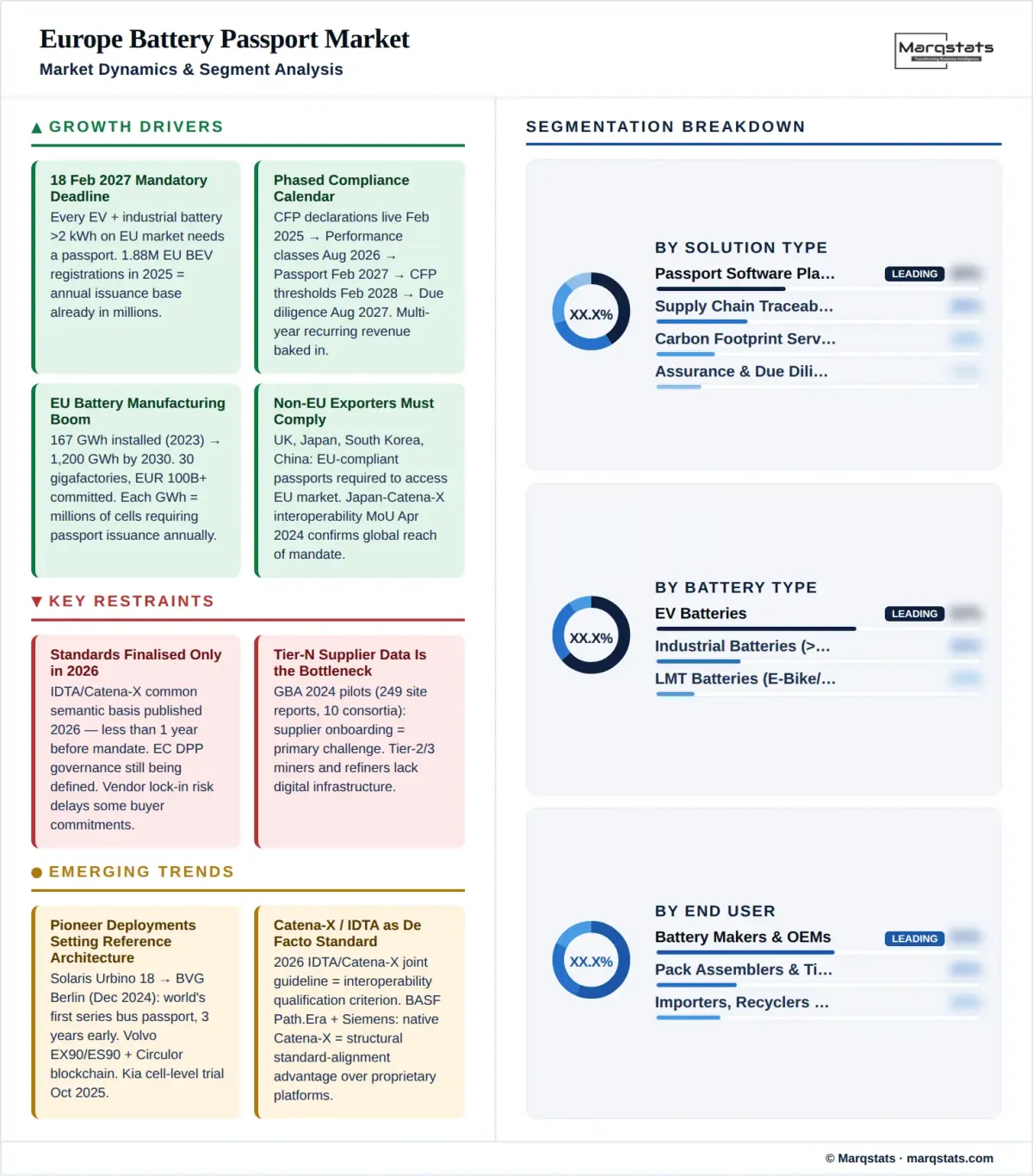
- Mandatory 18 February 2027 EU battery passport deadline creating guaranteed addressable market: The fundamental driver of the Europe battery passport market is legislative obligation with a hard deadline. Every EV battery, industrial battery above 2 kWh, and LMT battery placed on the EU market from 18 February 2027 requires a compliant digital battery passport. With EU BEV registrations at 1,880,370 in 2025 (17.4% market share per ACEA) and growing, the annual volume of batteries requiring passports from 2027 is already in the millions and growing by hundreds of thousands per year. Unlike enterprise software markets where the addressable market depends on voluntary adoption decisions, the battery passport market has a defined mandatory entry point — every covered battery placed on the EU market is a required passport issuance. This creates a structurally guaranteed recurring revenue base for compliant platform providers.
- Phased compliance calendar generating multi-year revenue layers from 2025 through 2028+: The battery passport compliance obligation is not a single deadline event. Carbon-footprint declarations have been mandatory since 18 February 2025, driving immediate demand for carbon data management, supply chain emissions tracking, and declaration services. Carbon-footprint performance classes (from 18 August 2026) require comparative reporting infrastructure. The battery passport mandate (18 February 2027) requires the full passport platform and data architecture. Maximum lifecycle carbon-footprint thresholds (18 February 2028) require verified reduction commitments. Battery due-diligence requirements (18 August 2027) require audit-ready supply chain evidence. Recycled-content documentation adds a further compliance layer. This phased calendar means vendors can generate revenue from customers at multiple compliance stages simultaneously and cross-sell deeper services as customers move through each milestone — creating multi-year customer lifetime value considerably higher than a single-deadline market.
- European battery manufacturing scale-up creating large enterprise customer base: Europe's battery manufacturing capacity is scaling rapidly and creates the primary customer base for battery passport platforms. Europe had approximately 30 announced gigafactory projects targeting approximately 1.3 TWh of combined capacity by 2030, with installed capacity of approximately 167 GWh in 2023 growing toward an estimated 1,200 GWh by 2030. The European Battery Alliance involves approximately 440 actors and around EUR 100 billion in investment commitments. Cell manufacturers, pack assemblers, OEMs, tier-1 suppliers, and importers collectively constitute the buyer universe for battery passport services — a buyer base that is growing in number and in per-buyer passport volume as production scales. Each gigafactory produces millions of battery cells per year, each requiring passport issuance, data management, and lifecycle updates. This manufacturing scale-up directly multiplies the addressable revenue per enterprise customer.
- Non-EU exporters to Europe creating adjacent demand pool: The EU battery passport requirement applies to batteries placed on the EU market — regardless of where they are manufactured. This means UK manufacturers, Japanese OEMs and cell producers, South Korean battery manufacturers, and Chinese battery exporters supplying into Europe must all have EU-compliant battery passport capability to access the EU market. The UK has its own Battery Strategy targeting a competitive battery supply chain by 2030, and UK guidance has tightened lithium-ion battery safety expectations. Japan's IPA launched formal discussions on interoperability between the Ouranos Ecosystem and Catena-X in 2024, explicitly in response to the EU battery regulation's carbon-footprint mandate. This non-EU demand pool extends the Europe battery passport market's addressable universe well beyond EU-headquartered companies and creates an international customer base for Europe-based platform providers.
- Second-life, recycling, and circularity workflows creating premium services tier: The battery passport's value extends beyond initial regulatory compliance. The layered data architecture — covering composition, state of health, repair history, and material recovery information — creates a foundation for commercial second-life assessment (repair shops, residual-value specialists, battery refurbishers), recycling optimisation (material recovery rates, hazardous materials identification per Delegated Regulation (EU) 2025/606), and reverse-logistics workflow management. Minespider's 2026 launch of Recircle.market for circular batteries is a direct example of a commercial service built on battery passport data infrastructure. TWAICE's battery-analytics positioning — providing condition and performance data for passports — is another. These premium services carry higher average revenue per customer than base compliance and create a recurring engagement model with battery asset owners across the full lifecycle.
Key Restraints
- Implementation standards still being finalised — creating vendor and buyer uncertainty: Despite the hard 2027 deadline, the technical and governance architecture for battery passports is still being formalised. The European Commission's 2025 consultation on digital product passport data storage, service-provider governance, and potential certification schemes for service providers confirms that the service-provider layer was not fully defined as of 2025. The IDTA/Catena-X common battery passport semantic basis was published in 2026 — less than a year before the mandatory deadline — limiting the time available for ecosystem-wide implementation. BatteryPass-Ready, the testing environment to help companies prepare, is still releasing implementation guidance. This standards uncertainty creates a risk of vendor lock-in to frameworks that may not align with final technical standards, discouraging some buyers from committing to vendor contracts until the governance architecture is clearer.
- Supply chain data quality — tier-n supplier readiness is the operationalisation bottleneck: Battery passports require traceable data from across the full supply chain — lithium miners, refiners, cathode material producers, cell manufacturers, pack assemblers — many of whom are small, geographically dispersed suppliers with limited digital data infrastructure. The Global Battery Alliance's 2024 pilots, involving 10 consortia and 249 site-level sustainability reports, confirmed that supplier data readiness is the primary implementation challenge: data aggregation across tier-2 and tier-3 suppliers requires significant supplier onboarding investment, data validation, and often proxy data or third-party verification where direct supplier data is unavailable. This operationalisation bottleneck constrains the pace of compliant passport deployment and increases implementation cost for buyers, slowing the market's transition from concept to live compliance.
- Battery due-diligence delay reducing near-term urgency for full-stack compliance: The postponement of battery due-diligence obligations from 18 August 2025 to 18 August 2027 by Regulation (EU) 2025/1561 — driven by the unreadiness of notified bodies and recognised due-diligence schemes — reduces near-term commercial urgency for the most comprehensive and highest-value compliance services. It pushes some buyer investment from 2025 toward 2026–2027, concentrating near-term spending on passport and data architecture rather than the full audit-ready due-diligence stack. While the postponement does not reduce the ultimate scope of the market, it does compress the revenue timeline for the highest-margin due-diligence services and may delay the market's steepest growth phase by 12–18 months.
- Data sovereignty and commercial reuse restrictions creating platform business model constraints: The EU battery regulation explicitly prohibits operators storing or processing passport data from commercially reusing that data beyond the service needed to run the passport system. This restriction has significant implications for platform business model design — it prevents battery passport platforms from monetising the aggregated battery-performance and supply-chain data they host, limiting revenue to service fees, subscription access, and implementation charges rather than the data-as-a-service model that some early-stage platform business plans may have assumed. This constraint may reduce investor appetite for platform-scale battery passport ventures and concentrate the commercial market toward enterprise software vendors whose revenue model is service-based rather than data-monetisation-based.
Key Trends
- Pioneering OEM deployments establishing industry reference architecture before the 2027 mandate: Multiple high-profile deployments are establishing commercial reference implementations more than a year before the mandatory deadline. Solaris delivered the world's first series-produced bus with a battery passport — the Solaris Urbino 18 electric — to the BVG fleet in Berlin in December 2024, three years ahead of the EU deadline. Volvo launched what it described as the world's first EV battery passport for the EX90 with Circulor, with blockchain-based raw material sourcing transparency. Kia Europe announced the first public trial of a cell-level battery passport in October 2025 using a Kia EV3 equipped with Dukosi cell monitoring and TNO's data-sharing pilot environment. These early deployments are commercially significant because they validate vendor platforms, identify implementation challenges, and establish the technical and commercial reference architecture that later-adopting companies can follow — reducing total industry implementation cost and accelerating the pace of compliant deployment.
- Catena-X and IDTA open interoperability layer becoming the de facto standards infrastructure: The 2026 publication of a common semantic and technical basis for battery-passport implementation by IDTA and Catena-X participants is the most strategically important standards development in the battery passport market. Catena-X is the automotive industry's open data-sharing ecosystem, designed for interoperable data exchange across OEM, supplier, and service-provider ecosystems. IDTA (Industrial Digital Twin Association) provides the asset administration shell standard that underpins digital product passports. Together, their joint battery-passport guideline defines the data model that battery passport platforms must implement to be interoperable with the broader EU automotive data infrastructure — meaning vendors that align with the Catena-X/IDTA layer (Siemens describes its battery passport product as a native Catena-X solution; BASF's Path.Era is built on Catena-X) have a structural standards-alignment advantage over proprietary platforms. BatteryPass-Ready's test environment allows vendors and buyers to validate compliance with these requirements before the mandate activates.
- Global Battery Alliance pilots moving battery passport from concept to verified implementation: The GBA's second wave of Battery Passport pilots in 2024 — involving 11 consortia, 249 site-level sustainability reports, and verification activity in five consortia — represents the most comprehensive cross-industry demonstration of battery passport implementation at scale. Pilot consortia were led by CALB, CATL, EVE Energy, Farasis, FinDreams Battery, LG Energy Solution, Samsung SDI, and Sunwoda, collectively representing over 80% of global EV battery market share. The pilots established a Minimum Viable Product for the GBA Battery Passport with product-level ESG scoring and introduced data-assurance elements. This GBA activity is important commercially because it creates internationally recognised precedents for what a compliant, credible battery passport looks like — raising the quality bar for commercial platform vendors and reducing ambiguity for buyers about what 'compliance' means in practice.
- Adjacency to broader digital product passport ecosystem creating cross-market integration opportunity: The EU battery passport is the most advanced specific implementation of the European Commission's broader Digital Product Passport (DPP) framework, which is being extended to textiles, electronics, steel, cement, and other product categories. The 2025 Commission DPP consultation covers governance questions applicable across all DPP-covered sectors. Vendors building battery passport platforms that align with the Commission's broader DPP architecture — shared data-hosting standards, interoperability requirements, access-rights frameworks — are positioning for the larger DPP market rather than the battery-specific market alone. This creates a commercial incentive for battery passport platforms to be designed as general DPP infrastructure with battery-specific data extensions, rather than battery-only tools — increasing their addressable market beyond batteries and their long-term commercial scalability.
Market Segmentation
Battery passport software platforms — cloud-native or on-premises solutions providing the core digital infrastructure for passport creation, QR-code generation, data model hosting, layered access rights, and lifecycle data management — are the primary and largest segment of the Europe battery passport market. This segment spans a spectrum from specialist battery-traceability platforms (Circulor, Minespider, Circularise) to enterprise industrial software providers adding battery passport modules (Siemens, T-Systems, AVL, BASF Path.Era). T-Systems' public pricing — EUR 1,499 per month entry price for a package covering up to 5,000 new battery passports per year — provides a commercial benchmark for the enterprise-managed service tier, implying annual contract values of approximately EUR 18,000 at entry level scaling to six figures for high-volume passport issuance. The platform segment is the highest-revenue segment in the near term because every passport-obligated company requires a platform before it can implement any other service tier.
Supply chain traceability services — mapping and digitising the material journey from raw material extraction through cell manufacturing and pack assembly — are the most technically complex and operationally intensive component of battery passport implementation. Circulor's PROVE platform, which covers supply chain mapping, material traceability, embedded carbon emissions across supply chains, and battery passport creation — as deployed in its partnership with ACC covering lithium, graphite, cobalt, and nickel — represents the full-scope traceability service offering. Minespider's platform, deployed with TEMSA and announced partnerships with Tata Elxsi and TETHYS, similarly covers battery regulation readiness assessment, data collection consultancy, platform integration, and passport setup. The primary commercial challenge in this segment is that tier-2 and tier-3 supplier data must be onboarded, validated, and maintained — a managed-service component that generates ongoing professional services revenue in addition to platform subscription. Independent assessments suggest that supplier onboarding and data management represent the largest share of total battery passport implementation cost for most enterprise buyers.
Carbon footprint declaration and compliance data management services address the regulation's most immediately active obligation — carbon-footprint declarations have been mandatory from 18 February 2025, ahead of the 2027 passport mandate. This segment covers the tools and services needed to calculate, declare, and eventually demonstrate performance-class compliance for battery carbon footprints across the full lifecycle. BASF's Path.Era — described as a scalable ecosystem for digital battery passports based on Catena-X — explicitly addresses carbon and compliance data management alongside the passport infrastructure. TWAICE's battery analytics positioning provides the condition and performance data layer that increasingly feeds both carbon-footprint calculation and state-of-health passport data. This segment is generating the earliest live revenue in the market because the carbon declaration obligation predates the broader passport mandate by two years.
Assurance and verification services — independent validation that passport data is accurate, traceable, and auditable — represent a premium segment that will grow significantly from 2027 as due-diligence obligations activate. The GBA's Battery Passport pilots introduced data-assurance elements, with verification activity in five of the ten pilot consortia in the 2024 wave, providing early evidence of what commercially viable verification looks like. Battery due-diligence obligations under the regulation require documented evidence of responsible sourcing, human rights compliance, and environmental standards across battery supply chains — a significantly higher evidentiary standard than self-reported passport data. The postponement of due-diligence requirements to August 2027 has delayed this segment's revenue ramp, but the eventual mandate creates a structured demand for third-party assurance services, notified-body verification, and audit-trail management that will be a distinct and high-margin revenue stream for qualified providers.
Second-life and circularity services — using battery passport data to support residual-value assessment, second-life qualification, repair diagnostics, and recycling-optimised material recovery — represent the highest-potential premium segment in the medium term. Minespider's Recircle.market (launched 2026) is the clearest commercial example: a marketplace for circular batteries built directly on the passport data infrastructure, using battery traceability information to verify the provenance and condition of batteries entering second-life markets. Eatron Technologies and WMG University of Warwick's VIPER algorithm for Remaining Useful Life estimation — producing a battery health picture that accompanies batteries into second life as a form of battery passport — addresses the same data-enrichment opportunity from a battery management system direction. Kia's cell-level battery passport trial, transmitting live State of Health data per cell via Dukosi monitoring, represents the technically most advanced version of this service: real-time health tracking that transforms the passport from a static compliance document into a dynamic asset-management and residual-value tool.
EV batteries are the largest and commercially most visible segment of the Europe battery passport market, reflecting both the volume of EV batteries placed on the EU market annually (over 1.8 million EV registrations in 2025, equivalent to over 1.8 million battery packs requiring passports from 2027) and the regulatory and reputational exposure of automotive OEMs that drives early adoption investment. Volvo, Kia, Toyota (through its supply chain), and commercial vehicle manufacturers like Solaris have all made public battery passport commitments ahead of the 2027 deadline. The ACC-Circulor partnership — covering all principal battery materials across a three-year programme — represents the scale of supply chain investment being made in EV battery traceability. EV battery passports also generate the highest per-passport data complexity, because they require tracking across the full supply chain from raw material through cell to pack to vehicle, managing state-of-health updates throughout vehicle service life, and enabling end-of-life circularity workflows.
Industrial batteries above 2 kWh — covering stationary energy storage systems, industrial power systems, and large-format batteries used in material handling, grid storage, and commercial applications — are subject to the same 2027 passport mandate as EV batteries. This segment is commercially significant because the addressable market extends well beyond the automotive ecosystem to include energy storage developers, grid operators, industrial OEMs, and large logistics operators. The passport requirements for industrial batteries are structurally similar to EV batteries — composition, carbon footprint, supply chain provenance, state of health — but the use-case complexity is different, as industrial batteries may serve as grid assets across very long service lives with complex ownership chains. Commercially, this segment is earlier-stage than EV batteries, with fewer publicly documented pilot implementations, but the EU battery regulation applies equally and the market will develop in parallel with EV battery passport adoption.
LMT batteries — covering electric bicycles, electric scooters, electric motorcycles, and other light mobility vehicles — are the third mandatory passport category under the EU regulation from 2027. This segment is distinct from EV batteries in that the value chain is more fragmented (many more, smaller manufacturers and importers), battery values per unit are lower, and the supply chain traceability challenge is different (Chinese and Asian manufacturers dominate LMT battery supply, and many importers are small businesses without sophisticated compliance infrastructure). The LMT segment therefore creates a distinct commercial opportunity for lower-cost, high-volume, import-oriented passport services — potentially served by different vendors or service tiers than the enterprise EV battery passport market. The UK's tightened lithium-ion battery safety guidance for e-bikes and LMT vehicles is a parallel non-EU regulatory development that reinforces compliance awareness in this segment.
By Geography
Germany — Largest National Battery Passport Market
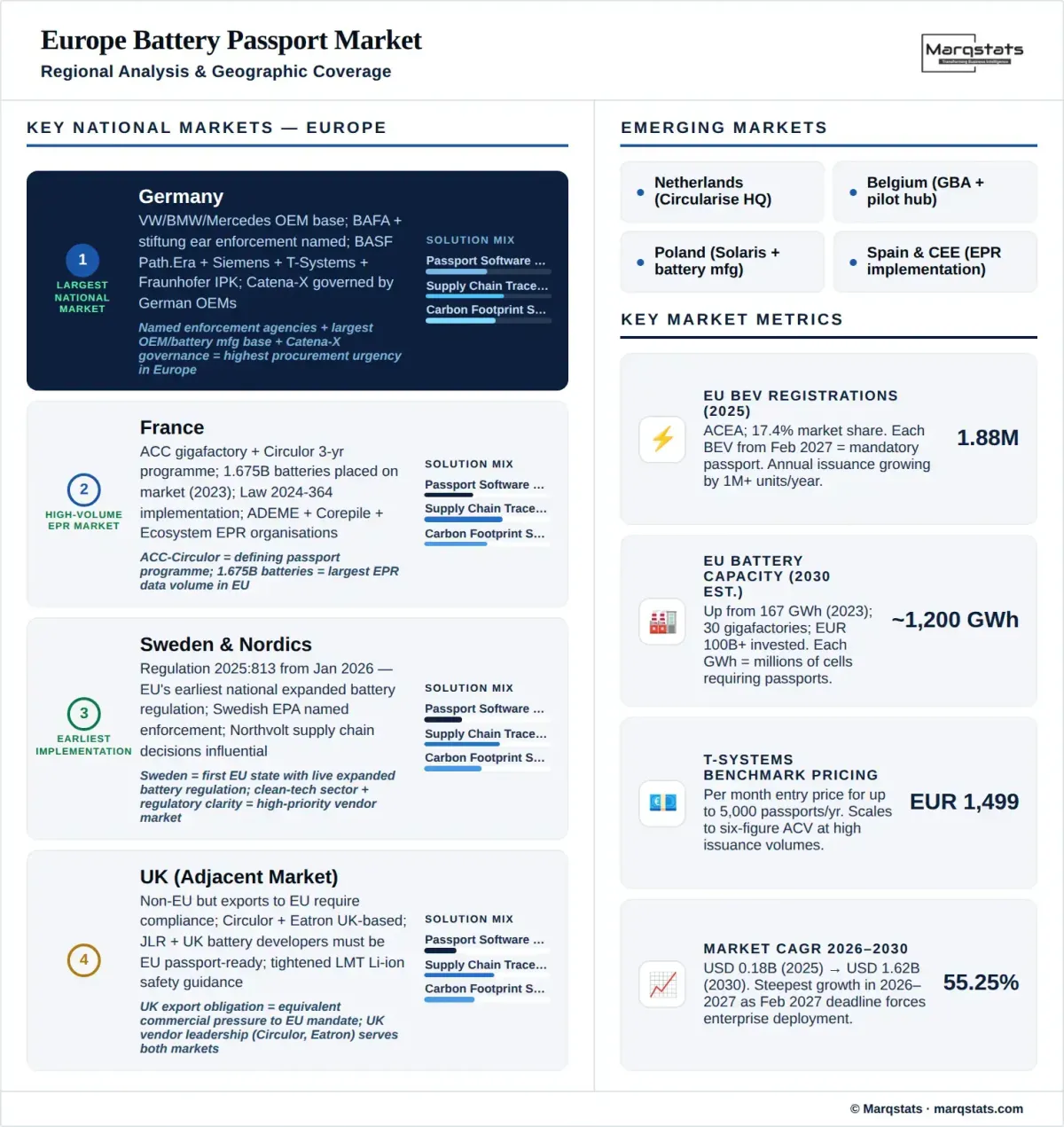
Germany is the largest and most commercially important national battery passport market in Europe, combining the EU's most significant automotive and battery manufacturing base with a comparatively explicit and formalised national enforcement infrastructure. Germany's federal environment ministry has created an enforcement framework under the EU regulation that assigns stiftung ear responsibility for producer registration and approval of producer-responsibility organisations, gives conformity authorities to federal states, and assigns BAFA oversight for due-diligence compliance. This explicit enforcement architecture — with named agencies and defined roles — gives the German battery passport market a clearer compliance certainty than many other EU member states, which in turn drives procurement decisions. Commercially, Germany is home to Volkswagen Group, BMW, Mercedes-Benz, and their battery supply chains; it hosts BASF's Path.Era on Catena-X, Siemens' native Catena-X battery passport product, Fraunhofer IPK's Battery Pass Consortium, and T-Systems' Magenta DPP offering — making it both the largest buyer and the most active vendor hub. The Catena-X automotive data ecosystem, developed and governed primarily by German OEM and supplier participants, is based in Germany and will shape the interoperability standards that European battery passport platforms must implement.
France — High-Volume EPR Market with Active Compliance Ecosystem
France is the second-largest national battery passport market, anchored by both battery manufacturing activity (ACC — Automotive Cells Company — operates gigafactory development in France) and the scale of batteries already placed on the French market: official data show 1.675 billion batteries placed on the French market in 2023, approximately 349,115 tonnes, with 212,880 tonnes collected. Law 2024-364 adapted national law to the EU battery regulation, and the French ecology ministry has confirmed that since 18 August 2025, producer-responsibility obligations have expanded beyond portable batteries to include LMT, EV, SLI, and industrial batteries. ADEME lists approved producer-responsibility organisations including Corepile and Ecosystem — organisations that are both compliance gatekeepers and potential distribution channels for passport compliance services. ACC's partnership with Circulor — announced in January 2024, covering supply chain mapping, material traceability, embedded carbon emissions, and due-diligence reporting across all principal battery materials over three years — is the most commercially significant individual battery passport deployment in France.
Sweden and Nordic Countries — Policy-Aligned Early Adoption
Sweden is a materially important battery passport market, combining battery and clean-tech activity with comparatively clear regulatory administration. The Swedish Environmental Protection Agency requires producers to register and appoint authorised producer-responsibility organisations before placing batteries on the Swedish market. Swedish Regulation 2025:813 introduced producer-responsibility requirements applicable from 1 January 2026, making Sweden one of the earliest EU member states with active national-level implementation of the expanded battery regulation framework. Sweden also hosts Northvolt (undergoing restructuring but historically the largest European-based gigafactory project) — whose supply chain and battery data architecture decisions are influential across the European battery passport vendor ecosystem. Northvolt's difficulties, and the associated restructuring, have created a temporary uncertainty in the Swedish battery manufacturing landscape that may delay some passport-related procurement, but the structural demand from Sweden's clean-technology sector and the clarity of the national regulatory framework make it a high-priority market for battery passport vendors.
Rest of EU — Significant but Less Advanced National Implementation
The remaining EU member states — including Spain, Belgium, Netherlands, Poland, Italy, and others — collectively represent significant battery passport demand as the 2027 mandatory deadline approaches, but with less advanced national implementation infrastructure than Germany, France, and Sweden. Spain's national consultation on adapting domestic law explicitly notes the primacy of Regulation (EU) 2023/1542 as directly applicable EU law, and the official consultation documents show ongoing work to align national waste and battery rules with the regulation — indicating that the compliance architecture is still being built rather than already operational. Belgium is notable because the Global Battery Alliance is headquartered in Brussels and hosted its second wave of Battery Passport pilots from Belgium. Poland is significant because Solaris Bus & Coach (a major electric bus manufacturer and battery passport early adopter) is based there. The Rest of EU market is expected to generate accelerating revenue in 2026–2027 as the deadline approaches and companies in all member states are forced to begin compliance preparations regardless of national enforcement maturity.
United Kingdom — Adjacent Non-EU Market
The UK sits outside the EU battery passport regime but generates adjacent demand through its role as a major automotive manufacturing and battery development hub with export obligations to the EU market. UK manufacturers — including Jaguar Land Rover, Arrival, and EV battery developers associated with the Faraday Institution and WMG at University of Warwick — that sell or supply batteries into the EU market must meet EU passport requirements to access EU customers. The UK Battery Strategy targets a competitive battery supply chain by 2030, and separate UK guidance has tightened lithium-ion battery safety standards for LMT batteries. Eatron Technologies (UK) and WMG's VIPER battery health algorithm — developed with Faraday Institution funding — is a direct example of UK battery technology developing passport-adjacent capabilities in response to EU regulatory demand. Commercially, UK-based battery passport vendors (Circulor is UK-based) are significant actors in the European market, and UK companies exporting to Europe represent a distinct customer segment requiring EU-compliant passport capability without UK-specific regulatory mandate.
How Competition Is Evolving
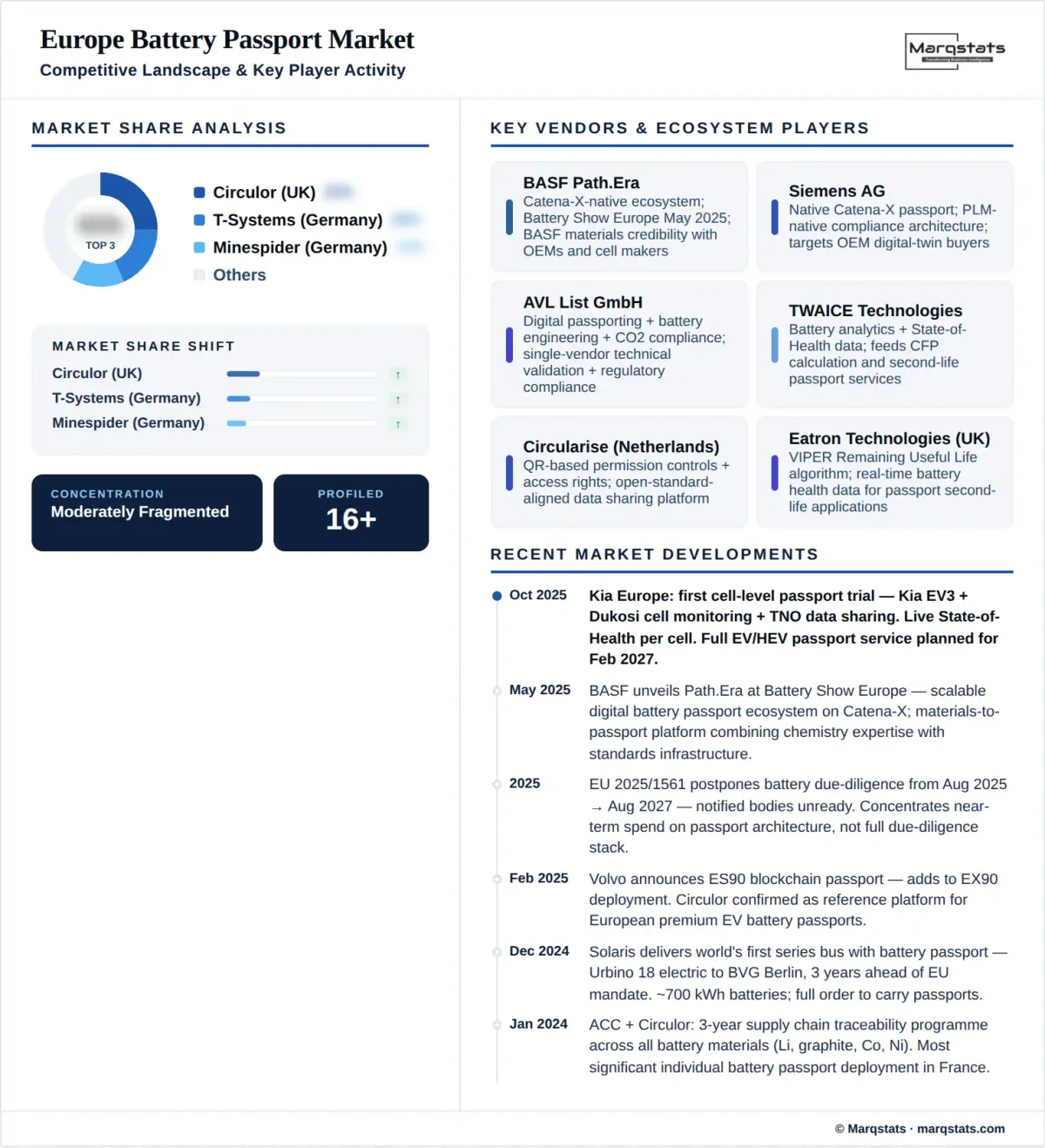
The Europe battery passport competitive landscape is fragmented and still consolidating, because the market is at the earliest commercial stage — most companies are deploying pilot implementations or building vendor relationships ahead of the 2027 mandatory deadline rather than operating at full commercial scale. The competitive architecture is best understood as three tiers: specialist battery-traceability and passport platforms (Circulor, Minespider, Circularise) that built focused solutions for the battery supply chain specifically; enterprise industrial software vendors adding battery passport as a regulated compliance module within broader digital twin or PLM/ERP ecosystems (Siemens, T-Systems, SAP-adjacent vendors, AVL); and emerging ecosystem infrastructure players (BASF Path.Era on Catena-X, TWAICE for battery analytics) that address specific data enrichment or standards integration gaps. A fourth layer — infrastructure and standards bodies (Catena-X, IDTA, BatteryPass-Ready, Global Battery Alliance) — shapes the ecosystem but does not directly compete in the commercial market.
Circulor is one of the commercially most advanced battery passport providers, having secured the highest-profile deployments: the Volvo EX90 battery passport (described by Volvo as blockchain-based, covering raw material sourcing transparency) and the ACC-Circulor three-year supply chain traceability programme covering all principal battery materials. These deployments give Circulor significant reference customer advantage in the EV OEM and battery manufacturer buyer segment. Minespider is the second most active specialist, with the TEMSA partnership for bus battery passports (January 2024), announced partnerships with Tata Elxsi and TETHYS, and the 2026 Recircle.market launch for circular battery commercialisation — positioning Minespider as a platform that connects passport compliance with second-life market access. T-Systems' Magenta DPP is notable for its transparent public pricing (EUR 1,499/month for up to 5,000 passports per year), which establishes the lower end of enterprise commercial expectation for battery passport services and makes T-Systems the most commercially accessible entry point for mid-market buyers. BASF's Path.Era — described as a scalable ecosystem for digital battery passports built natively on Catena-X — is strategically significant because it combines BASF's battery materials position (customer-side credibility with cell manufacturers and OEMs) with standards-native Catena-X architecture (technical credibility with the interoperability gatekeepers). Siemens similarly positions its battery passport as a native Catena-X solution, giving it the same interoperability advantage. AVL's positioning combines digital passporting with battery engineering and CO2/compliance support, targeting the OEM and battery developer segment that needs both technical validation and regulatory compliance in a single vendor relationship. Independent assessments suggest the competitive landscape will consolidate toward 3–5 scale platform providers by 2028, as the regulatory deadline forces buyers to commit to production-grade deployments, rewarding vendors with proven implementations, interoperability credentials, and enterprise-grade security and availability.
Companies Covered
The report profiles 16++ companies with full strategy and financials analysis, including:
Recent Market Activity
Table of Contents
Coverage & Segmentation
This report provides a comprehensive analysis of the Europe battery passport market covering the full commercial ecosystem of software platforms, data management services, supply chain traceability services, carbon-footprint compliance services, assurance and verification services, second-life and circularity workflow services, and consulting and implementation services — covering the 2021–2030 study period with 2025 as base year. The regulatory foundation of the market is Regulation (EU) 2023/1542 on batteries and waste batteries, as supplemented by Delegated Regulation (EU) 2025/606, Regulation (EU) 2025/1561 (due-diligence postponement), and associated implementing and delegated acts. Geographic coverage is EU-27 with particular focus on Germany, France, Sweden, Netherlands, Belgium, Spain, and Poland as primary national markets, plus the United Kingdom as the most commercially significant adjacent non-EU market. End-user analysis covers battery and cell manufacturers, automotive OEMs, pack assemblers, tier-1 and tier-2 battery suppliers, importers, recyclers, second-life operators, and institutional buyers. Battery type coverage includes EV batteries, industrial batteries above 2 kWh, and LMT batteries. Standards ecosystem analysis covers Catena-X, IDTA, BatteryPass-Ready, and the Global Battery Alliance's Battery Passport framework. Primary research includes 40+ interviews with battery passport platform vendors, battery manufacturers, automotive OEM compliance teams, standards body representatives, EU policy experts, and battery recycling operators.