Market Snapshot
Middle bar: base-year value × (1 + CAGR), rounded to two decimals. This is a calculated illustration, not a separately researched annual estimate.
The India commercial EV fleet depot energy management software market is valued at USD 24 million in 2025 and is projected to reach USD 160 million by 2030, expanding at a CAGR of 46.14% over the 2026–2030 forecast period. The market covers software platforms used by electric bus, electric truck, logistics, delivery, ride-hailing and institutional fleets to plan, monitor, optimize and control charging operations at private and semi-private depots. The platform stack spans depot energy and load management, charge scheduling, charge-point management, fleet charging analytics, and tariff and billing optimization. Demand is anchored to a fast-scaling commercial electric-vehicle base, with about 16,300 electric buses operational by March 2026.
India operated approximately 16,300 electric buses by March 2026, with close to 46,000 buses awarded across government schemes, tying software demand directly to the India electric bus market. As depots add dozens of buses and chargers, software becomes necessary to prevent peak-load spikes, ensure vehicles are charged before dispatch, track charger uptime and lower electricity costs. Charge management at scale shifts from a hardware question to a software-coordination question, which defines this market.
Growth is attributed to the shift from pilot fleets to scaled commercial operations under the PM-eBus Sewa scheme, which targets 10,000 electric buses on a public-private model with a ₹57,613 crore outlay and ₹20,000 crore central support, alongside e-truck incentives and rising private capital. The market is fragmented, with India charge-management software providers, charge-point operators, bus manufacturers bundling depot software, and global smart-charging specialists competing across depot deployments.
Key Takeaways
Market Overview & Analysis
Report Summary
The India commercial EV fleet depot energy management software market comprises software platforms that plan, monitor, optimize and control charging at private and semi-private fleet depots. The defined scope includes electric bus and truck depot charging software, smart charging, charge scheduling, depot load management, transformer-capacity optimization, fleet state-of-charge monitoring, charger allocation, charge-point and charging-station management systems, remote diagnostics, depot energy dashboards, dispatch-readiness tools, and route- and telematics-integrated charging. Public consumer-facing charging apps, home chargers, standalone charger hardware and battery-swap hardware fall outside the scope unless integrated with depot energy software.
India operated approximately 16,300 electric buses by March 2026, up from 9,714 by 2024, with close to 46,000 buses awarded across government schemes and around 62,000 tendered. Electric-bus penetration is expected to rise from about 7% to 35–40% of annual bus sales by FY35, while the National Electric Bus Programme targets 40,000 electric buses, per the International Energy Agency. This deployment converts directly into depot-level charging that requires coordinated software as fleets scale.
The 2025 market is estimated at USD 24 million, weighted toward depot energy and load management and charge-point management systems, with charge scheduling, analytics and tariff optimization forming growing shares. Near-term value is moderated by bundled procurement, owing to depot software being tied to vehicle manufacturers, fleet operators and engineering-procurement-construction contractors. Demand is increasing owing to fleet scale-up, multi-depot visibility needs and electricity-cost pressure. Forecast value reaches USD 160 million by 2030 as standalone software procurement matures and depots require dynamic charge scheduling, tariff optimization and uptime analytics.
Commercial depots need software because multiple buses and trucks share limited chargers, grid capacity, dispatch windows and energy tariffs. Smart charge management is the dynamic, coordinated control of charging that reduces grid-upgrade delays, lowers electricity costs and ensures fleet vehicles receive the required energy before departure. Charge-point management functions include charger monitoring, remote error resolution, third-party application interfaces, basic load management, and billing and payment. Depot and private chargers add customer identification, dashboards, advanced load management and fleet management, which positions the depot software stack above a simple charger-control layer.
The value chain spans charger hardware, charge-point and charging-station management software, depot energy management platforms, fleet telematics, and the public transport agencies, logistics operators and charge-point operators that consume the software. India providers such as Kazam EV Tech Private Limited, Pulse Energy and TelioEV serve fleet and depot charging, charge-point operators such as ChargeZone Energy Private Limited and Statiq provide management systems, and global specialists such as Driivz Ltd and Ampcontrol provide route-linked charge scheduling and depot optimization.
Policy and Demand Framework
PM-eBus Sewa targets 10,000 electric buses on a public-private model across 169 eligible cities, with a total outlay of ₹57,613 crore and central support of ₹20,000 crore. The scheme provides full central assistance for depot and charging infrastructure, including behind-the-meter power arrangements, and integrates intelligent transport and conductorless ticketing. Implementation reached its first operational cities, Guwahati, Bhavnagar, Nagpur and Chandigarh, in February 2026, with letters of confirmed quantity and concession agreements progressing across additional cities. Each depot under the scheme requires charging-operations and energy-management software to coordinate multi-bus charging within power and dispatch limits.
The PM E-DRIVE scheme, with a ₹10,900 crore outlay, allocates ₹2,000 crore for public charging infrastructure, including 1,800 fast chargers for electric buses, and ₹4,391 crore for e-bus incentives supporting 14,028 buses. The scheme adds an electric-truck subsidy of ₹5,000 per kWh of battery capacity, extending depot software demand into freight fleets. A proposed package exceeding USD 1 billion for private electric buses and trucks would further broaden the commercial-depot software base.
Market Dynamics
Key Drivers
- India operated about 16,300 electric buses by March 2026, with roughly 46,000 awarded across schemes, creating depots that require coordinated multi-charger energy-management software.
- PM-eBus Sewa targets 10,000 electric buses with full central assistance for depot and charging infrastructure, embedding software demand within each depot deployment.
- PM E-DRIVE allocates ₹2,000 crore for charging infrastructure, including 1,800 e-bus fast chargers, and adds an e-truck subsidy of ₹5,000 per kWh, extending depot software into freight fleets.
- Private capital is scaling fleets, with KKR committing up to USD 310 million to PMI Electro Mobility Solutions and Allfleet to deploy more than 5,000 electric buses.
- Depot charging at scale creates peak-load and grid-capacity risk, so smart charge management lowers demand charges, defers grid upgrades and ensures dispatch readiness.
- A proposed package exceeding USD 1 billion for private electric buses and trucks would broaden the commercial-depot software base beyond public transport.
Key Restraints
- Many depot projects bundle software with vehicle manufacturers, fleet operators or engineering-procurement-construction contractors, which limits standalone software procurement in the near term.
- Grid-capacity constraints and lengthy high-tension power approvals in tier-2 and tier-3 cities slow depot energization and the software that depends on it.
- Fragmented early deployments and small per-depot fleet sizes reduce the immediate need for advanced multi-depot scheduling and analytics.
- Payment-default risk in public transport contracts, addressed through a central payment-security mechanism, has historically slowed depot and software investment.
Key Trends
- Charge scheduling is integrating with route planning and telematics so vehicles are charged before departure while energy use and demand charges are optimized.
- Depot load management and transformer-capacity optimization are becoming core, owing to shared chargers and constrained grid connections at depots.
- Multi-depot visibility, state-of-charge monitoring and uptime analytics are emerging as fleets scale beyond single-site pilots.
- Cloud-based platforms are integrating charge-point management, energy management and fleet dispatch into single operator dashboards.
Market Segmentation
Depot energy and load management holds the largest value share, coordinating charging across shared chargers within transformer and grid-connection limits. The segment performs peak-load shaving, demand-charge management and charger allocation to prevent simultaneous high-power draw. It is the structural core of the market because depots add multiple buses against limited power capacity, making coordinated control essential to operations and cost.
Charge scheduling sequences charging against dispatch windows, route energy requirements and tariff periods. The segment integrates route planning and telematics so vehicles reach the required state of charge before departure while energy use is optimized. It is the fastest-growing software type as fleets scale and dispatch reliability becomes operationally critical.
Charge-point and charging-station management systems provide charger monitoring, remote error resolution, application interfaces, basic load management and billing. The segment forms the backbone layer on which depot energy management and scheduling build, and adoption scales directly with charger counts at depots. ChargeZone Energy Private Limited and Statiq supply management systems used across fleet and depot sites.
Analytics and remote monitoring track charger uptime, energy consumption, state of charge and depot performance across sites. The segment supports multi-depot visibility and predictive maintenance, growing as operators move from single depots to networks. TelioEV provides centralized charging management with real-time tracking of vehicle battery levels for fleet and logistics operators.
Tariff and billing optimization shifts charging to low-tariff windows and reconciles energy costs across depots and operators. The segment lowers electricity cost per kilometer and supports cost allocation for gross-cost-contract operations, growing as energy expense becomes a primary lever in fleet economics.
Electric buses account for the largest share of depot software demand, anchored by PM-eBus Sewa and state transport deployments. Public-transport depots charge large fleets overnight and between trips, requiring coordinated load and dispatch management. India recorded 4,441 electric-bus registrations in 2025, up from 3,730 in 2024, with PMI Electro Mobility Solutions taking about 23.4% share, and a base of about 16,300 buses operational by March 2026.
Electric trucks form the fastest-growing vehicle segment, supported by the PM E-DRIVE e-truck subsidy of ₹5,000 per kWh and a proposed private-fleet incentive package. Logistics depots require route-based charging and high-power load management, expanding depot software demand into freight.
Electric vans and light commercial vehicles serve last-mile delivery and e-commerce fleets, charging at distributed hubs. The segment favors scheduling and state-of-charge monitoring to maximize daily uptime across many small vehicles.
Electric three-wheeler fleets in delivery and shared mobility add depot and hub charging demand, with software focused on charger allocation and high-utilization scheduling across large vehicle counts.
Public-transport depots represent the largest application, driven by state transport undertakings and PM-eBus Sewa city deployments. These depots charge large bus fleets within fixed dispatch schedules and constrained grid connections, making load and dispatch software essential.
Logistics and last-mile hubs charge delivery vans, trucks and three-wheelers at distributed sites. The application grows with freight electrification and favors route-linked scheduling, state-of-charge monitoring and tariff optimization to sustain daily operations.
Airport and port fleets electrify buses, ground vehicles and shuttles within enclosed, high-utilization environments. These sites adopt depot energy management to coordinate charging against fixed operational cycles and limited power capacity.
Institutional and employee-transport fleets, including corporate and campus buses, charge at private depots on predictable schedules. The application adopts scheduling and tariff optimization to lower cost and ensure availability.
Cloud-based software-as-a-service holds the largest share, providing multi-depot visibility, remote monitoring and over-the-air updates. The model scales with fleet networks and forms the dominant deployment for operators managing multiple sites.
On-premise depot control systems run charging coordination locally for resilience and low-latency load management. The mode suits large single depots with constrained connectivity or strict operational-continuity requirements.
Hybrid platforms combine local depot control with cloud analytics and multi-depot management, balancing resilience with network-wide optimization. The mode grows as operators standardize across mixed depot estates.
By Geography
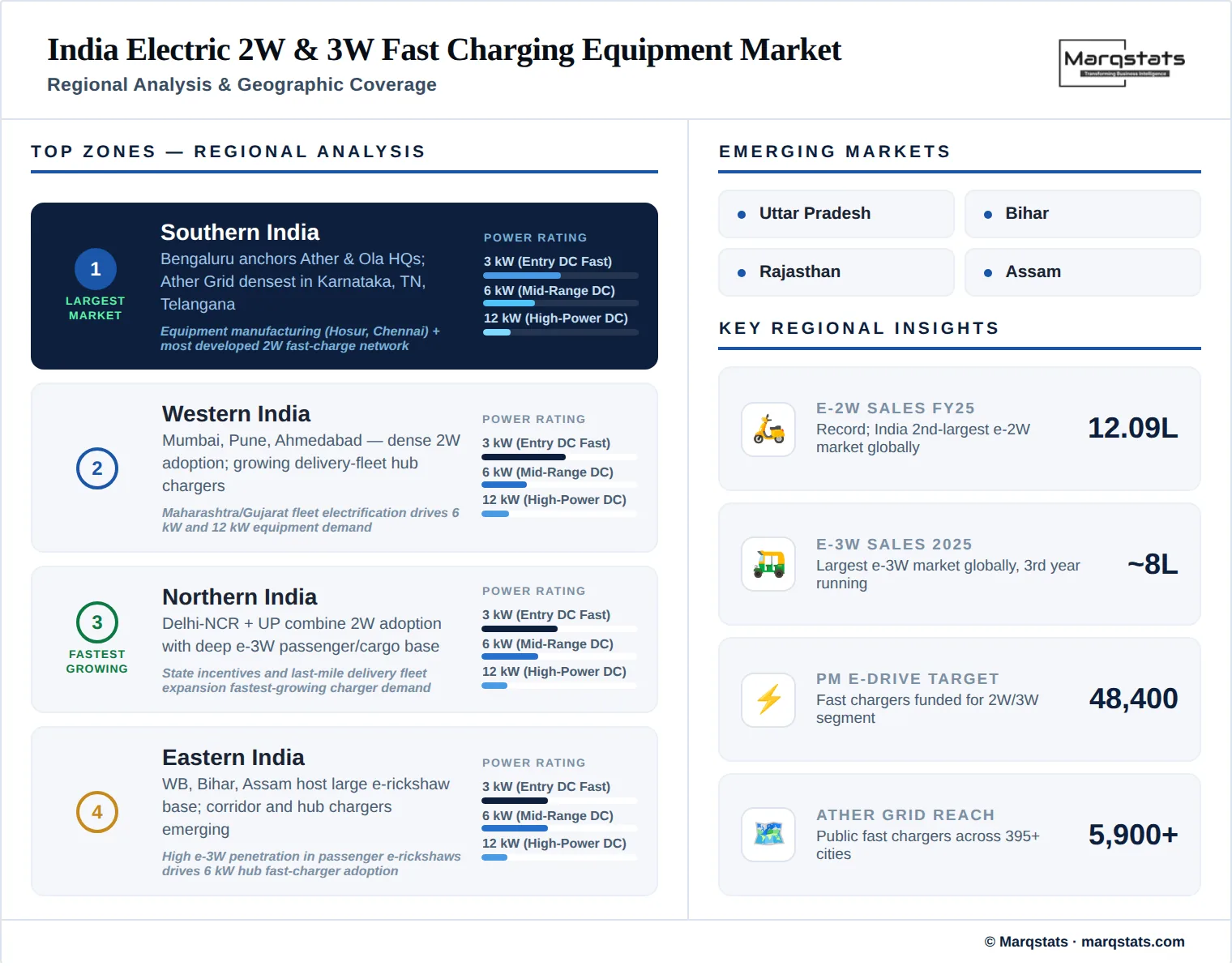
Southern India
Southern India holds the largest share, combining dense electric-bus deployments across Karnataka, Telangana, Andhra Pradesh and Tamil Nadu with Bengaluru as the development hub for fleet and depot software. Andhra Pradesh State Road Transport Corporation depot redevelopment, including a Vijayawada depot with 20 charging stations for 100 electric buses, illustrates depot-scale charging operations. Software development capacity and deployment density together anchor the region.
Western India
Western India records the fastest growth, anchored by Maharashtra and Gujarat. Maharashtra State Road Transport Corporation depot conversions, including a Nashik Road hub with seven charging stations, demonstrate multi-charger scheduling and load management needs. Mumbai, Pune and Ahmedabad combine public-transport and logistics-fleet electrification, broadening depot software demand.
Northern India
Northern India is anchored by Delhi-NCR, which operates one of the largest electric-bus fleets in the country, supported by state incentives and dense depot charging. Uttar Pradesh, Rajasthan and Haryana add public-transport and logistics deployments along freight corridors, expanding scheduling and load-management demand.
Eastern and Rest of India
Eastern and remaining states form a growing share, with Guwahati among the first PM-eBus Sewa operational cities and West Bengal, Odisha and Bihar adding deployments. Depot software demand develops as state transport undertakings energize new depots under central schemes.
How Competition Is Evolving
The market is fragmented and stratifies into four groups: India charge-management and fleet software providers, charge-point operators offering charging plus software, bus manufacturers and operators bundling depot software with vehicle contracts, and global smart-charging specialists. Early depot software is frequently bundled within vehicle or charging-infrastructure contracts, which concentrates demand among integrated providers while a standalone software tier develops as fleets scale.
India software providers include Kazam EV Tech Private Limited, Numocity Technologies Private Limited, Pulse Energy and TelioEV, which serve fleet and depot charging with management, scheduling and analytics platforms. Pulse Energy positions a complete fleet charging platform for park-and-charge hubs and fleet management, while TelioEV provides centralized charging management with real-time battery-level tracking for logistics operators. ChargeZone Energy Private Limited operates a cloud platform to manage, monitor and control charging infrastructure with real-time monitoring, and Statiq supplies a charging-station management system to fleet partners and hosts.
Bus manufacturers and operators bundle depot software with vehicle contracts. PMI Electro Mobility Solutions Private Limited, Olectra Greentech Limited and Switch Mobility Automotive Limited ranked among the top electric-bus suppliers in 2025, while Tata Power Company Limited supplies depot charging for Tata electric buses and JBM Auto Limited integrates depot charging within its bus platform. These contracts embed charging-operations software within depot deployments, which shapes early demand.
Global smart-charging specialists provide route-linked charge scheduling, depot monitoring and energy optimization. Driivz Ltd and Ampcontrol offer scheduling that integrates route planning and telematics to ensure dispatch readiness while optimizing energy use. Competition centers on depot load-management depth, dispatch-linked scheduling, multi-depot analytics and integration with charger hardware and telematics, with the standalone software tier expanding as fleets move beyond pilots toward multi-depot operations.
Companies Covered
Companies covered in the report include:
Recent Market Activity
Table of Contents
Coverage & Segmentation
This report analyzes the India commercial EV fleet depot energy management software market across the 2021–2025 historical period, a 2025 base year, and the 2026–2030 forecast period. The study quantifies market size in value, segments demand by software type, vehicle type, fleet application and deployment mode, and profiles India software providers, charge-point operators, bus manufacturers and global smart-charging specialists. Market sizing follows a bottom-up approach calibrated to the commercial electric-vehicle base, depot counts and software pricing, validated against top-down estimates. Forecasts present base, conservative and accelerated scenarios reflecting fleet scale-up, policy support and standalone software adoption.
The scope covers depot energy and load management, charge scheduling and dispatch optimization, charge-point and charging-station management systems, fleet charging analytics, remote monitoring, and tariff and billing optimization for commercial fleets. Coverage includes PM-eBus Sewa, PM E-DRIVE charging-infrastructure policy and e-truck incentives. The report excludes public consumer-facing charging apps, home chargers, standalone charger hardware, four-wheeler public fast-charging without fleet software, and battery-swap hardware unless integrated with depot energy software.