Market Snapshot
Middle bar: base-year value × (1 + CAGR), rounded to two decimals. This is a calculated illustration, not a separately researched annual estimate.
The Mexico electric truck market size is estimated at USD 11.84 million in 2025 and is projected to reach USD 127.88 million by 2030, expanding at a 60.95% CAGR across the 2026 – 2030 forecast period. The market covers new battery-electric heavy commercial vehicles sold domestically, measured on the national heavy-vehicle registration basis. Volume was approximately 64 units in 2025 against 30,673 heavy vehicles sold at wholesale, a 0.21% penetration rate, and is forecast to reach 825 units and 1.59% penetration by 2030. Mexico produced 1.8 times more electric heavy vehicles than it sold domestically, making it a manufacturing base before a demand market.
Market size and forecast figures are generated using Marqstats' proprietary estimation framework, updated as of September 2026.
Mexico is the clearest example in the Americas of an electric-truck market whose supply side is developing faster than its demand side. National registration data for January to July 2025 record 68 electric heavy vehicles produced and 46 exported — 67.6% of output leaving the country — against 90,204 diesel heavy vehicles produced in the same seven months. The domestic sales figure of roughly 64 units for the full year is smaller than the annualised production run. That asymmetry is the market's defining structural feature, and it means Mexico cannot be read the way a pure import-and-retail market is read.
The 2025 base year is also a cyclical trough, which materially affects how any growth rate from it should be read. Heavy-vehicle wholesale sales fell 54.7% in 2025 to 30,673 units from 67,704, and production fell 34.8% to 138,954. A high forecast CAGR from that base reflects both genuine electrification and ordinary cyclical recovery; the two are separated here by forecasting penetration against a recovering total market rather than extrapolating unit growth. On that basis electric penetration rises from 0.21% to 1.59% by 2030 — meaningful progress, but still a market where more than 98% of new heavy vehicles will run on diesel at the end of the forecast period.
Key Takeaways
Market Overview & Analysis
Report Summary
The Mexico electric truck market comprises new domestic sales of battery-electric heavy commercial vehicles, measured in units and in vehicle transaction value. Volume is taken from the national administrative register of the heavy-vehicle industry, which is the only official series that separates energy source, and value is built bottom-up by applying an observed price range to that volume. On this basis the market stood at approximately USD 11.84 million and 64 units in 2025. Charging infrastructure, depot works and energy costs are excluded from the market value.
Two measurement caveats shape every figure, and neither can be resolved from public data. First, the official heavy-vehicle reporting universe includes passenger buses alongside trucks and tractors, so a figure described as electric heavy-vehicle sales is not automatically a battery-electric freight truck count. The 64-unit figure for 2025 is therefore a working ceiling for electric trucks rather than a precise registration total, and it is qualified as such wherever it appears. Second, a propulsion-specific annual series running back to 2015 is not publicly comparable, because reporting coverage and powertrain categories have changed. Populating earlier years with zeros because electric trucks were not separately tabulated would be misleading, so the historical series begins where the powertrain split becomes reliable.
A third boundary is becoming more important than either. The fastest-growing part of Mexico's electric commercial vehicle activity is urban and last-mile distribution, and vehicles in that class frequently sit below the heavy-vehicle threshold that the official series covers. The 100 BYD T75 units that landed at Lázaro Cárdenas in July 2026 carry a 4.45-tonne payload and a 270-kilometre range, and a fleet of that description may not appear in the heavy-vehicle register at all. The practical consequence is that the official number understates electric truck activity by an unknown margin, and that the gap is widening rather than closing.
Published market-value estimates for Mexico diverge widely because of exactly these definitional problems, with values ranging from roughly USD 16 million on a narrow new-vehicle basis to several hundred million on much broader definitions that include light commercial vehicles, infrastructure or aftermarket revenue. This report's estimate of USD 11.84 million sits at the conservative end of the narrow cluster and is derived transparently: approximately 64 units at an observed price range of USD 120,000 to USD 250,000 per vehicle, taken at a midpoint of USD 185,000. Because the unit baseline itself is medium-to-low confidence, the value estimate inherits that confidence level and is presented as an order of magnitude rather than a precise figure.
Electric Truck Sales Volume and Unit Forecast
Electric heavy-vehicle sales in Mexico were approximately 64 units in 2025 and are forecast to reach 825 units by 2030, a 66.75% compound annual growth rate. Volume carries the central measurement caveat in this market, and it runs in both directions at once: 64 is a ceiling, because the national heavy-vehicle reporting universe includes passenger buses alongside trucks and tractors, and it is simultaneously a floor, because urban and last-mile electric trucks frequently fall below the heavy-vehicle threshold and may not enter the register at all. The 100 units landed at Lázaro Cárdenas in July 2026 carry a 4.45-tonne payload and a fleet of that description may be entirely invisible to the official series.
Domestic sales volume is the smallest of three flows that must be kept apart. National registration data for January to July 2025 record 68 electric heavy vehicles produced and 46 exported, 67.6% of output, against 90,204 diesel heavy vehicles produced in the same seven months. Annualised electric production of roughly 116 units against domestic sales of 64 means Mexico builds about 1.8 electric heavy vehicles for every one it sells at home. Production and export volumes are analysed throughout but excluded from market size, because a vehicle shipped abroad never reaches a Mexican operator. Natural gas out-produces electric 12.5 to one at 852 units, competing for the same replacement budget.
Market Dynamics
Key Drivers
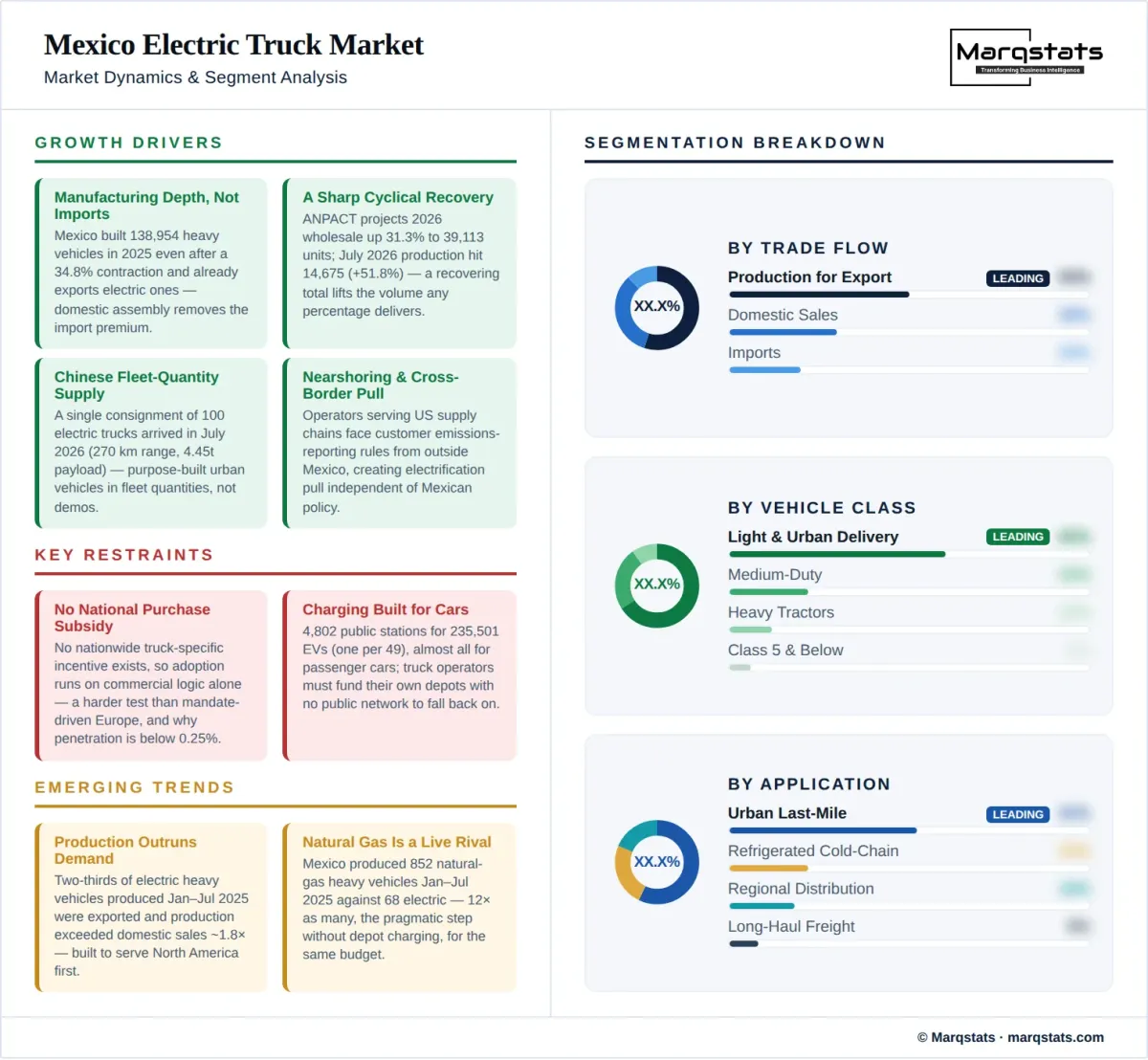
- Manufacturing depth gives Mexico a different path from an import-dependent market. The country is one of the world's major heavy-vehicle production bases, building 138,954 heavy vehicles in 2025 even after a 34.8% contraction, and it already produces and exports battery-electric heavy vehicles. As volumes scale, domestic assembly shortens lead times, localises parts supply and removes the import-duty and logistics premium that constrains adoption in markets without a manufacturing base.
- A sharp cyclical recovery is under way. The national association projected 2026 heavy-vehicle wholesale sales of 39,113 units, up 31.3%, and retail sales of 42,727, up 9.9%, after the 2025 contraction. July 2026 production reached 14,675 units, up 51.8% year on year, with exports of 13,117 units, up 66.7%. A recovering total market raises the absolute volume that any given electrification percentage delivers.
- Chinese manufacturers are supplying volume the domestic market has not previously seen. A single consignment of 100 electric trucks arrived in July 2026 with a 270-kilometre range and a 4.45-tonne payload, alongside refrigerated electric units entering retail logistics fleets. These are aggressively priced, purpose-built urban vehicles rather than adapted diesel platforms, and they are arriving in fleet quantities rather than as demonstration units.
- Nearshoring and cross-border freight demand favour predictable operating costs. Mexican logistics operators serving United States supply chains face customer emissions reporting requirements that originate outside Mexico, which creates commercial pull for electrification independent of Mexican policy. Urban distribution fleets serving national retail chains are the earliest adopters because their duty cycles fit current vehicle range without infrastructure investment beyond the depot.
- Total cost of ownership improves fastest in high-utilisation urban duty cycles. Diesel service networks are mature and cheap in Mexico, so electrification does not win on maintenance alone, but a delivery vehicle running fixed urban routes at high daily utilisation accumulates energy savings quickly and returns to a single depot every night, which removes the public charging dependency that constrains long-haul applications.
Key Restraints
- There is no national purchase subsidy for electric trucks. No sufficiently robust public source establishes a nationwide truck-specific battery-electric purchase incentive, and tax treatment varies with vehicle classification and trade origin. Mexican adoption is therefore running on commercial logic alone, which is a materially harder test than the mandate-driven European market or the incentive-supported United States market, and it is the single largest reason penetration remains below one-quarter of one percent.
- Charging infrastructure is thin and built for the wrong vehicles. Mexico had 4,802 public charging stations against 235,501 electric vehicles in the first quarter of 2026, roughly one charging point per 49 vehicles, and almost all of that network is specified for passenger cars rather than for heavy vehicles requiring high-power depot charging. Truck operators must therefore fund their own depot infrastructure with no public network to fall back on.
- The 2025 collapse destroyed the capital base for a drivetrain transition. A 54.7% fall in wholesale heavy-vehicle sales in a single year is an exceptionally weak backdrop for asking operators to accept a higher-capex vehicle. Fleets that deferred replacement through the downturn will replace on the cheapest available terms when they return, and for most Mexican operators that remains a diesel tractor.
- Residual values are unknown because no used market exists. There is no national series for electric truck stock, age distribution, mileage distribution or resale value, and the domestic used electric truck market is too small to have generated one. An operator financing a vehicle over five to seven years cannot price the residual, which raises the effective cost of capital on every electric unit relative to a diesel equivalent with decades of resale evidence.
- Data opacity itself constrains investment. Battery and range sales-weighted averages, average transaction prices, financing penetration and warranty penetration are all unpublished for Mexican electric trucks, and electric-specific import origins are not separated in the accessible trade tables. Every business case in this market therefore rests on modelled rather than observed inputs, which widens the risk premium applied to it.
Key Trends
- Production is outrunning domestic demand and will continue to. Two-thirds of electric heavy vehicles produced in January to July 2025 were exported, and annualised production exceeded domestic sales by roughly 1.8 times. Mexico's electric truck industry is being built to serve North American demand first, which means domestic availability improves as a by-product of export scale rather than as a response to Mexican orders.
- The centre of gravity is urban distribution, not long-haul freight. Vehicles arriving in fleet quantities carry payloads around 4.45 tonnes and ranges around 240 to 270 kilometres, matched to last-mile and refrigerated retail distribution. Long-haul tractor applications remain demonstration-scale: the first battery-electric tractor delivered in Mexico offered 240 kilometres of range against national freight corridors measured in thousands.
- Corporate fleet buyers are moving before owner-operators. National retail and consumer goods groups are placing multi-unit orders with published emissions commitments behind them, while the fragmented owner-operator segment that carries most Mexican freight has neither the balance sheet nor the depot access to follow. Adoption will therefore concentrate in a small number of large fleets long before it broadens.
- Natural gas remains a live alternative in a way it is not in Europe. Mexico produced 852 natural-gas heavy vehicles in January to July 2025 against 68 electric ones, more than twelve times as many. For operators seeking lower emissions without depot electrification or residual-value uncertainty, gas remains the pragmatic intermediate step, and it competes directly for the same replacement budget.
Market Segmentation
Light and urban delivery trucks are the volume core of Mexican electric truck adoption and the fastest-growing class. Vehicles entering fleets carry payloads around 4.45 tonnes with ranges of 240 to 270 kilometres, matched to single-depot urban duty cycles. This class also sits at the boundary of the official heavy-vehicle reporting threshold, so a material share of its volume may not appear in the national register at all — which is why the official 64-unit figure should be treated as a floor for electric truck activity rather than a complete count.
Medium-duty trucks serve regional distribution, beverage and consumer goods delivery and municipal applications. Battery capacity in this class typically runs 100 to 350 kWh with 150 to 350 kilometres of daily range, stated here as a planning envelope rather than an observed sales-weighted average because no such average is published for Mexico. The class is where electrification economics are most finely balanced: duty cycles are long enough to accumulate meaningful energy savings but not so long that range becomes a constraint.
Heavy tractors are the largest part of the Mexican diesel market and the smallest part of the electric one. The national association projected 18,593 retail tractor sales for 2026, up 12.4%, and 17,560 at wholesale, up 40.1%, against an electric tractor population still measured in single figures. The first battery-electric tractor delivered in Mexico offered 536 horsepower, a 36-tonne gross combined weight rating and 240 kilometres of range — adequate for regional drayage but not for the long-haul corridors that define Mexican freight.
Class 5 and lighter vehicles are a small and declining part of the official heavy-vehicle series, with 1,059 retail units projected for 2026, down 6.9%. Electrification in this class overlaps with the light commercial vehicle market and with purpose-built electric vans, which are outside the heavy-vehicle register. This is the clearest example of the classification gap that makes Mexican electric truck volumes hard to measure consistently.
Battery-electric vehicles constitute the entire market, at approximately 64 units and 0.21% of heavy-vehicle wholesale sales in 2025. The segment is forecast to reach 825 units and 1.59% penetration by 2030. Growth is driven by vehicle availability from manufacturers scaling for export rather than by domestic policy, and by a small number of large corporate fleets rather than by broad market adoption.
Natural gas is the more established alternative powertrain in Mexico and competes directly with battery-electric for the same replacement budget. Mexico produced 852 natural-gas heavy vehicles in January to July 2025 against 68 electric ones and exported 766 of them. For an operator seeking lower emissions without depot electrification, unknown residual values or range constraints, gas remains the pragmatic option, and its twelve-to-one production advantage over electric reflects that.
Diesel remains overwhelmingly dominant and will still hold more than 98% of new heavy-vehicle sales at the end of the forecast period. Mexico produced 90,204 diesel heavy vehicles in January to July 2025, and exported 75,203 of them. The maturity and low cost of the Mexican diesel service ecosystem is itself a restraint on electrification, because it narrows the maintenance-cost advantage that supports the electric business case in higher-labour-cost markets.
Urban last-mile distribution is where Mexican electric trucks are actually being deployed. Fixed routes, predictable daily distances well inside available range, overnight return to a single depot and high daily utilisation combine to make this the only application where the economics work today without subsidy. Vehicles arriving in fleet quantities are purpose-built for this duty cycle rather than adapted from diesel platforms.
Refrigerated distribution is an early and commercially logical adopter because electric drivetrains can power refrigeration units without idling a diesel engine, which is both a cost and an emissions advantage. A national convenience-store chain added five refrigerated electric trucks with 240-kilometre range to its Querétaro operation, following electrification activity begun in January 2024. Cold-chain fleets also tend to be corporate rather than owner-operated, which matters for access to capital.
Regional distribution sits at the edge of current vehicle capability. Routes of 150 to 350 kilometres are within the planning envelope for a medium-duty electric truck but leave little margin for load, terrain or air-conditioning demand, and they may require charging away from the home depot on a network that does not yet exist for heavy vehicles. This segment converts as range improves and as depot charging spreads to secondary distribution centres.
Long-haul freight is the largest Mexican trucking application and the least addressable by current electric vehicles. National corridors run to thousands of kilometres against tractor ranges around 240 kilometres, with no high-power public charging along them. This segment is not forecast to convert materially within the period, and treating national tractor volumes as an addressable electric market would substantially overstate the opportunity.
Domestic sales are the measurement basis for market size: approximately 64 electric heavy vehicles in 2025 against 30,673 heavy vehicles sold at wholesale. This is the flow that represents Mexican demand, and it is the smallest of the three flows analysed here. It is also the flow most exposed to the absence of a national purchase subsidy, because an exported vehicle is sold into a market that may have one.
Production for export is the largest electric flow and the reason Mexico matters in this market. National registration data record 68 electric heavy vehicles produced in January to July 2025 with 46 exported, 67.6% of output, alongside 766 of 852 natural-gas vehicles exported over the same period. Annualised electric production of roughly 116 units against domestic sales of 64 means Mexico builds about 1.8 electric heavy vehicles for every one it sells at home. This flow is not added to the market size, because production is supply rather than domestic demand.
Imports supply the vehicles Mexico does not build, and the arriving Chinese urban trucks are the clearest example. Total heavy-vehicle imports for January to July 2025 were 3,967 units, led by Japan at 1,745, Brazil at 1,068, Poland at 422, China at 329 and the United States at 316. The accessible import tables do not separate electric vehicles by origin, so assigning any of those totals to electric trucks would be incorrect, and the split remains an open data gap.
Smaller packs serve light urban delivery vehicles on short fixed routes with overnight depot charging. This band carries the lowest vehicle cost and the shortest payback, and it is where the arriving fleet-quantity imports concentrate. Range of roughly 240 to 270 kilometres is sufficient for a full urban shift with margin.
This is the planning band for a medium-duty Mexican distribution truck at 150 to 350 kilometres of daily range. It is stated as an engineering envelope rather than a measured market average, because no sales-weighted battery or range statistic is published for Mexico. The band covers most regional distribution applications and is where vehicle choice is widest.
Larger packs serve tractor and heavy regional applications, where the first Mexican battery-electric tractor delivered 240 kilometres at a 36-tonne gross combined weight rating. Cost, weight and charging power requirements all scale with capacity, and in a market with no public heavy-vehicle charging network the operator carries the full infrastructure burden. This band remains demonstration-scale.
National retail and consumer goods groups are the leading adopters, placing multi-unit orders backed by published corporate emissions commitments and financed from group balance sheets. Their urban and refrigerated distribution duty cycles fit current vehicle capability, and their depot networks allow charging investment to be concentrated at a small number of sites.
Third-party logistics operators adopt where their customers require it, particularly on cross-border supply chains where emissions reporting obligations originate with United States shippers. The first battery-electric tractor delivered in Mexico went to a domestic logistics company, and this segment is where long-haul electrification will eventually begin if range and charging improve.
Owner-operators and small fleets carry a large share of Mexican freight and are the least able to electrify. They lack depot access, balance-sheet capacity for a higher-capex vehicle and any way to price residual value, and they are the segment most likely to replace deferred capacity with the cheapest available diesel as the market recovers. Adoption here is not forecast to be material within the period.
By Geography
Nuevo León and the Northeast
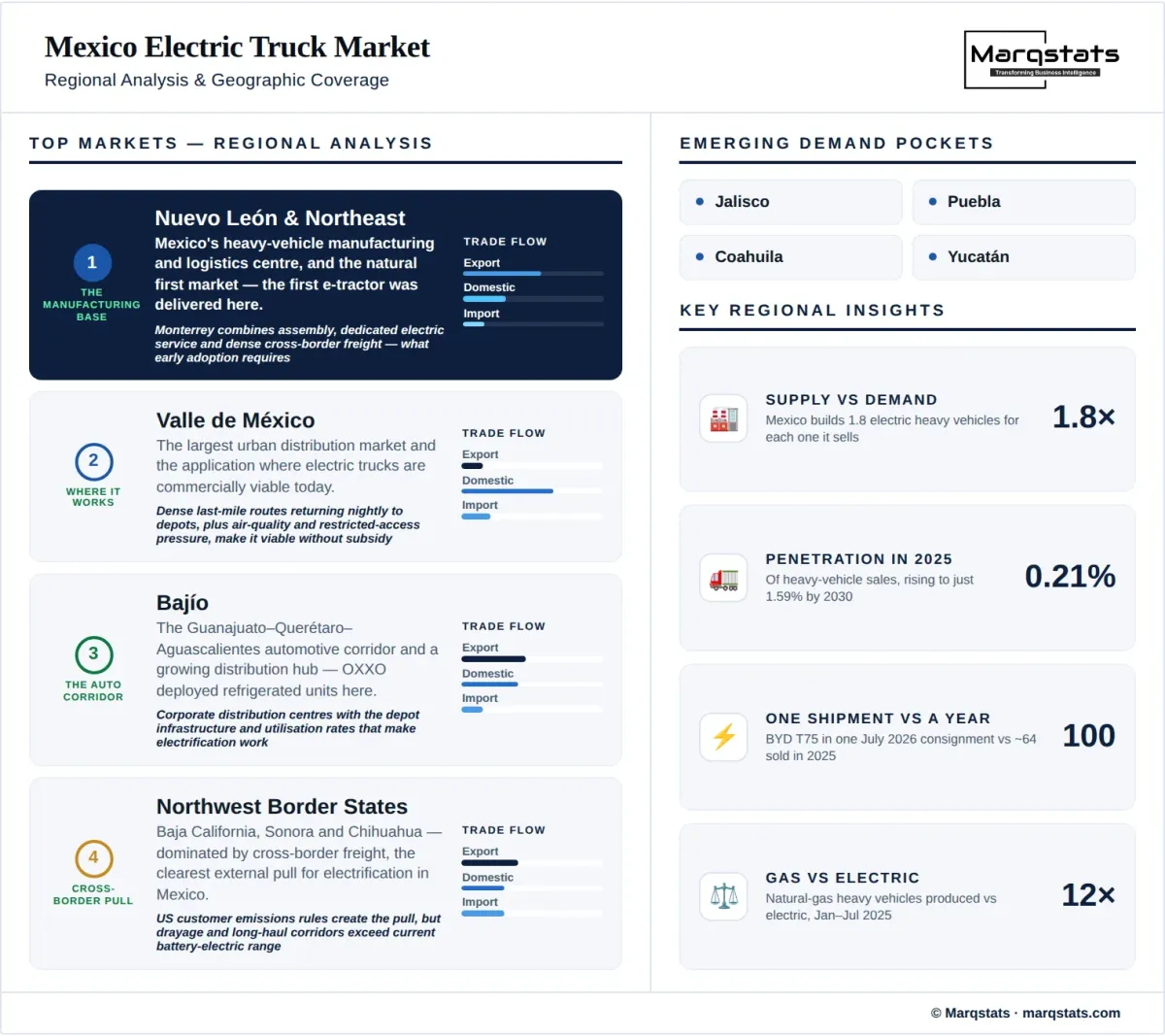
Nuevo León is Mexico's heavy-vehicle manufacturing and logistics centre and the natural first market for electric trucks. Monterrey hosts assembly and dealer infrastructure including dedicated electric service capability, and the first battery-electric tractor delivered in Mexico was supplied through a Monterrey dealership with a purpose-built charging and service facility at Santa Catarina. The region combines vehicle availability, technical support and dense cross-border freight demand, which is the combination early adoption requires.
Estado de México and the Valle de México
The Valle de México is the country's largest urban distribution market and the application where electric trucks are commercially viable today. Dense last-mile delivery, severe air-quality pressure and short fixed routes returning nightly to depots all favour electrification, and the metropolitan area concentrates the retail and consumer goods distribution fleets that are placing the first multi-unit orders. Congestion and restricted-access zones add a further operating advantage to zero-emission vehicles.
Bajío
The Bajío states of Guanajuato, Querétaro and Aguascalientes form Mexico's automotive manufacturing corridor and a growing distribution hub. A national convenience-store chain deployed refrigerated electric trucks into its Querétaro logistics operation, which is characteristic of the region: corporate distribution centres serving national networks, with the depot infrastructure and utilisation rates that make electrification work. The region also supplies component manufacturing to the vehicle industry itself.
Jalisco and the West
Jalisco and the western states form a large secondary distribution market centred on Guadalajara, with consumer goods, beverage and retail fleets operating urban and regional duty cycles. Adoption here follows the Valle de México pattern with a lag determined by dealer and service coverage rather than by demand, since the applications are comparable and the fleets are frequently divisions of the same national groups.
Northwest Border States
Baja California, Sonora and Chihuahua are dominated by cross-border freight into the United States, which creates the clearest external pull for electrification in Mexico: customer emissions reporting requirements that originate outside the country. The constraint is that cross-border drayage and long-haul corridors exceed current battery-electric tractor range, so conversion here depends on range improvement and on charging infrastructure along the border corridors rather than on Mexican demand conditions.
How Competition Is Evolving
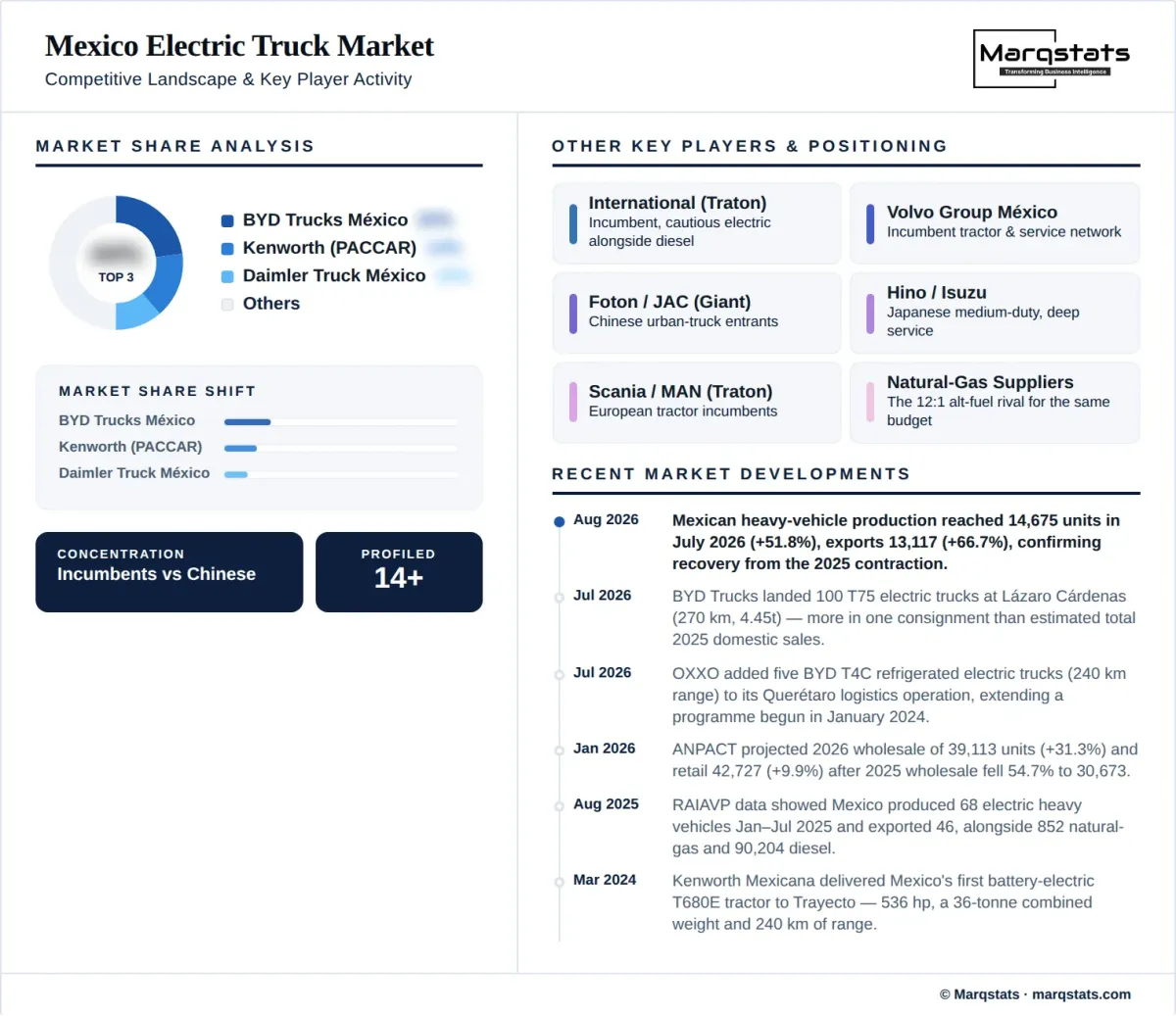
The Mexican electric truck market is too small for meaningful share to be measured, and any published share ranking should be treated with caution. Brand-level electric data are partial: in the January to July 2025 comparison published by the national association, one Chinese manufacturer recorded 25 electric retail units and another six. That establishes participation but is insufficient to construct a defensible full-year national ranking. What can be established is which manufacturers are actually present, which are shipping in fleet quantities and which are still at demonstration scale.
Competition divides along a clear line. The incumbent heavy-vehicle manufacturers — the North American, European and Japanese groups that dominate Mexican diesel sales and operate the country's assembly plants — hold the service networks, the financing relationships and the fleet accounts, and are introducing electric products cautiously alongside their diesel ranges. Chinese manufacturers are entering with purpose-built electric vehicles at fleet quantities and aggressive pricing, targeting urban distribution rather than the tractor segment where incumbents are strongest. A single consignment of 100 electric trucks landing in July 2026 exceeded the entire estimated domestic electric heavy-vehicle sales figure for the prior year.
The decisive competitive asset in Mexico is service coverage rather than product. Diesel service networks are mature, dense and inexpensive, and an operator considering a vehicle with no established residual value will not also accept uncertainty about who repairs it. The manufacturers making progress are those investing in dedicated electric service capability alongside the vehicle — trained technicians, charging infrastructure at the dealership and parts availability — and that investment is currently concentrated in Monterrey, the Valle de México and the Bajío. Manufacturers selling into Mexico without that footprint are selling demonstration units, whatever their product specification.
Companies Covered
Companies covered in the report include:
Recent Market Activity
Table of Contents
Coverage & Segmentation
This report covers new domestic sales of battery-electric heavy commercial vehicles in Mexico, with 2025 as the base year and 2026–2030 as the forecast period. Market size is reported as vehicle transaction value in US dollars and corroborated by unit volume and penetration of the total heavy-vehicle market. Note that the value figures are in millions rather than billions: this is a market of roughly USD 12 million in the base year, and quoting it on a billion scale would misrepresent it by three orders of magnitude. Segmentation covers vehicle class, powertrain, application, trade flow, battery capacity and range, and end user, with regional analysis for Nuevo León and the Northeast, the Valle de México, the Bajío, Jalisco and the West, and the Northwest border states.
Four scope boundaries define the market perimeter, and each reflects a genuine data limitation rather than an analytical choice. First, the official reporting universe for heavy vehicles includes passenger buses, so the 64-unit 2025 figure is a working ceiling for electric trucks rather than a verified truck-only count. Second, urban and last-mile electric trucks frequently fall below the heavy-vehicle threshold and may not appear in the register at all, so the same figure simultaneously acts as a floor for total electric truck activity — the two effects run in opposite directions and neither is quantified. Third, a propulsion-specific series comparable back to 2015 does not exist publicly, so no historical trend line is published for years in which the powertrain split was not separately tabulated. Fourth, production and export volumes are reported and analysed but are not added to market size, because production is supply rather than domestic demand and adding them would double-count vehicles that never reach a Mexican operator.
The forecast is built as a penetration path against a recovering total heavy-vehicle market rather than as an extrapolation of unit growth, because the 2025 base year is a cyclical trough in which wholesale sales fell 54.7%. Any growth rate quoted from that base combines electrification with ordinary cyclical recovery, and separating them is the point of the penetration framing: electric share rises from 0.21% in 2025 to 1.59% in 2030 against a total market recovering toward roughly 52,000 units. The penetration path carries the forecast and the value CAGR follows from it, rather than the reverse.