Market Snapshot
Key Takeaways
Market Overview & Analysis
Report Summary
The Poland two-wheeler market comprises motorcycles, scooters, and mopeds sold for personal and commercial use across internal combustion and electric propulsion. This study segments demand by vehicle type, propulsion type, engine displacement and motor power, price band, end user, sales channel, and brand, with a 2025 base year, historical coverage from 2021 to 2025, and forecasts to 2030. Poland is Central Europe's largest two-wheeler market, built on leisure motorcycling rather than the urban commuting that shapes Southern European demand.
Poland's 2025 performance diverged sharply from the European pattern. Where the Euro 5+ emissions standard prompted a pre-buy surge in late 2024 and a sharp correction across most markets tracked by the European Association of Motorcycle Manufacturers, Polish registrations continued to climb. New motorcycle registrations reached 41,366 units in 2025, about 4% above the previous record, and new-moped registrations added a further 14,867 units, growing faster still. The market absorbed a soft November, when the prior-year comparison was inflated by the emissions changeover, and finished the year ahead.
Supply is led by Honda, whose range spans the PCX 125 scooter to large adventure machines, followed by Yamaha and BMW, the latter powerful in the dominant large-displacement classes. The Polish marques Junak and Romet Motors hold strong positions, particularly in mopeds and entry motorcycles, though their machines are manufactured in China. Chinese brands QJMOTOR, Zontes, and CFMoto have expanded rapidly, while KTM registrations halved during its parent Pierer Mobility's financial restructuring. Electric adoption remains concentrated in mopeds rather than motorcycles.
Market sizing in this study is stated on the national registration basis. Reported 2025 volume of 56,230 units combines 41,366 motorcycles with 14,867 mopeds, and displacement, price, channel, and brand shares are expressed against the 41,400-unit motorcycle and scooter core, which is where registration records validate them. Mopeds are reported separately, reflecting a category far larger in Poland than in Western Europe. This structure avoids understating a segment that accounts for more than a quarter of all new two-wheeler registrations in the country.
Market Dynamics
Key Drivers
- Rising incomes and a maturing riding culture drive demand, as the market has expanded more than tenfold since the mid-2000s.
- Licensing rules support the 125cc class, as holders of a category-B car licence for at least three years may ride 125cc machines without additional examinations.
- Leisure and touring demand anchors value, with large-displacement adventure and road machines dominating the motorcycle core.
- Record momentum carried into 2026, with the strongest January and April registration months in the market's monitored history.
Key Restraints
- Imported used machines compete heavily with new sales, with over 100,000 second-hand two-wheelers registered in 2025, more than the combined new motorcycle and moped market.
- The new-moped mix declines within the forecast, as buyers shift toward 125cc motorcycles and scooters.
- Seasonality constrains demand, as the riding season is compressed by cold winters across most of the country.
Key Trends
- Electrification concentrates in mopeds rather than motorcycles; the global electric ATV and UTV market reflects the wider electrification of powered leisure vehicles.
- Chinese brands surge, as QJMOTOR climbed to fourth place with growth above 300%, and Zontes and CFMoto expanded rapidly.
- Online retail expands quickly at an 18% CAGR, as offline dealership volumes decline through the forecast period.
- Domestic marques defend the moped category, where Romet Motors and Junak together hold about 38% of registrations.
Market Segmentation
Motorcycles account for about 60% of 2025 volume, roughly 33,600 units, and together with scooters form the market's 41,400-unit core. The category is weighted toward large-displacement adventure, road, and touring machines, reflecting a leisure-driven market rather than a commuting one. Honda, Yamaha, and BMW lead this core, and adventure models such as the BMW R 1300 GS Adventure anchor the premium segments. New-motorcycle registrations grew about 4% in 2025 to set a record, and momentum strengthened into 2026, when the first quarter ran roughly 44% ahead of the prior year.
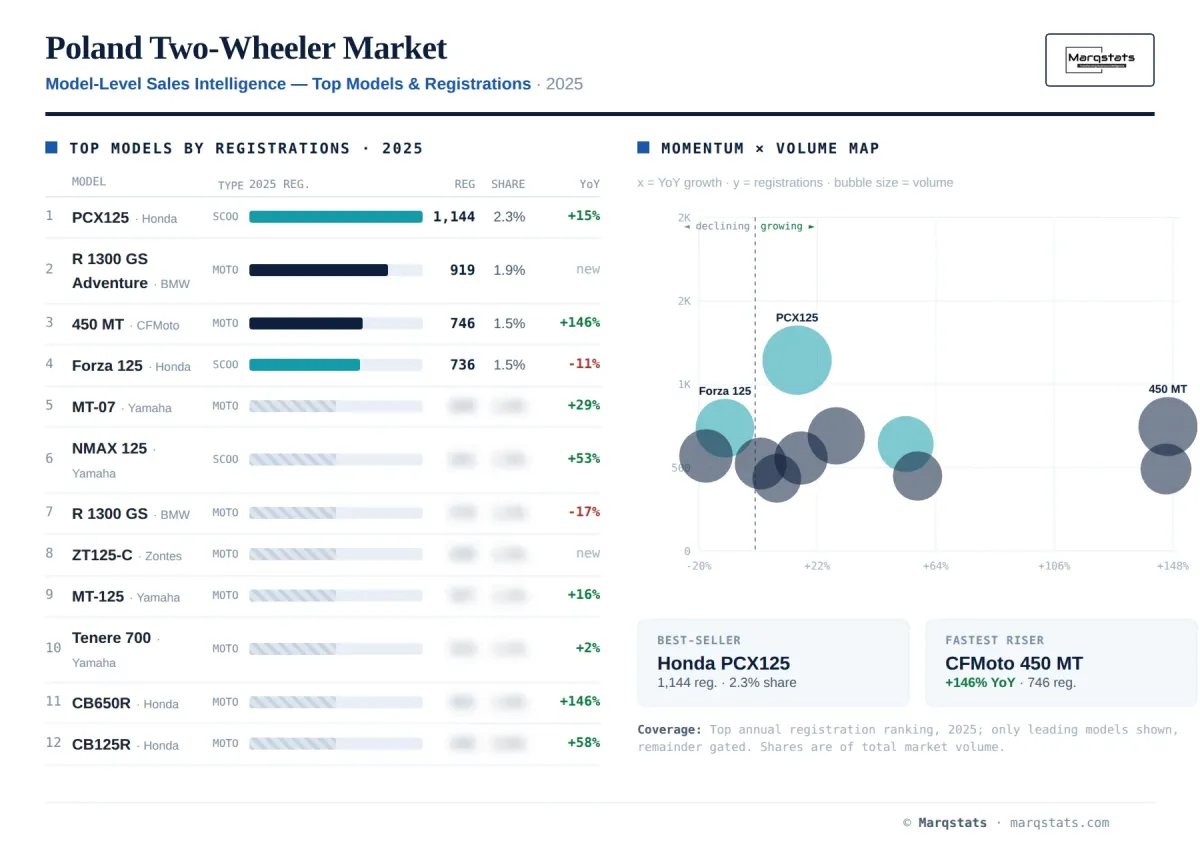
Scooters account for about 7,800 units in 2025, roughly 14% of volume, growing at a 3% CAGR. Demand centres on urban commuting in Warsaw, Kraków, and other cities, and the 125cc class accessible on a car licence forms the bulk of registrations. The Honda PCX 125 is the market's top-selling model, underlining the practicality of the class. Scooter demand has strengthened as congestion and parking pressure rise in the larger cities, drawing new riders into the market.
Mopeds account for about 14,900 units in 2025, roughly 26% of total volume, a substantially larger category than in Western European markets. The Polish marques Romet Motors and Junak dominate, together holding about 38% of moped registrations, and around 30% of new mopeds sold are electric. New-moped volumes decline gradually through the forecast as riders move toward 125cc machines. The category serves younger riders, rural utility use, and short urban trips, and its scale explains why Poland's overall two-wheeler volumes exceed those of several larger Western European economies.
Combustion models hold about 96% of the motorcycle and scooter core, growing at a modest 1% CAGR. Combustion dominates the large-displacement leisure classes that define the market, now built to the Euro 5+ standard. Electric motorcycles have attracted limited interest among Polish riders, so combustion is set to retain an overwhelming share of the motorcycle core throughout the forecast period. Range, refuelling convenience, and the touring character of Polish motorcycling all favour combustion machines in the segments that generate most of the market's value.
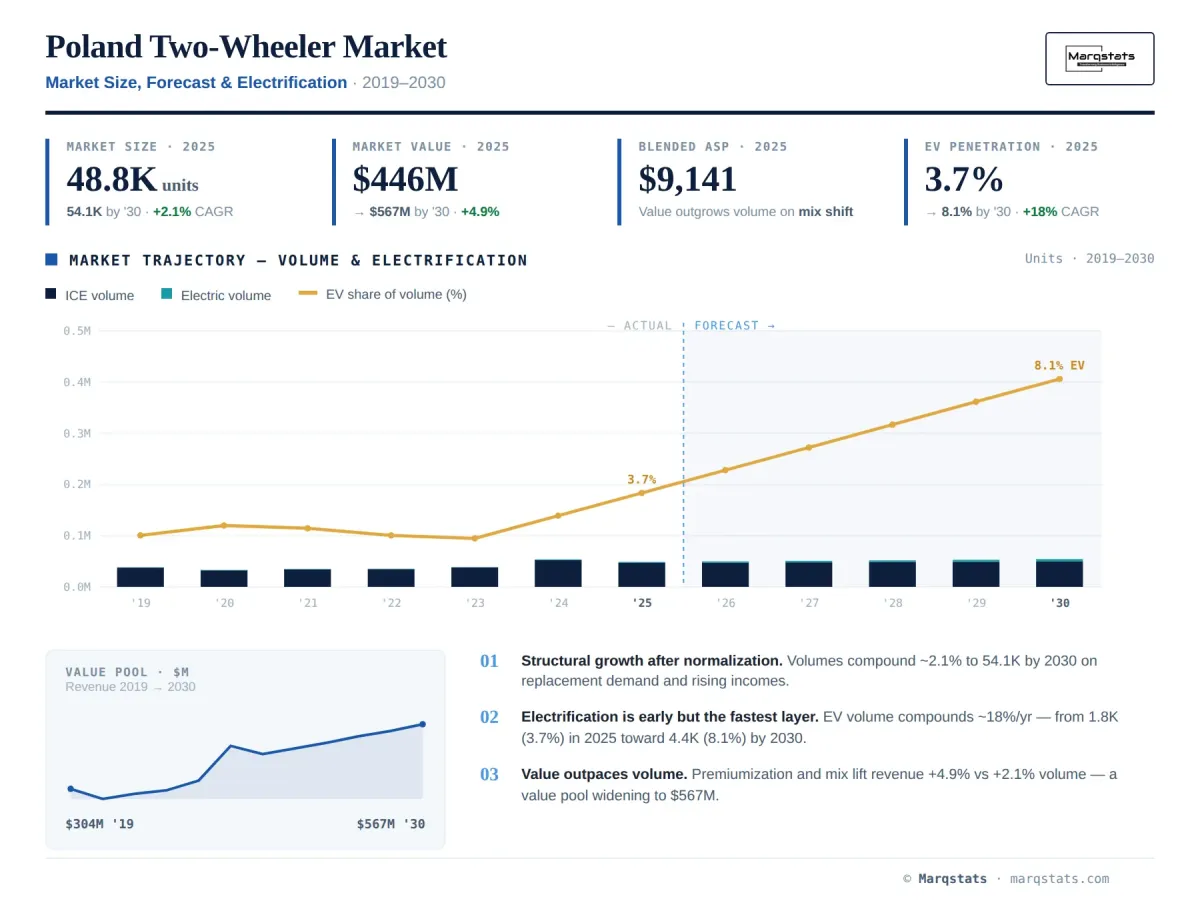
Electric two-wheelers grow fastest at a 17.93% CAGR, though adoption is concentrated in mopeds rather than motorcycles. About 30% of new mopeds registered in 2025 were electric, making the moped category the principal channel for electrification in Poland. Within electric machines, the above-5.0 kW class grows fastest, at about 23%, as higher-power models gradually enter the market. The pattern differs from Western Europe, where electric scooters lead adoption, and it reflects both the scale of the Polish moped segment and the limited appeal of electric motorcycles to a rider base focused on long-distance leisure use.
Large-displacement machines above 350cc are overwhelmingly dominant, at about 62% of the motorcycle and scooter core and roughly 46% of total volume. Adventure, touring, and road motorcycles fall here, generating the large majority of market value. This concentration is unusual outside premium Western markets and is the clearest signature of Poland's leisure-driven demand. Polish riders buy motorcycles primarily for weekend and touring use rather than daily commuting, and the strength of the adventure category, where the BMW R 1300 GS Adventure is the top-selling model, reflects a rider base that values long-distance capability and equipment over urban practicality.
The 111–125cc class is the second-largest at about 29% of the core, supported by rules allowing category-B licence holders with three years of experience to ride 125cc machines without further examinations. Sub-110cc machines and mopeds serve entry-level and utility demand, and the 125cc class grew strongly through 2025 and into 2026 as new riders entered the market.
The entry and mass band is the largest by volume within the core at about 30%, and the mid segment adds a further 25%. These bands anchor unit volumes, spanning 125cc machines, entry motorcycles, and the domestic marques' models, and they are where the rising Chinese brands compete most aggressively on price and equipment.
Premium accounts for about 27% of core volume and the high-premium performance band a further 18%, together contributing the clear majority of value. Large adventure and touring machines from BMW, Triumph, Harley-Davidson, and Ducati populate these bands, and their strength explains why market value grows more than twice as fast as unit volume through 2030. The premium concentration reflects a rider base that treats motorcycling as a leisure pursuit and invests accordingly in capable, well-equipped machines.
Private consumers account for about 91% of volume, the highest business-to-consumer share among the markets in this series. Ownership is discretionary and leisure-driven, weighted toward touring and adventure riders, weekend enthusiasts, and commuters on 125cc machines, and the private channel drove the record result of 2025. The near-absence of large commercial fleets distinguishes Poland from the delivery-heavy markets of Southern Europe, and it makes demand more sensitive to consumer confidence and disposable income than to platform-economy activity.
Commercial demand is small yet growing. Delivery and logistics accounts for about 7% of volume, supported by urban food-delivery platforms, while rental and tourism grows fastest among commercial users at about 7%. Fleet and institutional demand adds modest volumes across the forecast period.
The online channel reaches about 22% of core sales and grows fastest at an 18% CAGR. Buyers research, configure, finance, and increasingly transact online, and the channel is central to how younger and value-focused buyers compare the growing range of Chinese and domestic models.
Franchised dealerships remain central to premium sales and after-sales service, though offline volumes decline at about 7% annually as digital retail expands. Dealers retain their role in test rides, servicing, and financing for the large-displacement machines that generate most of the market's value. The channel is shifting toward a hybrid model in which buyers research and configure online before completing high-value purchases in person, and dealers with strong digital presences have adapted most successfully.
By Geography
Mazovia & Warsaw
Mazovia, centred on Warsaw, is the largest regional market, combining the capital's commuting demand with the highest incomes in the country. The region concentrates premium and large-displacement demand alongside a growing 125cc scooter segment, and it hosts the densest dealer network. Warsaw's traffic congestion has drawn more commuters to 125cc machines accessible on a car licence, while the region's affluence sustains the strongest premium and adventure demand nationally.
Silesia & Lesser Poland
Silesia and Lesser Poland, centred on Katowice and Kraków, form a major market spanning dense industrial and urban areas. Demand mixes commuting on smaller machines with strong leisure riding, supported by proximity to the Beskids and Tatra mountains that draw touring and adventure riders. The combination of large urban populations and celebrated mountain routes makes the regions a core market for both 125cc commuters and large adventure machines.
Greater Poland & Western Regions
Greater Poland, centred on Poznań, and the western regions benefit from proximity to Germany, sustaining strong leisure and touring demand and substantial cross-border used-machine imports. The regions support premium and adventure segments alongside entry-level demand.
Northern & Eastern Poland
Northern and Eastern Poland, including the Baltic coast and the Masurian lake district, sustain seasonal demand shaped by tourism and touring. Cold winters compress the riding season, though the summer months support strong leisure, rental, and touring activity across the regions' scenic routes. Seasonality is more pronounced here than anywhere else in the country, concentrating sales into the spring and summer and shaping dealer inventory and promotional cycles accordingly.
How Competition Is Evolving
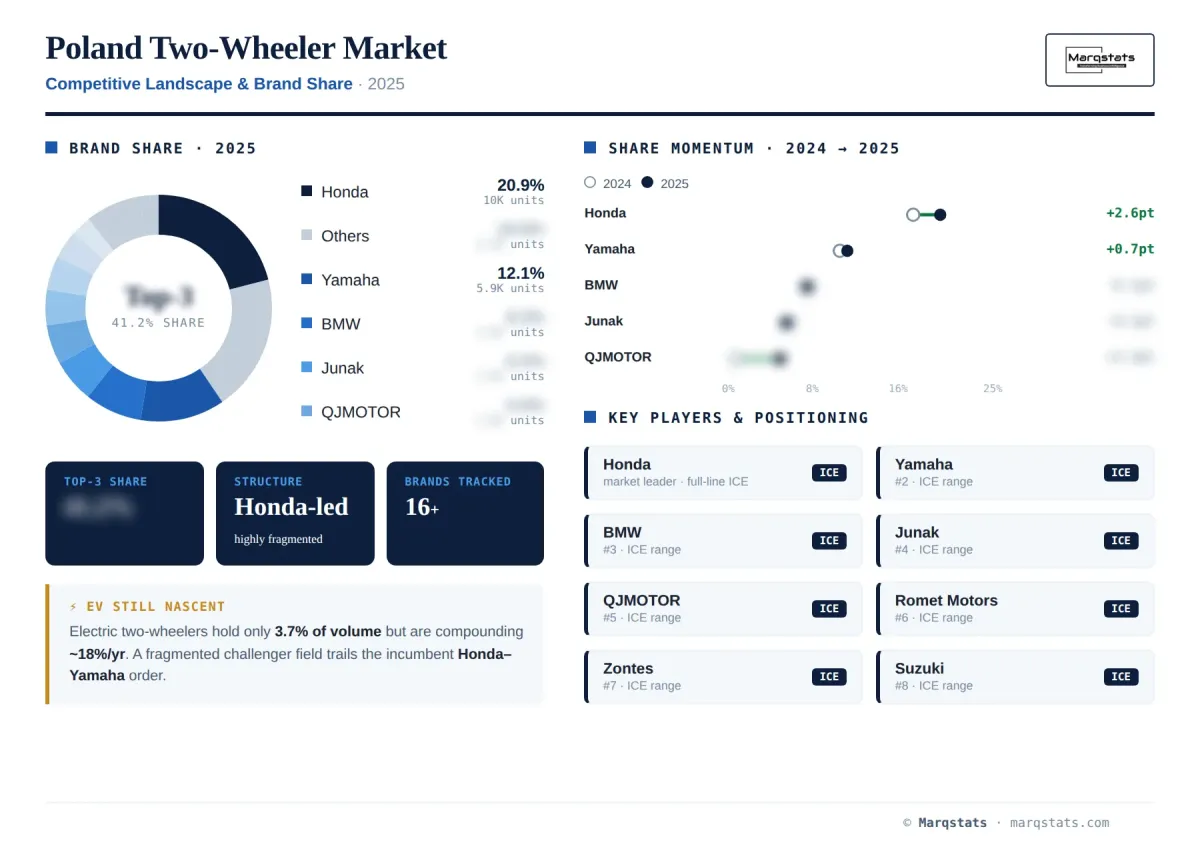
The Poland two-wheeler market is moderately fragmented. Honda leads decisively among motorcycles with 8,659 registrations in 2025, about 21% of the segment, followed by Yamaha at about 12% and BMW at about 8%. The top four brands account for under half of motorcycle registrations, leaving a broad field of Japanese, European, domestic, and Chinese marques competing across displacement and price tiers.
The competitive field shifted decisively in 2025. QJMOTOR, owned by Qianjiang Motorcycle Group and majority held by Geely Technology Group, climbed to fourth place with 2,307 registrations, up from just 529 a year earlier, an increase above 300%. Zontes and CFMoto also advanced strongly, while KTM registrations halved during its parent Pierer Mobility's financial restructuring. The domestic marques Junak and Romet Motors, whose machines are produced in China, dominate the moped category with about 38% of registrations between them, though Junak's motorcycle volumes declined through 2025.
The pace of the Chinese advance is without parallel in the European markets covered in this series. In some months QJMOTOR out-registered BMW, and by early 2026 both Zontes and QJMOTOR had climbed further up the rankings while established Japanese and European names slipped. Their machines combine competitive pricing with equipment levels that appeal to riders stepping up from the 125cc class, and the CFMoto 450 MT became the top-selling Chinese motorcycle in the country. This momentum has pressured incumbents on pricing and specification across the entry and mid tiers, and it is expected to keep reordering the brand table through the forecast period.
Competition centres on value and equipment in the entry and mid tiers, and on brand and capability in the dominant large-displacement classes. Growth is attributed to brands that combine strong adventure and touring portfolios with disciplined pricing, moreover rewarding those that navigate intensifying Chinese competition. Honda's breadth, BMW's premium strength, the domestic marques' hold on mopeds, and the rapid advance of Chinese challengers together define a market in which value and product breadth increasingly determine competitive position.
Companies Covered
The report profiles 16+ companies with full strategy and financials analysis, including:
Recent Market Activity
Table of Contents
Coverage & Segmentation
This report provides a comprehensive assessment of the Poland two-wheeler market across a 2025 base year, historical data from 2021 to 2025, and forecasts spanning 2026 to 2030. Market sizing is presented in unit-volume terms and complemented by value analysis in United States dollars, with segmentation by vehicle type, propulsion type, engine displacement and motor power, price band, end user, sales channel, and brand. Brand-level shares, segment growth rates, and competitive positioning are quantified to support commercial and investment decisions in Central Europe's largest two-wheeler market.
The scope covers demand drivers, restraints, and structural trends, with particular focus on Poland's divergence from the European correction, the dominance of large-displacement leisure machines, the substantial moped category and its domestic marques, competition from imported used machines, the surge of Chinese brands, and moped-led electrification. An extended forecast to 2035 is available under customization for subscribers requiring a longer planning horizon, alongside deeper cuts by region, brand, or channel on request.