Market Snapshot
Key Takeaways
Market Overview & Analysis
Report Summary
The France two-wheeler market comprises motorcycles, scooters, and mopeds sold for personal and commercial use across internal combustion and electric propulsion. This study segments demand by vehicle type, propulsion type, engine displacement and motor power, price band, end user, sales channel, and brand, with a 2025 base year, historical coverage from 2021 to 2025, and forecasts to 2030. France combines one of Europe's strongest urban scooter cultures with a premium trail and touring market, giving it a distinctive dual character.
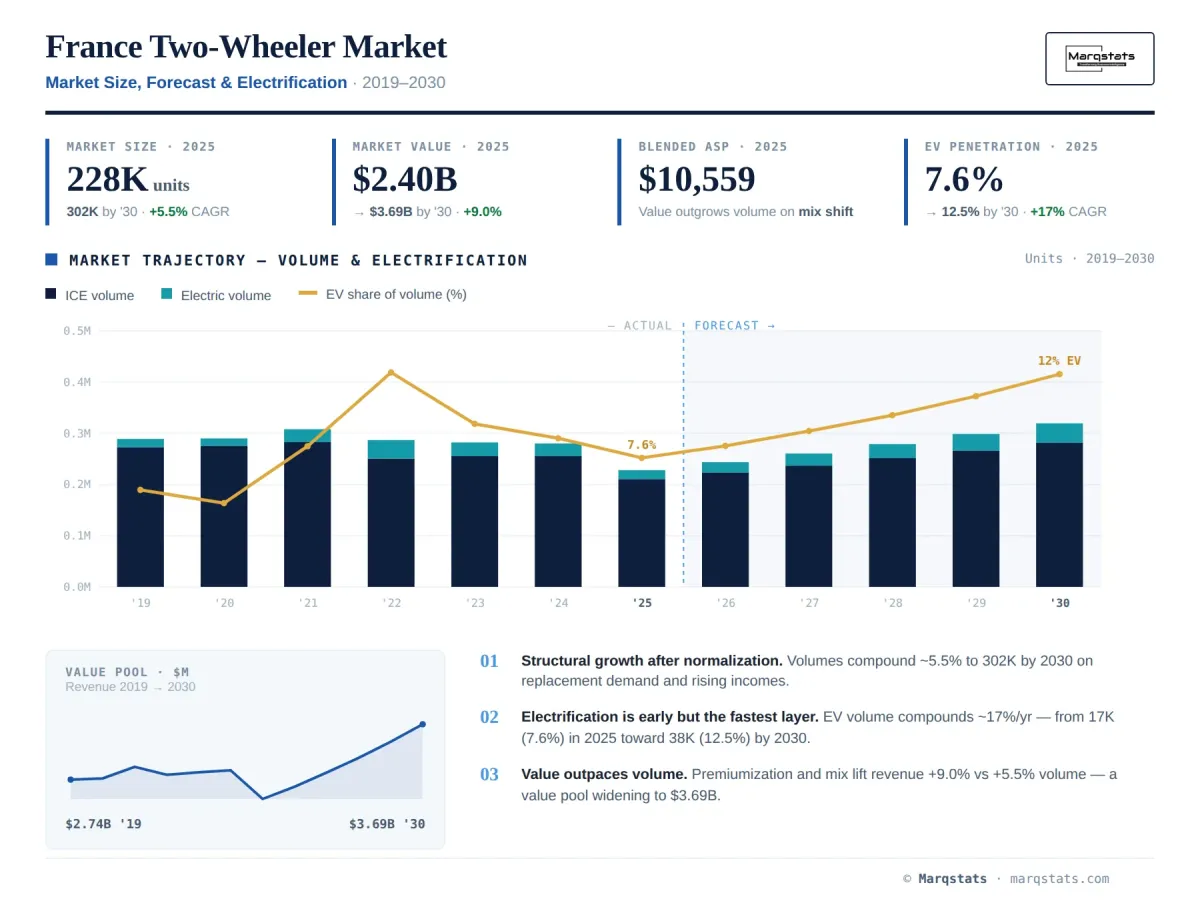
The 2025 result must be read against a distorted 2024. Ahead of the Euro 5+ emissions standard, effective January 2025, dealers and distributors registered large volumes of compliant stock late in 2024, leaving many zero-kilometre used machines in showrooms and pulling demand forward. Registrations then fell sharply in 2025 before recovering, and the European Association of Motorcycle Manufacturers recorded the same pull-forward pattern across major European markets. The forecast rebuilds from this distorted low toward steady growth to 2030.
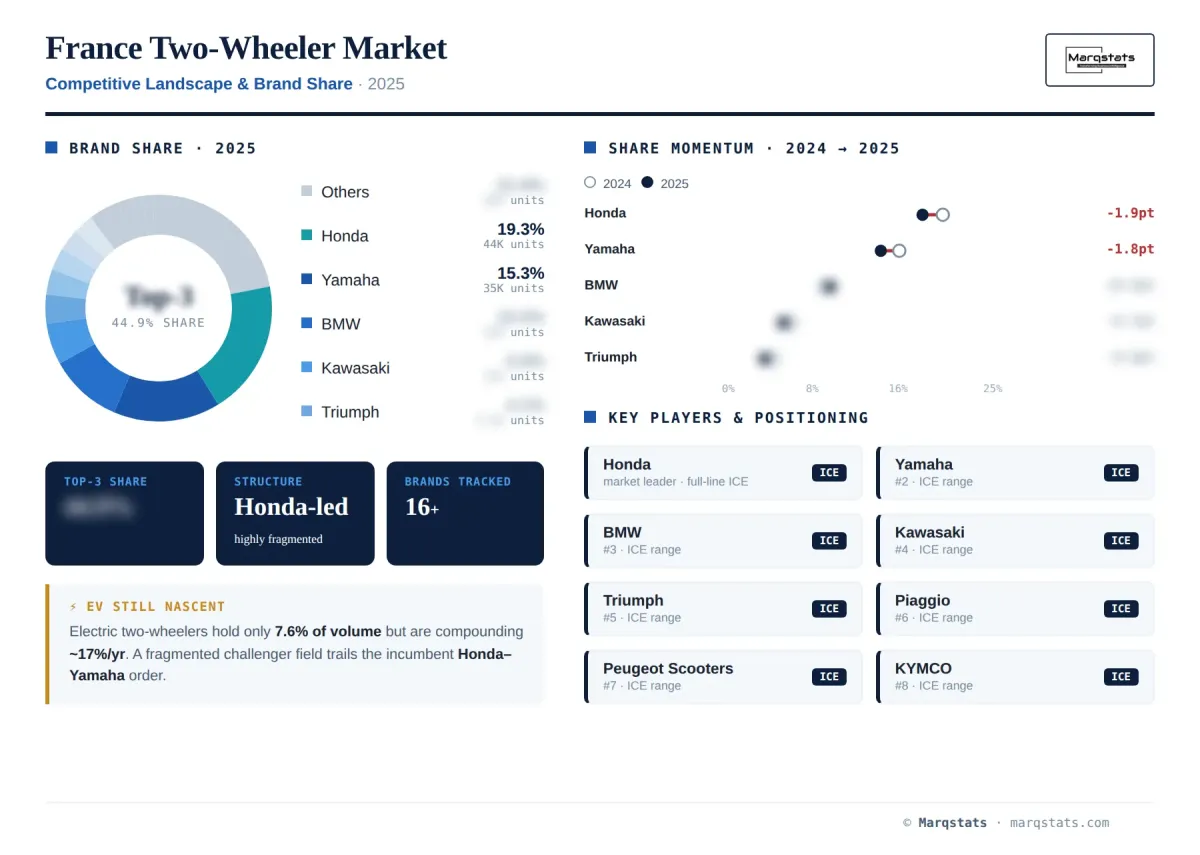
Supply is led by Honda, whose range spans the top-selling Forza 125 scooter to large trails and tourers, followed by Yamaha and BMW, the latter strong at the premium end with the R 1300 GS. Kawasaki, Triumph, Suzuki, and the French scooter marque Peugeot Motocycles compete across segments, alongside Piaggio and Vespa in scooters. KTM and Husqvarna, both part of Pierer Mobility, saw registrations fall steeply during financial restructuring, while Chinese brands such as CFMoto and Zontes have gained share rapidly. Electric two-wheelers hold a relatively high share concentrated in scooters and light machines.
The market's defining feature is its dual character. On one side sits Europe's deepest 125cc scooter culture, where car-licence holders can ride 125cc machines after a short training course, making scooters such as the Forza 125 a mainstream urban mobility solution in Paris, Lyon, and other congested cities. On the other sits a mature premium market of trails, tourers, and roadsters bought for leisure and long-distance riding. These two demand pools have different buyers, price points, and growth dynamics, and together they make France one of Europe's most balanced two-wheeler markets between everyday mobility and enthusiast leisure.
Market Dynamics
Key Drivers
- Recovery from the emissions-led correction drives growth, as demand normalises from the 2025 low toward a higher forecast base through 2030.
- The 125cc scooter culture supports volume, as car-licence holders can ride 125cc machines after seven hours of training, making scooters central to urban commuting.
- The trail and adventure segment lifts value, with versatile machines such as the BMW GS range and mid-displacement trails anchoring premium demand.
- Automatic and semi-automatic transmissions broaden appeal, as clutchless systems such as Honda DCT, Yamaha Y-AMT, and BMW ASA draw new and returning riders to larger machines.
Key Restraints
- Economic weakness and inflation weigh on demand, particularly for higher-value discretionary machines.
- Urban low-emission zones in Paris and Lyon restrict circulation and raise compliance requirements, dampening some city demand.
- Weak and volatile electric incentives slow the electric transition despite a relatively high base share.
Key Trends
- Electrification holds a relatively high share yet has been volatile, concentrated in scooters; the Thailand electric two-wheeler market offers a comparison for scooter-led electric adoption.
- Chinese brands gain share rapidly, as makers such as CFMoto and Zontes expand with value-priced models across commuter and mid segments.
- The trail segment sets records, reaching a large share of the above-125cc market as riders favour versatile machines.
- Online retail grows quickly at a 21% CAGR, complementing dealers particularly for research and accessories.
Market Segmentation
Motorcycles dominate at about 79% of 2025 volume, roughly 179,000 units, growing at a 2.93% CAGR. The category spans large trails and tourers, roadsters, and 125cc motorcycles, and it concentrates in the premium and mid displacements. Trails and adventure machines lead the above-125cc segment and generate most of the market's value, reflecting a mature enthusiast market in which buyers increasingly favour versatile, well-equipped machines over pure sport models today.
Scooters and mopeds account for about 49,000 units in 2025, roughly 21% of volume, growing fastest at a 12.62% CAGR. Demand centres on urban commuting, particularly in Paris and Lyon, where 125cc scooters accessible on a car licence are a mainstream mobility choice. The Honda Forza 125 is the market's top-selling model, and this category hosts much of the electric two-wheeler market. The scooter share is among the highest in Europe, reflecting France's distinctive urban riding culture, and the segment recovers strongly through the forecast period as commuting demand and electric models expand, making it the fastest-growing vehicle type.
Combustion models hold about 92% of 2025 volume, roughly 211,000 units, growing at a 6% CAGR from the 2025 low. Combustion remains dominant across trail, touring, roadster, and scooter classes, now built to the Euro 5+ standard, and it continues to define the premium large-displacement machines at the heart of the market. Even in a market with a relatively high electric share, combustion is set to remain dominant throughout the forecast period, particularly in the premium trail and touring segments where range and character are central to the ownership experience.
Electric two-wheelers hold about 8% of 2025 volume, roughly 17,000 units, growing at a 17.05% CAGR to reach about 38,000 units by 2030, the highest electric share among major European markets. Adoption is concentrated in scooters and light urban machines. Growth has been volatile, however, reflecting changing incentives and the absence of a coherent national strategy, so the pace depends heavily on policy support over the forecast period. The segment reached an early peak before subsidy changes and softening demand pulled it back, and its recovery will hinge on urban policy, low-emission-zone requirements, and the pricing of new electric scooter models from both established and Chinese brands.
Large-displacement machines above 350cc are the largest segment at about 44% of 2025 volume, roughly 101,000 units, growing at a 6% CAGR. Trails, tourers, and roadsters fall here, generating the large majority of market value and reflecting the strength of premium and enthusiast demand, with the trail category reaching record shares of the above-125cc market. The rise of automatic and semi-automatic transmissions, offered across large models, has broadened this segment's appeal, drawing riders who value comfort and ease of use on touring and commuting machines and reinforcing the premiumisation that lifts market value ahead of unit volumes.
The 111–125cc class is the second-largest at about 35% of volume, central to urban commuting and accessible to car-licence holders after seven hours of training. The class is anchored by scooters such as the Forza 125 and PCX, and together with the above-350cc band it gives the market its bimodal shape, with thinner demand in the middle displacements.
The mid segment is the largest price band by volume at about 34%, driven by popular scooters and mid-displacement motorcycles, while the entry and mass band adds about 26%. These bands anchor unit volumes, particularly among commuters and new riders, and include much of the 125cc market. The concentration of demand in the mid and entry tiers reflects the market's large commuter base, and it is precisely where rising Chinese brands are competing most aggressively on price and equipment.
Premium and high-premium performance bands together account for about 40% of volume and the majority of value. The high-premium and performance band, though about 16% of units, contributes a far larger share of revenue on the strength of large trails and tourers, and premium demand grows steadily as buyers favour higher-value machines financed through lease arrangements. The shift toward financing premium models rather than buying entry models outright is a defining feature of the French market's premiumisation.
Private consumers account for about 84% of 2025 volume, the core of a market weighted toward personal mobility and leisure. Ownership spans urban commuters on 125cc scooters, trail and touring enthusiasts, and returning riders, and buyers increasingly finance premium machines through lease arrangements.
Commercial demand is meaningful and led by delivery. Delivery and logistics accounts for over a tenth of volume, supported by urban food-delivery platforms, while rental and tourism grows fastest among commercial users. This delivery base, concentrated in cities, is an early adopter of electric scooters. Clean-air requirements in Paris and other cities increasingly steer this fleet demand toward electric models, and the delivery segment is expected to be a key channel for electric-scooter adoption over the forecast period.
The online channel reaches about 25% of 2025 sales and grows fastest at a 21% CAGR. Buyers research, configure, finance, and increasingly transact online, and the channel complements the dealer network, particularly for accessories, used machines, and pre-purchase research. Online platforms have also become important for comparing the growing range of value and Chinese models, and for sourcing the discounted pre-registered stock that circulated widely through 2025.
Franchised dealerships remain central to premium sales and after-sales service, though the channel's share is declining as digital retail expands. Dealers managed a difficult 2025, clearing surplus pre-registered stock that pressured margins across the network.
By Geography
Île-de-France (Greater Paris)
Île-de-France, centred on Paris, is the largest regional market, with dense urban commuting, a substantial delivery economy, and a low-emission zone that shapes demand toward scooters and cleaner machines. The region concentrates 125cc scooter, delivery, and early electric demand, and its congestion makes two-wheelers a mainstream mobility choice. Parking pressure, congestion, and the Crit'Air low-emission framework all favour compact 125cc scooters and electric models, and the capital's large food-delivery workforce sustains steady demand for commuter machines, making Île-de-France the bellwether for urban and electric trends nationally.
Auvergne-Rhône-Alpes
Auvergne-Rhône-Alpes, centred on Lyon, combines strong urban commuting with proximity to the Alps, supporting both scooters and premium trail and touring machines. Lyon's low-emission zone shapes urban demand, while the region's mountain roads sustain enthusiast riding. The dual profile of a large commuting city alongside celebrated Alpine routes makes the region a strong market for both 125cc scooters and large adventure machines, mirroring the market's national dual character.
Provence-Alpes-Côte d'Azur & the South
The Mediterranean south, including Marseille, Nice, and the Côte d'Azur, benefits from warm weather and year-round riding, supporting strong scooter and premium demand. The region is a core market for both urban mobility and leisure touring across its coastal and mountain roads. Mild winters extend the riding season well beyond that of northern regions, sustaining consistent scooter commuting in the coastal cities and drawing touring and rental demand to the roads of the hinterland and the Alpes-Maritimes.
Western & Northern France
Western and Northern France sustain steadier demand across urban centres and rural areas, with seasonality shaping usage. Cities such as Bordeaux, Nantes, and Lille support commuter and leisure demand, while the regions track the national pattern of trail and scooter strength. Cooler, wetter winters make riding more seasonal than in the south, yet the substantial urban populations sustain year-round commuter and delivery demand, and the surrounding countryside supports a committed leisure-riding community during the warmer months.
How Competition Is Evolving
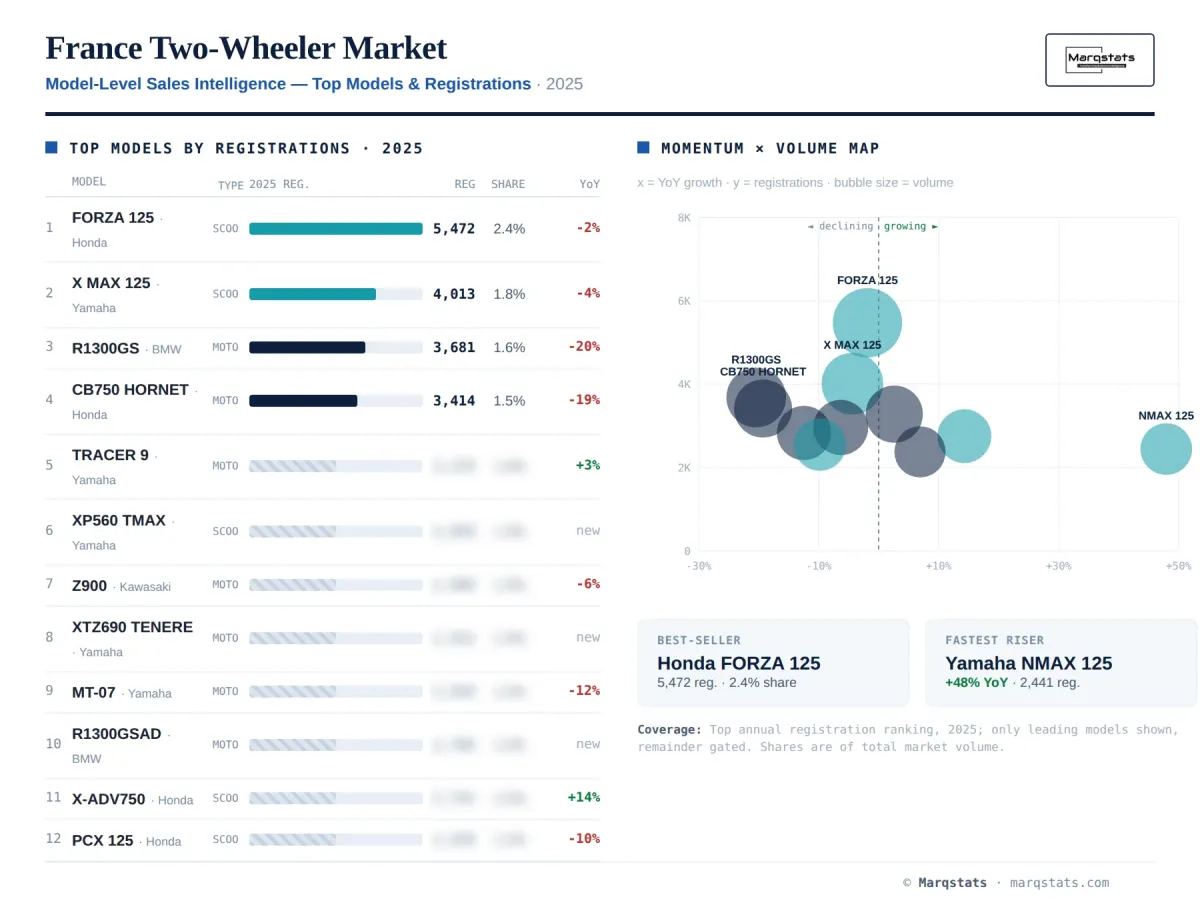
The France two-wheeler market is moderately fragmented, without a single dominant player. Honda leads across the range, from the top-selling Forza 125 scooter to large trails and tourers, and gained share through the downturn, followed by Yamaha and BMW, the latter powerful at the premium end with the R 1300 GS. Kawasaki, Triumph, and the French scooter marque Peugeot Motocycles hold established positions, and together the market's largest brands account for under half of the market.
The competitive field has shifted through the 2025 disruption. KTM and Husqvarna, both part of Pierer Mobility, saw registrations fall steeply during a financial restructuring driven by heavy debt, and KTM was overtaken by Chinese brand CFMoto. CFMoto and Zontes have expanded rapidly with value-priced models, Royal Enfield has gained on the modern-classic trend, and European marques including Piaggio, Aprilia, and Ducati compete in scooter and premium categories. Electric competition is concentrated in scooters and light machines.
The rise of Chinese brands is among the most significant recent shifts in the French market. CFMoto's sharp growth carried it past KTM in the rankings, and Zontes and QJ Motor have built momentum with well-equipped, competitively priced machines that appeal to value-conscious and new riders. This has pressured established brands to sharpen pricing and refresh model ranges, particularly in the mid-displacement and 125cc segments where the newcomers are strongest, accelerating a rebalancing of the competitive field that is likely to continue through the forecast period.
Competition centres on brand, product breadth, and value in the commuter and scooter tiers, and on brand and capability at the premium end. Growth is attributed to brands that combine strong scooter and trail portfolios with disciplined pricing, moreover rewarding those that navigate the emissions transition and rising Chinese competition. Honda's breadth, the strength of the scooter and trail segments, and the rapid rise of value and Chinese brands together define a market in which model strength and positioning increasingly determine competitive position.
Companies Covered
The report profiles 16+ companies with full strategy and financials analysis, including:
Recent Market Activity
Table of Contents
Coverage & Segmentation
This report provides a comprehensive assessment of the France two-wheeler market across a 2025 base year, historical data from 2021 to 2025, and forecasts spanning 2026 to 2030. Market sizing is presented in unit-volume terms and complemented by value analysis in United States dollars, with segmentation by vehicle type, propulsion type, engine displacement and motor power, price band, end user, sales channel, and brand. Brand-level shares, segment growth rates, and competitive positioning are quantified to support commercial and investment decisions.
The scope covers demand drivers, restraints, and structural trends, with particular focus on the 2025 emissions-led correction and recovery, the 125cc scooter culture, the trail and adventure boom, urban low-emission zones, rising Chinese competition, and the electric transition. An extended forecast to 2035 is available under customization for subscribers requiring a longer planning horizon, alongside deeper cuts by region, brand, or channel on request.