Statistics & Highlights

Market Snapshot

Market size in USD Billion
$3.10B
2025
Base year
$3.66B
2026
Estimated
  
$7.10B
2030
Forecast
Largest market
Southern Vietnam (Ho Chi Minh City)
Fastest growing
Northern Vietnam (Hanoi and Hai Phong)
Dominant segment
Battery Electric Vehicle (BEV)
Concentration
Highly Concentrated
CAGR
18.05%
2026 – 2030
GROWTH
+$4.00B
Absolute
STUDY PARAMETERS
Base year2025
Historical period2021 – 2025
Forecast period2026 – 2030
Units consideredValue (USD BN), Volume (Units)
REPORT COVERAGE
Segments covered4 segment dimensions (Propulsion, Vehicle Type, End User, Charging Infrastructure)
Regions covered4 regions
Companies profiled17++
Report pages260+
DeliverablesPDF, Excel, PPT
Executive Summary

Key Takeaways

Market valued at USD 3.10 billion in 2025, projected to reach USD 7.10 billion by 2030 at 18.05% CAGR — driven by VinFast's ecosystem dominance, 0% registration fee policy through 2027, and Vietnam's 33% xEV share of new car sales.
VinFast delivered 175,099 EVs in Vietnam in 2025 — nearly doubling 2024 volumes, securing Vietnam's top automotive brand position for 15 consecutive months, and targeting 300,000 global deliveries in 2026.
Commercial EVs are Vietnam's fastest-growing sub-segment — electric buses projected at 33.11% CAGR through 2030, with Ho Chi Minh City deploying 169 buses in March 2026 and 48.4% of its fleet already on clean energy.
V-Green charging network spans 150,000+ ports across 34 provinces — with 99 ultra-fast hubs (150 kW, 15-minute charge) planned for 2026 backed by a VND 10 trillion investment, making Vietnam's charging density the highest in ASEAN relative to market size.
Kim Long Motor's USD 130 million BYD Battery JV factory in Hue — Phase 1 at 3 GWh targeting buses, trucks, and commercial EVs positions Vietnam as a regional commercial EV battery manufacturing base with 80%+ localisation by Q2 2026.
Vietnam's EV ecosystem beyond passenger cars is maturing rapidly — Jiuzi Holdings secured agreements for 100+ electric heavy trucks, VinFast launched the first electric school bus service via GSM-VinBus, and the Limo Green MPV became Vietnam's top-selling 7-seat vehicle in August 2025.
Market Insights

Market Overview & Analysis

Report Summary

The Vietnam electric vehicle market covers all BEV, PHEV, and HEV passenger vehicles, commercial vehicles (buses, trucks, vans), and electric two-wheelers and three-wheelers across Vietnam's regional markets. The study spans the full national ecosystem from consumer retail EV sales through fleet electrification, commercial bus procurement, charging infrastructure, battery manufacturing, and the mobility-services platforms that have made Vietnam's EV market structurally distinct from every other ASEAN market.

Vietnam's EV transformation is, at its core, an OEM-ecosystem story. No other country in ASEAN has experienced the creation of a dominant domestic EV manufacturer — VinFast — within the same decade as its EV market launch. VinFast's strategy is not simply vehicle manufacturing: it encompasses charging (V-Green), ride-hailing (Green SM / GSM), bus services (VinBus), battery technology partnerships, and international expansion across Asia and North America. This vertical integration has created a self-reinforcing adoption loop: VinFast vehicles feed the V-Green charging network, which reduces range anxiety, which drives further consumer adoption, which funds further network expansion. The result is a market concentration structure seen only in China (with BYD) among major EV markets globally.

The market's growth trajectory through 2030 will be shaped by three key uncertainties. First, whether Vietnam's fiscal incentive stack — particularly the 0% registration fee and 3% special consumption tax — is extended beyond February 2027 or allowed to lapse. Independent assessments consistently identify post-incentive demand as a critical vulnerability for Vietnam's EV growth rate after 2027. Second, whether VinFast can sustain its delivery growth cadence to 300,000+ units globally while maintaining product quality and service network depth. Third, whether the bus and commercial EV segment can scale from city-specific pilots to national procurement volumes — a trajectory that, if realised, would add a structurally distinct demand stream that is less price-sensitive than consumer retail EV sales.

Market Dynamics

Key Drivers

  • Vietnam's consumer-first fiscal policy — 0% registration fee (Decree 51/2025 through February 2027) and 3% special consumption tax for BEVs — is the most direct demand accelerator in any ASEAN market, reducing total cost of ownership by 15–25% versus equivalent ICE vehicles and creating a 5-year uninterrupted policy runway that has anchored consumer confidence in EV purchases.
  • VinFast's ecosystem-scale infrastructure investment: with 150,000+ charging ports, 400 service workshops, the V-Green network's planned 99 ultra-fast hubs in 2026, free charging until 2027, and zero-down-payment schemes on mass-market models, VinFast has systematically eliminated the non-price barriers (range anxiety, service access, upfront cost) that slow EV adoption in markets without a dominant domestic OEM.
  • Government Decision 876 — mandating 100% of urban taxis on electricity or clean energy by 2030 — creates an institutional procurement mandate that is structurally separate from consumer demand. With hundreds of thousands of taxis operating in Hanoi and Ho Chi Minh City, this policy has directly spawned VinFast's Green SM ride-hailing fleet and the Limo Green / Herio Green commercial lineup, adding a non-cyclical demand base to the consumer EV market.
  • Rising fuel costs amplifying EV purchase intent: the 2026 Middle East conflict-driven oil price volatility directly strengthened Vietnamese consumers' economic rationale for EVs. VinFast launched a 'Gasoline Trade-in for Electric' campaign in March 2026, offering 3% additional discounts on EV purchases and a 10% fare reduction on Green SM ride-hailing services — demonstrating how fuel-price volatility functions as a demand accelerant in markets with a well-established EV ecosystem.
  • Commercial EV manufacturing ecosystem development: Kim Long Motor's new Hue truck manufacturing plant (March 2026, 20,000-unit annual capacity), the USD 130 million BYD Battery JV factory, and VinFast's partnership with 30 universities for EV talent development are building a commercial EV industrial base in Vietnam that extends beyond passenger cars and positions the country as a regional commercial EV production hub.

Key Restraints

  • Post-February 2027 incentive cliff risk: Vietnam's 0% registration fee and 3% SCT relief are anchored by specific legislative deadlines. If these are not extended — as happened when the temporary 50% registration fee reduction in 2021–2022 expired — demand could soften materially. Independent analyses identify this as Vietnam's single highest-impact policy risk for the 2027–2030 EV growth trajectory.
  • Market concentration and single-OEM ecosystem dependency: VinFast's approximately 95%+ share of Vietnam's BEV sales (based on VinFast's 175,099 units versus total market scale) creates systemic risk — any production disruption, quality issue, or financial stress at VinFast directly impacts Vietnam's EV market performance. The interoperability question also emerges: V-Green's charging network is primarily optimised for VinFast vehicles, limiting multi-brand charging standardisation.
  • Affordability gap restricting mass-market access: VinFast's VF 3 — at approximately USD 9,200 — remains unaffordable for large segments of Vietnam's population, particularly in rural areas and lower-income urban demographics. Despite battery-subscription schemes and zero-down-payment offers, meaningful mass-market EV penetration below the upper-middle-income tier requires either further price reduction from domestic battery manufacturing or sustained fiscal support.
  • Charging infrastructure maturity outside major cities: while the V-Green network is comprehensive in Hanoi and Ho Chi Minh City, inter-city and rural charging density remains inadequate for non-urban adoption. Vietnam's geography — a long, narrow country with urban centres separated by hundreds of kilometres — makes corridor charging deployment more challenging than in denser markets.

Key Trends

  • Commercial service EVs are becoming the fastest-scaling segment: VinFast's Q4 2025 data showed commercial models (Green lineup + EC Van) accounting for approximately 49% of total deliveries — a structural shift signalling that fleet and mobility-service demand has overtaken pure retail consumer sales as Vietnam's primary EV volume driver. This trend is validated by Jiuzi Holdings' 100+ electric heavy truck agreements, VinFast's first electric school bus (December 2025, GSM-VinBus), and Ho Chi Minh City's electric bus network expansion.
  • Battery localisation is enabling a 'Made in Vietnam' commercial EV value proposition: Kim Long Motor's GK48-EV (41.86 kWh BYD battery, VND 480 million, 305 km range), assembled in Vietnam with the battery initially imported, is moving toward 80%+ local content by Q2 2026 through the Hue battery factory. This progression mirrors Indonesia's TKDN journey but is driven by commercial EV logic (buses, trucks, vans) rather than passenger car policy mandates.
  • International EV brands entering Vietnam via asset-light models: BYD's market presence in Vietnam is growing through dealership networks rather than manufacturing, supported by VinFast's competitive pricing keeping entry barriers high for a full-scale rival production base. Jiuzi Holdings' entry specifically for electric heavy trucks represents a commercial-segment-specific market development strategy that avoids head-to-head competition with VinFast's passenger lineup.
  • Autonomous driving and AI mobility as next competitive frontier: VinFast's January 2026 partnership with Autobrains (Israel) for Level 2++ autonomous driving and a 'Robo-Car' system using seven standard cameras (no LiDAR), and the collaboration with Tensor Auto (San Jose) for Level 4 robocar commercialisation, signals that Vietnam's EV market is beginning to converge with AI mobility — a competitive positioning that could differentiate VinFast internationally as robocar demand scales post-2027.
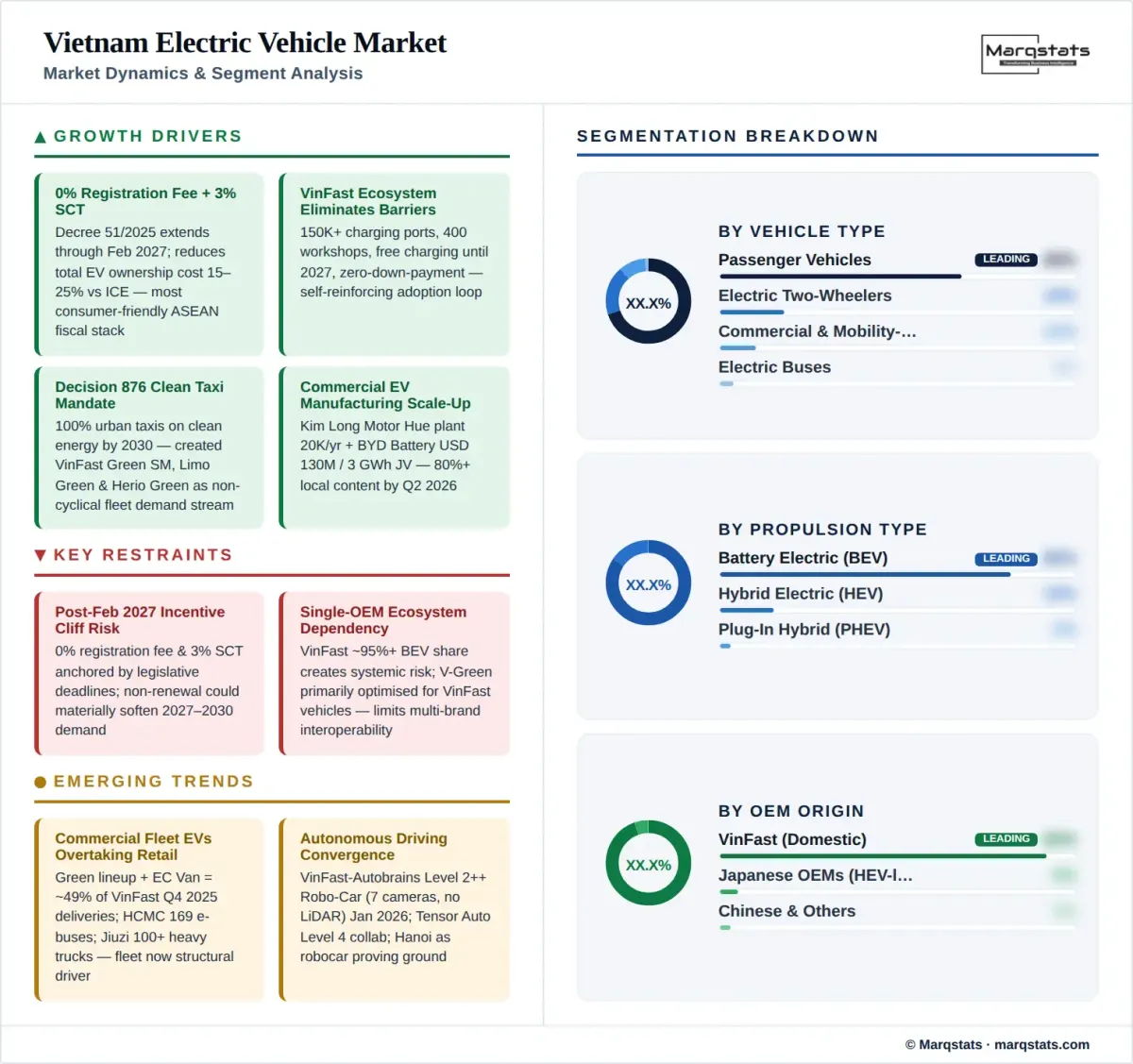
Vietnam Electric Vehicle Market Dynamics Segment Analysis Infographic
Segment Analysis

Market Segmentation

Battery Electric Vehicle (BEV)
Leading

BEVs dominate Vietnam's electrified vehicle market, with VinFast's all-BEV lineup accounting for the overwhelming majority of registered units. Vietnam's VAMA data for 2025 shows hybrid vehicles up 48% YoY in February 2026, confirming a growing secondary HEV segment, but BEVs remain the primary growth driver. VinFast's BEV dominance is supported by three consumer advantages unique to Vietnam: free charging at V-Green stations until 2027, a zero-down-payment option on popular models, and a comprehensive warranty and battery-subscription model that addresses residual-value anxiety. The BEV segment is projected to maintain its dominant share through 2030, with growth accelerating as Kim Long Motor's commercial BEV portfolio (GK48-EV van, electric buses) adds volume from institutional procurement.

Hybrid Electric Vehicle (HEV)

HEVs are a growing but secondary segment in Vietnam, supported primarily by Japanese OEMs (Toyota, Honda, Mitsubishi) whose existing dealership and service networks give them a distribution advantage in non-urban markets where BEV charging access remains limited. Toyota was the second-best-selling brand in Vietnam in February 2026 with 3,890 units (20.2% market share), and its HEV lineup (Corolla Cross HEV, Camry HEV, Yaris Cross HEV) drives a meaningful share of those volumes. VAMA data shows HEV sales up 48% YoY in February 2026. The HEV segment will remain relevant through 2030 as a transitional technology for consumers outside Vietnam's major urban corridors who are not yet served by sufficient BEV charging infrastructure.

Plug-In Hybrid Electric Vehicle (PHEV)

PHEVs are currently a minimal segment in Vietnam, with no major PHEV-specific model launch comparable to Proton's e.MAS 7 PHEV in Malaysia or BYD's SEALION 5 DM-i in Thailand having taken place in Vietnam's market by early 2026. The 3% special consumption tax applies specifically to BEVs, giving full BEVs a stronger price advantage over PHEVs than in other ASEAN markets. PHEV growth may accelerate post-2027 if the BEV-specific fiscal advantage is not renewed, as PHEVs would then become relatively more competitive for consumers with range-anxiety concerns.

Passenger Vehicles
Leading

Passenger vehicles contributed approximately 67.65% of Vietnam's EV market revenue in 2025. VinFast's consumer lineup spans the full price and segment spectrum: VF 3 (A-segment mini, VND ~200M), VF 5 (B-segment compact), VF 6 (B-SUV), VF 7 (C-SUV), VF 8 (D-SUV), VF 9 (full-size SUV), and the ultra-luxury Lac Hong line. The VF 3 and VF 5 are the volume drivers, collectively accounting for over 88,000 units in 2025. The VF MPV 7 (7-seat family MPV, VND 819 million, 450 km NEDC range) launched in January 2026, further expanding VinFast's passenger vehicle breadth. In February 2026, VinFast remained the market leader for the 17th consecutive month, delivering 9,903 EVs including 2,274 VF 3 units and 1,808 Limo Green units.

Commercial and Mobility-Service Vehicles

Commercial and mobility-service vehicles have emerged as Vietnam's fastest-growing EV sub-segment. The electric bus sector is growing at a 33.11% CAGR through 2030, with Ho Chi Minh City's 169-bus deployment on nine routes from March 2026 representing the most advanced city-scale electric bus network in mainland Southeast Asia. VinBus and Green SM are the primary commercial EV operators, with VinFast providing the vehicle supply through its Green lineup (Limo Green, Herio Green, Nerio Green, Minio Green) and EC Van. The Limo Green became Vietnam's top-selling 7-seat MPV within four months of launch, delivering 10,981 units in December 2025 alone — demonstrating the scale of mobility-service demand when a competitively priced, reliable electric platform is available. Kim Long Motor's GK48-EV (VND 480 million, 6.2 m³ cargo, 305 km range) and its newly opened Hue truck plant provide domestic manufacturing capacity for urban logistics electrification beyond the VinFast ecosystem.

Electric Two-Wheelers and Three-Wheelers

Vietnam has one of Southeast Asia's largest electric motorcycle markets, driven by its enormous two-wheeler culture (approximately 50 million motorcycles registered nationally). VinFast reported 406,498 e-scooters and e-bikes delivered globally in 2025, with Vietnam the primary market. Domestic brands including Dat Bike (Quantum model), Selex Motors, and the government-aligned Electrum consortium compete alongside VinFast. The V-Green battery-swapping network for electric motorcycles — being expanded through the April 2026 Vikki Bank partnership with plans for new battery-swapping cabinets — directly targets the range limitation that has historically constrained two-wheeler EV adoption in long-distance use cases. Vietnam's two-wheeler EV segment is structurally significant because it creates consumer familiarity with EVs at a lower price point than four-wheelers, building the familiarity and trust that supports subsequent passenger car EV purchases.

Regional Analysis

By Geography

Southern Vietnam (Ho Chi Minh City and Surrounding Provinces)

Southern Vietnam — anchored by Ho Chi Minh City, the country's largest urban economy — held approximately 45.21% of Vietnam's EV market revenue in 2025. Ho Chi Minh City is ASEAN's most advanced city-scale electric bus market, with 169 electric buses deployed on nine routes from March 1, 2026, and 48.4% of its total bus fleet already on clean energy — targeting 100% green public transport by 2030. The city's Green SM ride-hailing service, operated by VinFast's mobility platform, operates a growing fleet of Limo Green, Herio Green, and Nerio Green vehicles that have significantly raised EV visibility in the urban transport ecosystem. Southern Vietnam is also the primary logistics market for Kim Long Motor's GK48-EV van and the target market for Jiuzi Holdings' electric heavy truck agreements.

Northern Vietnam (Hanoi and Hai Phong)

Northern Vietnam is advancing at a 28.40% CAGR — the fastest in the country — driven by Hanoi's status as VinFast's operational headquarters and the location of its primary Hai Phong manufacturing complex. The Hai Phong plant produced 200,000 vehicles in 2025 (setting a single-day record of 1,062 units on December 14), operates with more than 1,200 ABB robots at up to 90% automation, and employs over 18,000 staff. VinFast's deep integration with Hanoi's transportation ecosystem — including Green SM taxi services, VinBus electric bus routes, and the company's Level 2++ autonomous driving trials in controlled areas in Hanoi — makes the capital the most EV-saturated urban environment in mainland ASEAN. The V-Green partnership with Autobrains for robocar testing is being conducted in Hanoi, positioning the city as a future autonomous EV proving ground.

Central Vietnam (Da Nang, Hue, and Surrounding Provinces)

Central Vietnam has emerged as a strategically significant commercial EV manufacturing hub through Kim Long Motor's investments. Kim Long Motor inaugurated its Hue truck manufacturing plant in March 2026 — a 10-hectare facility with 20,000-unit annual capacity, ISO 9001/14001 and IATF 16949 certification, robotic welding, and an ED electrostatic dip-coating line. The adjacent BYD Battery Factory (USD 130 million, 3 GWh Phase 1) broke ground in January 2026, with Phase 2 targeted to reach 6 GWh annually — the first dedicated commercial EV battery facility in Vietnam. Central Vietnam's lower labour costs, improving logistics connectivity, and available industrial land make it a viable long-term alternative to concentration in Hanoi-Hai Phong for EV manufacturing scale-up.

Mekong Delta and Rural Provinces

Vietnam's Mekong Delta and rural provinces represent the frontier of EV adoption, where income levels, charging infrastructure density, and dealer network coverage are all materially lower than in major urban centres. VinFast's 400 service workshops and 150,000+ charging ports provide broader rural coverage than any other OEM in ASEAN, but gaps persist in the deepest rural areas. The electric motorcycle segment is more relevant in rural Vietnam than four-wheelers, as two-wheelers are the primary transport mode and the VND 200–400 million price point of VinFast's entry electric motorcycles is more accessible than passenger EVs. Rural EV adoption will depend primarily on the post-2027 policy environment and the pricing trajectory of VinFast's entry-level models.
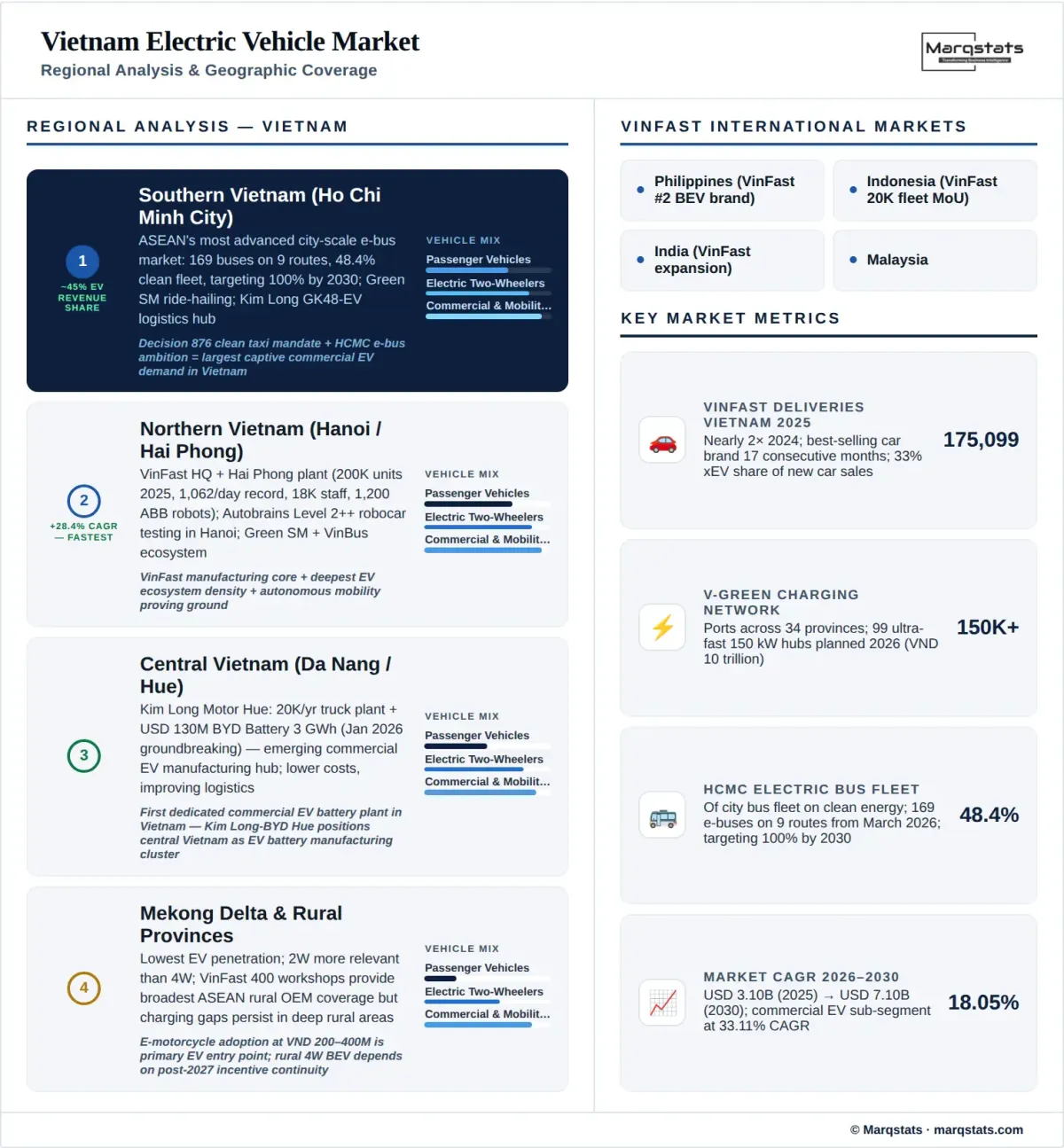
Vietnam Electric Vehicle Market Regional Analysis Infographic
Competitive Landscape

How Competition Is Evolving

Vietnam's EV competitive landscape is singular in ASEAN: a market structurally shaped by one dominant domestic OEM — VinFast — that operates as an integrated vehicle manufacturer, charging network operator, ride-hailing platform, bus fleet operator, and autonomous driving technology developer simultaneously. VinFast's approximately 95%+ share of Vietnam's BEV sales (based on its 175,099 units versus total market scale of approximately 183,000–190,000 BEVs estimated for 2025) means that Vietnam's EV market growth is, in practice, inseparable from VinFast's strategic and operational execution.

International OEMs present in Vietnam — Toyota, Hyundai, Ford, Mitsubishi, Honda, BYD, and Jiuzi — compete either in specific segments (HEVs for Japanese OEMs, commercial EVs for Jiuzi) or at the premium price tier where VinFast's volume-focused strategy leaves space. Toyota Vietnam reported 3,890 units in February 2026 (second-largest brand, 20.2% share) on the back of its HEV lineup, while Hyundai, Ford, and Mitsubishi retain their positions through ICE and hybrid vehicles. BYD's Vietnam market presence is growing through dealership networks, but its penetration remains limited relative to VinFast's ecosystem advantage. Industry analyses indicate that any new entrant seeking significant BEV market share in Vietnam must either offer a compelling price undercut versus VinFast (extremely difficult given VinFast's localisation advantage) or target commercial segments — buses, trucks, vans — where VinFast's portfolio is less dominant.

The domestic competitive ecosystem beyond VinFast includes Kim Long Motor (commercial EVs, GK48-EV van, electric trucks), Selex Motors (electric motorcycles for logistics fleets), Dat Bike (performance electric motorcycles, Quantum model), and TMT Motors (commercial vehicles). These players collectively serve niches that VinFast has not fully penetrated, creating a viable domestic supplementary market. The emergence of Jiuzi Holdings' heavy truck programme and the GSM-VinBus electric school bus joint venture signal that Vietnam's commercial EV ecosystem is maturing beyond VinFast's direct control — a healthy diversification for long-term market resilience.
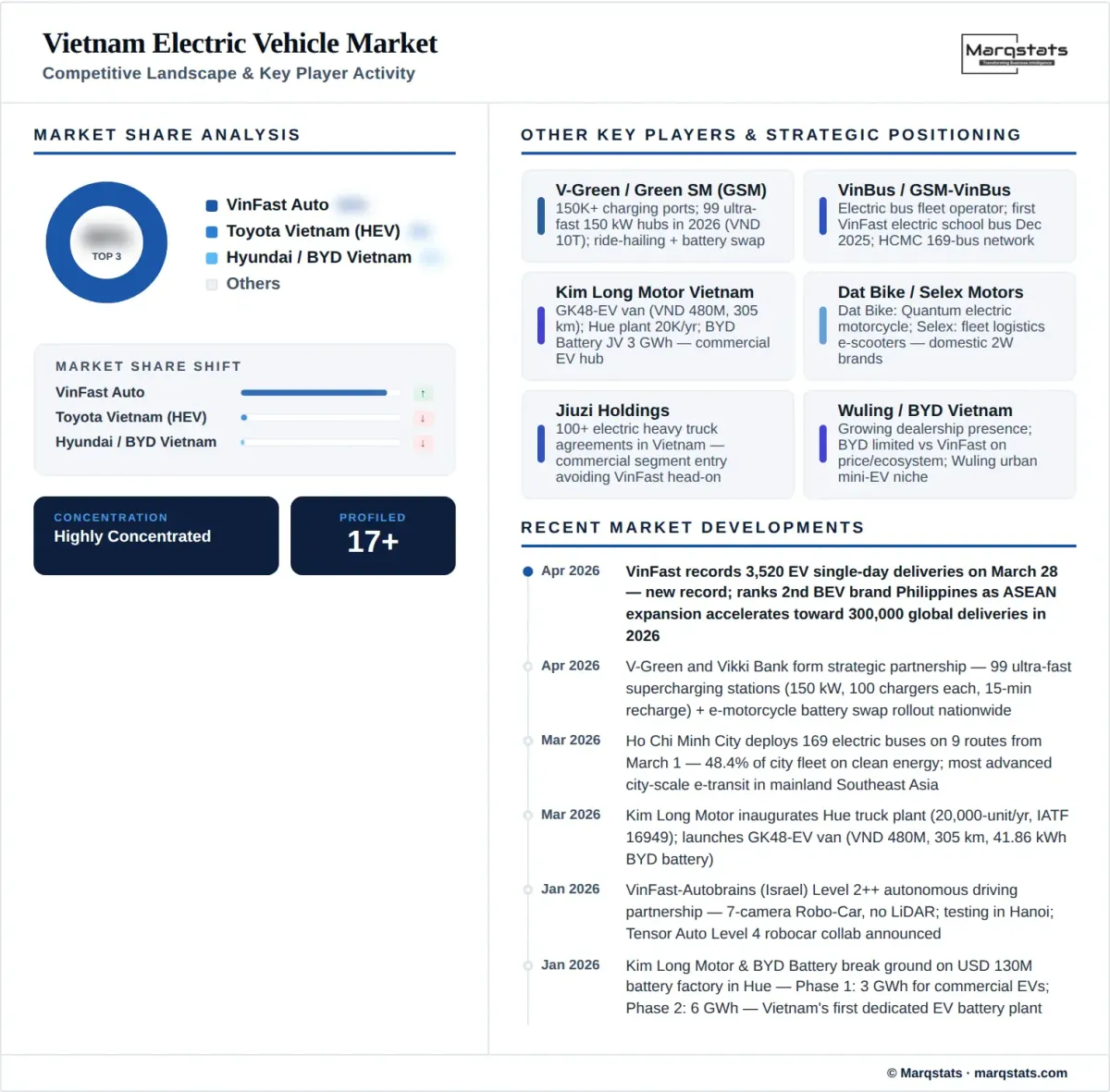
Vietnam Electric Vehicle Market Competitive Landscape Infographic
Major Players

Companies Covered

The report profiles 17++ companies with full strategy and financials analysis, including:

VinFast Auto Ltd.
V-Green Global Charging Station Development JSC
Green SM (GSM) / VinFast Mobility Services
VinBus (VinFast Electric Bus Operations)
Kim Long Motor Vietnam
Toyota Motor Vietnam Co., Ltd.
Hyundai Vietnam
Honda Vietnam Co., Ltd.
BYD Vietnam (BYD Company Limited)
Thaco Group (THACO AUTO — Kia, Peugeot, Mazda assembly)
Ford Vietnam Ltd.
Mitsubishi Motors Vietnam Co., Ltd.
Jiuzi Holdings, Inc.
Dat Bike Company Limited
Selex Motors
TMT Motors Corporation
Wuling Vietnam (SGMW Vietnam)
Note: Full company profiles include revenue analysis, product portfolio, SWOT, and recent strategic developments.
Latest Developments

Recent Market Activity

Apr 2026
VinFast reported record single-day deliveries of 3,520 EVs in Vietnam on March 28, 2026, and ranked second among BEV brands in the Philippines as of March 2026 — demonstrating simultaneous domestic dominance and accelerating international scale as the company pursues its 300,000-unit global delivery target for 2026.
Apr 2026
V-Green and Vikki Bank formed a strategic partnership to deploy EV charging stations and electric motorcycle battery-swapping cabinets across Vietnam. V-Green's 2026 plan includes 99 ultra-fast supercharging stations nationwide (each with up to 100 chargers at 150 kW), enabling 15-minute recharges, supported by Vikki Bank land and financial backing.
Mar 2026
Ho Chi Minh City deployed 169 electric buses on nine urban routes from March 1, 2026, with 48.4% of the city's total bus fleet on clean energy — establishing the most advanced city-scale electric transit network in mainland Southeast Asia and targeting 100% clean public transport by 2030.
Mar 2026
Kim Long Motor officially inaugurated its Hue truck manufacturing plant — a 10-hectare, 20,000-unit-capacity facility with ISO 9001/14001 and IATF 16949 certification — and launched the GK48-EV electric van (VND 480 million, 305 km range, 41.86 kWh BYD battery), KIMAN9 light truck, and KIMLONG X9 van.
Jan 2026
VinFast and Autobrains (Israel) partnered to develop Level 2++ autonomous driving and a Robo-Car system using seven standard cameras and Agentic AI — eliminating the need for LiDAR or HD maps — with testing underway in Hanoi and plans to expand to larger cities and global markets.
Jan 2026
Kim Long Motor broke ground on the BYD Battery Factory at the Hue plant — a USD 130 million project (Phase 1: 4.4 hectares, 3 GWh, targeting commercial EVs; Phase 2: 6 GWh total) — making it Vietnam's first dedicated commercial EV battery manufacturing facility and positioning Kim Long Motor to exceed 80% domestic content by Q2 2026.
Report Structure

Table of Contents

1. Introduction
1.1 Study Assumptions & Market Definition
1.2 Scope of the Study — Coverage and Exclusions
1.3 Executive Summary
1.4 Currency and Units — USD and VND Conventions
1.4.1 Currency Convention
1.4.2 Units and Conversion Factors
2. Research Methodology
2.1 Analysis Framework
2.2 Primary Research — Interviews and Field Studies
2.3 Secondary Research — Data Sources
2.4 Market Estimation Approach
2.4.1 Bottom-Up Model — VAMA and VinFast Investor Data
2.4.2 Top-Down Validation — ASP Benchmarks
2.4.3 Cross-Validation Against V-Green Charging Data
2.5 Assumptions and Limitations
3. Vietnam Automotive Industry Overview
3.1 Vietnam Automotive Market Structure (2021–2025)
3.1.1 Total Industry Volume — VAMA Annual Data
3.1.2 Brand Rankings — VinFast Surpasses Toyota in 2025
3.1.3 ICE vs. xEV Market Split Trajectory
3.2 Vietnam EV Sales Historical Trajectory
3.2.1 EV Registrations 2018–2025 — From 167 to 175,099 Units
3.2.2 VinFast Monthly Delivery Data — 2024 vs. 2025 Comparison
3.2.3 xEV Share of New Car Sales — 33% in 2025 (PwC eReadiness Data)
3.3 Vietnam's National EV Vision and Targets
3.3.1 Decision 876 — 100% Clean-Energy Taxis in Urban Areas by 2030
3.3.2 50% EV Penetration in Urban Areas by 2030
3.3.3 Net-Zero Emissions Target by 2050
3.4 Market Size and Forecast 2021–2030
4. Policy and Regulatory Landscape
4.1 Registration Fee Policy — 0% for BEVs Through February 2027
4.1.1 Decree 10/2022 — Original Registration Fee Waiver
4.1.2 Decree 51/2025 — Extension Through 28 February 2027
4.1.3 Post-2027 Policy Uncertainty and Impact Assessment
4.2 Special Consumption Tax (SCT) Framework
4.2.1 Law 03/2022/QH15 — 3% SCT for BEVs (≤9 Seats) Through Feb 2027
4.2.2 SCT vs. ICE Vehicle Rates — Competitive Advantage Quantified
4.2.3 PHEV and HEV SCT Treatment
4.3 Urban Taxi and Fleet Electrification Mandates
4.3.1 Decision 876 — Scope and Enforcement Mechanism
4.3.2 Impact on Green SM, VinBus, and Ride-Hailing Fleet Demand
4.4 EV Charging Equipment Safety Regulation
4.4.1 WTO TBT Notification — Draft TCVN Aligned with IEC 61851-1:2017
4.4.2 Standards Entry Into Force — June 2025
4.4.3 Implications for Multi-Brand Charging Interoperability
4.5 VinFast Ecosystem Incentives
4.5.1 Free Charging at V-Green Stations Until 2027
4.5.2 Zero-Down-Payment and 6–10% Discount Schemes
4.5.3 Battery-Subscription Model — Separating Battery Cost from Vehicle Price
5. Market Dynamics
5.1 Key Market Drivers
5.1.1 Vietnam's Consumer-First Fiscal Policy — 0% Registration Fee and 3% SCT
5.1.2 VinFast Ecosystem-Scale Infrastructure Investment
5.1.3 Decision 876 — Institutional Fleet Mandate Creating Non-Cyclical Demand
5.1.4 Rising Fuel Costs Amplifying EV Purchase Intent
5.1.5 Commercial EV Manufacturing Ecosystem Development
5.2 Key Market Restraints
5.2.1 Post-February 2027 Incentive Cliff Risk
5.2.2 Single-OEM Market Concentration and Ecosystem Dependency
5.2.3 Affordability Gap — VF 3 at USD 9,200 Still Beyond Mass Market
5.2.4 Charging Infrastructure Maturity Outside Major Cities
5.3 Key Market Trends
5.3.1 Commercial Service EVs Become Fastest-Scaling Segment
5.3.2 Battery Localisation — Made in Vietnam Commercial EV Value Chain
5.3.3 International EV Brands Entering Vietnam via Asset-Light Models
5.3.4 Autonomous Driving and AI Mobility as Next Competitive Frontier
5.4 Industry Value Chain Analysis
5.4.1 Upstream — Battery Cells and Components (BYD Battery JV in Hue)
5.4.2 Midstream — VinFast Hai Phong Manufacturing and Kim Long Motor Hue Plant
5.4.3 Downstream — V-Green Charging, Green SM Ride-Hailing, VinBus Fleet
6. Market Segmentation — By Propulsion Type
6.1 Overview and Market Share by Propulsion (2025 vs. 2030)
6.2 Battery Electric Vehicle (BEV)
6.2.1 BEV Market Size and Revenue Share
6.2.2 VinFast BEV Dominance — 175,099 Units in 2025
6.2.3 BEV Growth Trajectory — 201.7% YoY Growth in 2025
6.2.4 BEV Model Volume Breakdown — VF 3, VF 5, VF 6, VF 7, VF 8, VF 9
6.2.5 Commercial BEV — Limo Green (27,127 Units), Herio Green (12,568 Units)
6.2.6 BEV Forecast 2026–2030
6.3 Hybrid Electric Vehicle (HEV)
6.3.1 HEV Market Size and Revenue Share
6.3.2 VAMA HEV Data — 48% YoY Growth in February 2026
6.3.3 Key HEV Players — Toyota, Honda, Mitsubishi
6.3.4 HEV Forecast 2026–2030
6.4 Plug-In Hybrid Electric Vehicle (PHEV)
6.4.1 PHEV Market Size and Current Stage
6.4.2 PHEV Competitive Landscape — International Entrants
6.4.3 PHEV Forecast 2026–2030
6.5 Fuel Cell Electric Vehicle (FCEV) — Outlook
7. Market Segmentation — By Vehicle Type
7.1 Overview and Market Share by Vehicle Type (2025 vs. 2030)
7.2 Passenger Vehicles
7.2.1 Segment Revenue Share — 67.65% of Market in 2025
7.2.2 VF 3 (A-Segment, ~VND 200M) — 44,585 Units in 2025
7.2.3 VF 5 (B-Segment Compact) — 43,913 Units in 2025
7.2.4 VF 6 (B-SUV) — 23,291 Units in 2025
7.2.5 VF 7 (C-SUV) — 9,653 Units in 2025
7.2.6 VF 8, VF 9, and Lac Hong Ultra-Luxury Lineup
7.2.7 VF MPV 7 — 7-Seat Family EV, Launched January 2026
7.3 Commercial and Mobility-Service Vehicles
7.3.1 Segment Growth Rate — Electric Buses at 33.11% CAGR Through 2030
7.3.2 Electric Buses — Ho Chi Minh City 169-Bus Deployment (March 2026)
7.3.3 Limo Green — 7-Seat Fleet MPV, 27,127 Units (2025), Best-Seller in Dec
7.3.4 Herio Green and Nerio Green — Ride-Hailing and Taxi Optimised Models
7.3.5 EC Van and Minio Green — Urban Cargo and Last-Mile Delivery
7.3.6 Kim Long Motor GK48-EV — Electric Van (VND 480M, 305 km, BYD Battery)
7.3.7 Electric School Bus — GSM-VinBus Launch (December 2025)
7.3.8 Electric Heavy Trucks — Jiuzi Holdings 100+ Truck Agreements in Vietnam
7.4 Electric Two-Wheelers and Three-Wheelers
7.4.1 VinFast Electric Motorcycles — 406,498 Units Globally in 2025
7.4.2 V-Green Battery Swap Network for Electric Motorcycles
7.4.3 Dat Bike — Quantum Performance Electric Motorcycle
7.4.4 Selex Motors — Fleet-Oriented Electric Motorcycle for Logistics
7.4.5 Three-Wheeler Segment — Nascent Stage Overview
8. Market Segmentation — By End User
8.1 Overview and Market Share by End User (2025 vs. 2030)
8.2 Personal and Household
8.2.1 Retail BEV Buyer Profile — Urban Upper-Middle Income Concentration
8.2.2 VinFast Consumer Incentives — Zero Down, Free Charging, Battery Subscription
8.2.3 EV Ownership Sentiment — 79% Willing to Buy (PwC eReadiness ASEAN 2025)
8.3 Commercial Fleets and Mobility Services
8.3.1 Green SM (GSM) Ride-Hailing — VinFast Mobility Platform
8.3.2 Logistics and Last-Mile Delivery — Kim Long GK48-EV and EC Van
8.3.3 Corporate and Enterprise Fleet Electrification
8.4 Public Transport and Government
8.4.1 Decision 876 — 100% Clean-Energy Taxis in Urban Areas by 2030
8.4.2 VinBus Electric Bus Operations — Route Coverage and Fleet Size
8.4.3 Ho Chi Minh City Public Bus Programme — 169 Buses, 9 Routes (March 2026)
8.4.4 Hanoi Public Bus Electrification Plans
9. Market Segmentation — By Charging Infrastructure
9.1 Overview — V-Green Network Scale and 2026 Expansion Plan
9.1.1 V-Green — 150,000+ Charging Ports Across 34 Provinces
9.1.2 V-Green 2026 Plan — 99 Ultra-Fast Hubs (up to 100 × 150 kW chargers each)
9.1.3 VND 10 Trillion Investment in Ultra-Fast Charging Infrastructure
9.1.4 V-Green x Vikki Bank Partnership — April 2026
9.2 AC Slow / Level 2 Charging
9.2.1 Installed Base and Market Size
9.2.2 Residential vs. Public AC Charging
9.3 DC Fast Charging
9.3.1 Market Size and Growth Trajectory
9.3.2 Ultra-Fast Charging (150 kW) — 15-Minute Recharge Capability
9.3.3 Corridor Charging — North-South Highway Coverage
9.4 Battery Swapping Networks
9.4.1 Electric Motorcycle Battery Swap — V-Green Cabinet Network
9.4.2 V-Green x Vikki Bank Expansion Plan
10. Regional Analysis
10.1 Southern Vietnam
10.1.1 Ho Chi Minh City — 45.21% of National EV Revenue (2025)
10.1.2 Electric Bus Network — 169 Buses on 9 Routes from March 2026
10.1.3 Green SM Ride-Hailing Fleet Deployment in HCMC
10.1.4 Logistics EV Demand — Kim Long GK48-EV and Jiuzi Truck Agreements
10.1.5 Key OEM Showrooms and V-Green Charging Hubs
10.2 Northern Vietnam
10.2.1 Hanoi — VinFast Operational HQ and Primary Consumer EV Market
10.2.2 Hai Phong — VinFast Manufacturing Complex (200,000 Units in 2025)
10.2.3 VinFast Hai Phong — Production Records, ABB Robots, 90% Automation
10.2.4 Robocar and Autonomous Driving Trials — Hanoi Testing Areas
10.2.5 Northern Vietnam CAGR — 28.40%, Fastest Region in Country
10.3 Central Vietnam
10.3.1 Da Nang — Emerging Consumer EV Market
10.3.2 Hue — Kim Long Motor Truck Plant (March 2026, 20,000 Units/Year)
10.3.3 Hue BYD Battery Factory — USD 130M, Phase 1: 3 GWh
10.3.4 Central Vietnam as Commercial EV Manufacturing Hub
10.4 Mekong Delta and Rural Provinces
10.4.1 EV Market Overview — Lower Penetration, Two-Wheeler Focus
10.4.2 V-Green Rural Charging Expansion Strategy
10.4.3 Electric Motorcycle Adoption as Gateway to Four-Wheeler EVs
11. VinFast Ecosystem Deep Dive
11.1 VinFast Auto Ltd. — Company Overview and Market Position
11.1.1 Vietnam Market Leadership — 34.4% Share of Total Automotive Market
11.1.2 15 Consecutive Months as Vietnam's Best-Selling Brand
11.1.3 Global Deliveries — 196,919 Units in 2025, 300,000 Target for 2026
11.2 VinFast Passenger Vehicle Portfolio
11.2.1 VF 3 (A-Segment) — 44,585 Units, Best-Selling EV in Vietnam 2025
11.2.2 VF 5 (B-Segment Compact) — 43,913 Units
11.2.3 VF 6 (B-SUV) — 23,291 Units
11.2.4 VF 7 (C-SUV) — 9,653 Units
11.2.5 VF 8 (D-SUV), VF 9 (Full-Size SUV), and Lac Hong Ultra-Luxury
11.2.6 VF MPV 7 — Launched January 2026 (VND 819M, 450 km NEDC)
11.3 VinFast Commercial and Mobility-Service Portfolio
11.3.1 Limo Green (7-Seat Fleet MPV) — 27,127 Units in 2025
11.3.2 Herio Green (Ride-Hailing Optimised) — 12,568 Units
11.3.3 Nerio Green (C-SUV for Fleet) and Minio Green
11.3.4 EC Van — Urban Cargo and Delivery
11.3.5 Electric School Bus — GSM-VinBus Launch, December 2025
11.4 V-Green Charging Infrastructure
11.4.1 Network Scale — 150,000+ Ports Across 34 Provinces
11.4.2 400 VinFast Service Workshops Nationwide
11.4.3 2026 Expansion — 99 Ultra-Fast Supercharging Stations
11.4.4 V-Green x Vikki Bank Partnership
11.5 VinFast Technology and Autonomous Driving
11.5.1 VinFast x Autobrains — Level 2++ ADAS and Robo-Car System
11.5.2 VinFast x Tensor Auto — Level 4 Robocar Commercialisation
11.5.3 Hanoi Testing Phase and Global Expansion Plans
12. Competitive Landscape
12.1 Market Concentration — VinFast's Dominant Position
12.1.1 VinFast BEV Share vs. Total Market
12.1.2 Japanese OEM Position — HEV Stronghold Outside BEV Segment
12.1.3 International BEV Entrant Strategies — BYD, Jiuzi, Others
12.2 Company Profiles
12.2.1 VinFast Auto Ltd.
12.2.1.1 Company Overview and Group Structure (Vingroup)
12.2.1.2 Vietnam Market Position — 175,099 Deliveries, 34.4% Share
12.2.1.3 Global Expansion — Indonesia, Philippines, India, US
12.2.1.4 Full Product Portfolio — Passenger, Commercial, Two-Wheeler
12.2.1.5 Recent Strategic Developments
12.2.2 V-Green Global Charging Station Development JSC
12.2.2.1 Company Overview — VinFast Charging Subsidiary
12.2.2.2 Network — 150,000+ Ports, 34 Provinces
12.2.2.3 2026 Ultra-Fast Hub Rollout — 99 Stations, VND 10 Trillion
12.2.2.4 Vikki Bank Partnership and Battery Swap Expansion
12.2.2.5 Recent Strategic Developments
12.2.3 Green SM (GSM) / VinFast Mobility Services
12.2.3.1 Company Overview — VinFast's Ride-Hailing and Taxi Platform
12.2.3.2 Vietnam Fleet Operations — Limo Green, Herio Green Deployment
12.2.3.3 Indonesia Operations — Green SM Launched via VinFast Indonesia
12.2.3.4 Electric School Bus Service — GSM x VinBus (Dec 2025)
12.2.3.5 Recent Strategic Developments
12.2.4 Kim Long Motor Vietnam
12.2.4.1 Company Overview
12.2.4.2 Hue Truck Manufacturing Plant — 20,000 Units/Year (March 2026)
12.2.4.3 BYD Battery JV — USD 130M Factory, Phase 1: 3 GWh
12.2.4.4 Commercial EV Portfolio — GK48-EV, KIMAN9, KIMLONG X9
12.2.4.5 Recent Strategic Developments
12.2.5 Toyota Motor Vietnam Co., Ltd.
12.2.5.1 Company Overview — Vietnam's Second-Largest Auto Brand
12.2.5.2 HEV Portfolio — Corolla Cross, Camry, Yaris Cross HEV
12.2.5.3 EV Transition Plans in Vietnam
12.2.5.4 Recent Strategic Developments
12.2.6 Hyundai Vietnam
12.2.6.1 Company Overview
12.2.6.2 EV and HEV Portfolio in Vietnam
12.2.6.3 Market Position and Recent Performance
12.2.6.4 Recent Strategic Developments
12.2.7 Honda Vietnam Co., Ltd.
12.2.7.1 Company Overview
12.2.7.2 HEV and Hybrid Portfolio in Vietnam
12.2.7.3 Electric Two-Wheeler Presence
12.2.7.4 Recent Strategic Developments
12.2.8 BYD Vietnam (BYD Company Limited)
12.2.8.1 Company Overview
12.2.8.2 Vietnam Market Entry via Dealership Network
12.2.8.3 Product Portfolio and Pricing in Vietnam
12.2.8.4 Recent Strategic Developments
12.2.9 Thaco Group (THACO AUTO)
12.2.9.1 Company Overview — Kia, Peugeot, Mazda Distributor
12.2.9.2 Electrification Plans and xEV Portfolio
12.2.9.3 Recent Strategic Developments
12.2.10 Ford Vietnam Ltd.
12.2.10.1 Company Overview
12.2.10.2 Electrification Strategy in Vietnam
12.2.10.3 Recent Strategic Developments
12.2.11 Mitsubishi Motors Vietnam Co., Ltd.
12.2.11.1 Company Overview
12.2.11.2 PHEV Portfolio — Outlander PHEV in Vietnam
12.2.11.3 Recent Strategic Developments
12.2.12 Jiuzi Holdings, Inc.
12.2.12.1 Company Overview (NASDAQ: JZXN)
12.2.12.2 Vietnam Entry — Agreements for 100+ Electric Heavy Trucks
12.2.12.3 ASEAN Expansion Plans — Indonesia, Thailand, Malaysia
12.2.12.4 Recent Strategic Developments
12.2.13 Dat Bike Company Limited
12.2.13.1 Company Overview — Vietnam's Performance EV Motorcycle Brand
12.2.13.2 Quantum Model — Specifications and Market Positioning
12.2.13.3 Recent Strategic Developments
12.2.14 Selex Motors
12.2.14.1 Company Overview — Fleet-Oriented Electric Motorcycle Brand
12.2.14.2 Logistics Fleet Focus — Last-Mile Delivery Electrification
12.2.14.3 Recent Strategic Developments
12.2.15 TMT Motors Corporation
12.2.15.1 Company Overview — Commercial Vehicle Manufacturer
12.2.15.2 EV Commercial Portfolio in Vietnam
12.2.15.3 Recent Strategic Developments
12.2.16 VinBus (VinFast Electric Bus Operations)
12.2.16.1 Company Overview — VinFast Electric Public Bus Operator
12.2.16.2 Route Coverage — Hanoi and Ho Chi Minh City
12.2.16.3 Electric School Bus Service (GSM x VinBus, Dec 2025)
12.2.16.4 Recent Strategic Developments
12.2.17 Wuling Vietnam (SGMW Vietnam)
12.2.17.1 Company Overview
12.2.17.2 Vietnam Market Entry and Product Portfolio
12.2.17.3 Recent Strategic Developments
12.3 Strategic Developments, Partnerships, and M&A Activity
13. Appendix
13.1 Research Methodology
13.2 Glossary of Key Terms
13.3 List of Tables
13.4 List of Figures
13.5 Disclaimer and Legal Notice
Study Scope & Focus

Coverage & Segmentation

This report provides a comprehensive analysis of the Vietnam electric vehicle market covering the 2021–2030 study period, with 2025 as the base year, historical data from 2021 to 2025, and a forward-looking forecast from 2026 to 2030. The study encompasses all major EV powertrain categories — battery electric vehicles (BEVs), plug-in hybrid electric vehicles (PHEVs), and hybrid electric vehicles (HEVs) — across passenger vehicles, commercial vehicles (buses, trucks, vans), and electric two-wheelers and three-wheelers. Geographic coverage includes Southern Vietnam (Ho Chi Minh City), Northern Vietnam (Hanoi, Hai Phong), Central Vietnam (Da Nang, Hue), and the Mekong Delta and rural provinces. Special analytical coverage is devoted to Vietnam's unique EV ecosystem model — encompassing VinFast's vehicle portfolio, V-Green's charging network, Green SM's ride-hailing fleet, VinBus's bus services, and the emerging commercial EV manufacturing cluster in central Vietnam.

Competitive intelligence covers 17 companies spanning vehicle OEMs, charging operators, commercial EV manufacturers, and two-wheeler specialists. Policy analysis is centred on Decree 51/2025 (0% registration fee extension), the 3% special consumption tax framework, Decision 876 (clean taxi mandate), Vietnam's WTO-notified charging equipment safety regulation aligned with IEC 61851-1:2017, and the broader fiscal incentive landscape through 2027 and beyond. Primary research for this report includes 40+ interviews with automotive industry executives, fleet operators, Ministry of Transport officials, VinFast ecosystem partners, and charging infrastructure operators across Vietnam's major markets.
Frequently Asked Questions

FAQs About the Vietnam Electric Vehicle Market

The Vietnam electric vehicle market was valued at approximately USD 3.10 billion in 2025 and is projected to reach USD 7.10 billion by 2030, growing at a CAGR of 18.05% during the 2026–2030 forecast period. Vietnam's xEV share of new car sales reached 33% in 2025, the second highest in ASEAN after Singapore.
VinFast delivered 175,099 electric vehicles domestically in Vietnam in 2025 — nearly doubling its 2024 total — making it Vietnam's best-selling automotive brand for 15 consecutive months with a 34.4% share of the total vehicle market. December 2025 was the highest monthly sales volume ever recorded by any automaker in Vietnam, at 27,649 units.
Vietnam's key EV policies include a 0% vehicle registration fee for BEVs extended through February 2027 (Decree 51/2025), a 3% special consumption tax for BEVs with nine or fewer seats (through Feb 2027), and Decision 876 mandating 100% of urban taxis to run on electricity or clean energy by 2030. V-Green also offers free charging at its network until 2027 for VinFast vehicle purchasers.
Northern Vietnam — anchored by Hanoi and Hai Phong — is the fastest-growing region at a 28.40% CAGR. Hai Phong hosts VinFast's primary manufacturing complex, which produced 200,000 vehicles in 2025 with 90% automation. Southern Vietnam (Ho Chi Minh City) holds the largest current share at approximately 45.21% of national EV revenue.
Key players include VinFast Auto Ltd., V-Green Global Charging Station Development JSC, Green SM (GSM/VinFast Mobility), VinBus, Kim Long Motor Vietnam, Toyota Motor Vietnam, Hyundai Vietnam, Honda Vietnam, BYD Vietnam, Thaco Group, Ford Vietnam, Mitsubishi Motors Vietnam, Jiuzi Holdings, Dat Bike, Selex Motors, TMT Motors Corporation, and Wuling Vietnam.
Yes. Marqstats offers customization including provincial-level analysis, VinFast ecosystem deep-dives, commercial EV segment modelling, and post-2027 incentive scenario analysis. Contact sales@marqstats.com for Single User, Team, and Enterprise tier options.
The report is delivered as a PDF (260+ pages) with full market analysis, Excel data tables including VinFast monthly delivery data and VAMA market statistics, and a PowerPoint executive summary deck. All formats are included in every licence tier.