Market Snapshot
Key Takeaways
Market Overview & Analysis
Report Summary
Malaysia's plug-in hybrid segment barely existed in 2025 and is the fastest-growing powertrain in the country by 2030. An estimated 3,400 units were sold in the base year, almost all of them the Jaecoo J7. Within the first seven months of 2026 a single new model had delivered 4,946 units on its own, which is more than the entire prior-year segment, and had taken more than 11,000 bookings.
The measure is the retail value of new plug-in hybrid passenger vehicles sold in Malaysia, covering sport utility vehicles and multi-purpose vehicles with externally rechargeable batteries, whether locally assembled or imported, together with the local powertrain and assembly activity supporting them. Full hybrids, mild hybrids and battery electric vehicles are excluded and are separate panels in this catalogue. Range-extended models are included where the manufacturer positions them in this segment.
The analysis is written for manufacturers deciding whether a plug-in hybrid at mass-market money cannibalises their own battery electric range, distributors modelling a segment whose volume is running four times ahead of its 2025 base, component suppliers whose plug-in hybrid content awards sit inside larger electrified programmes, and policymakers assessing a powertrain that uses charging infrastructure without depending on it.
Malaysia Plug-in Hybrid Electric Vehicle Market Size and Forecast
Plug-in hybrid retail value is estimated at USD 141.67 million in 2025, USD 470.00 million in 2026 and USD 1,380.00 million by 2030, an increase of USD 1,238.33 million against 38,600 additional units. Volume moves from 3,400 to 42,000 plug-in hybrids, with average transaction value falling from MYR 175,000 to MYR 138,000, or USD 41,667 to USD 32,857 at a constant MYR 4.20 per USD.
Two growth rates apply and the second is far lower. The five-year value rate connecting 2025 and 2030 is 57.66%; the four-year rate connecting 2026 and 2030 is 30.90%. The 26.76-point gap is the widest in this catalogue and it exists because 2026 is not a trend year at all: volume rises an estimated 311.76% to 14,000 units and value an estimated 231.76% in a single year as the e.MAS 7 plug-in hybrid reaches market.
Value compounds 7.67 points behind volume at 57.66% against 65.33%, and the mechanism is price rather than discounting. The 2025 mix was the Jaecoo J7 plus premium European models; the 2030 mix centres on a MYR 109,800 national-brand model. Both rates are high enough that quoting either alone is misleading, and the four-year rates of 30.90% on value and 31.61% on volume are the more useful pair for anyone planning from 2026 rather than from 2025.
The unit base reconciles to the published national electrified series. Battery electric and plug-in hybrid together accounted for 30,848 units in 2025, and the plug-in hybrid share of that is set by the Jaecoo J7 at more than 3,000 units with a small premium European remainder. All four Malaysian powertrain panels in this catalogue carry one 2025 base of 689,735 internal combustion, 38,515 hybrid, 27,448 battery electric and 3,400 plug-in hybrid, summing to the 759,098 passenger cars sold.
A sizing range is published rather than a point. The 2030 figure sits within a band of USD 1,050.00 million to USD 1,760.00 million against 34,000 to 52,000 units, corresponding to rates of 49.11% and 65.55%, and the spread turns on whether the announced 2027 assembly programmes launch on schedule.
One Model at One Price Created This Segment
The Proton e.MAS 7 plug-in hybrid launched in February 2026 from MYR 109,800 with 18.4 kWh and 29.8 kWh lithium iron phosphate battery options delivering 83 km and 146 km of electric range on a combined 193 kW and 262 Nm. It took more than 6,500 bookings by late April and more than 11,000 by 8 July.
Its monthly trajectory is the segment's trajectory. Deliveries ran 646 units in March, its first full month, then 1,013 in April, 1,181 in May and 1,138 in June, with 616 domestic registrations in August, and Proton reported it as the country's best-selling plug-in hybrid from April onward. Across January to July 2026 it delivered 4,946 units.
The number that matters most is the comparison inside Proton's own range. The e.MAS 7 plug-in hybrid delivered 4,946 units against 3,666 for the e.MAS 7 battery electric over the same seven months, within combined e.MAS deliveries of 21,808 led by the e.MAS 5 battery electric at 13,196. Offered the same vehicle in two powertrains at comparable money, Malaysian buyers chose the plug-in hybrid by 34.92%.
A Plug-in Hybrid That Costs the Same as a Hybrid
Malaysia's mass-market hybrids arrived in 2026 at MYR 103,900 for the locally assembled Toyota Vios Hybrid and MYR 109,900 for the Yaris Cross hybrid. The e.MAS 7 plug-in hybrid sits at MYR 109,800, MYR 100 below the Yaris Cross hybrid, while offering 83 km to 146 km of electric-only range that no hybrid provides.
Price parity of that kind between the two powertrains is not the normal relationship anywhere, and it exists here because a national manufacturer with local assembly, local battery pack work and local dedicated hybrid transmission production set the price rather than an importer. Proton began local production of dedicated hybrid transmissions and electric drive units at Tanjung Malim in August 2026, the first manufacturer in Malaysia to build both components locally, and they go into this model.
The rest of the segment sits well above it. The Omoda C9 plug-in hybrid launched in March 2026 at MYR 208,800 with a 34.46 kWh pack, 145 km of electric range and 537 PS; the Great Wall Motor WEY G9 launched in January at MYR 269,800 with a 44.2 kWh pack, 170 km of range and 442 PS; and the Zeekr 9X opened bookings from MYR 800,000 at up to 1,030 kW with 1,250 km of combined range. The price spread across the segment is more than seven to one.
Chinese Brands Are Building Plug-in Hybrids in Malaysia and Exporting Them
Omoda and Jaecoo Malaysia delivered more than 2,300 new energy vehicles in the first half of 2026 against 244 a year earlier, within more than 8,100 total deliveries year to date to July that placed it fifth among brands and more than 32,000 cumulative units since 2024. The Jaecoo J7 plug-in hybrid contributed more than 3,000 units in 2025 inside a brand total of 17,849.
The assembly footprint is already in place and already exporting. The Jaecoo J7 and the Omoda C9 are assembled at Shah Alam, with the Omoda C7 plug-in hybrid confirmed for a fourth-quarter 2026 launch from the same plant. The Great Wall Motor WEY G9 is assembled at EP Manufacturing's Pegoh plant at 40.05% localisation against a target of 5,000 units a year in Malaysia and 5,000 for export, and it is exported to Thailand. The Jaecoo J7 plug-in hybrid is exported to Brunei.
Two more programmes are committed for the window. Great Wall Motor confirmed the Haval H7 Hi4 plug-in hybrid for completely knocked down production at Pegoh with an early 2027 launch, at 370 PS and 750 Nm on 150 km of electric range and more than 1,000 km combined. The XPeng X9 range-extended model is slated for completely knocked down production in Melaka. Both fall inside the published sizing band rather than the point estimate, because neither has launched.
The Policy Position Favours This Powertrain Twice
Locally assembled electrified vehicles keep import duty, excise and sales tax exemptions until 31 December 2027, and every significant plug-in hybrid in Malaysia is locally assembled. The segment therefore captures the benefit almost in full, where the fully imported premium models that dominate parts of the battery electric market do not.
The second advantage is the mirror image of the first. From 1 July 2026 fully imported electric vehicles require a minimum CIF value of MYR 200,000 and motor output of at least 180 kW under franchise approved permit rules, which removes affordable imported battery electric supply from the market. A locally assembled plug-in hybrid at MYR 109,800 faces no such threshold and inherits the demand that the import rule displaces.
The expiry is the risk the segment carries into the second half of the window. No replacement scheme has been published for the exemptions ending on 31 December 2027, and a segment whose volume centre sits at MYR 109,800 is more exposed to a tax change than one whose models sit above MYR 200,000.
Market Dynamics
Key Drivers
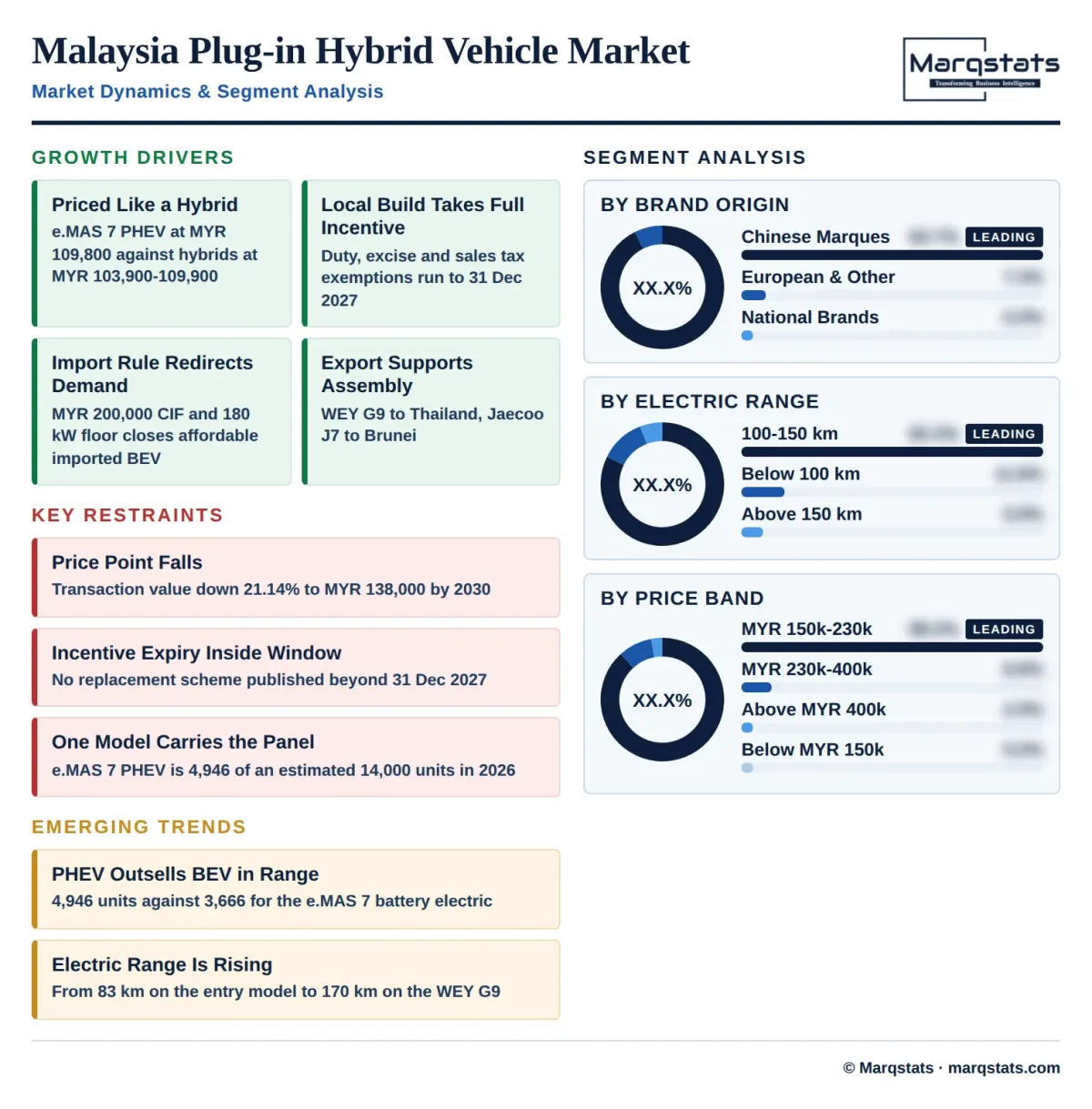
- Price parity with hybrids is the primary driver, with the e.MAS 7 plug-in hybrid at MYR 109,800 against mass-market hybrids at MYR 103,900 to 109,900 while offering 83 km to 146 km of electric range.
- Local assembly captures the full incentive, with import duty, excise and sales tax exemptions running to 31 December 2027 and every significant plug-in hybrid in Malaysia assembled domestically.
- The fully imported electric vehicle rule from 1 July 2026, setting a MYR 200,000 minimum CIF value and 180 kW minimum motor output, displaces affordable imported battery electric supply toward this segment.
- Powertrain localisation is deepening, with Proton building dedicated hybrid transmissions and electric drive units at Tanjung Malim from August 2026 and its new energy vehicle plant expanded to 42,000 units a year on MYR 37 million.
- Export demand supports assembly volume beyond the domestic market, with the WEY G9 exported to Thailand against a 5,000-unit annual target and the Jaecoo J7 plug-in hybrid exported to Brunei.
Key Restraints
- Average transaction value falls 21.14% from MYR 175,000 to MYR 138,000, so segment revenue compounds 7.67 points slower than its unit volume across the window.
- The incentive supporting the segment's price position expires on 31 December 2027, inside the forecast window, with no published replacement scheme.
- Local content in the volume model is low at 30% for the e.MAS 7 plug-in hybrid, which leaves its cost base exposed to imported component pricing and currency movement.
- The segment depends heavily on one model, with the e.MAS 7 plug-in hybrid at 4,946 of an estimated 14,000 units in 2026, so a single programme's performance moves the whole panel.
Key Trends
- Plug-in hybrids are outselling battery electric equivalents within the same range, with the e.MAS 7 plug-in hybrid at 4,946 units against 3,666 for the e.MAS 7 battery electric across January to July 2026.
- Malaysia is becoming a plug-in hybrid export base, with the WEY G9 shipped to Thailand and the Jaecoo J7 plug-in hybrid to Brunei from domestic assembly lines.
- Contract assembly is the Chinese route in, with the WEY G9 at 40.05% localisation and the Haval H7 Hi4 both assigned to EP Manufacturing's Pegoh plant rather than to plants of their own.
- Electric range is rising across the segment, from 83 km on the entry e.MAS 7 to 145 km on the Omoda C9, 150 km on the Haval H7 Hi4 and 170 km on the WEY G9.
Market Segmentation
National brands accounted for 0 plug-in hybrid units in 2025 and reach an estimated 24,000 units or 57.14% of the segment by 2030, the largest group. The entire position is the Proton e.MAS 7 plug-in hybrid, which launched in February 2026 from MYR 109,800 and delivered 4,946 units across its first seven months.
Chinese marques accounted for an estimated 3,150 plug-in hybrid units in 2025, 92.65% of the segment, led by the Jaecoo J7 at more than 3,000 units. The group reaches an estimated 15,500 units or 36.90% by 2030, holding strong absolute growth while ceding leadership as national supply arrives.
European and other marques accounted for an estimated 250 plug-in hybrid units in 2025, 7.35% of the segment, and reach an estimated 2,500 units or 5.95% by 2030. The group carries the highest transaction values in the segment and the least volume, and its position is defined by premium sport utility and executive models rather than by any volume nameplate.
The mass-market band accounted for 0 units in 2025 and reaches an estimated 26,500 units or 63.10% of the segment by 2030. It was created in February 2026 by the Proton e.MAS 7 plug-in hybrid at MYR 109,800, which sits MYR 100 below the Toyota Yaris Cross hybrid at MYR 109,900.
The mid-range band accounted for an estimated 3,000 units in 2025, 88.24% of the segment, anchored on the Jaecoo J7 plug-in hybrid, and reaches an estimated 9,500 units or 22.62% by 2030. The Omoda C9 plug-in hybrid at MYR 208,800 with 145 km of electric range and 537 PS sits at the band's upper edge.
The premium band accounted for an estimated 300 units in 2025, 8.82% of the segment, and reaches an estimated 5,000 units or 11.90% by 2030. The Great Wall Motor WEY G9 at MYR 269,800 with a 44.2 kWh pack, 170 km of electric range and 442 PS is the band's volume nameplate.
The luxury band accounted for an estimated 100 units in 2025, 2.94% of the segment and the smallest band, reaching an estimated 1,000 units or 2.38% by 2030. The Zeekr 9X from MYR 800,000, at up to 1,030 kW and 1,250 km of combined range, defines the band's ceiling.
Sport utility vehicles and crossovers accounted for an estimated 3,150 units in 2025, 92.65% of the segment, and reach an estimated 37,000 units or 88.10% by 2030. The e.MAS 7, Jaecoo J7, Omoda C9, Omoda C7 and Haval H7 Hi4 are all in this body type, and it dominates the segment throughout.
Multi-purpose vehicles accounted for an estimated 250 units in 2025, 7.35% of the segment, reaching an estimated 5,000 units or 11.90% by 2030. The Great Wall Motor WEY G9 at MYR 269,800 and the Zeekr 9X from MYR 800,000 are the body type's established models, with the GAC M8 adding to the offer.
Locally assembled plug-in hybrids accounted for an estimated 3,050 units in 2025, 89.71% of the segment, the highest local share of any Malaysian powertrain, and reach an estimated 40,000 units or 95.24% by 2030. Tanjung Malim, Shah Alam and EP Manufacturing's Pegoh plant carry the capacity, with Melaka added when the XPeng X9 range-extended programme starts.
Fully imported plug-in hybrids accounted for an estimated 350 units in 2025, 10.29% of the segment, and reach an estimated 2,000 units or 4.76% by 2030. The channel is confined to premium and luxury models and to launch allocations, as with the initial 50 fully imported Omoda C9 units delivered ahead of Shah Alam assembly.
Models offering below 100 km of electric range accounted for an estimated 400 units in 2025, 11.76% of the segment, and reach an estimated 12,000 units or 28.57% by 2030. The entry Proton e.MAS 7 plug-in hybrid with its 18.4 kWh pack and 83 km of range is the band's volume model.
Models offering 100 km to 150 km accounted for an estimated 2,800 units in 2025, 82.35% of the segment, and reach an estimated 24,000 units or 57.14% by 2030. The higher e.MAS 7 variant at 29.8 kWh and 146 km, the Omoda C9 at 145 km and the Haval H7 Hi4 at 150 km sit here.
Models offering above 150 km accounted for an estimated 200 units in 2025, 5.88% of the segment, and reach an estimated 6,000 units or 14.29% by 2030. The Great Wall Motor WEY G9 at 170 km on a 44.2 kWh nickel manganese cobalt pack is the established model, with the Zeekr 9X at 1,250 km combined range at the segment's technical ceiling.
By Geography
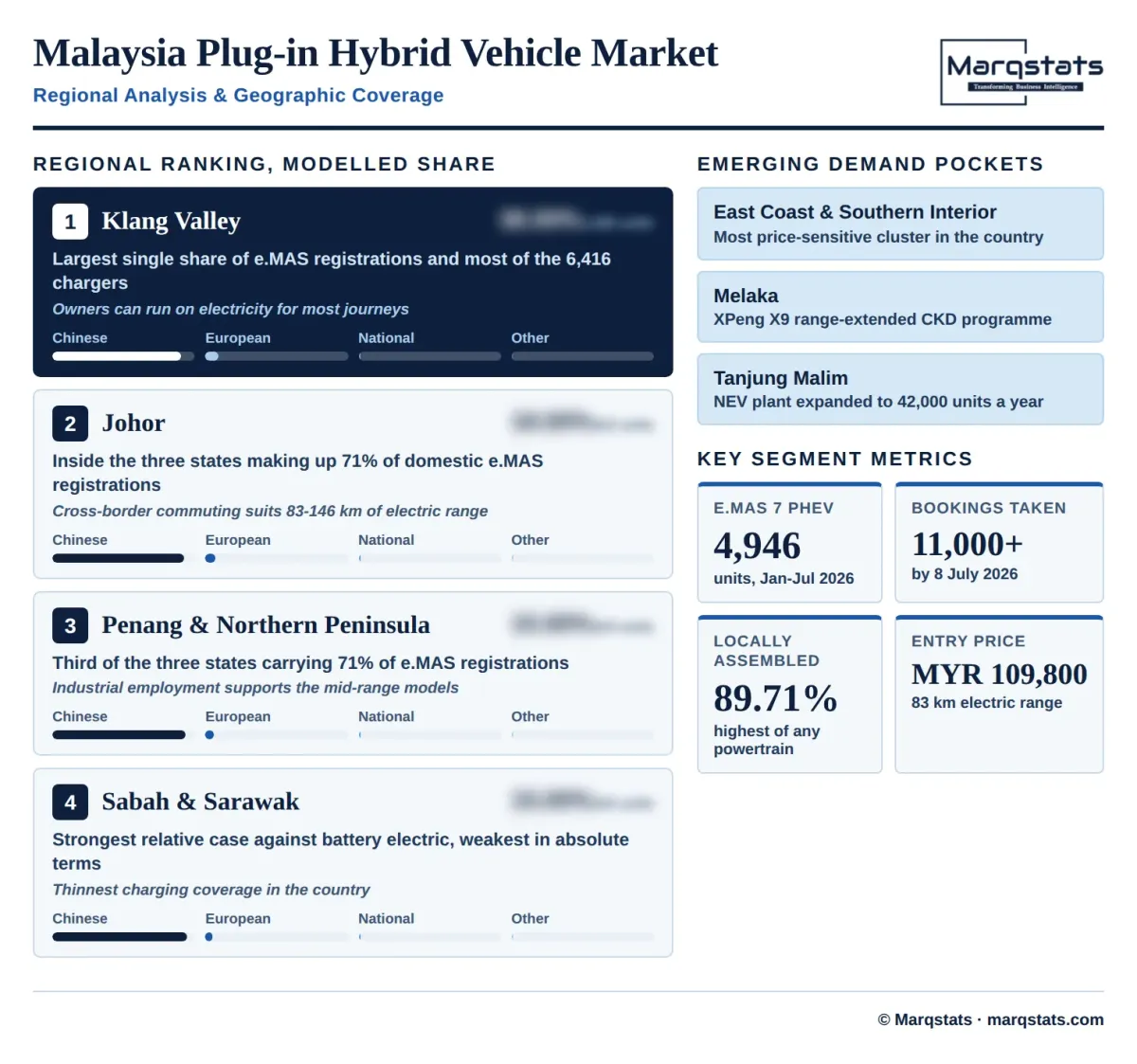
Klang Valley
Selangor accounts for the largest single share of Proton e.MAS registrations, and together with Johor and Penang made up 71% of domestic e.MAS registrations in August 2026. The Klang Valley carries most of the country's 6,416 public chargers, of which 2,143 are direct current, and a plug-in hybrid owner there can realistically run on electricity for most journeys.
Johor
Johor sits inside the three states accounting for 71% of domestic e.MAS registrations and is the fastest-growing region for the segment. Cross-border commuting patterns suit a powertrain with 83 km to 146 km of electric range and no range anxiety on longer trips, and the state's charging density is second only to the Klang Valley.
Penang and the Northern Peninsula
Penang is the third of the three states making up 71% of domestic e.MAS registrations. The northern corridor's industrial employment base supports the segment's mid-range models, and Proton's Tanjung Malim powertrain hub at up to 240,000 engines a year sits within the wider region.
Sabah and Sarawak
East Malaysia is where the plug-in hybrid case is strongest relative to battery electric and weakest in absolute terms. Charging coverage within the national total of 6,416 public chargers is thinnest there, which suppresses battery electric adoption, and a plug-in hybrid removes that constraint entirely while still requiring a charger to deliver its 83 km to 146 km of electric range economically.
East Coast and Southern Interior
Pahang, Terengganu, Kelantan, Negeri Sembilan and Melaka form the segment's smallest regional cluster. The region is the most price-sensitive in the country, which makes the MYR 109,800 entry point decisive, and Melaka gains assembly capacity when the XPeng X9 range-extended programme begins completely knocked down production.
How Competition Is Evolving
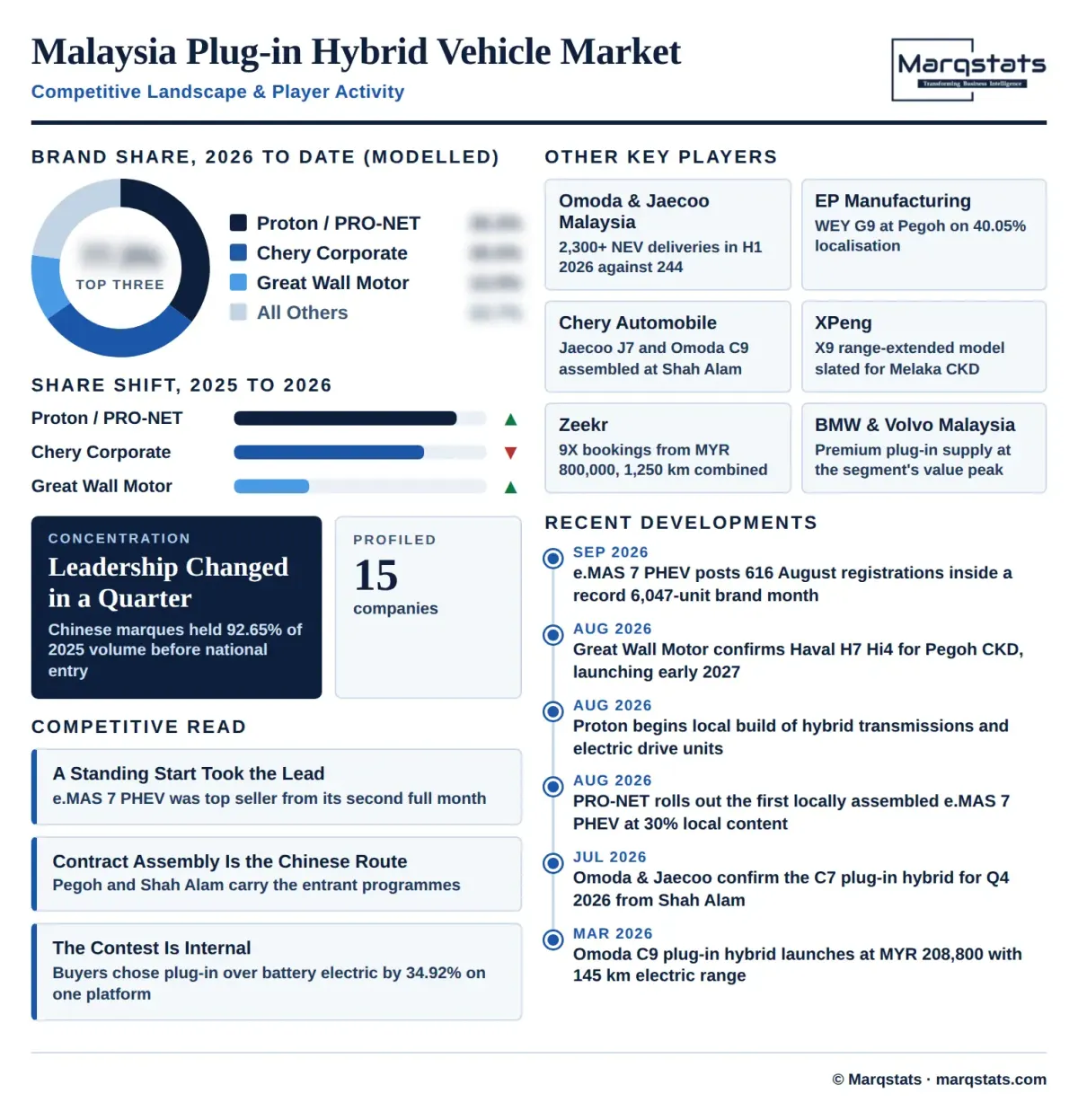
Malaysia's plug-in hybrid segment changed leadership in a single quarter. Chinese marques held an estimated 92.65% of 2025 volume, almost entirely the Jaecoo J7 at more than 3,000 units within a brand total of 17,849, and Omoda and Jaecoo Malaysia grew new energy vehicle deliveries from 244 units in the first half of 2025 to more than 2,300 in the first half of 2026.
Proton took the lead from a standing start. The e.MAS 7 plug-in hybrid launched in February 2026, reached 1,013 units in April, its second full month, and was reported as the country's best-selling plug-in hybrid from that point, running at roughly 1,000 to 1,200 units a month through May and June. National brands move from zero units in 2025 to an estimated 57.14% of the segment by 2030 on that single programme.
The competitive question the segment now poses is internal rather than external. The e.MAS 7 plug-in hybrid outsold the e.MAS 7 battery electric by 34.92% across January to July 2026 on the same platform at comparable money, which suggests that in a market with 6,416 public chargers the plug-in hybrid is the product customers actually want. Every manufacturer with both powertrains in the Malaysian market now faces that arithmetic, and the Chinese entrants arriving through Pegoh and Shah Alam have answered it by bringing plug-in hybrids rather than battery electric models.
Companies Covered
The report profiles 15+ companies with full strategy and financials analysis, including:
Recent Market Activity
Table of Contents
Coverage & Segmentation
The analysis measures the retail value of new plug-in hybrid passenger vehicles sold in Malaysia from 2021 to 2030, with 2025 as the base year and 2026 to 2030 as the forecast period, covering sport utility vehicles and multi-purpose vehicles with externally rechargeable batteries, locally assembled and fully imported supply, and the local powertrain and assembly activity supporting the segment. Range-extended models are included where the manufacturer positions them here. Full hybrids, mild hybrids and battery electric vehicles are excluded and are separate panels in this catalogue. Values are expressed in USD at a disclosed constant MYR 4.20 per USD.
Coverage spans three brand origin groups, four price bands, two body types, two assembly origins and three electric range bands, with five regional clusters analysed on registration concentration and charging density. Plug-in hybrid unit volume is carried as the unit series at 3,400 in 2025 and average transaction value as a derived series at MYR 175,000, and both are published alongside the value panel because a segment whose volume is multiplying while its price point falls cannot be represented by either alone. Fifteen entities are profiled across manufacturers with plug-in hybrid supply in market, the distributors and contract assemblers carrying them, and the component suppliers holding electrified content awards.