Market Snapshot
Key Takeaways
Market Overview & Analysis
Report Summary
Indonesia's plug-in hybrid and range-extender segment went from negligible to a defined market inside eighteen months, and it did so entirely through Chinese entrants. The 2025 base of 5,134 units followed 136 units in 2024. Through August 2026 the segment had already sold 8,981 units, up 223.8%, and the model count had gone from a handful to more than ten.
The measure is the retail value of new plug-in hybrid and range-extended passenger vehicle sales in Indonesia, covering models that plug in and carry an engine, whether the engine drives the wheels as in a plug-in hybrid or generates electricity only as in a range extender. Full hybrids are excluded at 65,943 units in 2025 and battery electric vehicles at 103,931 units, each sized separately. Commercial vehicles, two-wheelers and three-wheelers are excluded.
The analysis is written for manufacturers deciding whether a plug-in programme earns its place against a battery electric one in a market where entry battery electric pricing is low, distributors weighing a segment where one model supplies most volume, battery suppliers sizing packs between 18.4 and 34.31 kWh, and investors reading a segment whose growth rate is the country's fastest and whose absolute base is its smallest.
Indonesia Plug-in Hybrid Market Size and Forecast
Plug-in hybrid and range-extender retail value is estimated at USD 158.91 million in 2025 and USD 1,328.57 million by 2030, an increase of USD 1,169.66 million on 42,866 additional units. Volume moves from 5,134 to 48,000 units at 56.37%, while average transaction value falls from IDR 520 million to IDR 465 million, or USD 30,952 to USD 27,679 at a constant IDR 16,800 per USD.
Value compounds 3.46 points below volume at 52.91% against 56.37%, the same direction as the Indonesian hybrid segment and for the same reason. Average transaction value falls 10.58% as locally assembled models at IDR 449 million to 499 million take share from imported product above IDR 600 million. Both Indonesian electrified panels grow faster in units than in money, and that is a localisation effect rather than a discounting one.
The segment is 0.84% of the 608,687 passenger car base in 2025, reaching an estimated 6.15% of 780,000 by 2030. It is growing inside a market that is itself recovering: total vehicle sales reached 436,564 units across January to June 2026, up 15.9%, with June alone at 77,550 units and up 32.9%, growth the association attributed partly to rising battery electric and plug-in hybrid demand. Within the 175,008 electrified passenger cars sold in 2025 it is 2.93%, reaching an estimated 10.26% of an estimated 468,000 by 2030. It is the only Indonesian powertrain whose share of electrification more than triples across the window.
A wide sizing band is published rather than a narrow one, because a segment where one model supplies more than half the volume carries model risk that a diversified segment does not. The 2030 figure sits within a band of 34,000 to 62,000 units, and the spread turns on whether the entrants that launched in 2026 convert their pre-order books into repeat volume or whether the segment consolidates around two or three nameplates.
One Model Is Most of This Market
The BYD M6 DM took 1,161 units in August 2026 and 1,437 in July, which is 58.25% and 72.83% of those months against segment totals of 1,993 and 1,973. It opened pre-orders on 19 May 2026, began deliveries in June, and was the largest plug-in hybrid in the country within two months. It is a seven-seat multi-purpose vehicle using BYD's DM 5.0 system with a 1.5-litre Atkinson engine and a lithium iron phosphate battery, claiming more than 100 km of electric-only range on the published cycle.
Monthly volume is not yet a clean upward line: the segment ran 1,825 units in June, 1,973 in July and 1,993 in August, and the leader itself fell 276 units between July and August. The concentration is unusually high even for a young segment. The August top ten covered 1,871 of 1,993 units, or 93.88%, and the second-placed model, the Chery Tiggo 8 CSH, took 319 units, roughly a quarter of the leader. Below that the distribution falls away quickly: Jetour T1 i-DM 140, Chery Tiggo 9 CSH AWD 74, Jaecoo J7 SHS-P 59, Geely Starray EM-i 39, Jetour T2 i-DM 28, Jaecoo J8 SHS-P ARDIS 24, Wuling Darion PHEV 16 and Wuling Eksion PHEV 11.
Read as a group rather than by brand, the picture changes. The Chery group supplied 476 units across Jetour, Jaecoo and its own nameplates in August, 23.88% of the month, which makes it a genuine second position rather than the scattered presence the model table suggests. Wuling, with two nameplates and 27 units between them, is the entrant whose launch has converted least.
The practical consequence is model risk rather than brand risk. A segment where one nameplate supplies more than half the volume two months after launch has not yet demonstrated that demand is for the powertrain rather than for that vehicle, which is why the published sizing band here is wider than on any other Indonesian page.
The Launch Wave Is Broad and the Price Premium Is the Constraint
Seven Chinese-owned brands brought plug-in or range-extended product to Indonesia within twelve months. Wuling launched the Eksion in April 2026 at IDR 449 million to 499 million for the first 2,000 customers, BYD opened M6 DM pre-orders in May, Jetour launched the T1 i-DM in June at IDR 558 million, Changan launched the Deepal S05 in July from IDR 509 million, and DFSK priced the E5 Plus at IDR 479 million at the July to August show after more than 1,200 pre-bookings.
The product case is range rather than efficiency. The DFSK E5 Plus carries a 25 kWh lithium iron phosphate battery for 140 km electric and 1,400 km combined, the Wuling Eksion 20.5 kWh for 125 km electric and over 1,000 km combined, the Jetour T1 i-DM 18.4 kWh charging from 30% to 80% in 27 minutes, and the Changan Deepal S05 range extender 27.28 kWh for over 1,100 km combined. In a country where charging coverage is thin outside Java, a thousand kilometres of combined range is the proposition.
The pricing case is weaker. Plug-in variants carry a premium of roughly IDR 60 million to 150 million over the sibling battery electric or combustion version, and the Wuling Eksion illustrates it directly at IDR 389 million for the battery electric entry grade against IDR 449 million for the plug-in hybrid. The Jetour T1 shows the same gap against combustion, at IDR 408 million against IDR 558 million.
Against that, an entry battery electric hatchback sells from IDR 155 million and a mass-market full hybrid from IDR 308 million. The segment therefore competes for buyers who want long combined range and can absorb a premium, which is a real but bounded population, and it is why the forecast reaches 6.15% of passenger cars rather than a share comparable to hybrids or battery electric.
Range Extenders Arrive With No Published Base
Range-extended electric vehicles entered Indonesia in the second half of 2026 and had no measurable base before that. Changan launched the Deepal S05 in range-extended form in July 2026 from IDR 509 million during the launch period and IDR 529 million regularly, pairing a 27.28 kWh battery with a 1.5-litre petrol generator for over 1,100 km combined and a media-tested 4.3 litres per 100 km. iCAR opened pre-orders on 29 July 2026 for the V27, with a 34.31 kWh battery, a 1.5T range extender, about 200 km of electric range and over 1,200 km combined.
The association series does not identify range extenders separately from plug-in hybrids, and no range-extended model appeared in the August 2026 model table, which covered 93.88% of the month. Range-extender volume is therefore carried inside this panel rather than alongside it, and is estimated at nil in 2025 and an estimated 9,000 units or 18.75% of the segment by 2030, with no compound rate published because the base is nil.
The classification question is a watch item rather than a modelling assumption. If the association places range extenders under battery electric, as some markets do because the wheels are driven only by the motor, the published battery electric series will absorb volume this panel counts. The convention adopted here is that a vehicle which plugs in and carries an engine belongs in this panel regardless of whether the engine drives the wheels, and it is stated so it can be checked.
Market Dynamics
Key Drivers
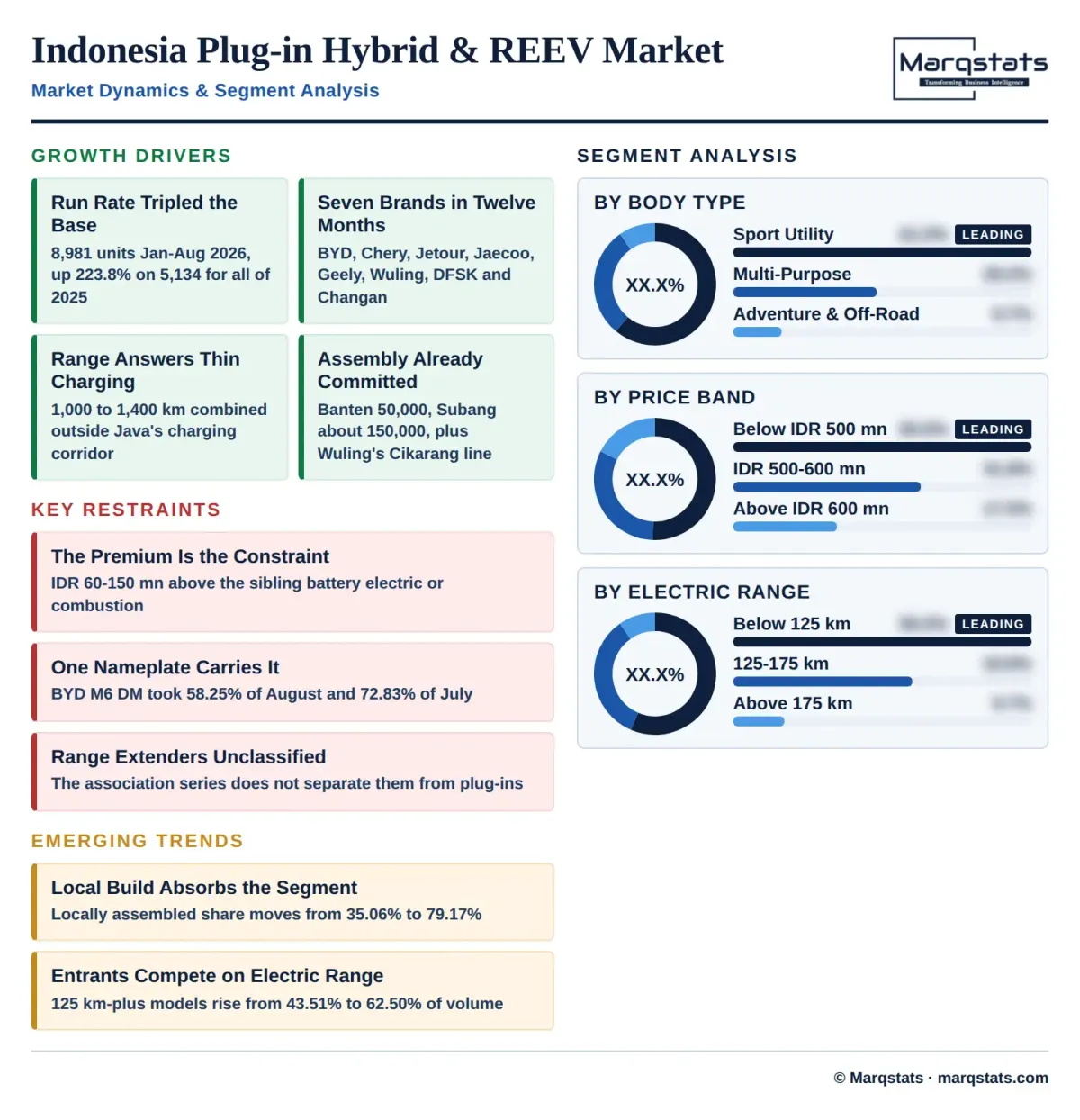
- Wholesales reached 8,981 units across January to August 2026, up 223.8%, with August at 1,993, putting the year on course for roughly 18,200 against 5,134 in 2025.
- Seven Chinese-owned brands launched plug-in or range-extended product within twelve months, taking the model count from a handful to more than ten.
- Combined range of 1,000 to 1,400 km answers thin charging coverage outside Java, where Kalimantan, Sulawesi and eastern Indonesia hold an estimated 7.00% of segment volume.
- Local assembly capacity is already in place, with DFSK's Banten plant at 50,000 units a year, BYD's Subang plant at around 150,000 and Wuling's Cikarang line.
- Battery packs between 18.4 and 34.31 kWh sit well below battery electric requirements, so a domestic cell supply chain serves the segment sooner than it serves battery electric.
Key Restraints
- Plug-in variants carry a premium of roughly IDR 60 million to 150 million over sibling versions, against an entry battery electric hatchback at IDR 155 million.
- One nameplate supplied 58.25% of August 2026 and 72.83% of July, so segment volume has not yet been shown to be independent of a single model.
- Locally built volume was minimal through the base year, with production at 185 units in February 2026, down from 224 in January, against 5,334 battery electric and 8,131 hybrid.
- The association series does not identify range extenders separately, so an estimated 18.75% of the 2030 panel rests on a classification convention rather than a published split.
Key Trends
- Locally assembled volume rises from an estimated 35.06% to an estimated 79.17% as the Banten, Subang and Cikarang lines absorb the segment.
- Models with 125 km or more of electric range move from an estimated 43.51% of volume to an estimated 62.50%, as entrants compete on electric range rather than on combined range alone.
- Volume below IDR 500 million rises from an estimated 50.64% to an estimated 62.50%, pulling average transaction value down 10.58% across the window.
- Chinese marques move from an estimated 82.47% of segment volume to an estimated 93.75%, the highest origin concentration of any Indonesian powertrain panel.
Market Segmentation
Plug-in hybrids accounted for all 5,134 units in 2025 and reach an estimated 39,000 units or 81.25% by 2030 at a 50.01% compound rate. The BYD M6 DM, Chery Tiggo 8 CSH, Jetour T1 i-DM, Jaecoo J7 SHS-P, Geely Starray EM-i and Wuling Eksion all sit here, with batteries between 18.4 and 25 kWh.
Range-extended electric vehicles had no measurable base in 2025 and reach an estimated 9,000 units or 18.75% by 2030. No compound rate is published because the base is nil. The Changan Deepal S05 launched in July 2026 from IDR 509 million with a 27.28 kWh battery, and the iCAR V27 opened pre-orders on 29 July 2026 with 34.31 kWh and about 200 km of electric range.
Sport utility models accounted for an estimated 3,134 units in 2025, 61.04% of volume, reaching an estimated 29,000 units or 60.42% by 2030 at a 56.05% compound rate. The Chery Tiggo 8 CSH and Tiggo 9 CSH AWD, Jaecoo J7 SHS-P, Wuling Eksion, DFSK E5 Plus and Changan Deepal S05 are all in this body type.
Multi-purpose vehicles accounted for an estimated 1,500 units in 2025, 29.22% of volume, reaching an estimated 13,000 units or 27.08% by 2030 at a 54.02% compound rate. The seven-seat BYD M6 DM dominates the category and took 58.25% of all segment volume in August 2026, which reflects Indonesia's deep multi-purpose vehicle preference.
Adventure and off-road utility models accounted for an estimated 500 units in 2025, 9.74% of volume, reaching an estimated 6,000 units or 12.50% by 2030 at a 64.38% compound rate, the fastest body type. The Jetour T1 i-DM at IDR 558 million and T2 i-DM sit here, alongside the iCAR V27 range extender.
Chinese marques accounted for an estimated 4,234 units in 2025, 82.47% of volume, reaching an estimated 45,000 units or 93.75% by 2030 at a 60.43% compound rate. Every plug-in hybrid and range-extended model launched in Indonesia during 2026 came from a Chinese-owned brand, across BYD, Chery, Jetour, Jaecoo, Geely, Wuling, DFSK and Changan.
Western and other marques accounted for an estimated 900 units in 2025, 17.53% of volume, reaching an estimated 3,000 units or 6.25% by 2030 at a 27.23% compound rate, the slowest origin group. The category is premium European product above IDR 600 million and loses more than two thirds of its share as the volume bands fill.
The volume band accounted for an estimated 2,600 units in 2025, 50.64% of volume, reaching an estimated 30,000 units or 62.50% by 2030 at a 63.09% compound rate, the fastest band. The Wuling Eksion at IDR 449 million to 499 million and the DFSK E5 Plus at IDR 479 million to 499 million define it, and its growth is what pulls average transaction value down.
The mid band accounted for an estimated 1,634 units in 2025, 31.83% of volume, reaching an estimated 14,000 units or 29.17% by 2030 at a 53.67% compound rate. The Jetour T1 i-DM at IDR 558 million and the Changan Deepal S05 from IDR 509 million sit here, and the band holds most of its share.
The premium band accounted for an estimated 900 units in 2025, 17.53% of volume, reaching an estimated 4,000 units or 8.33% by 2030 at a 34.76% compound rate, the slowest band. It carries imported European plug-in product and more than halves its share as Chinese entrants fill the bands beneath it.
Locally assembled models accounted for an estimated 1,800 units in 2025, 35.06% of volume, reaching an estimated 38,000 units or 79.17% by 2030 at an 84.04% compound rate, the fastest series in the segment. Capacity is already committed rather than planned, across DFSK's 50,000-unit Banten plant, BYD's Subang plant at around 150,000 units and Wuling's Cikarang line.
Imported models accounted for an estimated 3,334 units in 2025, 64.94% of volume, reaching an estimated 10,000 units or 20.83% by 2030 at a 24.57% compound rate. The category held most of the base year because local plug-in production ran at only 185 units in February 2026, and it loses three quarters of its share as assembly lines absorb the volume.
Models offering less than 125 km of electric-only range accounted for an estimated 2,900 units in 2025, 56.49% of volume, reaching an estimated 18,000 units or 37.50% by 2030 at a 44.07% compound rate, the slowest range band. The BYD M6 DM at more than 100 km and the Jetour T1 i-DM on an 18.4 kWh battery sit here.
Models offering 125 km to 175 km accounted for an estimated 1,734 units in 2025, 33.77% of volume, reaching an estimated 22,000 units or 45.83% by 2030 at a 66.22% compound rate, becoming the largest range band. The Wuling Eksion at 125 km on 20.5 kWh and the DFSK E5 Plus at 140 km on 25 kWh define it.
Models offering more than 175 km accounted for an estimated 500 units in 2025, 9.74% of volume, reaching an estimated 8,000 units or 16.67% by 2030 at a 74.11% compound rate, the fastest range band. The iCAR V27 at about 200 km on a 34.31 kWh battery is the reference model, and the band is almost entirely range-extended rather than plug-in hybrid.
By Geography
Jakarta and Greater Jabodetabek
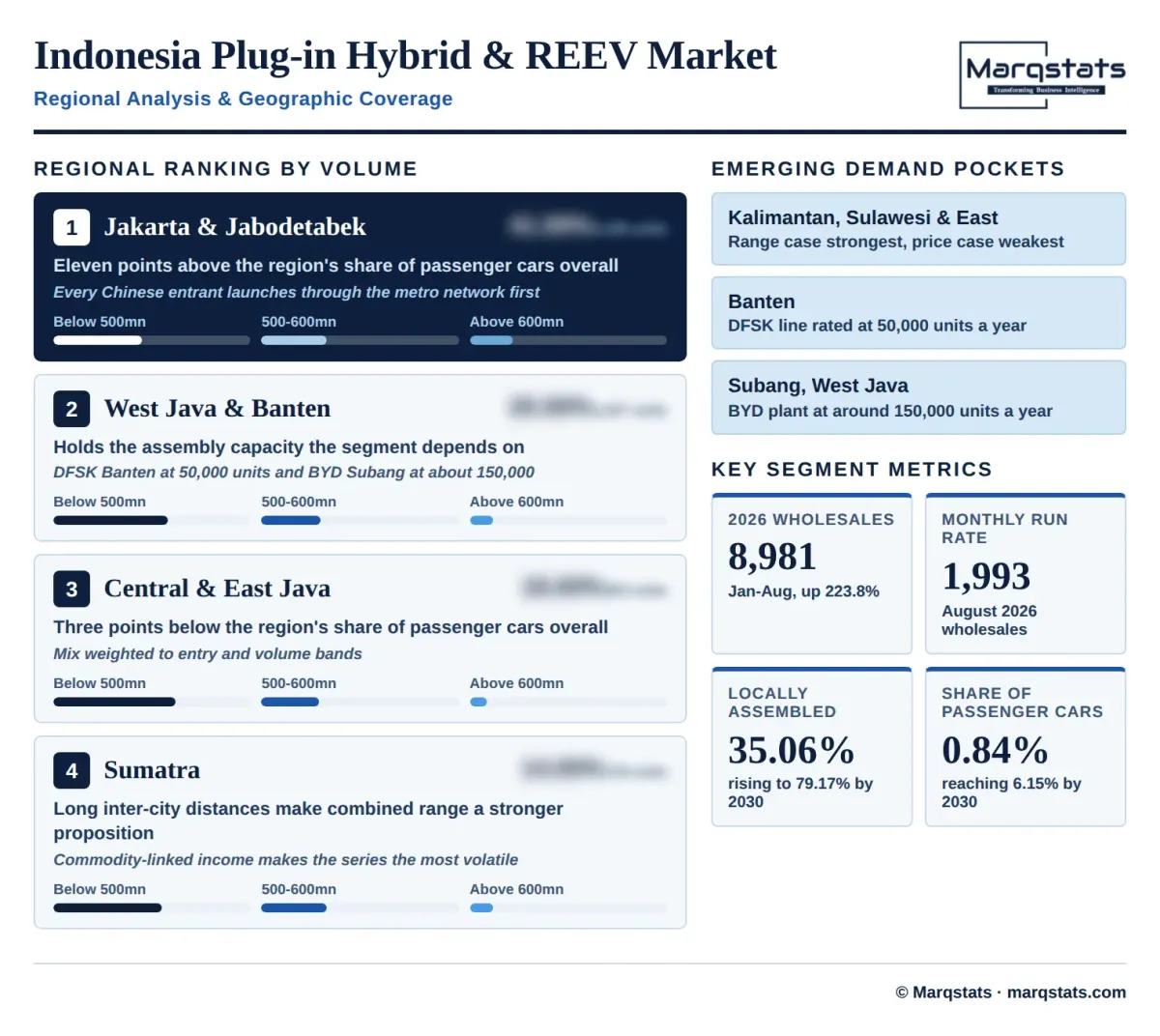
Jakarta and the surrounding metropolitan area account for an estimated 2,105 registrations in 2025, 41.00% of segment volume, eleven points above the region's 30.00% share of passenger cars overall. Transaction values above IDR 450 million concentrate here, both major motor shows are held here, and every Chinese entrant launches through the metropolitan dealer network first.
West Java and Banten
West Java and Banten account for an estimated 1,027 registrations, 20.00% of volume, and hold the assembly capacity the segment depends on, including DFSK's Banten plant at 50,000 units a year and BYD's Subang plant at around 150,000. Proximity to those lines supports earlier availability as local production replaces imports.
Central and East Java
Central and East Java account for an estimated 924 registrations, 18.00% of volume, three points below the region's share of passenger cars overall. The mix is weighted toward the entry and volume bands, and a segment priced from IDR 449 million penetrates it less deeply than a market whose largest band sits below IDR 350 million.
Sumatra
Sumatra accounts for an estimated 719 registrations, 14.00% of volume. Long inter-city distances and thin charging coverage make combined range of 1,000 km or more a stronger proposition here than in Java, but commodity-linked income cycles make the series the most volatile in the segment.
Kalimantan, Sulawesi and Eastern Indonesia
Kalimantan, Sulawesi and eastern Indonesia account for an estimated 359 registrations, 7.00% of volume, three points below the cluster's share of passenger cars overall and the smallest regional position. The range case is strongest here and the price case weakest, and the second consideration has so far governed.
How Competition Is Evolving
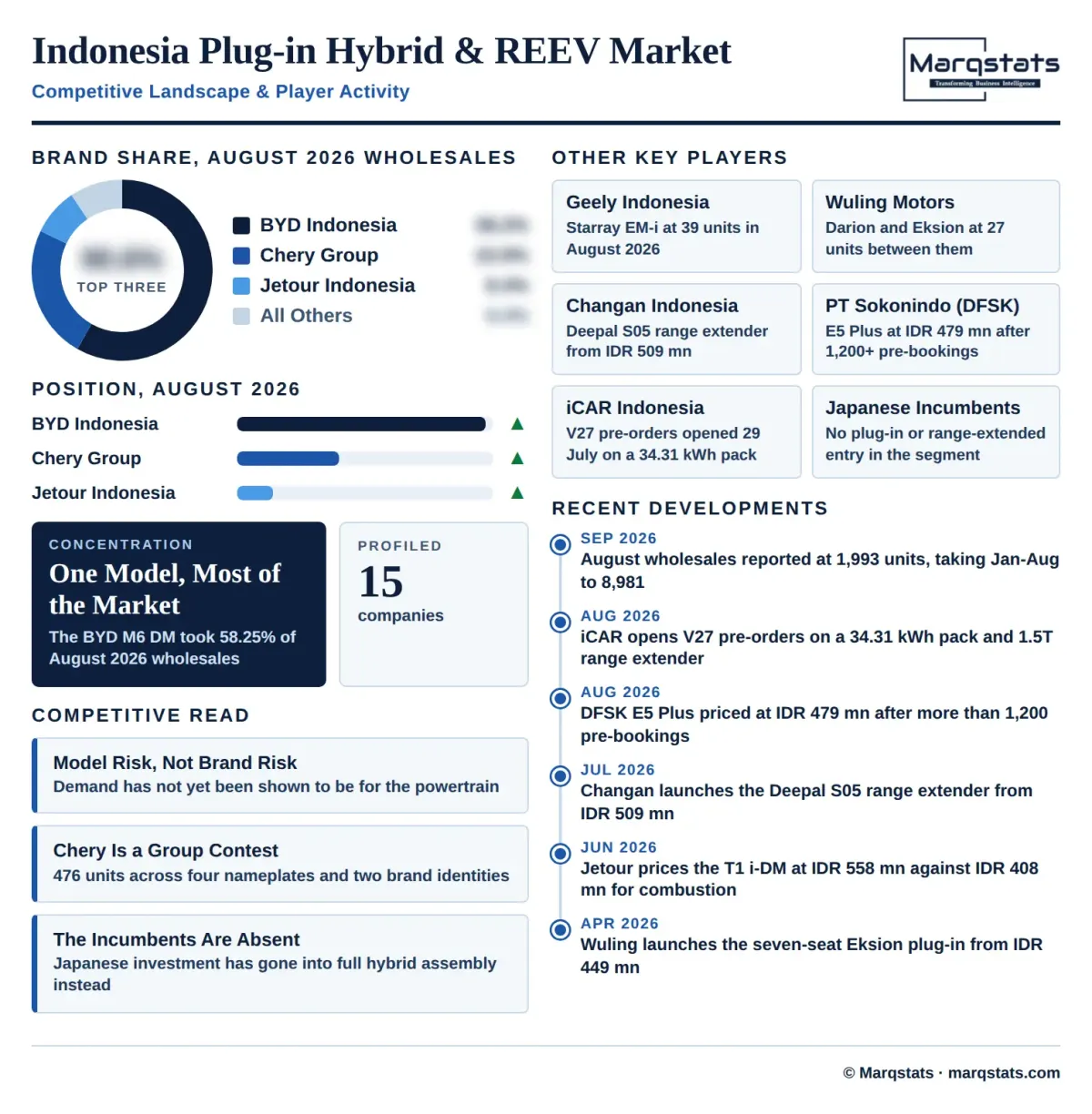
This is the most concentrated vehicle segment in Indonesia and the concentration sits on one model rather than on one brand. The BYD M6 DM took 58.25% of August 2026 wholesales and 72.83% of July, two and three months after deliveries began. The August top ten covered 93.88% of the month, and the second-placed model took roughly a quarter of the leader's volume.
Below the leader the competition is a group contest rather than a brand one. The Chery group supplied 476 units in August across the Tiggo 8 CSH at 319, the Tiggo 9 CSH AWD at 74, the Jaecoo J7 SHS-P at 59 and the Jaecoo J8 SHS-P ARDIS at 24, giving it 23.88% of the month through four nameplates and two brand identities. Jetour added 168 across the T1 and T2 i-DM, Geely 39 with the Starray EM-i, and Wuling 27 across the Darion and Eksion.
The absent competitor is the Japanese incumbent group. Toyota, Suzuki, Mitsubishi, Honda and Daihatsu hold an estimated 95.45% of the Indonesian hybrid segment and an estimated 80.01% of passenger cars, and none has a plug-in or range-extended entry here. Their electrification investment has gone into full hybrid assembly and hybrid battery localisation, which leaves the plug-in segment entirely to entrants and explains why origin concentration reaches an estimated 93.75% by 2030.
Companies Covered
The report profiles 15+ companies with full strategy and financials analysis, including:
Recent Market Activity
Table of Contents
Coverage & Segmentation
The analysis measures the retail value of new plug-in hybrid and range-extended passenger vehicle sales in Indonesia from 2021 to 2030, with 2025 as the base year and 2026 to 2030 as the forecast period, covering powertrain architecture, body type, brand origin, price band, assembly origin and electric-only range, together with the assembly capacity and battery supply arrangements behind them. Full hybrids are excluded at 65,943 units in 2025 and battery electric vehicles at 103,931 units, each sized separately. Commercial vehicles, two-wheelers, three-wheelers, used vehicle retail, aftermarket and financing are excluded. Values are expressed in USD at a disclosed constant IDR 16,800 per USD.
Coverage spans two powertrain architectures, three body types, two brand origin groups, three price bands, two assembly origins and three electric-range bands, with five regional clusters analysed on registration volume. Segment volume is carried as the unit series at 5,134 in 2025 and average transaction value as a derived series at IDR 520 million, and both are published alongside the value panel because average transaction value falls across the window while the unit base multiplies. Fifteen entities are profiled across manufacturers, national sales companies, contract assemblers and battery suppliers.