Market Snapshot
Key Takeaways
Market Overview & Analysis
Report Summary
The Indonesia hybrid electric vehicle market is the localised half of a two-speed electrification. Hybrids are assembled here, their batteries are packed here, and the brands that build them are the incumbents that have held the market for decades. Battery electric vehicles sell in greater numbers but were largely imported through the base year, which is why national production data and national sales data give opposite answers about which powertrain leads.
The measure is the retail value of new hybrid passenger vehicle sales in Indonesia, covering full hybrids such as the Kijang Innova Zenix, Veloz, Yaris Cross, Xforce and Rocky, and mild hybrid systems such as Suzuki's SHVS across the Grand Vitara, XL7 and Fronx. Plug-in hybrids are excluded at 5,134 units in 2025 and are sized separately, as are battery electric vehicles at 103,931 units. The exclusion matters commercially because the Chinese entrants arrive with plug-in hybrids rather than full hybrids, at IDR 449 million to 558 million for the Wuling Eksion, DFSK E5 Plus and JETOUR T1 i-DM, with DFSK assembling the E5 Plus at a Banten plant rated at 50,000 units a year. Commercial vehicles, two-wheelers and three-wheelers are excluded.
The analysis is written for manufacturers weighing further hybrid localisation against battery electric assembly, battery suppliers assessing cell and module demand as pack assembly localises upstream, component suppliers whose volumes follow local output rather than registrations, and investors reading a segment whose unit growth runs ahead of its value growth.
Indonesia Hybrid Electric Vehicle Market Size and Forecast
Hybrid passenger vehicle retail value is estimated at USD 1,413.06 million in 2025 and USD 3,142.86 million by 2030, an increase of USD 1,729.80 million on 94,057 additional units. Volume moves from 65,943 to 160,000 units at 19.40%, while average transaction value falls from IDR 360 million to IDR 330 million, or USD 21,429 to USD 19,643 at a constant IDR 16,800 per USD.
Value compounds 2.06 points below volume at 17.34% against 19.40%, and the direction is the opposite of most vehicle panels. The mechanism is mix rather than discounting. The entry full hybrid multi-purpose vehicle sells from IDR 308 million and mild hybrid systems appear across Suzuki's volume range, so the bands that grow fastest in units are not the bands that carry the highest transaction values.
Hybrids were 10.83% of the 608,687 passenger car base in 2025 and 8.21% of the 803,687 unit association total, reaching an estimated 20.51% of passenger cars by 2030. Within the 175,008 electrified passenger cars sold in 2025 hybrids were 37.68%, and that share holds at an estimated 36.04% by 2030, so hybrids grow with electrification rather than being displaced by it.
Volume grew 10.1% in 2025, from 59,903 units to 65,943, the slowest of the three electrified powertrains. Battery electric grew 140.6% to 103,931 units and plug-in hybrid rose from 136 units to 5,134. A segment growing at 10% in the base year and forecast at 19.40% requires a reason, and the reason is supply rather than demand: hybrid assembly capacity and hybrid model count both expand materially across 2026.
Production and Sales Point Opposite Ways
Indonesia built more hybrids than battery electric vehicles in every reported month of early 2026. February output was 8,131 hybrid units against 5,334 battery electric and 185 plug-in hybrid, following 8,058 hybrid units in January against 4,218 battery electric and 224 plug-in hybrid. Across the two months hybrids reached 16,189 units against 9,552 battery electric and 409 plug-in hybrid.
Indonesia sold the reverse ordering. Hybrid wholesales were 65,943 units in 2025 against 103,931 battery electric, so hybrids trailed by 36.55% on sales while leading by 52.44% on February output. Both series are correctly reported and neither is a revision of the other.
Assembly origin reconciles them. An estimated 92.42% of hybrid volume was locally assembled in 2025, consistent with Toyota citing roughly 90% local production for domestic sales and Suzuki 88%. Battery electric supply was substantially imported through the base year, with BYD confirming that the Atto 1 was fully assembled at Subang only from August 2026, so battery electric sales could run far ahead of battery electric output without either figure being wrong.
The practical consequence is a measurement rule. Production data describes where value is added and sales data describes where it is captured, and in Indonesia those are different powertrains. A supplier sizing demand off the 8,131 unit February production figure and a distributor sizing it off the 65,943 unit wholesale series are both right about different questions.
The Battery Localisation Step Is the Segment's Largest Single Variable
TMMIN operates a hybrid battery pack assembly line at Karawang serving the Kijang Innova Zenix, Veloz and Yaris Cross, with cells and modules imported. In April 2026 it announced a partnership with CATL backed by a planned IDR 1.3 trillion, or USD 75.8 million, to manufacture cells and modules in Indonesia.
The content step is large. Local battery content moves from approximately 8% where only pack assembly is domestic toward approximately 80% once cells and modules are produced locally, a roughly tenfold increase in the share of battery value captured in Indonesia. Exports of complete packs and battery components are planned from the second half of 2026, which would make the Indonesian subsidiary the first Toyota operation in Southeast Asia to export batteries.
Two battery plants including CATL's Karawang facility were targeted for operation in 2026, with inauguration guided for the first half. Locally assembled packs are estimated at 57.63% of hybrid volume in 2025, reaching an estimated 81.25% by 2030 at a 27.89% compound rate, the fastest series in the segment.
No local content threshold or luxury sales tax figure specific to hybrids appeared in the source material, and none is assumed here. That is a disclosed gap rather than a modelled input, and it is the single piece of information that would most improve the forecast.
Japanese Incumbents Own This Segment in a Way They No Longer Own the Market
Japanese marques held an estimated 95.45% of hybrid volume in 2025 against an estimated 80.01% of the passenger car market overall. Toyota leads local full hybrid assembly with the Kijang Innova Zenix, Veloz and Yaris Cross, Mitsubishi added the Bekasi-built Xforce HEV at IDR 445 million in July 2026, and Daihatsu contributes the Rocky HEV within a June 2026 retail month of 12,725 units, up 27.2% year on year, in which hybrid and related models took 1,027 units, or roughly 8%.
Suzuki's route is different and its volume contribution is larger than its profile suggests. SHVS mild hybrid systems run across the Grand Vitara, XL7 and Fronx rather than on a halo model, 60% of Suzuki passenger car buyers prefer those variants, and the Fronx alone reached nearly 10,000 units between May and December 2025, or 14% of Suzuki's sales. The July 2026 XL7 facelift retained SHVS on middle and upper grades at the Cikarang plant, which builds for domestic sale and export.
The Chinese cohort that is reshaping the wider market has largely bypassed full hybrids in favour of plug-in hybrids, which sit outside this panel. BAIC is the visible exception, with the BJ30 hybrid sport utility contributing 214 of its 382 unit first-half 2026 wholesale total. Chinese marques move from roughly 1,000 hybrid units in 2025 to an estimated 18,000 by 2030, and no compound rate is published for that series because a four-figure base makes the rate an artefact of the denominator rather than a description of the market.
Market Dynamics
Key Drivers
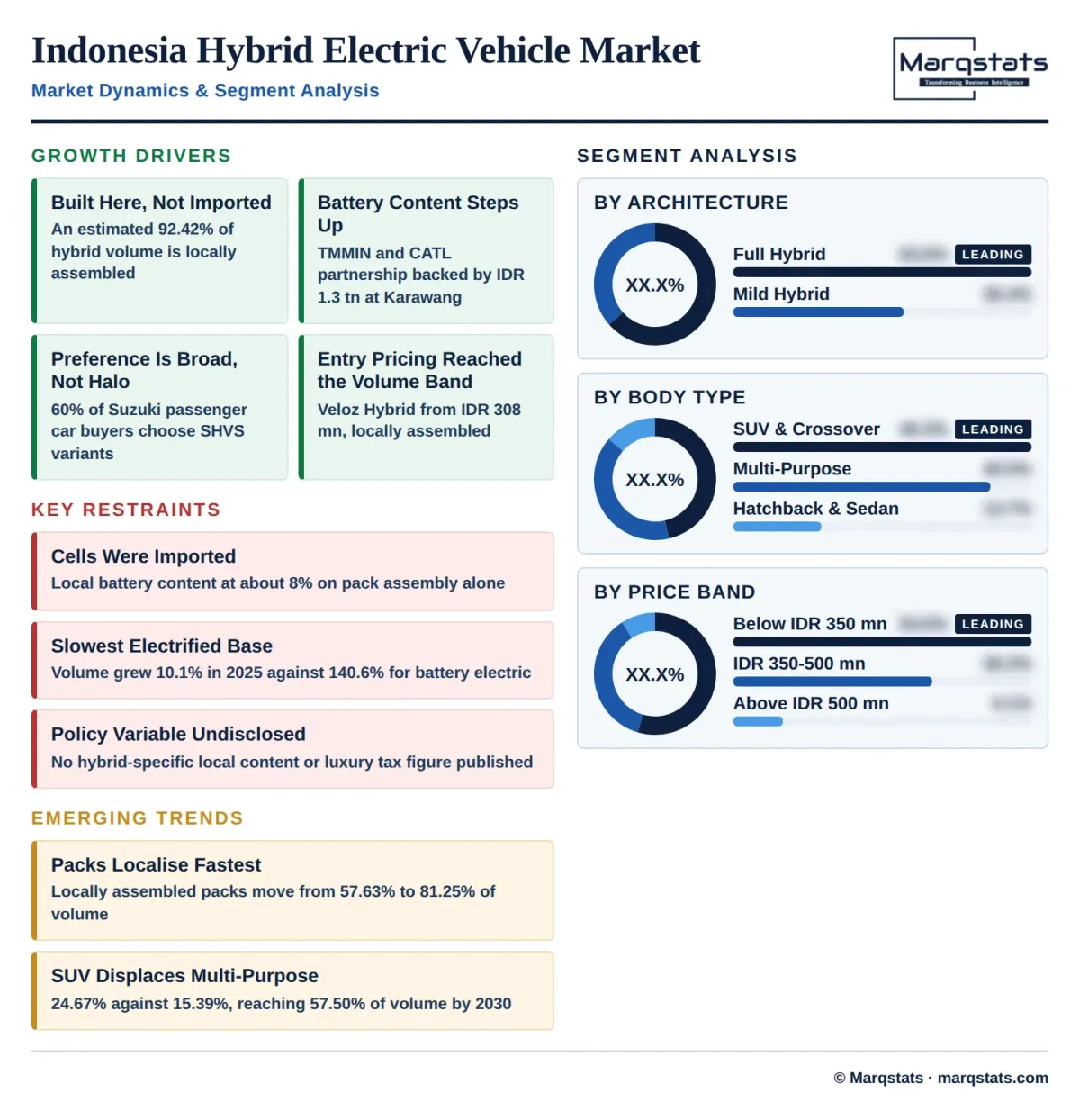
- Local assembly covers an estimated 92.42% of hybrid volume, against Toyota's roughly 90% local production for domestic sales and Suzuki's 88%, insulating supply from import timing and currency.
- TMMIN's IDR 1.3 trillion CATL partnership lifts local battery content from approximately 8% to approximately 80%, with pack and component exports planned from the second half of 2026.
- Hybrid preference is broad inside the incumbent brands, with 60% of Suzuki passenger car buyers choosing SHVS variants and hybrids taking 42.6% of Toyota's 2,793 motor show orders.
- Entry pricing has reached IDR 308 million for the locally assembled Veloz Hybrid, with an IDR 303 million promotional offer, bringing full hybrids into the volume band.
- Model count is expanding rather than deepening, with Mitsubishi's Xforce HEV at IDR 445 million and Honda's Prelude allocation of 100 units booked within three days of opening.
Key Restraints
- Battery cells and modules were imported through the base year, leaving local battery content at approximately 8% and the cost base exposed to currency until cell production starts.
- Hybrid volume grew only 10.1% in 2025, from 59,903 units to 65,943, against 140.6% for battery electric, so the segment enters the window from the slowest electrified base.
- Average transaction value falls 8.33%, from IDR 360 million to IDR 330 million, so value grows 2.06 points slower than volume across the window.
- No hybrid-specific local content threshold or luxury sales tax rate was disclosed in the source material, leaving the policy variable that most affects relative pricing unquantified.
Key Trends
- Locally assembled packs move from an estimated 57.63% of hybrid volume to an estimated 81.25% by 2030 at a 27.89% compound rate, the fastest series in the segment.
- Sport utility and crossover bodies displace multi-purpose vehicles, growing at 24.67% against 15.39% and reaching an estimated 57.50% of hybrid volume by 2030.
- Full hybrids outgrow mild hybrids at 20.82% against 16.72%, lifting the full hybrid share from an estimated 63.60% to an estimated 67.50%.
- Japanese marques fall from an estimated 95.45% of hybrid volume to an estimated 81.25% as Chinese and Korean entrants add an estimated 27,000 units between them.
Market Segmentation
Full hybrids accounted for an estimated 41,943 units in 2025, 63.60% of volume, rising to an estimated 108,000 units or 67.50% by 2030 at a 20.82% compound rate. The locally assembled Kijang Innova Zenix, Veloz and Yaris Cross anchor the category, joined by the Bekasi-built Xforce HEV at IDR 445 million with a 1.6-litre engine and a 116 PS motor.
Mild hybrids accounted for an estimated 24,000 units in 2025, 36.40% of volume, rising to an estimated 52,000 units or 32.50% by 2030 at a 16.72% compound rate. Suzuki's SHVS system carries almost all of it across the Grand Vitara, XL7 and Fronx, with 60% of Suzuki passenger car buyers choosing those variants and the Fronx alone reaching nearly 10,000 units between May and December 2025.
Sport utility and crossover hybrids accounted for an estimated 30,543 units in 2025, 46.32% of volume, rising to an estimated 92,000 units or 57.50% by 2030 at a 24.67% compound rate, the fastest body type. The Yaris Cross, Xforce HEV, Grand Vitara, XL7, Rocky HEV and BAIC BJ30 all sit here.
Multi-purpose vehicle hybrids accounted for an estimated 26,400 units in 2025, 40.03% of volume, rising to an estimated 54,000 units or 33.75% by 2030 at a 15.39% compound rate. The Kijang Innova Zenix and the Veloz from IDR 308 million carry the category, which reflects Indonesia's deep multi-purpose vehicle preference and loses share without losing volume.
Hatchback and sedan hybrids accounted for an estimated 9,000 units in 2025, 13.65% of volume, reaching an estimated 14,000 units or 8.75% by 2030 at a 9.24% compound rate, the slowest body type. The Fronx sits at the volume end and the Honda Prelude at the halo end, its entire 100-unit 2026 allocation booked within three days.
Japanese marques accounted for an estimated 62,943 hybrid units in 2025, 95.45% of volume, reaching an estimated 130,000 units or 81.25% by 2030 at a 15.61% compound rate. Toyota, Suzuki, Mitsubishi, Honda and Daihatsu hold a position in hybrids materially stronger than the estimated 80.01% they hold across passenger cars overall.
Chinese marques accounted for roughly 1,000 hybrid units in 2025, an estimated 1.52% of volume, reaching an estimated 18,000 units or 11.25% by 2030. No compound rate is published because a four-figure base produces a rate that describes the denominator rather than the market. BAIC is the visible entrant, with the BJ30 hybrid sport utility at 214 of its 382 unit first-half 2026 wholesale total.
Korean, Western and other marques accounted for an estimated 2,000 hybrid units in 2025, 3.03% of volume, reaching an estimated 12,000 units or 7.50% by 2030 at a 43.10% compound rate. The group carries the highest transaction values and the least volume, and its models sit predominantly above the IDR 500 million band.
The entry band accounted for an estimated 36,000 units in 2025, 54.59% of volume and the largest band, reaching an estimated 84,000 units or 52.50% by 2030 at an 18.47% compound rate. The Veloz Hybrid from IDR 308 million and Suzuki's SHVS models define it, and its weight is why average transaction value falls across the window.
The mid band accounted for an estimated 23,943 units in 2025, 36.31% of volume, reaching an estimated 58,000 units or 36.25% by 2030 at a 19.36% compound rate, holding its share almost exactly. The Xforce HEV at IDR 445 million and the upper Kijang Innova Zenix grades sit here.
The premium band accounted for an estimated 6,000 units in 2025, 9.10% of volume and the smallest band, reaching an estimated 18,000 units or 11.25% by 2030 at a 24.57% compound rate, the fastest band. Imported halo models including the Honda Prelude sit here, and scarcity rather than price governs volume.
Locally assembled hybrids accounted for an estimated 60,943 units in 2025, 92.42% of volume, reaching an estimated 150,000 units or 93.75% by 2030 at a 19.74% compound rate. Toyota's five Indonesian factories, Mitsubishi's Bekasi plant and Suzuki's Cikarang plant supply it, against cumulative Toyota investment near IDR 100 trillion and 3 million units exported to more than 100 countries.
Imported hybrids accounted for an estimated 5,000 units in 2025, 7.58% of volume, reaching an estimated 10,000 units or 6.25% by 2030 at a 14.87% compound rate. The category is halo and premium product rather than volume, exemplified by the Honda Prelude at 100 units for 2026, and its share declines as local model count expands.
Locally assembled packs accounted for an estimated 38,000 hybrid units in 2025, 57.63% of volume, reaching an estimated 130,000 units or 81.25% by 2030 at a 27.89% compound rate, the fastest series in the segment. TMMIN's Karawang line serves the Kijang Innova Zenix, Veloz and Yaris Cross, and the CATL partnership adds cells and modules behind it.
Imported complete packs accounted for an estimated 27,943 hybrid units in 2025, 42.37% of volume, reaching an estimated 30,000 units or 18.75% by 2030 at a 1.43% compound rate, effectively flat in absolute terms while halving in share. The category covers every hybrid not served by a domestic pack line, and it shrinks as localisation extends beyond Toyota.
By Geography
Jakarta and Greater Jabodetabek
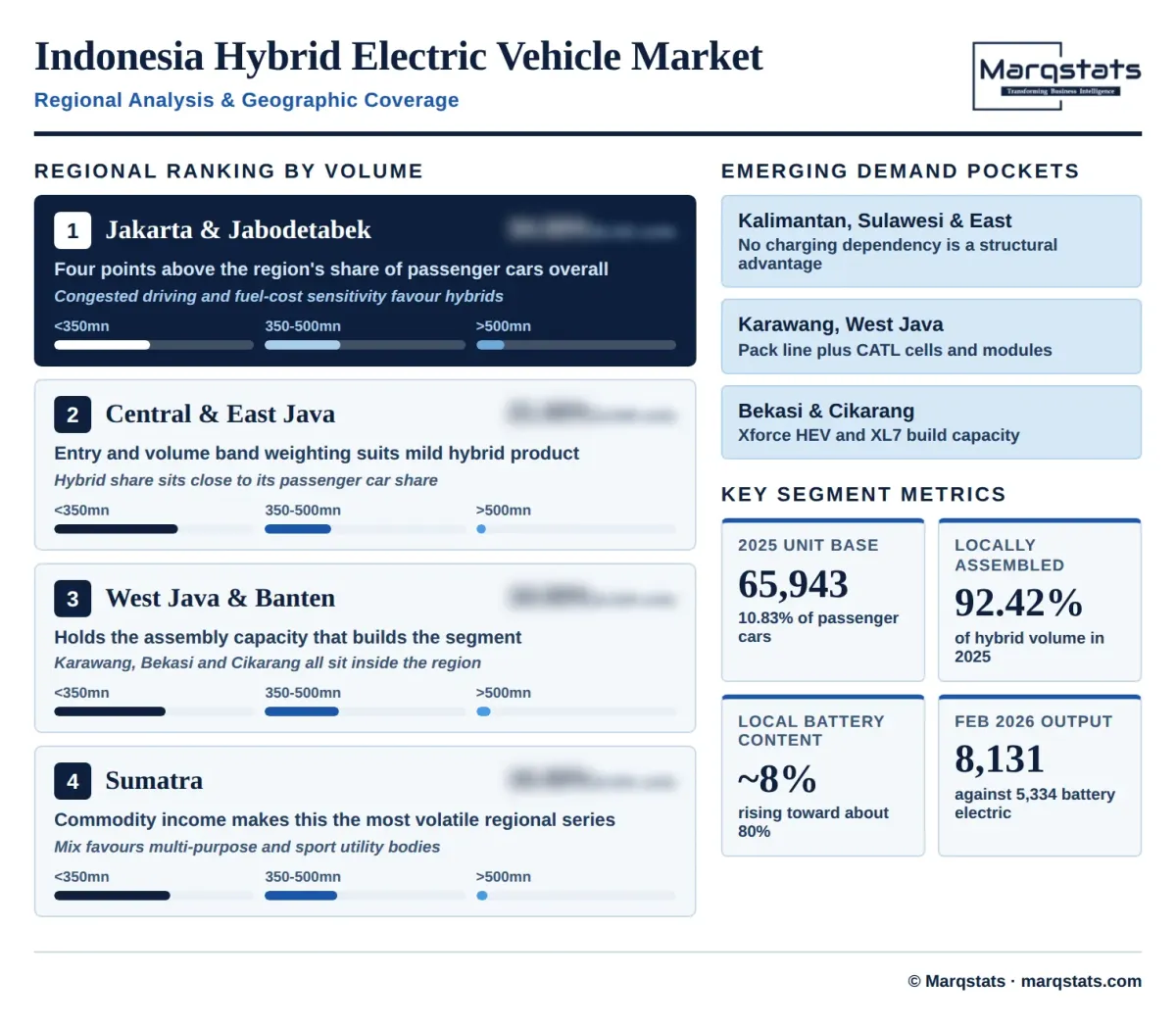
Jakarta and the surrounding metropolitan area account for an estimated 22,421 hybrid registrations in 2025, 34.00% of national hybrid volume, four points above the region's share of passenger cars overall. Income mix, fuel cost sensitivity in congested driving and the concentration of both major motor shows all favour hybrids here.
Central and East Java
Central and East Java account for an estimated 13,848 hybrid registrations, 21.00% of volume. The region's weighting toward the entry and volume bands suits mild hybrid and entry full hybrid product, and its hybrid share sits close to its share of passenger cars overall rather than above it.
West Java and Banten
West Java and Banten account for an estimated 12,529 hybrid registrations, 19.00% of volume, and hold the assembly capacity that builds the segment, including Toyota's Karawang complex, Mitsubishi's Bekasi plant and Suzuki's Cikarang plant. Proximity to manufacturing supports both employment-driven demand and earlier availability of new hybrid models.
Sumatra
Sumatra accounts for an estimated 10,551 hybrid registrations, 16.00% of volume. Commodity income drives purchase cycles more sharply than elsewhere and the mix favours multi-purpose vehicles and sport utility bodies, making the island the most volatile regional hybrid series in the market.
Kalimantan, Sulawesi and Eastern Indonesia
Kalimantan, Sulawesi and eastern Indonesia account for an estimated 6,594 hybrid registrations, 10.00% of volume, the smallest cluster. Hybrids hold a structural advantage over battery electric here because they require no charging infrastructure, and the region's battery electric adoption is the lowest in the country.
How Competition Is Evolving
The hybrid segment is the most concentrated part of the Indonesian vehicle market and the part the incumbents still control. Japanese marques hold an estimated 95.45% of hybrid volume against an estimated 80.01% of passenger cars overall, and Toyota alone accounts for the majority of locally assembled full hybrids through the Kijang Innova Zenix, Veloz and Yaris Cross. Where the wider market is being contested by six Chinese entrants at once, hybrids have been contested by one, and BAIC's BJ30 supplied 214 units in the first half of 2026.
Competition inside the segment is on architecture and price rather than on brand entry. Toyota and Mitsubishi compete with full hybrids from IDR 308 million to above IDR 445 million, while Suzuki competes on breadth by fitting SHVS across the Grand Vitara, XL7 and Fronx rather than on a single model, converting 60% of its passenger car buyers. Daihatsu adds the Rocky HEV within a retail base of 12,725 units in June 2026, up 27.2%.
The decisive investment is in batteries rather than in vehicles. TMMIN's IDR 1.3 trillion partnership with CATL moves local battery content from approximately 8% to approximately 80% and adds pack and component exports from the second half of 2026, which would give Toyota a cost and content position no other hybrid supplier in the country currently holds. Wuling's cumulative local production above 180,000 vehicles, exports to 22 countries and 119% year on year export growth show the same export logic being applied from the battery electric side.
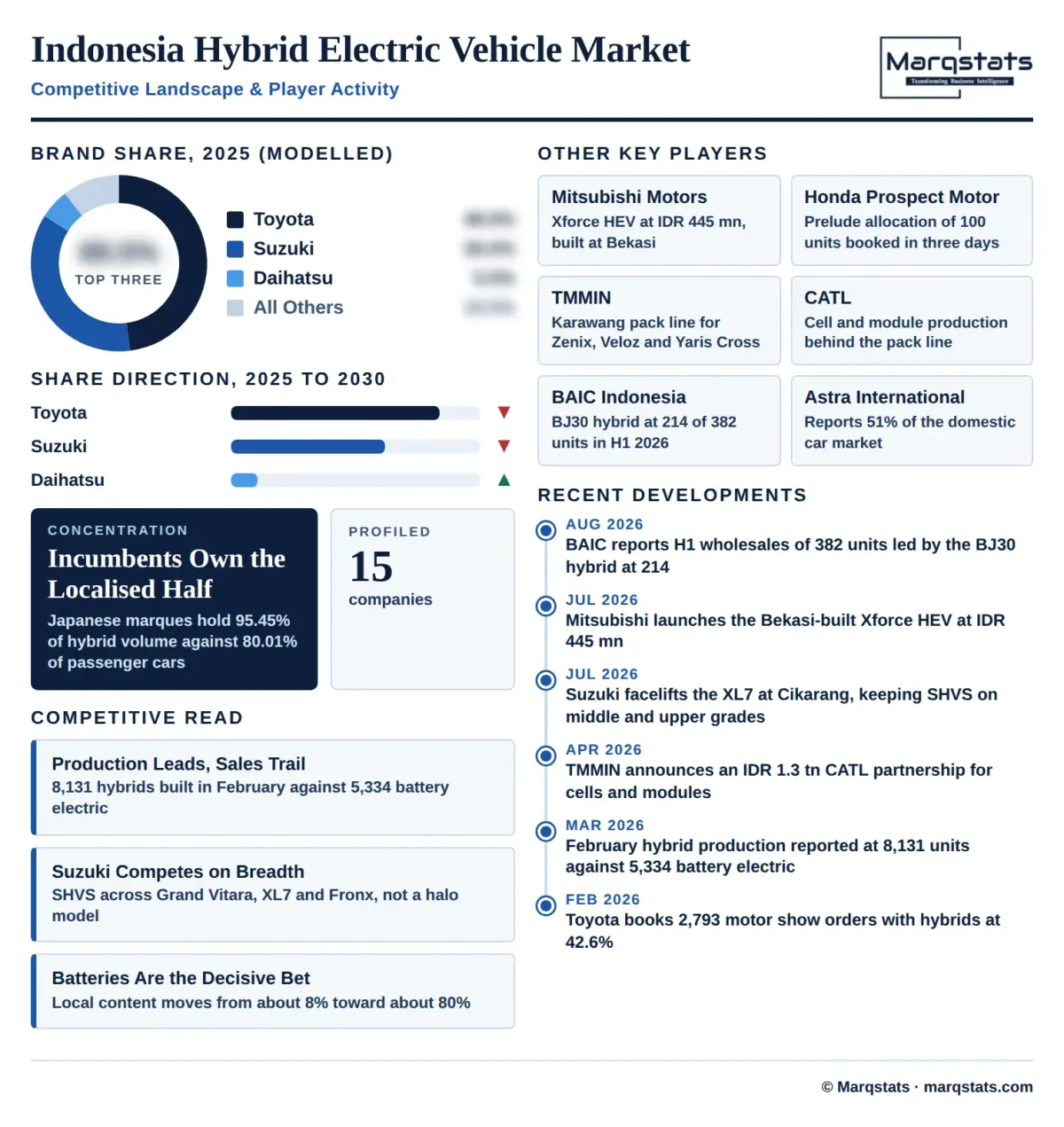
Companies Covered
The report profiles 15+ companies with full strategy and financials analysis, including:
Recent Market Activity
Table of Contents
Coverage & Segmentation
The analysis measures the retail value of new hybrid passenger vehicle sales in Indonesia from 2021 to 2030, with 2025 as the base year and 2026 to 2030 as the forecast period, covering full hybrids and mild hybrids, the brands and plants that build them, the price bands they sell into and the battery supply arrangements behind them. Plug-in hybrids are excluded at 5,134 units in 2025 and battery electric vehicles at 103,931 units, each sized separately. Commercial vehicles, two-wheelers, three-wheelers, used vehicle retail, aftermarket and financing are excluded. Values are expressed in USD at a disclosed constant IDR 16,800 per USD.
Coverage spans two hybrid architectures, three body types, three brand origin groups, three price bands, two assembly origins and two battery supply arrangements, with five regional clusters analysed on registration volume. Hybrid volume is carried as the unit series at 65,943 in 2025 and average transaction value as a derived series at IDR 360 million, and both are published alongside the value panel because a segment whose unit base rises while its transaction value falls cannot be represented by either alone. Fifteen entities are profiled across vehicle manufacturers, distribution groups, battery suppliers and entrants.