
Why Won't Japanese Drivers Pay for Connected Car Apps?
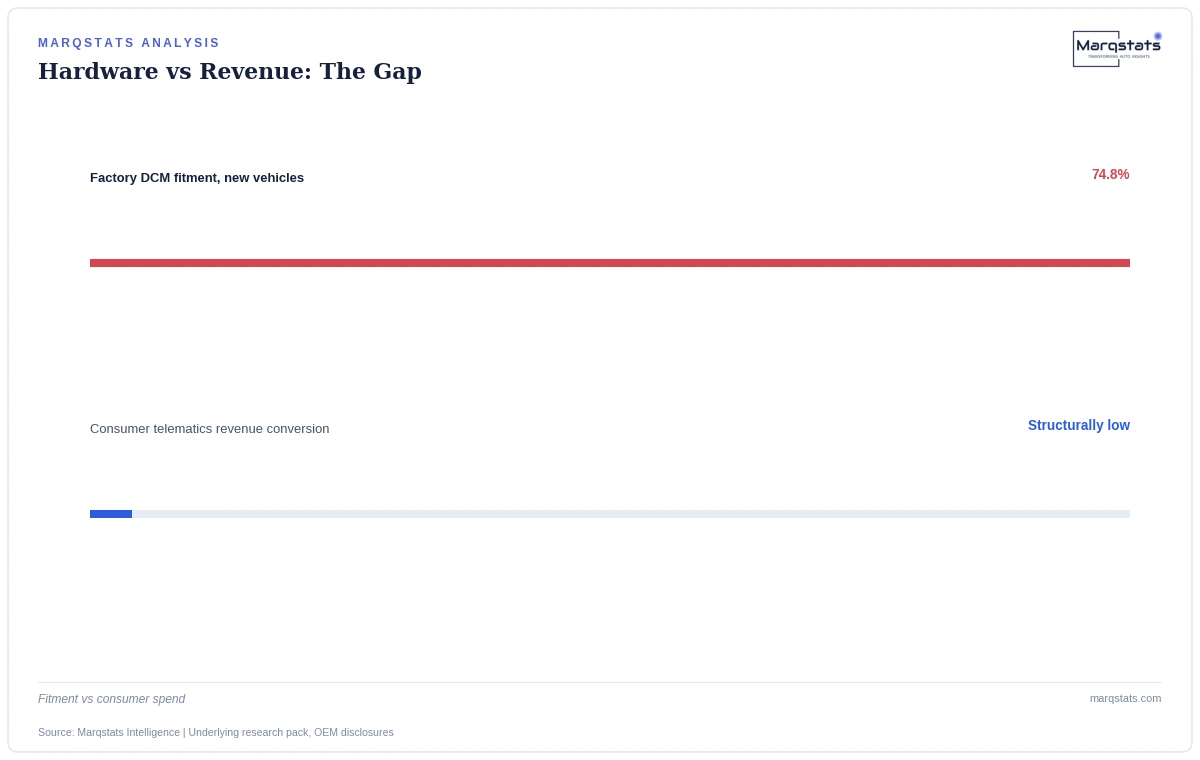
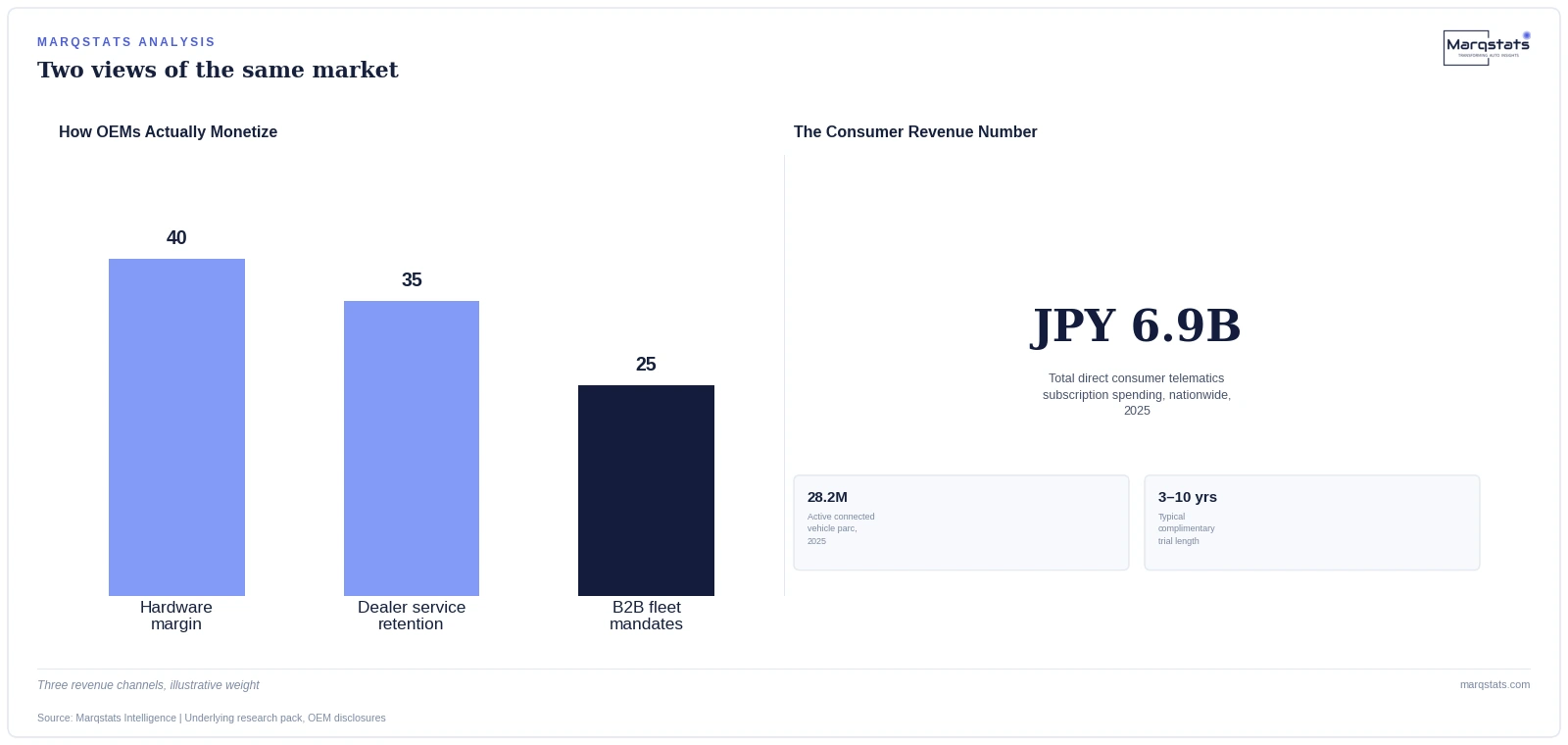
In brief: nearly three in four new Japanese passenger vehicles roll off the assembly line with factory-embedded connectivity hardware already installed. Almost none of the owners of those vehicles are paying anything to keep using the connected features once the free trial period ends. Total direct consumer spending on OEM telematics subscriptions across the entire country was just JPY 6.9 billion in 2025 — a strikingly small number set against a connected fleet in the tens of millions.
The Trial Period Problem
Japanese automakers have converged on a common strategy: bundle safety, diagnostics and emergency-call features into a complimentary period ranging from three years (Suzuki, Honda) to five years (Toyota's T-Connect) or even longer, then ask owners to convert to a paid plan for continued access to discretionary features like in-cabin streaming, digital key sharing or remote cabin climate control settings. Retention rates after that conversion point drop sharply.
The gap between the shortest and longest complimentary periods is itself telling. Suzuki and Honda's one-year trials are the outliers on the short end; Subaru and Mazda's three-to-five-year windows sit in the middle; and Toyota's five-year T-Connect bundle is the longest among major brands, suggesting Toyota specifically has concluded that a longer free period, not a shorter one designed to convert customers sooner, better serves its overall retention and residual-value strategy.
The strategy itself is not irrational — a long complimentary period maximizes the vehicle's perceived value at the point of sale, when the automaker actually has leverage over the buying decision, rather than trying to extract revenue later, when the automaker has none. The problem is what happens after that period ends: almost nothing, commercially speaking, because almost no one converts.
Why Japanese Consumers Specifically Resist This
The resistance is not a simple pricing problem, and it does not appear to be primarily about feature quality either. Two structural factors specific to Japan's automotive culture plausibly explain the pattern better than either. First, Japan's famously long vehicle ownership cycle — an average 13.40-year lifespan — means the emotional and financial relationship between an owner and a specific vehicle is already different from markets with faster replacement cycles, and subscription fatigue compounds over a much longer holding period than in markets where owners trade in every three to five years anyway. Second, the same generation of Japanese consumers driving this connected fleet has broadly resisted subscription models across other product categories as well, not just automotive ones specifically, suggesting a broader cultural pattern rather than an automotive-specific one — seemingly quite independent of any single OEM's own marketing choices.
A third, more mundane factor is worth naming too: many of the features gated behind a paid subscription — streaming audio, digital key sharing, remote climate control — are genuinely nice-to-have rather than essential, and a Japanese consumer culture with a strong existing preference for cash purchases over recurring commitments in categories from mobile phones to entertainment subscriptions was never a natural fit for exactly this kind of optional add-on billing in the first place, automotive or otherwise.
Japan solved the hardware problem. It has not solved the revenue problem — and OEMs have stopped trying to.
— Marqstats Analyst Team
How OEMs Actually Make Money From This Instead
Rather than continuing to push against consumer resistance, Japanese OEMs have redirected their connected-vehicle revenue strategy toward three channels that do not depend on a consumer opting into a subscription at all. Hardware margin absorption prices the DCM cost into the vehicle at point of sale, capturing revenue regardless of post-trial conversion. Dealer service-bay retention uses remote diagnostic data to schedule maintenance appointments automatically, capturing revenue through the dealership's own service department rather than a discrete software fee. And B2B fleet management, driven heavily by the 2024 Logistics Problem's statutory compliance requirements, generates recurring operators who have no discretion to decline in the first place.
Each of these three channels shares a structural feature the failed subscription model lacks: none of them require the vehicle owner to make an active, ongoing purchasing decision. Hardware margin is captured once, at the point of sale. Dealer retention is triggered automatically by the vehicle's own diagnostic data, not by an owner choosing to renew anything. And B2B fleet revenue comes from an operator obligated by statute, not persuaded by a marketing campaign. Japanese OEMs appear to have concluded, correctly based on the JPY 6.9 billion figure, that any revenue model requiring a Japanese consumer to actively opt into a recurring payment is fighting a cultural headwind not worth the sustained engineering and marketing investment required to overcome it.
What KDDI's WAKONX Initiative Shows About the B2B Path
KDDI's own strategic pivot illustrates where the real growth is concentrated. Rather than treating its automotive connectivity business as a straightforward consumer SIM reseller, KDDI has built WAKONX as a dedicated mobility enterprise framework explicitly targeting fleet operators, insurers and OEMs as its primary customers, with a stated ambition of 100 million active IoT connections by 2030 — a target built almost entirely on B2B and industrial use cases rather than consumer telematics subscriptions. That is a carrier, not an automaker, independently arriving at the same conclusion this piece has been describing throughout: in Japan, the money sits squarely in the enterprise relationship, not in the individual driver's own wallet.
Would This Work Anywhere Else?
The Japanese model is a genuinely different answer to the same monetization question every connected-car market in this coverage set is asking, and it is worth naming as a distinct strategic option rather than treating consumer subscription revenue as the only viable path. A market where consumers structurally will not pay for software, but where hardware margin, dealer retention and B2B compliance can absorb the cost instead, does not need to solve the subscription problem to remain commercially healthy — it needs to stop trying to solve it and build elsewhere, exactly as Japan's OEMs appear to have done.
A Named Comparison: France's Very Different Consumer Resistance
France, covered elsewhere in this batch, shows a superficially similar pattern — post-warranty subscription renewal rates below 40% — but for a structurally different reason. French consumers resist connected-service subscriptions primarily because of new-car price inflation eating into household budgets, with free smartphone mirroring as a fully adequate substitute for the features on offer. Japan's resistance persists even though Japanese new-car pricing has not seen the same twelve-year run-up France has documented, suggesting the underlying driver in Japan is closer to a durable cultural pattern around subscription products generally than a household-budget response specific to automotive pricing.
What This Means for a Foreign Software Vendor
A foreign connected-car software company evaluating Japan should read this pattern as a clear and fairly unambiguous signal about where to direct sales effort. Building a consumer subscription product for the Japanese market and expecting it to succeed where domestic OEMs with far deeper brand loyalty have already failed is a difficult bet. Building B2B tooling that Japanese automakers can license to improve their own hardware-margin, dealer-retention or fleet-compliance revenue streams works with the market's actual structure rather than against it — exactly the strategic guidance this market's own strategic-implications section gives foreign entrants generally, and it applies with particular force to the consumer-monetization question specifically, more so than almost any other decision a foreign vendor will face entering this market.
Even Japanese domestic suppliers appear to be internalizing this lesson: Denso's own software operations increasingly frame their value proposition around lifecycle management and edge compute integration for OEM and carrier customers, not around any end-consumer product line, reinforcing that the B2B orientation is not a foreign-vendor workaround but simply how this market currently works for everyone currently operating within it, foreign or domestic alike.
Outlook: One Trigger, Not Three
This market does not support a three-scenario outlook on consumer monetization specifically. The pack's own Accelerated Disruption Scenario identifies the single evidenced trigger that could change this pattern: Autonomous Driving-as-a-Service features compelling enough to overcome subscription resistance entirely, which the scenario models as pushing recurring software revenue above 15% of total market value by 2030 if it materializes.