Market Snapshot
Key Takeaways
Market Overview & Analysis
Report Summary
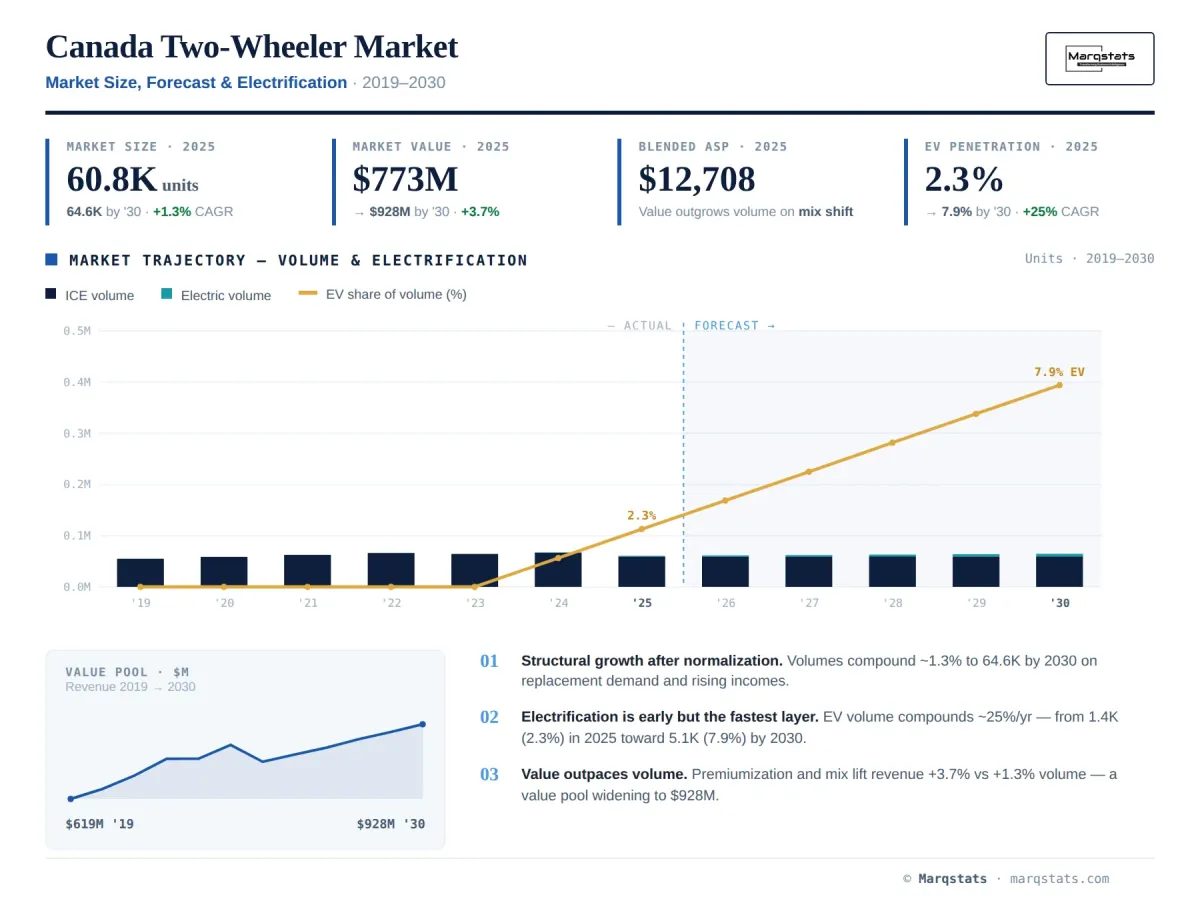
The Canada two-wheeler market comprises motorcycles, scooters, and mopeds sold for personal and commercial use across internal combustion and electric propulsion. This study segments demand by vehicle type, propulsion type, engine displacement and motor power, price band, end user, sales channel, and brand, with a 2025 base year, historical coverage from 2021 to 2025, and forecasts to 2030. Canada is a mature, affluent, seasonal market defined by touring, cruiser, and adventure riding across long distances.
The 2025 decline reflects a structural shift across North America rather than a one-year disruption. Industry data compiled by the Motorcycle Industry Council shows customers moving toward smaller, more affordable, versatile, and performance-focused models, while traditional large-displacement touring and cruiser segments continue to decline. Sport bikes gained 13% across the region, with all of that growth coming from models under 750cc. The Canadian pattern mirrors this, as small-displacement classes grow at about 21% annually from low bases while the dominant above-350cc band contracts.
Supply is concentrated among the Japanese majors and premium marques. Honda leads across the range, followed by Yamaha, and BMW has gained share on the strength of its adventure and touring machines. Harley-Davidson, long a fixture of the Canadian cruiser segment, saw registrations fall by about a third. KTM and Husqvarna, both part of Pierer Mobility, declined by roughly 47% and 42% during their parent's financial restructuring. The Canadian manufacturer Can-Am, based in Quebec, expanded its three-wheeled on-road vehicles against the market trend.
Canada's structure resembles the United States more than any European market. There is effectively no commuter tier: the 125cc class that carries half of Spanish volume accounts for about 2% here, because licensing offers no car-licence pathway onto light motorcycles and because distances and winters make two-wheelers impractical for daily transport across most of the country. What remains is a recreational market of large, expensive machines bought by private buyers for touring and weekend riding, concentrated into a season that in much of the country lasts barely half the year.
Market Dynamics
Key Drivers
- Affluence sustains premium demand, with an average selling price of roughly USD 12,700 per machine across a leisure-driven market.
- Adventure and touring culture underpins demand, as long distances and open highways favour capable large-displacement machines across the country.
- Digital retail expands rapidly, reaching about 35% of volume as buyers research, configure, finance, and purchase online.
- Smaller and electric machines broaden the market, as sub-350cc classes and electric models grow at more than 20% annually.
Key Restraints
- A compressed riding season limits usage, as long winters restrict riding across most provinces for several months of each year.
- The traditional cruiser and touring segments contract, weighing on the brands and displacement bands that dominate volume.
- Insurance costs and in-person licence testing remain obstacles to new rider entry, as noted by the national trade association.
Key Trends
- Electrification advances from a small base, concentrated in machines above 5.0 kW; the global electric ATV and UTV market reflects the wider electrification of powered recreational vehicles.
- The market rebalances toward smaller displacements, as sub-350cc classes grow at about 21% annually while the above-350cc band contracts.
- Offline dealership volumes contract at about 8% annually as digital retail expands across a geographically dispersed market.
- The competitive field reshapes, as cruiser brands retreat and the Canadian marque Can-Am and premium marques gain share.
Market Segmentation
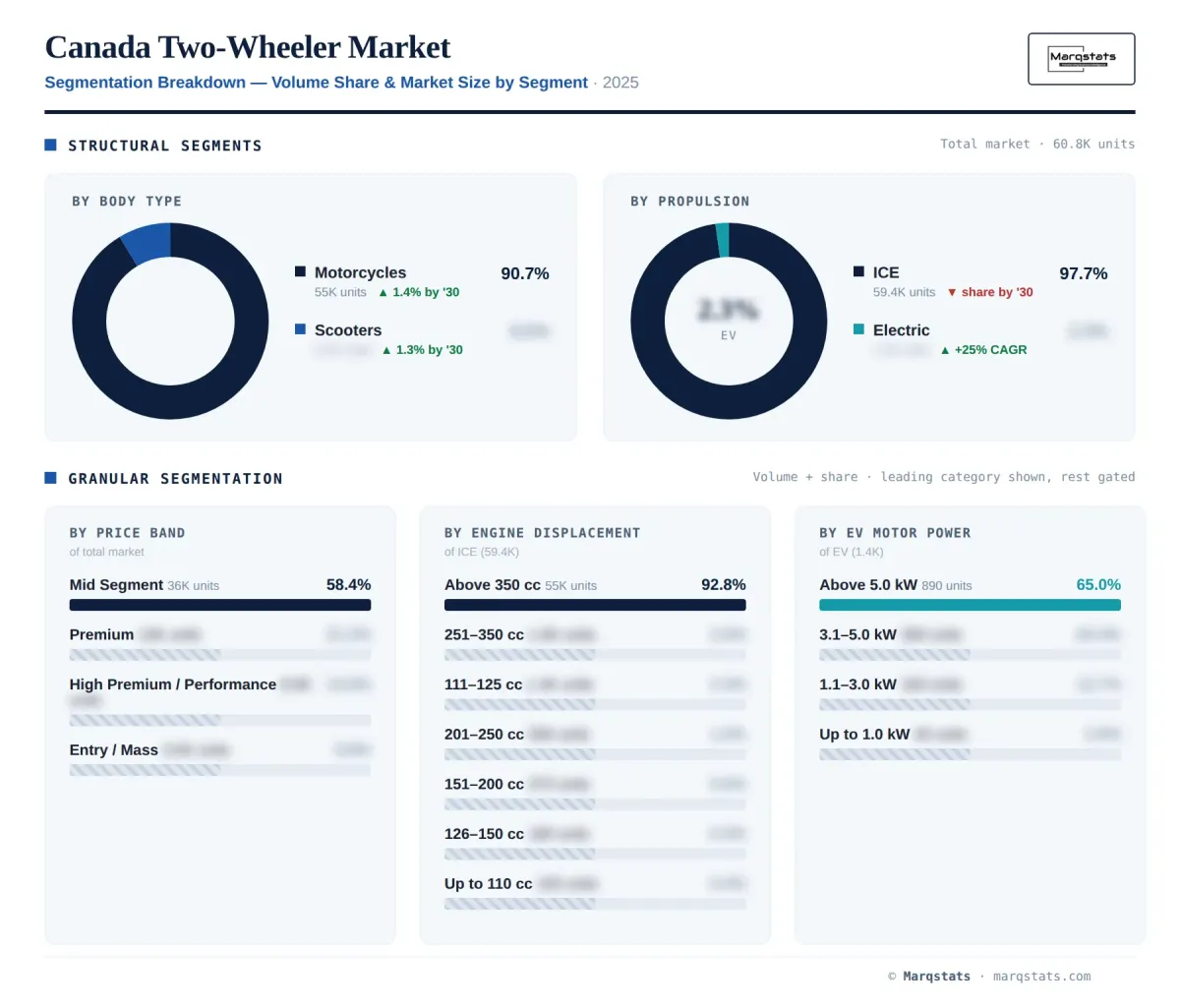
Motorcycles account for about 91% of 2025 volume, roughly 55,100 units, growing at a modest 1.4% CAGR. The category is weighted decisively toward touring, cruiser, adventure, and sport machines. Canada's long highways and open terrain support a strong touring tradition, and these machines generate the overwhelming majority of market value across a market with almost no commuter tier. Within the category, adventure and sport machines gain share while cruisers and large tourers contract, reshaping the mix without changing the category's overall dominance.
Scooters account for about 5,200 units in 2025, roughly 9% of volume, growing at about 1.3% annually, while mopeds contract sharply at about 32% annually to negligible volumes by 2030. Scooter demand concentrates in the denser urban centres of Ontario, Quebec, and British Columbia, where short trips and parking constraints favour smaller machines. The moped category has effectively reached the end of its relevance in the Canadian market, displaced by electric bicycles and other light urban vehicles.
Combustion models hold about 98% of 2025 volume, roughly 59,400 units, and remain essentially flat through the forecast period. Combustion dominates the touring, cruiser, and adventure classes that define the market, and it continues to generate almost all market value. The flat combustion forecast means effectively all net growth through 2030 comes from electric machines. Range, refuelling convenience, and the long distances typical of Canadian touring all favour combustion machines in the segments that carry the market.
Electric two-wheelers hold about 2% of 2025 volume, roughly 1,400 units, growing fastest at a 25.22% CAGR to reach about 5,100 units by 2030. Adoption concentrates in machines above 5.0 kW, which account for most electric volume and grow at about 29%. Electric registrations are reported from 2024 onward in the underlying data, so no historical series exists before that year, and adoption remains constrained by price, range, and the seasonal riding pattern. Cold-weather range loss and the recreational nature of demand both slow adoption relative to the urban commuter markets where electric two-wheelers have advanced fastest.
Large-displacement machines above 350cc are overwhelmingly dominant at about 91% of 2025 volume, roughly 55,100 units, the highest concentration among the markets in this series. Touring, cruiser, adventure, and large sport machines fall here. The band contracts at about 3% annually through the forecast as demand shifts toward smaller models, a pattern observed across North America, though it retains a decisive majority of volume and value in 2030. The gradual erosion of the band, in a market that is otherwise growing, is the clearest quantitative expression of the generational shift away from large touring and cruiser machines.
The 111–125cc class holds about 2% of volume and grows fastest among combustion segments at about 21% annually, and the 251–350cc class grows at a similar pace. These classes remain small in absolute terms, though their growth reflects the North American shift toward smaller, affordable, and performance-focused machines that industry data has documented across the region. Their expansion matters strategically rather than numerically, as they represent the entry point through which a new generation of riders joins the market.
The mid segment is the largest price band at about 58% of volume, though it contracts sharply at about 9% annually, the steepest decline of any band. The entry and mass band holds about 6% and grows fastest at about 27%, reflecting the arrival of smaller and more affordable machines. The entry-segment series reflects a reclassification from 2024 onward in the underlying data. The simultaneous contraction of the mid band and expansion of both entry and premium tiers describes a market hollowing out in the middle, where the traditional mid-priced cruiser once sat.
Premium accounts for about 21% of volume and grows at about 4%, while the high-premium performance band holds about 15% and grows at about 8%, the strongest of the established tiers. Together the premium tiers contribute the majority of market value, and their growth against a contracting mid segment explains why market value rises nearly three times as fast as unit volume.
Private consumers account for about 89% of 2025 volume, the core of a recreational market. Ownership is discretionary and leisure-driven, weighted toward touring riders, cruiser owners, and adventure enthusiasts, and demand is therefore sensitive to consumer confidence, insurance costs, and disposable income. The market's exposure to discretionary spending explains the depth of the 2025 decline, as households facing higher borrowing and insurance costs deferred purchases of machines costing well over ten thousand dollars.
Commercial demand is modest. Fleet and business users account for about 11% of volume, delivery and logistics for roughly 6%, and rental and tourism grows fastest among commercial users at about 7%, supported by adventure and touring tourism across the western provinces. Rental operators serving visiting riders in British Columbia and the Rocky Mountain corridor represent the most dynamic part of this small commercial base.
The online channel reaches about 35% of 2025 volume, growing at about 11% annually. Canada's geographic dispersion makes digital retail practical for buyers far from dealer networks, and the channel handles a growing portion of complete machine purchases alongside parts, accessories, and used inventory. Riders in the Prairies, northern regions, and Atlantic provinces may live hours from the nearest franchised dealer, and digital platforms have become the practical route to comparing models, securing financing, and arranging delivery.
Offline dealership volumes contract at about 8% annually. Dealers retain their role in test rides, servicing, and financing for the premium machines that generate most of the market's value, and the surviving network is consolidating around larger operators combining physical presence with strong digital platforms. Dealers heavily weighted toward cruiser franchises have faced the sharpest pressure, mirroring the contraction of the segment itself.
By Geography
Ontario
Ontario is the largest provincial market, combining the country's largest population with a dense dealer network across the Greater Toronto Area and southern corridor. The province concentrates touring, cruiser, and sport demand, and its urban centres sustain the largest scooter and commuter segment in the country. Insurance costs in the province are among the highest nationally, and they remain a recognised obstacle to new rider entry alongside in-person licence testing requirements.
Quebec
Quebec is a major market and home to the Canadian manufacturer Can-Am, based in Valcourt. The province combines strong touring and recreational demand with a distinctive domestic manufacturing presence, and Can-Am's three-wheeled on-road vehicles have expanded steadily against the wider market trend. The company's growth reflects the appeal of stable three-wheeled platforms to riders seeking touring capability without the handling demands of a conventional motorcycle, a proposition that has drawn both older riders and new entrants into the market.
British Columbia
British Columbia benefits from the mildest climate in the country and the longest riding season. Demand concentrates in adventure, touring, and premium machines, and the province's mountain roads and coastal routes support a substantial touring, rental, and enthusiast market through the extended season. The province leads early electric adoption, supported by its milder winters and established acceptance of electric passenger vehicles.
The Prairies & Atlantic Canada
Alberta, Saskatchewan, and Manitoba sustain strong cruiser and touring demand across open highways, supported by higher incomes in the energy provinces. Atlantic Canada forms a smaller, highly seasonal market where coastal touring anchors summer demand across a compressed riding calendar. Both regions rely heavily on digital retail, as dealer networks are thin across large distances, and both were disproportionately exposed to the contraction of the cruiser segment.
How Competition Is Evolving
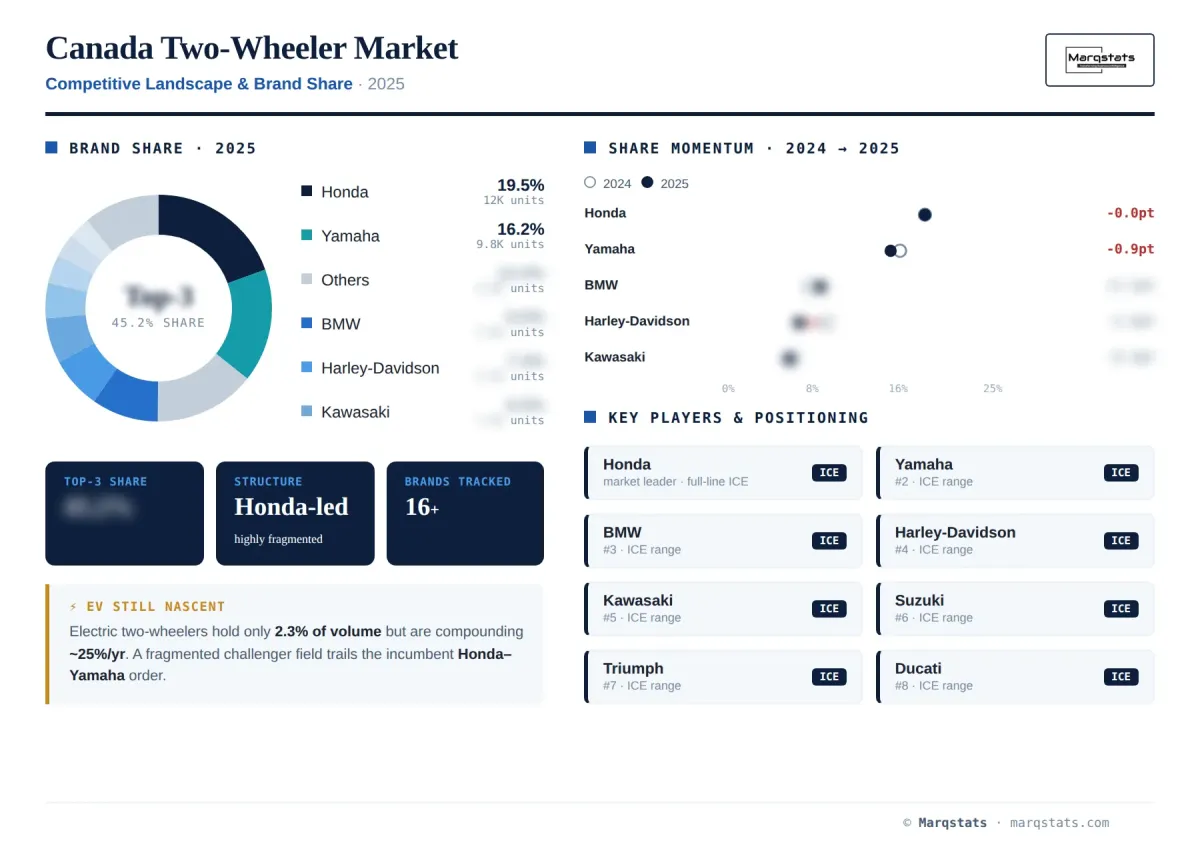
The Canada two-wheeler market is moderately concentrated. Honda leads with about 20% of volume across a range spanning scooters to large adventure machines, followed by Yamaha at about 16%. BMW holds about 10% and gained share through the downturn, while Harley-Davidson holds about 7%. The top four brands account for roughly 53% of volume, and a substantial tail of premium, cruiser, and specialist marques competes across the remainder.
The competitive field shifted decisively in 2025. Harley-Davidson registrations fell about 33%, reflecting the North American retreat from traditional cruiser machines. KTM and Husqvarna, both part of Pierer Mobility, fell about 47% and 42% respectively during their parent's financial restructuring. Against this, BMW gained share on adventure and touring demand, Royal Enfield grew about 11% on the modern-classic trend, and the Canadian manufacturer Can-Am expanded about 14%, the strongest performance among established brands.
The retreat of the cruiser segment is the market's defining structural story. Harley-Davidson and the touring category it anchors have depended on an ageing rider base, and replacement demand from younger buyers has not materialised at comparable price points. Those buyers are instead entering on smaller, cheaper, sport-oriented machines, a shift visible in the 13% regional gain for sport bikes concentrated entirely below 750cc. The consequence for Canada is a market whose dominant displacement band and dominant price band both contract while the market as a whole grows, a rebalancing that reshapes brand positions faster than it reshapes headline volume.
Competition centres on brand and capability at the premium end, where the great majority of volume sits, rather than on price. Growth is attributed to brands that combine strong adventure and touring portfolios with disciplined pricing, moreover rewarding those that adapt to smaller-displacement demand and digital retail. Honda's breadth, Yamaha's scale, BMW's premium momentum, the retreat of the cruiser and Pierer brands, and Can-Am's domestic position together define a market in which product mix and channel capability increasingly determine competitive position.
Companies Covered
The report profiles 16+ companies with full strategy and financials analysis, including:
Recent Market Activity
Table of Contents
Coverage & Segmentation
This report provides a comprehensive assessment of the Canada two-wheeler market across a 2025 base year, historical data from 2021 to 2025, and forecasts spanning 2026 to 2030. Market sizing is presented in unit-volume terms and complemented by value analysis in United States dollars, with segmentation by vehicle type, propulsion type, engine displacement and motor power, price band, end user, sales channel, and brand. Brand-level shares, segment growth rates, and competitive positioning are quantified to support commercial and investment decisions.
The scope covers demand drivers, restraints, and structural trends, with particular focus on the 2025 decline and the North American shift toward smaller machines, the dominance of large-displacement recreational riding, the retreat of the cruiser and off-road specialist brands, the growth of the domestic manufacturer Can-Am, digital retail expansion, and the early electrification transition. An extended forecast to 2035 is available under customization for subscribers requiring a longer planning horizon, alongside deeper cuts by province, brand, or channel on request.