Market Snapshot
Middle bar: base-year value × (1 + CAGR), rounded to two decimals. This is a calculated illustration, not a separately researched annual estimate.
The India EV mobile charging market size is estimated at USD 3.85 million in 2025 and is projected to reach USD 35.42 million by 2030, growing at a CAGR of 55.87% over 2026 – 2030. The active fleet of mobile charging units grows from about 158 to 1,520, a 57.27% annual rate, as carmakers bundle doorstep charging with new electric cars and delivery fleets use mobile chargers at depots without permanent grid connections.
Marqstats defines the market as the combined value of mobile charging hardware sold or commissioned in India and the revenue from mobile charging services. Hardware covers vans and light commercial vehicles fitted with battery storage and DC fast chargers, portable rescue chargers and mobile battery swapping units. Services cover scheduled doorstep charging subscriptions, emergency roadside charging, contracted charging at fleet depots and temporary power for events and sites. In rupee terms, the market grows from INR 33.47 crore in 2025 to INR 308.16 crore in 2030. Values are converted at INR 87.00 per US dollar. Fixed public and home chargers, fixed battery swapping stations and diesel generators are excluded.
Electric passenger cars account for an estimated 66.00% of 2025 value, scheduled doorstep charging for 53.00% and 30 kW to 60 kW mobile DC chargers for 57.99%. Delhi-NCR accounts for 42.99% of 2025 value. The study segments the market by vehicle type served, service model, charging technology and region.
Key Takeaways
Market Overview & Analysis
Report Summary
Marqstats sizes the India EV mobile charging market as the value of mobile charging hardware commissioned each year plus the revenue earned by mobile charging services. In 2025 the market was worth an estimated INR 33.47 crore, or USD 3.85 million, of which INR 14.70 crore came from about 60 new mobile charging units and INR 18.77 crore from charging services delivered by an active fleet of about 158 units.
Mobile charging brings the charger to the vehicle. A typical unit is a light commercial vehicle such as a Tata Ace EV fitted with a 40 kWh lithium iron phosphate battery, a 30 kW DC fast charger with a CCS2 connector, a smart meter and telematics, and fire suppression and earth fault protection. It delivers 15 to 20 kWh to an electric car in 30 to 45 minutes. Smaller trolley- or bike-mounted units of 5 kW to 11 kW rescue electric two- and three-wheelers, and mobile swap vehicles carry charged batteries for commercial scooters and rickshaws.
Demand comes from a housing gap. Most electric car owners in Delhi-NCR, Bengaluru, Mumbai, Pune and Hyderabad live in apartments, where resident welfare associations often delay or refuse charger installations over fire, metering and load concerns. Running a cable from the basement meter room to a parking bay can cost INR 40,000 to 90,000, more than the charger itself, and tenants or owners without a fixed bay often cannot install one at all. Local transformers are also near capacity in many neighbourhoods.
Regulation treats EV charging as a service, not a sale of electricity, so private companies can operate chargers without a distribution licence. The Ministry of Power guidelines for EV charging infrastructure issued in September 2024 cap the tariff for EV charging at the average cost of supply until March 2028, with cheaper rates during solar hours, and the battery swapping and charging station guidelines issued in January 2025 extend the framework to swapping. Mobile units must also meet Central Electricity Authority safety rules for earth continuity, residual energy and connector interlocks, and the converted vehicle must meet motor vehicle rules on weight and braking.
India sold about 2.27 million electric vehicles in calendar 2025, around 8% of all vehicle retail sales, including about 1.28 million two-wheelers, 0.80 million three-wheelers and 0.18 million passenger cars, with electric car sales up 77% on 2024. The market grew from INR 4.70 crore in 2021 to INR 7.30 crore in 2022, INR 12.69 crore in 2023 and INR 22.20 crore in 2024, and Marqstats expects INR 59.80 crore in 2026.
Mobile charging fills a specific gap rather than replacing fixed chargers. Public fast-charging hubs on highways and in commercial areas serve drivers who can stop and wait, while home chargers serve owners with a dedicated parking bay and approval to install. Mobile charging serves the large group in between: apartment residents without a home charger, tenants, households with more than one electric car, delivery fleets in leased depots without high-power connections, and drivers who run out of charge on the road. As long as electric car sales grow faster than charger installations in housing societies, this group keeps growing.
India EV Mobile Charging Market Size and Forecast
The India EV mobile charging market grows from USD 3.85 million in 2025 to USD 35.42 million in 2030, a CAGR of 55.87%. In rupees, Marqstats expects INR 59.80 crore in 2026, INR 95.01 crore in 2027, INR 146.27 crore in 2028 and INR 214.94 crore in 2029, before reaching INR 308.16 crore in 2030.
The active fleet grows from about 158 units in 2025 to 270 in 2026, 440 in 2027, 690 in 2028, 1,040 in 2029 and 1,520 in 2030. New units commissioned each year rise from about 60 to 480.
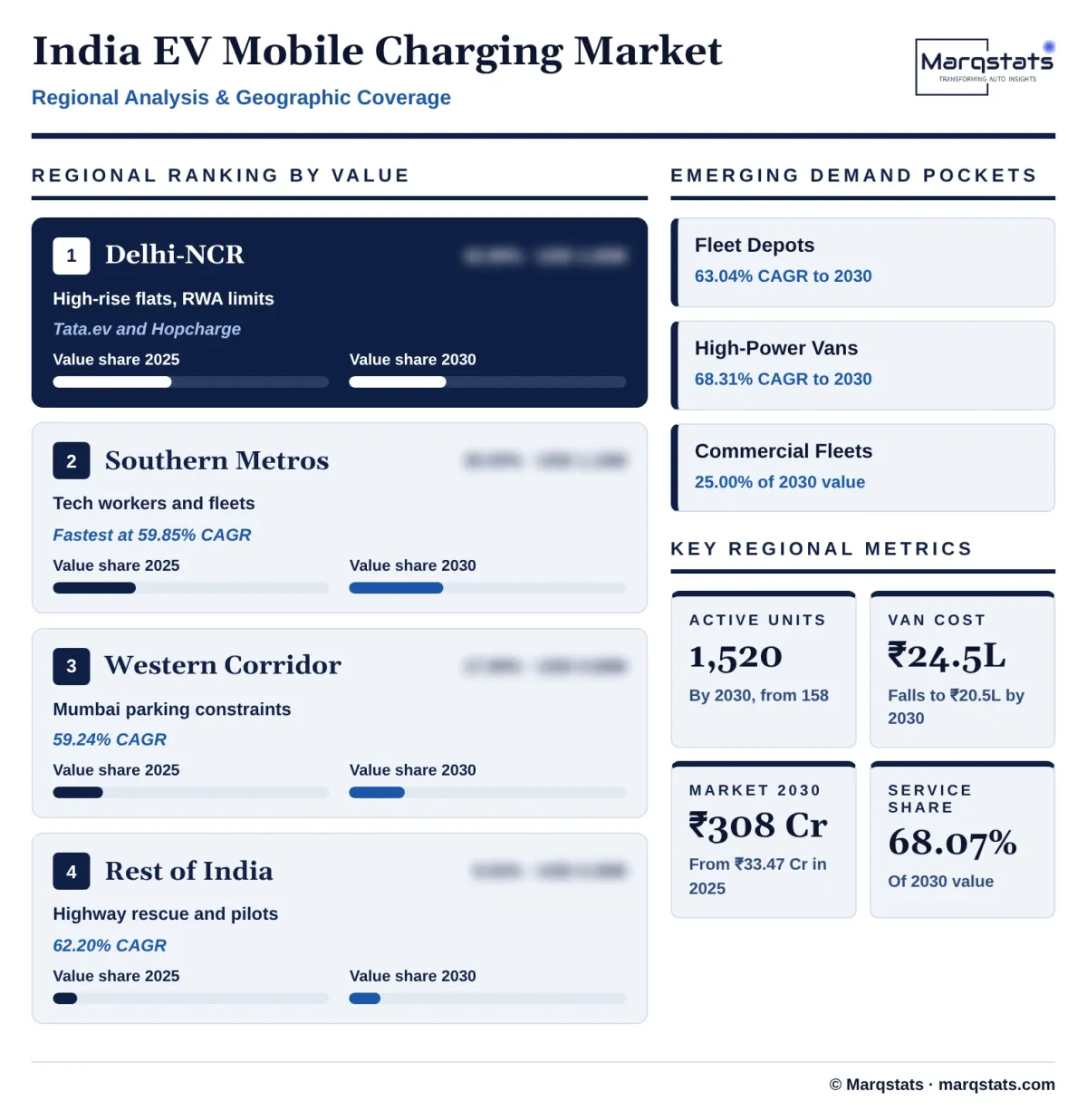
Hardware gets cheaper, services grow faster. Marqstats estimates the cost of a fully equipped mobile charging van falls from about INR 24.50 lakh in 2025 to INR 20.50 lakh in 2030 as battery and power electronics prices fall. Hardware value rises from INR 14.70 crore to INR 98.40 crore, while service revenue rises from INR 18.77 crore to INR 209.76 crore, lifting services from 56.08% to 68.07% of the market.
Utilisation drives service revenue. In 2025 an active van completed about 4.8 sessions a day over 330 days, earning about INR 11.88 lakh a year at a blended INR 750 a session. Subscription top-ups are priced at about INR 550 to 700 and emergency rescues at INR 1,200 to 1,800. Marqstats expects average use to rise to about 5.5 sessions a day by 2030, lifting revenue per van to about INR 13.80 lakh.
The cost structure shows why scale matters. In a Delhi-NCR example, a van earning INR 97,500 a month spends about INR 32,000 on two-shift staff, INR 22,160 on electricity at INR 7.50 per kWh, INR 8,500 on running the vehicle, INR 6,500 on a battery wear reserve and INR 7,500 on maintenance, insurance and software, leaving operating profit of about INR 20,800 a month, a 21.37% margin.
Marqstats tracks four indicators to monitor the forecast: the number of carmaker partnerships offering bundled mobile charging, the number of delivery and logistics depots using contracted mobile charging, average sessions per van per day, and the cost of the battery and charger fitted to each van.
The mix of the market shifts toward commercial use. Fleet depot charging rises from 15.98% to 20.00% of value and electric commercial fleets from 23.01% to 25.00%, while two- and three-wheelers fall from 10.99% to 8.00% because fixed battery swapping serves most commercial riders. High-power battery vans of 100 kW to 150 kW rise from 15.00% to 22.00% of value as premium cars with 800-volt systems and larger batteries enter the market. Southern metros rise from 30.00% to 34.00% of value and Delhi-NCR falls from 42.99% to 35.00% as operators expand beyond NCR.
Market Dynamics
Key Drivers
Five forces are expanding demand for charging that comes to the vehicle in India.
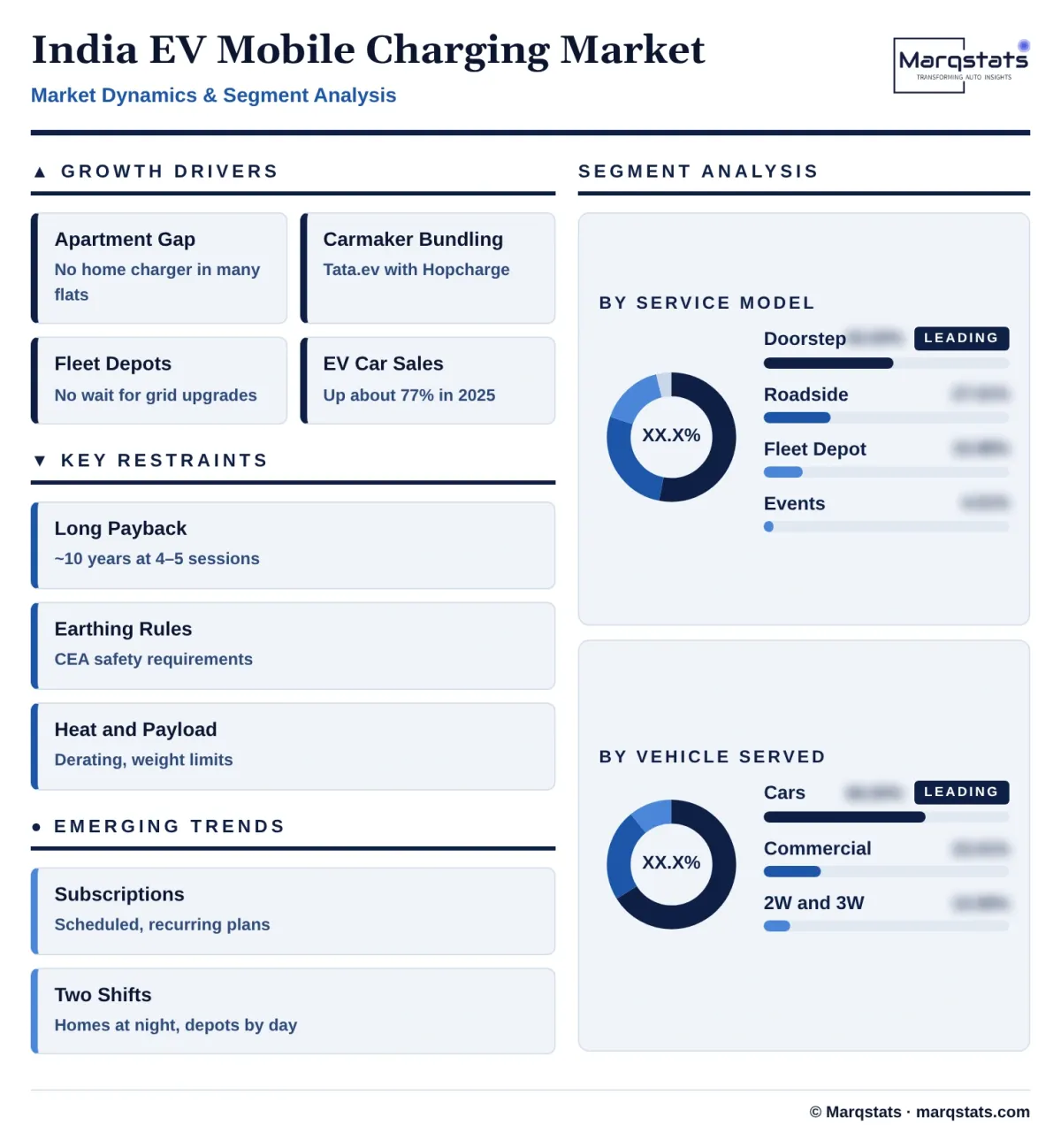
- The apartment charging gap. Residents of apartment complexes in Tier-1 cities often cannot get permission, cabling or load sanction for a home charger, and mobile charging reaches them without any building works.
- Carmaker bundling. Tata.ev offers complimentary doorstep charging through Hopcharge to new buyers in Delhi-NCR, using mobile charging to remove a barrier to electric car sales.
- Fleet electrification. Delivery and logistics operators adding electric vans to leased depots can use mobile chargers during loading windows instead of waiting months for high-power grid connections.
- Fast-growing electric car sales. Electric car retail sales rose about 77% in 2025 to about 177,000, creating a growing base of owners in cities where fixed chargers are hard to install.
- Supportive charging rules. Treating EV charging as a de-licensed service and capping charging tariffs at the average cost of supply until March 2028 keep energy costs predictable for operators that recharge their vans at depots.
Key Restraints
Four constraints limit how fast mobile charging fleets can grow profitably.
- Long payback at low use. At about four to five sessions a day, a mobile charging van takes close to ten years to pay back its cost, so operators that rely on ad-hoc emergency calls struggle to make money.
- Safety and earthing requirements. Grounding a mobile charger parked on a road surface and meeting Central Electricity Authority rules for earth continuity and residual energy require extra monitoring and protection equipment.
- Heat and payload limits. Summer temperatures in north and west India force batteries and chargers to derate and draw power for cooling, and the weight of a 40 kWh to 60 kWh battery pushes light commercial vehicles close to their legal weight limit.
- Competition from fixed chargers. The public network reached 52,718 stations in July 2026, and as more chargers are installed in housing societies and offices, the need for doorstep charging in some locations will fall.
Key Trends
Four shifts are changing how mobile charging is sold and operated in India.
- Subscriptions replace one-off calls. Operators are moving from emergency rescue to scheduled subscription plans that give predictable routes and recurring revenue.
- Two shifts per van. Vans serve apartment complexes in the evening and overnight and delivery depots, offices and roadside calls during the day, roughly doubling daily sessions.
- Higher-power units. Operators are adding 100 kW to 150 kW units with liquid-cooled batteries to serve 800-volt electric cars and larger commercial batteries.
- Mobile units as a test for fixed chargers. Charge point operators use mobile units to measure demand in new areas before investing in permanent fast-charging hubs.
Strategic Implications
- For new operators, contracts come first. Signing delivery fleets, corporate campuses and carmaker programmes before relying on consumer subscriptions gives stable baseload revenue and dense routes.
- For charge point operators, mobile units reduce site risk. Deploying vans to test demand in new localities before building permanent hubs lowers the chance of under-used fixed chargers.
- For carmakers, bundled charging supports sales. Partnering with specialist mobile charging providers lets carmakers address home-charging concerns for apartment buyers without owning or running the vans.
- For fleet operators, mobile charging buys time. Contracted mobile charging lets operators electrify depots quickly while grid upgrades are planned, then shift to fixed chargers where volumes justify it.
- For equipment makers, weight and heat are the design priorities. Lighter batteries, efficient cooling and integrated safety systems increase usable energy per trip and the number of sessions a van can complete.
- For housing societies and property developers, mobile charging is a stopgap. Societies that cannot yet approve or fund common chargers can allow scheduled mobile charging in visitor or common parking, while new projects increasingly plan wiring and load for fixed chargers from the start.
Market Segmentation
Electric passenger cars account for 66.00% of 2025 value, INR 22.09 crore or USD 2.54 million, rising to INR 206.47 crore or USD 23.73 million by 2030, a 56.36% CAGR, and 67.00% of the market. Apartment residents without a home charger and buyers of new Tata.ev models with bundled doorstep charging drive demand.
Electric light commercial vehicles and vans account for 23.01% of 2025 value, INR 7.70 crore, and grow fastest, at 58.51% a year, to INR 77.04 crore and 25.00% of the market by 2030, as delivery operators top up vans at depots during loading windows.
Electric two- and three-wheelers account for 10.99% of 2025 value, INR 3.68 crore, rising to INR 24.65 crore by 2030, a 46.28% CAGR, while their share falls to 8.00%. Small batteries mean low revenue per session, and fixed battery swapping networks serve most commercial riders.
Scheduled doorstep charging in residential and office car parks accounts for 53.00% of 2025 value, INR 17.74 crore, rising to INR 160.24 crore by 2030, a 55.30% CAGR, and 52.00% of the market. Subscription plans give operators predictable routes and recurring revenue.
Emergency roadside charging for vehicles that run out of charge accounts for 27.01% of 2025 value, INR 9.04 crore, rising to INR 77.04 crore by 2030, a 53.50% CAGR, through roadside assistance networks and carmaker programmes.
Contracted mobile charging at logistics hubs and sorting yards accounts for 15.98% of 2025 value, INR 5.35 crore, and grows fastest, at 63.04% a year, to INR 61.63 crore and 20.00% of the market by 2030.
Short-term power for exhibitions, construction sites and remote locations accounts for 4.00% of 2025 value, INR 1.34 crore, rising to INR 9.25 crore by 2030, a 47.17% CAGR.
Mobile DC fast chargers of 30 kW to 60 kW with built-in battery storage account for 57.99% of 2025 value, INR 19.41 crore, rising to INR 178.73 crore by 2030, a 55.90% CAGR, as they balance vehicle payload, battery size and charging speed.
High-power battery vans of 100 kW to 150 kW account for 15.00% of 2025 value, INR 5.02 crore, and grow fastest, at 68.31% a year, to INR 67.80 crore and 22.00% of the market by 2030, serving 800-volt cars and commercial vehicles.
Portable chargers of 5 kW to 11 kW on trolleys or bikes for two- and three-wheelers and roadside rescue account for 17.99% of 2025 value, INR 6.02 crore, rising to INR 40.06 crore by 2030, a 46.09% CAGR.
Mobile battery swapping vehicles carrying charged packs for commercial scooters and rickshaws account for 9.02% of 2025 value, INR 3.02 crore, rising to INR 21.57 crore by 2030, a 48.17% CAGR.
By Geography
Delhi-NCR
Delhi-NCR is the largest market, with an estimated 42.99% of 2025 value, INR 14.39 crore or USD 1.65 million, and about 66 of the 158 active units, rising to INR 107.86 crore or USD 12.40 million by 2030, a 49.61% CAGR, while its share falls to 35.00%. High-rise apartment complexes in Gurugram, Noida and Greater Noida, resident association restrictions on chargers and the Tata.ev and Hopcharge partnership make NCR the core market.
Southern Metros
Bengaluru, Hyderabad, Chennai and Kochi account for an estimated 30.00% of 2025 value, INR 10.04 crore, and about 49 active units, and grow fastest, at 59.85% a year, to INR 104.77 crore and 34.00% of the market by 2030. High electric car adoption among technology workers, large tech parks and active delivery fleets drive demand, and Bengaluru hosts roadside assistance provider ReadyAssist.
Western Corridor
Mumbai, Pune, Thane, Navi Mumbai, Ahmedabad and Surat account for an estimated 17.99% of 2025 value, INR 6.02 crore, and about 29 active units, rising to INR 61.63 crore by 2030, a 59.24% CAGR. Severe parking constraints and older cooperative housing in Mumbai, where rewiring is costly, favour doorstep charging for premium electric car owners.
Rest of India
Kolkata, Chandigarh, Jaipur, Lucknow and national highway corridors account for an estimated 9.02% of 2025 value, INR 3.02 crore, and about 14 active units, rising to INR 33.90 crore by 2030, a 62.20% CAGR and 11.00% of the market, mainly from highway emergency charging and city pilots.
How Competition Is Evolving
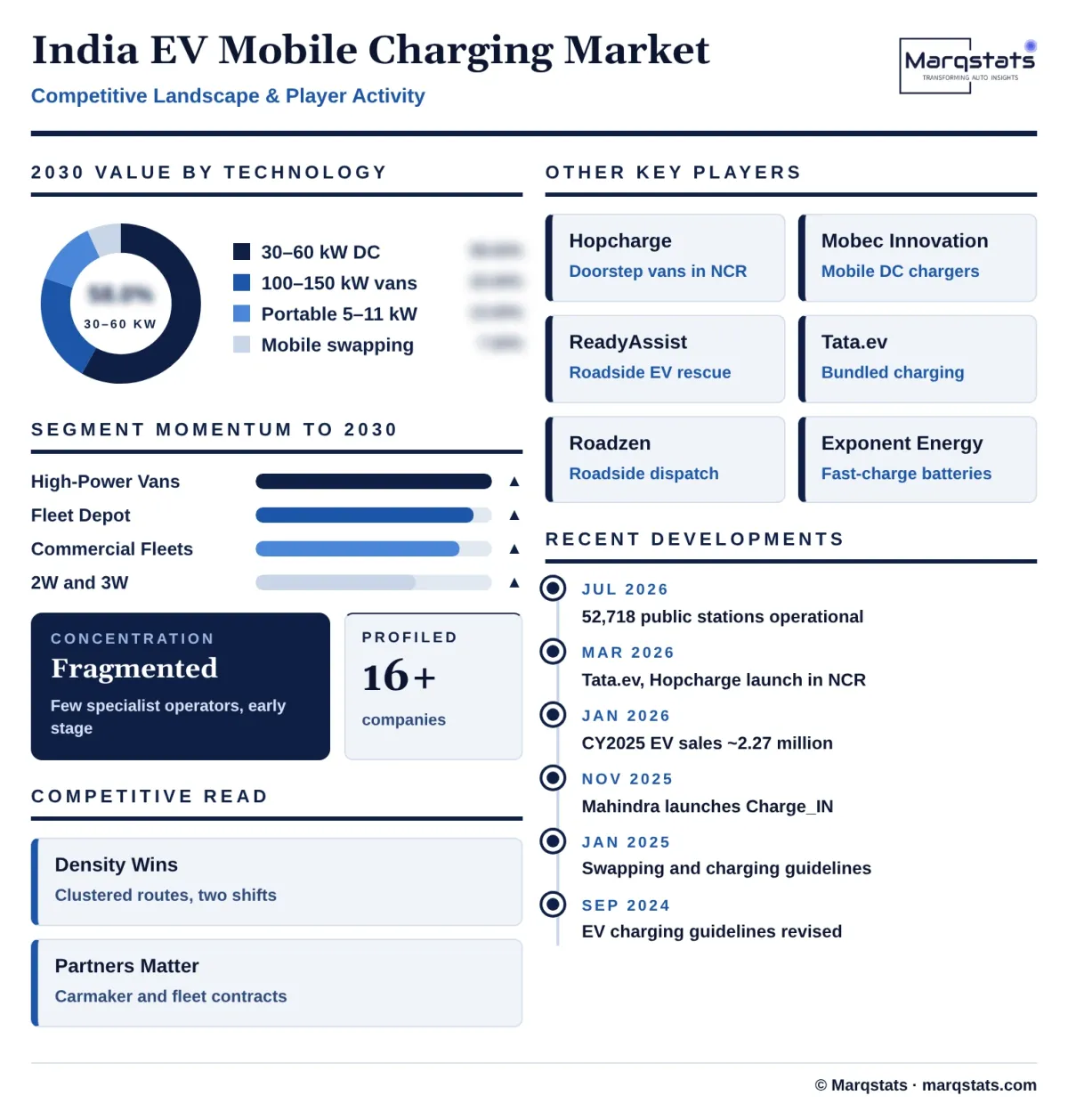
The India EV mobile charging market is fragmented and at an early stage. A few specialist operators, Hopcharge in Delhi-NCR and Mobec Innovation in Noida, run most dedicated mobile charging vans, while roadside assistance networks such as ReadyAssist, Roadzen and Europ Assistance offer emergency charging alongside towing and repair.
Carmakers participate through partnerships rather than owning vans. Tata.ev bundles complimentary Hopcharge doorstep charging with new cars in NCR, and other carmakers include emergency charging in roadside assistance programmes for their electric models. This keeps the capital cost of vans off carmaker balance sheets.
Hardware is built locally on Indian light commercial vehicles, with lithium iron phosphate batteries and DC chargers integrated by operators and specialist body builders. Charging technology firms such as Exponent Energy develop battery and fast-charging systems that can be adapted to mobile use.
Competition will be decided by route density and partnerships. Operators that sign carmaker and fleet contracts, cluster customers in neighbouring housing complexes and run vans across two shifts will reach profitability first.
Fixed charging networks are part of the competitive picture. Tata Power EV Charging Solutions, Statiq, ChargeZone, Jio-bp pulse and Mahindra Charge_IN are expanding public fast-charging hubs, and Bolt.Earth supplies chargers for housing societies and workplaces. Each fixed charger installed in a housing society or office reduces the need for doorstep charging at that location, so mobile operators focus on places where fixed charging is slow or costly to install and on fleets that need flexible capacity.
Companies Covered
Companies covered in the report include:
Recent Market Activity
Table of Contents
Coverage & Segmentation
The study covers the India EV mobile charging market, with 2025 as the base year, 2021 – 2025 as the historical period and 2026 – 2030 as the forecast period. Values are in US dollars and Indian rupees, converted at INR 87.00 per US dollar. The market covers the value of mobile charging hardware commissioned each year and the revenue from mobile charging services, segmented by vehicle type served, service model, charging technology and region.
Fixed public, workplace and home chargers, fixed battery swapping stations, diesel generators and fuel delivery are excluded. Segment and regional splits are Marqstats estimates built on operator fleet data, van cost and utilisation benchmarks, carmaker partnership announcements and EV sales data.