Market Snapshot
Key Takeaways
Market Overview & Analysis
Report Summary
The India EV insurance market comprises motor insurance premiums written on battery-electric vehicles registered across all states and union territories, spanning third-party liability, own-damage and comprehensive cover together with electric-specific add-ons. This study segments the market by vehicle category, coverage type, distribution channel, add-on product, insurer type and region, with a 2025 base year, historical coverage from 2021 to 2025, and forecasts to 2030. Market size is stated as gross written premium.
Sizing is derived rather than estimated directly. Gross written premium is computed as insurable electric vehicle parc multiplied by average annual premium per vehicle within each category, with both inputs stated so that a reader who disagrees with either can substitute and recompute. The parc was built from cumulative registrations net of retirements, and validated against the 1.96 million electric vehicles registered during the 2024-25 fiscal year, of which about 1.14 million were two-wheelers.
The regulated tariff structure anchors the two-wheeler segment. Third-party premium for private electric two-wheelers up to 3 kilowatts is fixed at 457 rupees annually, which is materially below the petrol equivalent because of the mandated 15% electric vehicle discount. Average realised premium across the electric two-wheeler parc runs higher than the tariff, reflecting own-damage and add-on cover taken by the comprehensive-insured share, though the regulated floor keeps segment revenue per vehicle low.
The depreciation treatment of batteries is the most consequential technical detail in this market and the least understood by buyers. The regulator classifies the battery under the standard depreciation schedule, reaching 50% at the relevant age band, so a pack replacement claim settles at half the component value unless the policyholder holds zero-depreciation cover. On a mid-market electric compact sport-utility vehicle, that gap can leave an owner roughly 1.75 lakh rupees out of pocket on a single claim.
Market Dynamics
Key Drivers
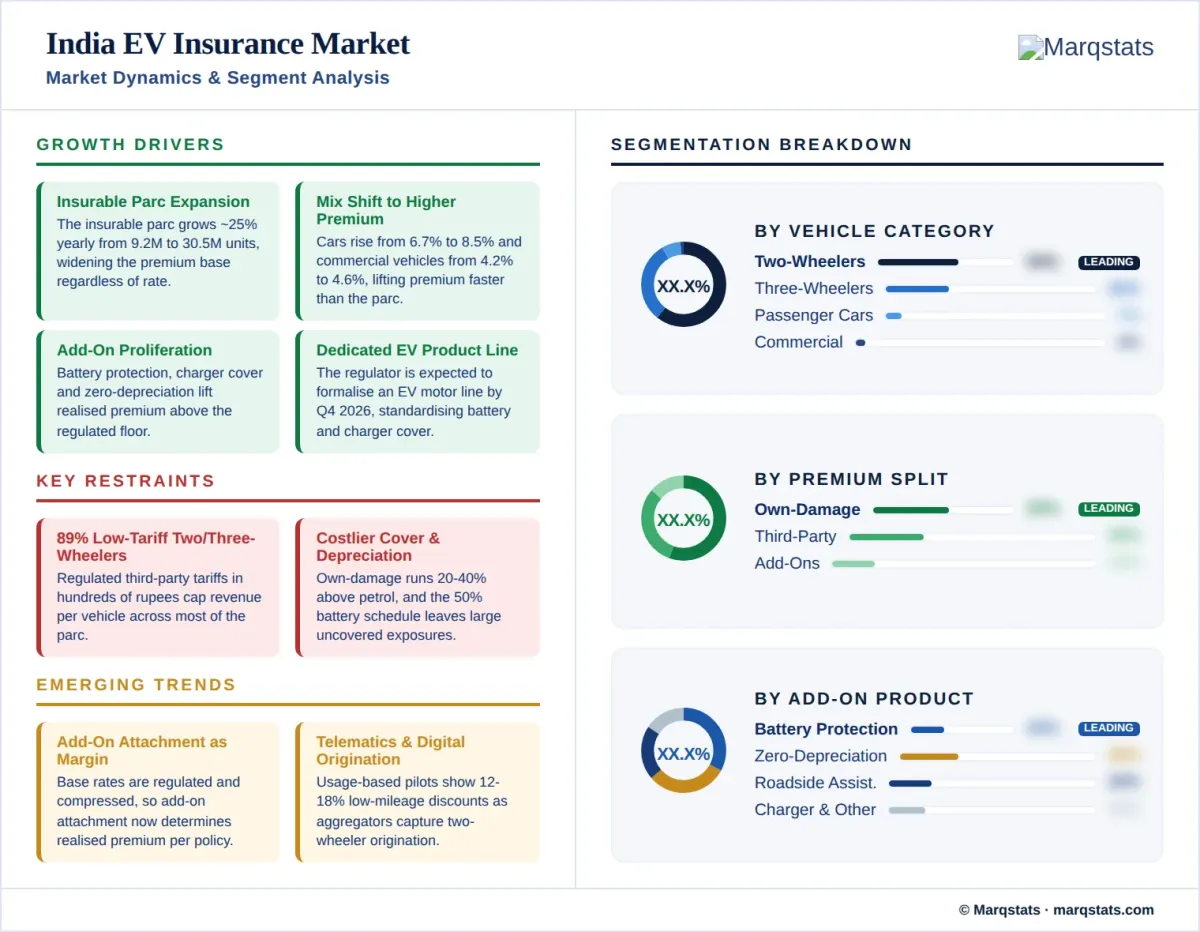
- The insurable electric vehicle parc grows at a 25.49% CAGR from 9.20 million to 30.50 million units, expanding the premium base regardless of rate movement.
- Vehicle mix shifts toward higher-premium categories, with electric passenger cars rising from about 6.7% to about 8.5% of the parc and commercial vehicles from about 4.2% to about 4.6%.
- Electric-specific add-ons are proliferating, including battery protection, charger cover, roadside assistance and zero-depreciation, lifting realised premium above the regulated floor.
- The regulator is expected to formalise a dedicated electric vehicle motor insurance product line by the fourth quarter of 2026, standardising battery and charging equipment cover.
- Telematics-based usage pricing is in pilot with major private insurers, with early data indicating discounts of 12% to 18% for owners driving under 12,000 kilometres annually.
Key Restraints
- Two-wheelers and three-wheelers account for about 89% of the parc at regulated third-party tariffs measured in hundreds of rupees, capping revenue per vehicle.
- Own-damage premiums run 20% to 40% above petrol equivalents, discouraging comprehensive uptake among price-sensitive buyers.
- Battery depreciation at the standard 50% schedule creates large uncovered exposures that damage customer satisfaction and complicate claims settlement.
- Repair network capability for high-voltage systems remains thin outside metropolitan centres, extending claim cycle times and raising loss adjustment costs.
Key Trends
- Add-on attachment is becoming the principal margin lever, since base rates are regulated on the third-party component and competitive on own-damage.
- Usage-based pricing pilots are moving toward commercial launch, supported by connected-vehicle data from electric two-wheeler manufacturers.
- Digital aggregators are capturing a growing share of electric vehicle policy origination, particularly in the two-wheeler segment.
- Insurers are building battery state-of-health assessment capability to price own-damage risk and to contest inflated pack replacement claims.
Market Segmentation
Electric two-wheelers account for about 59% of the 2025 insurable parc and rise to about 62% by 2030, though they contribute a far smaller share of premium because third-party tariffs are regulated at 457 rupees annually for units up to 3 kilowatts. Electric three-wheelers account for about 30% of the parc and generate proportionally more premium, since commercial use requires higher liability limits and operators carry own-damage cover more consistently than private two-wheeler owners.
Electric passenger cars account for about 6.7% of the 2025 parc and rise to about 8.5% by 2030, yet they generate a disproportionate share of premium because comprehensive cover on a vehicle with a battery worth several lakh rupees commands premiums an order of magnitude above two-wheeler levels. Electric buses and commercial vehicles account for about 4.2% of the parc and generate the highest premium per unit of any category, driven by fleet liability limits and high asset values.
Third-party liability is compulsory and therefore covers effectively the entire insured parc, and it is the segment the regulator controls directly. The mandated 15% discount for electric vehicles applies to the basic third-party premium and 7.5% to hybrids, applied under the statutory rate-setting power and stated explicitly as an incentive for environmentally friendly vehicles. Because rates are fixed, insurers compete on nothing within this segment and margin is determined entirely by claims experience.
Own-damage cover is where electric vehicle premiums exceed petrol equivalents by 20% to 40%, and where insurers set rates competitively rather than under tariff. The premium reflects battery value as a proportion of vehicle cost, limited repair network capability and uncertainty over long-run battery degradation and residual value. Comprehensive uptake is materially higher among car owners than among two-wheeler owners, and the gap between the two is the principal determinant of realised premium per vehicle.
Battery protection cover is the most commercially significant add-on in this market and addresses the depreciation gap directly, restoring full pack value where the standard schedule would settle at half. Zero-depreciation cover performs a comparable function across all components and is effectively essential for electric vehicle owners given battery value concentration. Charger and charging equipment cover has emerged as a distinct product, protecting home wall-box installations that fall outside conventional motor policies.
Roadside assistance carries particular value for electric vehicles because a depleted battery cannot be resolved with a fuel can, and towing to a capable workshop may involve considerable distance outside metropolitan areas. Consumables cover, engine or motor protection and return-to-invoice options complete the standard add-on suite. Attachment rates for the full suite remain well below car-segment levels in two-wheelers, which represents the clearest near-term revenue opportunity for insurers.
Digital aggregators have captured a growing share of electric vehicle policy origination, particularly in the two-wheeler segment where price comparison dominates purchase behaviour and policy values are too small to support intermediated distribution economics. Direct-to-consumer digital insurers have built strong positions in the same segment. Electric vehicle buyers skew younger and more digitally engaged than the motor insurance average, which reinforces the channel shift.
Traditional agent and broker channels retain the majority of electric car premium, where policy values support advice-led distribution and where add-on selection materially affects outcomes. Dealer-embedded distribution at the point of vehicle sale is significant across all categories and particularly strong in the three-wheeler and commercial segments, where financing and insurance are frequently bundled. Manufacturer-affiliated distribution is growing as electric vehicle makers build captive or partnered insurance offerings.
Private general insurers hold the majority of electric vehicle premium and have moved fastest on product development, add-on design and telematics pilots. Their advantage rests on underwriting flexibility, digital distribution capability and willingness to price own-damage risk on limited historical data. The largest private insurers are running usage-based pricing pilots with connected-vehicle data, and early results indicate discounts of 12% to 18% for low-mileage owners.
Public sector insurers retain substantial share in commercial vehicle and three-wheeler categories, where established fleet relationships and rural distribution reach matter more than digital experience. Digital-first insurers have concentrated on the two-wheeler and private car segments, competing on purchase and claims experience rather than price, and they have been early to electric-specific add-on design because their customer base skews toward newer vehicles.
Maharashtra, Gujarat, Karnataka, Tamil Nadu and Kerala together account for the largest share of electric vehicle premium, reflecting both higher electric vehicle registration density and higher comprehensive cover uptake. The southern states record particularly strong electric two-wheeler adoption, while Maharashtra and Karnataka concentrate electric car registrations in Mumbai, Pune and Bengaluru where household incomes and charging availability are highest.
Delhi and the National Capital Region generate premium well above their registration share, driven by high electric car penetration and by state incentives that accelerated adoption. Uttar Pradesh, Bihar and West Bengal account for a very large share of the electric three-wheeler parc, since e-rickshaws form the backbone of last-mile transport across those states, though insurance penetration in that category is materially below the national average and represents a significant uninsured exposure.
By Geography
West India
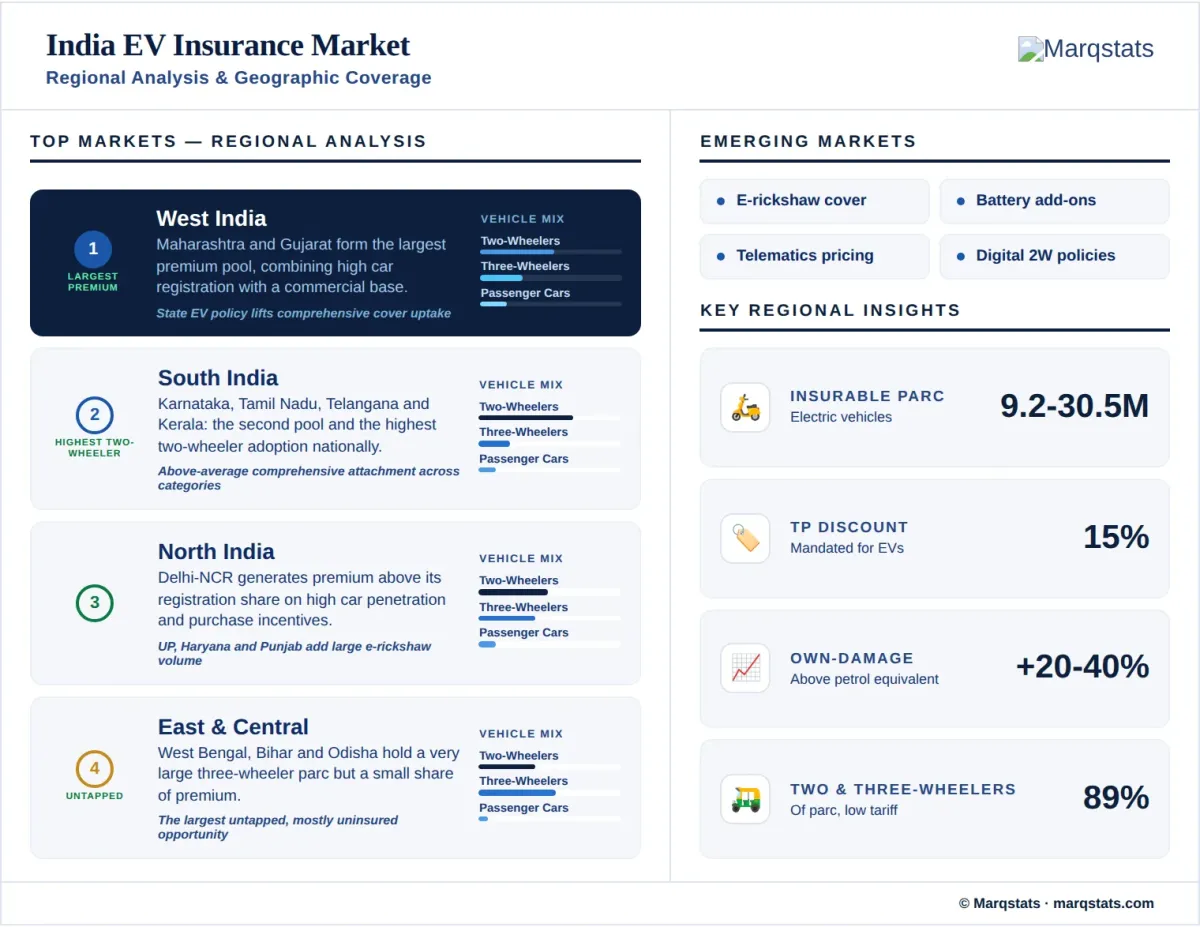
Maharashtra and Gujarat form the largest regional premium pool, combining high electric car registration in Mumbai, Pune and Ahmedabad with a substantial commercial vehicle base. Maharashtra's state electric vehicle policy and its concentration of corporate fleets have supported comprehensive cover uptake above the national average. Gujarat contributes strongly through electric three-wheeler and commercial registrations serving industrial and logistics corridors.
South India
Karnataka, Tamil Nadu, Telangana, Andhra Pradesh and Kerala together generate the second-largest premium pool and record the highest electric two-wheeler adoption in the country. Bengaluru, Chennai and Hyderabad concentrate electric car registrations, and the region hosts most of the country's electric two-wheeler manufacturing base, which supports dealer-embedded and manufacturer-affiliated insurance distribution. Comprehensive attachment rates run above the national average across categories.
North India
Delhi and the National Capital Region generate premium well above their share of registrations, reflecting high electric car penetration supported by state purchase incentives and by vehicle age restrictions that accelerated fleet replacement. Uttar Pradesh, Haryana, Punjab and Rajasthan contribute large electric three-wheeler volumes, particularly e-rickshaws serving last-mile transport, where insurance penetration is materially below the national average.
East & Central India
West Bengal, Bihar, Odisha, Jharkhand, Madhya Pradesh and Chhattisgarh account for a very large share of the electric three-wheeler parc and a small share of premium. E-rickshaws form the backbone of last-mile passenger transport across these states, frequently financed informally and insured inconsistently, which creates both a substantial uninsured exposure and the single largest untapped premium opportunity in the market. Electric car registrations remain concentrated in Kolkata and the state capitals.
How Competition Is Evolving
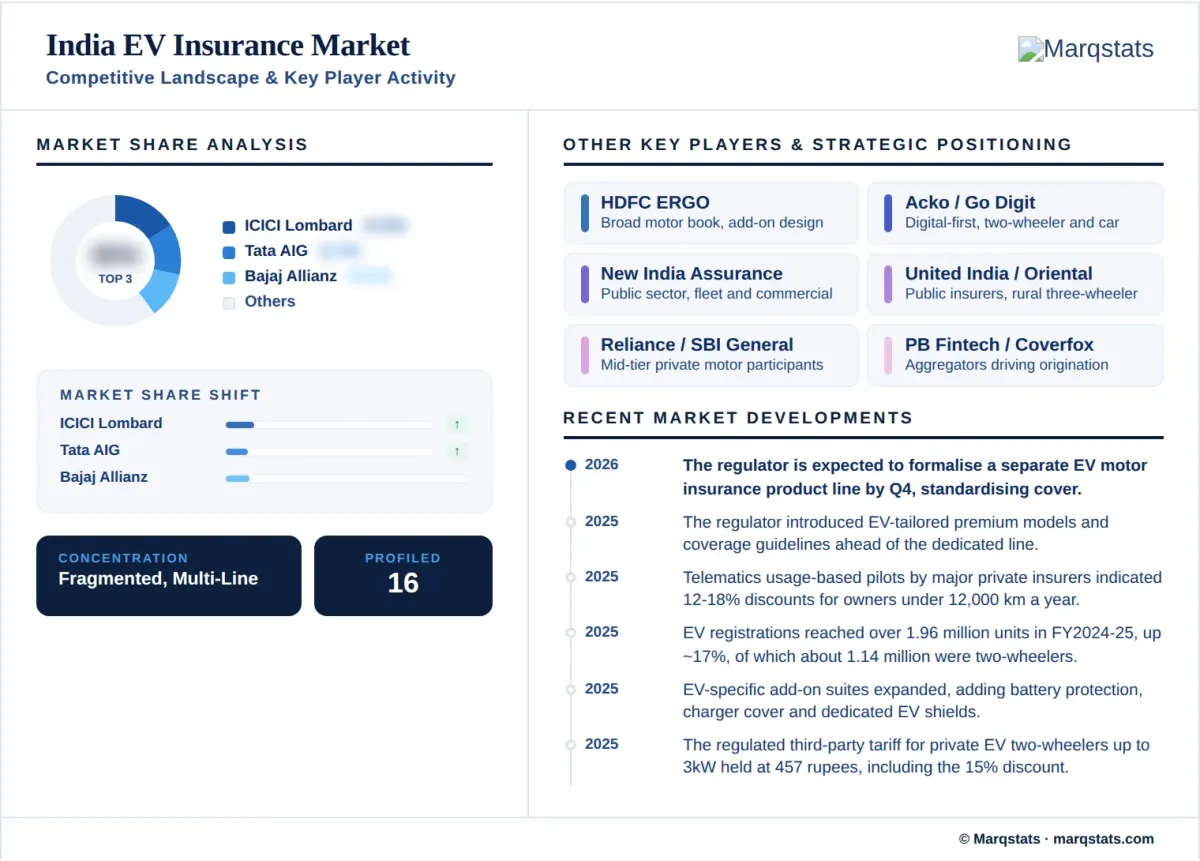
The India EV insurance market is contested within the wider motor insurance sector rather than as a standalone segment, and no insurer has established a dominant electric-specific position. Private general insurers collectively hold the majority of electric vehicle premium, having moved fastest on product development and add-on design, while public sector insurers retain substantial share in commercial vehicle and three-wheeler categories through established fleet relationships and rural distribution reach.
Competition centres on add-on attachment rather than on base rate, because the regulator fixes third-party premium and own-damage rates are competitively compressed. Battery protection, zero-depreciation, charger cover and roadside assistance together determine both realised premium per policy and customer outcomes at claim, and insurers that explain the battery depreciation gap effectively at point of sale achieve materially higher attachment. Distribution partners have become the practical arbiter of that explanation.
Telematics represents the clearest available differentiation. Usage-based pricing pilots run by the largest private insurers using connected-vehicle data indicate discounts of 12% to 18% for owners driving under 12,000 kilometres annually, which is a substantial proportion of the electric car base given that many are second household vehicles used for urban commuting. Electric vehicles are better suited to this than combustion vehicles because connectivity is standard rather than optional.
The regulatory calendar is the principal near-term variable. A dedicated electric vehicle motor insurance product line is expected to be formalised by the fourth quarter of 2026, standardising battery and charging equipment cover. That would convert what are currently competitively differentiated add-ons into standard product features, compressing a margin source and shifting competition back toward claims service and distribution reach. Insurers that have built battery assessment capability will be better placed when it occurs.
Companies Covered
The report profiles 16+ companies with full strategy and financials analysis, including:
Recent Market Activity
Table of Contents
Coverage & Segmentation
This report provides a comprehensive assessment of the India EV insurance market across a 2025 base year, historical data from 2021 to 2025, and forecasts spanning 2026 to 2030. Market size is stated as gross written premium in United States dollars converted from a rupee base, alongside the insurable electric vehicle parc as the volume metric. Segmentation covers six dimensions. Only battery-electric vehicles are counted; hybrids are noted where the regulator treats them differently and are excluded from market size.
The scope covers demand drivers, restraints and structural trends, with particular focus on the mandated third-party discount set against higher own-damage rates, battery depreciation treatment and the resulting uncovered exposure, add-on attachment as the principal margin lever, telematics pricing pilots, and the regulatory product-line change expected in 2026. Vehicle-market context is available in the India Used Car Market report. An extended forecast to 2035 is available under customization, alongside state-level premium analysis on request.