Market Snapshot
Key Takeaways
Market Overview & Analysis
Report Summary
The EV motor shaft grounding ring market sits at the intersection of EV powertrain reliability, NVH compliance, and EMC certification. Inverter-driven traction motors generate high-frequency common-mode voltage that couples through motor parasitic capacitances, creating bearing voltage and bearing current. Without controlled mitigation, these currents discharge through motor bearings causing electrical discharge machining (EDM), pitting, fluting, lubricant degradation, NVH issues, and premature bearing failure. The problem intensifies in 800V architectures, SiC-inverter platforms, and compact high-speed e-axles where the cost of failure is substantial owing to integrated, sealed, hard-to-service e-axle designs.
Component categories split between specialist grounding solutions and integrated bearing alternatives. Conductive microfiber rings (AEGIS, with patented FiberLock channel) channel currents away from bearings using millions of microfiber discharge points circumferentially around the shaft. Conductive brush rings (SKF, KACO, Schunk, Helwig, Inpro/Seal) use carbon fibre, silver graphite, or proprietary brush materials. Electrical bypass plates (NSK-Warner) use conductive paper pressed by a diaphragm spring against the bearing inner ring, providing surface-to-surface contact in a thin axial space. Axial conductive brush concepts (NSK) contact the shaft at the central axis where peripheral speed is zero, maintaining conductivity in oily and high-speed conditions. Hybrid ceramic insulated bearings (SKF, Schaeffler, NSK, Niterra silicon nitride) provide an alternative path by electrically insulating the bearing itself.
Per-vehicle component value ranges from approximately USD 8 in cost-down high-volume Chinese passenger BEV applications to USD 25 or more in premium 800V SiC-inverter platforms. Dual-motor and tri-motor architectures multiply addressable content per vehicle, with average motors-per-EV ranging from 1.10 in entry BEVs to 1.35 in AWD premium and performance configurations. Smaller traction motors deployed across two-wheeler and three-wheeler EV platforms within the India Two-Three Wheeler Motor Market typically operate at lower voltage and lower power, reducing bearing-current severity per unit but expanding the addressable motor count base.
The competitive battlefield is shifting from external-mount industrial-style grounding rings toward integrated, compact, oil-compatible, high-speed-capable solutions positioned inside the e-axle. KACO showcased shaft grounding schemes for water-cooled and oil-cooled motors at a Schaeffler-hosted New Energy Vehicle powertrain seminar in Anting Town in June 2025, presenting working principles, structural design, conductive material selection, test data, and patented solutions. The KACO presentation reflects the broader Chinese supplier strategy of combining low-cost manufacturing with engineering-grade IP. SKF Conductive brush rings are available in different configurations for wet (oil lubricated) and dry (sealed) motor designs. NSK-Warner’s Electrical Bypass Plate is engineered to be inserted between bearing and housing without press-fitting equipment, supporting design flexibility in eAxles.
Market Dynamics
Key Drivers
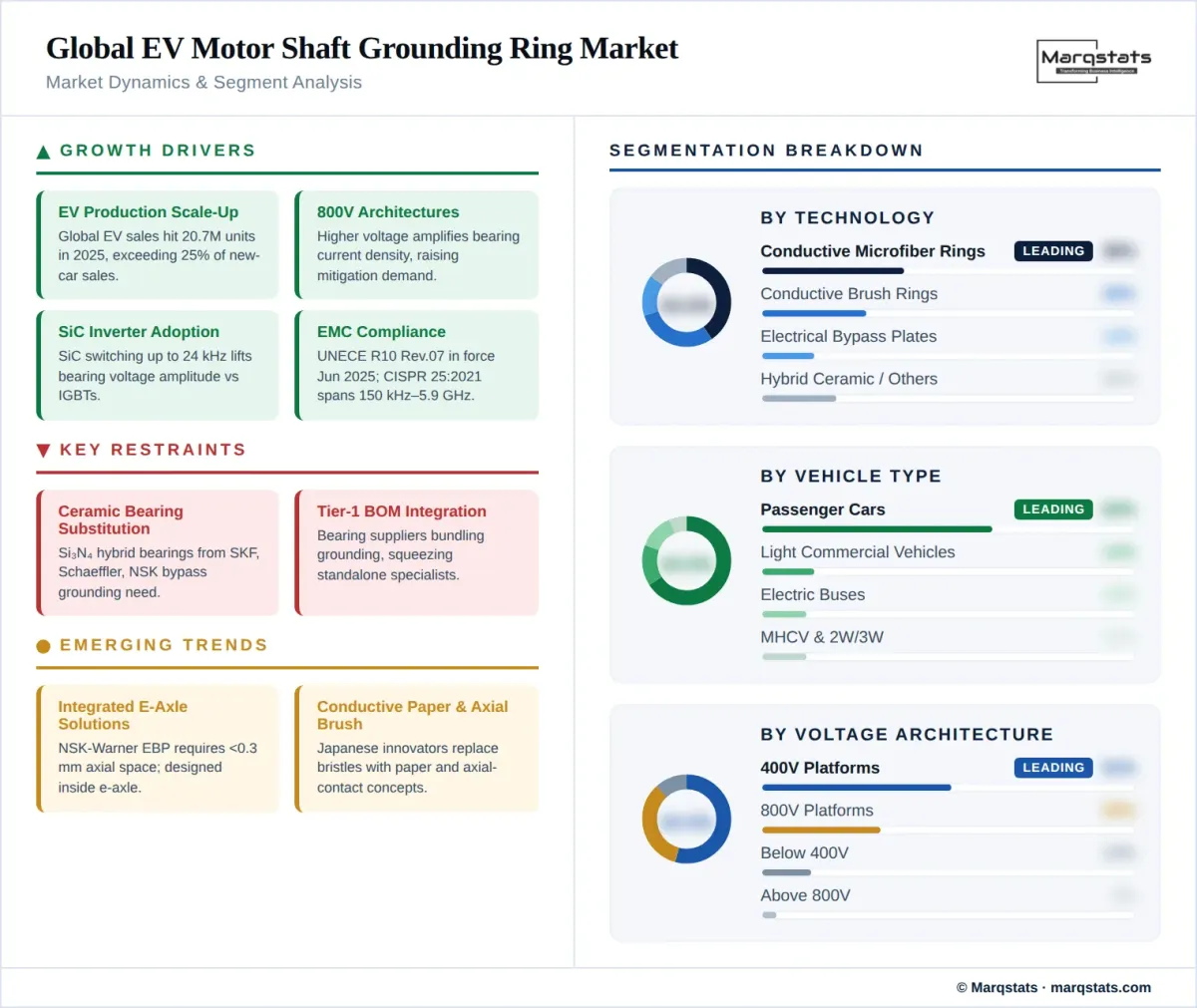
- EV production scale-up drives volume demand. Each new electric traction motor and e-axle creates incremental addressable content for shaft grounding rings or alternative bearing-current mitigation. China at 12.4 million EV units in 2024 anchors the largest regional demand pool, followed by Europe, North America, Japan, and Korea.
- Higher-voltage EV platforms increase electrical corrosion risk. 800V architectures increase shaft voltage amplitude and bearing current density; OEMs deploying 800V SiC-inverter premium platforms face elevated warranty exposure if bearing protection is not robust, making grounding components a low-cost insurance investment.
- SiC inverter adoption raises high-frequency electrical stress. Silicon carbide MOSFETs switch faster than silicon IGBTs, reduce switching losses by approximately 50%, and support switching frequency up to 24 kHz. Higher switching frequency excites parasitic capacitances and raises bearing voltage amplitude, increasing the importance of grounding and EMC mitigation.
- Warranty, NVH, and reliability pressure on integrated e-axles. Modern e-axles combine motor, reduction gears, and control electronics in compact sealed packages that are difficult to service. Bearing-current damage producing noise, vibration, lubricant degradation, and premature failure makes shaft grounding components economically attractive insurance against costly e-axle replacements.
- EMC compliance under ECE R10 and CISPR 25 standards. Rev.07 of UNECE Regulation 10 came into force in June 2025 with transition requirements extending through 2029. CISPR 25:2021 sets limits and procedures for radio disturbance measurement from 150 kHz to 5,925 MHz. Shaft grounding rings function as both bearing protection and EMC countermeasure components.
Key Restraints
- Substitution by hybrid ceramic and insulated bearings constrains pure-play ring revenue. Silicon nitride ceramic balls supplied by Niterra and integrated by SKF, Schaeffler, NSK, NTN, and JTEKT electrically insulate the bearing path entirely, removing the need for shaft grounding in some platforms. Polymer-coated insulated bearings offer a lower-cost insulation alternative.
- Integration into bearing and e-axle BOM compresses standalone supplier addressable share. Tier-1 bearing suppliers (SKF, Schaeffler, NSK, NTN, JTEKT) are increasingly bundling grounding solutions with bearings or hybrid bearings, squeezing standalone grounding-ring specialists out of OEM platform decisions.
- Durability constraints in oil-lubricated, high-speed e-axles. EV e-axles operate at high temperature, in oil-lubricated environments, and at high rotational speeds. Conventional brush-based solutions face oil-film insulation, brush wear, and contact-resistance stability challenges, requiring specialized material and design solutions.
- Commoditization pressure from Chinese suppliers. Chinese B2B manufacturers offer shaft grounding rings at substantially lower prices than Western branded channels, compressing margins for premium-positioned global suppliers, particularly in domestic Chinese EV platforms where cost pressure is acute.
- Long automotive validation cycles delay product adoption. OEM qualification requires durability, NVH, EMC, thermal, oil-compatibility, and production-quality validation extending 18 to 36 months before serial production approval, slowing the pace at which new grounding technologies reach mainstream EV platforms.
Key Trends
- Shift from external bolt-on rings to integrated e-axle solutions. NSK-Warner Electrical Bypass Plate sits between bearing and housing requiring under 0.3 mm axial space, demonstrating the integrated-design direction. SKF Conductive brush rings feature narrow profiles and scalable design for direct integration into new or existing e-axle powertrains.
- Conductive paper and axial brush concepts emerge as next-generation Japanese supplier innovations. NSK-Warner replaces conductive brushes with conductive paper pressed by diaphragm spring; NSK separately develops axial conductive brush + steel ball concepts where contact occurs at the shaft central axis with zero peripheral speed.
- Hybrid configurations combining grounding rings with hybrid ceramic bearings. SKF’s typical EV configuration places a Conductive brush ring at one motor end with a hybrid ceramic ball bearing at the opposite end, addressing both EDM axial currents and circulating ring currents in a complementary architecture.
- Freudenberg eCON conductive nonwoven solutions extend the technology mix. Freudenberg Sealing Technologies offers eCON pure (grounding only), eCON LFS (combined with Low-Friction Simmerring), and eCON LEVITEX (combined with gas-lubricated mechanical seal), supplying European EV programs since 2015 including the Renault Zoe.
- Chinese supplier capability build-up combining cost with patented IP. KACO/Zhongding Sealing presented patented shaft grounding schemes for water-cooled and oil-cooled motors at the June 2025 Schaeffler seminar in Anting Town, demonstrating the maturation of Chinese supply-side capability beyond commodity-tier participation.
Market Segmentation
Conductive microfiber rings hold the largest revenue share at approximately 38% of the EV motor shaft grounding ring market in 2025, anchored by AEGIS / Electro Static Technology’s patented FiberLock channel design and over a million installations worldwide. Conductive brush rings represent the fastest-growing technology segment, expanding at approximately 32% CAGR during 2026–2030, supported by SKF’s April 2024 Conductive brush ring launch and KACO/Zhongding’s patent-backed water-cooled and oil-cooled solutions presented at the June 2025 Schaeffler Anting Town seminar. Electrical bypass plates are the second fastest-growing segment, scaling rapidly from a small 2025 base following NSK-Warner’s announced 2026 commercial market entry.
AEGIS / Electro Static Technology anchors the segment with patented FiberLock channel technology arranging conductive microfibers circumferentially around the motor shaft. The microfibers create millions of discharge points providing the path of least resistance for shaft currents to discharge to ground. The segment benefits from an established installation base across industrial and EV applications, with maintenance-free operation that lasts the operational life of the motor. The technology is preferred for OEM applications where proven validation and field reliability are decision-critical.
SKF launched its Conductive brush ring with pure carbon fibre bristles in April 2024 for EV e-axle applications, available in wet (oil-lubricated) and dry (sealed) configurations. KACO/Zhongding Sealing presented water-cooled and oil-cooled shaft grounding schemes with patented conductive material solutions at the Schaeffler-hosted New Energy Vehicle powertrain seminar in Anting Town in June 2025. Schunk Group, Helwig Carbon (silver graphite brush kits), and Inpro/Seal (Current Diverter Ring and Motor Grounding Seal) contribute additional segment depth. The segment is favored for OEM-integrated applications requiring narrow profile and scalable design.
NSK-Warner K.K. announced its Electrical Bypass Plate (EBP) in October 2025 with planned market launch in 2026 and JPY 1 billion projected sales by 2027. The EBP uses conductive paper pressed against the bearing inner ring by a diaphragm spring, providing surface-to-surface contact rather than the line-contact spherical-brush approach used by competing ring designs. The technology requires under 0.3 mm axial space and offers more than 10x conductivity per NSK-Warner research data, enabling space-constrained e-axle integration. Forecast growth is concentrated in the 2026–2030 window as NSK-Warner platform wins materialize.
Axial conductive brush systems remain at concept and pilot deployment stage in 2025. NSK has developed axial conductive brush concepts where the brush contacts the shaft at the central axis where peripheral speed is zero, maintaining conductivity even under oil-lubrication and high-speed operating conditions. Freudenberg eCON solutions including eCON LFS (Low-Friction Simmerring combination) and eCON LEVITEX (gas-lubricated mechanical seal combination) extend the conductive nonwoven approach across European EV platforms.
Hybrid ceramic insulated bearings serve as the primary substitute technology, using silicon nitride ceramic balls within a steel raceway to electrically insulate the bearing path. SKF, Schaeffler, NSK, NTN, and JTEKT supply hybrid bearings using Niterra silicon nitride material or equivalent. The technology is most effective for high-volume EV applications where electrical corrosion prevention is critical, however cost is materially higher than conductive ring solutions, limiting deployment to premium platforms and selected commercial EV applications.
NSK plastic over-moulded bearings deliver electrical insulation for eAxles at lower cost than ceramic-ball bearings, with resin overmolding of approximately 0.5 mm thickness providing higher durability than insulating film alternatives. Schaeffler’s Insutect product line and equivalent Tier-1 offerings extend the segment. The technology is positioned as a cost-effective alternative for high-volume passenger EV applications where ceramic ball bearings are uneconomical, scaling moderately through the forecast period.
The complementary current-mitigation category includes conductive grease formulations, conductive sealing elements, inverter-side filter solutions, and motor-design modifications that reduce parasitic capacitance. The segment is small but technically significant as a complementary layer in multi-element bearing-current mitigation strategies adopted by premium OEM platforms requiring redundant protection across both bearing-side and inverter-side mitigation.
Passenger cars hold the largest share at approximately 62% of the EV motor shaft grounding ring market in 2025, anchored by global passenger BEV and PHEV volume. Electric buses represent the fastest-growing vehicle segment expanding at approximately 28% CAGR during 2026–2030, supported by Class 1 to Class 8 commercial EV adoption and Inpro/Seal’s Current Diverter Ring and Motor Grounding Seal solution coverage across the full commercial vehicle range. Light commercial vehicles, medium and heavy commercial vehicles, and two-wheeler/three-wheeler EV segments together represent the remaining addressable volume base.
Tesla Model Y and Model 3, BYD Atto, Seal, Han, Tang and Yuan, Hyundai Ioniq 5, Kia EV6 and EV9, Volkswagen ID.4, and Mercedes EQE/EQS lead OEM-side adoption. 800V SiC-inverter premium platforms command the highest per-vehicle component value, while mass-market Chinese passenger BEV programs anchor the largest regional volume cohort. BYD overtook Tesla in full-year battery-electric sales for the first time in 2025 at 2.26 million BEVs, materially expanding the addressable Chinese OEM platform footprint for shaft grounding component suppliers.
Electric light commercial vehicles including Ford E-Transit, Mercedes eSprinter, Volkswagen ID.Buzz Cargo, Renault Master E-Tech, BYD T3, and Chinese fleet vans drive segment demand. Fleet utilization patterns and total-cost-of-ownership pressure make bearing reliability particularly critical, supporting attach rates above the passenger car average. The segment scales steadily through the forecast horizon as fleet electrification programs expand across European and North American urban delivery applications.
The electric bus segment is anchored by Chinese suppliers BYD, Yutong, and Foton, with Tata Motors, Ashok Leyland, Olectra, JBM, and PMI in India, and Volvo Buses, Daimler eCitaro, MAN Lion’s City, and BYD ADL in Europe. Class 8 commercial EV applications use Inpro/Seal Current Diverter Ring and Motor Grounding Seal solutions, with the supplier explicitly addressing PMSM, induction, and switched reluctance motor configurations across passenger EV through Class 8 heavy-duty EV ranges. The segment’s rapid expansion is supported by metropolitan zero-emission bus mandates and operator electrification commitments.
Tesla Semi, Daimler Trucks eActros, Volvo FH Electric, Renault Trucks E-Tech, and Chinese commercial EV platforms anchor the segment. Heavy commercial vehicles operate at higher torque cycles and longer duty cycles than passenger cars, creating elevated bearing-current exposure that supports premium pricing for robust grounding solutions. The segment is positioned for accelerated growth as logistics fleet electrification scales beyond demonstration deployments through 2026–2030.
Smaller traction motors operating at lower voltage and lower power create reduced bearing-current severity per unit, however the addressable motor base is substantial given India and Southeast Asia volume. Premium electric motorcycles and three-wheeler platforms increasingly adopt entry-level grounding solutions as the segment matures. The segment represents an expanding long-tail volume opportunity rather than a high-value-per-unit pool, particularly relevant for cost-down sensorless or simplified grounding configurations.
The 400V class holds the largest share at approximately 51% of the 2025 market, anchored by mainstream passenger BEV and light commercial vehicle platforms. The 800V class represents the fastest-growing voltage architecture, expanding at approximately 38% CAGR during 2026–2030, supported by Hyundai E-GMP, Porsche Taycan, Audi e-tron GT, Lucid Air, and emerging Chinese 800V premium BEVs. Below-400V systems and above-800V high-power commercial platforms occupy the remaining volume.
The segment covers entry-level passenger BEVs, electric two-wheelers, three-wheelers, and selected light commercial vehicles. Bearing-current risk is lower at reduced voltage levels, however attach rates for grounding rings remain meaningful owing to NVH and lifetime durability considerations. Cost-sensitive Chinese passenger BEVs in the 350V class anchor the largest segment volume within the below-400V band.
Mainstream passenger BEVs, light commercial vehicles, and most current-generation e-axle platforms operate in the 400V class. The segment combines high volume with established bearing-current mitigation requirements, supporting both established conductive microfiber rings and emerging conductive brush ring deployments. The 400V class remains the volume anchor through 2030 even as 800V adoption accelerates in the premium tier.
Hyundai E-GMP (Ioniq 5/6, EV6/EV9, Genesis GV60), Porsche Taycan, Audi e-tron GT, Lucid Air, Kia EV6 GT, and emerging Chinese 800V premium BEVs anchor the segment. The voltage step-up and faster SiC-inverter switching combined with compact e-axle integration drive the highest per-vehicle component value across all voltage classes. The 800V band is the fastest-growing voltage segment as automakers transition premium platforms toward 800V to enable faster charging and higher motor power density.
Above-800V systems and high-power commercial EV platforms are concentrated in heavy commercial vehicles, performance EVs, and emerging megawatt-class charging-compatible platforms. Per-vehicle component value is highest in this band, however absolute volume remains limited through the 2026–2030 forecast horizon. The segment is positioned for material growth post-2030 as megawatt-class charging infrastructure scales for heavy-duty commercial fleets.
Permanent magnet synchronous motors (PMSM) hold the largest share at approximately 71% of the 2025 market, dominating passenger BEV traction applications globally. Electrically excited synchronous motors (EESM) represent the fastest-growing motor architecture during 2026–2030, supported by BMW gen-5 eDrive deployment and OEM rare-earth-reduction strategies seeking to eliminate dependency on neodymium and dysprosium. Induction motors and switched reluctance motors occupy the remaining motor mix across premium AWD and selected commercial EV applications.
PMSMs dominate passenger BEV traction applications owing to high power density, efficiency, and torque characteristics. Tesla, BYD, Hyundai-Kia, and most premium European BEVs deploy PMSM. The motor architecture creates pronounced parasitic capacitance and bearing-voltage dynamics requiring grounding ring or hybrid ceramic bearing intervention. The motor type accounts for the largest absolute volume of grounding component demand globally.
Tesla front-axle motors, premium AWD applications, and selected commercial EV platforms deploy induction motors. The motor architecture creates different parasitic capacitance characteristics from PMSM, however bearing-current risk remains substantial under high-frequency SiC-inverter operation. The segment is concentrated in dual-motor and AWD configurations where induction motors complement PMSM rear motors.
BMW iX3 and i4 (gen 5 eDrive) and selected Renault platforms deploy EESM technology, which avoids permanent magnet rare earth dependency. The motor architecture introduces specific shaft-grounding considerations owing to rotor field winding electrical interactions, supporting differentiated component requirements. Forecast growth is the fastest among motor architectures as additional OEMs adopt EESM in response to rare-earth supply chain pressures and ESG-led material sourcing strategies.
The architecture is deployed in select commercial EV applications and emerging passenger applications targeting rare earth elimination. Inpro/Seal explicitly addresses switched reluctance motor configurations within its EV motor grounding portfolio, alongside PMSM and induction motor variants. The segment is small but technically significant for commercial fleet applications and niche premium platforms exploring alternative motor architectures.
By Geography
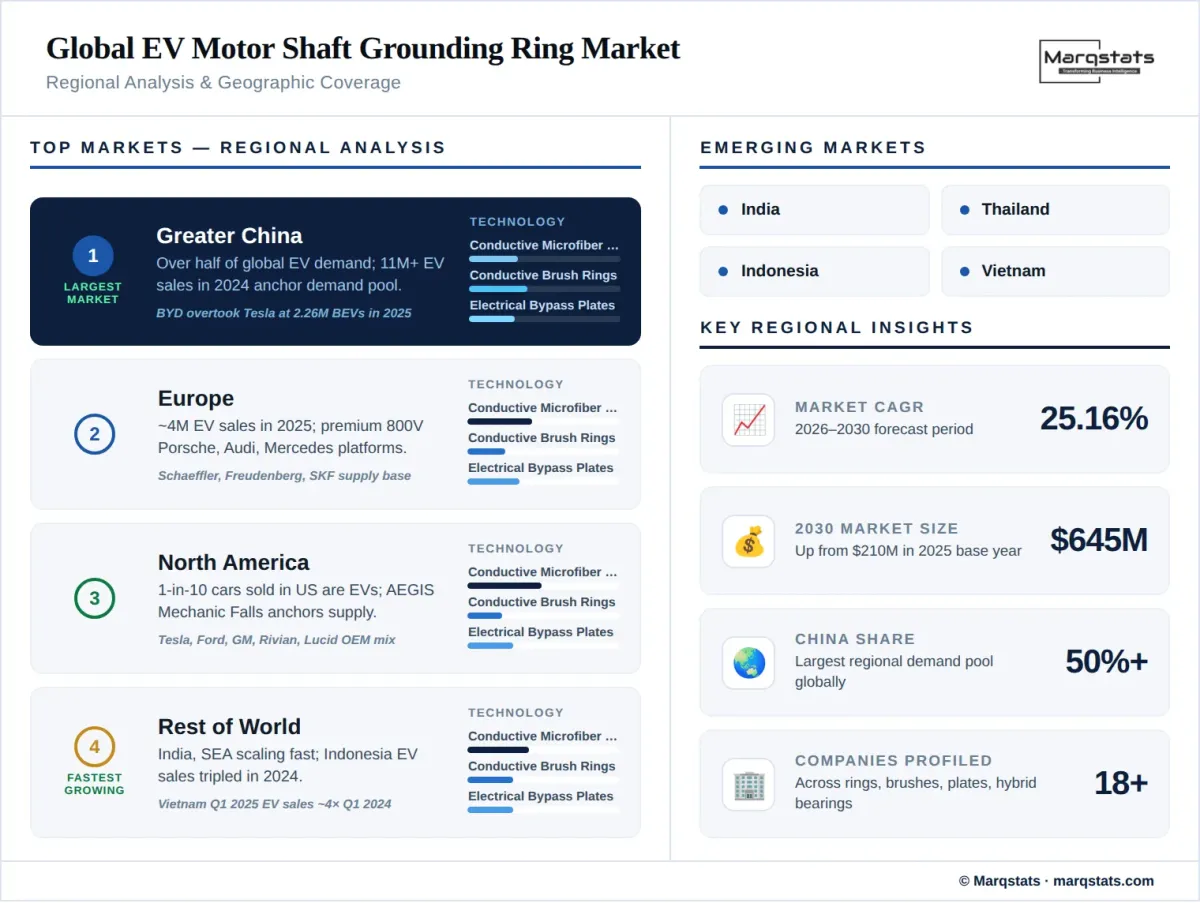
Greater China holds the largest regional share at over half of global EV motor shaft grounding ring demand in 2025, anchored by China’s dominant EV production and sales position. Rest of World, including India and Southeast Asia, represents the fastest-growing regional cluster expanding at approximately 35% CAGR during 2026–2030, supported by regional EV manufacturing scale-up and Chinese OEM investment across Thailand, Indonesia, and Vietnam. Europe, North America, and Japan-Korea anchor the established EV markets with stable share contribution.
Greater China
Greater China is the largest regional cluster, supported by over 11 million electric cars sold in 2024 and continued dominance through 2025 with electric cars reaching nearly 60% of total Chinese car sales. Tesla Shanghai, BYD, NIO, Li Auto, XPeng, GAC, SAIC, Geely, Great Wall, and Chery anchor OEM-side demand. BYD overtook Tesla in full-year battery-electric sales for the first time at 2.26 million BEVs in 2025. Domestic suppliers KACO/Zhongding Sealing, NBI Industrial, and emerging Chinese Tier-2 manufacturers compete on cost and patent-backed engineering. KACO presented water-cooled and oil-cooled shaft grounding schemes at a Schaeffler-hosted New Energy Vehicle powertrain seminar in Anting Town in June 2025.
Europe
Europe represents the second-largest regional cluster with electric car sales reaching approximately 4 million units across the full year 2025 and electric car sales share rising to around 25%. Germany (Volkswagen Group, BMW, Mercedes-Benz, Porsche, Audi), France (Stellantis, Renault), Italy (Stellantis), and emerging Eastern European battery-EV programs anchor the cluster. Tier-1 suppliers including Schaeffler (Insutect insulated bearings), Freudenberg (eCON solutions deployed in Renault Zoe since 2015), and SKF’s European operations drive supply-side capability. Premium 800V platforms from Porsche Taycan, Audi e-tron GT, and Mercedes EQS support per-vehicle value above regional average.
North America
North America anchors the third-largest regional cluster with electric car sales growing approximately 10% year-on-year in 2024 and reaching more than 1 in 10 cars sold in the United States. Tesla, Ford, GM, Rivian, Lucid, Stellantis North America, Canada, and Mexico anchor the cluster. AEGIS / Electro Static Technology operates from Mechanic Falls, Maine and supplies the regional EV motor market alongside global industrial applications. Inpro/Seal supplies Current Diverter Ring and Motor Grounding Seal solutions across Class 1 passenger EVs to Class 8 heavy-duty commercial EVs in the regional fleet market.
Japan and Korea
Japan and Korea form the established advanced supplier cluster. Toyota, Honda, Nissan, Subaru, Mazda, and Suzuki in Japan, alongside Hyundai-Kia and Genesis in Korea, drive OEM-side demand. NSK and NSK-Warner anchor Japanese supply-side capability with the Electrical Bypass Plate launching in 2026. NTN, JTEKT, and Niterra contribute hybrid bearing and silicon nitride ceramic capability. Hyundai-Kia E-GMP 800V platform anchors the largest regional value cluster from the OEM side, supporting elevated per-vehicle component content.
Rest of World
Rest of World, including India, Southeast Asia, and emerging EV markets, represents the fastest-growing regional cluster. India anchored by Tata Motors, Mahindra, and Ola Electric is positioned for accelerated deployment as 800V platforms and SiC inverters reach the Indian market. Southeast Asian EV manufacturing in Thailand, Indonesia, and Vietnam is scaling with Chinese OEM investment, creating downstream demand for shaft grounding components in regional EV assembly. Indonesia electric car sales tripled in 2024 with the conventional market contracting 20%, pushing EV share above 7%; Vietnam approached 35,000 electric car sales in Q1 2025, nearly four times Q1 2024 volumes.
How Competition Is Evolving
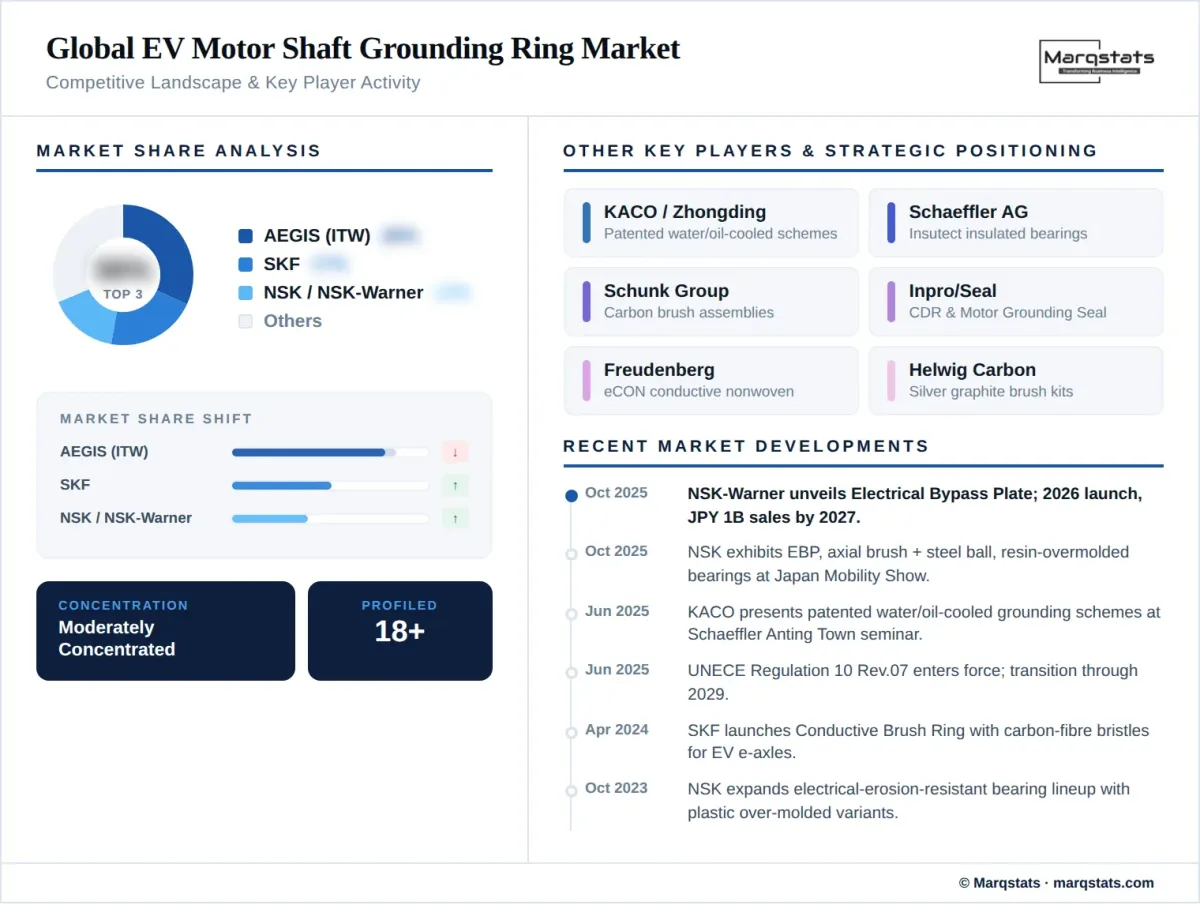
The competitive environment in the EV motor shaft grounding ring market is fragmented at the specialist-supplier level and consolidating at the bearing-and-e-axle integrator level. The top six suppliers — AEGIS / Electro Static Technology (an ITW Company), SKF, NSK / NSK-Warner, KACO / Zhongding Sealing, Schunk Group, and Inpro/Seal — collectively account for approximately 64% of standalone grounding-component revenue in 2025. Bearing integrators Schaeffler, NTN, JTEKT, and material supplier Niterra hold complementary positions through hybrid ceramic and insulated bearing alternatives that compete with standalone rings.
AEGIS anchors the conductive microfiber segment with patented FiberLock channel technology. SKF launched the Conductive brush ring in April 2024 with pure carbon fibre bristles in wet and dry configurations, typically deployed at one motor end alongside hybrid ceramic ball bearing at the opposite end. According to the NSK-Warner Electrical Bypass Plate announcement, the new product is planned for 2026 market launch with JPY 1 billion projected sales in 2027, using conductive paper pressed by a diaphragm spring against the bearing inner ring to deliver high electrical conductivity in space-saving designs without press-fitting equipment.
KACO / Zhongding Sealing presented patented water-cooled and oil-cooled shaft grounding schemes at the June 2025 Schaeffler New Energy Vehicle powertrain seminar in Anting Town, demonstrating Chinese supplier capability beyond commodity-tier participation. Freudenberg Sealing Technologies extends through eCON pure, eCON LFS (Low-Friction Simmerring combination), and eCON LEVITEX (gas-lubricated mechanical seal combination), with deployment history including the Renault Zoe since 2015. Schunk Group anchors carbon and contact-material expertise with shaft grounding assemblies for electric drive units. Helwig Carbon supplies silver graphite brush shaft grounding kits primarily to industrial and commercial motor markets. Inpro/Seal Current Diverter Ring and Motor Grounding Seal solutions span Class 1 passenger to Class 8 commercial EV ranges across PMSM, induction, and switched reluctance motor configurations.
Companies Covered
The report profiles 18 company profiles+ companies with full strategy and financials analysis, including:
Recent Market Activity
Table of Contents
Coverage & Segmentation
The EV Motor Shaft Grounding Ring Market report analyzes the bearing-current mitigation component opportunity across battery-electric, plug-in-hybrid, and hybrid electric vehicles for the period 2021 to 2030. The report covers historical data for 2021-2025, with 2025 as the base year, and forecasts spanning 2026-2030. Market sizing is conducted in USD millions and unit volumes. The study examines conductive microfiber shaft grounding rings, conductive brush rings, electrical bypass plates, axial conductive brush systems, hybrid ceramic insulated bearings, polymer-coated insulated bearings, and complementary current-mitigation solutions including conductive grease and seals.
The scope evaluates competing technology economics across passenger cars, light commercial vehicles, electric buses, medium and heavy commercial vehicles, and two-wheeler and three-wheeler EV traction applications. Voltage architectures covered include below-400V, 400V, 800V, and above-800V high-power commercial platforms. Motor types include PMSM, induction, electrically excited synchronous, and switched reluctance motors. Hybrid ceramic insulated bearing technology including Niterra silicon nitride ceramic balls is included as a competing solution category given its lightweight, wear-resistant, corrosion-resistant, and electrically insulating properties applied across EV and hybrid vehicle motor bearings. Regulatory frameworks evaluated include UNECE Regulation 10 Rev.07, CISPR 25:2021, and ISO 11452 component immunity testing standards.