Market Snapshot
Key Takeaways
Market Overview & Analysis
India E-Bus Charging Infrastructure Market — Report Summary
The India e-bus charging infrastructure market is positioned at the intersection of urban transport electrification, distribution grid upgrades, and civil depot redesign. System coverage spans charging hardware including 120 kW, 180 kW, 200 kW, 240 kW, and 300 kW DC fast chargers, dual-gun configurations, depot chargers, and opportunity chargers. Power infrastructure coverage spans 11 kV and 33 kV feeder bays, compact substations of 1,250 kVA to 2,500 kVA, transformers, ring main units, HT and LT switchgear, cables, and protection systems. Civil infrastructure coverage spans depot redesign, charging bays, canopies, parking circulation, trenching, cable routing, and fire-safety zones.
Software coverage spans charging management systems, fleet charging schedulers, load management platforms, energy monitoring dashboards, payment and billing modules, and uptime monitoring tools. Service coverage spans engineering procurement and construction, installation, commissioning, grid connection, charger annual maintenance contracts, safety audits, and fire-protection works. End-user coverage spans State Transport Undertakings including KSRTC, MSRTC, BMTC, DTC, BEST, and TNSTC; city bus authorities; private Gross Cost Contract operators; e-bus original equipment manufacturers; airport bus fleets; and intercity bus operators.
Demand is increasing owing to a structural shift from pilot fleets to large-scale city deployment. Under PM-eBus Sewa, four cities started operations in February 2026 including Guwahati, Bhavnagar, Nagpur, and Chandigarh, while Letter of Confirmed Quantity has been issued for 6,228 buses, Letter of Award for 5,012 buses across 69 cities, and concession agreements signed for 2,730 buses across 32 cities. The next phase plans an additional 35,000 e-buses, expanding the addressable charging infrastructure opportunity beyond 2030. Furthermore, e-bus depots require connected loads of approximately 10 megawatts for a 100-bus facility, making depot electrification the dominant capex line item rather than charger hardware alone.
Market Dynamics
Key Drivers
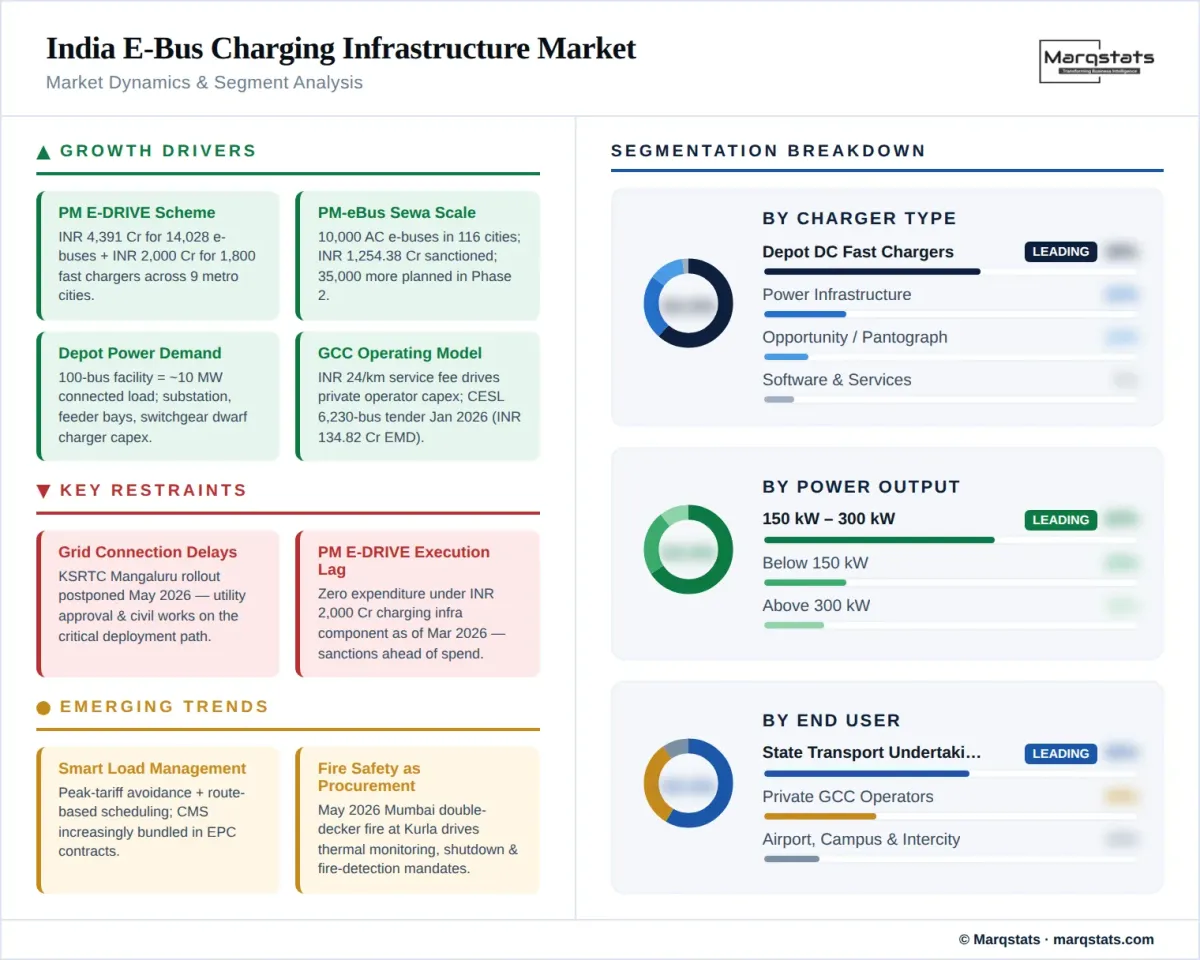
- Government-backed e-bus deployment drives the India e-bus charging infrastructure market, with PM E-DRIVE scheme allocating INR 4,391 crore for 14,028 e-buses and INR 2,000 crore for charging infrastructure including 1,800 e-bus fast chargers across Delhi, Mumbai, Kolkata, Chennai, Ahmedabad, Surat, Bangalore, Pune, and Hyderabad.
- Depot power demand is becoming a major infrastructure category, with heavy-duty operations requiring connected load of approximately 10 megawatts for a 100-bus facility, supporting demand for substations, transformers, feeder bays, and grid coordination services.
- Gross Cost Contract and Public Private Partnership procurement models support charging infrastructure as a long-term operating asset, where private operators handle buses, charging, and maintenance while public transport authorities pay per-kilometre service fees, with PM-eBus Sewa offering INR 24 per kilometre for 12-metre buses.
- City depot conversion into electric vehicle energy hubs is accelerating, with Delhi Transport Corporation electrifying eight depots at over INR 31 crore including 1,600 kVA compact substations and 240 kW chargers, and Nagpur approving INR 1.55 crore for 33 kV feeder bays at Wathoda and Khapri depots.
- Tendering scale supports addressable opportunity expansion, with Convergence Energy Services Limited issuing a 6,230 e-bus aggregated tender in January 2026 under PM E-DRIVE and Delhi Gross Cost Contract programme, with EMD exposure of INR 134.82 crore covering vehicle supply, operations, maintenance, and allied electric and civil infrastructure.
- Charger uptime and fleet scheduling priorities are increasing, owing to fixed-route bus operations that cannot afford charging downtime, supporting demand for charging management software, remote diagnostics, predictive maintenance, redundant charger design, and service level agreement-backed operations and maintenance contracts.
Key Restraints
- Grid connection delays restrain deployment timelines, with Karnataka State Road Transport Corporation Mangaluru e-bus rollout postponed in May 2026 owing to charging-station and civil-infrastructure works not being ready, indicating that utility approvals and depot construction sit on the critical path of bus deployment.
- High upfront depot capital expenditure restrains pace of city-wide electrification, with Delhi's eight-depot charging plan estimated at over INR 31 crore demonstrating that depot-level capex is significant for transport undertakings, however 100% central assistance under PM-eBus Sewa for behind-the-meter power infrastructure mitigates this constraint.
- Land and depot redesign constraints restrain conversion economics, owing to existing bus depots being designed for diesel fleets rather than charging bays, cable routes, HT rooms, fire zones, and charger circulation, requiring civil works and land allocation alongside electrical infrastructure procurement.
- Slow charging infrastructure expenditure restrains near-term momentum, owing to no expenditure incurred under the INR 2,000 crore PM E-DRIVE charging infrastructure component as of 11 March 2026, indicating execution timelines are still ahead of sanctioned outlays.
Key Trends
- Smart charging and load management adoption is accelerating, owing to peak-demand tariff exposure, route-based bus scheduling, charger utilization optimization, and grid-stress avoidance, with software platforms increasingly bundled into engineering procurement and construction contracts.
- Solar rooftop and battery energy storage system integration at bus depots is increasing, owing to electricity tariff optimization, demand response capability, peak load management, and behind-the-meter generation incentives, however space and capital constraints temper near-term penetration.
- Fire safety and thermal monitoring systems are emerging as a distinct procurement category, owing to the May 2026 Mumbai electric double-decker bus fire at Kurla depot, supporting demand for thermal monitoring, emergency shutdown systems, fire detection, ventilation, and standard operating procedure-based charging.
- Airport, industrial campus, and closed-fleet charging hubs are emerging alongside city bus depots, with Servotech Renewable Power System installing 240 kW DC charging projects including Bengaluru airport airside electric vehicle operations, supporting addressable expansion beyond municipal transport.
Market Segmentation
Depot DC fast chargers accounted for the largest share, supported by city bus operations that depend on overnight or scheduled depot charging cycles. Configurations range from 120 kW to 300 kW, with 240 kW chargers emerging as the standard for metropolitan transport undertaking deployments. Delhi Transport Corporation's eight-depot upgrade specifies 240 kW chargers paired with 1,600 kVA compact substations, while Tata AutoComp and Tellus Power supplied 64 units of 200 kW DC fast chargers to Tata Power for e-bus charging stations in Mumbai and Ahmedabad.
Opportunity chargers and pantograph chargers serve high-frequency corridor operations where mid-route top-up charging is required. Adoption is constrained, however, owing to depot charging dominance in near-term India deployments. Long-term penetration is supported by intercity coach routes and dedicated bus rapid transit corridors where dwell-time charging at terminals optimizes operational availability.
Dual-gun and high-capacity chargers in the 200 kW to 300 kW range support simultaneous charging of two buses, optimizing depot charger-to-bay ratios. Exicom's Harmony Direct 2.0 supports vehicles including buses and trucks with battery voltage range of 200 to 1,000 VDC, while domestic and global suppliers compete on power density, cooling architecture, and integration with charging management platforms.
Below 150 kW power output configurations serve mid-size urban bus depots, lower-frequency intercity routes, and supplementary back-up charging needs. The segment is supported by simpler grid integration requirements and lower per-charger capital expenditure, however limited charging speed restricts applicability for high-utilization metropolitan fleets.
The 150 kW to 300 kW segment accounted for the dominant share, supported by metropolitan transport undertaking depot deployments, PM-eBus Sewa city allocations, and PM E-DRIVE nine-city aggregated procurement. Configurations include 180 kW, 200 kW, 240 kW, and 300 kW chargers, with 240 kW emerging as the standard tier in Delhi, Mumbai, Bengaluru, and Hyderabad city deployments.
Above 300 kW configurations support intercity bus charging hubs, airport airside fleet operations, and corridor-based opportunity charging. Adoption is increasing owing to faster turnaround requirements, however civil and grid-side complexity at this power level requires dedicated transformer capacity and reinforced cable infrastructure.
Charging hardware includes DC fast chargers, AC chargers, dual-gun configurations, charging guns, cable management systems, and charger enclosures. The segment is supplied by domestic and global original equipment manufacturers including Exicom, Delta Electronics India, Servotech Renewable Power System, Tata AutoComp Systems, ABB India, Siemens, Schneider Electric India, and Hitachi Energy India.
Power infrastructure includes 11 kV and 33 kV feeder bays, compact substations from 1,250 kVA to 2,500 kVA, transformers, ring main units, HT and LT switchgear, ring main units, cables, and protection systems. Demand is increasing owing to depot connected load requirements that scale to multiple megawatts per facility, supporting electrical equipment supplier addressable expansion.
Civil infrastructure includes depot redesign, charging bays, canopies, parking circulation, trenching, cable routing, fire-safety zones, control rooms, and operator facilities. Demand is supported by behind-the-meter power infrastructure assistance under PM-eBus Sewa, with depot construction sanctioned across more than 300 acres of land and over 500 circuit kilometres of HT power line infrastructure approved.
Software and services include charging management systems, fleet schedulers, energy monitoring platforms, billing systems, engineering procurement and construction services, installation, commissioning, grid connection, charger annual maintenance contracts, and safety audits. Demand is increasing owing to fleet uptime priorities and Gross Cost Contract operating model requirements.
State Transport Undertakings accounted for the largest share, supported by Maharashtra State Road Transport Corporation, Karnataka State Road Transport Corporation, Bangalore Metropolitan Transport Corporation, Delhi Transport Corporation, Brihanmumbai Electric Supply and Transport Undertaking, and Tamil Nadu State Transport Corporation deployments. The segment is supported by PM-eBus Sewa Payment Security Mechanism with INR 3,435.33 crore outlay covering more than 38,000 e-buses.
Private Gross Cost Contract operators including Tata Motors-led consortia, Olectra-led consortia, JBM Auto-led consortia, PMI Electro Mobility, and Switch Mobility-led consortia procure and operate buses including charging infrastructure, with public transport authorities paying per-kilometre service fees. The model is supported by aggregated demand under Convergence Energy Services Limited tenders.
Airport bus fleets, industrial campus shuttle services, special economic zone operators, port logistics fleets, and intercity bus operators support addressable demand beyond municipal transport. Servotech Renewable Power System has installed high-power 240 kW DC charging projects including Bengaluru airport airside electric vehicle operations, demonstrating the emerging non-municipal charging hub category.
By Geography
Western India
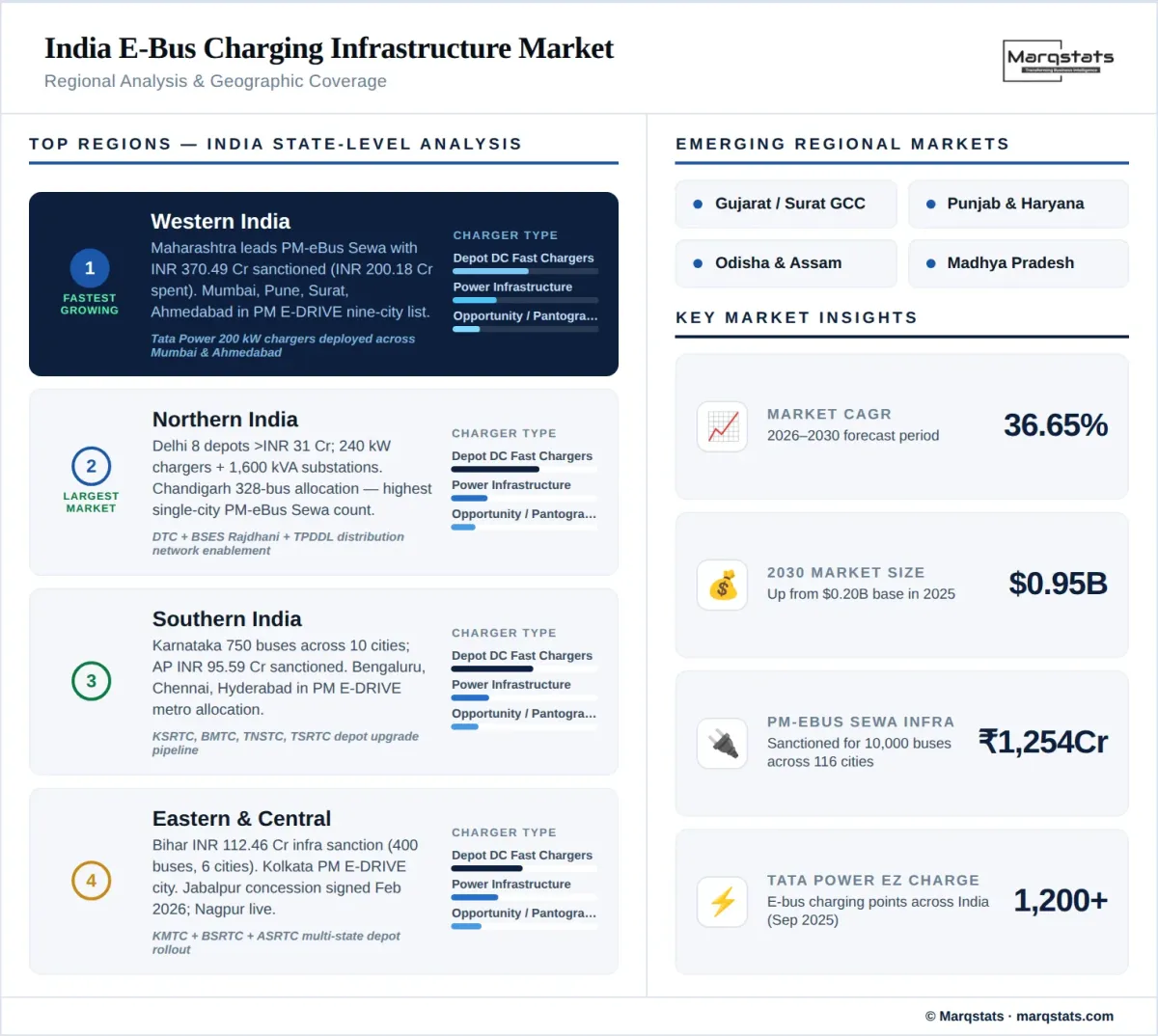
Western India is the fastest-growing region, supported by Maharashtra State Road Transport Corporation, Brihanmumbai Electric Supply and Transport Undertaking, Pune Mahanagar Parivahan Mahamandal, and Gujarat State Road Transport Corporation electric bus deployments. Maharashtra leads PM-eBus Sewa infrastructure sanction with INR 370.49 crore, of which INR 200.18 crore had been spent. Mumbai and Pune are PM E-DRIVE allocation cities, while Surat and Ahmedabad host PM E-DRIVE GCC deployments. Tata Power supplied 200 kW DC fast chargers across e-bus charging stations in Mumbai and Ahmedabad.
Northern India
Northern India accounted for a substantial share, supported by Delhi Transport Corporation, BSES Rajdhani Power Limited, Tata Power Delhi Distribution Limited, and Chandigarh Transport Undertaking deployments. Delhi Transport Corporation is electrifying eight depots at over INR 31 crore including 1,600 kVA compact substations and 240 kW chargers. Chandigarh started PM-eBus Sewa operations in February 2026 with the highest single-city allocation of 328 buses. Punjab, Haryana, and Uttar Pradesh PM-eBus Sewa allocations support charging infrastructure expansion across NCR satellite cities.
Southern India
Southern India is supported by Karnataka State Road Transport Corporation, Bangalore Metropolitan Transport Corporation, Tamil Nadu State Transport Corporation, Andhra Pradesh State Road Transport Corporation, Kerala State Road Transport Corporation, and Telangana State Road Transport Corporation deployments. Karnataka has 750 PM-eBus Sewa buses sanctioned across 10 cities including 100 buses for Belagavi with INR 6.85 crore civil infrastructure. Andhra Pradesh secured INR 95.59 crore PM-eBus Sewa infrastructure sanction. Bengaluru, Chennai, and Hyderabad are PM E-DRIVE allocation cities.
Eastern India
Eastern India is supported by Kolkata Metropolitan Transport Corporation, Assam State Transport Corporation, Bihar State Road Transport Corporation, and Odisha State Road Transport Corporation deployments. Guwahati started PM-eBus Sewa operations in February 2026, while Bihar received 400 buses sanctioned across Bhagalpur, Darbhanga, Gaya, Muzaffarpur, Patna, and Purnea with INR 112.46 crore associated infrastructure sanction. Kolkata is a PM E-DRIVE allocation city, supporting metropolitan depot electrification.
Central India
Central India is supported by Madhya Pradesh, Chhattisgarh, and Vidarbha deployments. Jabalpur received INR 10.48 crore for behind-the-meter power and civil depot infrastructure to support 200 e-buses, with concession agreement signed in February 2026. Nagpur is among the four cities that started PM-eBus Sewa operations in February 2026, with INR 1.55 crore approved for 33 kV feeder bays at Wathoda and Khapri depots. Indore and Bhopal are emerging PM-eBus Sewa allocation cities.
How Competition Is Evolving
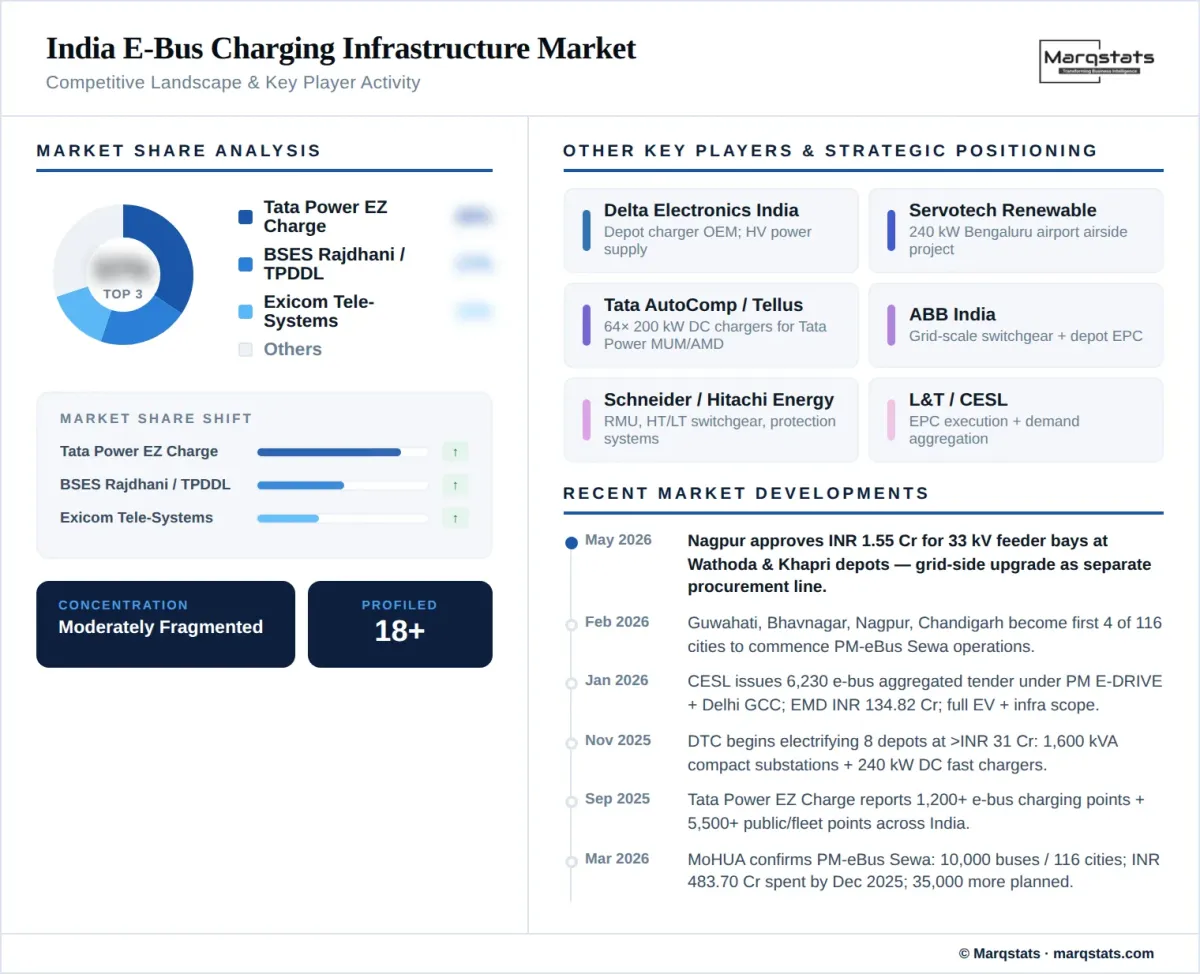
The market is moderately fragmented across four competitive layers. Charging infrastructure operators and power utilities occupy the deployment and energy services layer, charger original equipment manufacturers and electrical equipment suppliers occupy the hardware layer, electric bus original equipment manufacturers and Gross Cost Contract operators occupy the integrated procurement layer, and engineering procurement and construction firms, software platforms, and operations and maintenance providers occupy the services layer. Competitive intensity is increasing owing to PM-eBus Sewa, PM E-DRIVE, and CESL aggregated tendering that compress procurement decision windows and reward depot-electrification capability.
Companies compete through depot-level engineering capability, multi-megawatt power infrastructure execution, charging management software depth, India-specific service network coverage, and pricing aligned with Gross Cost Contract operating economics. Tata Power EZ Charge has 1,200+ e-bus charging points alongside 5,500+ public, semi-public, and fleet charging points, indicating that incumbent operators with utility relationships and depot execution experience hold a structural advantage. Tata AutoComp and Tellus Power supplied 64 units of 200 kW DC fast chargers to Tata Power for e-bus charging stations in Mumbai and Ahmedabad, demonstrating that hardware-operator partnerships influence platform selection.
Strategic activity covers charging operator network expansion, charger original equipment manufacturer capacity additions, depot engineering procurement and construction wins, software platform integration, utility-side feeder bay procurement, and battery energy storage system pilot deployments. Furthermore, BSES Rajdhani Power and Tata Power Delhi Distribution have added thousands of charging points during FY2025-26, indicating that distribution companies are becoming important enablers for depot load approval and charging-network expansion.
Pricing competition in the India e-bus charging infrastructure market is structured around system-level depot-electrification packages rather than commodity charger pricing. Bundled offerings combining 240 kW chargers, compact substations, civil works, charging management software, and operations and maintenance contracts command higher margins. Domestic suppliers compete through localized manufacturing of chargers, transformers, and switchgear, while global Tier-1 suppliers retain perception around grid-scale power electronics, ring main unit reliability, and integration with utility-side protection systems.
Companies Covered
The report profiles 18+ companies with full strategy and financials analysis, including:
Recent Market Activity
Table of Contents
Coverage & Segmentation
This report covers the India e-bus charging infrastructure market for the historical period 2021 to 2025 and the forecast period 2026 to 2030. The base year is 2025. The study examines market size, segment-level forecasts, government scheme impact, vehicle category coverage including standard 12-metre buses, 9-metre midi buses, and articulated buses, system-level analysis covering charger types, power output tiers, components, and end-user categories, and competitive positioning across charging infrastructure operators, charger original equipment manufacturers, electrical equipment suppliers, e-bus original equipment manufacturers, Gross Cost Contract operators, and engineering procurement and construction firms.
Coverage includes PM-eBus Sewa scheme implementation and Payment Security Mechanism, PM E-DRIVE charging infrastructure outlay, Convergence Energy Services Limited aggregated tendering, behind-the-meter power infrastructure assistance, civil depot infrastructure, 11 kV and 33 kV feeder bay procurement, distribution company depot energization, charging management software adoption, fire safety and thermal monitoring, and solar and battery energy storage system integration. Data sources span government databases, industry bodies, distribution company disclosures, charger original equipment manufacturer announcements, and primary stakeholder interviews.