Market Snapshot
Middle bar: base-year value × (1 + CAGR), rounded to two decimals. This is a calculated illustration, not a separately researched annual estimate.
The India micro-mobility market reached USD 0.60 billion in 2025 and is projected to reach USD 3.00 billion by 2030, expanding at a CAGR of 37.97% across the forecast period. The market covers shared, rented, and fleet-leased low-speed electric two-wheelers, electric bicycles, and electric kick scooters, together with the battery-swapping energy services that power these fleets. Growth is attributed to the structural shift of shared micro-mobility from consumer commuting toward business-to-business last-mile logistics.
Demand is concentrated in the quick-commerce and hyperlocal delivery sector, where compressed delivery windows require dense, responsive fleets of low-cost zero-emission vehicles. Shared electric two-wheelers have become the default asset for India's expanding gig-worker economy, owing to a total-cost-of-ownership advantage over petrol two-wheelers. To sustain fleet expansion, battery-swapping networks have scaled rapidly, allowing riders to exchange depleted packs for fully charged units in under a minute, removing range anxiety and idle charging time from delivery operations.
The market is moderately fragmented across vehicle operators and battery-swap providers. South India, anchored by Bengaluru, Hyderabad, and Chennai, formed the largest regional cluster in 2025, while West and North India, led by Mumbai-Pune and Delhi-NCR, recorded the fastest growth. Low-speed electric two-wheelers commanded the largest share of value, supported by a regulatory classification that exempts sub-250-watt vehicles from registration and licensing.
The fleet pipeline is reinforced by sustained new two-wheeler registrations, which ranged between roughly 1.3 million and 3.2 million units per month across the latest reporting cycle, with electric models accounting for a rising share of retails. Each new low-speed electric vehicle entering shared and delivery fleets expands the addressable base for rental, subscription, and battery-swap services through the forecast period. Against a personal two-wheeler fleet exceeding 300 million vehicles, shared and fleet-leased micro-mobility remains a small, fast-scaling slice anchored in commercial last-mile use.
Key Takeaways
Market Overview & Analysis
Report Summary
The India micro-mobility market represents the convergence of gig-economy logistics, urban decarbonization, and localized battery technology. Rather than replicating Western dockless kick-scooter models, which struggled against road conditions and limited protected lanes, domestic operators built an asset-heavy, vertically integrated model adapted to local urban structures. Demand is driven by the rapid expansion of quick-commerce, whose gross merchandise value has scaled sharply, anchoring a predictable, high-volume revenue stream for fleet operators.
The economic case rests on utilization. A delivery rider operates a shared vehicle for eight to ten hours daily, covering high annual mileage, which amortizes acquisition cost within roughly twelve to fourteen months and supports positive unit economics even at affordable rental rates. By contrast, consumer commuting is seasonal and low-utilization, which explains the sector's pivot toward business-to-business logistics after the pandemic compressed consumer-facing rentals and prompted operators to redeploy fleets into delivery.
Public policy reinforces the transition. Municipal investment under the central Smart Cities Mission funds dedicated low-speed lanes, multi-modal transit hubs, and integrated ticketing, while a sub-250-watt vehicle classification removes registration and licensing friction. A mobile subscription base exceeding 1.14 billion connections and a mature digital-payments network remove access barriers to shared mobility, allowing operators to onboard riders and settle rentals digitally at scale.
The ecosystem operates as three connected layers. Fleet operators provide low-speed electric vehicles to gig riders through lease-to-own and subscription models; a gig-delivery pool executes high-volume hyperlocal deliveries for quick-commerce and food-delivery platforms; and battery-as-a-service providers supply charged packs through dense swap networks. This vertical structure lets the strongest operators capture value across vehicles, software, and energy, rather than competing on a single layer, and it insulates fleet uptime from the constraints of fixed charging infrastructure.
Financing is a decisive enabler of fleet scale. Conventional lenders historically discounted shared two-wheelers owing to depreciation and resale uncertainty, leaving non-banking financial companies and specialist fintech lenders to underwrite the asset base using telematics and utilization data. Maharashtra and the National Capital Region concentrate a large share of shared and used-vehicle financing for cargo fleets, where lenders dynamically adjust loan-to-value ratios against real-time vehicle telemetry.
Market Dynamics
Key Drivers
- The elevated total cost of ownership of petrol two-wheelers, with fuel prices above INR 100 per litre, makes electric micro-mobility attractive; shared electric two-wheelers deliver 40%-50% savings on running and maintenance, translating into higher take-home pay for gig workers and faster operator payback. Daily rental rates for delivery e-bikes remain low relative to the fuel and financing costs of an owned petrol vehicle, widening the economic gap further.
- Quick-commerce expansion provides a sustained demand anchor, since delivery windows of ten to fifteen minutes require dense dark-store coverage and a responsive fleet; shared electric two-wheelers now hold a sizeable share of urban dark-store delivery vehicles, securing operators a predictable, high-volume revenue stream.
- The PM E-DRIVE scheme, administered by the Ministry of Heavy Industries, funds electric two-wheelers at INR 2,500 per kWh, capped at INR 5,000 per vehicle for models priced under INR 1.5 lakh, with the window extended to July 2026, lowering fleet-acquisition costs.
- Battery-swapping networks remove charging downtime, allowing sub-minute pack exchange and high fleet uptime, which underpins delivery-fleet economics and asset utilization. Thermal-managed stations sustain availability under extreme ambient temperatures and dispense only health-verified packs, protecting both riders and operators.
- A mobile subscription base exceeding 1.14 billion connections and mature UPI-led digital payments remove access friction for shared, rental, and subscription models across metropolitan and emerging markets.
Key Restraints
- A deficit of safe, dedicated road infrastructure, since metropolitan roads regulated under the Ministry of Road Transport and Highways framework are designed for larger motorized vehicles, raises collision risk for low-speed riders and keeps the segment reliant on business-to-business logistics corridors rather than personal commuting.
- The high cost of advanced battery packs, compounded by stricter AIS-156 battery-safety testing and limited domestic cell manufacturing, raises capital expenditure and makes continuous funding rounds necessary for fleet expansion. Reliance on imported cells also exposes operators to currency and supply-chain volatility, pressuring margins on long-term lease contracts.
- Seasonality and low asset utilization in consumer-facing commuting constrain business-to-consumer economics, concentrating profitable demand in delivery and logistics fleets. Vandalism, theft, and parking-compliance costs further weigh on dockless consumer deployments in unstructured urban environments.
Key Trends
- Operators are pivoting decisively to business-to-business fleet leasing and subscription contracts that bundle maintenance, insurance, and battery-swap access, replacing volatile consumer rentals with stable recurring revenue.
- Battery-as-a-service and swapping have become the default energy model for logistics fleets, feeding the adjacent India battery-as-a-service market, with national networks crossing 100 million cumulative swaps and sub-minute swap times.
- IoT-enabled telemetry and AI-led fleet management platforms monitor motor performance, battery health, and location, applying predictive maintenance to cut fleet downtime and extend asset life. These platforms also feed utilization analytics that inform dynamic rebalancing, demand-based pricing, and lender risk models.
- Expansion into Tier-2 and Tier-3 towns through organized leasing networks is widening the addressable market beyond the major metros, supported by rising quick-commerce coverage. Local entrepreneurs and franchise partners increasingly host swap points and manage neighbourhood fleets, accelerating geographic reach with limited central capital.
Market Segmentation
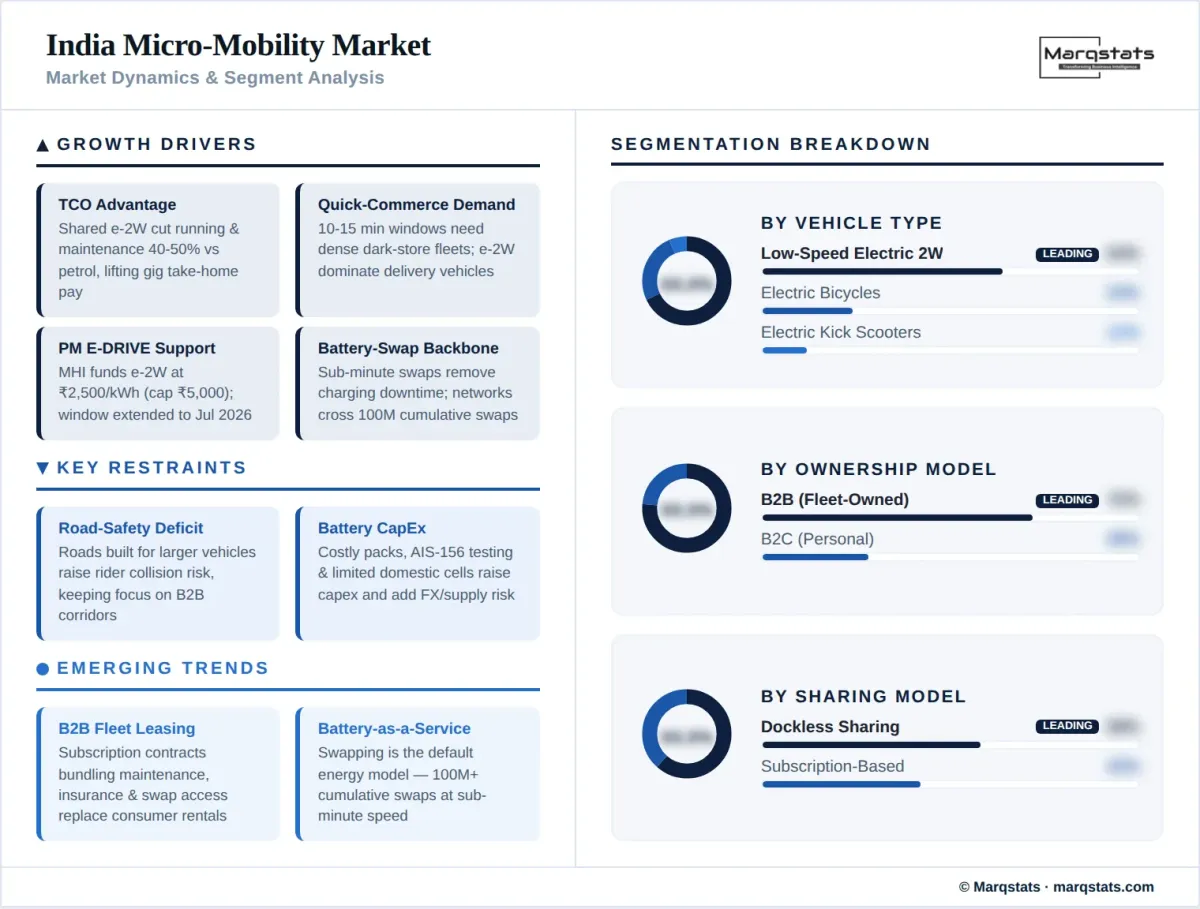
Low-speed electric two-wheelers form the largest segment, accounting for the majority of market value in 2025. Comprising cargo and passenger e-scooters that are non-motorized under the Central Motor Vehicles Rules, this segment is the default vehicle for hyperlocal delivery fleets. Growth is driven by quick-commerce demand and registration-exempt deployment, which lets operators onboard gig riders with minimal administrative friction. Purpose-built cargo variants with reinforced frames, swappable packs, and integrated telematics dominate fleet procurement, as operators prioritize uptime and serviceability over top speed.
Electric bicycles represent a stable, high-volume entry segment serving personal commuting and short-distance urban travel. Demand is supported by affordability and the popularity of shared e-bike models in metropolitan corridors, where they serve first-mile and last-mile connectivity to transit nodes. The segment also benefits from corporate and institutional sharing programs that deploy fleets within campuses and gated communities.
Electric kick scooters are the fastest-growing vehicle segment, adopted across premium residential complexes, corporate campuses, and localized smart-city sharing networks. Growth is attributed to rising campus and last-mile sharing deployments, though adoption for open-road personal travel remains constrained by infrastructure and safety considerations. Operators position kick scooters as a controlled, geofenced offering within enclosed or low-speed environments.
The business-to-business segment is the dominant and fastest-growing pool, driven by delivery and logistics operators that lease low-speed electric fleets on long-term contracts to support quick-commerce distribution, feeding the broader India electric two-wheeler fleet market. Demand is increasing owing to high asset utilization, predictable contract revenue, and bundled maintenance and energy services.
Fleet contracts increasingly take the form of platform-integrated commitments, in which delivery aggregators reserve large vehicle volumes from a single operator to guarantee rider supply during peak windows. These arrangements lengthen contract duration, smooth utilization, and improve financing terms, while embedding the micro-mobility operator within the aggregator's logistics stack. The model favours operators that can guarantee uptime through dense swap networks and proactive maintenance, reinforcing the advantage of vertically integrated platforms.
The business-to-consumer segment serves individual commuters and students who rent lightweight electric bicycles or scooters for daily short-distance travel. The segment is smaller and more seasonal than fleet leasing, with demand concentrated in dense urban centres and supported by zero-deposit and maintenance-inclusive subscription plans. Adoption is strongest where protected lanes and campus environments lower perceived safety risk, and operators increasingly cross-sell personal plans to riders already familiar with the brand through delivery work.
Dockless sharing is the dominant model, valued for flexibility in locating and returning vehicles via smartphone apps at permissible urban locations. Growth is supported by app-led convenience and dense fleet placement around transit hubs, commercial districts, and dark stores. Operators manage rebalancing and parking compliance through geofencing and incentive nudges to maintain availability where demand concentrates.
Subscription-based access is the fastest-growing model, where delivery partners and corporate users rent vehicles on weekly or monthly contracts that bundle maintenance, insurance, and battery-swap access. Demand is increasing owing to predictable operating costs for gig workers and stable recurring revenue for fleet operators. Zero-deposit and equated-instalment plans further lower the entry barrier for low-income riders entering the delivery workforce.
By Geography
South India
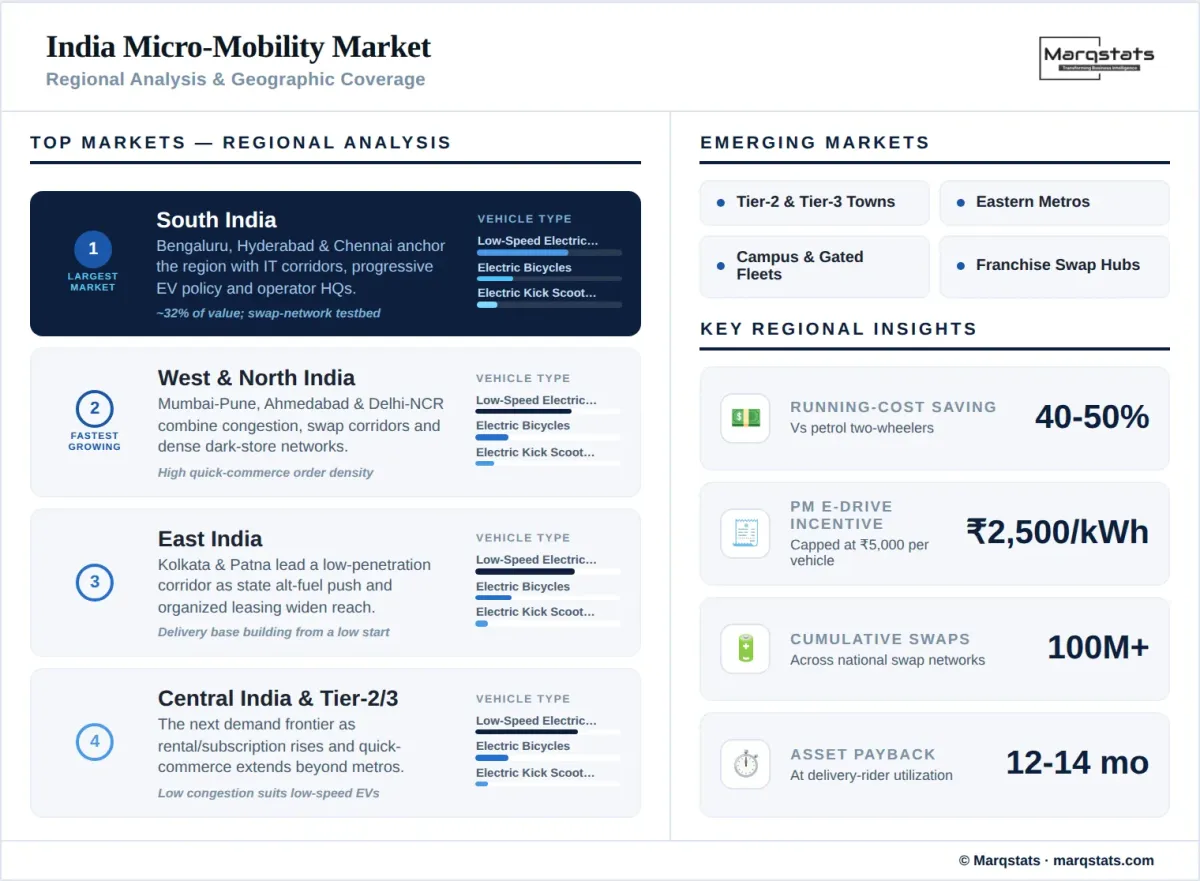
South India is the largest regional market, accounting for roughly 32% of national value in 2025. Bengaluru, Hyderabad, and Chennai anchor the region through a technology-oriented population, dense information-technology corridors, and progressive state electric-vehicle policies. Bengaluru hosts the headquarters of several major operators and serves as the primary testing ground for next-generation battery-swapping networks and smart-city transit hubs. High commuter density and a concentration of quick-commerce dark stores sustain elevated fleet utilization across the region.
West and North India
West and North India together form the fastest-growing cluster, led by Mumbai-Pune, Ahmedabad, Delhi-NCR, Ghaziabad, and Noida. Dense metropolitan layouts and severe congestion make micro-mobility attractive for last-mile delivery, and the region concentrates heavy investment in commercial battery-swapping corridors. Maharashtra also concentrates a large share of shared and used-vehicle financing for cargo fleets. Delhi-NCR's high quick-commerce order density and extensive dark-store network make it a primary deployment market for delivery fleets, while operators continue to add swap stations across Noida and Gurugram to support high-density commercial corridors.
East India
East India represents a promising growth corridor characterized by lower private-vehicle penetration, anchored by Kolkata and Patna. State governments promote alternative-fuel vehicles to reduce urban air pollution, and the expansion of organized leasing networks into Tier-2 and Tier-3 towns is expected to support rental and subscription adoption. Rising quick-commerce penetration in eastern metros is gradually building the delivery-fleet demand base from a low starting point.
Central India and Tier-2 and Tier-3 Cities
Central India and smaller urban centres represent the next demand frontier, where rental and subscription adoption rises as affordability improves and quick-commerce extends beyond the major metros. New two-wheeler registrations in these markets supply a widening pool of electrification-ready assets for shared and delivery fleets. Lower congestion and shorter average trip distances make low-speed electric vehicles well suited to these markets, while franchise-based swap points reduce the capital required to establish local energy infrastructure.
How Competition Is Evolving
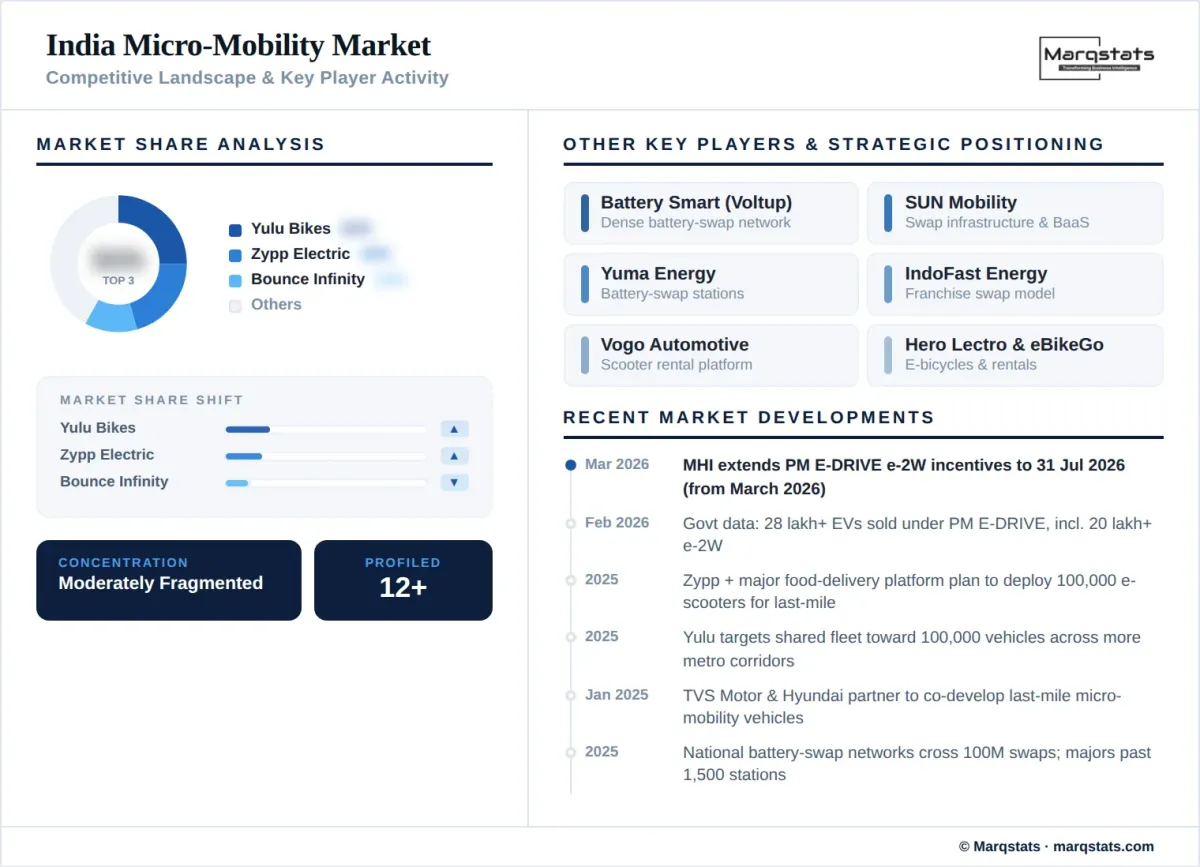
The India micro-mobility market is moderately fragmented, with concentration among the top shared-mobility platforms and a more dispersed battery-swapping layer. The top shared operators command the bulk of digital transactions, and market position depends on software integration, fleet scale, and business-to-business logistics partnerships with quick-commerce and e-commerce platforms. Barriers to entry have risen as incumbents lock in platform contracts, deepen swap-station density, and accumulate utilization data that improves both dispatch efficiency and financing access.
Vehicle operators compete on fleet uptime, swap-network access, and unit economics, integrating proprietary telemetry and AI dispatch to maximize utilization. The energy layer is contested by battery-swap providers operating asset-light franchise and company-owned station models, several of which have crossed large cumulative-swap milestones. Strategic investments from automotive manufacturers and global component suppliers have reinforced the capital base of the largest platforms.
Competitive intensity is shaped by funding cycles and the migration of delivery-platform contracts between operators. Vertical integration across vehicles, software, and battery-swap energy distinguishes the strongest players, while partnerships with food-delivery and quick-commerce platforms anchor demand. Expansion into smaller cities and bundled subscription offers are the primary levers for share gains, alongside continued fleet electrification and standardized swapping.
Among shared-mobility operators, Yulu Bikes runs a multi-modal fleet spanning commuter and cargo low-speed vehicles and has accumulated billions of kilometres of operation, backed by strategic investment from an automotive manufacturer and a global component supplier. Zypp Electric, operated by Mobycy Technologies, has scaled a fleet of more than twenty thousand electric two-wheelers focused on last-mile delivery, while Wickedride Adventure Services restructured its Bounce business from consumer rentals toward business-to-business leasing and subscription. On the energy side, Yuma Energy, Voltup Mobility's Battery Smart network, SUN Mobility, and IndoFast Energy operate the swap infrastructure on which these fleets depend, with the asset-light franchise model partnering local retailers to extend station density rapidly.
Companies Covered
Companies covered in the report include:
Recent Market Activity
Table of Contents
Coverage & Segmentation
This report analyzes the structural dynamics of the India micro-mobility market, providing value-based forecasts spanning 2026 through 2030, with a 2025 base year and a 2021-2025 historical period. The study covers shared, rented, and fleet-leased low-speed electric two-wheelers, electric bicycles, and electric kick scooters, together with associated battery-swapping energy services, segmented by vehicle type, ownership model, and sharing model. Regional coverage spans South India, West and North India, East India, and Central India together with Tier-2 and Tier-3 city clusters.
The analysis draws on retail registration statistics from automobile dealer associations, Ministry of Heavy Industries scheme disclosures, central and state electric-vehicle policy documents, and operator-level fleet and revenue data. Findings were validated through 40+ primary interviews with micro-mobility company founders, battery-swapping operators, logistics fleet managers, and urban-transport planners. The report quantifies market size and growth across the three segmentation dimensions, profiles the competitive structure, and maps the regulatory framework governing low-speed vehicle classification, battery safety, and demand incentives.