Market Snapshot
Key Takeaways
Market Overview & Analysis
Report Summary
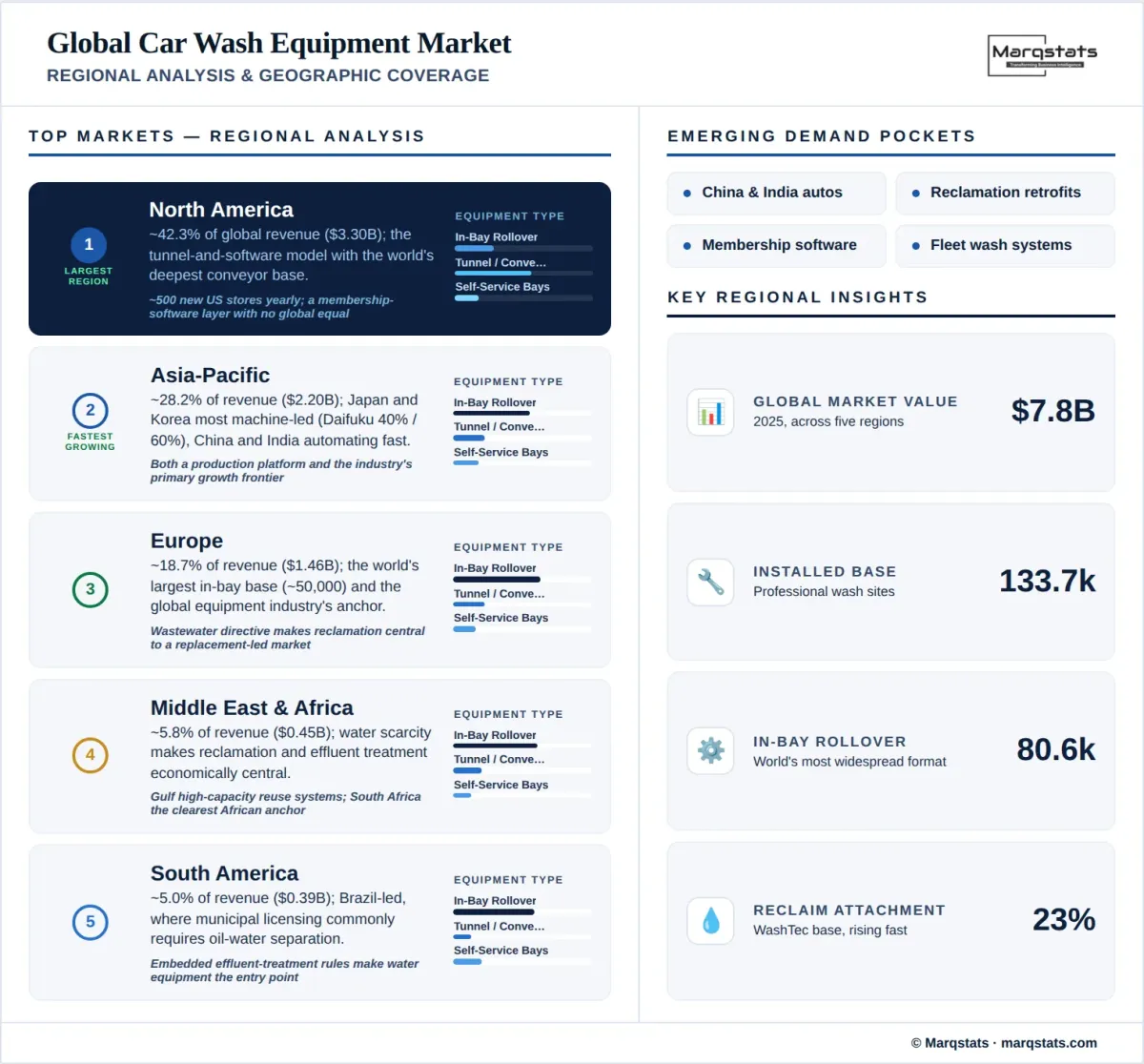
The car wash equipment market comprises the manufacture and sale of vehicle-wash hardware and systems across three core wash formats — automatic in-bay (rollover), tunnel/conveyor, and self-service — together with attached subsystems and the recurring parts, consumables, and software that support the installed base. The 2025 global market of USD 7.80 billion aggregates North America (USD 3.30 billion), Asia-Pacific (USD 2.20 billion), Europe (USD 1.46 billion), the Middle East & Africa (USD 0.45 billion), and South America (USD 0.39 billion), set against a documented professional installed base exceeding 133,700 wash sites worldwide.
The market has expanded from USD 6.24 billion in 2021 to USD 7.80 billion in 2025. Growth was constrained in 2021 and 2022 by supply-chain disruption and component costs, recovered through 2023 and 2024 on express-tunnel new-build and regulation-driven retrofit, and eases gradually across the forecast period as mature markets turn over toward replacement and modernization. Regional shares shift slowly: North America holds near 42%, Asia-Pacific rises toward 29% on emerging-market automation, Europe eases toward 18% as a replacement-led market, and the Middle East & Africa and South America edge higher from small bases.
Format structure diverges sharply by region, defining the market's two-engine character. North America is tunnel-led, with roughly 17,500 United States conveyor sites, an express-exterior model built on unlimited memberships and site-management software. Europe is in-bay-led, with about 50,000 rollover systems against 8,000 tunnels, a mature replacement-and-upgrade market. Asia-Pacific is machine-led in Japan and South Korea, where Daifuku holds direct 40% and 60% national shares, while China and India automate from lower bases. Globally, in-bay rollover systems are the most widespread format, accounting for roughly 80,600 of the 133,700 documented professional sites, while tunnel/conveyor systems command the highest per-site equipment value.
Demand density frames the market's structural differences. The United States operates roughly 4,740 registered vehicles per professional wash site against about 297.5 million registered vehicles, while Europe operates roughly 3,700 cars per site against about 256 million cars, indicating a denser professional footprint in Europe relative to its parc and far higher tunnel scale at site level in North America. Canada adds about 26.8 million registered vehicles and South Africa about 13.1 million, marking the clearest documented demand bases in their regions, while China and India remain the largest long-run demand pools with installed bases unquantified in public records. This density gradient explains the market's format geography: high vehicles-per-site ratios support the high-throughput tunnel economics of North America, while denser site coverage sustains Europe's rollover-led replacement model, and low organized penetration across emerging regions marks the industry's long-run expansion headroom.
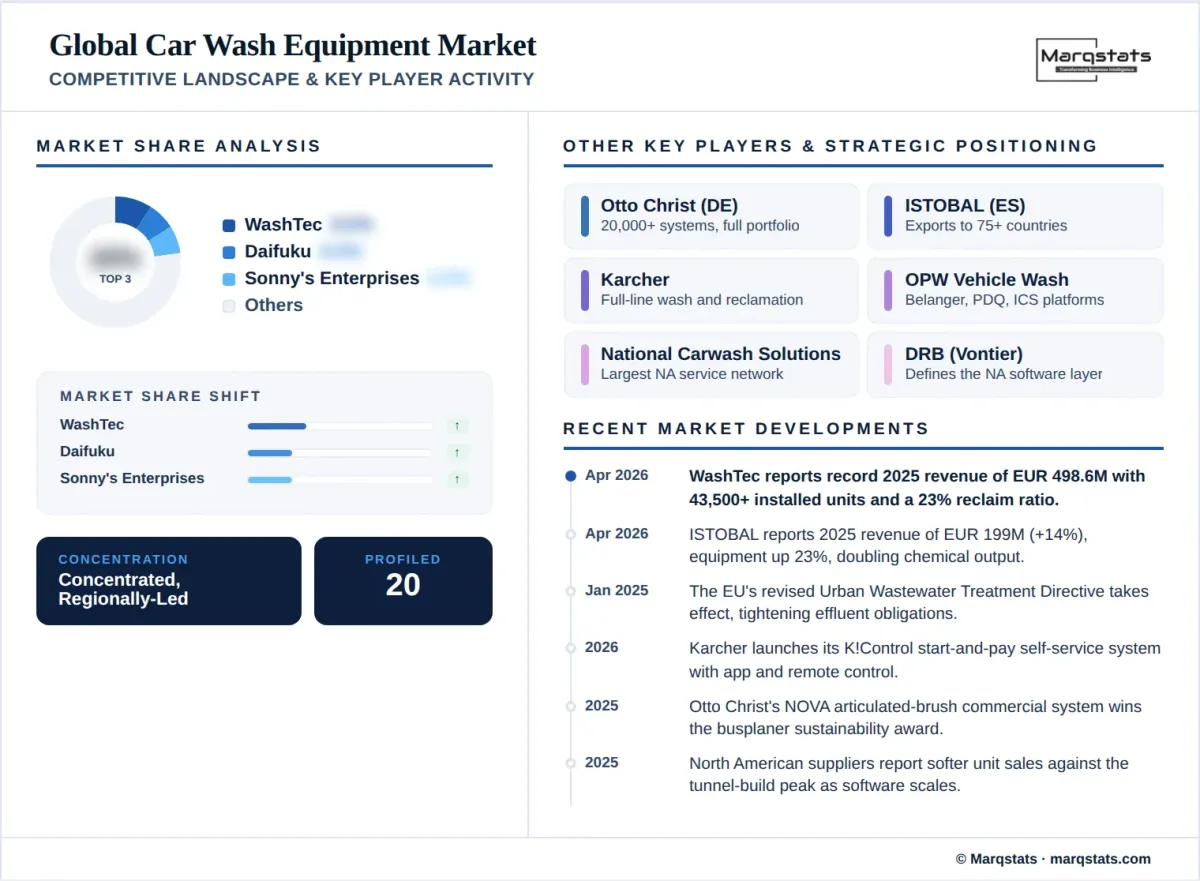
The equipment tier is globally concentrated even where operations fragment. WashTec of Germany is the clearest documented global leader, reporting more than 43,500 installed vehicle-wash units and over 50,000 car washes across more than 80 countries. Otto Christ reports more than 20,000 installed systems worldwide, ISTOBAL exports to more than 75 countries from plants in Spain, the United States, and Brazil, and Daifuku manufactures across Japan, China, Taiwan, South Korea, Thailand, and India while holding direct national shares in Japan and South Korea. In North America, Sonny's, OPW, National Carwash Solutions, and Tommy anchor the supply base, with Mark VII serving as WashTec's North American subsidiary.
Water regulation is the industry's defining external force worldwide. The European Union's revised Urban Wastewater Treatment Directive took effect in January 2025, alongside the Water Framework Directive and Detergents Regulation; California requires new conveyor and in-bay sites to recycle or reuse at least 60% of wash and rinse water; and Gulf, Brazilian, and South African rules mandate oil-water separation and effluent treatment. WashTec reports that 23% of its worldwide installed base carried a water-recycling system by the end of 2025, and ISTOBAL markets reclamation recovering 80% to 85% of water. Regulation increasingly determines the installed mix of reclaim systems, interceptors, dosing controls, and connected diagnostics, expanding equipment demand even where wash-site counts are mature.
Market Dynamics
Key Drivers
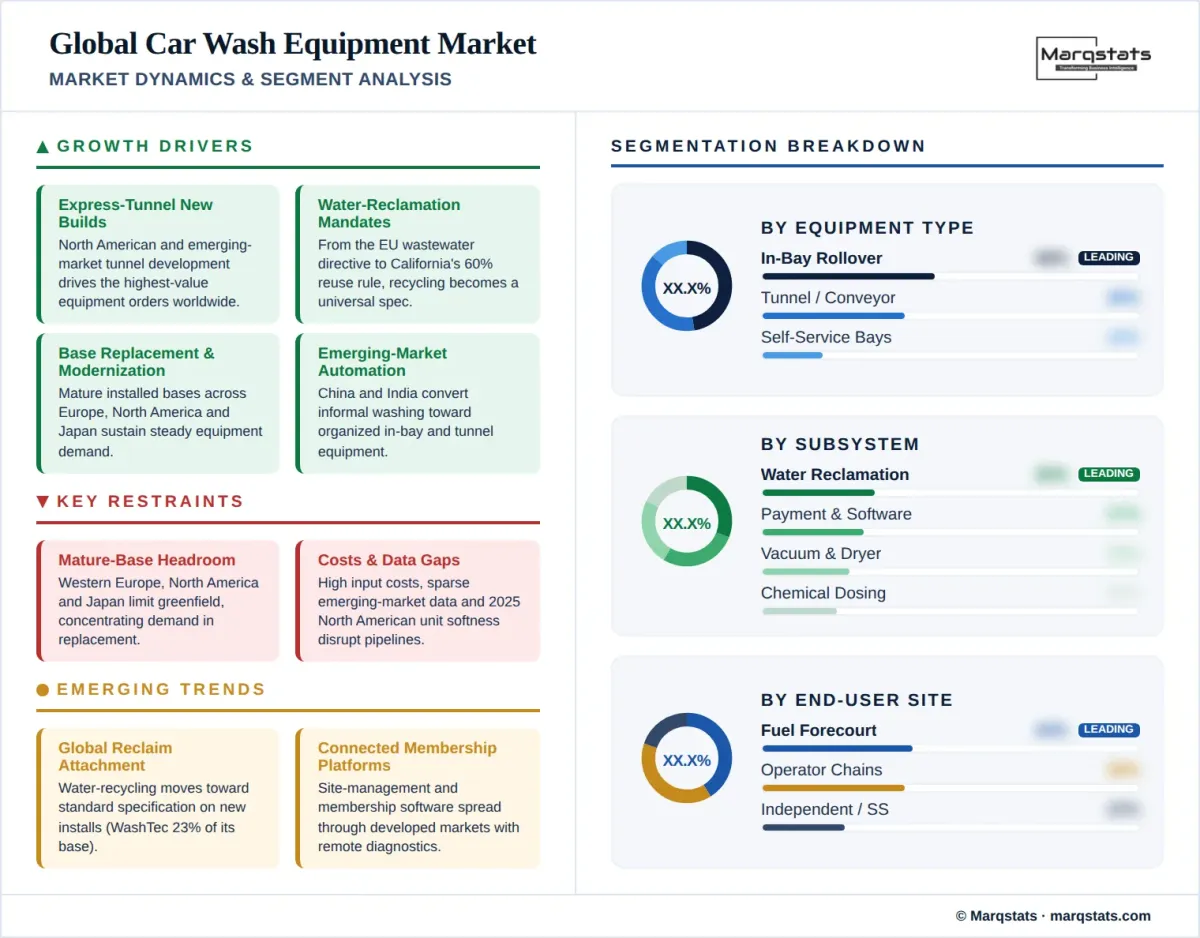
- Express-tunnel new-build development in North America and emerging markets drives the highest-value equipment orders worldwide.
- Water-reclamation mandates, from the EU wastewater directive to California's 60% reuse rule, make recycling systems a universal specification.
- Replacement and modernization of mature installed bases across Europe, North America, and Japan sustain steady equipment demand.
- Membership and site-management software expands as operators monetize subscriptions and connect networks in developed markets.
- Motor and drive efficiency rules across the EU and United States raise the value of efficient pumps, blowers, and dryers.
- Emerging-market automation, led by China and India, converts informal washing toward organized in-bay and tunnel equipment.
Key Restraints
- Mature installed bases across Western Europe, North America, and Japan limit greenfield headroom, concentrating demand in replacement and retrofit.
- High energy, component, and construction costs extend equipment payback and slow new development in saturated markets.
- Sparse public data and fragmented, partly informal markets across emerging regions constrain organized equipment penetration.
- Operator financial stress and equipment-order softness, as seen in 2025 North American unit-sales declines, disrupt supplier pipelines.
Key Trends
- Water-recycling attachment rises globally, with reclamation moving toward standard specification on new installations across regions.
- Connected site management and membership platforms spread through developed markets, adding predictive maintenance and remote diagnostics.
- Emerging-market automation accelerates, from China's unmanned smart-wash units to Gulf and Latin American forecourt systems.
- Commercial-vehicle and large-format systems advance, from Daifuku's heavy-vehicle machines to articulated-brush bus and truck lines.
Market Segmentation
Automatic in-bay rollover systems are the world's most widespread equipment format, accounting for roughly 80,600 of the 133,700 documented professional wash sites. In-bay gantry systems dominate Europe at about 50,000 units, lead Japan and South Korea through Daifuku's machine-led model, and anchor forecourt washing on every continent. Compact footprints and falling equipment costs make rollovers the default automation step for fuel stations and mid-density sites worldwide, and the category is the primary beneficiary of manual-to-automatic conversion in the Gulf, China, and Latin America. In-bay systems form the largest category by unit count and a substantial share of global revenue. Dual-gantry systems rated at up to 20 vehicles per hour illustrate the throughput band that makes rollovers the workhorse format for forecourts and dealer channels across mature and emerging markets alike.
Tunnel/conveyor systems command the highest per-site equipment value and the largest revenue concentration in North America, where roughly 17,500 United States conveyor sites anchor an express-exterior model with no global equal. Outside North America, tunnels hold a smaller footprint — about 8,000 European sites and a fast-growing base in China and the Gulf. A single express-tunnel installation can carry equipment value several times that of a rollover, so tunnels capture the largest share of new-build spend and the deepest subsystem and software attachment, and the format grows fastest where express-membership economics take hold. Modern express tunnels process between roughly 60 and 130 cars per hour depending on length, throughput that underpins the unlimited-membership economics driving the format's global expansion from North America into Europe, the Gulf, and East Asia.
Self-service high-pressure bays account for roughly 27,550 documented sites, strongest in Europe at about 11,000 units and the United States at about 16,250. Systems span high-pressure pumps, chemical arches, coin and cashless payment, and vacuum modules, and the format serves cost-conscious users and enthusiasts globally. Self-service increasingly adds contactless and app-based payment and remains resilient wherever attended washing is less economic, though cheap manual labour limits it across much of the emerging world.
Water reclamation and filtration is the fastest-growing subsystem and the market's single universal demand driver. Regulation from the EU wastewater directive to California's 60% reuse mandate makes recycling near-standard on new installations, and retrofit demand across mature bases compounds new-install volumes. WashTec reports a 23% reclaim-attachment ratio across its worldwide installed base, and ISTOBAL markets systems recovering 80% to 85% of water. As water stress spreads from the Gulf and northern China to Indian and Latin American cities, the compliance and cost advantage of reclamation compounds across every region. A traditional wash consumes well over 100 litres of water, so systems that recover the majority of that volume deliver both regulatory compliance and operating-cost savings, making reclamation among the first subsystems specified on new sites and the most common retrofit on the installed base worldwide.
Payment, membership, and site-management software is the market's fastest-growing digital subsystem, deepest in North America where it forms a region-defining category. Systems span unattended payment, license-plate recognition, loyalty, and enterprise membership management, converting standalone machines into connected, subscription-capable networks. Adoption spreads through developed markets and into emerging-market unmanned and app-based washing, and connectivity has become a competitive differentiator tied to predictive maintenance and remote diagnostics.
Chemical dosing systems gain from tightening chemistry regulation worldwide, including the EU Detergents Regulation and wastewater-discharge controls across North America, Brazil, and the Gulf. Precise, documented dosing and reformulated chemistry raise the value of each wash system, and suppliers integrate dosing with branded chemical lines to tie recurring consumables revenue to installed equipment. Chemical control is increasingly central to compliance in regulated projects on every continent.
Vacuum and dryer systems are standard modules bundled into forecourt, gantry, and tunnel packages worldwide, far larger in North America where the free-vacuum express model makes vacuum arrays a core amenity. Dryers gain from motor-efficiency rules across the EU and United States through higher-efficiency blowers and drives, and both categories tie to the recurring parts and consumables revenue that anchors supplier turnover globally.
Fuel-station forecourts are the world's most consistent equipment end-user, hosting extensive in-bay rollover networks operated by national fuel retailers on every continent. Forecourt integration favours compact gantry machines with reclamation and unattended payment, and retailer estate upgrades drive a substantial share of global replacement demand. The channel anchors in-bay orientation across Europe, the Gulf, Asia-Pacific, and Latin America.
Operator chains and dedicated wash sites are the fastest-growing end-user, investing in tunnels, premium gantries, and site-management software. Express-tunnel roll-ups in North America drive the highest-value equipment and software orders, and chains in Europe and Asia-Pacific increasingly adopt subscription-oriented systems. This channel supports the deepest subsystem and software attachment in the market.
Independent and self-service operators form a large, fragmented global end-user base, purchasing gantry, self-service, and jet-wash equipment through distributors and OEM direct channels. Concentrated in Southern and Central Europe, Latin America, and Asia, this channel sustains steady mid-value demand and is a primary adopter of cashless payment and compact reclamation systems worldwide.
Passenger-car wash systems account for the large majority of global equipment revenue, spanning gantry, tunnel, and self-service formats across all regions. Rising electric-vehicle and sensor-equipped vehicle ownership shifts demand toward gentler touch-free processes, most visibly in China, Europe, and North America, while an ageing mass-market parc sustains high-frequency gantry and tunnel use.
Commercial-vehicle and fleet wash systems are the fastest-growing application worldwide, driven by logistics, bus, and truck fleets and by mobility-as-a-service operators. Dedicated large-format systems — from Daifuku's heavy-vehicle machines washing a twelve-metre vehicle in under four minutes to articulated-brush bus and truck lines — meet presentation and throughput standards as last-mile delivery and electrified fleets expand across every region.
By Geography
North America
North America is the world's largest regional equipment market, contributing USD 3.30 billion, or 42.3% of 2025 global revenue, and growing at a 5.10% CAGR. The United States dominates, home to the world's deepest conveyor/tunnel base at roughly 17,500 sites and about 500 new stores opened annually. The region defines the tunnel-and-software model, with equipment leaders Sonny's, OPW, National Carwash Solutions, Washworld, and Tommy, and a membership-and-payment software layer with no global equal. Private-equity-backed operator consolidation concentrates high-value equipment and software orders, even as new-equipment unit sales softened in 2025 against the tunnel-build peak of prior years. Canada adds a mature, benchmarked market of about 26.8 million registered vehicles, and Mexico an emerging base formalizing from informal washing, together extending the region beyond its United States core.
Asia-Pacific
Asia-Pacific is the second-largest region, contributing USD 2.20 billion, or 28.2% of 2025 global revenue, and the fastest-growing on emerging-market automation. Japan and South Korea are the world's most machine-led national markets, where Daifuku holds direct shares of 40% and 60% and manufactures across the region. China and India automate rapidly from lower bases, with China's unmanned smart-wash and forecourt systems scaling nationwide, and Australia, at about 1,950 documented sites, operates a North American-style entrepreneur-owned model penetrated by both European and United States suppliers. The region combines mature machine density with the deepest long-run growth pool worldwide. Daifuku's regional manufacturing across Japan, China, Taiwan, South Korea, Thailand, and India signals that global OEMs treat Asia as both a production platform and the industry's primary growth frontier through 2030.
Europe
Europe contributes USD 1.46 billion, or 18.7% of 2025 global revenue, growing at a 5.10% CAGR as a mature replacement-and-upgrade market. The region carries the world's largest in-bay installed base at about 50,000 rollover systems among roughly 69,000 total sites, and it anchors the global equipment industry through WashTec, Otto Christ, ISTOBAL, and Kärcher. WashTec reports itself the clear market-share leader in Europe's core markets, and the region's revised Urban Wastewater Treatment Directive, in force from January 2025, alongside the Water Framework and Detergents Regulations, makes water reclamation and chemical-dosing compliance central to equipment specification. Germany's automotive car-wash conformity program adds dealer-safe brush and chemistry standards, and the region's high recurring service and consumables intensity confirms a market where modernization and retrofit, rather than greenfield installation, account for the majority of annual equipment demand.
Middle East & Africa
The Middle East & Africa contributes USD 0.45 billion, or 5.8% of 2025 global revenue, growing from a small base as water scarcity makes reclamation and effluent treatment economically central. Gulf markets favour high-capacity automatic and tunnel systems with water reuse, driven by municipal water-stewardship oversight, while South Africa provides the clearest African demand anchor at about 13.1 million registered vehicles under municipal car-wash licensing. Public installed-base data remain sparse, however regulation-driven water reuse shapes equipment specification across the region.
South America
South America contributes USD 0.39 billion, or 5.0% of 2025 global revenue, led by Brazil, where vehicle washing is formally classified under national industry codes and municipal licensing commonly requires oil-water separation and effluent treatment. ISTOBAL maintains a Brazilian manufacturing presence, evidence that the region supports local industrial footprint for a global OEM. Installed-base and unit-volume data remain largely unquantified in public records, and equipment demand advances gradually with formalization, forecourt investment, and embedded wastewater-treatment requirements in regulated projects. Argentina, Chile, and the Andean markets add smaller organized bases formalizing from low tickets, and the region's reliance on embedded effluent-treatment systems in licensed projects makes water-management equipment a structural entry point for suppliers across the continent.
How Competition Is Evolving
The global car wash equipment market is concentrated at the supplier tier atop a fragmented and regionally distinct operator base. WashTec of Germany is the clearest documented global leader, reporting more than 43,500 installed vehicle-wash units and over 50,000 car washes across more than 80 countries, and describing itself as the market-share leader in Europe's core markets. Otto Christ reports more than 20,000 installed systems worldwide across a full portfolio, ISTOBAL operates 15 subsidiaries and exports to more than 75 countries from plants in Spain, the United States, and Brazil, and Kärcher supplies a full-line vehicle-wash, digital, and reclamation portfolio.
Regional leaders anchor their home markets. In North America, Sonny's Enterprises describes itself as the world's largest manufacturer of conveyorized equipment, OPW Vehicle Wash Solutions combines Belanger, PDQ, ICS, Kesseltronics, and Transchem, National Carwash Solutions operates the region's largest service network, and Tommy, Washworld, AVW, and Motor City Wash Works complete the field, with Mark VII serving as WashTec's North American subsidiary. In Asia-Pacific, Daifuku holds direct 40% and 60% shares in Japan and South Korea and manufactures across the region, while China's domestic builders scale unmanned and forecourt systems. Software leader DRB, a Vontier company, defines the North American digital layer.
Competition worldwide increasingly turns on recurring service, water efficiency, and digital differentiation rather than core wash mechanics alone. Suppliers report high recurring service, parts, and consumables revenue shares, and water-recycling attachment has become a competitive and regulatory imperative, exemplified by WashTec's 23% installed-base reclaim ratio and ISTOBAL's 80% to 85% reuse systems. Connectivity, predictive maintenance, and enterprise membership software define the next equipment cycle, with greenfield expansion advancing fastest in North America, China, and emerging markets, and regulation-driven modernization reshaping Europe, California, and the Gulf through 2030. The supplier field remains a comparatively short list of industrial OEM groups even as the operator base fragments across regions, giving equipment makers durable pricing power anchored in service-network depth, installed-base scale, and the rising compliance value of water and chemistry systems.
Companies Covered
The report profiles 20++ companies with full strategy and financials analysis, including:
Recent Market Activity
Table of Contents
Coverage & Segmentation
This report provides a comprehensive analysis of the global car wash equipment market covering the historical period 2021 to 2025 and the forecast period 2026 to 2030, with 2025 as the base year. The study aggregates five regional markets — North America, Asia-Pacific, Europe, the Middle East & Africa, and South America — and defines the market as annual revenue from the manufacture and sale of vehicle-wash equipment and systems across in-bay, tunnel/conveyor, and self-service formats, together with attached subsystems (water reclamation, chemical dosing, payment and site-management software, vacuums, and dryers) and the recurring parts and consumables that support the installed base; wash-service revenue earned by operators is excluded and covered in a separate study. Market size is presented in value terms (USD), with 2025 as the base year and forecasts assuming constant conditions.
The study segments the market by equipment type, subsystem, end-user/site, and vehicle application, and examines regional and country demand, format divergence, installed-base density, water-recycling adoption, regulation, and competition across all five regions. Market sizing aggregates bottom-up regional models anchored to documented installed-base counts — more than 133,700 professional wash sites worldwide, including about 80,600 in-bay, 27,550 self-service, and 25,550 conveyor systems — reconciled against supplier disclosures including WashTec's 43,500 global installed units. Figures are transparently estimate-based where public regional equipment data are unavailable. The competitive section profiles 20 equipment suppliers and systems providers spanning every region.