Market Snapshot
Middle bar: base-year value × (1 + CAGR), rounded to two decimals. This is a calculated illustration, not a separately researched annual estimate.
The China electric vocational truck market is estimated at USD 5.10 billion in 2025 and is projected to reach USD 15.15 billion by 2030, at a CAGR of 24.31%. Marqstats estimates new-energy work-body truck volumes at 61,629 units in 2025, rising to 200,000 by 2030. Published registrations of new-energy dump trucks alone reached 26,129 units in 2025, up 98.06%, against 15,500 concrete mixers in the first eleven months. In renminbi the market grows from 36.68 to 99.24 billion, a CAGR of 22.02%.
Market size and forecast figures are generated using Marqstats' proprietary estimation framework, updated as of August 2026.
The unit aggregate above is a Marqstats harmonised estimate, not a registration count. Only the dump truck line is a published full-year figure, 42.4% of the 2025 total; the mixer, sanitation and other-specialised lines are Marqstats extensions of published part-year data or, for sprinklers, tankers and concrete pumps, Marqstats construction with no published series behind them. The four components also run on four calibers, and the registration definition of a dump truck explicitly includes tipper-type refuse vehicles, so an unquantified number of municipal vehicles sit in both the dump and the sanitation lines. Marqstats has not netted that overlap out because no published split exists. The aggregate carries a small upward bias whose direction is known and whose size is not.
The concrete mixer is the best electrification duty cycle in Chinese road transport, and the reason is mechanical rather than logistical. On a diesel mixer the drum turns through a power take-off from the main engine, which must therefore idle continuously whenever the drum rotates — through loading, transit and discharge. An electric mixer runs the drum off a 30 to 60 kilowatt direct-drive motor. One European manufacturer states that its drum-only system carries a 32 kilowatt-hour battery covering a full working day of rotation, which Marqstats derives at roughly 8% to 9% of the 350 to 405 kilowatt-hour packs Chinese electric mixers carry — a derivation that transplants a European figure, because no Chinese source publishes drum energy in kilowatt-hours. Drum-only electrification of an unchanged diesel truck is stated by manufacturers at 18% to 30% fuel saving. A fifth to a third of avoided burn against a tenth of a pack is a stronger argument than the return-to-base duty cycle mixers share with city buses. The penetration figures usually quoted, however, rest on a narrower base than their circulation suggests: the above-65% mixer rate for the first half of 2025 comes from one battery-manufacturer engineer speaking at a Luoyang conference on 5 August 2025. Dump trucks at 43% across 2025 and sanitation at roughly 21% are independently compiled, on a class average of 29%. Marqstats publishes no mixer penetration rate of its own, and figures still placing mixers near 20% are approximately three years stale.
What reframes the whole segment is the denominator. Chinese cement output fell 6.9% in 2025 to 1.693 billion tonnes and a further 8.0% in the first half of 2026; ready-mixed concrete volumes fell 10.1% in 2024 with the industry running at roughly one-sixth of nameplate capacity; property development investment fell 17.2% and then 18.0%. Every electric mixer and construction dumper sold in China is sold into a market whose underlying activity is contracting at high single digits a year. This is substitution into a shrinking base, not growth — and any 2030 forecast that extrapolates 2026's 106% growth is modelling an impossibility.
Key Takeaways
Market Overview & Analysis
Report Summary
This report sizes the China electric vocational truck market — new-energy purpose-built work-body vehicles, covering concrete mixers, dump and tipper trucks, sanitation and refuse vehicles, sprinklers and tankers, concrete pumps and other specialised bodies. Tractor units and general cargo bodies are excluded and are covered by separate Marqstats reports on Chinese electric heavy-duty trucks and Chinese electric light and medium trucks. Non-road wide-body mine trucks are also excluded, because they sit outside the on-road registration series entirely. The scope boundary matters, because vocational bodies are routinely folded into general heavy-truck totals where their very different economics disappear into a tractor-dominated average.
Vocational trucks are about a quarter of China's new-energy heavy-truck unit pool and rising. Dump trucks and mixers together took 35,528 of 141,683 units in the first half of 2026 on the registration caliber, or 25.1%, with tractors at 68.5%; adding the specialised-body residual line takes vocational to roughly 28% to 29%. The direction of travel matters more than the level. Tractors fell from above 75% of the pool in the first eleven months of 2025 to 68.5% in the first half of 2026, while the mixer share rose from roughly 9.7% in full-year 2024 to 10.6% in the first half of 2026 and dump fell from about 16% to 14.5% on the same two readings. The comparison spans three different periods and should be read as a direction rather than a rate.
The segment splits into two economically distinct halves that this report keeps apart. Mixers and dump trucks are bought by ready-mix producers, contractors and quarry operators on an operating-cost calculation, and their electrification is running well ahead of the class. Sanitation and refuse vehicles are bought by municipalities and contracted operators through public tender, are supplied by environmental-services groups rather than truck manufacturers, and are electrifying more slowly despite a duty cycle that on paper suits them just as well. Treating the two as one market produces a blended figure that describes neither.
Market Dynamics
Key Drivers
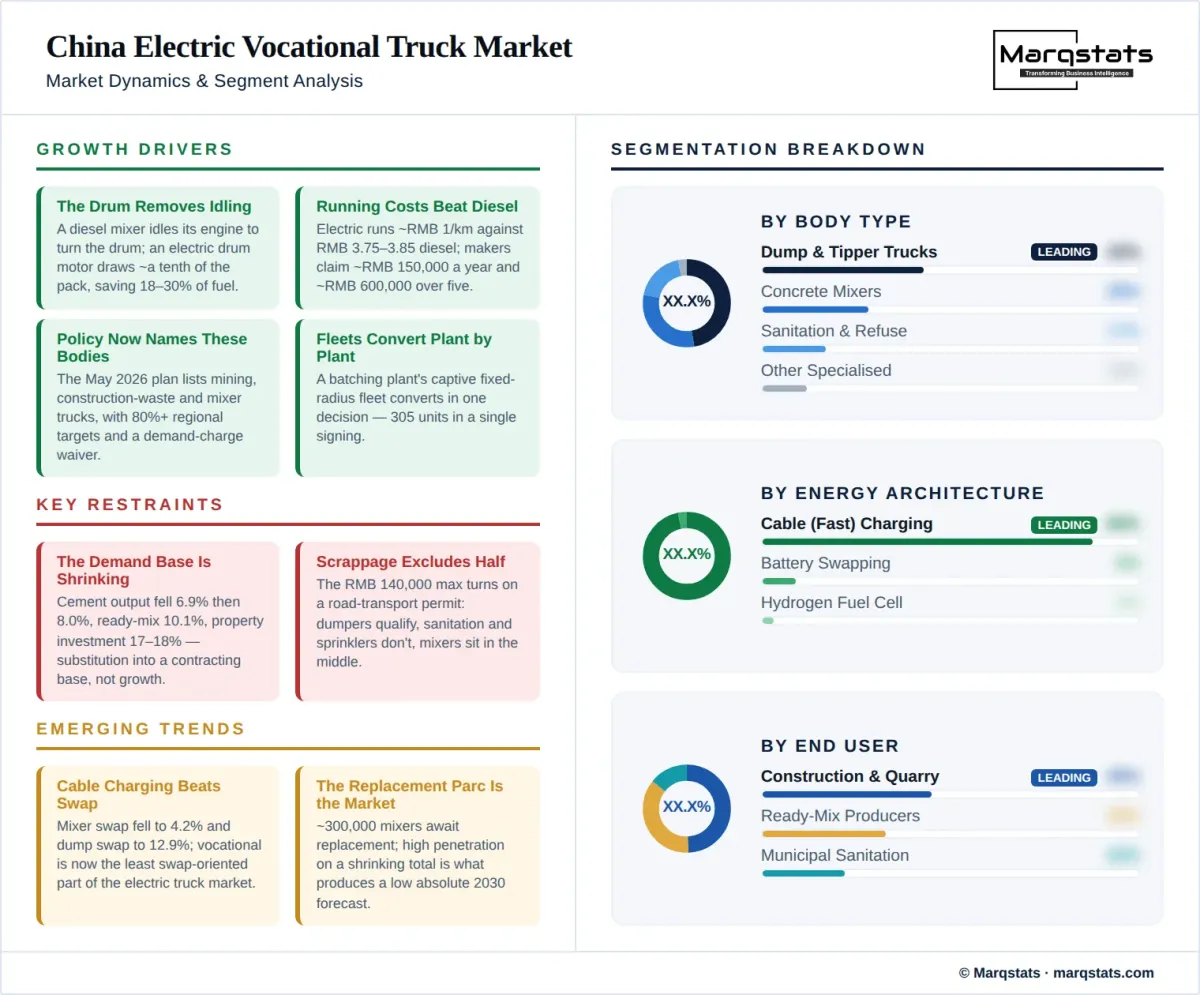
The drum removes a continuously idling engine, which no other body type offers. Because a diesel mixer's main engine must run whenever the drum turns, the vehicle burns fuel while stationary at the plant and at the pour. Manufacturer-stated drum-only electrification saves 18% to 30% of fuel on an otherwise unchanged truck, and the drum motor draws roughly 8% to 9% of a Chinese electric mixer's pack across a full working day on a Marqstats derivation from European drum data.
Running costs are corroborated four ways and the gap is large. Electric vocational trucks run at roughly RMB 1 per kilometre against RMB 3.75 to 3.85 for diesel, at consumption of 1.2 to 2.1 kilowatt-hours per kilometre. Manufacturers claim annual savings of RMB 150,000 and around RMB 600,000 over five years, though both figures are stated as savings without the purchase premium they must repay.
National policy now names these bodies specifically. The eleven-ministry plan signed 29 May 2026 lists mining transport vehicles, construction-waste transport vehicles and concrete mixers among the vehicle types to be electrified, and pairs the targets with roughly 3,000 charging and swap stations and a demand-charge waiver to 2030. Regional targets are sharper still, at above 80% short-haul electrification in the Beijing-Tianjin-Hebei and Fenwei Plain regions.
A single fleet buyer can convert an entire batching plant at once. The same August 2025 conference statement that supplies the 65% penetration figure reports one major mixer manufacturer at an 83% new-energy mix in its domestic mixer business for the first half of 2025. Independently of that claim, the delivery record shows plant-scale conversion — 305 units in one signing, 100 units in another, 20 units taking a Beijing producer's electric fleet to 30 — a consequence of fleets being bought and replaced plant by plant rather than vehicle by vehicle.
Municipal procurement gives sanitation a demand floor independent of construction. Sanitation fleets are replaced on public budget cycles and against air-quality task lists rather than on payback arithmetic, which insulates that half of the segment from the construction contraction driving mixers and dumpers. The scale of the contracting market is substantial: 12,792 sanitation service projects reached expiry in 2025 on total contract value of RMB 1,439.4 billion.
Key Restraints
The demand base is shrinking at high single digits a year. Cement output fell 6.9% in 2025 and 8.0% in the first half of 2026; ready-mixed concrete fell 10.1% in 2024 at roughly 16.6% capacity utilisation; property development investment fell 17.2% then 18.0%. Rising penetration into a contracting base produces a unit series that decelerates hard once conversion of the installed fleet is largely done, and that turn is inside the forecast horizon rather than beyond it.
The purchase premium is real, its size is not currently measurable at heavy-truck level, and payback is longer than manufacturers claim. The only published heavy price pair puts an electric mixer at RMB 800,000 against RMB 400,000 for diesel, but it is dated 24 October 2023 and is very likely too wide after two years of price competition; the freshest pair obtainable is a bodybuilder's price list for a light refuse body at a 67% to 83% premium. Manufacturer figures imply 2.7 to 3.3 years to payback; the one independent trade calculation obtained puts the electric vehicle at five years against three for the diesel.
The scrappage scheme excludes part of the segment on a technicality. Eligibility for the RMB 140,000 maximum turns on holding a road transport permit under the May 2026 implementation rules. Dump trucks registered as goods vehicles hold one and qualify; sanitation vehicles and sprinklers, registered as special-operation vehicles, do not. Mixers sit in an unresolved middle that no retrievable document settles, and the RMB 140,000 headline is being restated by manufacturer marketing as though it were a mixer-specific subsidy.
Residual values and battery replacement reserves are unpublished for every vocational body type. Nothing in this research establishes what a used electric mixer or dump truck is worth, or what operators reserve against pack replacement, which leaves the back half of any total-cost calculation unevidenced. One manufacturer has begun to answer it commercially rather than statistically, warranting a mixer battery for ten years or 1.8 million kilowatt-hours of throughput.
Key Trends
Cable charging is displacing battery swap, against the direction most commentary assumes. Mixers ran 4.2% swap in June 2026, down from 9.04% across January to April, and dump trucks fell from 23.58% to 12.9% while the segment doubled. Vocational is now materially less swap-oriented than the tractor market it is usually grouped with, and the vendor rankings confirm it — the leading mixer manufacturer sits ninth in swap volumes and fell 32%, while the leading dump truck manufacturer sits fifth and fell 4%.
Vocational is taking share of the electric truck pool from tractors. Tractors fell from above 75% of new-energy heavy-truck units in the first eleven months of 2025 to 68.5% in the first half of 2026, with mixers and specialised bodies absorbing the difference.
The replacement parc, not new construction, is becoming the market. The August 2025 conference statement puts the installed mixer base awaiting replacement at 300,000 units and forecasts 22,000 new-energy mixers at above 85% penetration by 2029. Marqstats does not adopt that forecast — first-half 2026 registrations of 15,002 units have already overtaken its implied run rate — but the logic behind it holds: a high penetration rate applied to a shrinking total mixer market is what produces a low absolute forecast, and that mechanism is the single most important thing to understand about this segment.
Fast charging is being specified around the existing work cycle rather than the reverse. Dual-gun 600-ampere systems taking a pack from 20% to 80% in about 30 minutes are being marketed explicitly at return-to-base vocational operation, which is why the segment has not needed swap infrastructure to electrify. Sand and gravel haulage, where roughly 43,000 charging terminals now serve the scenario at two-to-three-year station payback, is the clearest worked example.
Market Segmentation
The electrification leader and the analytical centre of this report. New-energy mixer registrations went from 2,121 units in 2022 to 5,315 in 2023 and 8,036 in 2024, reached 15,500 in the first eleven months of 2025, and hit 15,002 in the first half of 2026 alone, up 106.3%. Marqstats models 17,000 for 2025 rising to 52,000 by 2030 — a deliberate plateau rather than a continuation, with modelled growth falling from 27% in 2027 to 14%, 6% and 2% in the years that follow, because the underlying concrete market is contracting. Concentration is high and rising: the top three bodybuilders took 63.5% of registrations in the first four months of 2026 and 63.7% across the half year.
The largest vocational body type by volume and the second fastest to electrify. Registrations reached 26,129 in 2025, up 98.06%, with a single-month record of 4,466 in December, and 20,526 in the first half of 2026, up 99.8%. Penetration was 43% across 2025 and one major manufacturer forecast above 53% for 2026. Marqstats models 80,000 units by 2030. Note the definitional point that governs the whole segment: the registration definition of this body type explicitly includes tipper-type refuse vehicles, so part of what a reader would call sanitation is counted here.
The laggard, and a different industry. Retail volumes were 9,709 units on an all-new-energy basis in 2024, at 13.36% penetration of a total sanitation vehicle market that itself fell 5.6% to 72,657 units. The most recent comparable reading is 9,084 pure-electric units across the first three quarters of 2025, up 57.7% on the same pure-electric basis — that figure counts a narrower powertrain set than the 2024 total and the two must not be compared directly. Penetration is reported at 18.8% for the first three quarters of 2025 and 29.4% for the first half of 2026, the latter on a single source with its caliber unstated. Demand runs through municipal tender rather than operator purchase, and the leading suppliers are environmental-services groups rather than truck manufacturers.
Sprinklers and tankers, concrete pumps, mobile cranes and other work bodies. Marqstats models 6,000 units in 2025 rising to 25,000 by 2030. This segment is entirely a Marqstats construction — no unit series, penetration rate or growth rate exists for sprinklers or concrete pumps on any published caliber, and the evidence that they exist as electric products is confined to individual type-approval filings and single deliveries. The figures should be read as an order-of-magnitude estimate rather than a measurement.
The dominant and increasingly the default architecture, on 95.8% of mixer registrations in June 2026 and 84.6% of dump trucks in the same month, the latter up 204.7% year on year. Dual-gun 600-ampere systems recover 20% to 80% of pack in about 30 minutes, and 1,000-ampere options are appearing, which fits inside the stationary time a return-to-base work truck already has.
Losing share in every vocational body type measured. Mixers ran 4.2% swap in June 2026 against 9.04% for January to April; dump trucks fell from 23.58% across 2025 to 12.9% in June 2026 even as the segment doubled. Both sit below the 24% to 25% rate for new-energy heavy trucks as a class, which makes vocational the least swap-oriented part of the Chinese electric truck market rather than the stronghold it is often assumed to be. The economics reinforce the duty cycle: a swap station costs RMB 5 million to 8 million per site and requires standardised pack geometry across a fleet, where a depot charger requires neither.
Small, and moving in opposite directions in two body types. In dump trucks fuel cell reached 843 units across 2025, a 3.23% share, then fell to 20 units and a 0.4% share in June 2026, down 78.7% year on year, while cable charging took the segment. In sanitation it is growing, because municipal tender can carry a RMB 1.45 million hydrogen wash-sweeper that no commercial fleet would buy — twenty such vehicles were bought in Zhengzhou in February 2026 and twenty fuel-cell sanitation vehicles delivered in Beijing Fangshan in January 2026. In mixers a fuel-cell product exists in the catalogue, rated at 360 kilowatts peak with a 127 kilowatt-hour buffer battery and 240 to 280 kilometres of range, but recorded zero registrations across January to April 2026. These are not one phenomenon and should not be aggregated.
The buyers of the mixer fleet, and the reason conversion happens in blocks. A batching plant runs a captive fleet on a fixed radius, is sized at 300,000 to 400,000 cubic metres a year in the two sources that state a figure, and can convert in a single procurement decision — which is what produces body-type conversion rates far above anything seen in owner-operator freight.
The dump truck buyers. Site and quarry haulage is short-radius, high-tonnage and return-to-base, and unlike mixers it is partly served by non-operating vehicles that fall outside the road transport permit regime — which is precisely the line the scrappage scheme cuts along. In sand and gravel specifically, trade reporting states that almost all heavy-truck capacity added in the past two years has been electric.
Public buyers on tender cycles, purchasing against air-quality task lists and municipal budgets rather than payback. This is the only part of the segment whose demand does not depend on construction activity, and the only one where the supplier base sits outside the truck industry.
By Geography
Beijing-Tianjin-Hebei
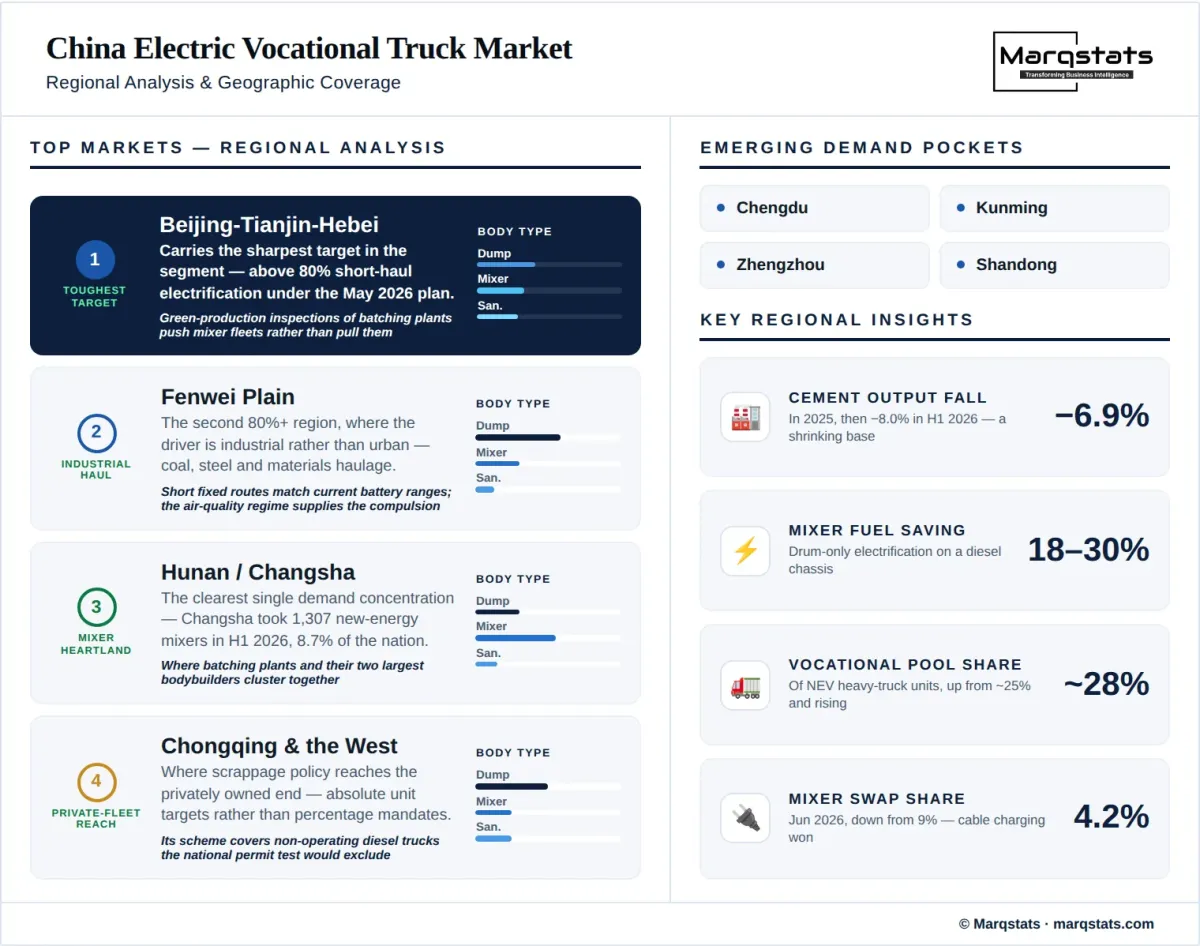
The region carrying the sharpest regulatory target in the segment: above 80% short-haul electrification under the eleven-ministry plan of May 2026. Beijing's annual air-quality action plan drives municipal fleet turnover, and the city separately runs green-production inspections of ready-mix batching plants, which is the compliance channel through which mixer fleets are pushed rather than pulled.
Fenwei Plain
The second region named for above 80% short-haul electrification, and the one where the driver is industrial rather than urban. Coal, steel and building-materials haulage over short fixed routes makes the duty cycle unusually well matched to current battery ranges, and the regional air-quality regime supplies the compulsion.
Hunan and the Changsha Cluster
The clearest single demand concentration in the mixer data: Changsha alone took 1,307 new-energy mixers in the first half of 2026, or 8.7% of the national total. That concentration is itself evidence for the plant-radius thesis, and it is reinforced by vendor geography — the two largest mixer bodybuilders are both headquartered in Changsha, so local fleet conversion and supplier proximity compound each other. Mixer demand clusters where batching plants and their makers cluster, not where freight corridors run.
Chongqing and the Western Provinces
Where scrappage policy reaches the privately owned end of the segment. Chongqing's June 2025 public-domain electrification plan sets absolute unit targets rather than percentage mandates — 300 cumulative new-energy sanitation vehicles and 4,000 specific-scenario vehicles by the end of 2025 — and its July 2025 programme covers scrapping and replacement of China IV and China III non-operating diesel trucks, which is exactly the registration category into which privately owned mixers and site dumpers fall and which the national road-transport-permit test would otherwise exclude. Dump truck demand concentrates further west still, on Chengdu and Kunming.
Rest of China
Demand outside the named regions and clusters tracks construction activity and municipal budgets rather than mandate. With cement output falling nationally and property investment down in the high teens, the areas without a regional electrification target or a dense batching-plant network are where the contracting denominator shows through first.
How Competition Is Evolving
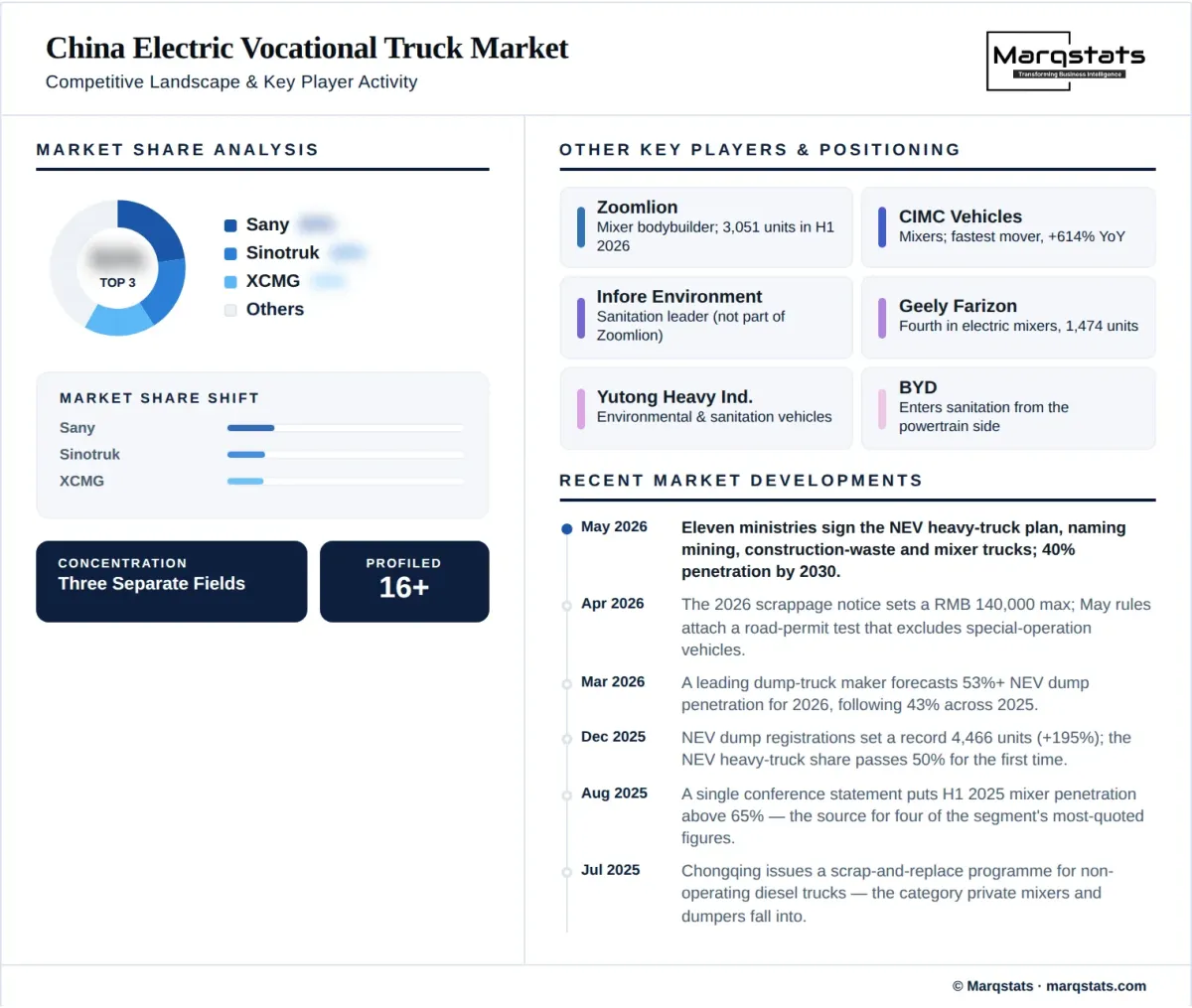
This is not one competitive field but two, and conflating them is the most common error in coverage of the segment. Mixers are supplied by concrete-machinery and bodybuilder groups — Sany, Zoomlion and CIMC took 63.7% of new-energy mixer registrations between them in the first half of 2026, with Geely Farizon fourth on 1,474 units. Dump trucks are supplied by truck manufacturers: Sinotruk led 2025 on 5,502 units and 21.09%, with Xuzhou XCMG Automobile at 5,498 and 21.07% and Sany's automotive arm third. Sanitation and refuse vehicles are supplied by environmental-services groups — Infore Environment, Zhengzhou Yutong Heavy Industry and Fulongma, alongside BYD entering from the powertrain side and XCMG through its environmental equipment division. These are different companies, different customers, different procurement mechanisms and different balance sheets, and no published table spans all three. A reader who ranks Chinese electric vocational truck makers by adding the tables will produce a ranking that describes no real population.
The identity trap in the sanitation half is severe enough to mis-assign roughly a third of Chinese new-energy sanitation volume. Changsha Zoomlion Environmental Industry Co., Ltd. is not part of Zoomlion. Infore Environment acquired it in two steps — RMB 11.6 billion for an initial 51% announced in May 2017 and a consolidation of the remainder announced in May 2018 at more than RMB 14.5 billion — and never renamed it. It plates its vehicles under the Infore marque, and Zoomlion is today Infore's second-largest shareholder rather than its parent. Zoomlion's 3,051 new-energy mixers in the first half of 2026 and Infore's 3,275 new-energy sanitation vehicles across January to May 2026 are two different companies, despite the shared character string in their corporate identities, and are listed here as one player each rather than as four.
Two further structural points govern how these tables should be read. Corporate identity is unstable on the truck side as well: Sany, XCMG and CIMC each trade under three or more corporate names, and the dump-truck and battery-swap rankings mean Xuzhou XCMG Automobile Manufacturing, not the listed machinery company — and beneath that sits the chassis-versus-body problem, since CIMC describes its own output as upper-structure products and sells bodies to chassis makers whose despatch figures already count them. And on energy architecture the vendor rankings corroborate the registration data: the leading mixer manufacturer sits ninth in battery-swap volumes and fell 32%, the leading dump truck manufacturer sits fifth and fell 4%. The companies winning the vocational segment are not the companies winning battery swap, which is the clearest available confirmation that these duty cycles are being served by fast charging inside existing return-to-base time. The fastest share mover in the segment is CIMC, up 614% year on year in mixers off a small base.
Companies Covered
Companies covered in the report include:
Recent Market Activity
Table of Contents
Coverage & Segmentation
This study covers new-energy vocational trucks in China — purpose-built work-body vehicles including concrete mixers, dump and tipper trucks, sanitation and refuse vehicles, sprinklers and tankers, concrete pumps and other specialised bodies, across battery-electric, plug-in and range-extended, and fuel-cell powertrains. Tractor units and general cargo bodies are excluded and are covered by the Marqstats reports on Chinese electric heavy-duty trucks and Chinese electric light and medium trucks; non-road wide-body mine trucks are excluded because they fall outside the on-road registration series; and sanitation and refuse vehicles are covered here on a China basis, while the Marqstats global Electric Refuse Truck report covers that body type worldwide with China as one sub-region. The boundaries are stated so the four reports do not overlap.
Market value is measured at vehicle selling price in renminbi and converted to United States dollars at annual average exchange rates for historical years and assumed rates thereafter, with both series reported because they diverge by 2.29 percentage points across the forecast. The base year is 2025, the historical period 2021 to 2025 and the forecast period 2026 to 2030. Chinese vocational vehicle statistics run on several incompatible calibers — compulsory insurance, terminal registration, invoice despatch and terminal retail — and the unit series here is built on terminal registration where available, with each figure's caliber stated at the point of use. The aggregate unit total is a Marqstats harmonised estimate rather than a registration count — the mixer line is terminal registration at 12 tonnes and above, dump is licence-plate data, sanitation is all-tonnage terminal retail, and the specialised remainder has no published caliber at all, so the four are individually sound and jointly approximate — and no penetration rate is calculated by Marqstats for mixers, for the reason set out under Methodology Summary.