Market Snapshot
Middle bar: base-year value × (1 + CAGR), rounded to two decimals. This is a calculated illustration, not a separately researched annual estimate.
The United States commercial electric vehicle charging infrastructure market is no longer just a fleet depot charger story. It now spans five interconnected layers: private fleet depots (delivery vans, trucks, buses, municipal vehicles), workplace and destination charging at commercial sites, shared truck-charging hubs for fleets without dedicated facilities, corridor and freight-node charging for high-utilisation trucks, and the software-plus-energy layer (managed charging, demand charge management, microgrids, energy storage) needed to operate these assets economically. The federal Station Locator tracked 211,382 total public and private nonresidential charging ports in Q2 2024 (up 6.3% quarter-over-quarter), expanding to roughly 219,000 public ports by mid-2025. The United States commercial EV charging infrastructure market size was valued at approximately USD 7.84 billion in 2025 and is projected to reach USD 24.67 billion by 2030, expanding at a CAGR of 25.76% during the forecast period (2026–2030).
Depot and return-to-base charging remain the core. Approximately 87% of US medium- and heavy-duty vehicles operate under 200 miles daily, and an estimated 75–90% of MD/HD chargers will be at depots by 2030. Over 59,000 zero-emission trucks are operating nationwide (June 2025), more than 8,100 full-size and 1,400 small ZE transit buses are funded/deployed (July 2025), and 5,100+ electric school buses are on the road with 13,931 committed. For private fleet charging ports where use was known, approximately 36% were used for fleet charging, 75% were Level 2, and most served light-duty vehicles—meaning the commercial market is not only about megawatt truck charging; a large part of today’s installed base is still lower-power workplace and light-duty fleet infrastructure.
A critical structural issue: 95.5% of the approximately 577,000 FMCSA-registered trucking businesses had 10 vehicles or fewer, and 44% of all on-road commercial vehicles operate in fleets of 10 or less. This makes shared depots, Charging-as-a-Service (CaaS), utility make-ready programmes, and no-upfront-capex infrastructure models essential—not optional add-ons for edge cases. The market is becoming an industrial infrastructure business, not just a charger market. The Marqstats US fleet depot charging infrastructure market report and US megawatt charging system infrastructure market report provide deeper coverage of depot and high-power corridor sub-segments.
Key Takeaways
Market Overview & Analysis
Report Summary
The United States commercial EV charging infrastructure market covers all charging infrastructure deployed for commercial and fleet electric vehicle operations, distinct from residential consumer charging. The five market layers are: (1) private fleet depot charging—Level 2 AC (19.2 kW) through megawatt charging systems at fleet facilities for overnight, mid-day, and shift-change charging; (2) workplace and destination charging at commercial properties, offices, retail, and hospitality sites serving employee and visitor EVs; (3) shared commercial hubs and truck-charging centres for fleets without dedicated depots; (4) corridor and freight-node charging along interstate highways and at port/intermodal facilities; and (5) software, energy management, storage, microgrid, and utility coordination services that make commercial charging economically viable. The market covers both public-access and private-access commercial ports, all power levels from Level 2 through megawatt, and all commercial vehicle classes from light-duty fleet vans through Class 8 heavy-duty trucks.
Commercial charging differs from personal-vehicle charging because it involves fewer vehicles per site but much higher per-site electricity demand, more geographically concentrated charging, and power requirements from tens of kilowatts to more than 1 MW per vehicle. Deployment timelines range from approximately six months to more than four years depending on grid-upgrade needs. The market is fundamentally a phased buildout: first electrifying fleets with lighter payloads, predictable routes, limited daily travel, return-to-base operations, and policy support—then expanding to heavier, longer-range, and more complex fleet applications.
Market Dynamics
Key Drivers
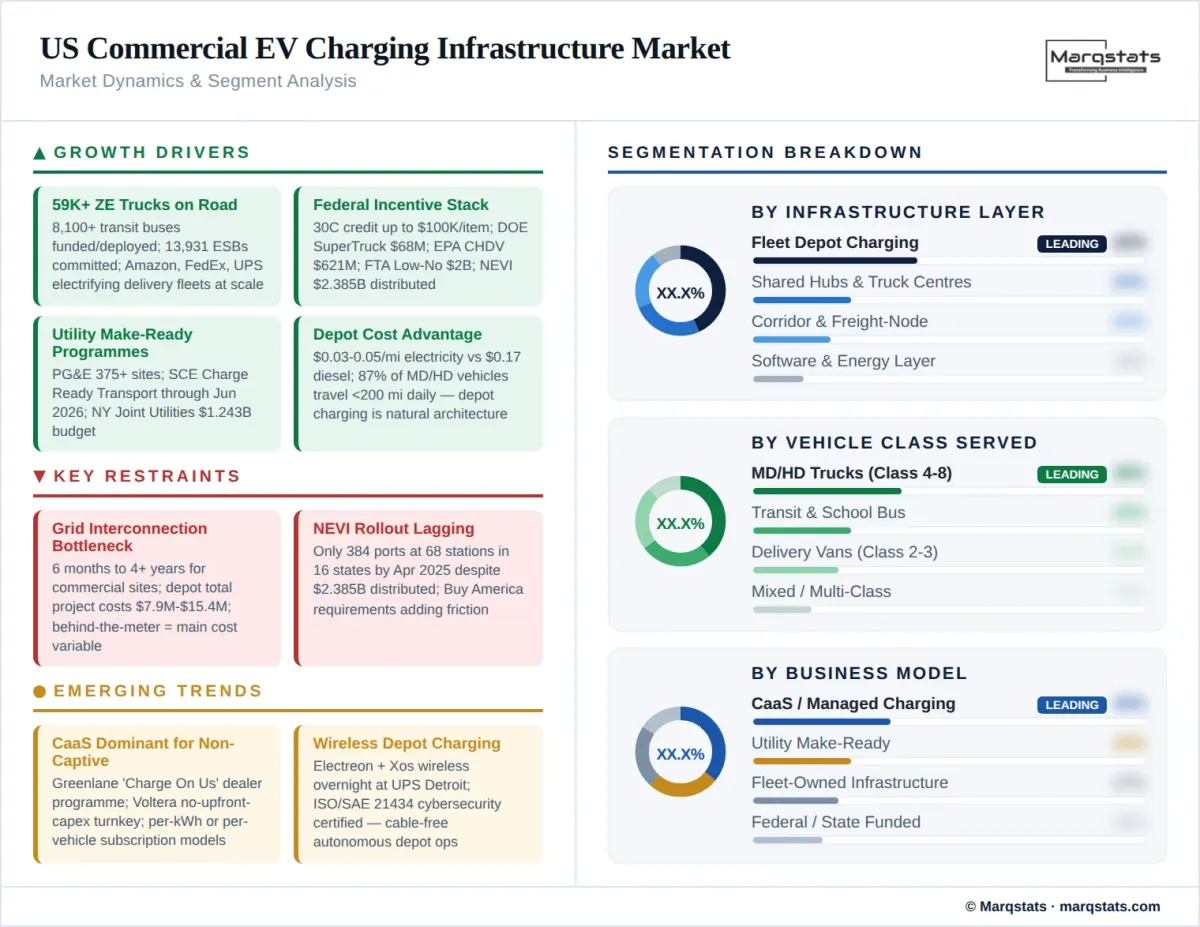
- 59,000+ ZE trucks, 8,100+ transit buses, 5,100+ electric school buses creating fleet charging demand: Amazon, FedEx, and UPS are electrifying delivery fleets with proprietary depot infrastructure. Transit agencies across 45+ states deploy electric buses under FTA Low-No funding (USD 2 billion, 165 projects, November 2025). EPA’s Clean School Bus Program awarded nearly USD 3 billion (95% electric). Zenōbē acquired California-based Revolv (March 2026) to expand into North American commercial electric truck fleets with end-to-end services including vehicles, charging infrastructure, financing, and battery management.
- Federal incentives driving near-term project acceleration: Section 30C credit: 6% or 30% (with prevailing wage) up to USD 100,000 per item through June 2026. DOE SuperTruck Charge: USD 68 million for high-power commercial charging near ports and corridors. EPA CHDV: USD 621 million across 58 grants for 2,000+ legacy vehicles and infrastructure in 24 states. FTA Low-No: USD 2 billion for zero-emission buses and facilities. NEVI formula funds: USD 2.385 billion distributed. EnergIIZE: USD 84+ million to 250+ projects in California.
- Utility make-ready programmes directly enabling commercial projects: PG&E EV Fleet targets 375+ sites and 6,500+ EVs. SCE Charge Ready Transport provides MD/HD fleet infrastructure at low or no cost through June 2026. New York Joint Utilities EV Make-Ready has USD 1.243 billion total budget with USD 885+ million for make-ready. Some projects eligible for up to 100% of electric infrastructure costs. These programmes change project viability by absorbing the utility-side investment that would otherwise be the fleet operator’s responsibility.
- National Zero-Emission Freight Corridor Strategy targeting 30% ZE-MHDV sales by 2030: The Joint Office’s strategy frames freight electrification around hubs, depots, corridors, utilities, and phased infrastructure rollout. It targets 100% ZE-MHDV sales by 2040. Greenlane partnered with Volvo Trucks North America (April 2025) as its first official Charge Point Operator, integrating real-time charging access into Volvo Open Charge for all heavy-duty BEVs regardless of brand.
- Commercial EV charging energy storage and microgrid integration reducing grid dependence: Prologis/Maersk’s Torrance depot: 9 MW capacity with 2.75 MW Mainspring generators and 18 MWh battery storage charging 96 trucks simultaneously. DOE positions co-located storage and microgrids as both interim and long-term depot solutions. Managed charging reduces incremental grid investment by approximately 30% and depot peak loads by up to 77%.
Key Restraints
- Grid interconnection and site energisation as the primary bottleneck: Commercial charging deployments can take 6 months to 4+ years depending on grid-upgrade needs. Higher-capacity sites require feeder, breaker, transformer, or substation upgrades. Behind-the-meter infrastructure is the main source of depot cost variation (total project costs: USD 7.9M small to USD 15.4M medium depot). Voltu Motor’s patented 40 kW onboard fast charger (200 kW from AC three-phase) specifically addresses this by allowing Class 3 commercial trucks to charge overnight on existing infrastructure without DC fast charging installation.
- NEVI rollout significantly slower than policy ambitions: By April 2025, federally backed NEVI programmes had produced only 384 ports at 68 stations in 16 states despite USD 2.385 billion distributed. Proposed tighter Buy America content requirements (55% to potentially 100%) and litigation over suspended charger funding create additional uncertainty. Commercial corridor charging is most affected because it depends on publicly accessible infrastructure at scale.
- Small fleet structure requiring different infrastructure models: 95.5% of FMCSA-registered trucking businesses have 10 vehicles or fewer. These fleets lack capital, utility expertise, permanent depot facilities, and in-house electrical engineering. Coulomb Solutions’ 40 kW onboard charger combo addresses this by enabling Class 8 trucks to fully charge overnight from standard AC outlets without upgraded electrical service.
Key Trends
- Charging-as-a-Service (CaaS) emerging as the dominant model for non-captive fleets: CaaS subscription models allow fleet operators to pay per kWh or per vehicle per month without owning infrastructure. Providers handle hardware, installation, maintenance, software, demand charge management, and utility coordination. Greenlane’s “Charge On Us” dealer programme (September 2025) offers USD 500 in charging credits and six months of Edge subscription for every qualifying commercial EV sold—with Velocity Truck Centers as its first dealer partner.
- Shared commercial hubs scaling beyond California: Voltera expanded to 22 sites across California, Texas, Georgia, Arizona, and Florida (October 2024)—including Wilmington, CA (4 miles from Port of Long Beach, 5 MW, USD 4.1 million in grants) and West Sacramento (100 electrified stalls, 1 MW). Forum Mobility FM Harbor serves 200+ drayage trucks/day. These shared hubs are essential for the 95.5% of trucking businesses that cannot build dedicated depots.
- Wireless commercial charging entering fleet depot trials: Electreon and Xos deployed wireless charging for commercial delivery vehicles in Michigan (November 2024), including wireless overnight charging at a UPS facility in Detroit. Electreon achieved ISO/SAE 21434 cybersecurity certification for its inductive charging platform (February 2025). Wireless charging eliminates driver plugging, reduces cable damage, and enables autonomous depot operations.
- Interoperable V2G entering commercial bus fleets: Hubject, Heliox, Cummins/Accelera, and Blue Bird achieved the first commercial interoperable V2G deployment under ISO 15118-20 (June 2025) on Blue Bird electric school buses—enabling encrypted bidirectional energy transfer. V2G transforms commercial fleet depots from pure electricity consumers into grid assets that generate revenue.
Market Segmentation
The largest segment by installed ports and revenue. 75–90% of MD/HD chargers will be depot chargers. Covers overnight Level 2 (19.2 kW for school buses, light-duty fleet vans), DC fast charging (50–480 kW for trucks, transit buses, delivery), and managed charging software. Over 90% of school buses electrifiable with 19.2 kW depot charging. ChargePoint’s 2025 platform manages OCPP-based chargers across depot, corridor, and commercial settings. Siemens provides end-to-end depot solutions with DepotFinity software. Kempower’s ChargEye manages depot charge scheduling for trucks, buses, and ports.
Serving the 95.5% of trucking businesses with ≤10 vehicles. Voltera: 22 sites, 115+ MW, Lynwood truck hub (65 DC chargers, 200 trucks/day). Forum Mobility FM Harbor: 44 chargers, 9 MW, 200+ drayage trucks/day at Port of Long Beach. Greenlane Colton: 40+ chargers (12 pull-through, 29 bobtail), I-15 flagship with Volvo Trucks as first CPO partner. Prologis/Maersk Torrance: 96 trucks, 9 MW microgrid.
Interstate charging for en-route and rapid-turn commercial operations. Greenlane’s I-15 corridor (Long Beach–Colton–Barstow–Baker) with sites every 60–90 miles, plus I-10 corridor to Phoenix (August 2025, with Windrose electric truck OEM partnership). Tesla/Pilot Travel Centers: 1.2 MW Semi Chargers along I-5 and I-10 (summer 2026). EVgo/Pilot/GM: 200+ fast-charging locations with ~850 stalls across 40 states serving commercial light-duty and mixed-use corridors. DOE SuperTruck Charge: USD 68 million for port/corridor sites.
The most underrepresented segment in public data. Workplace charging data are probably underrepresented in federal tracking. 75.1% of fleet charging ports are Level 2, most serving light-duty vehicles. Workplace charging at commercial properties, corporate campuses, retail, and hospitality serves employee and visitor EVs. This segment is important because it captures the light-duty commercial fleet market (service vehicles, sales fleets, company cars) that charges during working hours.
The enablement layer that makes commercial charging economically viable. Smart charging and demand charge management software optimise depot schedules to flatten peak demand. Microgrids and co-located storage (Prologis 9 MW / 18 MWh) reduce grid dependence. Managed charging reduces grid upgrade needs by ~30% and peak loads by up to 77%. Utility make-ready absorbs front-of-the-meter infrastructure costs. This layer is where commercial charging economics are won or lost.
Delivery vans, service vehicles, company cars, and sales fleets. The highest-volume commercial charging segment by port count. Predominantly Level 2 depot and workplace charging. Voltu Motor’s Voltu3 Class 3 electric work truck with patented 200 kW onboard fast charger eliminates traditional DC infrastructure dependency.
Urban delivery, box trucks, vocational vehicles. Bollinger B4 Class 4 truck with Texas Consulting & Development for ports, C&I, telecom, and utility sectors with V2G/V2B capability. Electreon/Xos wireless charging for Xos Stepvan delivery vehicles at UPS Detroit. Coulomb Solutions’ 40 kW OBC enables overnight charging from standard AC outlets.
Drayage, long-haul, regional freight. The highest-power and highest-investment segment. Forum Mobility, Prologis, Voltera, and WattEV serve port drayage and freight corridors. Greenlane’s Windrose R700 Class 8 electric truck completed single-charge journeys of 289 miles (Colton–Buckeye, AZ) at 74,420 lbs GCWR. Tesla/Pilot MCS-class corridor. Climate United USD 250 million for 500 electric semis with Forum Mobility depots.
8,100+ transit buses and 5,100+ school buses on road. FTA Low-No USD 2 billion. EPA Clean School Bus USD 5 billion. Highland Electric Fleets: 1,000+ school buses with V2G. V2G school bus depots become grid assets. VERDEK installed ABB 450 kW pantograph chargers at NYC MTA depot.
By Geography
California
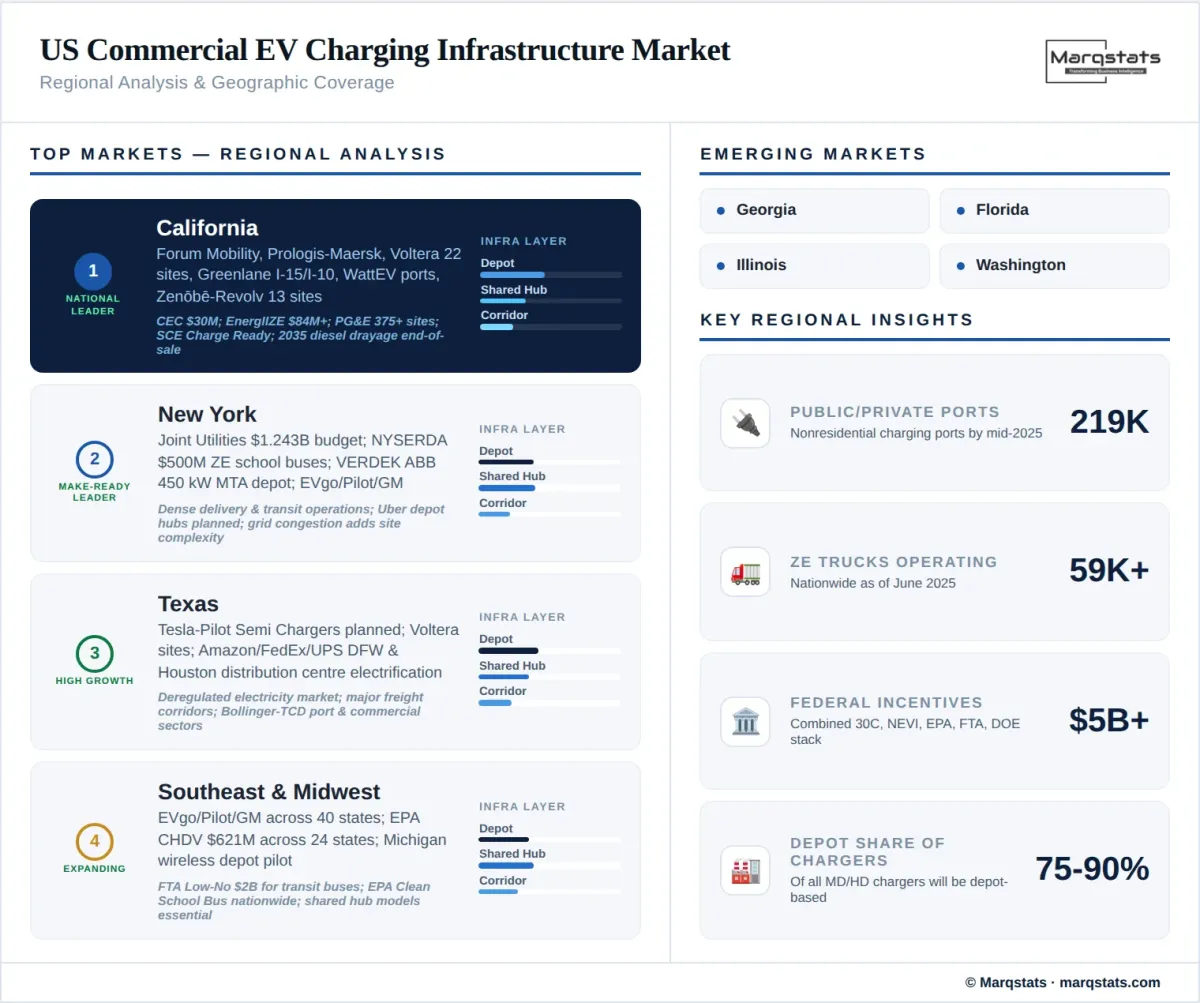
The undisputed leader. Forum Mobility FM Harbor (Port of Long Beach). Prologis/Maersk Torrance (9 MW microgrid). Voltera: 22 sites, Lynwood + Wilmington (USD 4.1M grants) + West Sacramento. Greenlane Colton (I-15 flagship) + I-10 corridor to Phoenix with Windrose. WattEV port operations + SST technology. CEC USD 30 million depot/hydrogen solicitation. EnergIIZE USD 84+ million to 250+ projects. PG&E EV Fleet (375+ sites). SCE Charge Ready Transport (through June 2026). Zenōbē/Revolv acquisition adds 13 operating sites and 100+ electric trucks in California.
New York
Second-largest market. Joint Utilities EV Make-Ready: USD 1.243 billion total, USD 885+ million for make-ready. NYSERDA USD 500 million for school bus and charging infrastructure. VERDEK installed ABB 450 kW pantograph chargers at NYC MTA Grand Avenue Depot. EVgo/Pilot/GM fast-charging network active across NY state.
Texas
High-growth market with deregulated electricity economics. Tesla/Pilot Semi Chargers planned for Texas. Voltera operates sites in Texas. Amazon/FedEx/UPS distribution centres in DFW and Houston drive delivery-fleet depot demand. Bollinger/TCD partnership targets Texas ports and commercial sectors. Greenlane’s I-10 corridor extends from California toward Texas freight nodes.
Southeast (Georgia, Florida)
Voltera operates in Georgia, Arizona, and Florida. Tesla/Pilot sites planned for Georgia. EVgo/Pilot/GM network across 40 states. Southeast transit agencies deploying electric buses under FTA Low-No. Hyundai Motor Group Metaplant America (HMGMA) in Georgia drives regional supply chain.
Pacific Northwest and Midwest
Portland’s Electric Island (Daimler/PGE) as heavy-duty testing venue. Michigan’s Electreon/Xos wireless commercial charging pilot at UPS Detroit. Chicago, Detroit, and Midwest distribution hubs growing depot demand. FTA Low-No covering transit bus depots in 45 states.
How Competition Is Evolving
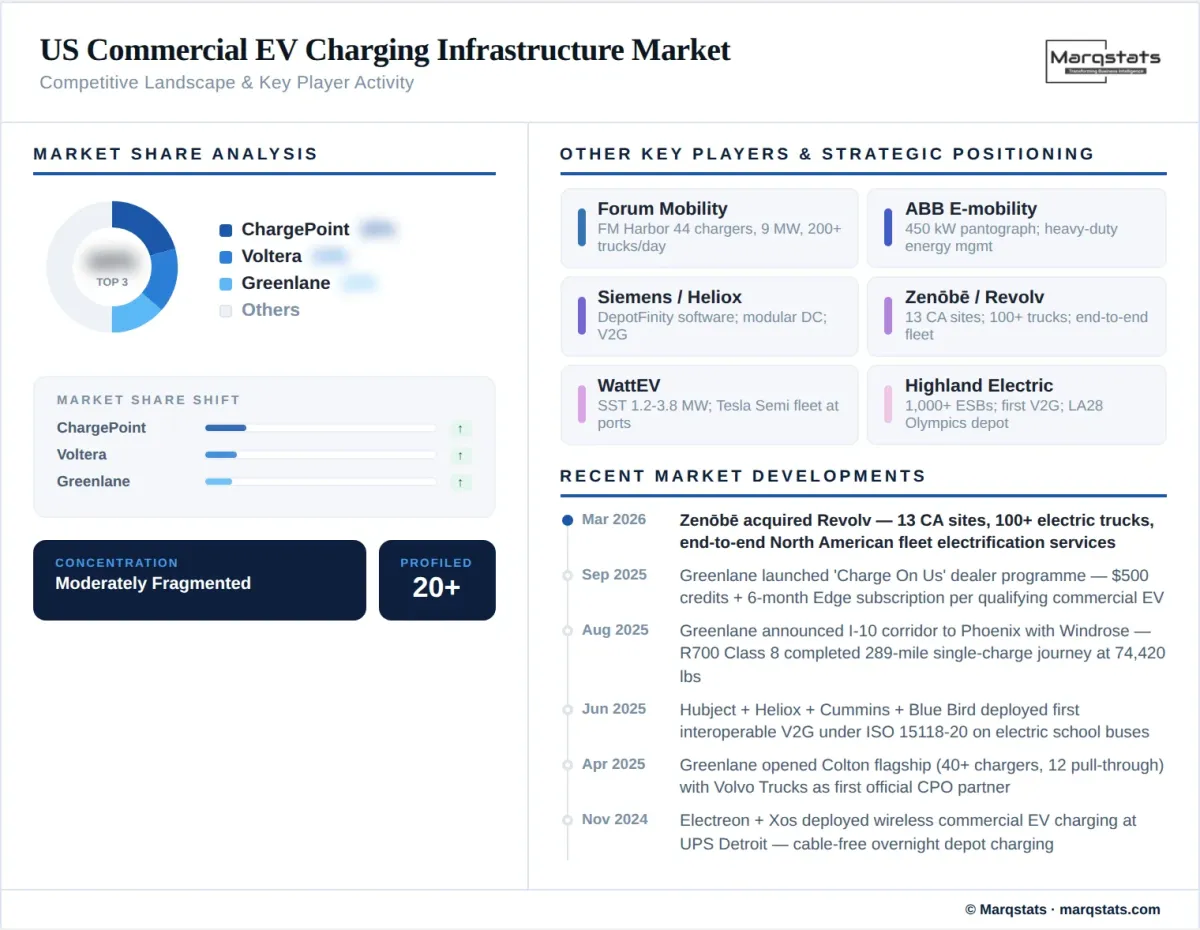
The competitive ecosystem has four roles. Infrastructure developers and CaaS operators build, own, and operate commercial charging sites: Voltera (22 sites, 115+ MW, no-upfront-capex turnkey model), Forum Mobility (FM Harbor 44 chargers, 9 MW, 200+ trucks/day), Prologis Mobility/Maersk (Torrance 96-truck 9 MW microgrid), Greenlane (I-15 + I-10 corridors, Colton flagship, Volvo Trucks CPO partnership, “Charge On Us” dealer programme with Velocity Truck Centers), Highland Electric Fleets (1,000+ school buses, first commercial V2G), WattEV (SST 1.2–3.8 MW, Tesla Semi fleet), and Zenōbē/Revolv (13 CA sites, 100+ electric trucks acquired March 2026).
Hardware and software providers supply charging technology and fleet management platforms: ChargePoint (fleet depot management platform for any OCPP-based operation), ABB E-mobility (450 kW pantograph for transit, Greenlane corridor), Siemens/Heliox (DepotFinity software, modular DC, V2G-capable chargers under ISO 15118-20 with Hubject/Cummins/Blue Bird), Kempower (ChargEye depot management), Zerova (DZ480 scalable to 3.84 MW, BABA Phoenix manufacturing), Electreon (wireless commercial charging, ISO/SAE 21434 cybersecurity certified), Coulomb Solutions (40 kW OBC for commercial EVs), and Voltu Motor (200 kW onboard fast charger eliminating DC infrastructure dependency).
Public corridor network operators serve commercial light-duty and mixed-use travel corridors: EVgo/Pilot/GM partnership (200+ locations, ~850 stalls, 40 states). Utility programmes enable commercial projects: PG&E EV Fleet (375+ sites), SCE Charge Ready Transport, New York Joint Utilities (USD 1.243 billion), NYSERDA (USD 500 million). Federal programmes fund infrastructure: DOE SuperTruck Charge (USD 68 million), EPA CHDV (USD 621 million), FTA Low-No (USD 2 billion), EPA Clean School Bus (USD 5 billion), Section 30C (30% up to USD 100K/item through June 2026), NEVI (USD 2.385 billion distributed).
Companies Covered
Companies covered in the report include:
Recent Market Activity
Table of Contents
Coverage & Segmentation
This report provides a comprehensive analysis of the United States commercial electric vehicle charging infrastructure market covering the historical period (2021–2025) and forecast period (2026–2030), with 2025 as the base year. The study examines market size in USD across infrastructure layer (fleet depot, shared hubs, corridor/freight, workplace/destination, software/energy management), vehicle class served (light-duty Class 1–3, medium-duty Class 4–6, heavy-duty Class 7–8, transit/school bus), business model (fleet-owned, shared hub, CaaS, utility make-ready), and geography covering 12 state/metro clusters. Company profiling covers 25+ players across infrastructure developers, hardware/software providers, corridor networks, and utility programmes. Policy analysis covers Section 30C, NEVI, SuperTruck Charge, EPA CHDV, EPA Clean School Bus, FTA Low-No, and state utility make-ready programmes.
Research methodology combines bottom-up modelling from port deployment counts (211,382 total nonresidential Q2 2024, 219,000 public mid-2025), ZE fleet vehicle data (59,000+ trucks, 8,100+ transit buses, 5,100+ school buses), depot project cost benchmarks (USD 7.9M–15.4M), utility make-ready programme budgets, and CaaS pricing models. Primary research encompasses 40+ interactions with fleet depot operators, shared-hub developers, charger hardware providers, utility programme managers, transit agencies, school district transportation directors, corridor developers, and managed-charging software companies.