Market Snapshot
Middle bar: base-year value × (1 + CAGR), rounded to two decimals. This is a calculated illustration, not a separately researched annual estimate.
The global EV battery immersion cooling market size is estimated at USD 136.00 million in 2025 and is projected to reach USD 418.50 million by 2030, growing at a CAGR of 25.21% over 2026 – 2030. Immersion-cooled pack fitments rise from about 10,460 to 49,820 a year, a 36.64% annual rate, while the average system value per pack falls from about USD 13,002 to USD 8,400.
Marqstats defines the market as the value of immersion cooling hardware and integration fitted to vehicle traction batteries, where cells, busbars and terminals sit in direct contact with a non-conductive dielectric fluid. It covers sealed pack enclosures and cassettes, vehicle coolant distribution units and heat exchangers, sealed pumps and manifolds, the factory first fill of dielectric fluid, and wireless battery management and sensors used inside the fluid. Conventional cold-plate cooling with water-glycol, wider vehicle thermal management, stationary battery storage racks and data centre immersion cooling are excluded.
Synthetic hydrocarbon fluids account for an estimated 73.53% of 2025 value, enclosures and cassettes for 43.01%, and high-performance cars for 50.00%. Asia-Pacific accounts for 44.00% of 2025 value and Europe for 36.00%. The study segments the market by fluid chemistry, system component, vehicle application and region.
Key Takeaways
Market Overview & Analysis
Report Summary
Marqstats sizes the EV battery immersion cooling market as the value of immersion cooling systems fitted to vehicle traction batteries, including the enclosure, coolant distribution unit, pumps, first-fill dielectric fluid and wireless monitoring. In 2025 about 10,460 immersion-cooled packs were fitted worldwide, worth an estimated USD 136.00 million at an average of about USD 13,002 per pack.
Most electric vehicles cool their batteries indirectly. A water-glycol coolant flows through aluminium cold plates under or between cells, and heat must pass through the cell casing, thermal pads and plate walls before it reaches the coolant. Under fast charging or high power, this creates temperature differences inside and between cells that speed up ageing, cause lithium plating and raise the risk of thermal runaway.
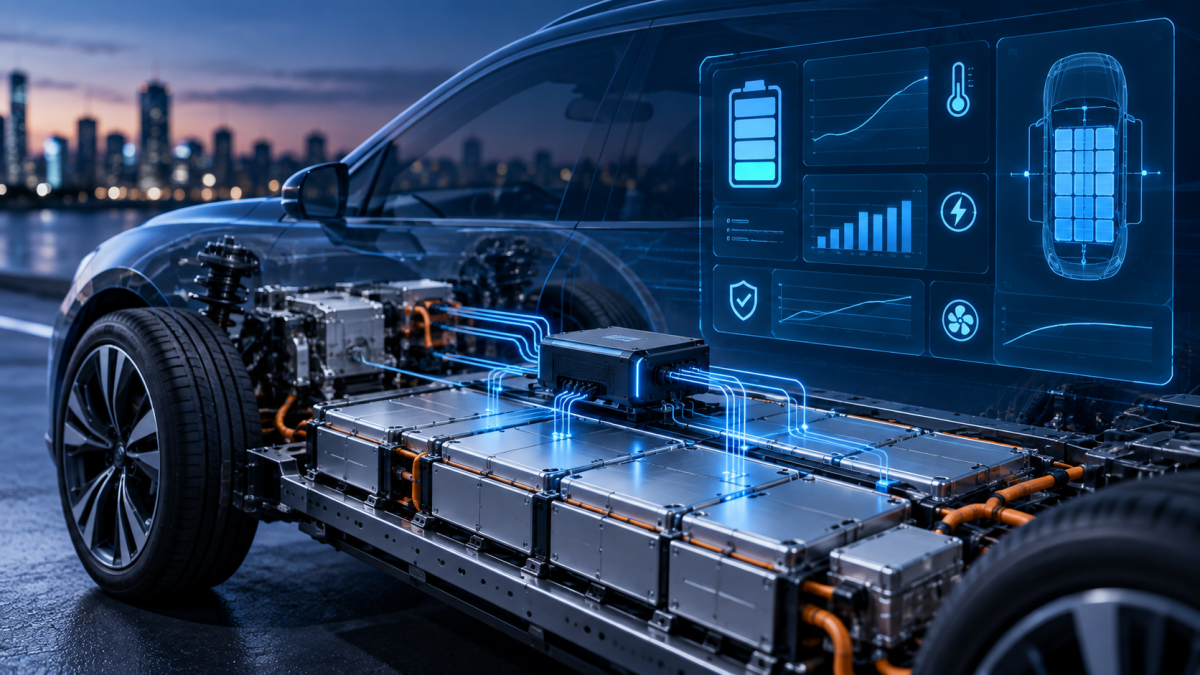
Immersion cooling places cells, busbars and terminals directly in a dielectric fluid that does not conduct electricity. The fluid removes heat from the whole cell surface, keeps cells within a narrow temperature band, and absorbs heat if a cell fails, slowing or stopping the spread of thermal runaway. It also removes the need for cold plates and thermal pads, which can simplify cell-to-pack designs.
The technology has reached series production in performance vehicles. The Mercedes-AMG GT 63 S E Performance uses a 6.1 kWh high-performance battery with 560 cells, each surrounded by a flow of non-conductive coolant, developed with the Mercedes-AMG Petronas Formula 1 team. Rimac Technology supplies the Bugatti Tourbillon with a 25 kWh, 800-volt pack whose more than 1,500 cells are immersed in oil. XING Mobility in Taiwan builds immersion-cooled cell-to-pack systems for sports cars, boats, industrial machinery and backup power.
The market grew from USD 58.50 million in 2021 to USD 72.30 million in 2022, USD 89.80 million in 2023 and USD 110.50 million in 2024, a 23.48% annual rate from 2021 to 2025. Marqstats expects USD 163.20 million in 2026 and USD 418.50 million in 2030.
Immersion cooling sits within a much larger thermal management industry. Total EV thermal management, including cabin heating and cooling, heat pumps and motor and inverter cooling, was worth about USD 22.42 billion in 2025, and battery thermal management about USD 8.07 billion. Immersion systems account for less than 2% of battery thermal management value, with cold plates using water-glycol accounting for most of the rest.
Regulation is shifting battery safety from escape time to containment. Earlier rules allowed a warning a few minutes before fire so occupants could leave the vehicle. China's GB 38031-2025 now requires no fire or explosion after a single cell fails, along with tests for fast-charge cycling and underbody impact, and UN Regulation No. 100 sets thermal propagation requirements for vehicles sold under UN type approval. In Europe, the Batteries Regulation adds durability and battery passport requirements, which favour cooling designs that slow cell ageing.
Global EV Battery Immersion Cooling Market Size and Forecast
The global EV battery immersion cooling market grows from USD 136.00 million in 2025 to USD 418.50 million in 2030, a CAGR of 25.21%. Marqstats expects USD 163.20 million in 2026, USD 208.90 million in 2027, USD 265.30 million in 2028 and USD 334.30 million in 2029.
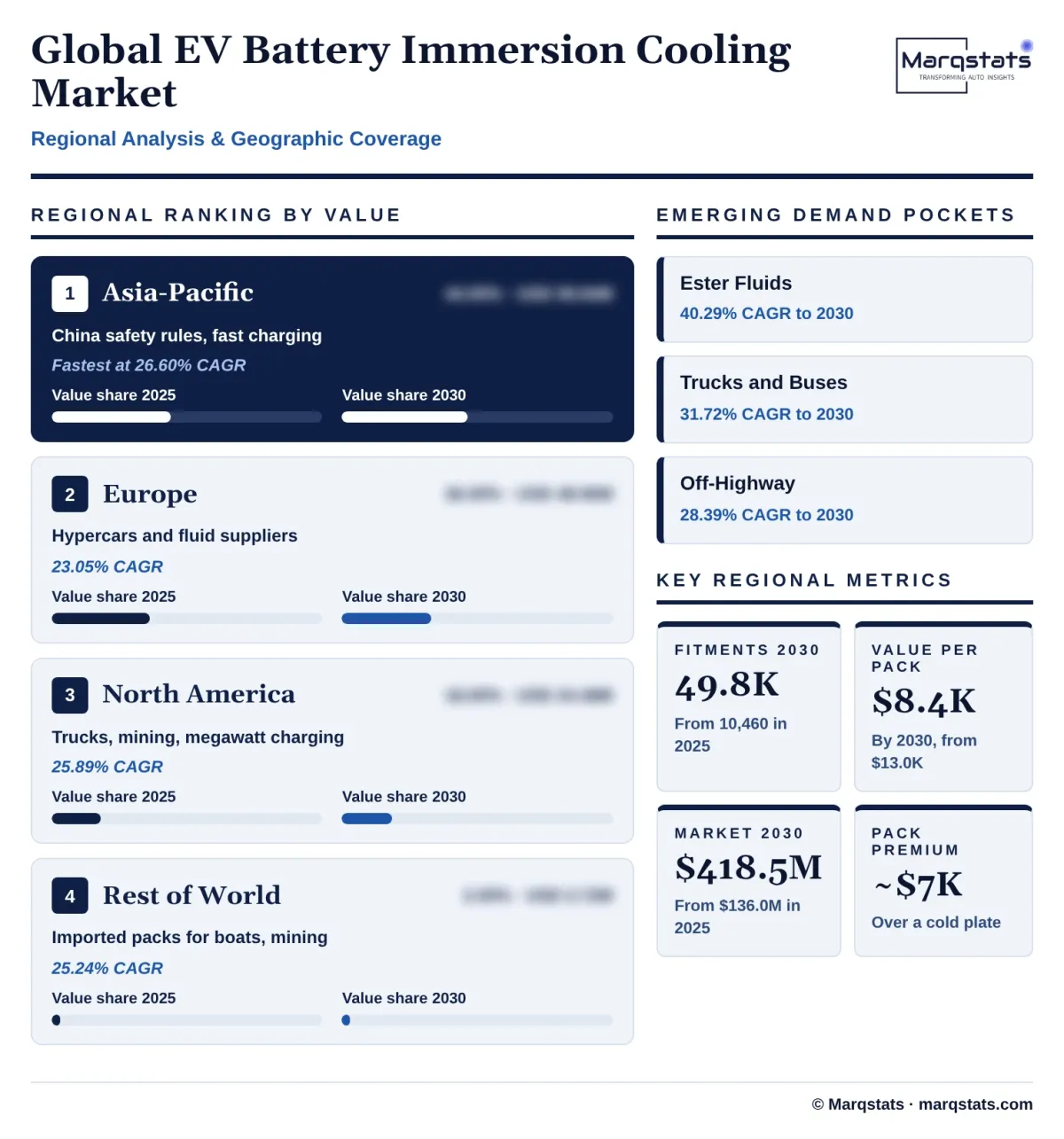
Fitments grow faster than value. Immersion-cooled pack fitments rise from about 10,460 in 2025 to 13,830 in 2026, 19,340 in 2027, 26,800 in 2028, 36,740 in 2029 and 49,820 in 2030, a 36.64% annual rate. The average system value per pack falls from about USD 18,750 in 2021 to USD 13,002 in 2025 and USD 8,400 in 2030 as the mix moves towards larger production runs, simpler cell-to-pack designs and lower-cost fluids.
For a typical 60 to 75 kWh passenger pack, Marqstats estimates the immersion system adds about USD 7,000 over a cold-plate design, with a range of USD 4,340 to USD 12,000. The enclosure and seals account for about USD 3,200, the coolant distribution unit and heat exchanger USD 1,800, pumps and valves USD 800, wireless monitoring and sensors USD 800, and about 40 litres of dielectric fluid USD 400 at USD 6 to USD 15 per litre.
Fluid volume per pack is a key assumption. Packs need about 0.4 to 0.8 litres of fluid per kWh depending on cell format and how tightly cells are packed. Each 10-litre change in average fill per vehicle changes fluid demand by about 500,000 litres a year by 2030, worth about USD 4.98 million at a synthetic hydrocarbon price of USD 10 per litre.
Marqstats tracks four indicators to monitor the forecast: enforcement of GB 38031-2025 in China, the pace of megawatt charging for heavy trucks, the outcome of the EU PFAS restriction, and the cost of sealed enclosures and wireless monitoring. Faster megawatt charging roll-out for trucks would push the market above the base path, while cheaper passive safety barriers that meet the new rules without immersion would slow it.
The mix of the market changes over the forecast. Heavy trucks, buses and off-highway equipment together rise from 41.18% of value in 2025 to 51.02% in 2030, overtaking cars and hypercars. Ester fluids nearly double their share, and enclosures remain the largest component at about 42% of value. Asia-Pacific rises from 44.00% to 46.50% of value, while Europe falls from 36.00% to 33.00% as production of immersion-cooled packs moves into higher-volume commercial vehicle programmes in China and Taiwan.
Market Dynamics
Key Drivers
Six forces are pulling immersion cooling from hypercars into wider vehicle use.
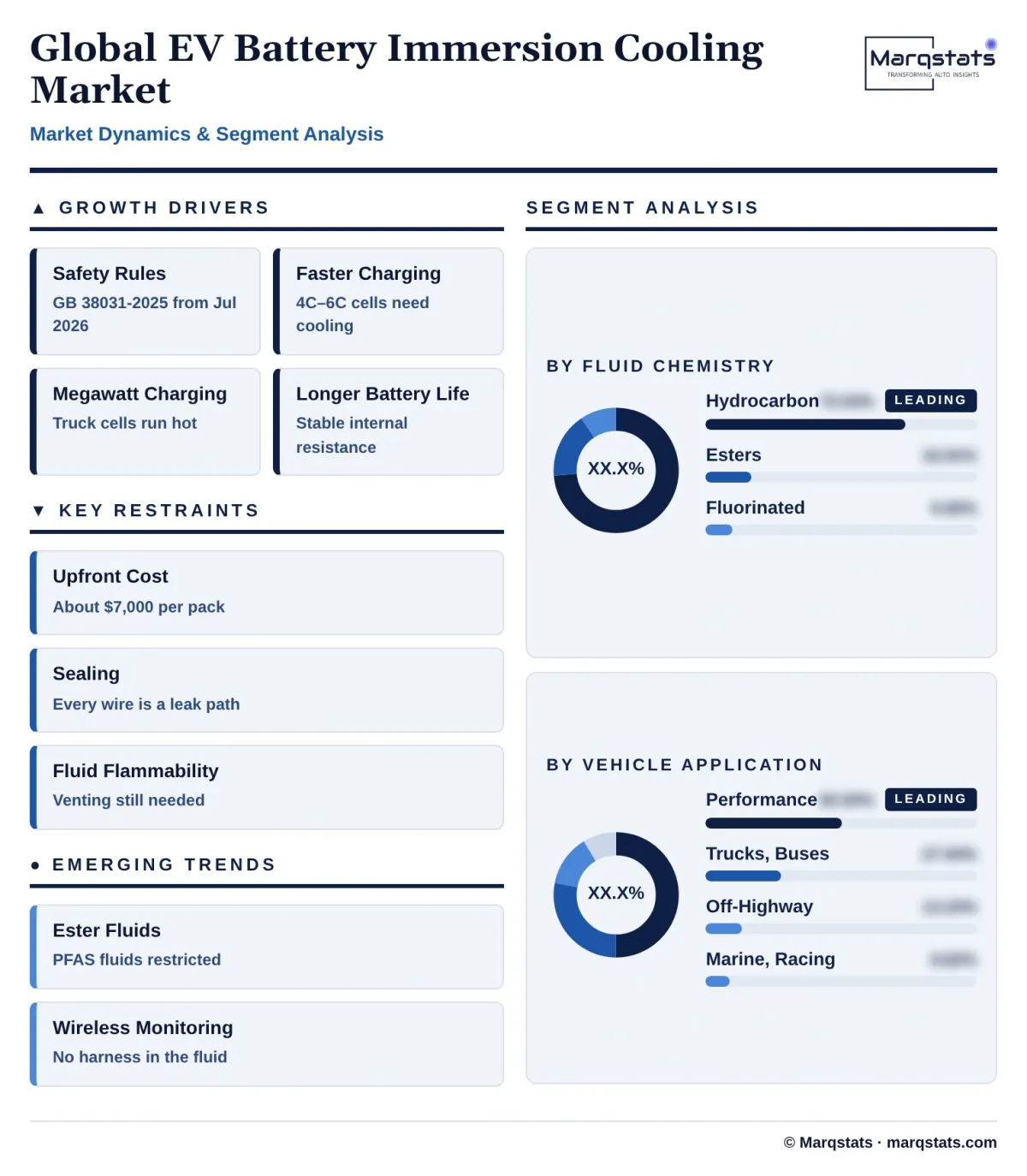
- Stricter battery safety rules. China's GB 38031-2025 requires no fire or explosion after a single cell enters thermal runaway, and UN Regulation No. 100 requires protection of occupants from thermal runaway. Immersion cooling helps high-energy packs meet these tests.
- Faster charging. Cells that charge at 4C to 6C rates, such as CATL's Shenxing range, produce much more heat, and immersion cooling keeps cells within a narrow temperature band so charging is not slowed to protect the battery.
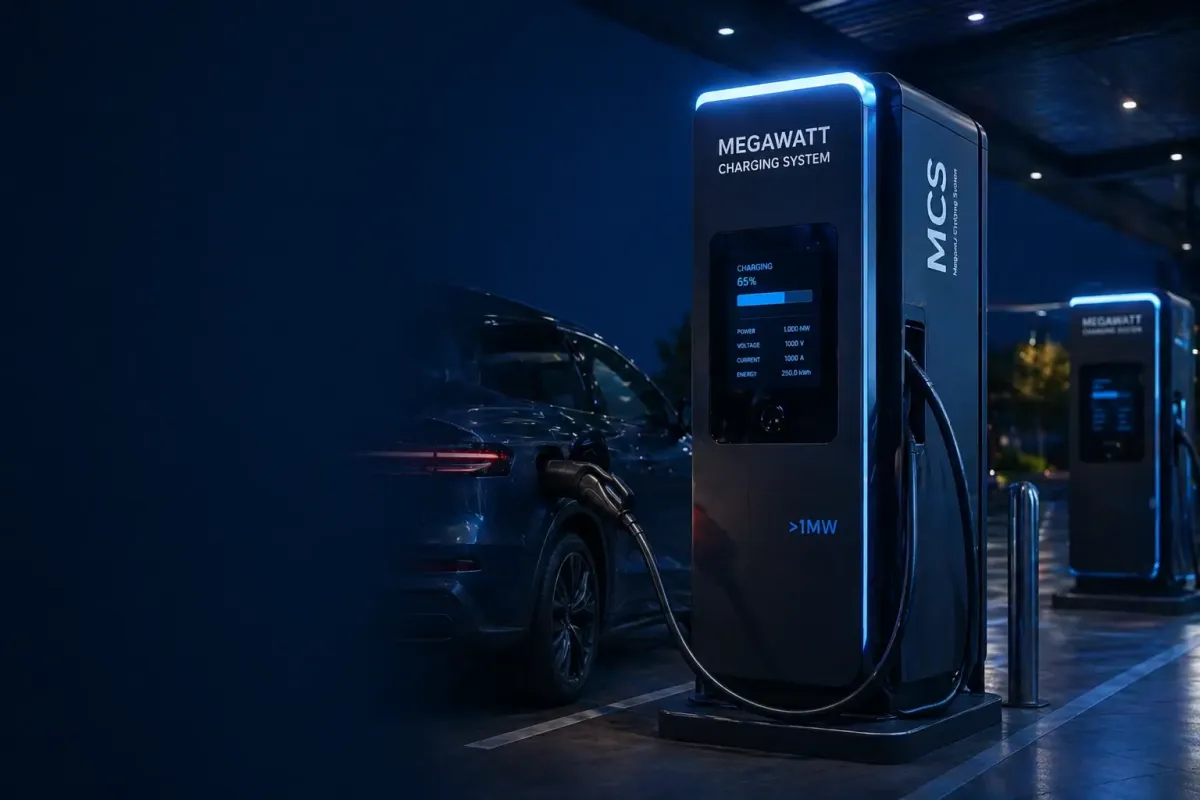
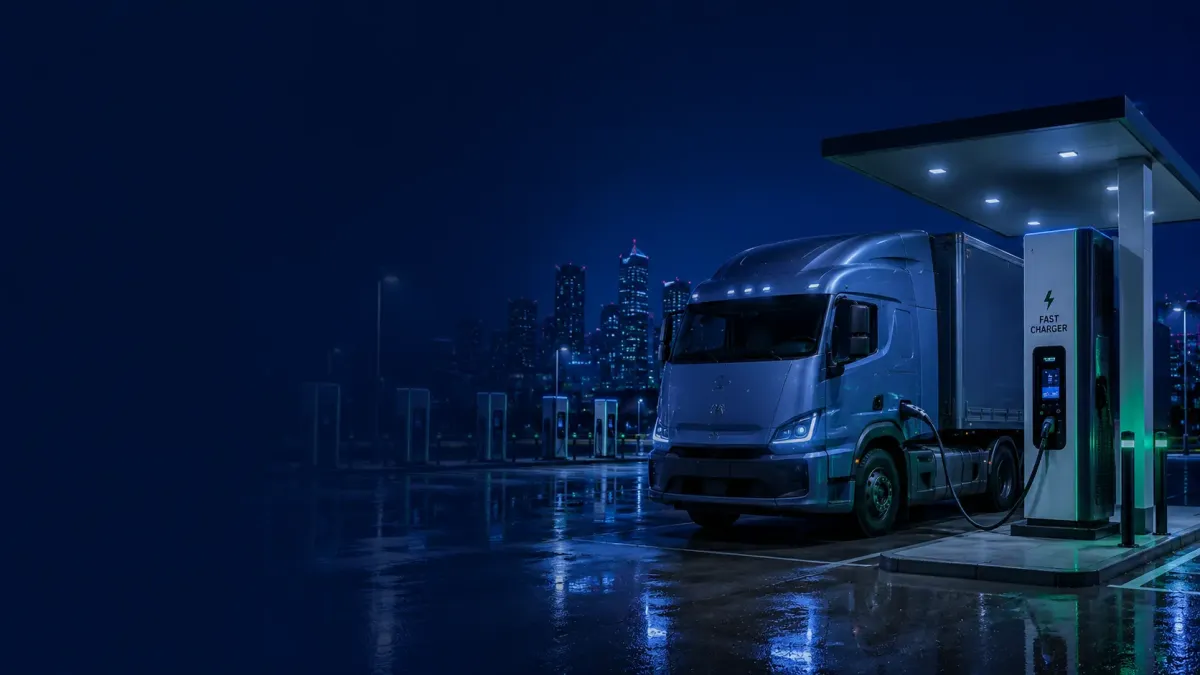
- Megawatt charging for trucks. The Megawatt Charging System for heavy trucks delivers very high currents, heating cells, tabs and busbars. Immersion cooling removes heat directly at these points.
- Longer battery life. Studies show that direct liquid cooling keeps internal resistance more stable over repeated fast charges than cold plates, extending battery life and supporting the durability requirements of the EU Battery Regulation.
- Fluid suppliers investing in electric vehicles. Shell, Castrol, TotalEnergies, Petronas and others are developing dielectric fluids and working with battery makers, such as Castrol with LION Smart and TotalEnergies with XING Mobility, to bring immersion systems to market.
- Simpler pack designs. Immersion removes cold plates, thermal pads and compression parts from the battery stack, which can raise usable volume in cell-to-pack designs and reduce assembly steps once production scales.
Key Restraints
Four constraints slow the move from cold plates to immersion-cooled packs.
- Higher upfront cost. An immersion system adds about USD 7,000 to a typical passenger pack, which is hard to justify in mass-market cars using low-cost lithium iron phosphate batteries.
- Weight and fluid volume. Filling a pack with fluid adds weight and requires careful design to keep fluid volume low, reducing some of the benefit of removing cold plates.
- Sealing and material compatibility. Seals, wires and plastics must survive years in contact with hot hydrocarbon or ester fluids, and every wire passing through the enclosure is a potential leak point.
- Flammability of non-fluorinated fluids. Hydrocarbon and ester fluids can burn at high temperatures, so packs need venting and fire protection, while the non-flammable fluorinated alternatives face restrictions.
Key Trends
Four shifts are changing how immersion-cooled packs are designed and supplied.
- Single-phase fluids replace two-phase systems. Immersion systems now use single-phase hydrocarbon and ester fluids rather than boiling fluorinated fluids, which face environmental restrictions.
- Immersion with cell-to-pack designs. Removing module housings and cold plates lets the pack enclosure act as the fluid tank, as in XING Mobility's IMMERSIO cell-to-pack system used in the Caterham Project V concept. Sealed enclosures that double as the fluid vessel also protect cells from dust, water and vibration in off-highway and marine use.
- Wireless cell monitoring. Cell-mounted wireless sensors replace wiring harnesses inside the fluid, reducing leak points and simplifying sealed packs.
- Shared technology with storage and data centres. Immersion battery makers sell the same technology for backup power, stationary storage and boats, as XING Mobility does with its data centre backup units and IMMERSIO Matrix marine battery, spreading development costs.
Strategic Implications
- For carmakers, immersion cooling is a pack design choice, not a drop-in part. Programmes that adopt cell-to-pack layouts and wireless monitoring from the start capture the most benefit.
- For truck and bus makers, megawatt charging makes the case. Immersion cooling allows faster charging during driver breaks without shortening battery life, supporting fleet economics.
- For thermal component suppliers, sealed pumps and compatible materials are needed. Suppliers should qualify fluorosilicone and other compatible seals and use magnetically coupled pumps without shaft seals.
- For fluid suppliers, esters and hydrocarbons are the growth path. Investment should focus on low-viscosity, high-flash-point synthetic fluids that remain stable for the life of the vehicle and protect copper and aluminium parts.
- For investors, early volume comes from niche fleets. Hypercars, motorsport, boats, mining equipment and heavy trucks will provide most of the volume before mass-market cars adopt immersion cooling.
- For regulators, clear test methods matter. Defining how immersion-cooled packs are tested for thermal propagation, fluid leakage and fire behaviour under GB 38031-2025, UN Regulation No. 100 and future US rules would give carmakers confidence to adopt the technology in higher-volume vehicles.
Market Segmentation
Synthetic hydrocarbon fluids, including polyalphaolefins and gas-to-liquids isoparaffins, account for 73.53% of 2025 value, USD 100.00 million, rising to USD 280.00 million by 2030, a 22.87% CAGR, while their share falls to 66.91%. Low viscosity at low temperatures, compatibility with copper and aluminium, and cost keep them the leading choice. Shell, Castrol, Petronas and ExxonMobil are key suppliers.
Ester fluids account for 16.91% of 2025 value, USD 23.00 million, and grow fastest, at 40.29% a year, to USD 125.00 million and 29.87% of 2030 value. High fire points, biodegradability and freedom from PFAS chemicals drive adoption, with M&I Materials, TotalEnergies and Croda among suppliers.
Fluorinated fluids account for 9.56% of 2025 value, USD 13.00 million, and stay almost flat at USD 13.50 million by 2030, a 0.76% CAGR, falling to 3.22% of the market as the EU moves to restrict PFAS chemicals.
Sealed pack enclosures, cassettes and seals account for 43.01% of 2025 value, USD 58.50 million, rising to USD 175.70 million by 2030, a 24.60% CAGR.
Vehicle coolant distribution units and heat exchangers that pass heat from the dielectric loop to the vehicle cooling circuit account for 25.00% of 2025 value, USD 34.00 million, and grow at 26.19% a year to USD 108.80 million.
Sealed, magnetically driven pumps and flow manifolds account for 14.34% of 2025 value, USD 19.50 million, rising to USD 58.60 million by 2030, a 24.62% CAGR.
The factory first fill of dielectric fluid accounts for 10.66% of 2025 value, USD 14.50 million, rising to USD 46.00 million by 2030, a 25.97% CAGR.
Wireless battery monitoring and sensors used inside the fluid account for 6.99% of 2025 value, USD 9.50 million, rising to USD 29.40 million by 2030, a 25.35% CAGR.
High-performance electric and hybrid cars and hypercars account for 50.00% of 2025 value, USD 68.00 million, rising to USD 167.40 million by 2030, a 19.74% CAGR, while their share falls to 40.00%. Mercedes-AMG, Bugatti and Caterham programmes lead.
Heavy trucks and transit buses account for 27.94% of 2025 value, USD 38.00 million, and grow fastest, at 31.72% a year, to USD 150.70 million and 36.01% of the market by 2030 as megawatt charging spreads.
Off-highway, mining and construction equipment accounts for 13.24% of 2025 value, USD 18.00 million, rising to USD 62.80 million by 2030, a 28.39% CAGR, because sealed packs protect cells from dust, moisture and vibration.
Motorsport and marine applications account for 8.82% of 2025 value, USD 12.00 million, rising to USD 37.60 million by 2030, a 25.66% CAGR.
By Geography
Asia-Pacific
Asia-Pacific is the largest region, with 44.00% of 2025 value, USD 59.84 million, rising to USD 194.60 million by 2030, a 26.60% CAGR, and 46.50% of the market. China's GB 38031-2025 safety standard, ultra-fast charging batteries from CATL and BYD, and XING Mobility's immersion pack production in Taiwan support growth. Most Chinese mass-market cars still use lithium iron phosphate batteries with cold plates, so early demand is concentrated in commercial vehicles and high-end platforms.
Europe
Europe accounts for 36.00% of 2025 value, USD 48.96 million, rising to USD 138.10 million by 2030, a 23.05% CAGR, while its share falls to 33.00%. Hypercar and performance car makers such as Mercedes-AMG, Bugatti and Rimac, fluid suppliers such as Shell, Castrol and TotalEnergies, and engineering firms such as LION Smart and Ricardo are based in the region. The EU PFAS restriction is accelerating the shift to ester and hydrocarbon fluids. The Risk Assessment Committee of the European Chemicals Agency backed an EU-wide PFAS restriction in March 2026, and the Socio-Economic Analysis Committee is expected to adopt its final opinion by the end of 2026.
North America
North America accounts for 18.00% of 2025 value, USD 24.48 million, rising to USD 77.42 million by 2030, a 25.89% CAGR, and 18.50% of the market. Heavy truck electrification, megawatt charging corridors and off-highway and mining equipment are the main demand sources.
Rest of World
The rest of the world accounts for 2.00% of 2025 value, USD 2.72 million, rising to USD 8.38 million by 2030, a 25.24% CAGR, mainly from imported packs for boats, mining and luxury vehicles in the Middle East and Latin America.
How Competition Is Evolving
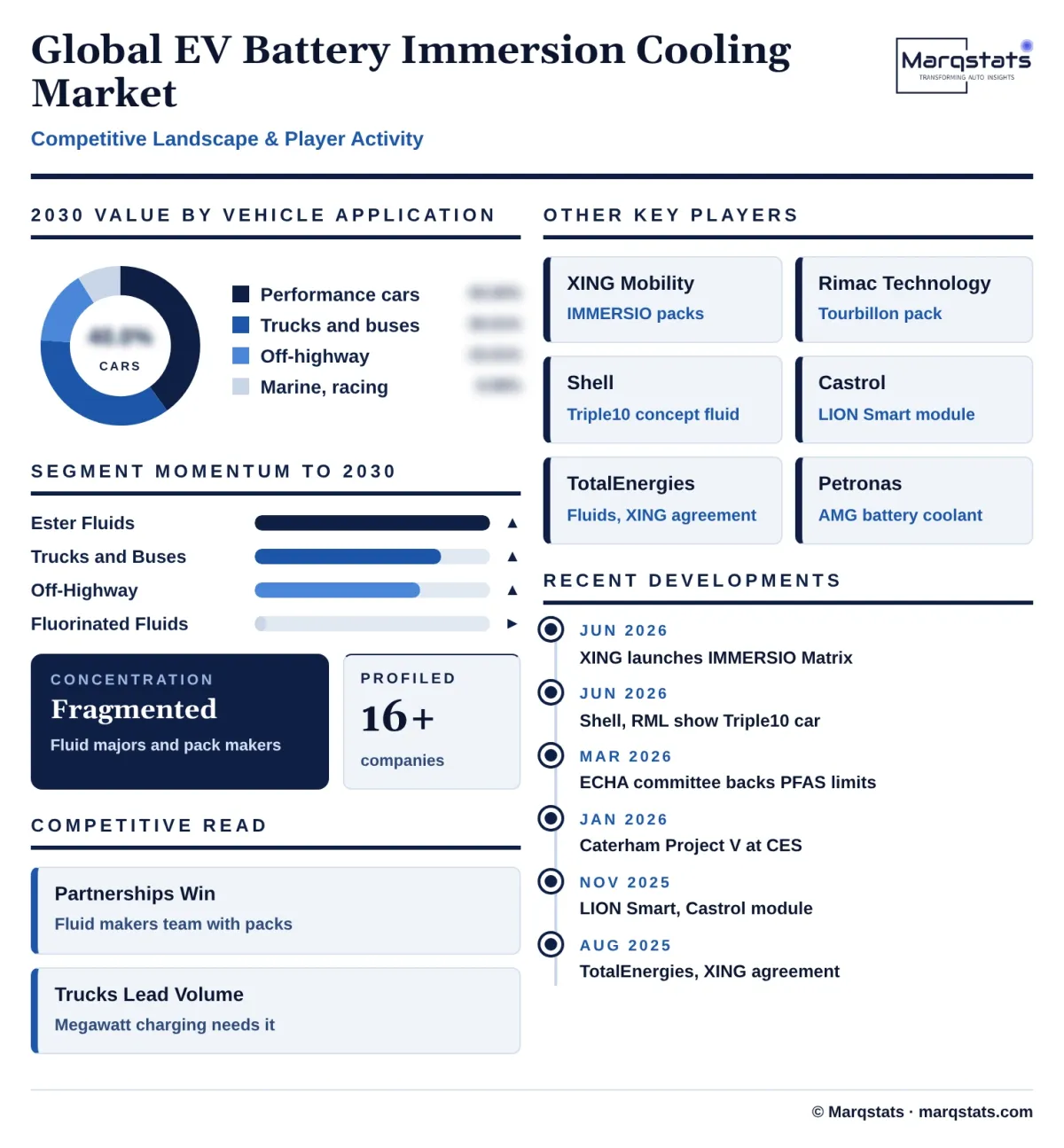
The EV battery immersion cooling market is fragmented across three groups. Fluid suppliers such as Shell, Castrol, TotalEnergies, Petronas, ExxonMobil, FUCHS and M&I Materials formulate dielectric fluids. Battery system specialists such as XING Mobility, Rimac Technology, LION Smart and Kreisel Electric design immersion-cooled packs. Thermal and automotive suppliers such as MAHLE and Valeo supply heat exchangers, pumps and valves.
Partnerships between fluid suppliers and pack makers are central. TotalEnergies Lubrifiants signed an agreement with XING Mobility in August 2025 to promote immersion-cooled batteries, starting with boats and extending to storage, mobility and backup power. LION Smart and Castrol are developing a direct-cooled battery module using Castrol ON EV Thermal Fluids. Petronas supplies the coolant for the Mercedes-AMG high-performance battery.
Carmakers adopt immersion cooling first in low-volume, high-value vehicles. Mercedes-AMG, Bugatti and Caterham use it for repeatable high power, while truck, bus and equipment makers evaluate it for megawatt charging and harsh operating conditions.
Competition will be decided by fluid performance, enclosure cost and safety approval. Suppliers that can offer fluids with high fire points and long life, low-cost sealed enclosures and proven compliance with new safety standards will win the largest programmes.
Demonstrators are helping fluid suppliers show what immersion cooling can do. Shell and RML built the Triple10 concept car with cells submerged in a Shell dielectric fluid, charging from 10% to 80% in about 10 minutes on a 175 kW charger with a 32 kWh battery. XING Mobility used CES 2026 to show its cell-to-pack system in the Caterham Project V concept alongside an immersion-cooled 800-volt backup battery for data centres, and launched the IMMERSIO Matrix marine battery in June 2026.
Companies Covered
Companies covered in the report include:
Recent Market Activity
Table of Contents
Coverage & Segmentation
The study covers the global EV battery immersion cooling market, with 2025 as the base year, 2021 – 2025 as the historical period and 2026 – 2030 as the forecast period. Values are in US dollars at constant 2025 exchange rates, and volumes are annual immersion-cooled pack fitments. The market is segmented by fluid chemistry, system component, vehicle application and region.
Conventional cold-plate battery cooling with water-glycol, wider vehicle thermal management, refill and service fluid, stationary battery storage, data centre immersion cooling and transformer oils are excluded. Segment and regional splits are Marqstats estimates built on vehicle programme data, supplier disclosures, component cost benchmarks and fluid volume assumptions.