Market Snapshot
Middle bar: base-year value × (1 + CAGR), rounded to two decimals. This is a calculated illustration, not a separately researched annual estimate.
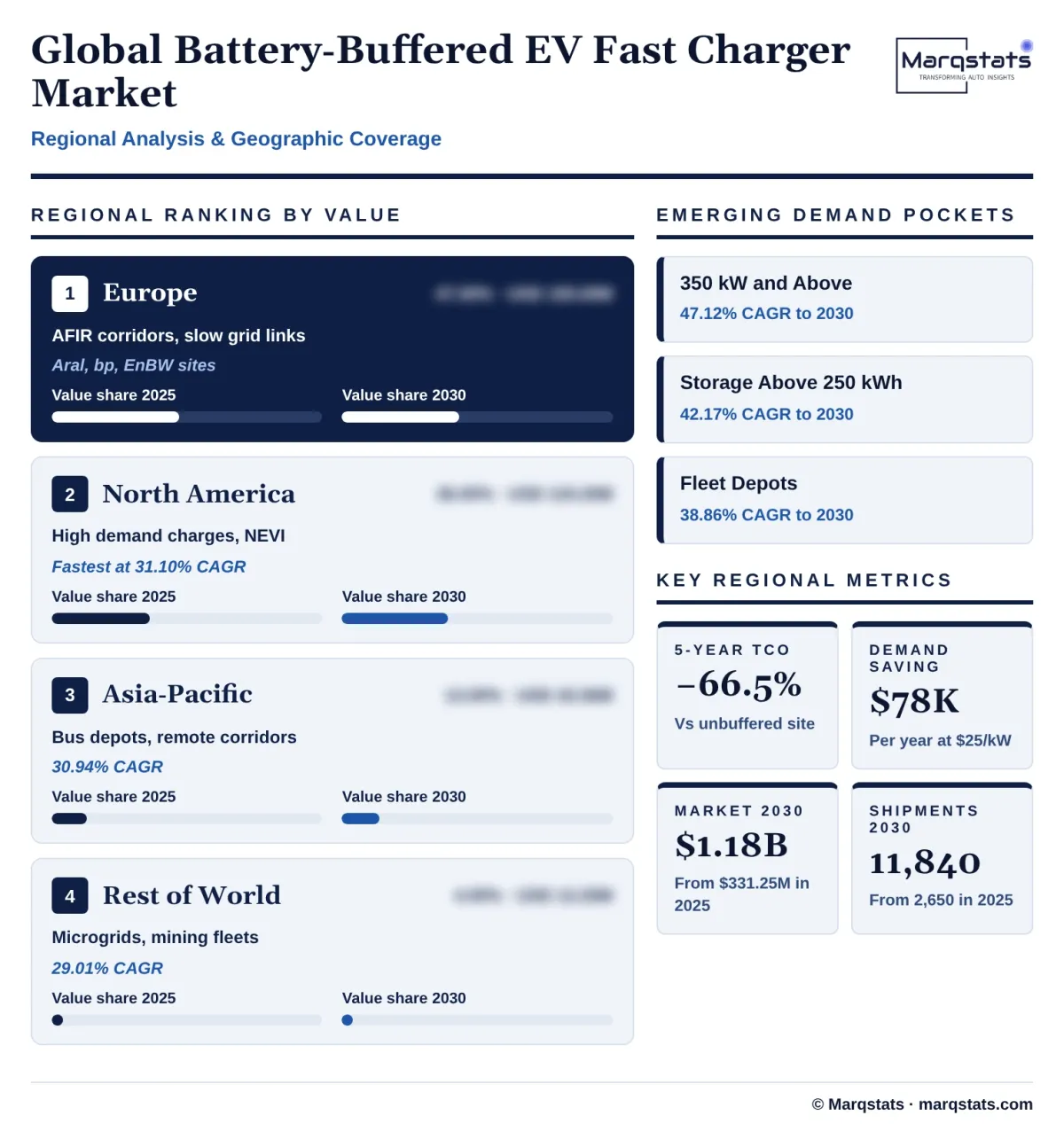
The global battery-buffered EV fast charger market size is estimated at USD 331.25 million in 2025 and is projected to reach USD 1,184.00 million by 2030, growing at a CAGR of 29.01% over 2026 – 2030. Annual shipments rise from about 2,650 systems to 11,840, a 34.90% annual rate, while the average system price falls from about USD 125,000 to USD 100,000.
Marqstats defines the market as the value of DC fast chargers rated at 150 kW and above that include a built-in battery, either inside the charger cabinet or in a directly connected DC module. The battery charges slowly from a low-voltage grid connection, typically 20 kW to 60 kW, and discharges at 150 kW to 400 kW into the vehicle. The market covers power electronics, battery modules, DC-DC converters, thermal systems and integrated power distribution. Unbuffered DC chargers, separate building batteries connected on the AC side, mobile and emergency chargers, civil works, transformers and software subscriptions are excluded.
Systems rated 150 kW to 249 kW account for an estimated 44.00% of 2025 value, and systems with 150 kWh to 250 kWh of storage for 68.00%. Europe accounts for 47.00% of 2025 value and North America for 36.00%. The study segments the market by power output, battery capacity, application and region.
Key Takeaways
Market Overview & Analysis
Report Summary
Marqstats sizes the battery-buffered EV fast charger market as the value of DC fast chargers with an integrated battery that lets them deliver 150 kW or more from a small grid connection. In 2025 about 2,650 systems were shipped worldwide, worth an estimated USD 331.25 million at an average price of about USD 125,000. The market is a small but distinct part of DC fast charging, which Marqstats estimates at about USD 12.60 billion in 2025.
A battery-buffered charger works like a water tank. It draws a steady 20 kW to 60 kW from a standard 400-volt or 480-volt three-phase supply to keep its internal battery full. When a vehicle connects and asks for 300 kW, the charger takes most of the power from its battery and the rest from the grid, so the site never draws more than its small grid connection. Batteries of 140 kWh to 215 kWh are typical, using lithium iron phosphate or nickel-rich lithium-ion cells.
The technology solves a specific problem. An unbuffered 300 kW charger draws 300 kW from the grid whenever a car charges at full power. Many retail sites, highway rest areas and depots do not have that capacity, and adding it needs a new transformer of 500 kVA to 2,500 kVA, switchgear, trenching and utility upgrades that can cost USD 150,000 to USD 400,000 per site and take years. A battery-buffered charger avoids most of that work.
Leading products include the ADS-TEC Energy ChargePost with a 201 kWh battery and up to 300 kW output, the ADS-TEC ChargeBox with a separate 140 kWh storage unit and up to 320 kW, XCharge Net Zero Series systems with 215 kWh of lithium iron phosphate storage and up to 400 kW, the Volkswagen Group and Elli Flexpole with 150 kW output used at bp and Aral sites, and the FreeWire Boost Charger with 160 kWh and up to 200 kW.
The market grew from USD 60.90 million in 2021 to USD 119.00 million in 2022, USD 205.20 million in 2023 and USD 291.20 million in 2024. Growth slowed to 13.75% in 2025 as manufacturers restructured and customers phased their deployments. Marqstats expects USD 414.00 million in 2026, a 24.98% increase, and USD 1,184.00 million in 2030.
Battery-buffered chargers differ from other combinations of storage and charging. A building battery connected on the AC side of a site is managed by the building energy system and mainly shaves the whole site peak, while a battery-buffered charger is a single DC-connected appliance designed for vehicle charging curves. Mobile chargers on trailers or vans serve roadside rescue and temporary sites without a permanent grid connection. Marqstats counts only fixed chargers with the battery built in or directly connected on the DC side.
Global Battery-Buffered EV Fast Charger Market Size and Forecast
The global battery-buffered EV fast charger market grows from USD 331.25 million in 2025 to USD 1,184.00 million in 2030, a CAGR of 29.01%. Marqstats expects about 3,450 systems worth USD 414.00 million in 2026 and USD 709.50 million in 2028.
Shipments grow faster than value. Annual shipments rise from about 2,650 systems in 2025 to 11,840 in 2030, a 34.90% annual rate, while the average system price falls from about USD 145,000 in 2021 and USD 125,000 in 2025 to USD 120,000 in 2026 and USD 100,000 in 2030. Lower prices come from larger production runs, silicon carbide power electronics and cheaper lithium iron phosphate cells.
Battery cost is the biggest price variable. Every USD 10 per kWh change in stationary battery pack prices moves the cost of a typical 160 kWh to 200 kWh system by about USD 1,600 to USD 2,000. Marqstats estimates that each USD 10,000 change in the average system price moves 2030 market value by about USD 118.40 million.
Demand charges set the payback. Many commercial electricity tariffs in North America and Europe charge USD 15 to USD 40 per kW each month for the highest 15-minute power draw. At USD 25 per kW, an unbuffered 300 kW charger creates a USD 7,500 monthly charge even with only a few sessions a week, while a buffered system capped at 40 kW pays about USD 1,000, a saving of about USD 78,000 a year. At low-use sites, demand charges can make up 60% to 85% of the electricity bill.
Payback is fastest where tariffs are high and use is low. Marqstats estimates avoided demand charges typically recover the equipment premium within 18 to 26 months where demand charges exceed USD 18 per kW and station use is below 35% in the first three years. Marqstats tracks four indicators to monitor the forecast: grid connection waiting times, commercial demand charge levels, stationary battery pack prices and corridor charging mandates in the EU and United States.
Upfront site cost often favours battery buffering. Marqstats estimates an unbuffered dual 150 kW site needing 300 kW of grid capacity costs about USD 315,000 to build, including USD 70,000 of charger hardware, USD 180,000 of transformer and substation work and USD 65,000 of civil works and permits. A battery-buffered 300 kW system with 201 kWh of storage costs about USD 160,000, including USD 125,000 of hardware, USD 15,000 of grid work and USD 20,000 of civil works. Over five years, demand charges of about USD 450,000 for the unbuffered site compare with about USD 60,000 for the buffered one, while maintenance and battery service costs are about USD 25,000 and USD 45,000.
The mix of the market changes over the forecast. The 250 kW to 349 kW band overtakes the 150 kW to 249 kW band to become the largest at 47.00% of 2030 value, systems above 250 kWh of storage rise from 16.00% to 26.00%, and fleet depots from 18.00% to 26.00%. North America narrows the gap with Europe, rising from 36.00% to 39.00% of value, while Europe falls from 47.00% to 43.00%.
Market Dynamics
Key Drivers
Five forces are increasing demand for fast chargers with built-in batteries.
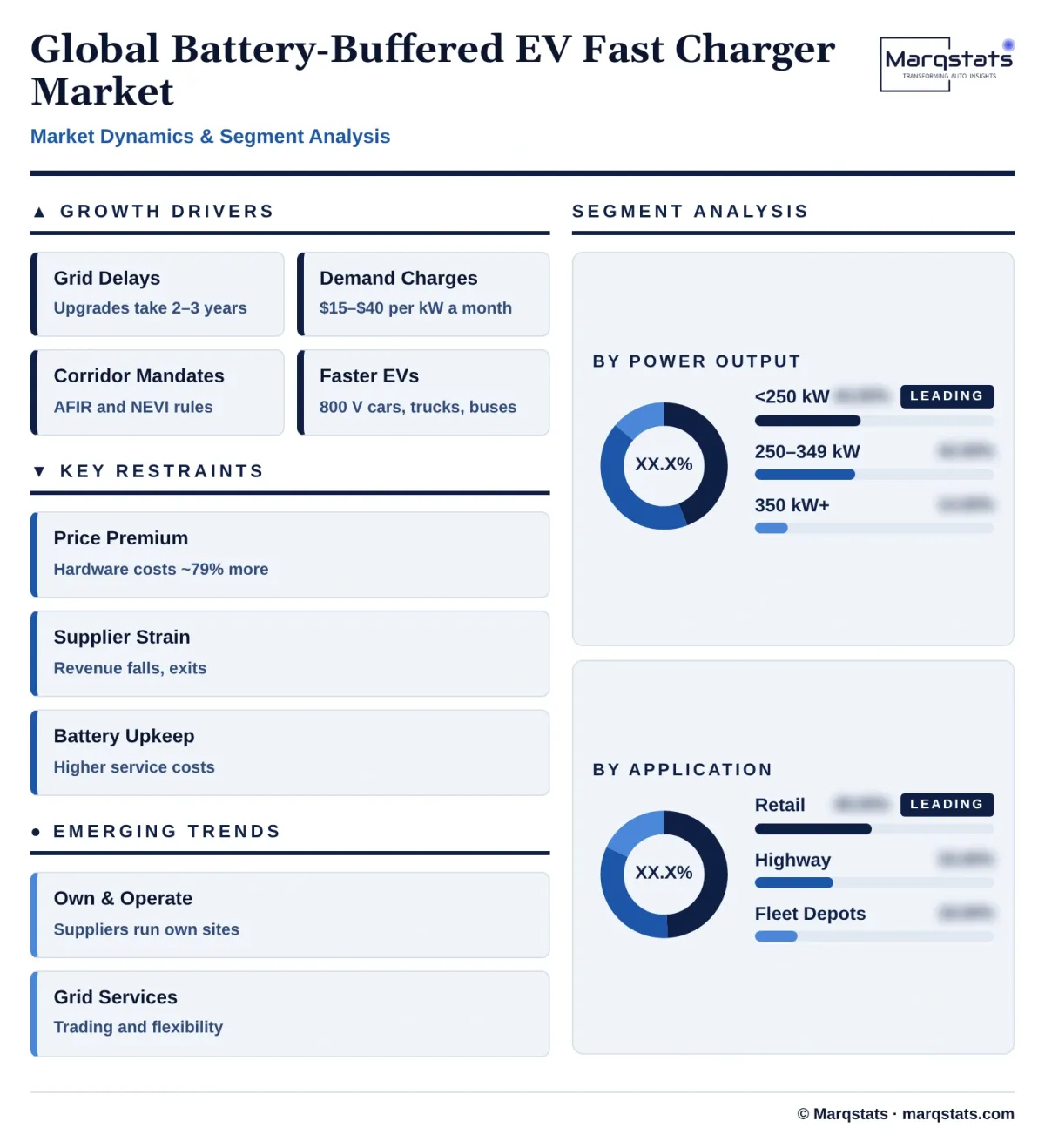
- Grid connections take too long. Distribution upgrades for chargers needing more than 500 kW can take two to three years, while battery-buffered systems can be installed in weeks on existing low-voltage supplies.
- Demand charges are high. Commercial tariffs charging USD 15 to USD 40 per kW of monthly peak demand make unbuffered chargers expensive at low-use sites, and battery buffering caps that peak.
- Corridor mandates require high power. The EU Alternative Fuels Infrastructure Regulation requires charging pools of at least 400 kW every 60 km on the core TEN-T network by the end of 2025 and 600 kW by the end of 2027, and the US NEVI programme requires four 150 kW ports per funded site, often at rural locations with weak grids.
- Electric vehicles charge faster. 800-volt cars and electric trucks and buses need 250 kW to 400 kW, raising the cost of grid upgrades for unbuffered chargers.
- Fleets electrify at leased sites. Delivery and bus operators at leased depots often cannot justify permanent substations, making battery-buffered chargers a practical option.
Key Restraints
Four constraints slow the adoption of battery-buffered fast chargers.
- Higher equipment price. A buffered charger costs much more than an unbuffered one as equipment, which deters buyers at sites where grid capacity is already available.
- Supplier financial pressure. FreeWire Technologies withdrew from markets outside North America and filed a closure notice in 2024, and ADS-TEC Energy reported lower first-half 2026 revenue after a battery supplier insolvency constrained production, raising buyer concerns about supplier stability.
- Battery maintenance and replacement. Internal batteries add maintenance and eventual cell replacement costs, increasing five-year service costs by about USD 20,000 per system.
- Tariff reform could reduce savings. Where regulators introduce demand charge holidays or energy-only tariffs for EV charging, the main saving from battery buffering shrinks.
Key Trends
Four shifts are changing how battery-buffered chargers are built and sold.
- Suppliers operating their own sites. ADS-TEC Energy has more than 100 secured Own & Operate locations, earning revenue from charging, energy trading and digital advertising screens.
- Long-term supply agreements. XCharge signed a multi-year framework agreement with EnBW in March 2026 after a field test of 400 kW chargers, and suppliers are prioritising such deals with large charging networks.
- Grid services and bidirectional power. Chargers with bidirectional inverters can trade stored energy, support local flexibility markets and provide frequency response when idle.
- Lithium iron phosphate cells. Suppliers are moving to cobalt-free lithium iron phosphate and lithium manganese iron phosphate cells for thermal stability and lives of more than 4,000 cycles.
Strategic Implications
- For charging network operators, battery buffering is a site selection tool. It allows high-power charging at locations where grid upgrades would be too slow or expensive, and is most attractive where demand charges are above USD 18 per kW and expected use is low in early years.
- For fleet operators, buffered chargers bridge connection delays. Depots facing grid waits of more than 18 months can start charging on existing supplies and later add unbuffered chargers when grid capacity arrives.
- For equipment suppliers, recurring revenue reduces volatility. Operating charging sites, offering charging as a service and earning grid services and advertising revenue smooth out lumpy hardware sales.
- For site hosts such as retailers and fuel stations, advertising adds income. Large digital screens on chargers can generate advertising revenue alongside charging fees.
- For utilities and regulators, fast-track connection rules help. Simplified connection rules for chargers drawing less than 50 kW from the grid could reduce queues while protecting distribution networks from high peaks.
- For investors, supplier strength matters as much as technology. Buyers commit to equipment with batteries that need service for many years, so financing partners and charging networks increasingly favour suppliers with strong balance sheets, service networks and recurring revenue.
Market Segmentation
Systems rated 150 kW to 249 kW account for 44.00% of 2025 value, USD 145.75 million, through products such as the Volkswagen Group and Elli Flexpole at bp and Aral sites and the FreeWire Boost Charger. Value rises to USD 307.84 million by 2030, a 16.13% CAGR, while the share falls to 26.00%.
Systems rated 250 kW to 349 kW account for 42.00% of 2025 value, USD 139.12 million, led by the ADS-TEC ChargePost and ChargeBox, and grow at 31.95% a year to USD 556.48 million, becoming the largest band at 47.00% of 2030 value as 800-volt vehicles spread.
Systems rated 350 kW and above account for 14.00% of 2025 value, USD 46.38 million, and grow fastest, at 47.12% a year, to USD 319.68 million and 27.00% of 2030 value, driven by electric trucks and buses that need high power to keep to schedules.
Systems with less than 150 kWh of storage account for 16.00% of 2025 value, USD 53.00 million, serving low-traffic sites such as car dealerships, and grow at 14.99% a year to USD 106.56 million, 9.00% of 2030 value.
Systems with 150 kWh to 250 kWh of storage account for 68.00% of 2025 value, USD 225.25 million, enough for three to five consecutive fast charges at retail sites and highway rest areas, and grow at 27.86% a year to USD 769.60 million.
Systems with more than 250 kWh of storage account for 16.00% of 2025 value, USD 53.00 million, and grow fastest, at 42.17% a year, to USD 307.84 million and 26.00% of 2030 value, serving freight terminals and bus depots.
Supermarkets, shopping centres and car dealerships account for 49.00% of 2025 value, USD 162.31 million, where low-voltage supplies cannot support unbuffered 300 kW charging. Value rises to USD 497.28 million by 2030, a 25.10% CAGR, while the share falls to 42.00%.
Highway rest areas and fuel station forecourts account for 33.00% of 2025 value, USD 109.31 million, and grow at 28.22% a year to USD 378.88 million, supported by EU and US corridor mandates.
Delivery yards, bus depots and airport operations account for 18.00% of 2025 value, USD 59.63 million, and grow fastest, at 38.86% a year, to USD 307.84 million and 26.00% of 2030 value.
By Geography
Europe
Europe is the largest market, with an estimated 47.00% of 2025 value, USD 155.69 million, rising to USD 509.12 million by 2030, a 26.74% CAGR, while its share falls to 43.00%. Germany, the United Kingdom, Austria and the Benelux countries lead. The EU Alternative Fuels Infrastructure Regulation requires high-power charging pools every 60 km on core corridors, and operators such as Aral pulse, bp pulse and EnBW use battery-buffered systems where grid connections are slow. Germany's controllable device rules under section 14a of the Energy Industry Act offer reduced grid fees for devices that can limit their load.
North America
North America accounts for an estimated 36.00% of 2025 value, USD 119.25 million, and grows fastest, at 31.10% a year, to USD 461.76 million and 39.00% of the market by 2030. Demand charges from investor-owned utilities often exceed USD 30 per kW, and the NEVI programme requires federally funded stations to offer four ports delivering 150 kW at the same time with 97% annual uptime, which battery buffering can meet on 100 kW to 200 kW grid supplies along rural corridors.
Asia-Pacific
Asia-Pacific accounts for an estimated 13.00% of 2025 value, USD 43.06 million, rising to USD 165.76 million by 2030, a 30.94% CAGR, and 14.00% of the market. Demand comes from remote logistics corridors and bus depots in China, intercity bus and coach routes in Australia where XCharge Net Zero Series systems are offered, and fleet and three-wheeler hubs in India.
Rest of World
Latin America, the Middle East and Africa account for an estimated 4.00% of 2025 value, USD 13.25 million, rising to USD 47.36 million by 2030, a 29.01% CAGR, mainly from microgrids, mining fleets and remote transport sites.
How Competition Is Evolving
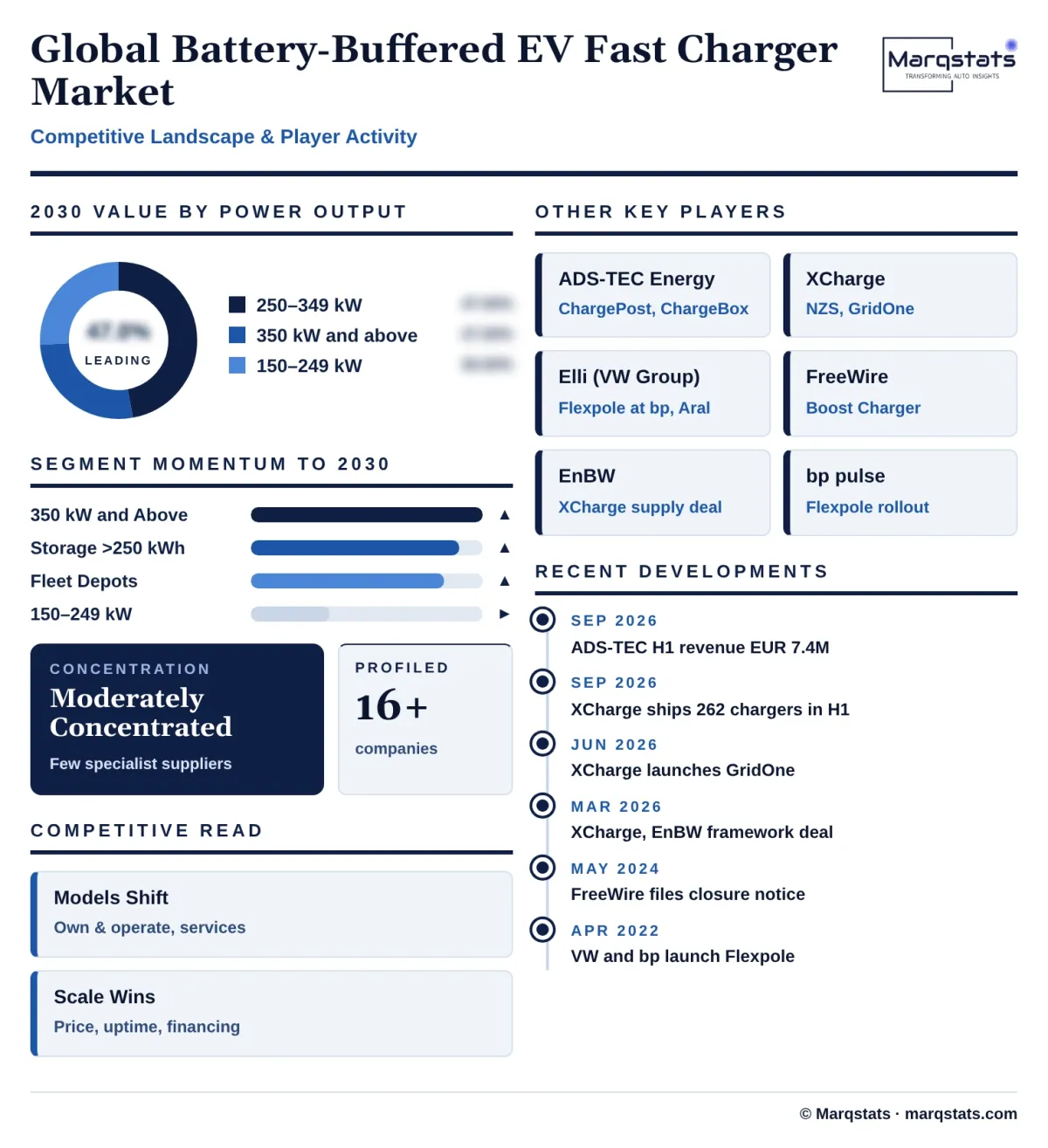
The battery-buffered EV fast charger market is moderately concentrated among a small number of specialist suppliers. ADS-TEC Energy, XCharge, Volkswagen Group Components with its Elli Flexpole and a few others account for most deliveries, alongside storage-integrated products from larger charger makers.
The industry is consolidating. FreeWire Technologies, which raised more than USD 225 million to scale its Boost Charger, withdrew from markets outside North America in early 2024 and filed a closure notice in May 2024. ADS-TEC Energy reported first-half 2026 revenue of EUR 7.4 million against EUR 14.6 million a year earlier as customers moved to smaller phased deployments and a battery supplier insolvency constrained ChargePost production. XCharge reported first-half 2026 revenue of USD 10.3 million and shipments of 262 chargers, down 44.5%.
Suppliers are responding with new models. ADS-TEC Energy is building an Own & Operate network with 17 sites in operation and more than 100 secured, and is developing a 1 GW, 4 GWh grid storage project in southern Germany. XCharge launched its GridOne commercial storage system with 215 kWh of lithium iron phosphate storage in June 2026 and signed a multi-year framework agreement with EnBW in March 2026.
Competition will be decided by cost, reliability and financing. Suppliers that offer lower system prices, proven uptime, financing or charging-as-a-service models and partnerships with large charging networks will capture most growth.
Product designs are diverging. All-in-one cabinets such as the ADS-TEC ChargePost combine battery, power electronics and large advertising screens, while split designs such as the ADS-TEC ChargeBox place a central storage unit away from the parking bays and connect several compact dispensers. Split designs suit sites where space or ground loading is limited, and all-in-one cabinets suit retail sites that want advertising income.
Companies Covered
Companies covered in the report include:
Recent Market Activity
Table of Contents
Coverage & Segmentation
The study covers the global battery-buffered EV fast charger market, with 2025 as the base year, 2021 – 2025 as the historical period and 2026 – 2030 as the forecast period. Values are in US dollars at system prices, and volumes are annual shipments. The market covers DC fast chargers rated at 150 kW and above with integrated or directly connected batteries, and is segmented by power output, battery capacity, application and region.
Unbuffered DC chargers, separate building batteries connected on the AC side, mobile and emergency chargers, civil works, transformers, installation labour and software subscriptions are excluded unless sold as part of the charger system. Segment and regional splits are Marqstats estimates built on supplier disclosures, shipment data, price benchmarks and site cost data.