Market Snapshot
Middle bar: base-year value × (1 + CAGR), rounded to two decimals. This is a calculated illustration, not a separately researched annual estimate.
The global semi-solid-state EV battery market size is estimated at USD 4,480.00 million in 2025 and is projected to reach USD 20,400.00 million by 2030, growing at a CAGR of 35.42% over 2026 – 2030. Installed volume rises from about 32.00 GWh to 255.00 GWh, a 51.45% annual rate, while the average pack price falls from about USD 140 to USD 80 per kWh.
Marqstats defines the market as the value of hybrid solid-liquid traction battery packs, commonly called semi-solid-state batteries, installed in new electric passenger cars, plug-in hybrids and commercial vehicles. These cells combine a solid or gel electrolyte with a residual liquid content of about 5% to 20% by mass. Conventional liquid lithium-ion batteries, all-solid-state batteries with less than 5% liquid, energy storage systems, drones and consumer electronics are excluded.
Oxide-polymer composite electrolytes account for an estimated 76.77% of 2025 value, high-nickel cathodes for 87.34% and executive and luxury passenger cars for 69.09%. China accounts for 98.69% of 2025 value. The study segments the market by electrolyte type, cathode chemistry, vehicle type and region.
Key Takeaways
Market Overview & Analysis
Report Summary
Marqstats sizes the semi-solid-state EV battery market as the value of hybrid solid-liquid traction battery packs installed in new electric vehicles. In 2025 about 32.00 GWh was installed worldwide, worth an estimated USD 4,480.00 million at an average pack price of about USD 140 per kWh.
Conventional lithium-ion cells use a liquid electrolyte of organic carbonate solvents and dissolved lithium salt, making up about 15% to 25% of cell weight. The liquid conducts lithium ions well but is flammable and limits the use of high-voltage cathodes and lithium-metal anodes. All-solid-state batteries replace the liquid entirely with a solid conductor such as a sulfide, oxide or halide, but suffer from poor contact between solid layers and need high stack pressure. Hybrid solid-liquid batteries sit between the two. They use a ceramic and polymer composite separator or a gel formed inside the cell, with a small amount of liquid to keep particles wetted, so they reach energy densities of 270 to 360 Wh/kg in series production while running on largely existing production equipment.
China has formalised the terms. A national standard on solid-state batteries for electric vehicles, covering terminology and classification, defines batteries with more than 20% liquid electrolyte by mass as liquid batteries, those with 5% to 20% as hybrid solid-liquid batteries and those below 5% as all-solid-state batteries, with an all-solid-state cell losing no more than 0.5% of its mass after six hours of vacuum drying at 120°C. The standard treats 'semi-solid' as a marketing label rather than a technical category.
The technology has moved quickly from pilot lines to vehicles. WeLion delivered its first 360 Wh/kg cells to Nio in June 2023 for a 150 kWh pack that offers more than 1,000 km of range, QingTao supplies SAIC's IM Motors, and CALB, SVOLT and other suppliers are entering series production. Marqstats estimates installed volume of about 0.05 GWh in 2021, 0.35 GWh in 2022, 1.10 GWh in 2023 and 8.80 GWh in 2024, worth USD 1,720.00 million, before reaching 32.00 GWh in 2025.
Applications are widening. Early volume went into flagship passenger cars with 130 to 150 kWh packs, but light trucks, delivery vans and long-range plug-in hybrids are now adopting the technology. Marqstats expects about 54.50 GWh worth USD 6,540.00 million in 2026.
Regulation outside China also matters. The EU Battery Regulation requires carbon footprint declarations for EV batteries, a digital battery passport for EV and industrial batteries from February 2027, and recovery of 50% of lithium and 90% of cobalt, nickel and copper from recycled batteries by the end of 2027, rising to 80% and 95% by the end of 2031. In the United States, rules on foreign entities of concern restrict Chinese battery materials and components in vehicles and factories claiming manufacturing tax credits, limiting imports of Chinese semi-solid cells.
Global Semi-Solid-State EV Battery Market Size and Forecast
The global semi-solid-state EV battery market grows from USD 4,480.00 million in 2025 to USD 20,400.00 million in 2030, a CAGR of 35.42%. Marqstats expects about 88.00 GWh worth USD 9,240.00 million in 2027, 132.00 GWh worth USD 12,410.00 million in 2028 and 188.00 GWh worth USD 16,170.00 million in 2029, before reaching 255.00 GWh in 2030.
Prices fall steadily. The average pack price falls from about USD 420 per kWh in 2021 to USD 195 in 2024, USD 140 in 2025, USD 105 in 2027 and USD 80 in 2030. In 2025 nickel-rich passenger car packs cost about USD 180 per kWh and commercial vehicle packs about USD 120. Lower costs for oxide ceramic powders, polymer electrolytes and coated separators, together with higher production yields, drive the decline.
Growth slows as the base grows. Volume growth falls from 263.64% in 2025 to about 70% in 2026, 61% in 2027, 50% in 2028, 42% in 2029 and 36% in 2030. Value growth falls from about 46% in 2026 to 26% in 2030.
The premium over liquid cells narrows but does not close. Liquid lithium iron phosphate cells cost about USD 50 to 65 per kWh in China in 2025 and liquid nickel-rich cells about USD 65 to 80. At USD 80 per kWh in 2030, semi-solid packs still cost more than liquid packs, so adoption depends on applications that value energy density, weight and safety.
Marqstats tracks four indicators to monitor the forecast: monthly semi-solid installations reported by Chinese industry bodies, pack prices for nickel-rich and phosphate-based hybrid cells, new vehicle models launched with semi-solid packs, and production line commissioning by battery makers in China, Europe and North America.
The mix of the market shifts over the forecast. Light trucks and vans rise from 20.08% to 26.44% of value, phosphate-based cathodes from 12.66% to 21.58% and sulfide-polymer electrolytes from 3.23% to 21.13%. Executive and luxury cars remain the largest vehicle segment and oxide-polymer composites the largest electrolyte type, but both lose share as the technology spreads to lower-cost and higher-conductivity designs.
Market Dynamics
Key Drivers
Five forces are moving semi-solid-state batteries from pilot lines into series vehicles.
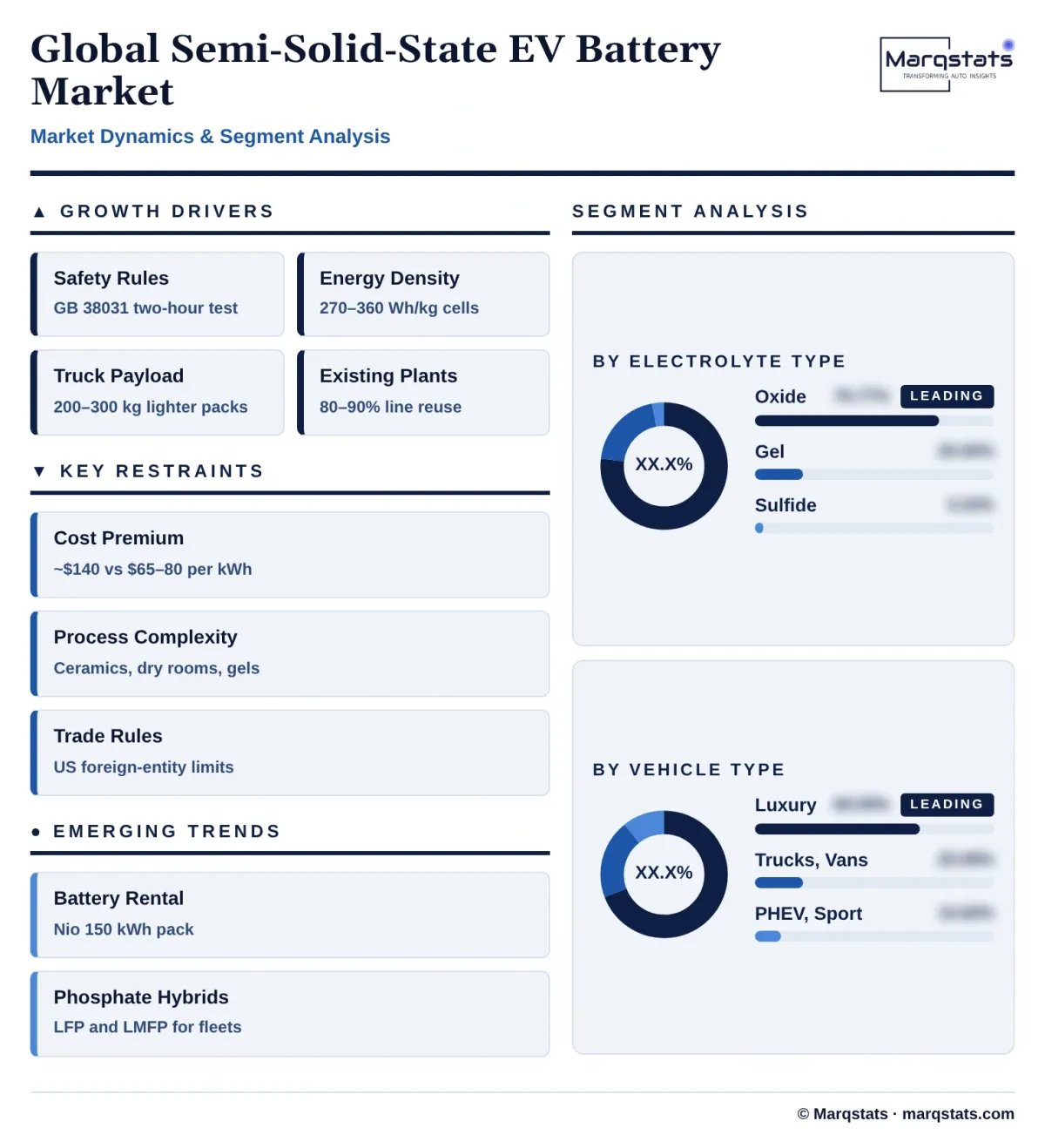
- Stricter safety rules. China's GB 38031-2025 requires battery packs in newly approved vehicles from 1 July 2026 to show no fire and no explosion for two hours after thermal runaway, sound an alarm within five minutes, survive a 150 J underbody impact and pass a short-circuit test after 300 fast-charge cycles. Low-liquid cells with ceramic layers help meet these tests.
- Higher energy density. Semi-solid cells reach 270 to 360 Wh/kg in series production and about 400 Wh/kg in new products, against 160 to 190 Wh/kg for lithium iron phosphate cells, enabling 1,000 km driving ranges or lighter packs.
- Payload limits on commercial vehicles. Light trucks and delivery vans face gross weight limits, so a lighter battery increases legal cargo capacity. CALB launched a 400 Wh/kg hybrid battery for light trucks in March 2026, already fitted to Chery light trucks.
- Use of existing factories. Hybrid cells can be made on 80% to 90% of existing liquid cell equipment, letting Chinese battery makers add the technology without building new plants.
- New vehicle launches. Chinese carmakers including Dongfeng, GAC and Chery have announced semi-solid or hybrid solid-liquid packs for models launching in 2026, adding to Nio and IM Motors.
- Battery swapping and rental models. Swap networks such as Nio's, which passed 120 million cumulative swaps in August 2026, let expensive high-energy packs be shared across many drivers, lowering the cost per user and giving suppliers real-world data on cell performance.
Key Restraints
Four constraints keep semi-solid-state packs a small share of EV batteries for now.
- High cost. Semi-solid packs cost about USD 140 per kWh in 2025, nearly double liquid nickel-rich packs and more than double lithium iron phosphate packs, limiting use in mass-market cars.
- Material and process complexity. Ceramic powders require high-temperature processing, sulfide electrolytes release hydrogen sulfide in moist air and need dry rooms, and curing gel electrolytes inside cells requires tight process control.
- Trade rules. US rules restricting batteries and materials from foreign entities of concern limit the use of Chinese semi-solid cells and electrolytes in vehicles and factories that claim US manufacturing tax credits.
- Western carmakers prefer to wait. European, US, Japanese and Korean carmakers focus most of their research spending on all-solid-state batteries expected later in the decade, buying liquid cells for current models.
Key Trends
Four shifts are changing where semi-solid-state batteries are used and how they are sold.
- Battery rental for premium packs. Nio offers its 150 kWh semi-solid pack through daily and monthly rental, letting owners of standard packs upgrade for long trips through its swap network.
- Phosphate-based hybrid cells. Battery makers are pairing hybrid electrolytes with lithium iron phosphate and lithium manganese iron phosphate cathodes for trucks, vans and plug-in hybrids that need long cycle life at lower cost.
- Moves toward all-solid-state. Suppliers are using semi-solid production to build experience before all-solid-state cells. Greater Bay Technology commissioned a GWh-scale all-solid-state line in October 2026, converted from part of a liquid cell line.
- Clear labelling. China's new terminology standard classifies batteries by liquid content, ending loose use of terms such as 'semi-solid' and 'quasi-solid' in marketing.
Strategic Implications
- For battery makers, gel and oxide-polymer chemistries that reuse existing equipment offer the lowest-cost route to volume. Suppliers seeking customers in North America need supply chains for electrolytes and separators that meet US foreign-entity rules.
- For carmakers in Europe and North America, waiting for all-solid-state cells carries risk. Validation programmes with hybrid cells build engineering experience in silicon anodes, low-temperature performance and high-voltage safety that will be needed for the next generation.
- For commercial vehicle makers and fleets, payload economics justify the premium. Light truck and van platforms designed around lighter, safer packs can recover the higher battery cost within two to three years through extra cargo.
- For materials suppliers, ceramic powders, coated separators and polymer electrolytes are growth products. Capacity for oxide electrolytes such as LLZO and for ceramic-coated separators will be needed as volume rises toward 255 GWh.
- For recyclers, hybrid cells need new processes. Polymer binders and ceramic particles complicate recovery of lithium, nickel and cobalt, and processes that meet EU recovery targets will be needed.
- For investors, the transition timeline matters. Semi-solid-state batteries are the volume technology through 2030, while all-solid-state cells move from pilot lines to small-batch vehicle installations. Suppliers with both hybrid production revenue and all-solid-state development programmes are best placed for the transition.
Market Segmentation
Oxide-polymer composite electrolytes, which blend garnet or NASICON ceramic particles into a polymer with 8% to 12% liquid, account for 76.77% of 2025 value, USD 3,439.19 million and about 24.32 GWh, rising to USD 11,932.08 million by 2030, a 28.25% CAGR, while their share falls to 58.49%. WeLion and QingTao lead this segment.
Gel electrolytes formed inside the cell after liquid filling, holding 10% to 18% liquid, account for 20.00% of 2025 value, USD 896.00 million and about 7.04 GWh, and grow at 35.92% a year to USD 4,156.98 million, 20.38% of 2030 value. Because they use standard liquid filling equipment, they are attractive to suppliers converting existing lines.
Sulfide-polymer hybrids account for 3.23% of 2025 value, USD 144.81 million, and grow fastest, at 97.13% a year, to USD 4,310.94 million and 21.13% of 2030 value. They offer high ionic conductivity but require dry-room production because sulfides release hydrogen sulfide in moist air.
Nickel-rich cathodes account for 87.34% of 2025 value, USD 3,912.94 million and about 26.56 GWh, used in premium cars where energy density matters most, and grow at 32.53% a year to USD 15,998.03 million, 78.42% of 2030 value.
Lithium iron phosphate and lithium manganese iron phosphate cathodes account for 12.66% of 2025 value, USD 567.06 million and about 5.44 GWh, and grow at 50.66% a year to USD 4,401.97 million and 21.58% of 2030 value, driven by trucks and vans that need long cycle life and lower cost.
Executive and luxury battery electric cars with 130 to 150 kWh packs account for 69.09% of 2025 value, USD 3,095.43 million and about 20.80 GWh, rising to USD 11,936.67 million by 2030, a 30.99% CAGR, while their share falls to 58.51%. Nio and IM Motors are the main users.
Light trucks and delivery vans account for 20.08% of 2025 value, USD 899.53 million and about 7.68 GWh, and grow at 43.08% a year to USD 5,393.20 million and 26.44% of 2030 value as lighter packs raise legal payload.
Performance electric cars and long-range plug-in hybrids with 70 to 80 kWh packs account for 10.83% of 2025 value, USD 485.04 million and about 3.52 GWh, and grow at 44.64% a year to USD 3,070.13 million, 15.05% of 2030 value.
By Geography
China
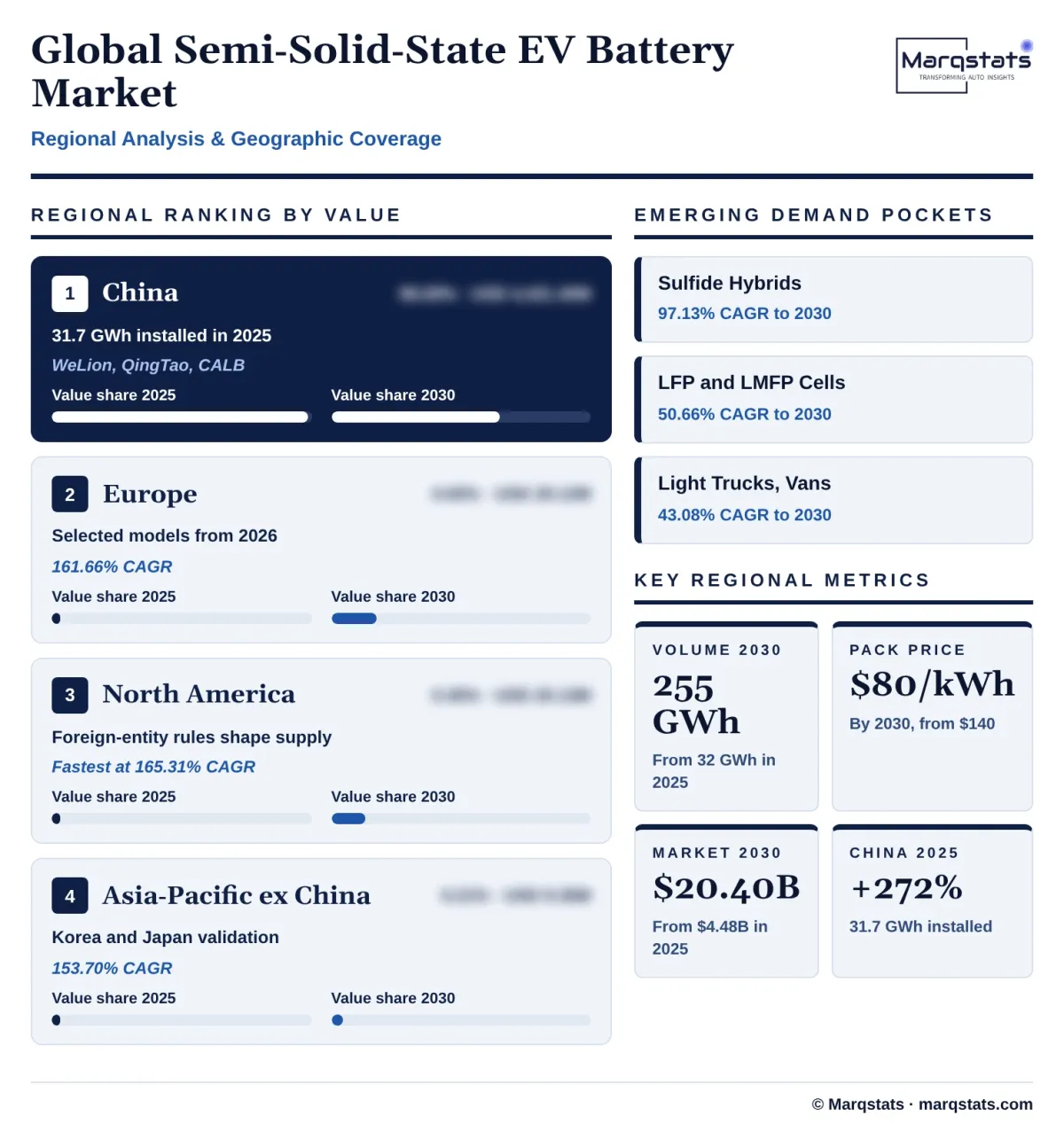
China accounts for 98.69% of 2025 value, USD 4,421.40 million and about 31.70 GWh, rising to USD 13,199.34 million by 2030, a 24.45% CAGR, while its share falls to 64.70%. Domestic supply of ceramic powders, coated separators and cathode materials, competition among battery makers and the GB 38031-2025 safety standard support adoption. China's 31.7 GWh of semi-solid installations in 2025 were up 272% and about 4.1% of total power battery installations. Industry data may count some cells with 5% to 10% liquid content as semi-solid, which is consistent with the hybrid solid-liquid definition used by Marqstats. Dongfeng plans a 350 Wh/kg semi-solid pack for its main models from September 2026, and GAC and Chery have announced hybrid packs for 2026 launches.
Europe
Europe accounts for 0.65% of 2025 value, USD 29.12 million and about 0.15 GWh, and grows at 161.66% a year to USD 3,571.98 million and 17.51% of 2030 value. European carmakers have focused on all-solid-state partnerships, such as BMW with Solid Power and Samsung SDI and Volkswagen Group's PowerCo with QuantumScape, but are expected to adopt hybrid cells in selected models, and SVOLT has orders from a European car brand. The EU Battery Regulation adds carbon footprint, battery passport and recycling requirements.
North America
North America accounts for 0.45% of 2025 value, USD 20.13 million and about 0.10 GWh, and grows at 165.31% a year to USD 2,645.91 million and 12.97% of 2030 value. Rules restricting battery materials and components from foreign entities of concern limit Chinese supply, so growth depends on domestic and allied production of electrolytes and cells.
Asia-Pacific excluding China
Asia-Pacific outside China accounts for 0.21% of 2025 value, USD 9.35 million and about 0.05 GWh, and grows at 153.70% a year to USD 982.77 million, 4.82% of 2030 value. Korean and Japanese battery makers and carmakers, including Samsung SDI, SK On, LG Energy Solution and Toyota, focus on sulfide-based all-solid-state cells, with hybrid cells used in validation programmes.
How Competition Is Evolving
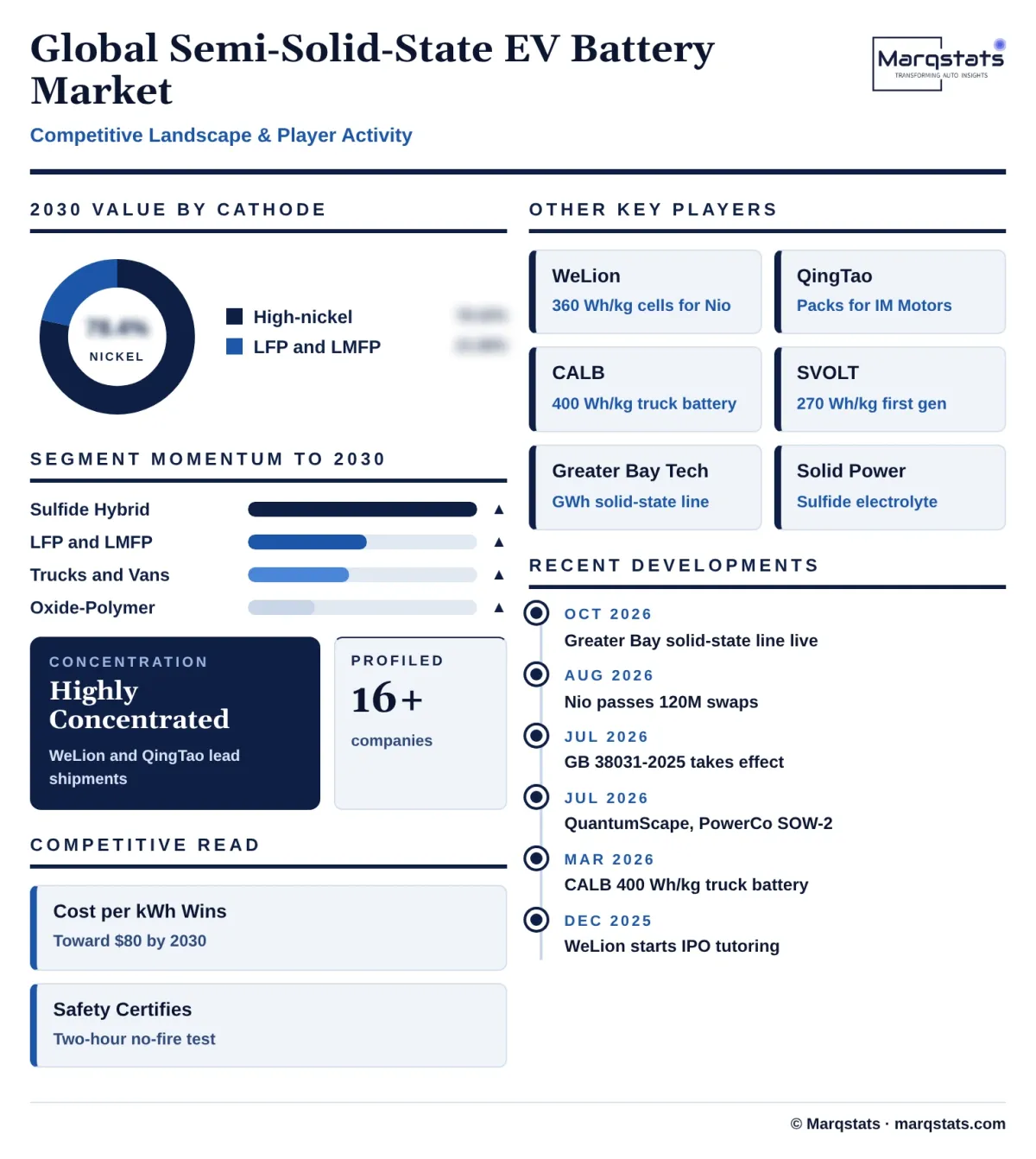
The semi-solid-state EV battery market is highly concentrated. WeLion and QingTao, two specialists that grew out of Chinese research institutes, account for the largest share of shipments, followed by large battery makers including CATL, CALB, SVOLT, Gotion, Sunwoda and EVE Energy, which are adding hybrid products to their ranges.
Carmakers shape demand. Nio and SAIC's IM Motors were the first to fit semi-solid packs in series cars, and Dongfeng, GAC and Chery have announced models for 2026. Outside China, BMW, Mercedes-Benz and Volkswagen Group are testing solid-state cells with partners such as Solid Power, Samsung SDI, Factorial Energy, ProLogium and QuantumScape.
Materials suppliers are part of the competition. SEMCORP supplies separators, Ronbay supplies cathode materials and Tianqi Lithium and Lianhong New Science have joint ventures with WeLion for lithium materials and polymer electrolytes.
Competition will be decided by cost per kWh, production yield and safety certification. Suppliers that bring pack prices toward USD 80 per kWh while passing China's two-hour thermal propagation test will win the largest programmes.
Capital markets are funding the sector. WeLion began preparations for a listing on Shenzhen's ChiNext board in December 2025, Solid Power raised USD 130 million in January 2026, and QuantumScape's agreement with PowerCo provides up to USD 75.4 million in milestone payments. Greater Bay Technology's conversion of part of a liquid cell line to all-solid-state production in October 2026 shows how Chinese suppliers are using existing plants to move up the technology ladder.
Companies Covered
Companies covered in the report include:
Recent Market Activity
Table of Contents
Coverage & Segmentation
The study covers the global semi-solid-state EV battery market, with 2025 as the base year, 2021 – 2025 as the historical period and 2026 – 2030 as the forecast period. Values are in US dollars at pack level, and volumes are installed GWh in new vehicles. The market is segmented by electrolyte type, cathode chemistry, vehicle type and region.
Conventional liquid lithium-ion batteries, all-solid-state batteries with less than 5% liquid electrolyte, stationary energy storage, drones, aviation and consumer electronics are excluded. Segment and regional values are Marqstats estimates built on installation data, supplier disclosures, vehicle launches and pack price benchmarks.