Market Snapshot
Middle bar: base-year value × (1 + CAGR), rounded to two decimals. This is a calculated illustration, not a separately researched annual estimate.
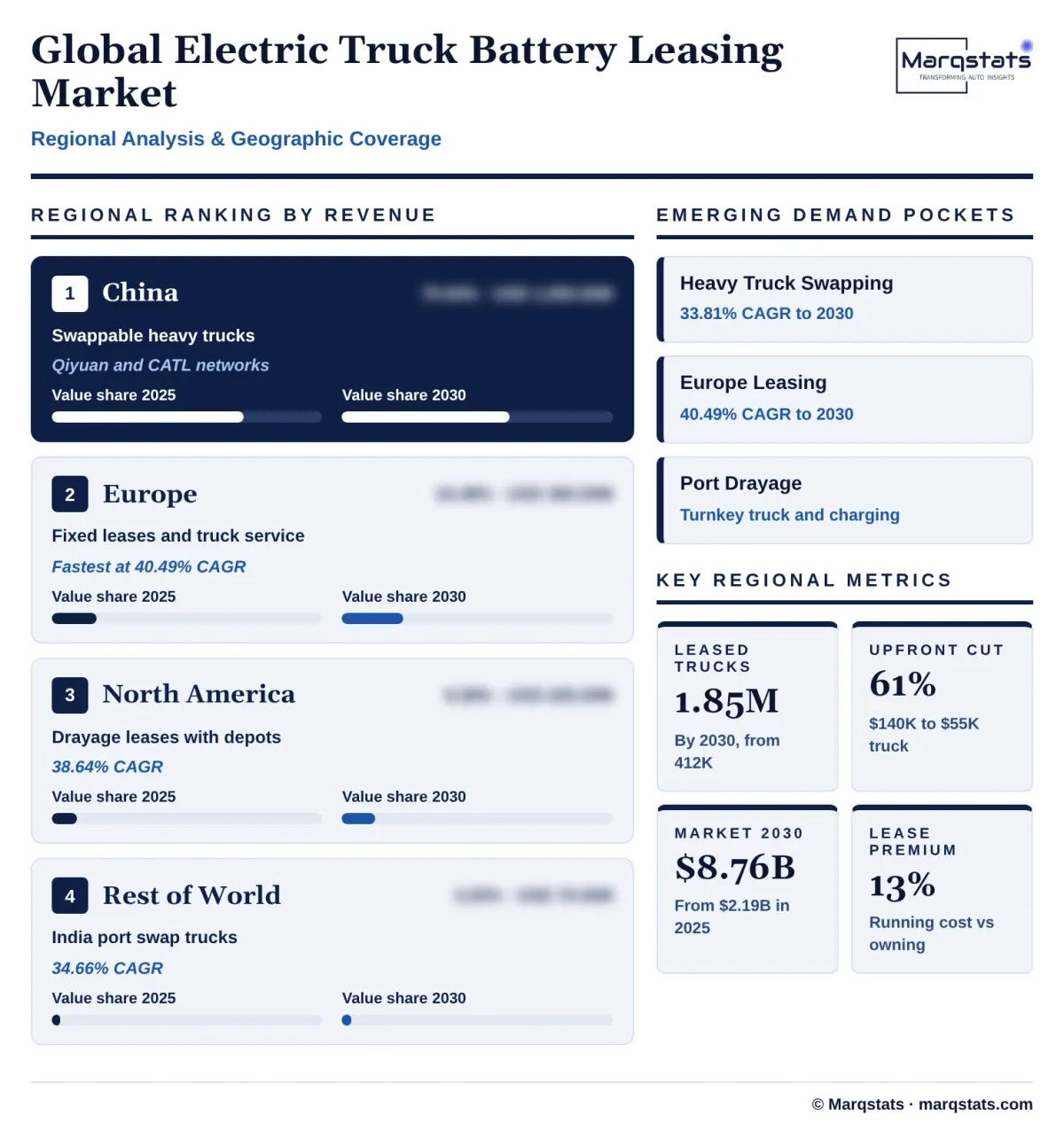
The global electric truck battery leasing market size is estimated at USD 2,185.00 million in 2025 and is projected to reach USD 8,760.00 million by 2030, growing at a CAGR of 32.01% over 2026 – 2030. The number of electric trucks with leased or subscription batteries grows from about 412,000 to 1,850,000, a 35.04% annual rate, as China's battery-swapping heavy trucks scale and European and North American fleets adopt leasing to cut upfront costs.
Marqstats defines the market as recurring revenue from leasing traction batteries for electric trucks separately from the vehicle. It covers battery-as-a-service subscriptions, battery operating leases where the pack is owned by a third party, and per-swap or per-kilometre battery charges for light commercial vehicles under 3.5 tonnes, medium-duty trucks of 3.5 to 15 tonnes and heavy-duty trucks above 15 tonnes. Vehicle sales, combined vehicle finance leases where the battery cannot be separated, electricity sold without a battery service charge, buses, and two- and three-wheelers are excluded.
Heavy-duty trucks account for an estimated 63.16% of 2025 revenue and swappable battery subscriptions for 65.68%. China accounts for 70.94% of 2025 revenue and Europe for 16.48%. The study segments the market by vehicle class, operating model and region.
Key Takeaways
Market Overview & Analysis
Report Summary
Marqstats sizes the electric truck battery leasing market as the recurring revenue that battery owners earn from fleets that use electric trucks without owning the battery. In 2025 about 412,000 electric trucks worldwide ran on leased or subscription batteries, generating an estimated USD 2,185.00 million of revenue.
The battery is the most expensive part of an electric truck. Packs of 280 to 600 kWh on heavy trucks account for 40% to 60% of the vehicle price, so an electric heavy truck bought outright costs about USD 140,000 against USD 52,000 for a diesel tractor. Trucking companies often earn operating margins of only 2.0% to 4.5%, and many cannot finance that difference or accept the risk that the battery will lose value faster than expected.
Battery leasing separates the vehicle from the battery. The fleet buys or leases the truck without its battery, at a price close to diesel, and pays a monthly fee, a per-kilometre charge or a per-swap charge for the battery. The battery owner, usually a specialist battery asset company, a battery maker or a truck maker's finance arm, takes responsibility for capacity loss, maintenance, replacement and resale.
Three operating models are used. In China, heavy trucks use swappable packs that are exchanged in about five minutes at swap stations, with the battery owned by an operator such as Qiyuan Green Power or CATL. In Europe, fleets more often lease a fixed battery as part of a depot charging contract or a truck-as-a-service package. In North America, turnkey providers such as Forum Mobility, WattEV and Revolv combine truck leases with depot charging for port drayage and regional freight.
The market grew from USD 210.00 million in 2021 to USD 435.00 million in 2022, USD 820.00 million in 2023 and USD 1,310.00 million in 2024, a 79.60% annual rate from 2021 to 2025, as China's heavy truck swap stations multiplied. Marqstats expects USD 2,885.00 million in 2026 and USD 8,760.00 million in 2030.
Battery owners earn money across several stages of the pack's life. For roughly the first six years the pack works in a truck, earning lease and swap fees while telematics track its health. When capacity falls to about 80%, it can be moved to stationary storage at depots for peak shaving and grid services for several more years, and finally recycled. This longer life lets battery owners charge lower monthly fees than the truck-only life would allow.
Global Electric Truck Battery Leasing Market Size and Forecast
The global electric truck battery leasing market grows from USD 2,185.00 million in 2025 to USD 8,760.00 million in 2030, a CAGR of 32.01%. Marqstats expects USD 2,885.00 million in 2026, USD 3,870.00 million in 2027, USD 5,120.00 million in 2028 and USD 6,710.00 million in 2029, with annual growth slowing from about 34% to about 31% as the market grows larger.
The fleet grows faster than revenue. The number of electric trucks with leased batteries rises from about 412,000 in 2025 to 585,000 in 2026, 810,000 in 2027, 1,105,000 in 2028, 1,450,000 in 2029 and 1,850,000 in 2030. Average annual revenue per leased truck falls from about USD 5,300 to USD 4,740 as cheaper cells lower lease fees, partly offset by larger 400 to 600 kWh packs on long-haul trucks.
Heavy trucks earn much more per vehicle. About 77,000 leased heavy trucks generated about USD 1,380.00 million in 2025, or roughly USD 17,900 per truck a year including swap service charges, against about USD 2,400 per truck for the medium-duty and light commercial fleets. Marqstats estimates a standard 282 kWh lithium iron phosphate heavy truck pack in China leases for about RMB 4,500, or USD 625, a month.
The operating economics favour electric trucks. A diesel tractor running 150,000 km a year at 35 litres per 100 km and USD 1.00 a litre spends about USD 52,500 on fuel, against about USD 22,500 of electricity for an electric truck using 150 kWh per 100 km at USD 0.10 per kWh. Marqstats estimates total annual running costs of USD 65,100 for diesel, USD 37,500 for an electric truck bought outright and USD 42,300 for an electric truck with a leased battery.
The forecast is most sensitive to the share of new heavy trucks sold without their battery. Marqstats estimates that a 5 percentage point change in that share moves the 2025 market by about USD 26 million, and a USD 50 a month change in the average heavy truck lease fee moves it by about USD 46 million. Marqstats tracks four indicators to monitor the forecast: new energy heavy truck sales and swap station numbers in China, electric truck registrations in Europe and North America, average monthly lease fees, and the number of packs moving into second-life storage.
Market Dynamics
Key Drivers
Five forces are moving electric truck batteries off fleet balance sheets and into service contracts.
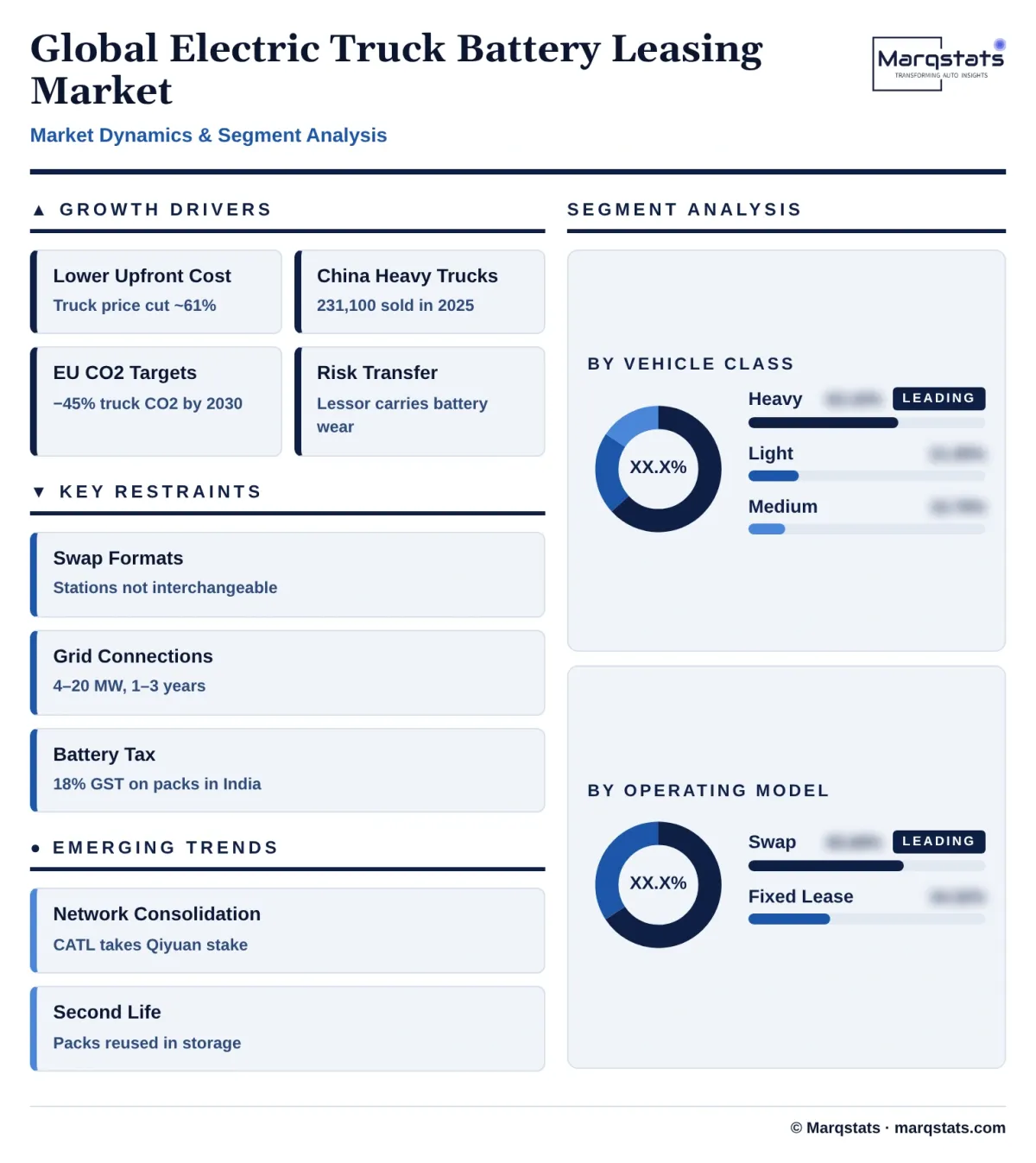
- Lower upfront cost. Leasing the battery cuts an electric heavy truck's purchase price by about 61%, from about USD 140,000 to USD 55,000, close to diesel, so carriers with thin margins can electrify without large loans.
- Fast growth of electric heavy trucks in China. New energy heavy truck sales reached about 231,100 in 2025, up 182%, and passed 54% of heavy truck sales in December 2025, with swappable trucks widely used on short-haul coal, steel and port routes.
- Stricter CO2 rules in Europe. Regulation (EU) 2024/1610 requires truck makers to cut fleet CO2 emissions by 45% by 2030, 65% by 2035 and 90% by 2040 against 2019, pushing manufacturers and their finance arms to offer leasing that lowers the barrier to buying electric trucks.
- Battery risk transfer. Fleets do not know how fast batteries will lose capacity under heavy daily use and fast charging, or what used packs will be worth. Leasing moves that risk to battery owners that can monitor packs and reuse them in storage.
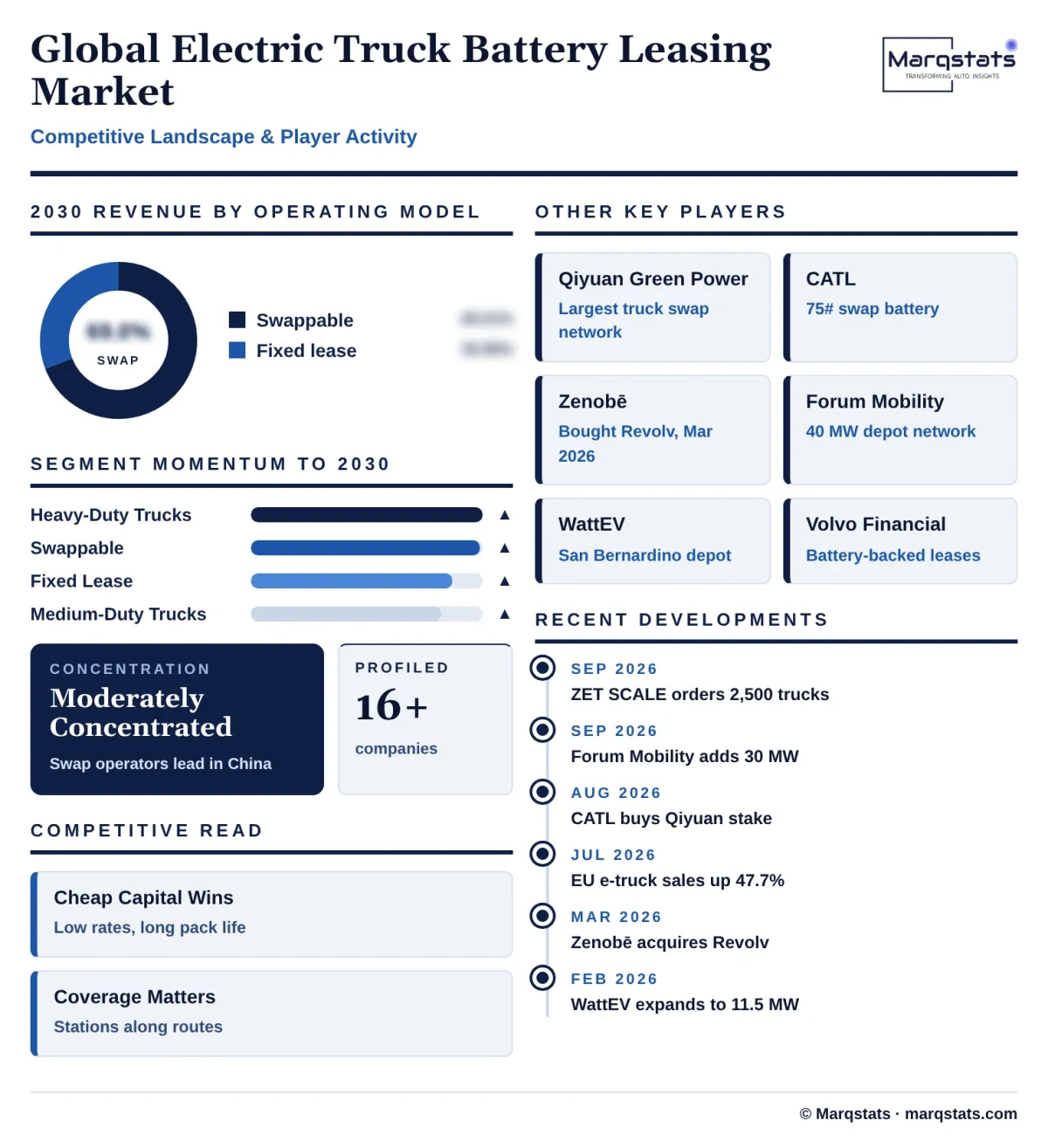
- Pooled purchasing and turnkey depots. Buyers' alliances such as ZET SCALE, which ordered 2,500 Class 8 electric trucks in September 2026 with a lease programme designed to remove residual value risk, and depot operators such as Forum Mobility and WattEV make it easier for fleets to lease trucks with guaranteed charging.
Key Restraints
Four constraints slow the spread of battery leasing for electric trucks.
- Incompatible swap systems. Back-mounted and chassis-mounted swap designs and different pack sizes limit which trucks can use which stations, reducing station use and route flexibility.
- Grid connection delays. Swap stations and truck charging depots often need 4 to 20 MW grid connections, which can take one to three years to secure in Europe and North America.
- Tax treatment. In India, electric vehicles carry 5% GST while batteries sold or leased separately carry 18%, adding cost to battery-as-a-service models.
- Uncertain residual values. Few used heavy truck packs have yet been sold, so lessors build risk margins into lease fees, and policy changes in the United States add uncertainty to fleet demand.
Key Trends
Four shifts are changing how electric truck batteries are financed, swapped and reused.
- Consolidation of swap networks. CATL's purchase of a 24.87% stake in Qiyuan Green Power in August 2026 combines the two main heavy truck swap formats in China under one battery maker.
- Standard battery blocks. CATL's 75# swap block, launched in May 2025, aims to let trucks from different makers use the same stations, with a network planned to cover 16 city clusters by 2030.
- Truck-as-a-service. In Europe and North America, providers increasingly bundle the truck, battery, charging and maintenance into one monthly fee.
- Battery passports and second life. The EU battery passport, required from February 2027, will record each pack's health and history, helping lessors price used packs and move them into stationary storage.
Strategic Implications
- For fleet operators, leasing trades a modest running-cost premium for lower capital and less risk. Fleets should compare the lease premium with their own cost of borrowing and their ability to manage battery wear, and check how swap station coverage fits their routes.
- For truck makers, battery leasing is a sales tool. Captive finance arms such as Volvo Financial Services and Daimler Truck Financial Services can offer battery guarantees and per-kilometre pricing to keep customers, while partnerships with swap operators give buyers access to shared stations.
- For battery owners and infrastructure investors, cheap capital and second life decide returns. Investors that finance packs at low rates, track their health and plan for reuse in storage can offer lower lease fees and still earn steady long-term returns.
- For battery makers, controlling swap networks secures demand. CATL's move into Qiyuan shows battery makers using swap networks to lock in long-term demand for their cells and influence standards.
- For utilities and regulators, swap stations are flexible loads. Stations can charge packs at night or when renewable power is plentiful, helping balance the grid if connection rules and tariffs reward that flexibility.
- For lenders and insurers, battery health data is becoming collateral. Separate registration of batteries in China and the EU battery passport from 2027 make it easier to take security over packs, insure them and finance them independently of the truck, which should widen the pool of capital available to battery owners and lower lease fees over time.
Market Segmentation
Heavy-duty trucks above 15 tonnes account for 63.16% of 2025 revenue, USD 1,380.00 million, and grow at 33.81% a year to USD 5,920.00 million and 67.58% of the market by 2030. Large packs, intensive use and swap corridors serving mines, steel plants and ports in China make heavy trucks the most valuable lease customers, with operators such as Qiyuan Green Power, CATL, Forum Mobility and WattEV.
Medium-duty trucks of 3.5 to 15 tonnes account for 15.79% of 2025 revenue, USD 345.00 million, rising to USD 1,180.00 million by 2030, a 27.88% CAGR, while their share falls to 13.47%. Regional delivery and municipal fleets in Europe and North America lease batteries through depot charging contracts and truck makers' finance arms.
Light commercial vehicles under 3.5 tonnes account for 21.05% of 2025 revenue, USD 460.00 million, and grow at 29.26% a year to USD 1,660.00 million by 2030. Urban delivery vans use fixed-battery leases with overnight charging, and in China and India some light trucks use swappable packs.
Swappable battery subscriptions account for 65.68% of 2025 revenue, USD 1,435.00 million, and grow at 33.32% a year to USD 6,045.00 million and 69.01% of the market by 2030. Fleets pay a monthly fee or per-swap charge and exchange packs in minutes at stations operated by Qiyuan Green Power, CATL and, in India, swapping providers serving ports and logistics hubs.
Fixed battery leases and truck-as-a-service contracts account for 34.32% of 2025 revenue, USD 750.00 million, and grow at 29.34% a year to USD 2,715.00 million by 2030. The battery stays in the truck and is owned by a lessor, depot operator or truck maker's finance arm, with charging at the fleet's depot or on public megawatt chargers.
By Geography
China
China is the largest market, with 70.94% of 2025 revenue, USD 1,550.00 million, rising to USD 5,430.00 million by 2030, a 28.50% CAGR, while its share falls to 61.99%. New energy heavy truck sales reached about 231,100 in 2025, up 182%, and 54% of heavy trucks sold in December 2025 were new energy models. Swappable trucks are widely used on coal, steel and container routes in Hebei, Shanxi and other industrial provinces. Qiyuan Green Power expected about 1,600 charging and swap stations across 208 cities by the end of 2025, and CATL planned about 300 heavy truck swap stations under its own system by the same date. Rules allowing vehicles and batteries to be registered and owned separately make it possible for banks and battery asset companies to own packs independently of the truck.
Europe
Europe accounts for 16.48% of 2025 revenue, USD 360.00 million, and grows fastest, at 40.49% a year, to USD 1,970.00 million and 22.49% of the market by 2030. EU electric truck registrations rose 47.7% in the first half of 2026, lifting their share of new trucks from 3.6% to 4.8%, led by Germany, the Netherlands and France. Fleets mainly lease fixed batteries through truck makers' finance arms, depot charging providers such as Zenobē and truck-as-a-service contracts rather than swapping.
North America
North America accounts for 9.38% of 2025 revenue, USD 205.00 million, and grows at 38.64% a year to USD 1,050.00 million and 11.99% of the market by 2030. About 72,309 zero-emission trucks had been deployed in the United States by December 2025, and zero-emission trucks made up 4.14% of new truck deployments in the second half of 2025. Forum Mobility, WattEV and Revolv combine truck leases with depot charging for port drayage around Los Angeles and Long Beach, and the ZET SCALE alliance ordered 2,500 Class 8 electric trucks in September 2026 with a lease programme that removes residual value risk from fleets.
Rest of World
India, Southeast Asia, Australia and other markets account for 3.20% of 2025 revenue, USD 70.00 million, rising to USD 310.00 million by 2030, a 34.66% CAGR. In September 2025 the Jawaharlal Nehru Port Authority deployed India's first fleet of 50 battery-swappable electric heavy trucks, supplied by Energy In Motion, with a target of replacing 90% of its roughly 900 port trucks with electric models by the end of 2026.
How Competition Is Evolving
The electric truck battery leasing market is moderately concentrated. In China, Qiyuan Green Power and CATL dominate heavy truck battery swapping, and CATL became Qiyuan's largest shareholder in August 2026. Outside China the market is fragmented among truck makers' finance arms, depot charging providers and specialist battery asset companies.
Four types of company compete. Specialist battery asset companies own packs and run swap stations. Battery makers such as CATL use swap networks and standard battery blocks to secure demand. Truck makers' finance arms, including Volvo Financial Services, Daimler Truck Financial Services, Scania Financial Services and PACCAR Financial, offer battery guarantees and operating leases. Depot and fleet electrification providers such as Zenobē, Forum Mobility and WattEV bundle trucks, batteries and charging.
Capital is the key competitive asset. Battery owners that raise money cheaply from infrastructure funds and banks can spread pack costs over a longer life and offer lower fees than carriers could achieve by financing batteries themselves.
Competition will be decided by station coverage, standardisation and data. Operators with the widest swap networks, packs that fit many truck models, and detailed battery health data to price leases and plan second-life use will win the largest fleets.
Deals are reshaping the market. Zenobē bought US fleet electrification provider Revolv, which runs 13 operational sites in California, in March 2026, and CATL paid about RMB 2.56 billion for its stake in Qiyuan, valuing the company at about RMB 10.28 billion, roughly 120% above book value.
Companies Covered
Companies covered in the report include:
Recent Market Activity
Table of Contents
Coverage & Segmentation
The study covers the global electric truck battery leasing market, with 2025 as the base year, 2021 – 2025 as the historical period and 2026 – 2030 as the forecast period. Values are in US dollars and measure recurring battery lease, subscription and swap service revenue. The market is segmented by vehicle class, operating model and region.
Electric truck and van sales, combined vehicle finance leases where the battery cannot be separated, electricity sold without a battery service charge, battery manufacturing value, buses, and two- and three-wheelers are excluded. Segment and regional splits are Marqstats estimates built on truck sales and registration data, swap station counts, lease fee benchmarks and company disclosures.