Market Snapshot
Middle bar: base-year value × (1 + CAGR), rounded to two decimals. This is a calculated illustration, not a separately researched annual estimate.
The India sodium-ion electric three-wheeler battery market size is estimated at USD 1.19 million in 2025 and is projected to reach USD 71.70 million by 2030, growing at a CAGR of 126.98% over 2026 – 2030. Sodium-ion packs go from about 1,600 electric three-wheelers in 2025, 0.20% of E3W sales, to 176,610 in 2030, 14.50% of sales, and deployed capacity rises from 8.80 MWh to 1,024.34 MWh.
Marqstats defines the market as the ex-factory value of sodium-ion traction battery packs, including cells, modules, battery management system and enclosure, fitted to new L3 e-rickshaws and e-carts and L5 passenger and cargo three-wheelers sold in India. Values exclude GST and purchase incentives. In rupee terms, at INR 87.00 per US dollar, the market grows from about INR 10.35 crore in 2025 to INR 623.79 crore in 2030. Vehicle values, two-wheeler and four-wheeler packs, stationary storage and 12V auxiliary batteries are excluded.
L3 e-rickshaws and e-carts account for an estimated 55.46% of 2025 value, L5 passenger autos for 31.93% and L5 cargo carriers for 12.61%. North India holds an estimated 62.18% of 2025 value. The study segments the market by vehicle category, pack architecture, cathode chemistry and region.
Key Takeaways
Market Overview & Analysis
Report Summary
Marqstats sizes the India sodium-ion electric three-wheeler battery market as the ex-factory value of sodium-ion traction packs, including cells, modules, battery management system and enclosure, fitted to new electric three-wheelers sold in India. The market covers L3 vehicles, low-speed passenger e-rickshaws and goods e-carts limited to 25 km/h, and L5 vehicles, high-speed passenger auto-rickshaws (L5M) and cargo carriers (L5N). In 2025 the market was worth an estimated USD 1.19 million from about 1,600 vehicles and 8.80 MWh of packs.
The market sits within a much larger battery market. India sold about 1.33 million three-wheelers in 2025, of which about 797,733 were electric. Marqstats estimates electric three-wheelers used about 4.4 GWh of traction batteries in 2025, worth about USD 570 million across LFP, NMC, lead-acid and sodium-ion packs. Sodium-ion is a very small part of this today but has a clear path to growth.
Battery choices differ sharply between vehicle types. Lithium-ion packs power nearly all new L5 autos, with packs averaging about 9 kWh, while lead-acid batteries still power about 42% of L3 e-rickshaws, with packs of about 3.8 kWh. Sodium-ion offers a drop-in replacement for lead-acid in e-rickshaws and a lower-cost, safer alternative to LFP in L5 vehicles as energy density improves.
Chemistry adoption is estimated rather than registered. India's VAHAN registry records electric three-wheelers by category and power but not by battery chemistry, so Marqstats builds sodium-ion volumes from supplier shipments, OEM programmes and fleet deployments, and checks them against total E3W registrations, which are fully published.
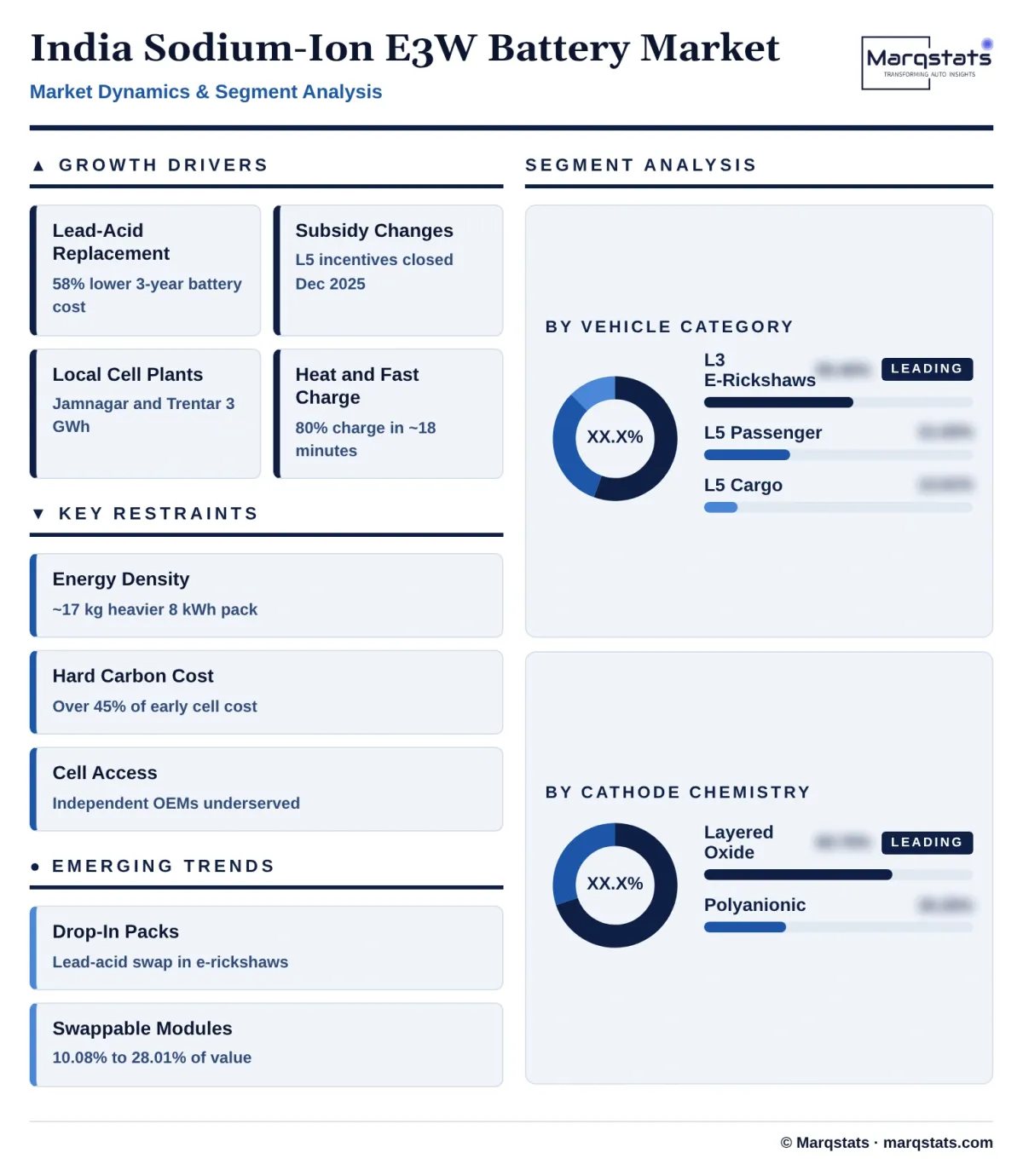
Sodium-ion batteries use sodium, which is abundant, instead of lithium, which India imports. Cells use aluminium current collectors on both electrodes, so they can be discharged fully and shipped as non-hazardous cargo. They tolerate heat up to about 60°C without liquid cooling, retain more than 88% of capacity at 0°C, and accept fast charging, reaching 80% charge in about 18 minutes. Their main drawback is lower energy density, which adds weight.
Policy and market conditions differ between L3 and L5 vehicles. L3 e-rickshaws are speed-limited, use small packs and are often bought by individual drivers on tight budgets, while L5 autos and cargo carriers are larger, faster vehicles bought by drivers and organised fleets that need range and reliability. Sodium-ion fits the first group immediately and the second as technology improves, which shapes the order of adoption.
Marqstats expects sodium-ion to reach 14.50% of electric three-wheeler sales by 2030. Adoption starts in L3 e-rickshaws replacing lead-acid and spreads to L5 passenger and cargo vehicles as domestic cell plants open, pack prices fall and energy density improves. The timing of Reliance's Jamnagar sodium-ion production is the most important single factor in the forecast.
India Sodium-Ion Electric Three-Wheeler Battery Market Size and Forecast
The India sodium-ion electric three-wheeler battery market grows from USD 1.19 million in 2025 to USD 71.70 million in 2030, a CAGR of 126.98%. Vehicle volumes grow from about 1,600 to 176,610, a 156.20% annual rate, and deployed capacity from 8.80 MWh to 1,024.34 MWh, a 158.94% annual rate. The average pack size rises slightly, from about 5.50 kWh to 5.80 kWh, as L5 vehicles with larger packs take a growing share.
Growth builds year by year. Marqstats estimates USD 4.49 million in 2026 with about 6,800 vehicles and 0.77% penetration, USD 14.41 million in 2027 with 24,500 vehicles and 2.53% penetration, USD 29.52 million in 2028 with 58,000 vehicles and 5.50% penetration, and USD 50.60 million in 2029 with 110,000 vehicles and 9.65% penetration, before reaching USD 71.70 million in 2030. Before 2024, sodium-ion was limited to research prototypes; first commercial pilot batches came in 2024.
Pack prices fall by almost half. Sodium-ion packs sold for about USD 135 per kWh in 2025, based on pilot cell production and imported cells, falling to about USD 120 in 2026, USD 105 in 2027, USD 90 in 2028, USD 80 in 2029 and USD 70 in 2030. Marqstats expects sodium-ion packs to approach the price of LFP packs, at about USD 68 per kWh, by 2030.
Total cost of ownership supports adoption beyond e-rickshaws. For a double-shift L5 passenger auto, fast charging cuts midday idle time, and long cycle life avoids a mid-life pack replacement that LFP packs in hard commercial use may need. Marqstats expects these savings, together with falling pack prices, to make sodium-ion competitive in L5 fleets from 2028, when domestic cells reach volume production.
The forecast is sensitive to adoption rates. Each percentage point of 2030 penetration changes annual volume by about 12,180 packs, capacity by about 70.64 MWh and value by about USD 4.95 million. A six-month delay in volume cell supply from Jamnagar would reduce 2027 penetration by about 2.2 percentage points.
Electric three-wheeler sales keep growing. Marqstats expects total E3W sales to rise from 797,733 in 2025 to about 1,218,000 in 2030, giving sodium-ion a larger base to capture. Growth comes from cargo delivery, last-mile passenger transport and the continued replacement of diesel, CNG and lead-acid vehicles.
Market Dynamics
Key Drivers
Five forces are opening Indian electric three-wheelers to sodium-ion packs.
- Lead-acid replacement offers immediate savings. E-rickshaw drivers replace lead-acid batteries about every nine to twelve months. Sodium-ion packs that last about 3,000 cycles cut battery spending over three years by about 58% and remove downtime for replacements, which matters to drivers who depend on daily earnings.
- Subsidy changes push OEMs to cut costs. PM E-DRIVE support for L5 three-wheelers ended in December 2025 after the target was met, and support for other vehicles is lower than before. OEMs need cheaper batteries to keep vehicle prices competitive without subsidy.
- Domestic manufacturing reduces import dependence. India imports most lithium cells and materials. Reliance's Jamnagar complex, Trentar's planned 3 GWh plant using KPIT technology, and start-ups such as Rechargion Energy and Naxion Energy create a domestic sodium-ion supply chain.
- Safety rules reward stable chemistries. AIS-156 Phase 2 requires packs to prevent thermal runaway spreading. Sodium-ion cells passed crush, nail penetration and short-circuit tests at ARAI without fire, and their stability reduces the cost of thermal protection in packs.
- Climate and duty cycles favour sodium-ion. Three-wheelers run long hours in temperatures of 45°C to 48°C in summer and near freezing in northern winters. Sodium-ion handles heat without liquid cooling, keeps more of its capacity in cold weather than lead-acid and supports fast charging, letting fleets run double shifts.
Key Restraints
Four constraints keep sodium-ion a small share of E3W packs for now.
- Lower energy density adds weight. In an L5 cargo vehicle with a 500 kg payload, an 8 kWh sodium-ion pack weighs about 17 kg more than an LFP pack, cutting payload by about 3.3%. This matters less in e-rickshaws but limits adoption in high-speed and long-range vehicles.
- Hard carbon anodes are costly and imported. Battery-grade hard carbon costs about USD 11 to 14 per kg and accounts for more than 45% of early cell costs. India still imports most hard carbon precursors, so domestic supply must scale before costs fall fully.
- Winter performance of lead-acid creates demand, but buyers need proof. Lead-acid batteries lose 35% to 40% of their capacity in northern winters, while sodium-ion retains more than 88% at 0°C. Drivers and dealers, however, need evidence from local fleets before switching, and building that trust through warranties and service networks takes time and money.
- Independent OEMs lack cell access. More than 65% of electric three-wheelers are made by smaller, independent manufacturers. Large cell makers are prioritising their own vehicles and stationary storage, so smaller OEMs depend on merchant suppliers and joint ventures for sodium-ion cells.
- Long-term field data are limited. Few results have been published on how sodium-ion packs age under Indian conditions of high heat and fast charging, which makes some fleet operators and financiers cautious about committing to the chemistry.
Key Trends
Four shifts are shaping how sodium-ion packs reach Indian three-wheelers.
- Sodium-ion packs are replacing lead-acid in e-rickshaws. Integrators offer sodium-ion packs that fit existing e-rickshaw battery bays and chargers, giving drivers a simple upgrade from lead-acid without changing vehicles.
- OEMs are designing for alternative chemistries. Mahindra Last Mile Mobility introduced a three-wheeler platform in 2026 designed to accommodate different cell formats, including sodium-ion pouch cells, giving it flexibility to switch chemistries as prices change.
- Battery swapping is adopting sodium-ion modules. Swapping operators value long cycle life and fast charging, and standard sodium-ion modules such as Naxion Energy's 3.5 kW, 5 kW and 10 kW packs suit swappable formats.
- Domestic start-ups are reaching production. Rechargion Energy demonstrated locally made sodium-ion packs in 2026 and plans output of 500 to 1,000 cells a day, and Naxion Energy began producing sodium-ion packs in Coimbatore, showing the shift from research to commercial supply.
Strategic Implications
- For e-rickshaw makers and dealers, sodium-ion is a selling point. Offering sodium-ion packs as standard or as an upgrade lowers drivers' battery costs and downtime, helping makers compete as subsidies change.
- For battery recyclers, sodium-ion brings new material flows. Packs without lithium, cobalt or nickel have lower recovered material value, so recyclers and producers will need to plan collection and processing under the Battery Waste Management Rules as volumes grow after 2028.
- For L5 OEMs, flexible platforms reduce risk. Designing vehicles that can take LFP or sodium-ion packs lets OEMs use sodium-ion where weight matters less and switch as prices and energy density change.
- For cell and pack makers, materials and certification come first. Securing domestic hard carbon supply, AIS-156 and IS 16893 certification and supply agreements with independent OEMs will decide who gains share.
- For fleet operators and swapping networks, sodium-ion lowers cost per kilometre. Long cycle life and fast charging reduce pack replacements and spare inventory, especially in hot cities with double-shift operation.
- For policymakers, battery chemistry data would help. VAHAN does not record battery chemistry, so adoption of sodium-ion, LFP and lead-acid is estimated from supplier and OEM data. Adding chemistry to registration records would improve planning for recycling, safety oversight and industrial policy.
- For lenders and financiers, battery life changes risk. Longer-lasting packs reduce the risk of drivers defaulting when batteries fail, which could make it easier to finance e-rickshaws and small fleets.
Market Segmentation
Low-speed L3 e-rickshaws and e-carts make up about 1,280 sodium-ion vehicles in 2025, 80% of units, and USD 0.66 million, or 55.46% of value. Value grows at 115.31% a year to USD 30.54 million by 2030, with about 114,800 vehicles, while the value share falls to 42.59%. YC Electric, Saera and Dilli Electric are leading L3 makers, and drivers replacing lead-acid batteries drive early demand.
High-speed L5M passenger auto-rickshaws account for about 240 sodium-ion vehicles in 2025 and USD 0.38 million, 31.93% of value. Value grows at 135.98% a year to USD 27.81 million and 38.79% of the market by 2030, with about 44,150 vehicles, as domestic cells reach the energy density needed for larger packs. Bajaj and Mahindra lead this category.
L5N cargo three-wheelers account for about 80 sodium-ion vehicles in 2025 and USD 0.15 million, 12.61% of value, and grow fastest, at 145.40% a year, to USD 13.35 million and 18.62% of the market by 2030, with about 17,660 vehicles. E-commerce and FMCG fleets value fast charging and lower pack cost, accepting a small payload penalty.
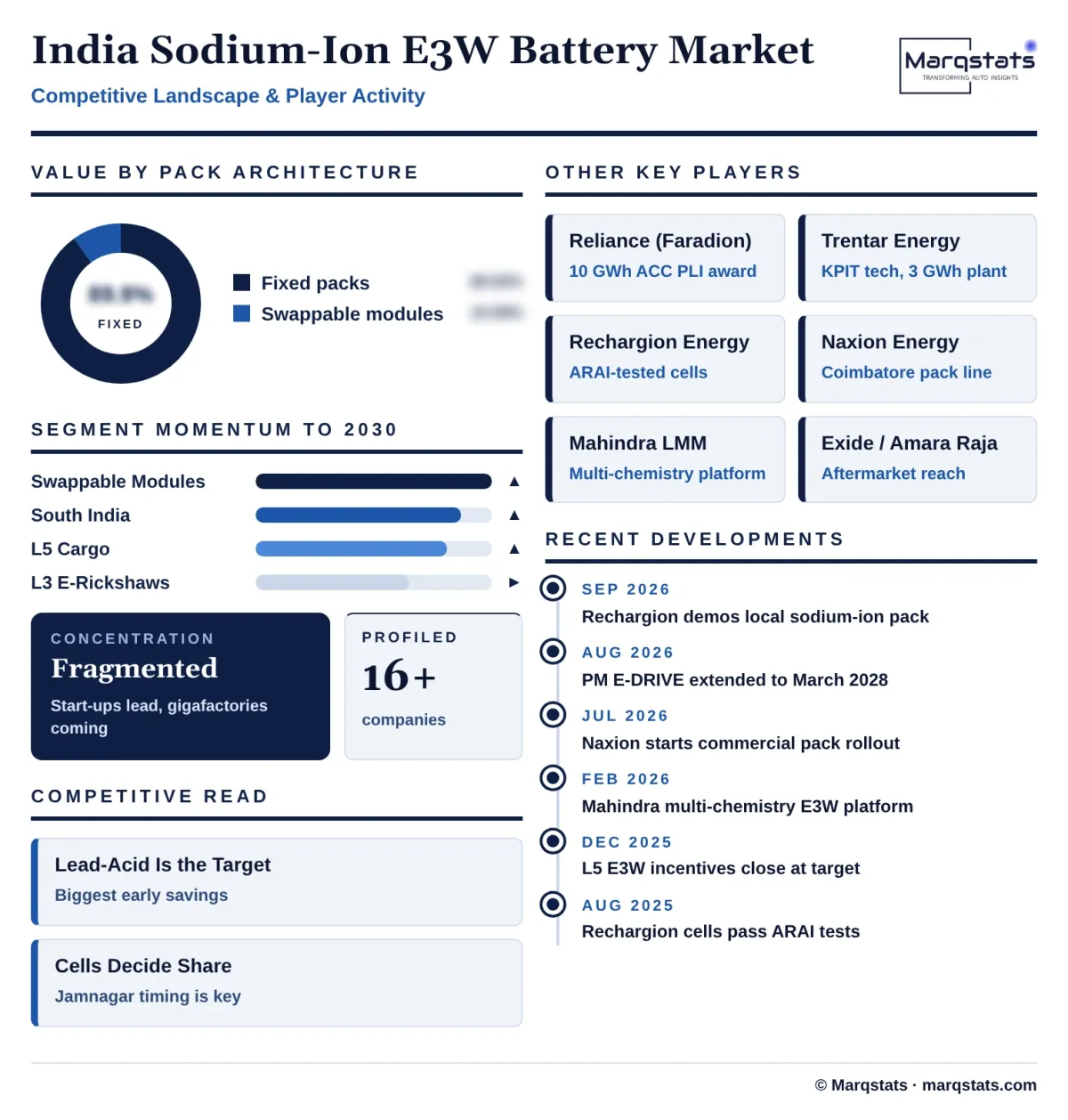
Fixed packs built into the vehicle account for 89.92% of 2025 value, USD 1.07 million, rising to USD 51.62 million by 2030, a 117.11% CAGR, while their share falls to 71.99%. Most OEM-fitted and replacement packs use this format.
Swappable sodium-ion modules used in battery-swapping networks account for 10.08% of 2025 value, USD 0.12 million, and grow fastest, at 178.43% a year, to USD 20.08 million and 28.01% of the market by 2030, supported by modular products from integrators such as Naxion Energy.
Layered transition metal oxide cathodes, used by Faradion and most early suppliers, account for 69.75% of 2025 value, USD 0.83 million, rising to USD 48.04 million and 67.00% of the market by 2030, a 125.17% CAGR. Their higher energy density suits compact L5 vehicles.
Polyanionic and Prussian blue cathodes account for 30.25% of 2025 value, USD 0.36 million, rising to USD 23.66 million and 33.00% of the market by 2030, a 130.96% CAGR. They offer longer cycle life and lower material cost, suiting heavily used commercial fleets.
By Geography
North India
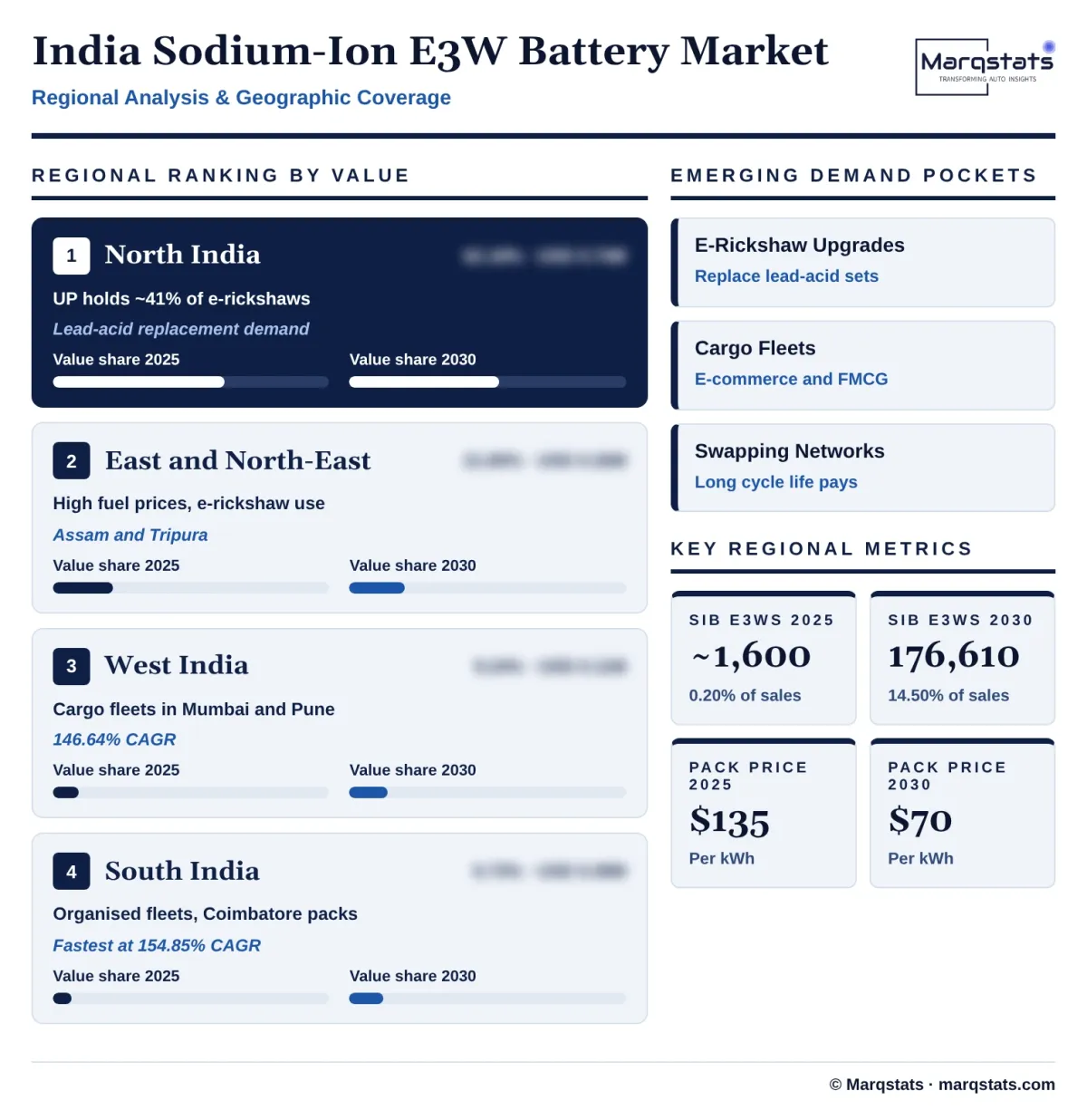
North India, covering Uttar Pradesh, Bihar, Delhi-NCR, Haryana and Punjab, is the largest market, with an estimated 62.18% of 2025 value, USD 0.74 million, from about 990 vehicles, rising to USD 38.72 million and 54.00% of the market by 2030, a 120.67% CAGR. Uttar Pradesh alone accounts for about 41% of India's e-rickshaws, and drivers in the region prioritise low upfront and running costs, making sodium-ion replacements for lead-acid attractive.
East and North-East India
East and North-East India, covering West Bengal, Assam, Odisha, Jharkhand and Tripura, accounts for an estimated 21.85% of 2025 value, USD 0.26 million, rising to USD 14.34 million and 20.00% of the market by 2030, a 123.01% CAGR. High fuel prices and strong e-rickshaw use in Assam and Tripura support adoption.
West India
West India, covering Maharashtra, Gujarat and Rajasthan, accounts for an estimated 9.24% of 2025 value, USD 0.11 million, rising to USD 10.04 million and 14.00% of the market by 2030, a 146.64% CAGR. Cargo delivery fleets in Mumbai and Pune and proximity to Reliance's Jamnagar complex and Pune's cell start-ups support growth in L5 vehicles.
South India
South India, covering Karnataka, Tamil Nadu, Telangana, Andhra Pradesh and Kerala, accounts for an estimated 6.73% of 2025 value, USD 0.08 million, but grows fastest, reaching USD 8.60 million and 12.00% of the market by 2030, a 154.85% CAGR. Organised logistics fleets, Tamil Nadu's vehicle tax waivers and Naxion Energy's Coimbatore production drive demand.
How Competition Is Evolving
The India sodium-ion electric three-wheeler battery market is fragmented and at an early stage. Supply in 2025 came from start-ups and integrators, including Rechargion Energy, Naxion Energy and IndiEnergy, often using imported cells, while large companies prepare volume production. No supplier holds a dominant share.
Large manufacturers will shape the market from 2027. Reliance New Energy, with Faradion technology and a 10 GWh ACC PLI award, and Trentar Energy, with KPIT's technology and a planned 3 GWh plant, are expected to supply most cells. Lead-acid leaders Exide Industries and Amara Raja are building advanced cell capacity and have strong distribution in the e-rickshaw aftermarket.
Chinese suppliers set the benchmark. CATL, with its Naxtra sodium-ion cells, and BYD, with large sodium-ion lines, set price and performance targets, and could supply Indian integrators if domestic supply is slow.
Freight and logistics advantages strengthen the case for domestic sodium-ion supply. Because sodium-ion packs can be shipped fully discharged as non-hazardous cargo, Marqstats estimates interstate shipping and handling costs fall by about 12.5% compared with lithium-ion packs, which must be shipped under dangerous goods rules at partial charge. This helps pack makers serve e-rickshaw assemblers spread across many states.
OEMs and fleets will decide winners. Mahindra Last Mile Mobility, Bajaj, TVS, Piaggio, YC Electric and Saera choose battery suppliers for new vehicles, while fleet operators such as Green Drive Mobility and swapping networks shape demand in commercial use. Suppliers that offer certified packs, reliable supply and service support will gain share.
Companies Covered
Companies covered in the report include:
Recent Market Activity
Table of Contents
Coverage & Segmentation
The study covers the India sodium-ion electric three-wheeler battery market, with 2025 as the base year, 2021 – 2025 as the historical period and 2026 – 2030 as the forecast period. Values are in US dollars at ex-factory pack prices excluding GST and incentives, with rupee values converted at INR 87.00 per US dollar. The market covers sodium-ion traction packs fitted to new L3 and L5 electric three-wheelers. It is segmented by vehicle category, pack architecture, cathode chemistry and region.
Vehicle values, two-wheeler and four-wheeler packs, stationary storage, 12V auxiliary batteries and unregistered vehicles are excluded. Sodium-ion volumes, pack prices, segment and regional splits are Marqstats estimates built on VAHAN and FADA registration data, PM E-DRIVE notifications, company announcements and pack cost benchmarks.