Market Snapshot
Middle bar: base-year value × (1 + CAGR), rounded to two decimals. This is a calculated illustration, not a separately researched annual estimate.
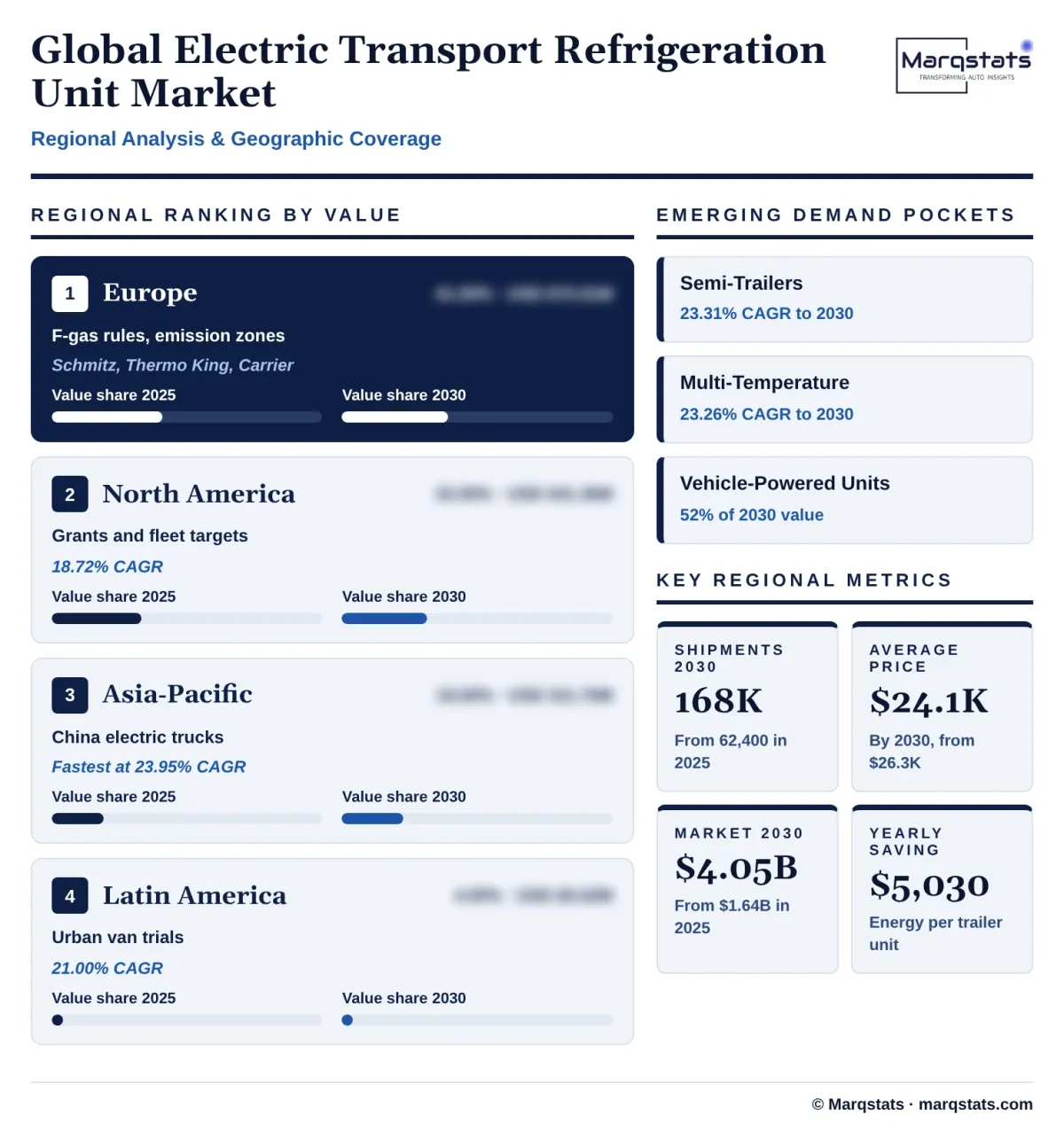
The global electric transport refrigeration unit market size is estimated at USD 1,640.50 million in 2025 and is projected to reach USD 4,052.70 million by 2030, growing at a CAGR of 19.83% over 2026 – 2030. Annual shipments rise from about 62,400 units to 168,200, a 21.93% annual rate, while the average selling price falls from about USD 26,290 to USD 24,095 per unit.
Marqstats defines the market as the value of electric transport refrigeration units (eTRUs) sold for road vehicles: refrigeration systems that keep an insulated van body, truck box or semi-trailer at a set temperature using electricity from the vehicle's traction battery, a dedicated battery pack, a generator axle that recovers braking energy, or a depot grid connection, without burning diesel while driving or idling. It covers electric compressors, power electronics, dedicated refrigeration batteries, generator axles and temperature control systems. The vehicle chassis, insulated bodies, cold stores, diesel-driven units and ocean or rail reefer containers are excluded.
Light commercial vehicles account for an estimated 39.50% of 2025 value and units powered from the vehicle battery for 47.00%. Europe accounts for 41.00% of 2025 value and North America for 33.00%. The study segments the market by vehicle type, power source, temperature configuration and region.
Key Takeaways
Market Overview & Analysis
Report Summary
Marqstats sizes the electric transport refrigeration unit market as the value of refrigeration systems for vans, rigid trucks and semi-trailers that run on electricity rather than a separate diesel engine. In 2025 about 62,400 units were shipped worldwide, worth an estimated USD 1,640.50 million at an average price of about USD 26,290.
Refrigerated road transport carries fresh food, frozen food, medicines and some chemicals. For decades most refrigeration units on trucks and trailers were driven by a small diesel engine of 1.0 to 2.2 litres that burns about 0.7 to 1.2 gallons of fuel an hour, emits particulates and nitrogen oxides, and runs at 72 to 82 decibels. Electric units replace that engine with an electric variable-speed compressor, power electronics and an energy source, cutting local emissions to zero and noise to about 52 to 60 decibels.
Three power designs are used. Direct-drive units draw power from the traction battery of an electric van or truck through an electric power take-off at 400 to 800 volts, with conversion efficiencies of 92% to 95%. Battery units carry their own lithium iron phosphate or nickel manganese cobalt pack of 15 to 45 kWh, enough for 8 to 14 hours of cooling, and suit trailers pulled by diesel tractors. Generator-axle units fit an electric generator into the trailer axle to recover energy during braking and store it in a buffer battery of 19 to 38 kWh, as in the Schmitz Cargobull S.KOe COOL and Thermo King AxlePower.
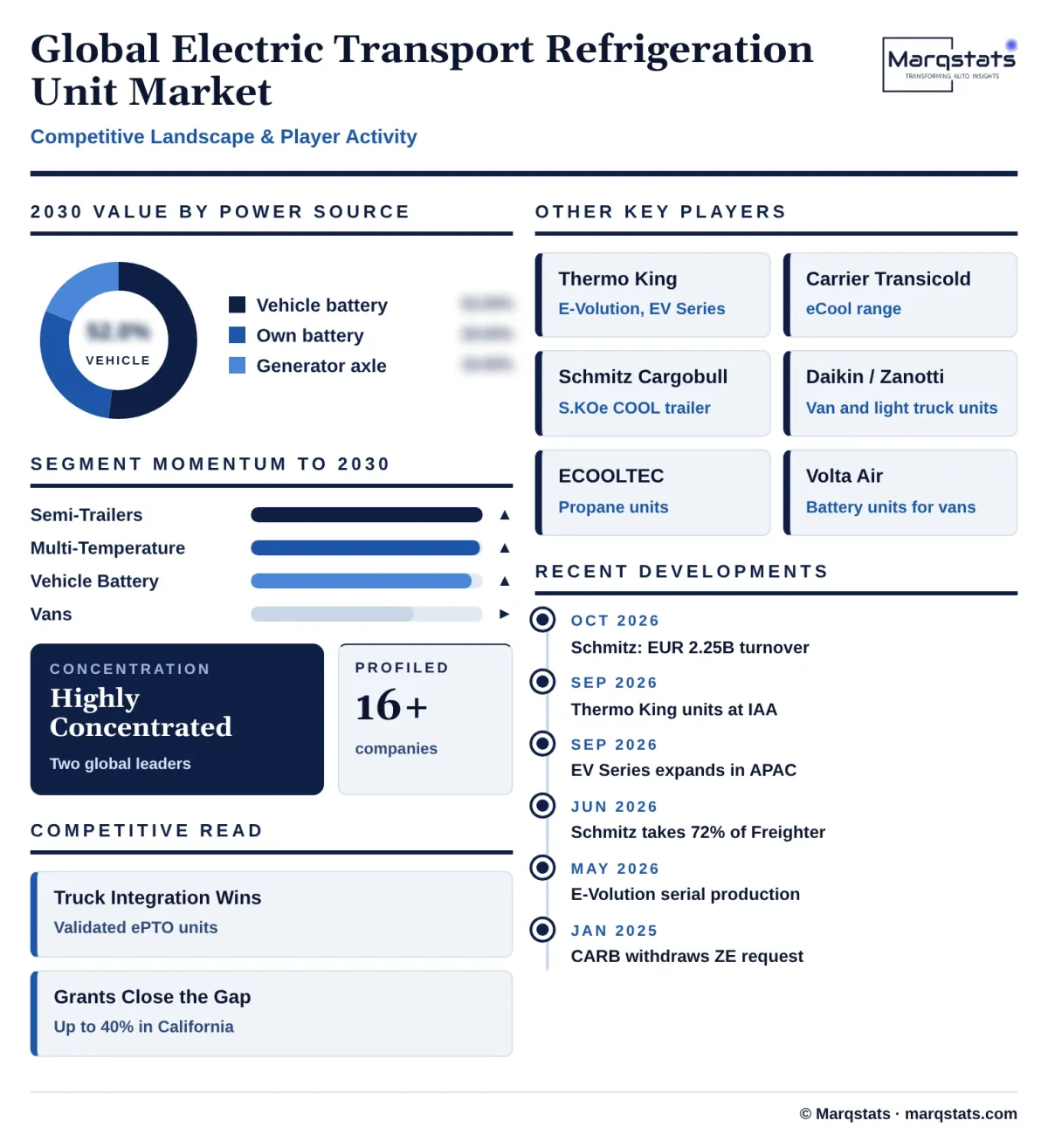
Two companies dominate the market. Thermo King, part of Trane Technologies, and Carrier Transicold, part of Carrier Global, supply most refrigeration units in North America and Europe and both offer full electric ranges. Schmitz Cargobull builds its own refrigeration units into its trailers, and Daikin through Zanotti and Hubbard, Mitsubishi Heavy Industries Thermal Systems and specialist firms such as ECOOLTEC and Volta Air serve vans, rigid trucks and natural refrigerant niches.
The market grew from USD 710.20 million in 2021, when about 22,900 units were shipped, to USD 860.40 million in 2022, USD 1,065.10 million in 2023 and USD 1,320.80 million in 2024. Marqstats expects about 76,500 shipments worth USD 1,965.60 million in 2026.
Regulation shapes demand in each region. The EU fluorinated gas regulation, Regulation (EU) 2024/573, phases down hydrofluorocarbons and pushes manufacturers towards low global warming potential refrigerants, while Regulation (EU) 2024/1610 requires truck makers to cut fleet carbon dioxide emissions by 45% by 2030. In California, operators must register refrigeration units in the state equipment registration system and meet particulate limits, and grants support zero-emission units. Cross-border food transport in Europe must also meet the UNECE ATP agreement on equipment for perishable foodstuffs.
Global Electric Transport Refrigeration Unit Market Size and Forecast
The global electric transport refrigeration unit market grows from USD 1,640.50 million in 2025 to USD 4,052.70 million in 2030, a CAGR of 19.83%. Marqstats expects USD 2,355.40 million in 2027, USD 2,822.40 million in 2028 and USD 3,382.00 million in 2029, with shipments of about 93,800, 114,900 and 139,800 units in those years.
Prices fall gradually. The average selling price falls from about USD 31,013 in 2021 to USD 27,806 in 2024, USD 26,290 in 2025 and USD 24,095 in 2030, about 1.7% a year, as lithium iron phosphate battery packs and power electronics get cheaper. Growth in high-value trailer units partly offsets the price fall, so shipments grow at 21.93% a year and value at 19.83%.
Operating costs favour electric units. Marqstats estimates a diesel trailer unit running 2,000 hours a year at 0.85 gallons an hour burns about 1,700 gallons of diesel, costing about USD 6,460 a year at USD 3.80 a gallon. An electric unit with an average load of 5.5 kW uses about 11,000 kWh, costing about USD 1,430 at a depot tariff of USD 0.13 per kWh, saving about USD 5,030 a year. Maintenance falls from about USD 1,700 a year to USD 600 because there is no engine, belt or oil to service.
Purchase price remains the barrier. A diesel trailer unit costs about USD 38,000 to 48,000, an electric unit with its own battery USD 75,000 to 95,000, and a generator-axle system USD 110,000 to 130,000. Over five years, Marqstats estimates operating costs of about USD 40,800 for diesel, USD 10,150 for a battery unit and USD 8,075 for a generator-axle unit, so electric units close most but not all of the purchase gap without grants.
Depot power is the second constraint. A terminal staging 100 refrigerated trailers at once needs 1.2 to 1.7 MW of electrical capacity to cover pull-down loads of 15 to 17 kW and holding loads of 8 to 12 kW per unit, and utility transformer lead times of 18 to 36 months can delay fleet conversions.
Marqstats tracks four indicators to monitor the forecast: electric van and truck sales with factory-fitted power take-offs, refrigeration battery pack prices, grant funding and new rules for zero-emission refrigeration units in California and other US states, and the progress of EU fluorinated gas quota cuts. A faster rollout of electric trucks with power take-offs would lift demand for direct-drive units, while delays to depot grid connections would slow trailer conversions.
Market Dynamics
Key Drivers
Five forces are moving refrigerated fleets from diesel cooling units to electric ones.
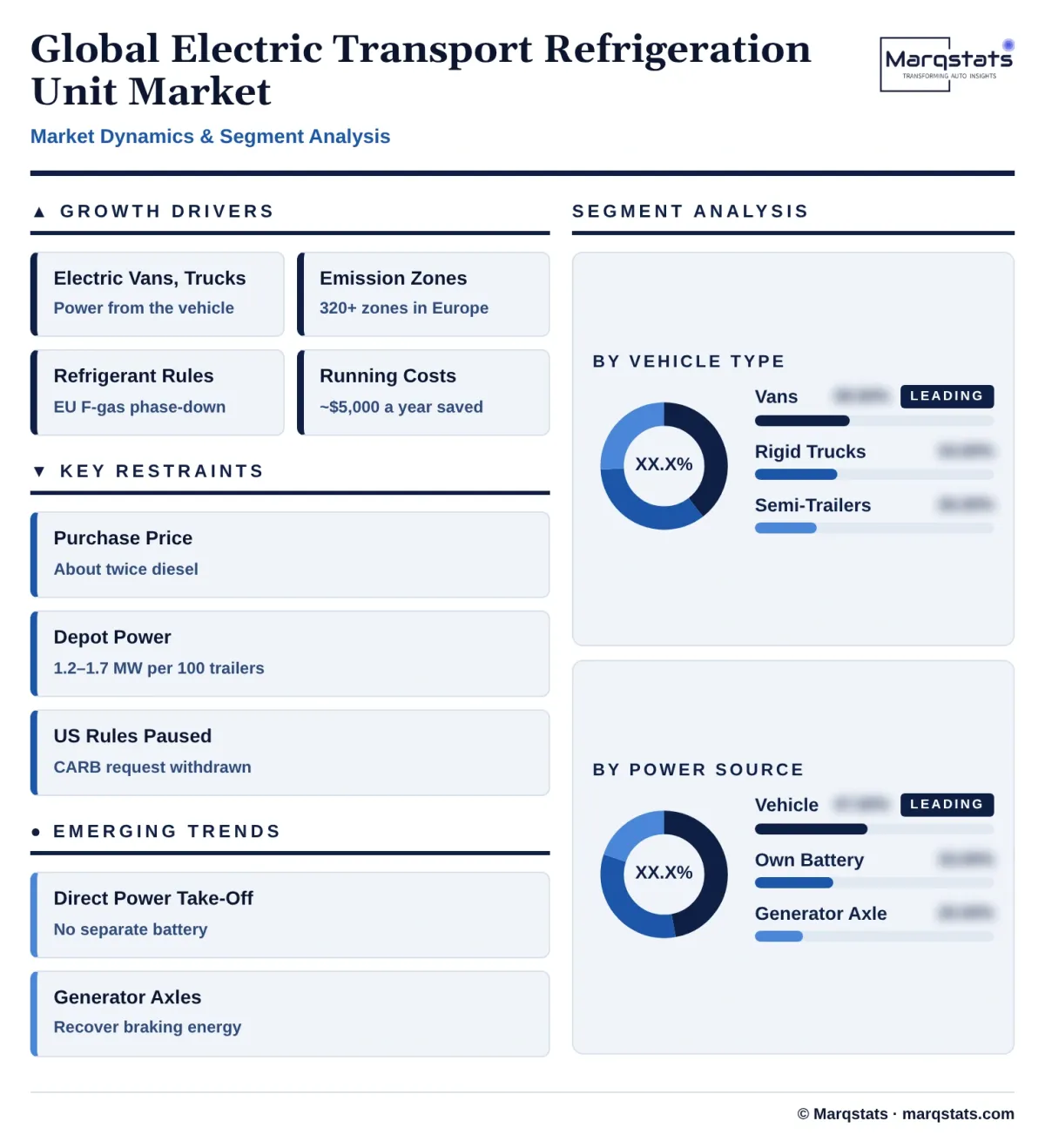
- Electric vans and trucks. As delivery fleets buy electric vans and rigid trucks, refrigeration units that run from the vehicle's traction battery become the natural choice, and truck makers increasingly offer high-voltage power take-offs from the factory.
- Low- and zero-emission zones. More than 320 low- and zero-emission zones across European cities such as London, Paris, Amsterdam and Milan restrict diesel engines, and night-delivery noise limits below 60 decibels favour quiet electric units.
- Refrigerant rules. The EU fluorinated gas regulation phases down hydrofluorocarbons, pushing operators to replace older units with new electric models that use low global warming potential refrigerants or natural refrigerants such as carbon dioxide and propane.
- Lower operating costs. Electric units cut energy costs by about 60% to 75% and maintenance by about 60%, saving an estimated USD 5,000 or more a year per trailer unit compared with diesel.
- Retailer and food company climate targets. Large grocery chains, food service companies and logistics providers have committed to cut emissions from their supply chains and are specifying electric refrigeration in new fleet orders.
Key Restraints
Four constraints slow the switch to electric transport refrigeration.
- High purchase price. Electric units with their own batteries cost roughly twice as much as diesel units, and generator-axle systems close to three times as much.
- Depot power. Charging refrigerated trailers and trucks needs dedicated high-power connections at depots, and utility upgrades can take one and a half to three years.
- Vehicle range and weight. Running a refrigeration unit from the traction battery can cut the driving range of a medium-duty electric truck by 18% to 28% in hot weather with frozen loads, and battery or generator-axle systems add 350 to 1,250 kg of weight.
- Uncertain US rules. California withdrew its request for federal authorisation of its zero-emission truck refrigeration requirements in January 2025, removing a firm deadline that would have forced fleets to switch.
Key Trends
Four shifts are changing how electric refrigeration units are designed, powered and sold.
- Power from the vehicle. Refrigeration makers are designing units that connect directly to the high-voltage power take-off of electric trucks, avoiding separate batteries and conversion losses.
- Energy recovery on trailers. Generator axles that recover braking energy, such as Thermo King AxlePower and the Schmitz Cargobull S.KOe COOL, let trailers run electric refrigeration behind diesel tractors.
- Low-impact refrigerants. New units use mildly flammable low global warming potential blends or natural refrigerants such as carbon dioxide and propane to meet EU rules.
- Units that work on any truck. Thermo King's E-Volution range is validated for both battery-electric and diesel trucks, letting fleets switch the refrigeration unit before they switch the vehicle.
Strategic Implications
- For refrigeration unit makers, integration with truck makers is the key to growth. Units validated for the power take-offs of leading electric truck chassis will capture the fastest-growing direct-drive segment.
- For trailer makers, refrigeration is becoming part of the product. Builders that integrate generator axles, batteries and refrigeration units, as Schmitz Cargobull does, can sell a complete electric reefer trailer and capture more value per vehicle.
- For fleet operators, grants and depot power decide timing. Securing grants such as California vouchers and planning depot grid upgrades early lets fleets switch units as diesel equipment reaches the end of its life.
- For utilities and depot developers, refrigerated logistics is a new load. Distribution centres staging many refrigerated trailers need megawatt-scale connections, creating demand for grid upgrades, on-site batteries and smart charging.
- For policymakers, clear rules matter. A revised California rule for zero-emission truck refrigeration units, or similar measures in other states, would give fleets the certainty needed to plan replacement cycles.
- For investors, the market offers steady growth with concentrated leadership. The two largest suppliers benefit from scale, dealer networks and relationships with truck and trailer makers, while specialists with natural refrigerant or low-voltage designs can grow in niches that the leaders serve less closely.
Market Segmentation
Vans below 3.5 tonnes account for 39.50% of 2025 value, USD 648.00 million, the largest share, and grow at 16.29% a year to USD 1,377.92 million by 2030, while their share falls to 34.00%. Urban grocery and pharmaceutical delivery fleets use direct-drive units such as the Carrier Transicold Pulsor eCool and Thermo King EV Series on electric vans.
Medium and heavy rigid trucks account for 34.50% of 2025 value, USD 565.97 million, and grow at 20.85% a year to USD 1,458.97 million and 36.00% of 2030 value, becoming the largest segment as electric trucks with factory power take-offs become available. Thermo King's E-Volution range for rigid trucks of 7.5 to 26 tonnes entered serial production in 2026.
Semi-trailers account for 26.00% of 2025 value, USD 426.53 million, and grow fastest, at 23.31% a year, to USD 1,215.81 million and 30.00% of 2030 value, driven by generator axles and trailer battery packs for long-haul routes.
Units powered from the vehicle's traction battery through an electric power take-off account for 47.00% of 2025 value, USD 771.04 million, and grow fastest, at 22.27% a year, to USD 2,107.40 million and 52.00% of 2030 value, as truck makers fit high-voltage power outputs at the factory.
Units with their own 15 to 45 kWh battery pack account for 33.00% of 2025 value, USD 541.37 million, and grow at 16.77% a year to USD 1,175.28 million, while their share falls to 29.00%.
Generator-axle and electric standby units account for 20.00% of 2025 value, USD 328.09 million, and grow at 18.60% a year to USD 770.02 million, 19.00% of 2030 value, mainly on long-haul trailers.
Single-temperature units account for 67.00% of 2025 value, USD 1,099.14 million, and grow at 17.98% a year to USD 2,512.67 million, used for bulk food distribution, meat, dairy and produce.
Multi-temperature units with two or three compartments account for 33.00% of 2025 value, USD 541.36 million, and grow at 23.26% a year to USD 1,540.03 million and 38.00% of 2030 value, driven by online grocery and mixed store deliveries.
By Geography
Europe
Europe is the largest market, with 41.00% of 2025 value, USD 672.61 million, rising to an estimated USD 1,580.55 million by 2030, an 18.63% CAGR, while its share eases to 39.00%. The EU fluorinated gas regulation, carbon dioxide standards for trucks and more than 320 low- and zero-emission zones drive demand, and grocery chains in Germany, France, the United Kingdom, the Netherlands and Scandinavia are switching urban fleets to electric. Schmitz Cargobull builds the type-approved S.KOe COOL electric reefer trailer, and Thermo King showed new electric and low global warming potential units at IAA Transportation 2026.
North America
North America accounts for 33.00% of 2025 value, USD 541.36 million, rising to an estimated USD 1,276.60 million by 2030, an 18.72% CAGR. California requires registration of refrigeration units and supports zero-emission units through vouchers covering up to 40% of cost, but the withdrawal of its zero-emission truck refrigeration requirements in January 2025 slowed conversions by smaller operators. Large grocery, food service and dedicated logistics fleets continue to order electric units, and Thermo King's e1000 serves Class 5 to 7 electric trucks such as the Freightliner eM2.
Asia-Pacific
Asia-Pacific accounts for 19.00% of 2025 value, USD 311.70 million, and grows fastest, at 23.95% a year, to an estimated USD 911.86 million and 22.50% of 2030 value. China's large production of light and medium electric trucks supports direct-drive units, and Thermo King launched four new all-electric EV Series models for the region in September 2026. Schmitz Cargobull raised its stake in Australia's Freighter Group to 72% in 2026 and has invested in Sub Zero Insulation Technologies in India.
Latin America
Latin America accounts for 4.00% of 2025 value, USD 65.62 million, rising to an estimated USD 170.21 million by 2030, a 21.00% CAGR, led by electric van trials by beverage and retail fleets in São Paulo, Rio de Janeiro and Mexico City.
Middle East and Africa
The Middle East and Africa account for 3.00% of 2025 value, USD 49.21 million, rising to an estimated USD 113.48 million by 2030, an 18.19% CAGR. High summer temperatures demand larger compressors and more insulation, limiting adoption to pharmaceutical routes and urban distribution.
How Competition Is Evolving
The electric transport refrigeration unit market is highly concentrated. Thermo King and Carrier Transicold lead in North America and Europe with complete electric ranges for vans, trucks and trailers. Thermo King offers the e1000 for Class 5 to 7 trucks, the E-Volution range for rigid trucks, the EV Series for vans and light trucks, and AxlePower energy recovery for trailers. Carrier Transicold offers the eCool range, including the Vector eCool trailer unit with an energy-recovery axle and the Pulsor and Neos eCool units for vans and trucks.
Trailer makers are moving into refrigeration. Schmitz Cargobull builds its own S.CU refrigeration units and sells the fully electric S.KOe COOL trailer with a generator axle, battery and electric refrigeration unit. It reported turnover of about EUR 2.25 billion and sales of more than 47,000 vehicles in its 2025/26 financial year.
Specialists serve niches. Daikin, through Zanotti and Hubbard, supplies electric units for vans and light trucks; Mitsubishi Heavy Industries Thermal Systems supplies electric and hybrid units in Asia; ECOOLTEC builds units using propane and propene; and Volta Air Technology supplies battery-electric units for straight trucks and delivery vans in North America.
Competition will be decided by integration with electric truck makers, refrigerant choices and service networks. Suppliers whose units are validated on the most electric truck chassis and use refrigerants that meet EU rules will win the largest fleet orders.
Global service networks matter. Fleets running refrigerated vehicles across many countries need dealers able to repair compressors, batteries and high-voltage electronics quickly, giving the established suppliers with large dealer networks an advantage over new entrants.
Product launches show where competition is heading. In 2026 Thermo King put its E-Volution range for rigid trucks into serial production, launched four EV Series models for vans and light trucks in Asia-Pacific, and showed the E-Volution S and E-Volution Undermount units with low global warming potential refrigerants at IAA Transportation in Hannover. Schmitz Cargobull continues to expand its electric reefer trailer range and its international manufacturing footprint, including its majority stake in Freighter Group in Australia.
Companies Covered
Companies covered in the report include:
Recent Market Activity
Table of Contents
Coverage & Segmentation
The study covers the global electric transport refrigeration unit market, with 2025 as the base year, 2021 – 2025 as the historical period and 2026 – 2030 as the forecast period. Values are in US dollars at manufacturer selling prices, and volumes are annual unit shipments. The market is segmented by vehicle type, power source, temperature configuration and region.
Vehicle chassis, insulated bodies, diesel-driven and belt-driven refrigeration units, cold stores, ocean and rail reefer containers and stationary retail refrigeration are excluded. Segment splits and 2030 regional values are Marqstats estimates built on manufacturer disclosures, electric van and truck sales, regulatory requirements and unit price benchmarks.