Market Snapshot
Key Takeaways
Market Overview & Analysis
Report Summary
This analysis sizes the global digital twin vehicle diagnostics market, encompassing recurring software licenses, platform subscriptions and edge-to-cloud diagnostic analytics deployed by automotive manufacturers, commercial fleet operators and aftermarket service providers to continuously evaluate dynamic component wear using physics-based and machine-learning models. Hardware components, including telematics control units and physical workshop equipment, are excluded to isolate purely digital software service revenues. The market is sized in USD across a 2021-2025 historical period and a 2026-2030 forecast period, with 2025 as the base year.
The global digital twin vehicle diagnostics market grew from $485.20 million in 2021 to $1,684.50 million in 2025, a compound annual growth rate exceeding 36% across the historical window, and is projected to reach $6,168.00 million by 2030, a 29.64% compound annual growth rate. This growth reflects the architectural transition of vehicle diagnostics from reactive, threshold-based fault logging under legacy standards like ISO 14229-1 and SAE J1979 toward continuous, virtualized lifecycle prognostics codified under ISO 23247-1, driven directly by statutory battery durability and cybersecurity mandates that require verified, continuous asset observability.
The Baseline Scenario projects the market reaching $6,168.00 million by 2030 (29.64% CAGR), supporting an active footprint of 312.0 million vehicles, assuming scheduled enforcement of Euro 7 minimum performance requirements and UN GTR No. 22 in-use verification procedures, alongside continued commercial fleet adoption of hybrid edge-to-cloud diagnostic twins. The Conservative Scenario, reaching only $4,850.00 million at a 23.56% CAGR, is triggered if administrative delays affect Euro 7 battery durability verification and EU Digital Battery Passport rollout while OEMs continue restricting third-party telematics access through UN R155/R156 cybersecurity gateways. The Accelerated Scenario, reaching $7,820.00 million at a 35.94% CAGR, is triggered if the European Union Data Act and prospective United States federal right-to-repair legislation establish secure, standardized API frameworks for vehicle diagnostic data, combined with Digital Battery Passports becoming standard across all major global automotive markets.
Market Dynamics
Key Drivers
- Statutory battery durability mandates directly reinforce commercial acceleration, exemplified by UN GTR No. 22, adopted 19 April 2022, establishing the first globally harmonized legal requirements for in-vehicle battery durability, requiring category-1 light-duty vehicle batteries to retain a State of Certified Energy of not less than 80% from the start of life up to 5 years or 100,000 kilometers.
- Commercial fleet operators demonstrate measurable, quantified return on investment from digital twin adoption, exemplified by Intangles Lab Pvt. Ltd.'s deployment across more than 40,000 commercial vehicles, saving fleet operators an average of $500 per vehicle per month in prevented breakdowns and maintenance overhead by identifying faults days to weeks before conventional Diagnostic Trouble Codes trigger.
- Enterprise fleet telematics platforms have scaled to genuinely massive operational data volumes, exemplified by Samsara Inc. reporting an Annual Recurring Revenue run rate exceeding $2.0 billion, with its Connected Operations Cloud ingesting more than 9 trillion data points and recording 60 billion miles driven annually to train machine-learning models benchmarking asset health.
- Automotive original equipment manufacturers are actively reorganizing electronic architectures to capture high-margin recurring software revenue, exemplified by Stellantis N.V.'s STLA Brain platform cutting electronic control unit counts in half to roughly 60 domain and zonal controllers, providing cloud-hosted digital twins with comprehensive over-the-air access to vehicle sensors and actuators.
- Hyperscale cloud providers and Tier-1 suppliers are establishing standardized edge-to-cloud infrastructure specifically for vehicle digital twins, exemplified by Continental AG integrating Amazon Web Services' AWS IoT FleetWise into its Continental Automotive Edge platform, linking vehicle edge processors directly with cloud digital twins to run virtual diagnostics and test software updates.
Key Restraints
- Modern connected vehicles generate between 1 and 2 terabytes of raw telemetry data per hour, making direct cellular streaming cost-prohibitive at $15.00 to $40.00 per vehicle per month for multi-gigabyte payloads, requiring system architects to deploy sophisticated edge processing that evaluates telemetry locally and transmits data to the cloud only when anomalous variance is detected.
- Electrochemical battery aging exhibits genuine non-linear behavior, including sudden degradation knees and accelerated capacity fade under cold-temperature fast charging, meaning pure physics-based digital twins require continuous parameter recalibration while pure machine-learning models struggle with out-of-distribution operating conditions, demanding specialized hybrid engineering expertise across chemical engineering and computer science disciplines.
- The statutory enforcement of UN R155 and UN R156 cybersecurity frameworks has created genuine tension between vehicle cybersecurity and right-to-repair principles, since Secure On-Board Gateways cryptographically lock internal bus communications, blocking third-party hardware from reading real-time sensor streams without OEM-issued security tokens, concentrating diagnostic data control in the hands of vehicle manufacturers.
- Automotive OEMs and cell manufacturers treat real-world cell degradation data as proprietary trade secrets to limit warranty liability exposure, leaving independent third parties without comprehensive, long-term public datasets detailing real-world aging behavior of specific cell chemistries under continuous fast-charging and extreme operating temperatures.
Key Trends
- The eightfold overstatement risk in equating the 770 million-vehicle connected parc with genuine digital twin deployment demonstrates that market participants relying on headline connectivity statistics without distinguishing telemetry granularity will systematically misjudge near-term addressable demand, since most connected vehicles transmit only low-frequency scalar metadata rather than the high-frequency, synchronized sensor telemetry true digital twins require.
- The consistency between Intangles' documented $500 per vehicle monthly savings and the broader industry shift toward prognostic rather than reactive diagnostics demonstrates that digital twin adoption is increasingly justified by measurable commercial return on investment rather than speculative technology enthusiasm, a genuinely important distinction for evaluating procurement business cases.
- The direct coupling between UN R155 cybersecurity enforcement and the accelerated migration toward hybrid edge-to-cloud digital twin architectures indicates that regulatory frameworks originally designed for cybersecurity purposes are functioning as a structural accelerant for digital twin adoption, independent of whether individual automakers or fleet operators actively sought that outcome.
- The persistent registration-clustering artefacts documented across both European corporate leasing hubs and United States tax-favorable titling states demonstrate that regional market sizing models mapping software demand directly to national or state vehicle registrations without adjustment will systematically misstate genuine geographic digital twin demand relative to where vehicles actually operate.
- While UNECE WP.29 adopted UN GTR No. 22 governing light-duty electrified vehicle battery durability in April 2022, the corresponding heavy-duty vehicle standard, UN GTR No. 25, remained in active working-group development as of mid-2026 rather than fully adopted, with formal consensus adoption anticipated around mid-2026, indicating that commercial heavy-duty digital twin deployment currently runs ahead of, rather than in response to, finalized statutory heavy-duty battery durability requirements.
Strategic Implications
For a software or telematics entrant, commercial success requires evolving beyond basic GPS tracking and reactive Diagnostic Trouble Code parsing toward physics-informed machine learning models that deliver actionable, pre-DTC prognostic insights; platforms must obtain ISO/SAE 21434 certification to pass OEM cybersecurity audits and interface with secure onboard gateways, while demonstrating verifiable return on investment, following the model of Intangles' documented $500 per vehicle monthly savings, to win enterprise fleet contracts as basic connectivity becomes commoditized.
For an incumbent automotive manufacturer, digital twin diagnostics must be treated as both a compliance necessity and a high-margin recurring revenue stream; to avoid regulatory penalties and recall expenses under Euro 7 and UN GTR No. 22, OEMs must deploy cloud-based battery digital twins tracking fleetwide State of Certified Energy degradation continuously, while following data monetization models established by General Motors' OnStar and Stellantis' Mobilisights to transform vehicle telemetry into B2B data services and modernizing electronic architectures toward centralized domain or zonal designs that halve electronic control unit counts.
For a cloud infrastructure or Tier-1 systems supplier, success requires delivering pre-integrated, standardized edge-to-cloud diagnostic platforms that manage data ingestion, edge-to-cloud filtering, and vehicle signal standardization out of the box, following the model demonstrated by AWS IoT FleetWise and Continental CAEdge, while packaging specialized physical models such as Bosch's Battery in the Cloud into modular microservices deployable across multiple OEM platforms to provide certified battery passport calculations and predictive component maintenance.
Outlook
Baseline Scenario: $6,168.00 million by 2030 (29.64% five-year CAGR), supporting an active footprint of 312.0 million vehicles. This trajectory assumes the scheduled enforcement of Euro 7 minimum performance requirements for battery durability and UN GTR No. 22 in-use verification procedures, with commercial fleet operators expanding their use of hybrid edge-to-cloud diagnostic twins via platforms like Geotab, Samsara and Intangles to control total cost of ownership, while major automotive manufacturers maintain planned investments in domain-centralized electronic architectures enabling standardized edge-to-cloud telemetry filtering.
Accelerated Scenario: $7,820.00 million by 2030 (35.94% five-year CAGR), with an active footprint of 395.0 million vehicles. The specific trigger is the European Union Data Act and prospective United States federal right-to-repair legislation establishing secure, standardized API frameworks for vehicle diagnostic data, allowing third-party software platforms to access cryptographically signed telemetry without paying monopolistic OEM gateway fees, combined with Digital Battery Passports becoming standard across all major global automotive markets and rapid deployment of zonal computing architectures reducing edge computing costs.
Conservative Scenario: $4,850.00 million by 2030 (23.56% five-year CAGR), with an active footprint of 235.0 million vehicles. The specific trigger is administrative delays in the implementation of Euro 7 battery durability verification and EU Digital Battery Passport requirements, lowering regulatory urgency for mass-market OEMs, while OEMs continue using UN R155/R156 cybersecurity requirements to restrict third-party telematics access, and legacy multi-ECU electronic architectures persist longer than planned as OEMs scale back pure electric vehicle programs.
Market Segmentation
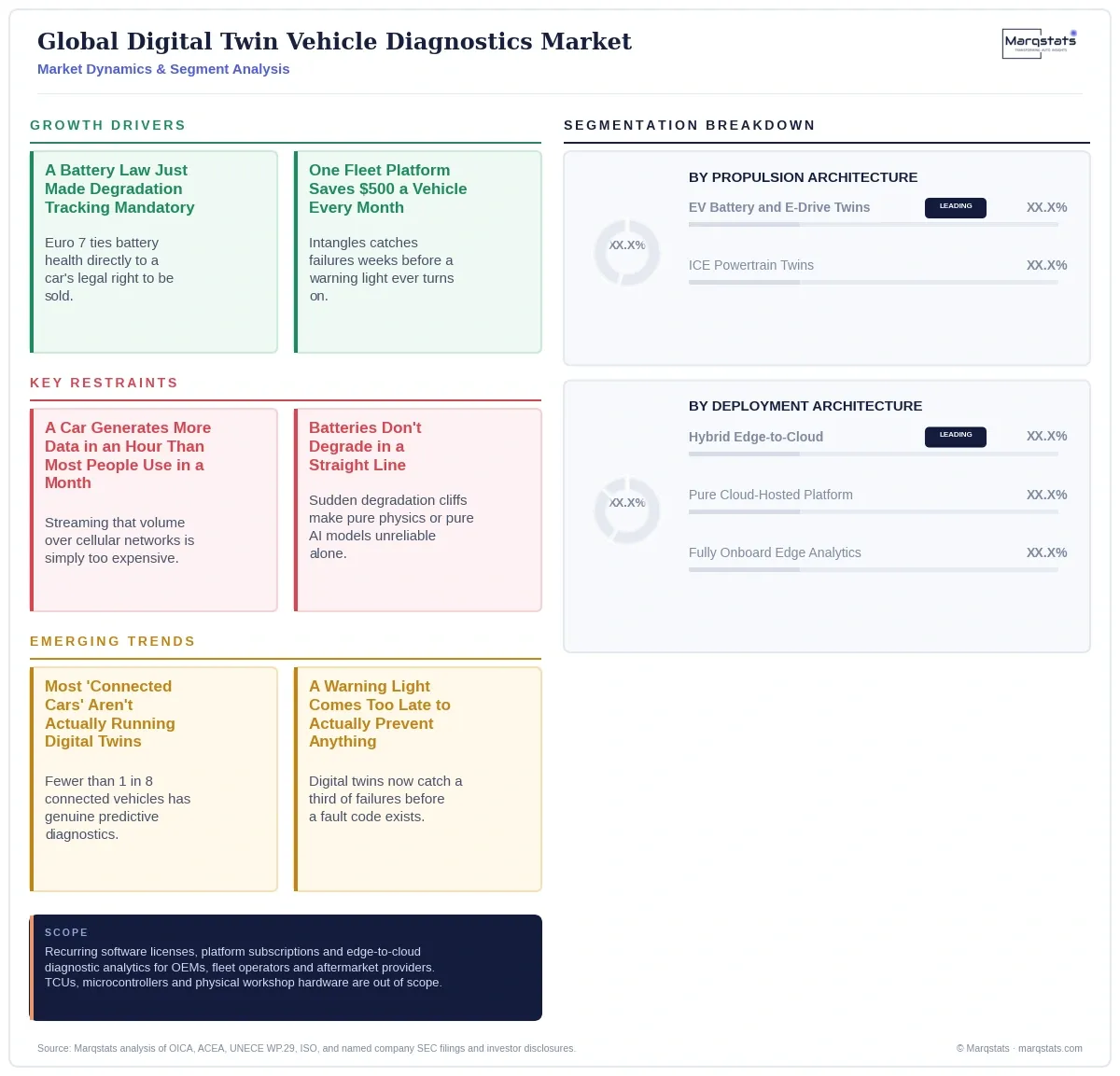
Electric vehicle battery and electric drive twins represented $913.00 million (54.2% share) in 2025, projected to reach $3,947.50 million by 2030 at a 34.02% compound annual growth rate, driven by battery replacement costs representing 30% to 40% of total vehicle bill of materials combined with regulatory mandates under UN GTR No. 22 and Euro 7 that hold manufacturers financially and legally liable for premature cell degradation.
Internal combustion engine powertrain twins accounted for $771.50 million (45.8% share) in 2025, projected to reach $2,220.50 million by 2030 at a 23.51% compound annual growth rate, sustained by the extended operating lifespans of legacy vehicle parcs, where European passenger cars average 12.5 years of age, with digital twins focused on thermo-mechanical stress modeling across turbochargers and exhaust aftertreatment systems.
Passenger cars generated $886.05 million (52.6% share) in 2025, reaching $3,145.70 million by 2030 at a 28.84% compound annual growth rate, supported by broad production volumes with embedded connectivity present in 71% of new passenger vehicles, driven primarily by OEM warranty monitoring, over-the-air software management and bundled subscription platforms.
Light commercial vehicles accounted for $468.30 million (27.8% share) in 2025, expanding to $1,788.70 million by 2030 at a 30.73% compound annual growth rate, since more than 30.1 million vans operate across the European Union alone, and the electrification of urban last-mile delivery fleets makes LCVs highly suitable for digital twin adoption given the direct revenue impact of unplanned downtime.
Heavy commercial vehicles and buses accounted for $330.15 million (19.6% share) in 2025, growing to $1,233.60 million by 2030 at a 30.18% compound annual growth rate, commanding higher software average revenue per user ranging from $15.00 to $35.00 per vehicle monthly because preventing a single major engine or battery failure can save more than $20,000 in repair, towing and secondary freight delay expenses.
Hybrid edge-to-cloud implementations represented $983.75 million (58.4% share) in 2025, projected to reach $3,824.20 million by 2030 at a 31.21% compound annual growth rate, balancing computing costs and cellular data consumption as an onboard edge agent runs lightweight anomaly detection locally, uploading high-frequency telemetry bursts to cloud servers only when anomalous performance is detected.
Pure cloud-hosted platforms represented $480.08 million (28.5% share) in 2025, expanding to $1,665.40 million by 2030 at a 28.24% compound annual growth rate, relying on standard telematics gateways uploading aggregated CAN bus logs to cloud warehouses for batch analytics, making this model common in retrofitted commercial fleets lacking onboard high-performance computing hardware.
Fully onboard edge digital twins represented $220.67 million (13.1% share) in 2025, reaching $678.40 million by 2030 at a 25.19% compound annual growth rate, driven by high-performance centralized vehicle computers executing diagnostics directly on the vehicle without requiring constant cloud connectivity, though simulation fidelity remains constrained by onboard memory and processing capacity.
By Geography
North America
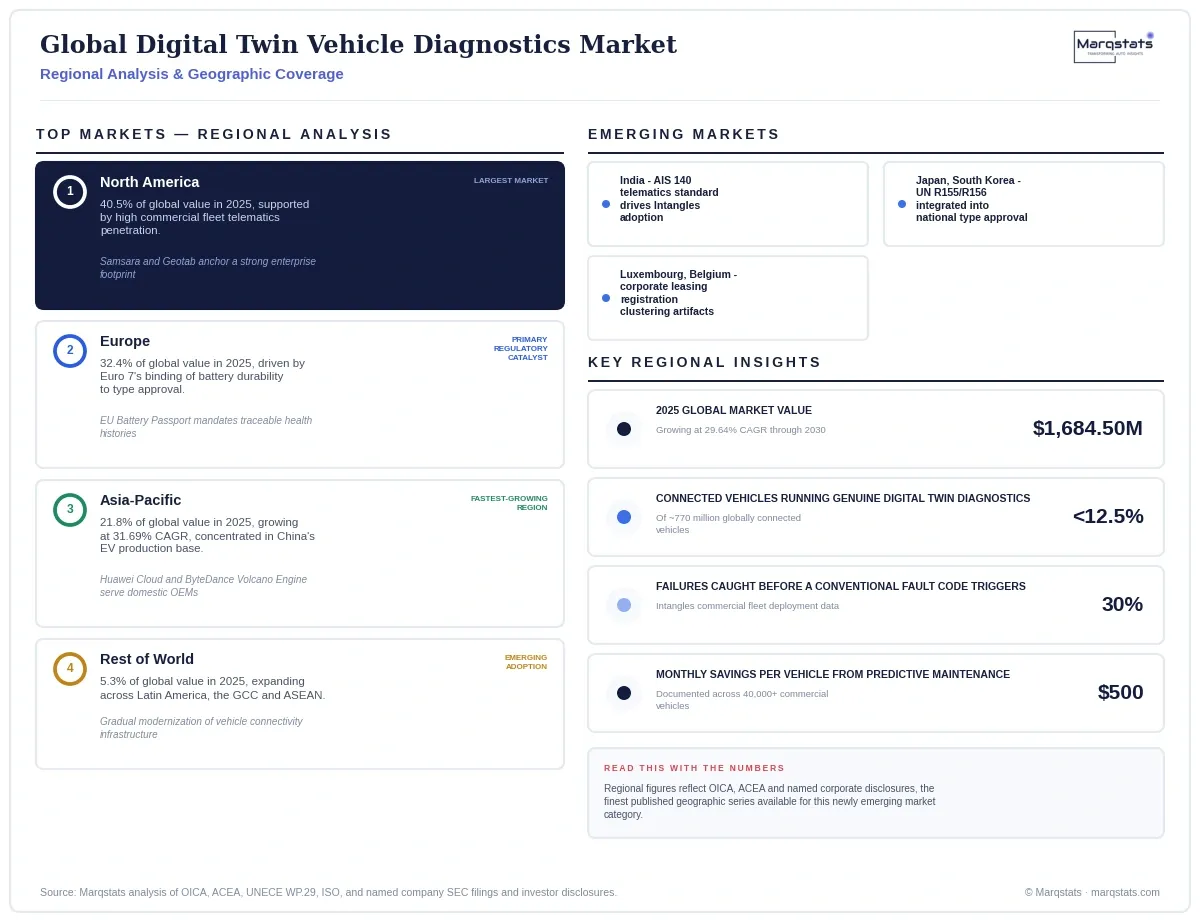
North America accounted for the largest share of the global digital twin vehicle diagnostics market in 2025, valued at $682.22 million (40.5% share), projected to reach $2,393.18 million by 2030 at a 28.54% compound annual growth rate, supported by high commercial fleet telematics penetration and long cross-country freight corridors where vehicle breakdown costs are acute, with fleet software providers Samsara and Geotab establishing strong regional footprints.
Europe
Europe represented the second-largest market in 2025, valued at $545.78 million (32.4% share), projected to expand to $2,084.78 million by 2030 at a 30.73% compound annual growth rate, serving as the primary regulatory catalyst for digital twin adoption globally through Euro 7's binding of battery durability directly to vehicle type approval and the EU Battery Passport mandate requiring traceable health histories for all traction batteries.
Asia-Pacific
Asia-Pacific represents the fastest-growing market, valued at $367.22 million (21.8% share) in 2025 and projected to reach $1,455.65 million by 2030 at a 31.69% compound annual growth rate, concentrated in China, the world's largest market for electric vehicle production, where domestic OEMs including BYD, Geely and SAIC incorporate cloud connectivity as standard equipment supported by regional cloud platforms including Huawei Cloud and ByteDance Volcano Engine.
Rest of World
The Rest of World region accounted for $89.28 million (5.3% share) in 2025, projected to reach $234.39 million by 2030 at a 21.29% compound annual growth rate, reflecting expanding fleet telematics adoption across Latin America, the Gulf Cooperation Council states and ASEAN markets as vehicle connectivity infrastructure gradually modernizes.
How Competition Is Evolving
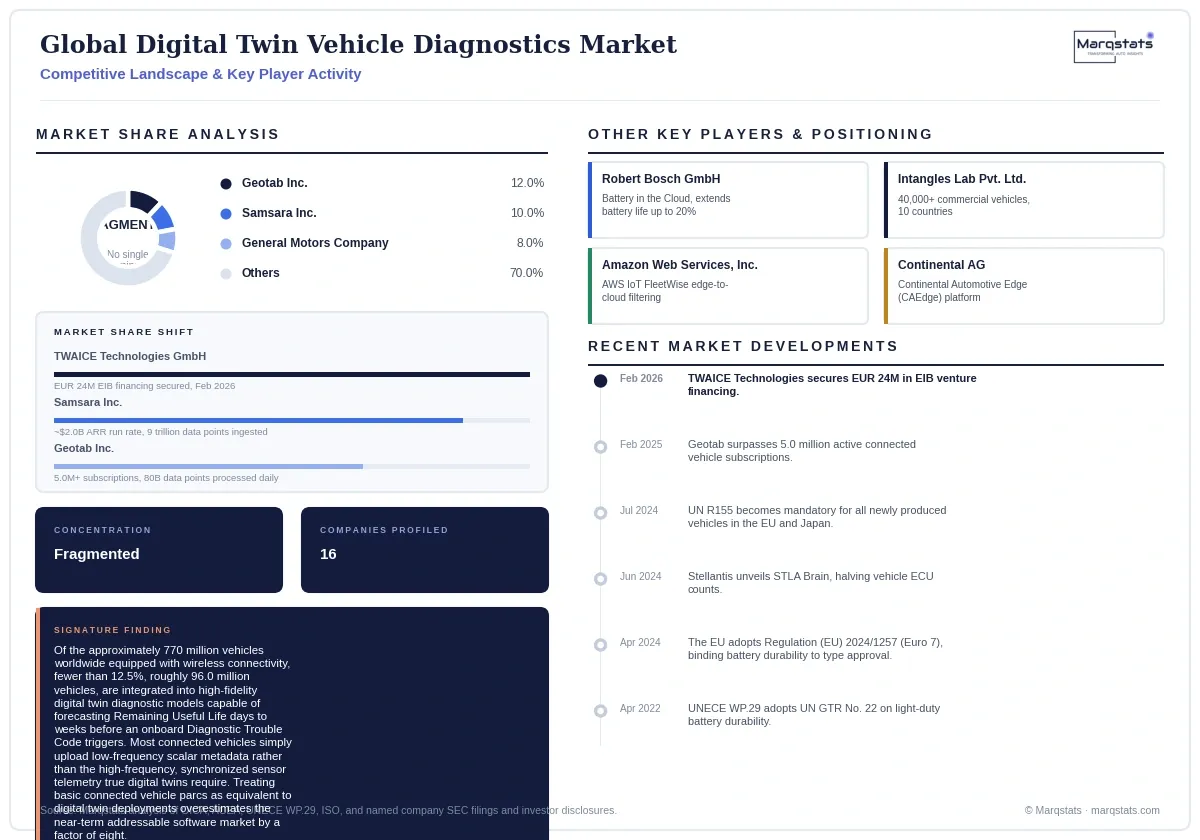
The global digital twin vehicle diagnostics market is fragmented across commercial fleet telematics specialists, automotive manufacturers and hyperscale cloud providers, with no single vendor commanding dominant share; Geotab Inc.'s 5.0 million active connected vehicle subscriptions, Samsara Inc.'s approximately $2.0 billion Annual Recurring Revenue run rate, and General Motors Company's 12 million OnStar subscribers illustrate the scale of participants competing across distinct segments of the value chain.
Firms compete differently by tier: commercial fleet telematics specialists compete on measurable total cost of ownership reduction and processing scale, exemplified by Geotab processing more than 80 billion operational telemetry data points daily, automotive OEMs compete on data monetization architecture, exemplified by Stellantis establishing Mobilisights as an independent data entity, and Tier-1 suppliers compete on standardized edge-to-cloud platform integration, exemplified by Continental AG's Continental Automotive Edge platform built atop AWS IoT FleetWise.
The most significant recent competitive-landscape development is TWAICE Technologies GmbH securing a EUR 24 million venture financing facility from the European Investment Bank in February 2026, earmarked to scale its battery digital twin analytics platform across Europe and North America, following the company's earlier $30 million Series B round and its analysis of more than 5 gigawatt-hours of battery capacity across OEM partnerships including Audi, Daimler and Hero Motors.
Companies Covered
The report profiles 16+ companies with full strategy and financials analysis, including:
Recent Market Activity
Table of Contents
Coverage & Segmentation
Coverage spans the global digital twin vehicle diagnostics market, encompassing recurring software licenses, platform subscriptions and edge-to-cloud diagnostic analytics deployed by automotive manufacturers, commercial fleet operators and aftermarket service providers to continuously evaluate dynamic component wear using physics-based and machine-learning models. The market is sized in USD across a 2021-2025 historical period and a 2026-2030 forecast period, with 2025 as the base year. Three segmentation dimensions are quantified: propulsion architecture, vehicle class, and deployment architecture.
Excluded from scope: telematics control units, microcontrollers and physical garage workshop equipment, basic connected telematics deployments limited to scalar diagnostic trouble code and GPS reporting without multi-physics simulation, and non-automotive industrial digital twin applications. A separate Marqstats study addresses the global connected car market on a comparable basis.