Market Snapshot
Key Takeaways
Market Overview & Analysis
Report Summary
This analysis sizes the Asia Pacific automotive digital twin synthesis software market, encompassing software licensing revenues, recurring software-as-a-service subscriptions, and high-performance compute-node runtime fees derived directly from automotive digital twin synthesis pipelines, spanning physics-based plant and behavioral co-simulation, generative environment and scenario synthesis, and synthetic sensor telemetry generation. The market is built from calibrated corporate financial disclosures from major industrial software vendors operating within the Asia Pacific theater, isolating the automotive digital twin synthesis segment from broader nominal geometry design suites. The market is sized in USD across a 2020-2024 historical period and a 2025-2030 forecast period, with 2024 as the base year.
The Asia Pacific automotive digital twin synthesis software market grew from USD 461.45 million in 2020 to USD 864.50 million in 2024, an 18.78% compound annual growth rate, and is projected to reach USD 2,427.88 million by 2030 at the same growth rate. This growth reflects a structural shift in software testing economics: because physical prototype verification consumes between 30% and 50% of total automotive electronic development budgets, original equipment manufacturers are shifting up to 85% of functional verification upstream into Software-in-the-Loop synthesis environments, virtualizing electronic control unit clusters and generating physics-grounded synthetic sensor data streams that reduce engineering cycle iterations from months to days.
The base-case 2030 forecast of USD 2,427.88 million assumes the measured continuation of national autonomous vehicle pilot initiatives, with China certifying 10 to 15 commercial Level 3 vehicle models by 2027 while Japan and South Korea expand automated driving along designated highway corridors, and on-premise enterprise clusters remaining the primary deployment model for Tier-1 suppliers. The binding upside condition, reaching USD 3,145.50 million at a 23.95% CAGR, is whether regional transport authorities including China's MIIT, Japan's MLIT and India's MoRTH formally mandate closed-loop virtual scenario testing as a statutory type-approval requirement, allowing synthetic certification to replace 50% of physical track testing; the binding downside condition, reaching only USD 1,785.20 million at a 12.84% CAGR, is whether regional geopolitical disputes and trade controls restrict high-performance automotive computing hardware, combined with heightened data localization regulations prohibiting the federation of synthetic testing pipelines across multinational engineering centers.
Market Dynamics
Key Drivers
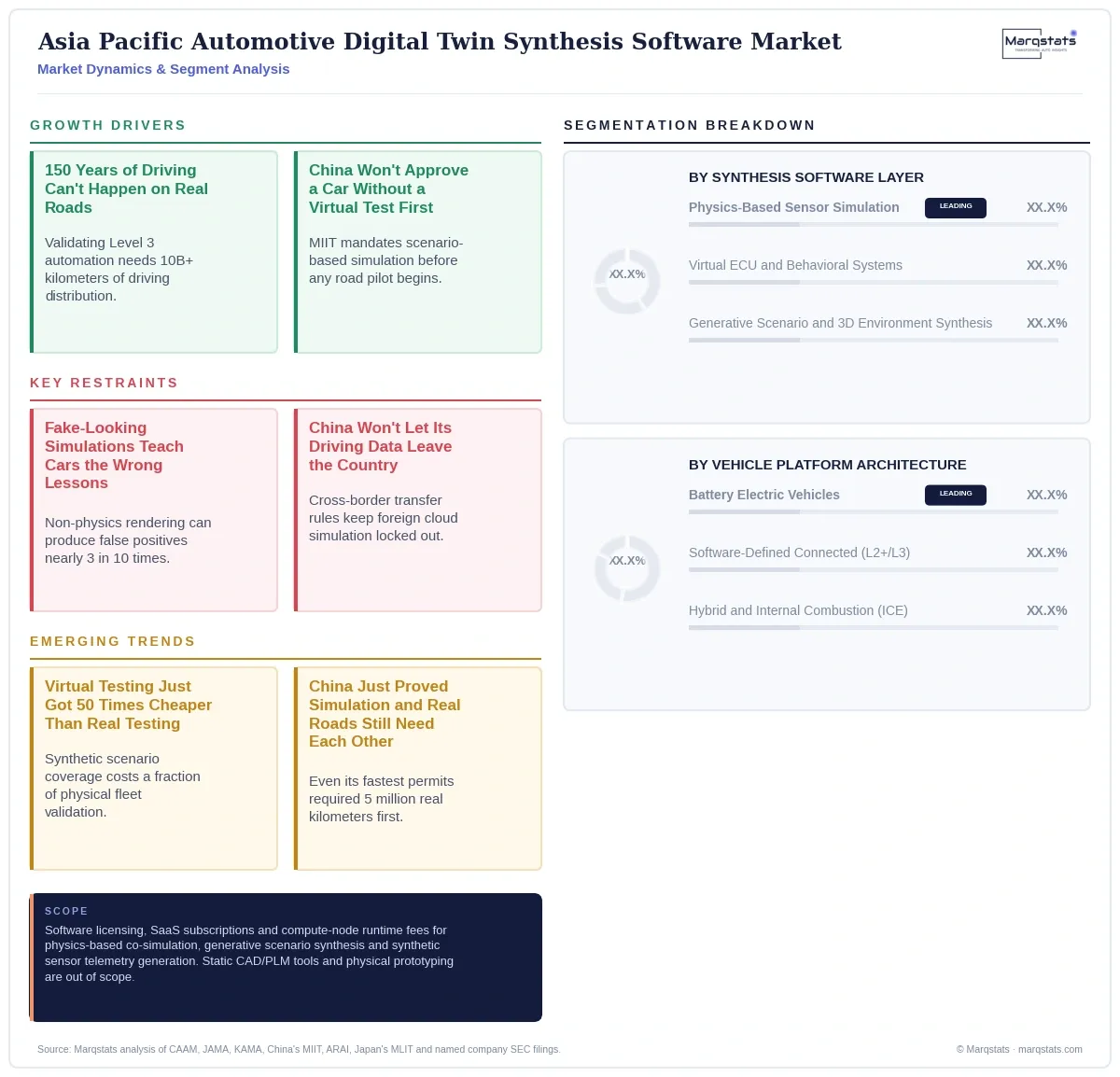
- Validating a Level 2+ or Level 3 autonomous system across required real-world driving distributions demands over 10 billion road kilometers, an operational task requiring a physical test fleet of 1,000 vehicles operating continuously for over 150 years, structurally compelling automakers toward synthetic scenario generation as the only commercially viable validation pathway.
- China's Ministry of Industry and Information Technology mandates comprehensive scenario-based verification for conditional Level 3 vehicle access permits, since physical proving grounds can evaluate fewer than 15% of complex edge cases without risking test hardware, forcing Tier-1 suppliers and OEMs to generate over 10 million procedural synthetic scenario variations per platform submission.
- Vehicle-level software sizes across China, Japan and South Korea are expanding from 100 million lines of code in basic connected architectures to over 300 million lines in software-defined, highly automated platforms, sustaining structural demand for Software-in-the-Loop synthesis environments capable of virtualizing consolidated electronic control unit clusters.
- Synopsys' USD 34.9 billion acquisition of Ansys marks the structural integration of silicon-level Electronic Design Automation and macro-scale automotive physics simulation, since centralized zonal vehicle computing requires simultaneous synthesis of semiconductor thermal profiles, on-chip communication buses and dynamic vehicle chassis behavior within a single unified toolchain.
- The Automotive Research Association of India has established dedicated virtual validation protocols under the AIS-185, AIS-186 and AIS-193 standards, requiring local automotive development programs to implement Software-in-the-Loop and Hardware-in-the-Loop digital twin toolchains to certify advanced safety features against India's dense, high-entropy traffic environments.
Key Restraints
- Purely graphical, gaming-engine-based simulation yields an unacceptably wide reality gap, generating up to 28% false-positive rates in perception algorithm training when compared with physical test track validation, requiring automakers to adopt deterministic, physics-based optical and radio-frequency solvers at substantially higher licensing cost than commodity rendering engines.
- Strict regulatory frameworks governing geospatial surveying and cross-border data transfers in China prevent foreign-hosted cloud simulation suites from ingesting Chinese driving logs, sustaining robust demand for localized private cloud deployments and preventing multinational engineering organizations from federating synthetic testing pipelines across borders.
- Historical road incident databases fail to cover 92% of safety-critical edge cases encountered by Level 3 operational design domains, meaning traditional open-loop replay of recorded road data cannot alone satisfy the scenario coverage regulators increasingly require, forcing continued investment in closed-loop synthetic generation capability regardless of existing recorded-data asset value.
- Widespread industry claims of 90% physical prototype elimination, traced to early academic hardware-in-the-loop experiments conducted in 2018, substantially overstate the empirical baseline savings actually observed across contemporary multi-physics vehicle programs, which range between 35% and 50%, creating a credibility gap between marketed and delivered digital twin synthesis return on investment.
Key Trends
- The total-cost-of-ownership gap between physical and synthetic validation, a cost differential exceeding 50 to 1 alongside a coverage improvement from under 8% to over 95%, represents a genuine structural economic advantage rather than a marginal efficiency gain, meaning the shift toward synthetic validation reflects rational capital allocation rather than a speculative technology bet.
- China's grant of the nation's first Level 3 commercial access permits to Changan and BAIC's Arcfox unit on 15 December 2025, following more than 5 million kilometers of real-world testing across 185 driving scenario categories, demonstrates that even China's aggressive regulatory timeline required extensive validation before commercial deployment, indicating synthetic and physical testing function as complements rather than pure substitutes in practice.
- The persistent 28% false-positive rate gap between purely graphical simulation and physics-based digital twin synthesis demonstrates that not all simulation investment delivers equivalent validation value, meaning automakers and Tier-1 suppliers evaluating vendors must distinguish rigorously between deterministic physics solvers and commodity rendering engines regardless of superficially similar marketing claims.
- The gap between widely cited 90% physical prototype elimination claims and the empirically observed 35% to 50% baseline savings range indicates that vendor and industry marketing materials have meaningfully overstated digital twin synthesis's realized return on investment, a discrepancy market participants should account for when evaluating procurement business cases.
- China's continued dominance at 50.00% of regional market value, despite India's markedly faster 27.88% compound annual growth rate, demonstrates that the region's automotive digital twin market remains structurally anchored to production scale and regulatory pace in the near term, even as capability is diversifying meaningfully toward India's engineering services sector.
Strategic Implications
For a specialized software entrant, developing generic computer-aided design or basic kinematic tools faces insurmountable competitive barriers against entrenched conglomerates; capital should instead target high-potential entry points including high-frequency radar multi-path solvers, solid-state LiDAR beam attenuation models, and generative scenario synthesis engines, while ensuring native support for open Functional Mock-up Interface and OpenSCENARIO standards and architecting software to run efficiently within localized on-premise high-performance computing clusters given data localization laws in China and South Korea.
For an incumbent industrial software provider, transitioning legacy desktop-bound engineering packages into distributed, cloud-native Software-in-the-Loop architectures is essential following major market consolidations including the Synopsys-Ansys merger and Siemens' acquisition of Altair; incumbents must connect silicon-level chip emulation tools with macro-scale vehicle dynamics simulators and modernize commercial licensing structures, moving away from rigid seat-based pricing toward value-based and compute-consumption models tied to core execution hours and generated scenario volumes.
For a Tier-1 automotive component supplier, establishing certified digital twin representations for all proprietary sensor, actuator and electronic control unit product lines is increasingly a precondition for winning business, since global original equipment manufacturers increasingly require component suppliers to provide verified virtual models compatible with Software-in-the-Loop co-simulation platforms during early platform bidding phases rather than accepting opaque physical component deliveries.
Outlook
Base scenario: USD 2,427.88 million by 2030 (18.78% six-year value CAGR). This trajectory assumes the measured continuation of national autonomous vehicle pilot initiatives, with China certifying 10 to 15 commercial Level 3 vehicle models by 2027 while Japan and South Korea expand automated driving along designated highway corridors, automotive OEMs transition electronic architectures toward centralized zonal computing at 15% to 20% annual license expansion, and on-premise enterprise clusters remain the primary deployment model for Tier-1 suppliers while hybrid sovereign cloud solutions expand proportionally.
Upside scenario: USD 3,145.50 million by 2030 (23.95% six-year value CAGR). The specific trigger is regional transport authorities, specifically China's MIIT, Japan's MLIT and India's MoRTH, formally mandating closed-loop virtual scenario testing as a statutory type-approval requirement, allowing synthetic certification to replace 50% of physical track testing, combined with cross-industry standardization around virtual electronic control unit compilers enabling automotive OEMs and Tier-1 suppliers to exchange secure, executable digital twins seamlessly across distributed supply chains.
Downside scenario: USD 1,785.20 million by 2030 (12.84% six-year value CAGR). The specific trigger is regional geopolitical disputes and trade controls leading to broader restrictions on high-performance automotive computing hardware, creating local hardware shortages that constrain large-scale parallel simulation capacity, combined with heightened data localization regulations prohibiting the federation of synthetic testing pipelines across multinational engineering centers and high-profile autonomous driving perception failures caused by synthetic training artifacts prompting regulatory authorities to slow virtual certification adoption.
Market Segmentation
Physics-based sensor simulation represents the largest functional segment at 41.00% of 2024 value (USD 354.45 million), driven by the rapid commoditization of Level 2+ driver assistance packages across mass-market vehicles in China and Japan, since autonomous driving engineering teams require continuous synthetic sensor data streams to train deep convolutional neural networks and transformer-based vision architectures.
Virtual electronic control unit and behavioral systems account for 32.00% of 2024 value (USD 276.64 million), underpinned by the transition toward centralized vehicle computing architectures, since consolidating distributed control modules into high-performance computing platforms requires Software-in-the-Loop environments that accurately reproduce microprocessor timing, bus communications and actuator plant dynamics without requiring physical prototype silicon.
Generative scenario and 3D environment synthesis represents the fastest-growing functional category at 27.00% of 2024 value (USD 233.41 million), as engineering teams deploy Neural Radiance Fields and generative AI to reconstruct real-world driving environments from fleet drive logs, converting raw sensor recordings directly into reusable, parametrically variable synthetic test scenarios.
Battery electric vehicles represent 53.00% of 2024 market revenue (USD 458.18 million), the largest vehicle platform segment, since the complex interdependencies governing lithium-ion battery electrochemistry, thermal management loops, regenerative braking blending and power inverter efficiency demand multi-physics digital twins to maximize driving range and ensure functional safety.
Software-defined connected vehicles equipped with Level 2+ and Level 3 automated driving systems represent 30.00% of 2024 value (USD 259.35 million), generating high-volume simulation workloads to validate safety-critical decision-making algorithms across dense urban driving scenarios characteristic of the region's major metropolitan centers.
Hybrid and legacy internal combustion platforms account for the remaining 17.00% of 2024 value (USD 146.97 million), focusing digital twin investment on emissions calibration and transmission software optimization rather than the perception and battery-centric workloads dominating the newer platform segments.
On-premise enterprise clusters remain heavily weighted at 58.00% of 2024 spend (USD 501.41 million), a footprint preserved by corporate intellectual property firewalls and national data protection regulations that restrict the hosting of proprietary vehicle CAD geometries and unreleased software code on multi-tenant cloud platforms.
Sovereign and hybrid cloud clusters represent 42.00% of 2024 spend (USD 363.09 million), growing rapidly as OEMs lease dynamic cloud compute nodes to run massive parallel virtual verification campaigns that exceed internal data center capacities, particularly for generative scenario synthesis and large-scale synthetic sensor generation workloads.
By Geography
China
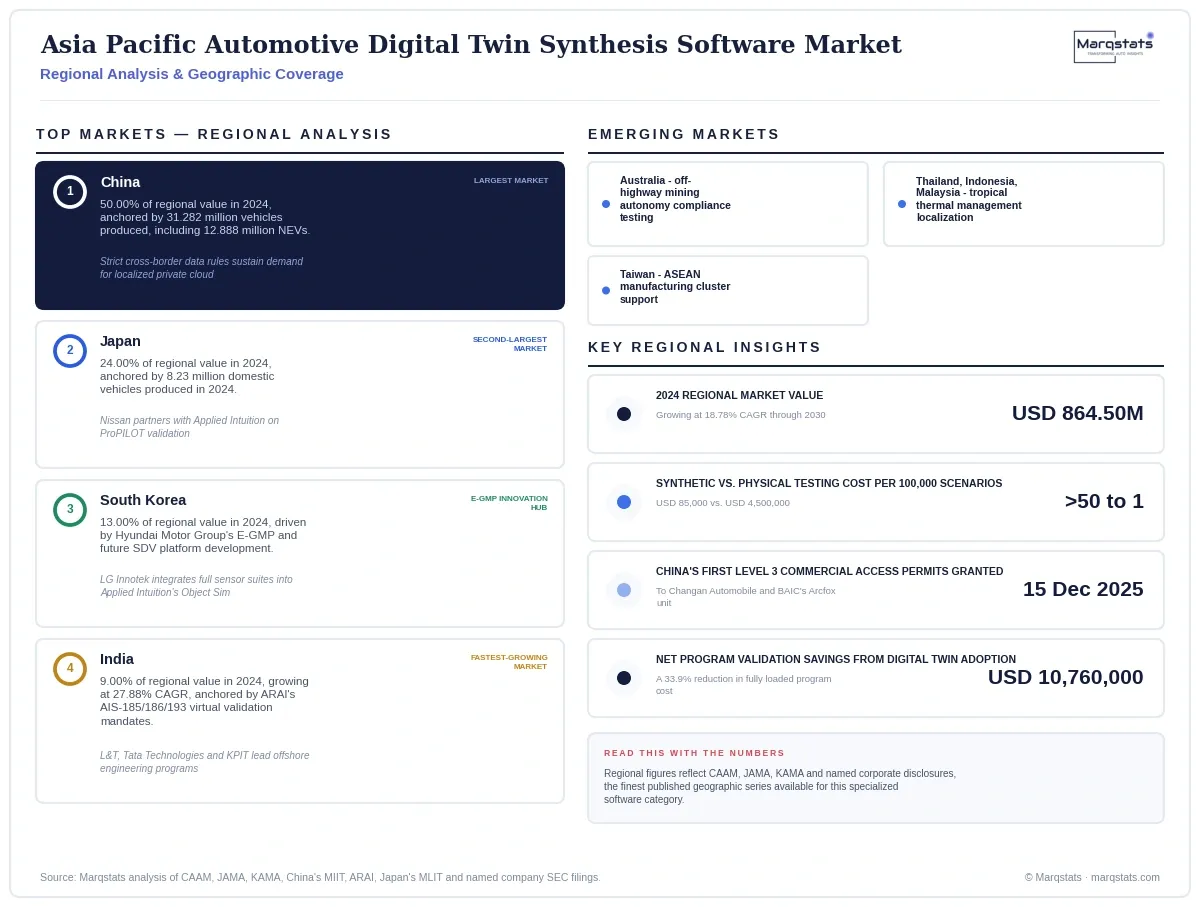
China represents the largest market, accounting for 50.00% of total regional software revenues (USD 432.25 million) in 2024, projected to reach USD 1,165.38 million by 2030 at a 17.98% compound annual growth rate. The China Association of Automobile Manufacturers confirmed domestic production reached 31.282 million units in 2024, with New Energy Vehicles exceeding 12.888 million units, while strict regulatory frameworks governing geospatial surveying and cross-border data transfers prevent foreign-hosted cloud suites from ingesting Chinese driving logs, sustaining robust demand for localized private cloud deployments.
Japan
Japan represents the second-largest market, generating USD 207.48 million (24.00% share) in 2024, projected to reach USD 510.85 million by 2030 at a 16.20% compound annual growth rate. The Japan Automobile Manufacturers Association recorded domestic motor vehicle production of 8.23 million units in 2024, and Japanese OEMs are shifting significant engineering capital toward Model-Based Systems Engineering and software-defined vehicle platforms, exemplified by Nissan's development partnership with Applied Intuition to validate its next-generation ProPILOT driver assistance system.
South Korea
South Korea accounted for USD 112.39 million (13.00% share) in 2024, projected to reach USD 291.35 million by 2030 at a 17.21% compound annual growth rate, driven by Hyundai Motor Group's accelerated development of its Electric-Global Modular Platform and future software-defined platforms. The Korea Automobile Manufacturers Association reported domestic manufacturing volumes of 3.76 million units in 2024, while major Tier-1 suppliers including Hyundai Mobis, HL Mando and LG Innotek integrate dynamic simulation environments into their hardware engineering workflows.
India
India generated USD 77.80 million (9.00% share) in 2024, the fastest-growing market in the region, projected to expand at a 27.88% compound annual growth rate to reach USD 339.90 million by 2030. The Automotive Research Association of India has implemented rigorous safety standards including AIS-185, AIS-186 and AIS-193 through its Intelligent Vehicle Technology Centre of Excellence, while global engineering service providers including L&T Technology Services, Tata Technologies and KPIT utilize digital twin synthesis toolchains to support offshore engineering programs for international vehicle manufacturers.
Rest of Asia Pacific
The Rest of Asia Pacific region accounted for USD 34.58 million (4.00% share) in 2024, covering Australia, Taiwan and ASEAN manufacturing clusters in Thailand, Indonesia and Malaysia. Australian demand focuses primarily on off-highway commercial mining autonomy and compliance testing aligned with Australian Design Rules, while ASEAN markets focus on localizing vehicle dynamics and thermal management systems for tropical operating environments.
How Competition Is Evolving
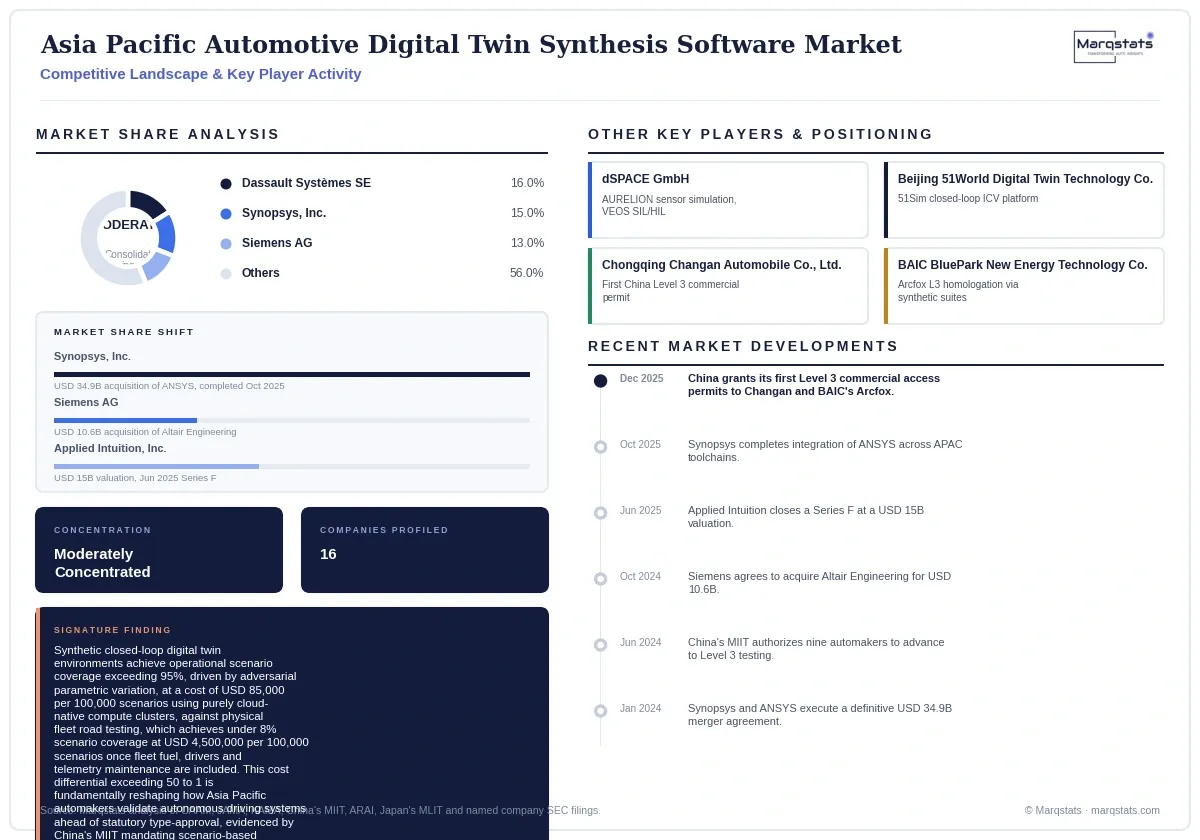
The Asia Pacific automotive digital twin synthesis software market is moderately concentrated following the recent global consolidation wave: Dassault Systèmes, Synopsys (incorporating Ansys), Siemens AG (incorporating Altair Engineering), and dSPACE GmbH together anchor a substantial share of regional enterprise engineering software revenue, while specialized providers including Applied Intuition and Beijing 51World Digital Twin Technology compete for high-margin generative scenario synthesis and autonomous driving simulation budgets.
Firms compete differently by tier: multi-domain conglomerates compete on delivering unified silicon-to-vehicle toolchains following the Synopsys-Ansys and Siemens-Altair integrations, Chinese domestic specialists including Beijing 51World compete on native compliance with China's data localization and sovereign cloud requirements, and pure-play scenario synthesis vendors including Applied Intuition and Foretellix compete on generative physical AI capability that commands premium licensing against legacy desktop-bound solvers.
The most significant recent competitive-landscape development is China's grant of the nation's first Level 3 commercial access permits to Changan Automobile and BAIC's Arcfox unit on 15 December 2025, following more than 5 million kilometers of real-world testing across 185 driving scenario categories, formally establishing virtual closed-loop simulation testing as an official regulatory prerequisite for commercial autonomous vehicle deployment across the region's largest automotive market.
Companies Covered
The report profiles 16+ companies with full strategy and financials analysis, including:
Recent Market Activity
Table of Contents
Coverage & Segmentation
Coverage spans the Asia Pacific automotive digital twin synthesis software market, encompassing software licensing revenues, recurring software-as-a-service subscriptions, and high-performance compute-node runtime fees derived from physics-based plant and behavioral co-simulation, generative environment and scenario synthesis, and synthetic sensor telemetry generation. The market is sized in USD across a 2020-2024 historical period and a 2025-2030 forecast period, with 2024 as the base year. Three segmentation dimensions are quantified: synthesis software layer, vehicle platform architecture, and deployment model.
Excluded from scope: traditional computer-aided design and product lifecycle management software that captures static geometry rather than dynamic behavioral synthesis, physical prototyping expenditures, downstream IT infrastructure hardware, and unbundled third-party engineering services. A separate Marqstats study addresses the global automotive digital twin synthesis software market on a comparable basis.