Market Snapshot
Key Takeaways
Market Overview & Analysis
Report Summary
This analysis sizes the European automotive digital twin synthesis software market, encompassing enterprise software license revenues, software-as-a-service subscriptions, and dedicated annual software maintenance and support contracts that synthesize, simulate and continuously validate multi-domain virtual vehicle representations. The market is built from reconciled primary financial disclosures from major European and international engineering software providers, calibrated against Verband der Automobilindustrie and European Automobile Manufacturers Association research and development benchmarks. The market is sized in USD across a 2020-2024 historical period and a 2025-2030 forecast period, with 2024 as the base year.
The European automotive digital twin synthesis software market grew from USD 545.20 million in 2020 to USD 1,280.50 million in 2024, and is projected to reach USD 4,772.10 million by 2030, a 24.50% compound annual growth rate. This growth reflects the transition of digital twin synthesis software from an ancillary computer-aided engineering validation utility into a core enterprise operating platform, as European automotive manufacturers execute a capital-intensive re-architecting of vehicle engineering toward centralized software-defined vehicles under acute operating margin pressure from high domestic energy costs, elevated engineering wages, and intensifying foreign competition.
The base-case 2030 forecast of USD 4,772.10 million assumes European OEMs adhere to established vehicle platform replacement roadmaps as centralized zonal computing architectures gradually cascade from premium implementations into mainstream B- and C-segment vehicles, with compliance to UNECE Regulations R155 and R156 becoming an integrated, predictable component of corporate software pipelines. The binding upside condition, reaching USD 5,752.40 million at a 28.45% CAGR, is whether European type-approval authorities formally amend vehicle certification procedures to permit virtual homologation runs as binding statutory proof for active safety, emissions compliance, and structural crashworthiness under Euro NCAP's 2026-2028 assessment protocols; the binding downside condition, reaching only USD 3,421.80 million at a 17.76% CAGR, is whether persistent structural stagnation in consumer electric vehicle adoption across Europe, coupled with intensified price competition from imported electric vehicles, compels OEMs to indefinitely prolong legacy ICE architectures and bifurcate R&D budgets across dual toolchains.
Market Dynamics
Key Drivers
- To avoid further platform retirements following the Porsche and Volkswagen precedents, European OEMs have embedded digital twin synthesis software into the core of their electrical and electronic development pipelines, synthesizing virtual electronic control units executing production code binaries within simulated in-vehicle networks to subject digital twins to automated penetration testing and cryptographic verification long before silicon fabrication.
- Euro NCAP's Virtual Testing Crashworthiness protocols increasingly supplement and, in designated test sequences, substitute calibrated finite element digital twins for physical barrier crash tests, requiring automotive safety engineering departments to transition from uncoupled structural finite element analysis runs to unified digital twin synthesis platforms integrating structural chassis deformation, sensor deployment triggers, and active restraint algorithms.
- The integration of the open VirtIO virtualization standard, illustrated by the Stellantis Virtual Engineering Workbench deployed in collaboration with Amazon Web Services and BlackBerry QNX, decouples vehicle application software from physical target hardware, reducing software validation cycle duration from months to days and enabling continuous, automated overnight regression testing across France, Germany and Italy.
- Catena-X, an industrial data space initiative developed under the European Gaia-X architecture, coordinates the sovereign interchange of operational data across European supply tiers, facilitating the secure return of operational sensor telemetry and in-use battery state-of-health data back into upstream engineering simulation models, establishing a closed feedback loop between operational vehicle twins and design synthesis engines.
- European OEMs are actively reclaiming control over their software and electrical and electronic architectures, shifting from historically outsourced Tier-1 black-box electronic control units toward vertically integrated software stacks developed in-house, requiring direct investment in comprehensive digital twin synthesis environments to orchestrate software components delivered across multi-tiered vendor chains.
Key Restraints
- European manufacturers face acute operating margin pressures stemming from high domestic energy costs, elevated engineering wages, slowing consumer adoption of battery-electric vehicles, and intensifying foreign competition, constraining the capital available for the very digital twin synthesis investments needed to compress development cycles and maintain regulatory compliance.
- Interoperability across disparate engineering simulation disciplines represents the central technical bottleneck in automotive digital twin deployment, requiring standardized mathematical, syntactical and spatial foundations under the ASAM OpenX family before synthesis engines across heterogeneous software toolchains can genuinely co-simulate scenarios without proprietary translation layers.
- Historically, European automotive manufacturers maintained strict on-premises data isolation to safeguard proprietary vehicle architectures and CAD surface definitions, and the computational demands of synthetic sensor generation and nightly software-in-the-loop regressions have forced an aggressive, sometimes contested migration toward hybrid and cloud-native simulation platforms.
- Modern vehicle platforms require the physical dynamics of the chassis, thermodynamic behavior of the battery pack, electromagnetic emissions of power inverters, and microsecond-level execution of embedded control code to be simulated within a unified digital thread, raising barriers to entry for early-stage software startups that must now build native interoperability with dominant platform backbones to secure commercial relevance.
Key Trends
- The forced discontinuation of established, high-margin European vehicle lines under UN Regulations No. 155 and No. 156 represents a genuinely severe and financially consequential regulatory event rather than a routine compliance transition: Porsche's own confirmation that retrofitting the 718 series would have consumed roughly half the budget required to design an entirely new model demonstrates that legacy architecture non-compliance carries costs comparable to a full platform redesign, not a minor engineering adjustment.
- The consolidation of computer-aided engineering around three landmark transactions, Siemens' acquisition of Altair, Synopsys' acquisition of Ansys, and Keysight's acquisition of ESI Group, mirrors the same competitive dynamic documented in the broader global automotive digital twin market, indicating European vendor consolidation is not an isolated regional phenomenon but part of a coordinated worldwide industry restructuring.
- Germany's outsized concentration of European automotive digital twin spending, anchored by Volkswagen Group's EUR 21.8 billion annual research and development budget ranking fifth among all global corporate R&D investors, demonstrates that regional market leadership in this sector tracks corporate R&D scale far more closely than national vehicle production volume alone.
- The cloud-native deployment migration from 54.0% to 67.0% of market share by 2030, despite European manufacturers' historically strict on-premises data isolation practices for proprietary vehicle architectures, indicates that the computational demands of modern synthesis workloads are overriding longstanding intellectual property security preferences across the industry.
- The market's own three-scenario framework discloses that European automotive digital twin software's growth trajectory depends more heavily on specific statutory decisions, whether European type-approval authorities formally codify virtual homologation as binding proof for safety and emissions compliance, than on underlying vehicle sales volume or general technology adoption curves alone.
Strategic Implications
For a specialized software startup or independent tool developer, marketing generic CAD modeling packages or uncoupled multi-body dynamics solvers against entrenched conglomerates faces insurmountable competitive barriers; new entrants should instead focus engineering resources on high-value computational friction points including physics-informed neural network surrogate models capable of replacing computationally intensive finite element analysis with low-latency inference models, while ensuring native compliance with ASAM OpenSCENARIO DSL v2.1/v2.2 and FMI 3.0 to function as modular nodes within broader Siemens, Dassault or hyperscaler cloud toolchains.
For an incumbent enterprise software conglomerate, particularly Siemens, Synopsys and Dassault Systèmes, transitioning from completing landmark acquisitions toward achieving deep, cross-disciplinary solver harmonization is essential, since marketing isolated per-seat perpetual licenses across uncoupled structural, electromagnetic, fluid and embedded software tools is incompatible with modern automotive development workflows; conglomerates must package unified silicon-to-cloud-to-vehicle toolchains through consumption-based subscription models while maintaining compliance with public open standards to alleviate OEM vendor lock-in concerns.
For a European automotive manufacturer or Tier-1 systems integrator, digital twin synthesis software must be re-evaluated as proprietary core engineering intellectual property rather than standard commoditized IT software; OEMs must establish enterprise-level Virtual Engineering Workbenches similar to architectures deployed by Stellantis and Mercedes-Benz, and procurement departments must formally mandate that Tier-1 suppliers deliver fully functional Level 3 virtual ECUs as a binding contractual prerequisite for component sourcing, eliminating opaque black-box physical controller deliveries.
Outlook
Base case (Progressive Architecture Convergence): USD 4,772.10 million by 2030 (24.50% six-year value CAGR). This trajectory assumes European OEMs adhere to established vehicle platform replacement roadmaps as centralized zonal computing architectures gradually cascade from premium implementations such as the Porsche PPE platform, Mercedes-Benz MB.OS and BMW Neue Klasse into mainstream B- and C-segment vehicles, with UNECE R155/R156 compliance becoming an integrated, predictable component of corporate software pipelines.
Upside case (Accelerated Virtual Homologation): USD 5,752.40 million by 2030 (28.45% six-year value CAGR). The specific trigger is European type-approval authorities formally amending vehicle certification procedures to permit virtual homologation runs as binding statutory proof for active safety, emissions compliance and structural crashworthiness, accelerated by Euro NCAP's 2026-2028 assessment protocols granting maximum safety score weighting to virtual Human Body Model simulation matrices that cannot be duplicated physically due to financial and ethical constraints.
Downside case (Fragmented Dual-Architecture): USD 3,421.80 million by 2030 (17.76% six-year value CAGR). The specific trigger is persistent structural stagnation in consumer electric vehicle adoption across Europe, coupled with intensified price competition from imported electric vehicles, compelling OEMs under severe operating margin compression to delay clean-sheet software-defined vehicle platform rollouts and extend the commercial lifecycle of existing internal combustion and hybrid architectures, forcing engineering departments to split diminishing R&D allocations between legacy physical testing maintenance and under-resourced virtual platform initiatives.
Market Segmentation
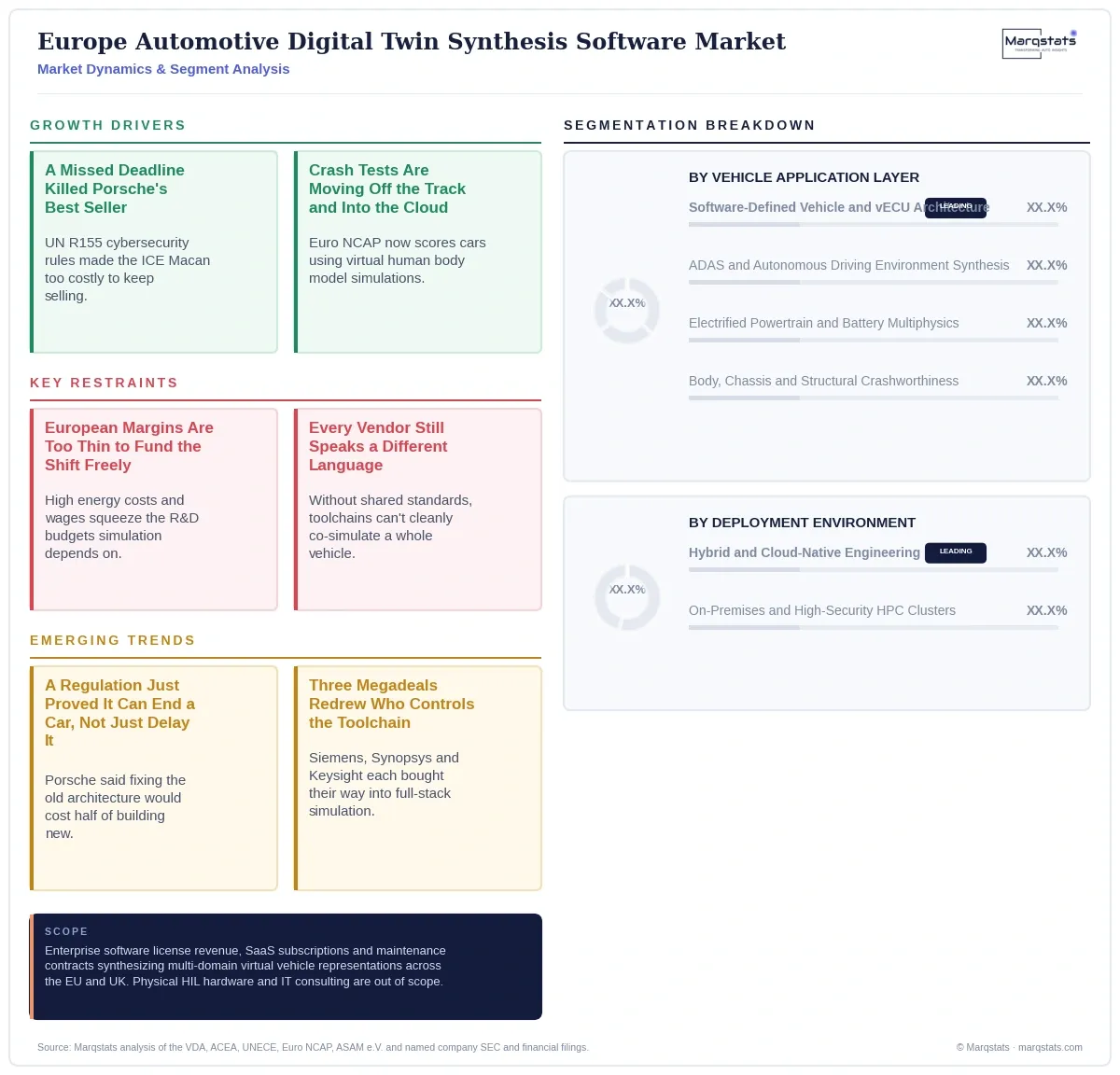
Software-defined vehicle and virtual ECU architecture constitutes the largest and fastest-growing discipline, expanding from 37.0% of total expenditure (USD 473.79 million) in 2024 to 41.0% (USD 1,956.56 million) by 2030, driven by the structural requirement to validate complex AUTOSAR and Linux-based software stacks across thousands of virtual integration branches prior to hardware tape-out.
ADAS and autonomous driving environment synthesis expands from 28.0% (USD 358.54 million) in 2024 to a 29.0% share (USD 1,383.91 million) by 2030, fueled by computational demand for synthetic scenario generation under ASAM OpenSCENARIO DSL standards to certify Level 2+ and Level 3 automation systems.
Electrified powertrain and battery multiphysics synthesis holds 21.0% (USD 268.91 million) of 2024 value, projected to reach USD 906.70 million by 2030 though contracting slightly to a 19.0% share as software-defined vehicle expenditure expands faster.
Body, chassis and structural crashworthiness modeling accounts for 14.0% (USD 179.27 million) in 2024, growing to USD 524.93 million by 2030 while contracting to an 11.0% share as foundational finite element analysis and one-dimensional simulation methodologies reach enterprise maturity.
Hybrid and cloud-native engineering deployment accounted for 54.0% (USD 691.47 million) of the 2024 European market, increasing to 67.0% (USD 3,197.31 million) by 2030, demonstrated by the Stellantis Virtual Engineering Workbench on Amazon Web Services, which enables engineering teams across France, Germany and Italy to run thousands of concurrent virtual cockpit simulations without on-premises hardware constraints.
On-premises and high-security HPC clusters held 46.0% (USD 589.03 million) of the 2024 market, declining to a 33.0% share (USD 1,574.79 million) by 2030, as computational demands of synthetic sensor generation and nightly software-in-the-loop regressions force an aggressive migration toward hybrid and cloud-native platforms despite historically strict on-premises intellectual property protection practices.
Automotive OEMs maintain the dominant procurement share, expanding from 52.0% (USD 665.86 million) in 2024 to 55.0% (USD 2,624.66 million) by 2030, as Volkswagen Group, BMW Group, Mercedes-Benz Group, Stellantis and Renault Group actively reclaim control over their software and electrical architectures, shifting from historically outsourced Tier-1 black-box ECUs toward vertically integrated software stacks developed in-house.
Tier-1 systems suppliers including Robert Bosch, Continental and ZF Friedrichshafen account for 34.0% (USD 435.37 million) of 2024 spend, projected to reach USD 1,527.07 million by 2030, deploying synthesis toolchains to validate subsystem integration ahead of physical handoff to vehicle manufacturers under increasingly stringent OEM digital mock-up compliance requirements.
Engineering service providers and labs, including Bertrandt, EDAG Engineering, FEV Group, AVL List and Applus IDIADA, constitute the remaining 14.0% (USD 179.27 million) of 2024 spend, reaching USD 620.37 million by 2030 as European OEM headquarters increasingly outsource intensive day-to-day validation scripting and automated test execution to specialized delivery centers.
By Geography
Germany
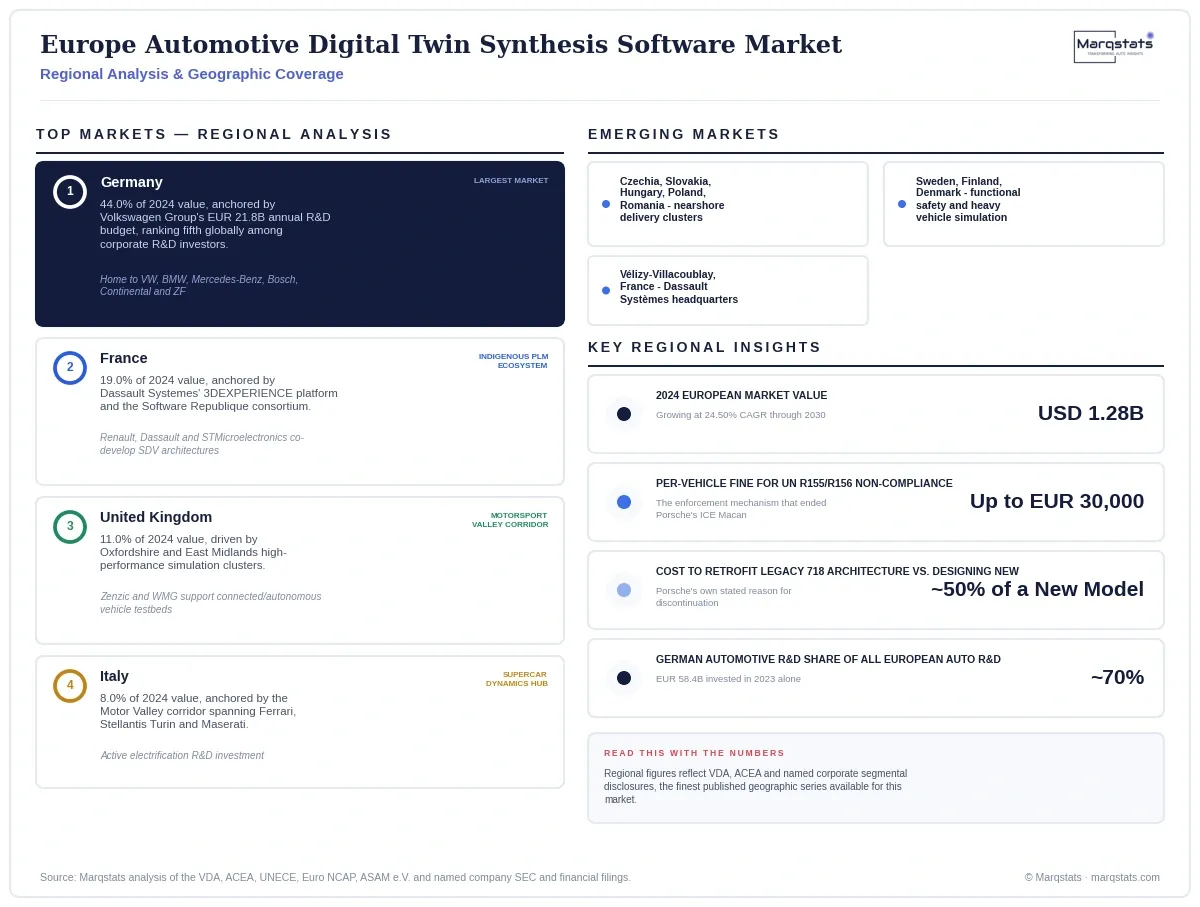
Germany represents the geographical center of the European market, commanding a 44.0% revenue share (USD 563.42 million) in 2024, anchored by Volkswagen Group's EUR 21.8 billion in annual research and development spending, ranking fifth among all global corporate R&D investors, alongside Mercedes-Benz Group, BMW Group and Tier-1 suppliers Robert Bosch, Continental and ZF Friedrichshafen.
France
France accounts for 19.0% (USD 243.30 million) of the European market in 2024, benefiting from an established indigenous software ecosystem anchored by Dassault Systèmes' 3DEXPERIENCE virtual twin backbone and Software République, an open innovation ecosystem established by Renault Group, Dassault Systèmes and STMicroelectronics to co-develop software-defined vehicle architectures.
United Kingdom
The United Kingdom accounts for 11.0% (USD 140.86 million) of European demand, driven by specialized computational engineering clusters, including the Motorsport Valley corridor across Oxfordshire and the East Midlands and sustained government support for connected and autonomous vehicle testing through institutions including Zenzic and the Warwick Manufacturing Group.
Italy
Italy holds 8.0% (USD 102.44 million) of 2024 value, anchored by the Motor Valley high-performance powertrain and supercar dynamics corridor spanning Ferrari, Stellantis Turin and Maserati, alongside active electrification research and development investment.
Nordics
The Nordics, spanning Sweden, Finland and Denmark, hold 7.0% (USD 89.64 million) of 2024 value, a pioneer in functional safety and heavy commercial vehicle simulation anchored by Volvo Group and Scania, with early adoption of cloud virtual ECU pipelines.
Rest of Europe (Central and Eastern Europe)
Rest of Europe, spanning the Czech Republic, Slovakia, Hungary, Poland and Romania, accounts for 11.0% (USD 140.86 million) of 2024 value, representing the fastest-growing engineering delivery region and supporting 11.5% of market value by 2030 through nearshore automotive software testing clusters housing essential Tier-1 technical development centers.
How Competition Is Evolving
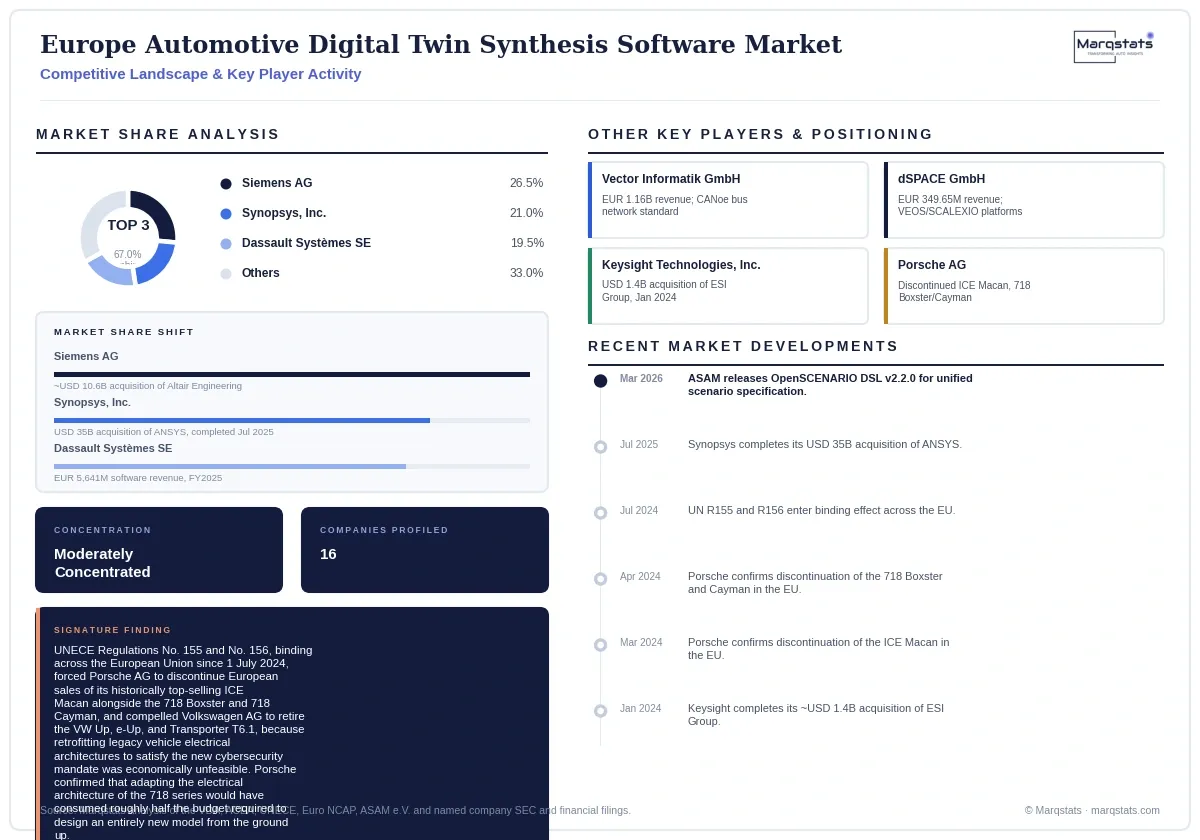
The European automotive digital twin synthesis software market is moderately concentrated, with the top three vendors, Siemens AG at an estimated 26.5% share, Synopsys, Inc. at 21.0%, and Dassault Systèmes SE at 19.5%, together commanding a combined 67.0% of European automotive digital twin revenue following the 2024-2025 consolidation wave, while Vector Informatik GmbH, reporting EUR 1.16 billion in worldwide 2023 revenue, and dSPACE GmbH, reporting EUR 349.65 million in 2024 revenue, retain substantial specialist niches in bus network simulation and virtual ECU execution respectively.
Firms compete differently by tier: multi-domain conglomerates compete on delivering unified silicon-to-cloud-to-vehicle toolchains, exemplified by Siemens' integration of Altair's RADIOSS solvers into Xcelerator and Synopsys' fusion of EDA leadership with Ansys multiphysics, while Dassault Systèmes SE, reporting non-IFRS software revenue of EUR 5,641 million in fiscal year 2025 with Europe accounting for 38% to 42% of that revenue, competes on comprehensive mechanical, thermal and manufacturing process virtual twin experiences leading European OEM PLM integration.
The most significant recent competitive-landscape development is the completion of three landmark transactions directly mirroring global industry consolidation: Siemens' approximately USD 10.6 billion acquisition of Altair Engineering, Synopsys' USD 35 billion acquisition of Ansys completed in July 2025, and Keysight Technologies' USD 1.4 billion acquisition of French virtual prototyping specialist ESI Group SA completed in January 2024 following a public tender offer valuing ESI Group's equity at EUR 155 per share.
Companies Covered
The report profiles 16+ companies with full strategy and financials analysis, including:
Recent Market Activity
Table of Contents
Coverage & Segmentation
Coverage spans the European automotive digital twin synthesis software market, encompassing enterprise software license revenues, software-as-a-service subscriptions, and dedicated annual software maintenance and support contracts across passenger and commercial vehicles in the European Union and the United Kingdom. The market is sized in USD across a 2020-2024 historical period and a 2025-2030 forecast period, with 2024 as the base year. Three segmentation dimensions are quantified: vehicle application layer, deployment environment, and end-user organizational hierarchy.
Excluded from scope: hardware revenue streams including physical hardware-in-the-loop enclosures, real-time processor boards, and general-purpose compute servers, alongside broad IT implementation consulting services. Physical prototype fabrication costs are addressed only as comparative context for digital twin synthesis unit economics. A separate Marqstats study addresses the global automotive digital twin synthesis software market on a comparable basis.