Market Snapshot
Key Takeaways
Market Overview & Analysis
Report Summary
The Europe residential EV charger market operates across four distinct product and deployment tiers that correspond to different housing types, regulatory contexts, and buyer profiles. The first tier is the single-family detached-home smart wallbox market — Level 2 AC chargers at 7 kW to 22 kW, app-connected, with time-of-use tariff scheduling and smart-grid responsiveness. This tier is the most mature segment, led by Germany (KfW-backed programme of up to 900,000 home charging points), the Netherlands (approximately 680,000 home charging points, RVO 2025 trend data), and Ireland (approximately 80% of EV charging sessions at home; three-quarters of Irish car owners have off-street parking). The second tier is the multi-dwelling unit (MDU), apartment, and collective-residential segment — shared charging infrastructure serving blocks of flats, condominiums, rented housing, and co-owned buildings. This is the fastest-growing regulatory focus: France's Advenir programme had crossed 100,000 funded charge points by 2022 including nearly 15,000 in collective residential; the UK's EV chargepoint grant specifically targets flats and renters; and Spain's MOVES III supports up to 70–80% of installation cost in private residential applications.
The third tier is the energy-managed and solar-integrated home charger segment — chargers with dynamic load balancing, home-solar production awareness, and whole-home energy management, typified by VW Group's Elli Charger 2 (launched 2024, capable of cutting charging costs up to 40% using solar energy and off-peak pricing with dynamic load management), Enphase IQ EV Charger 2, and Wallbox's Pulsar Plus with myWallbox energy platform. This segment is growing as European solar PV installations reach record levels and as utility-managed smart-charging programmes multiply. The fourth tier is bidirectional V2H and V2G residential charging — still early in commercial rollout in Europe but accelerating, with VW Group's Elli subsidiary explicitly investing in industrial energy storage (project pipeline of up to 350 MW / 700 MWh) alongside residential smart charging as part of an integrated home-grid energy strategy.
Europe's residential EV charger market is characterised by wide national heterogeneity in incentive structures, housing form, EV penetration, and regulatory implementation pace. Norway leads globally with 94% BEV share in October 2024 new-car registrations, but its unique tax exemptions (BEVs below NOK 500,000 exempt from 25% VAT) make its market conditions non-transferable. Denmark achieved 62% BEV market share in October 2024 with sustained government investment in incentives and infrastructure. Belgium saw 78% of new BEV registrations in Flanders in H1 2024, driven by leasing company activity and regional bonuses up to €40,000. Germany experienced a 37% BEV registration decline in July 2024 following removal of purchase incentives — the clearest demonstration that the European residential charger market's growth is highly sensitive to consumer incentive policy stability. Sweden and Ireland both registered declining BEV sales in 2024 following incentive reductions, before recovering with new policy measures in 2025. The Irish government's Budget 2025 specifically introduced a BIK exemption for home EV chargers as a corrective measure.
Market Dynamics
Key Drivers
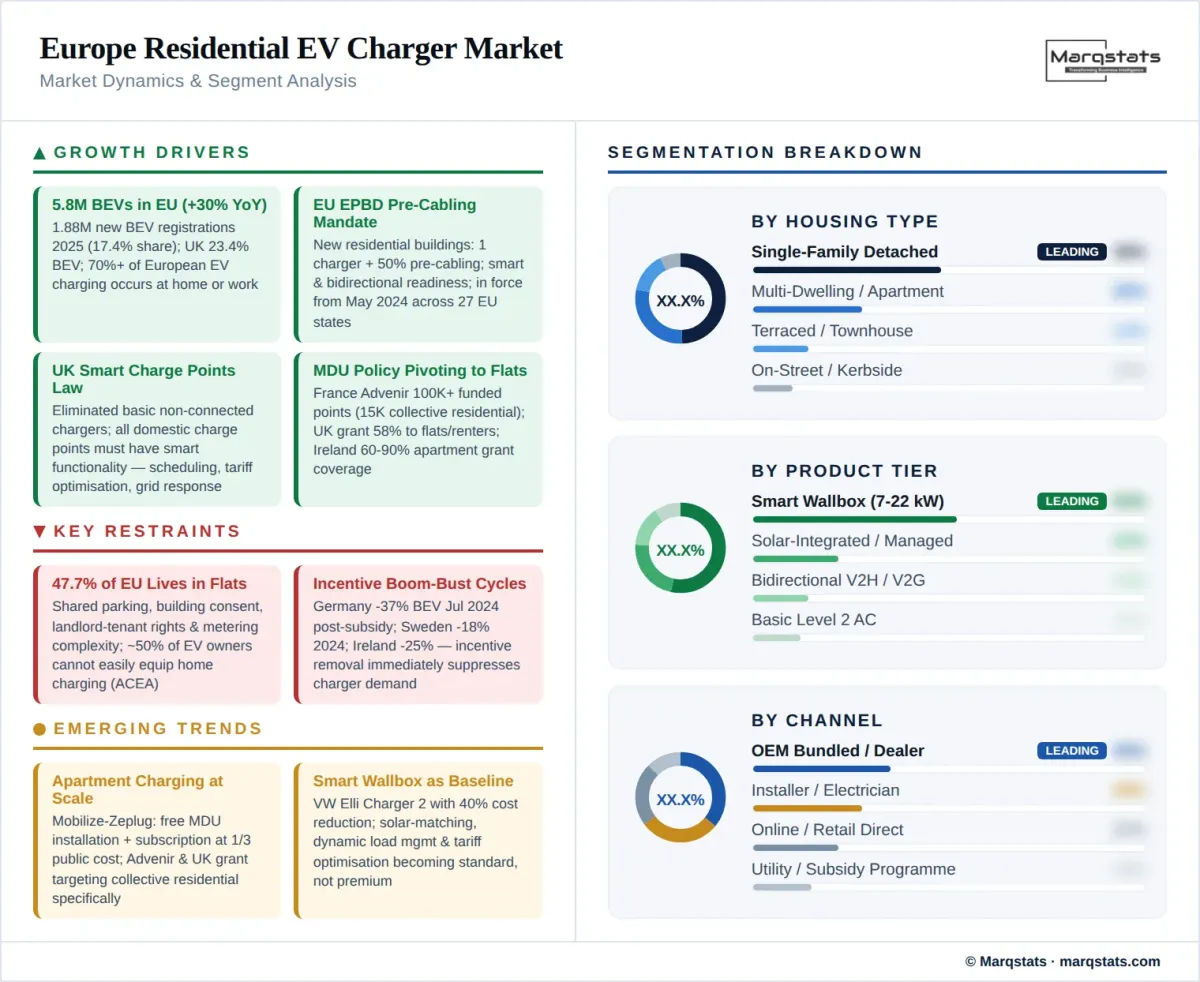
- Rapidly expanding EU and UK BEV installed base driving mandatory residential charging demand: ACEA reported 1,880,370 new BEV registrations in the EU in 2025 (17.4% share), adding to an installed fleet of approximately 5.8 million BEVs at end-2024, a 30% year-over-year increase per Eurostat. The UK registered 23.4% BEV share in 2025. Each new BEV sold to a household with private parking generates near-automatic residential charger demand, and the addressable pool continues to grow at multi-hundred-thousand-unit annual increments. EAFO's data that over 70% of European EV recharging occurs at home or work makes the residential segment structurally linked to EV penetration in a direct and durable way.
- EU EPBD building pre-cabling mandates creating structural multi-decade demand: The recast EU EPBD, in force from 28 May 2024, requires at least one recharging point and pre-cabling for at least 50% of parking spaces in new residential buildings with more than three spaces, with smart-charging and bidirectional-readiness requirements. Member states must also simplify installation procedures in existing residential buildings, including co-owned buildings and landlord-tenant situations. This regulatory requirement embeds EV-readiness as a standard feature of new European residential construction, creating a regulation-driven demand stream for compliant smart wallboxes and MDU systems that endures independently of any individual consumer incentive scheme.
- National subsidy programmes maintaining positive purchasing economics across major markets: Germany's KfW-backed residential charging programme received applications for approximately one million home charging points, with 175,000+ already funded, and offers employees €70 per month tax-free for home charging. France's home-charger tax credit was raised to €500, reduced VAT applies to installation, and apartment charging grants cover up to 50% of installation cost (capped at €5,000). Spain's MOVES III covers up to 70% (80% in small municipalities) of private residential charging infrastructure costs. Ireland's home-charger grant provides up to €300 plus a separate apartment charging grant covering 60–90% of eligible costs. The UK's EV chargepoint grant has funded 20,654 sockets worth £15.1 million since programme launch. These stacked national support frameworks collectively maintain residential charger adoption economics substantially below unsubsidised market cost.
- Electricity-cost optimisation driving upgrade to smart and solar-integrated chargers: Europe's high retail electricity prices — particularly in Germany, Denmark, and the UK — create strong ROI incentives for smart-charging systems that schedule EV charging to off-peak low-tariff periods or align it with rooftop solar generation. VW Group's Elli Charger 2, specifically marketed as cutting charging costs up to 40% using solar energy and off-peak pricing with dynamic load management and cost transparency, directly addresses this demand driver. Ireland's EV Infrastructure Strategy explicitly references smart charging as necessary to manage grid load, particularly as EV numbers grow and home-charging sessions increase.
- On-street and no-driveway residential charging emerging as a commercially investable infrastructure category: Vauxhall's August 2024 demand mapping across 11,500 UK streets, revealing that 40% of UK households lack driveways and 80% of EV charging occurs at home, and 56.5% of 267 surveyed local authorities still lack an on-street residential charging strategy, quantifies the structural gap in residential charging access for non-driveway urban households. Believ's June 2025 GBP 300 million investment facility — specifically earmarked in significant part for residential street chargers for drivers without private parking — demonstrates that this gap has crossed from a policy problem to a commercially fundable infrastructure asset category.
Key Restraints
- Apartment and flat dweller market structurally harder to serve than single-family homes: Eurostat's data showing 47.7% of EU citizens in flats, and ACEA's estimate that approximately 50% of current EV owners cannot easily equip their home with charging, reflects a genuine physical and legal constraint. Shared parking, building consent requirements, cost allocation between residents, landlord-tenant rights conflicts, and metering complexity all create installation friction that no subsidy alone fully resolves. The French Advenir programme, the UK EV chargepoint grant's flat-targeting mechanism, and Spain's MOVES III are all policy responses to this barrier, but the fundamental complexity of MDU charging installation remains a structural growth constraint.
- Incentive volatility creating boom-bust EV adoption cycles that disrupt residential charger demand: Germany's 37% BEV registration decline in July 2024 following subsidy removal, Sweden's 18% BEV sales decline in 2024 after climate bonus removal, and Ireland's 25% year-to-date BEV decline to October 2024 all demonstrate how sensitive European residential charger demand is to incentive policy continuity. The home-charger market is downstream of EV adoption, so incentive reversals at the vehicle level immediately suppress residential charger installation volumes, creating planning uncertainty for manufacturers, installer networks, and infrastructure fund investors.
- Grid capacity and peak-load management constraining high-density residential charging rollout: Ireland's EV Infrastructure Strategy explicitly notes the need to manage peak loads as home-charging sessions multiply. Germany's grid operator data shows significant renewable generation curtailment due to inadequate storage, which the VW Group Elli subsidiary's industrial storage project pipeline (up to 350 MW) is partly designed to address. As residential EV charger penetration in urban areas reaches meaningful density, local grid constraints — rather than consumer willingness — become the binding constraint on deployment speed, requiring smart-charging management, demand response integration, and local grid reinforcement investment.
Key Trends
- Collective-residential and apartment charging moving from pilot to mainstream investment: France's Advenir programme exceeding 100,000 funded charge points (including 15,000 in collective residential), the UK EV chargepoint grant directing 58% of funded sockets to flats and renters, and Ireland's separate apartment charging grant covering 60–90% of costs collectively signal that Europe's residential charging policy has already made the pivot from detached homes to shared buildings. The commercial industry is following: Mobilize's partnership with Zeplug in France — free infrastructure installation in residential buildings with individual resident subscriptions at one-third the cost of public charging — is the clearest commercial model for the apartment-charging market at scale.
- Smart wallbox market standardising on grid-interactive, solar-aware, and tariff-optimising functionality: The EU EPBD's smart-charging readiness requirements for new residential buildings, combined with the proliferation of time-of-use electricity tariffs across Europe, is pushing the residential charger market toward a universal smart baseline. Products positioned purely on charging speed or hardware reliability are being commoditised; value is migrating to scheduling intelligence, solar matching, dynamic load management, and OEM vehicle-ecosystem integration. VW Group's Elli Charger 2's 40% cost-reduction claim via solar and off-peak optimisation, and Wallbox's Supernova DC fast charger's CTEP-certified integration with solar and battery storage in the ENSOL partnership, both reflect this value migration.
- Spain emerging as Europe's residential EV charger manufacturing hub with global export ambition: AEDIVE's 2024 data showing Spain manufactured 326,000 charging points generating €332 million in revenue and exported 291,000 units (89% of production) represents a supply-side development of strategic significance. Spain's combination of strong domestic MOVES III demand, growing industrial base for AC charger production (305,000 AC units in 2024), competitive labour costs, and EU single-market access positions it as a major European charger export platform — with direct implications for pricing dynamics in residential charger markets across northern and central Europe.
- V2G and home energy storage integration positioning residential chargers as grid-flexible assets: VW Group's Elli subsidiary's entry into industrial energy storage (up to 350 MW / 700 MWh project pipeline) alongside its smart residential charger business reflects a European industry trend where EV charging is being designed as one node in a coordinated home-and-grid energy architecture. Germany's 2023 renewable curtailment of 10,500 GWh — equivalent to powering 3.2 million EVs for a year — creates a direct policy rationale for V2G residential chargers as demand-response assets that absorb surplus renewable generation and return it to the grid during peak periods.
Market Segmentation
Single-family homes with dedicated parking represent the most commercially mature residential charger segment in Europe, particularly in Germany, the Netherlands, Ireland, and the UK's suburban and rural areas. Germany's KfW data showing 43% of German households with parking suitable for home charging, combined with 54% of German EV charging events occurring at home, confirms that the private-driveway segment has already reached high penetration in accessible households. The Netherlands' approximately 680,000 home charging points installed, supported by RVO subsidy schemes and 79% of Dutch citizens living in houses (Eurostat), makes it Europe's most penetrated single-family home charging market on a per-EV-owner basis. This segment is shifting from basic Level 2 AC wallbox hardware toward smart, solar-integrated, and V2H-capable products as the initial generation of charger hardware reaches replacement age.
MDU and collective-residential charging is the fastest-growing and most policy-targeted deployment segment, reflecting the fundamental housing-stock challenge that Eurostat's 47.7% EU flat-dwelling population represents for residential EV charging. France's Advenir programme — which had funded over 100,000 charge points by 2022 including nearly 15,000 in collective residential — is Europe's most advanced collective-residential charging support programme by funded-unit volume. The programme's model, paying up to 50% of installation cost (capped at €5,000) for apartment building charging infrastructure, has been complemented by Mobilize's partnership with Zeplug providing free infrastructure installation with individual resident subscription pricing at one-third of public charging rates. The UK's EV chargepoint grant specifically targeting flats and renters (12,012 of 20,654 funded sockets, or 58%) provides the clearest quantitative evidence that the European residential charger policy has already made the transition from homeowner-led to renter-and-apartment-led investment.
On-street residential charging — public charge points installed on residential streets to serve EV owners without private parking access — is an emerging residential charging sub-segment that is moving from local authority pilot projects to commercially funded infrastructure programmes. Vauxhall's August 2024 demand mapping identified requests for on-street charging from motorists on over 11,500 UK streets, with 40% of UK households lacking driveways and only 43.5% of surveyed local authorities having on-street residential charging strategies. Believ's GBP 300 million investment facility, specifically prioritising residential street chargers for no-driveway households alongside rapid charging hubs and rural access, represents the market's transition from local authority grant-funded installations to private-sector infrastructure fund deployment at national scale. Ireland's national road EV charging plan also explicitly includes residential neighbourhood charging as a distinct infrastructure category.
Smart Level 2 AC wallboxes account for the dominant share of European residential charger installations by unit volume and revenue. This segment is directly shaped by the UK Smart Charge Points Regulations (mandating smart functionality for all domestic charge points in Great Britain) and the EU EPBD's smart-charging readiness requirements. Key products include VW Group Elli Charger 2 (dynamic load management, solar and off-peak integration, cost transparency), Wallbox Pulsar Plus with myWallbox energy platform, ChargePoint Home Flex (J1772 and NACS dual connector for markets with vehicle-standard diversity), and national-brand equivalents from Schneider Electric, Alfen, and ABB across European installer networks. Spain's AEDIVE data showing 305,000 AC chargers produced domestically in 2024 confirms the scale of European AC wallbox manufacturing.
Energy-managed residential chargers — which dynamically coordinate with home solar generation, battery storage, and whole-home electrical load — are the fastest-growing value segment within the European smart-charger market. VW Group's Elli Charger 2, marketed as capable of reducing residential EV charging costs by up to 40% through solar energy and off-peak scheduling with dynamic load management, represents the mainstream OEM-channel entry into this segment. Enphase IQ EV Charger 2 serves the solar-storage-EV-charging integrated household in Europe, while Wallbox's partnership with ENSOL in the US demonstrates how solar integration is becoming a defining commercial feature of premium residential charger products globally. As European residential solar PV installations continue to grow, energy-managed chargers will progressively displace pure-scheduling smart chargers in new installations at premium price points.
By Geography
Germany
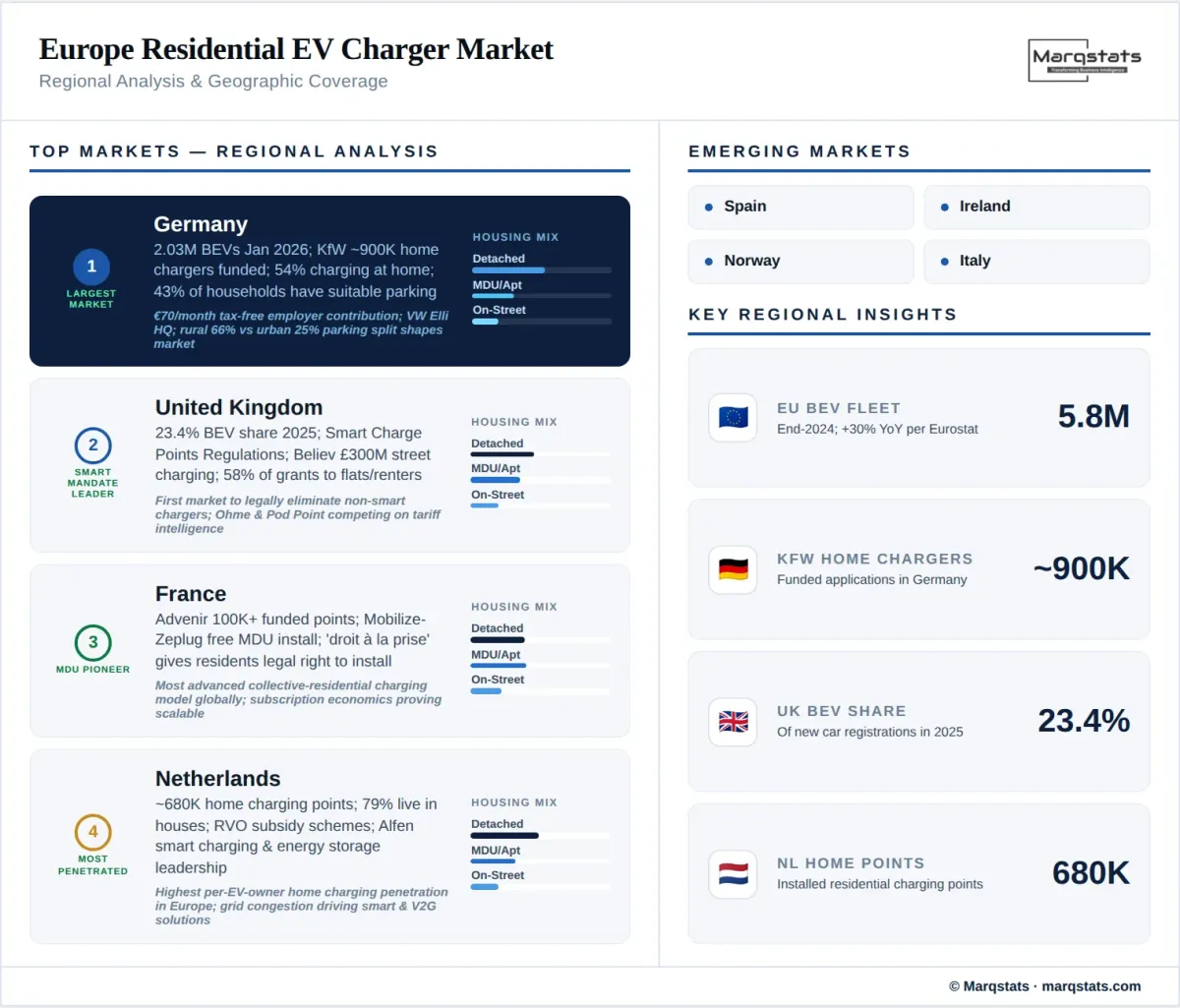
Germany is Europe's largest residential EV charger market by installed base and programme pipeline, anchored by 2,034,260 BEV passenger cars on German roads as of 1 January 2026 (EAFO). KfW's residential charging support programme received applications for approximately one million home charging points, with more than 175,000 already in operation and roughly 900,000 expected overall — making it the continent's largest single residential charger grant programme by volume. KfW data show 54% of German EV charging events occur at home, and 43% of German households have parking suitable for a charging point. However, the rural-urban split is structurally significant: approximately two-thirds of rural households versus only 25% of large-city households have suitable private parking, defining the geographic segmentation of Germany's residential charger market. The 37% BEV registration decline in July 2024 following subsidy removal also demonstrated Germany's market sensitivity to incentive policy — recovery in 2025 came partly through company-car tax write-off improvements (EVs up to €95,000 qualifying) and the retention of the €70/month tax-free employer contribution toward home charging. VW Group's Elli subsidiary's entry into industrial energy storage (up to 350 MW / 700 MWh project pipeline) alongside its Elli Charger 2 smart residential product positions Germany's largest automotive group as a home-grid energy services player as well as a charger hardware manufacturer.
France
France is Europe's strongest market for the collective-residential and apartment-building charging segment, driven by urban density, apartment-dominant housing stock, and a well-developed public subsidy architecture for multi-dwelling charging. EAFO reports France had approximately 1,663,365 BEVs and 852,749 PHEVs at end-2025, a combined electrified fleet of over 2.5 million. The Advenir programme had funded over 100,000 charge points by 2022 including nearly 15,000 in collective residential buildings — the clearest European example of a policy that successfully addressed the apartment-charging access gap at scale. The French home-charger tax credit was raised from €300 to €500, reduced VAT applies to residential charger installation, and apartment building grants cover up to 50% of installation costs (capped at €5,000). Mobilize's May 2025 partnership with Zeplug — providing free infrastructure installation in residential buildings with individual subscriptions at one-third the cost of public charging, plus a free one-year subscription for new Renault and Alpine buyers — directly addresses the French residential apartment market's primary adoption barrier: the upfront installation cost that deters individual residents from initiating shared-building charging projects.
Netherlands
The Netherlands is Europe's most mature blended residential-public EV charging ecosystem, with an approximately 680,000 home charging points and approximately 135,000 workplace charging points supplementing a public network of over 200,000 accessible points (RVO 2025 trend report, EAFO Netherlands data). The country ended 2025 with just over 209,000 publicly accessible charging points, while its home-charging installed base is the highest per-EV-owner ratio in Europe outside Norway. Eurostat data showing 79% of Dutch citizens living in houses (the highest house-dwelling rate among major EU EV markets) means the Netherlands has the most favourable housing-form profile for private-driveway residential charging in continental Europe. Despite this structural advantage, the Netherlands faces the same pricing challenges as other markets: 71% of Dutch consumers find EVs too expensive, and fiscal uncertainty has moderated sales growth in 2024. The Dutch government's future BEV policy trajectory will be critical to whether the residential charger market sustains its installed-base growth rate through 2030.
United Kingdom
The UK is Europe's most important market for the renter, flat-dweller, and no-driveway residential charging segment, both by policy focus and by commercial investment scale. As of 1 April 2025, the UK's EV chargepoint grant had supported 20,654 sockets worth £15.1 million — with 12,012 sockets (58%) specifically for flats and renters, making this the first major European grant programme where the apartment-and-renter segment exceeds the detached-home segment in funded units. BEVs reached 23.4% of UK new-car registrations in 2025, while Vauxhall's demand mapping identified requests for on-street residential charging from over 11,500 UK streets, with 40% of UK households lacking driveways. Believ's GBP 300 million investment facility (June 2025), led by Liberty Global and Zouk Capital alongside Santander, ABN Amro, NatWest, and MUFG, with explicit prioritisation of residential street chargers for no-driveway drivers, rural and underserved areas, and rapid charging hubs, represents the largest single private infrastructure commitment to UK residential-adjacent charging to date. Ireland's Budget 2025 BIK exemption for home EV chargers and separate apartment charging grant (60–90% of eligible costs) provide the clearest comparative evidence of how European governments are extending residential charger support from homeowners toward renters and flat owners.
Spain
Spain occupies a unique dual position in Europe's residential EV charger market — as both a growing domestic demand market and the continent's dominant charger manufacturing and export platform. AEDIVE's 2024 production data showing 326,000 charging points manufactured (305,000 AC, 21,000 DC) generating €332 million in revenue and 291,000 units exported (89% of production) establishes Spain as Europe's leading EV charger manufacturer by volume, with production scale that exceeds domestic residential installation demand by a factor of approximately eight to ten. Spain's MOVES III national subsidy programme covers up to 70% of eligible residential charging infrastructure cost for private individuals (80% in municipalities under 5,000 inhabitants), providing a strong domestic demand foundation alongside the export business. Wallbox, headquartered in Barcelona, is the most globally recognised European pure-play residential and commercial EV charger brand, with its Quasar 2 bidirectional V2H/V2G charger and Supernova DC fast charger defining the premium segment of Europe's smart residential charger market. Wallbox's March 2025 CTEP California certification for the Supernova and its ENSOL deployment across Texas, Florida, and Georgia underscore how Spain-based charger manufacturing is serving not just European but North American residential and semi-commercial charging markets.
Nordics — Norway, Denmark, Sweden
The Nordics represent the most advanced EV penetration environment globally, providing the clearest leading-indicator data for what European residential charging markets will look like at scale. Norway's 94% BEV share of new-car registrations in October 2024, driven by VAT exemption for EVs under NOK 500,000 and comprehensive charging infrastructure investment, makes it a unique market where residential charging infrastructure is already at near-saturation for the detached-home segment. Denmark achieved 62% BEV market share in October 2024 with sustained government investment in incentives and infrastructure and municipal zero-emission zones. Sweden experienced an 18% BEV sales decline in 2024 following climate-bonus removal, recovering with policy revision in 2025 — illustrating the Nordics' sensitivity to incentive structures even at high EV penetration levels. For residential charger vendors, the Nordic market's value has shifted from initial penetration to smart-charging software, energy management, V2G, and installer-channel maintenance revenues.
Rest of Europe — Belgium, Italy, Poland, and Emerging Markets
Belgium demonstrated a 157% year-over-year increase in Flemish individual BEV registrations in H1 2024 versus H1 2023, driven by regional bonuses (up to €40,000 for eligible EVs) and high leasing-company penetration — 78% of new BEVs registered in Flanders in H1 2024. Italy's large population, significant apartment-housing stock, and National Recovery Plan EV infrastructure investment are positioning it as the next major European residential MDU charging market after France. Poland, as Europe's fastest-growing automotive market, represents a medium-term emerging residential charging opportunity as EV penetration rises from its current low base with EU emissions pressure on new-car fleets. Ireland's 18.9% BEV share in 2025 and home-charging-dominant EV usage pattern (approximately 80% of sessions at home) make it a structurally strong residential charger market despite its modest absolute EV fleet size.
How Competition Is Evolving
The European residential EV charger market is moderately fragmented at the hardware level, with national champions in most major markets supplementing global platform leaders. The competitive structure is bifurcated between the smart-wallbox hardware market — where price competition is intensifying as Spain's low-cost manufacturing ecosystem scales exports — and the energy-management, MDU software, and installer-channel markets, where platform depth and regulatory compliance capability are the primary competitive differentiators.
Wallbox, headquartered in Barcelona, is the most internationally positioned European residential charging brand. Its product range spans the Pulsar Plus smart AC charger, the Supernova DC fast charger (CTEP-certified for California, deployed with ENSOL across Texas, Florida, and Georgia in a solar-integrated model), and the Quasar 2 bidirectional V2H/V2G charger — which opened pre-orders in March 2025 for eligible Kia EV9 owners, marking the commercial launch of residential bidirectional charging in Europe. Wallbox's combination of hardware innovation (bidirectional capability), market-access compliance (CTEP certification, European type approvals), and channel partnerships (ENSOL in the US) across residential, commercial, and semi-public charging segments makes it the clearest European residential charging innovator across both home and non-home segments.
VW Group's Elli subsidiary occupies a uniquely powerful position as both a residential charger hardware brand and an emerging home-grid energy services company. Elli Charger 2's 40% charging-cost-reduction claim through solar and off-peak scheduling, combined with Elli's industrial energy storage project pipeline (up to 350 MW / 700 MWh, with potential first project in Germany in 2025), reflects a strategic intent to capture the full home-energy-management stack — from EV charging hardware to battery storage to grid services — rather than competing purely on wallbox specification. This positions Elli as the OEM-channel-embedded competitor that independent pure-play charger vendors must account for across Germany and other VW-dominant European markets. Mobilize (Renault Group) pursuing a similar OEM-channel strategy through its Zeplug partnership in France reinforces the pattern.
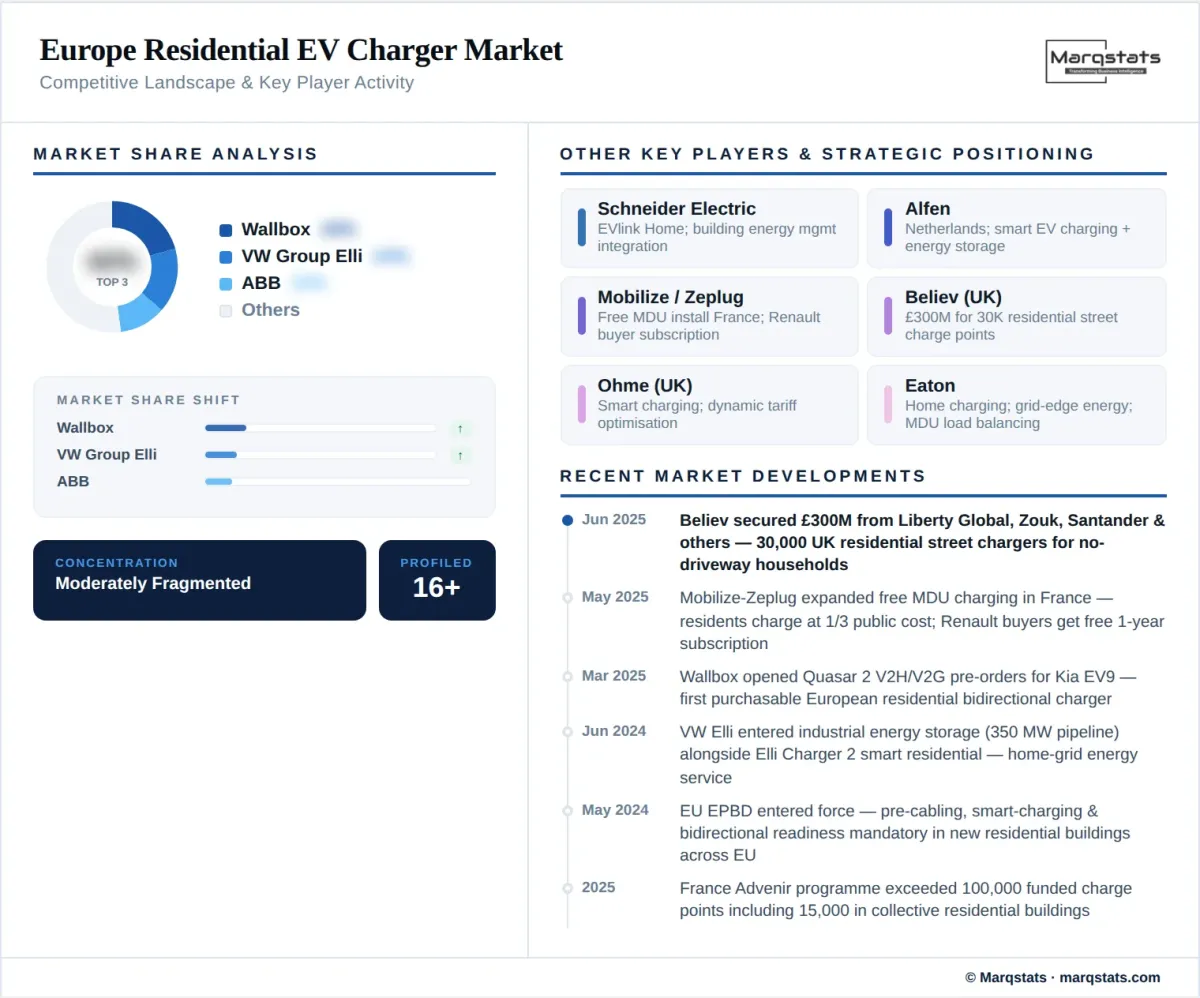
Companies Covered
The report profiles 16+ companies with full strategy and financials analysis, including:
Recent Market Activity
Table of Contents
Coverage & Segmentation
This report provides a comprehensive analysis of the Europe residential EV charger market covering the 2021–2030 period, with 2025 as the base year. The study covers Level 2 AC smart wallboxes (7 kW–22 kW), energy-managed and solar-integrated residential chargers, bidirectional V2H and V2G residential chargers, MDU and collective-residential shared-charging systems, on-street residential charging infrastructure, and the associated software platforms, installation services, utility-tariff integration, and demand-response programmes. Regulatory coverage spans the EU EPBD (entered into force 28 May 2024), UK Electric Vehicles (Smart Charge Points) Regulations 2021, national subsidy programmes in Germany (KfW), France (Advenir, home-charger tax credit, CITE), Netherlands (SEEH), UK (OZEV EV chargepoint grant), Spain (MOVES III), Ireland (SEAI home-charger grant, apartment charging grant), and the emerging AFIR (Alternative Fuels Infrastructure Regulation) requirements for smart charging and data reporting. Geographic coverage includes Germany, France, Netherlands, UK, Spain, Norway, Denmark, Sweden, Belgium, Ireland, and Italy as primary country studies, with aggregated coverage of Central and Eastern Europe and the Baltics as emerging residential charging markets. The companion Marqstats report on the Global Residential EV Charger Market (global-residential-ev-charger) covers North America, Asia-Pacific, Middle East, and Latin America.
Primary research included 40+ interviews with residential EV charger product managers, installer network managers and electricians, utility and grid operator smart-charging programme leads, national charging association representatives (AEDIVE Spain, AVERE, EAFO), property developer EV infrastructure procurement teams, OEM home-energy leads, and MDU charging software vendors. Secondary research drew from EAFO EV statistics, Eurostat housing and EV registration data, ACEA BEV registration reports, RVO Netherlands trend data, KfW programme reports, AEDIVE manufacturing statistics, Advenir France programme data, UK OZEV grant statistics, and company press releases and investor materials.