Market Snapshot
Key Takeaways
Market Overview & Analysis
Report Summary
China's residential EV charger market is the most data-rich residential charging market in the world, because unlike Europe or the United States, China's NEA publishes monthly counts of private charging facilities as a distinct category within the national charging infrastructure statistics. This means the market can be sized, trended, and forecasted from official first-party data rather than from triangulated estimates. The NEA's private facility count — which reached 14.7 million at end-November 2025, up from approximately 9.3 million at end-2024 — represents hardware predominantly used in residential parking spaces, company parking lots, and fixed-space individual installations, making it the most direct available measure of the residential charging installed base.
The market operates across three distinct layers that have materially different competitive dynamics and growth profiles. The first is the private pile hardware market — AC slow chargers (typically 7 kW to 11 kW) and DC fast chargers for individual homeowners and apartment-dwellers with dedicated fixed parking spaces. This layer is the existing installed base's foundation and is dominated by major domestic OEM-affiliated charger brands (BYD, SAIC, Geely/Sinopec JV), dedicated charging companies (Star Charge, TELD, Evcharger), and grid-affiliate brands (State Grid e-Chong, Southern Power Grid). The second layer is the community charging infrastructure market — shared charging facilities for residential compounds (小区) where individual fixed-space ownership is unclear or where older buildings lack dedicated parking, requiring property-management coordination, power-distribution upgrades, and multi-user access management. This is the fastest-growing commercial opportunity, driven by NEA policy focus on older community retrofits and the realisation that individual private piles cannot serve the large share of EV-owning residents in China's predominantly apartment-dwelling urban population. The third layer is the smart charging services and vehicle-grid interaction market — software platforms for orderly charging management, TOU tariff integration, demand-response grid services, and eventually V2G energy export, which the August 2024 action plan and Shanghai's implementation opinion are actively building the regulatory and technical foundation for.
The competitive ecosystem is dominated by a cluster of large domestic players with either OEM backing, state-grid affiliations, or dedicated charging infrastructure scale. Domestic brands collectively hold close to 95% of the Chinese residential charger market, with imported brands playing almost no material role at the hardware level. The relevant competitive dynamics are therefore primarily between large organised charging infrastructure operators building platform-scale community deployments, OEM-channel charger installation programmes bundled with vehicle sales, and the emerging smart-charging software and energy management layer being developed by both incumbent infrastructure players and technology-first startups.
Market Dynamics
Key Drivers
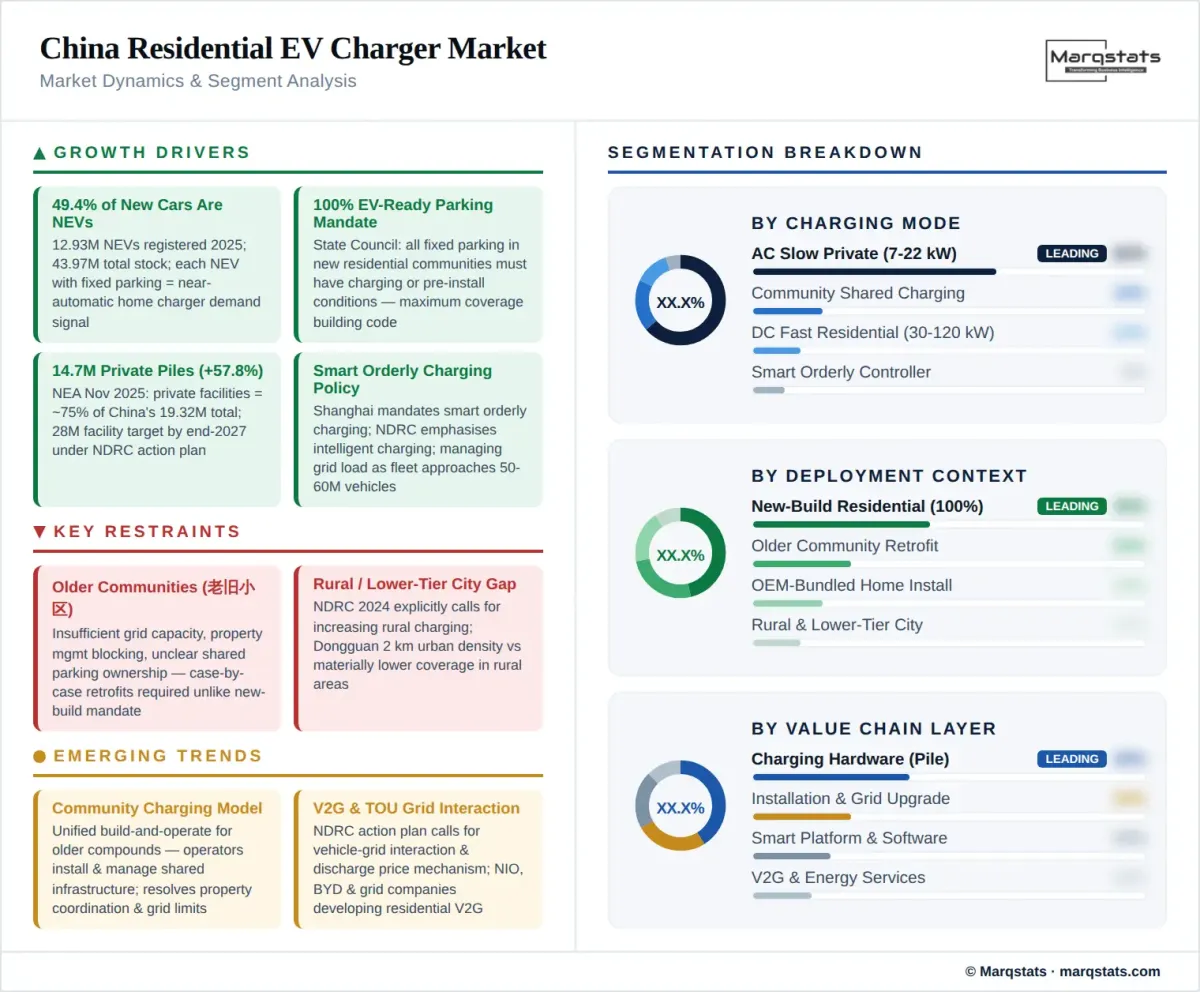
- Record NEV sales penetration — 49.38% of all new car registrations in 2025 are NEVs: The Ministry of Public Security's data showing 12.93 million NEVs newly registered in 2025, representing 49.38% of all newly registered passenger cars, is the single most powerful structural driver of China's residential EV charger market. Each new NEV sold to a Chinese consumer with a fixed private parking space generates a near-automatic demand signal for a home charger installation, and China's urbanisation and apartment ownership patterns mean that a large share of new NEV owners are in residential compounds with designated parking. The resulting 43.97 million total NEV stock at end-2025, growing by 12.57 million in a single year, creates a continuous sequential demand stream that has no parallel in any other national market.
- State Council 100% EV-ready parking mandate for new residential communities: China's most impactful residential charging policy — requiring 100% of fixed parking spaces in new residential communities to have charging infrastructure or pre-installation conditions — is now embedded in municipal implementation documents across China's major cities. Unlike European EPBD pre-cabling mandates or US IECC requirements which apply primarily to new buildings above threshold sizes, China's mandate applies to 100% of all fixed spaces in all new residential developments, creating a maximum-coverage building-code requirement that effectively mandates EV-readiness across the entire new-build residential construction pipeline. This has no equivalent in any other major market.
- Public fast charging costs approximately double home charging, preserving strong residential economics: IEA analysis confirms that public fast charging in China costs approximately twice as much per kWh as home charging. With local TOU valley tariffs enabling overnight home charging below CNY 0.35/kWh in several provinces — compared to public fast-charging costs of CNY 0.8–1.2/kWh across most Chinese cities — the economic case for residential charging is compelling and persistent. Fujian province's deployment of smart AC home-charger controllers that shift and manage charging to valley-tariff periods demonstrates that this residential cost advantage can be maintained and extended even as grids become more congested, reducing per-session costs by approximately 17.51% in documented pilot deployments.
- National 2024–2027 action plan targeting 28 million total charging facilities — residential sector the primary growth vector: The August 2024 NDRC/NEA/National Data Bureau Action Plan for Accelerating the Construction of a New Electricity System (2024–2027) explicitly targets 28 million total charging facilities by end-2027, prioritises residential area charging infrastructure under the 'two areas' priority framework, calls for intelligent and orderly charging integration, and acknowledges that the residential segment requires coordinated property-management, grid-capacity, and standard-setting interventions. Government investment backing of over CNY 200 billion is indicated for the programme, of which a substantial portion is directed toward residential area deployment and grid-upgrade support.
- Time-of-use electricity pricing and vehicle-grid interaction policy creating smart-charging demand premium: China's policy actively promotes TOU pricing for EV charging and is developing the regulatory framework for V2G discharge pricing. The NDRC's August 2024 action plan calls for improving time-based electricity price policy for EV charging, exploring the discharge price mechanism, and promoting EV participation in power-system interaction. These policy signals are pushing the residential charger market toward smart charging platforms, orderly charging controllers, and eventually V2G-enabled hardware — all of which command premium pricing above the basic private pile hardware market.
Key Restraints
- Older residential communities (老旧小区) lack the electrical capacity and property management infrastructure for individual private pile installation: NEA's 2025 response to the National People's Congress acknowledged that older residential communities face structural barriers including insufficient distribution-grid capacity, property management companies blocking or delaying charger installation requests, unclear ownership or allocation of shared parking spaces, and coordination complexity among multiple residents and grid operators. Unlike new-build communities where 100% pre-installation is mandated, older communities require case-by-case retrofits, community-level power-distribution upgrades, and coordinated management arrangements — creating genuine technical and organisational friction that limits residential charging penetration in China's large legacy apartment stock.
- Rural and lower-tier city EV charging infrastructure lagging behind tier-1 and tier-2 city deployment: While Dongguan's three-year action plan (2023) called for one charging station every 2 km in urban core areas, and Fuzhou's implementation rules mandate 100% coverage in new residential projects, rural areas and lower-tier cities have materially lower charging infrastructure density. The NDRC 2024 action plan explicitly calls for 'effectively increasing charging facilities in rural areas,' acknowledging the geographic coverage gap. This creates both a policy-driven growth opportunity and a near-term market-access constraint for residential charger vendors operating outside tier-1 urban markets.
- Vehicle-to-pile ratio of 2.57:1 indicating regional and community-level imbalances despite national adequacy: The NEA's national vehicle-to-pile ratio of 2.57:1 as of May 2025 indicates broad national parity between EV fleet and charging infrastructure, but this aggregated figure masks significant local imbalances — where some urban districts have surplus charging capacity and some residential communities remain severely underserved. For the residential charger market, this means that the growth opportunity is not uniformly distributed but concentrated in underserved communities, older compounds, rural areas, and regions where the 2023 State Council guidance on residential charging has been slower to operationalise.
Key Trends
- Community charging model replacing individual private pile as the primary residential charging paradigm for older compounds: China's NEA policy documents and municipal implementation frameworks are converging on a community-level charging model for older residential compounds — where operators install, own, and manage a shared charging infrastructure within the compound rather than individual residents each owning a private pile. This 'unified build and operation' model, explicitly encouraged in NDRC implementation guidelines, resolves property-management coordination issues, enables efficient use of limited grid connection capacity, and allows professional operations companies to capture maintenance and energy management revenue. It is a structurally different market from the individual wallbox market and requires different products, business models, and competitive strategies.
- Smart orderly charging becoming embedded infrastructure requirement, not premium feature: Shanghai's 2024 implementation opinion's explicit call for smart orderly charging, Fujian's grid-managed AC home-charger controller deployment, and the NDRC action plan's emphasis on intelligent and orderly charging all reflect a national regulatory direction in which basic unmanaged home charging is increasingly seen as a grid management problem rather than a neutral technical choice. As China's residential EV fleet approaches 50–60 million vehicles, unmanaged simultaneous peak-time charging creates local distribution-grid overload risks that smart orderly charging is designed to prevent. This regulatory pressure is transitioning the Chinese residential charger market from a hardware commodity market toward a software-and-service platform market.
- OEM-branded and OEM-affiliated charger installation becoming standard vehicle purchase bundle: China's major EV OEMs — BYD, Li Auto, NIO, SAIC, Geely, and others — have moved from offering optional home chargers to including them as standard vehicle-delivery elements or providing installation coordination as a built-in purchase service. This OEM-channel bundling compresses the addressable market for independent aftermarket charger sales and shifts competition from hardware retail toward OEM-preferred supplier relationships, installation network management, and software platform differentiation. NIO's NIO House and NIO Power home-charging service, BYD's integrated home charger delivery, and State Grid's e-Chong residential charging platform are all expressions of this trend.
- Multiple vehicles, one charger model and shared-space charging reducing per-household hardware requirement: The NDRC's explicit encouragement of 'multiple vehicles, one charger' arrangements and nearby-space sharing schemes reflects a real constraint in older residential communities where not every EV owner can install a dedicated private pile. Power-sharing hardware and scheduling software that enable one charging connection to serve multiple EVs sequentially — with smart reservation, usage tracking, and billing across multiple users — is an emerging product category directly serving the community charging market. This model reduces total hardware required per compound while increasing the revenue-per-charger for the operator, creating better unit economics for the community charging business model.
Market Segmentation
AC slow charging — typically 7 kW single-phase or 11 kW–22 kW three-phase wallbox installations for fixed private parking spaces — accounts for the dominant share of China's private charging installed base by unit count. The overnight 8–10 hour charge cycle of AC slow charging is fully adequate for the daily driving needs of the majority of Chinese urban EV owners, and the low hardware cost (typically CNY 800–2,500 for the charging unit) combined with straightforward installation into a dedicated parking space makes it the default choice for new-build residential communities with pre-installed conduit and dedicated power connections. The NEA's private facility count of 14.7 million includes a large majority of AC slow chargers, with DC fast charging accounting for a smaller share of the private base concentrated in higher-end residential developments and certain commercial-residential properties.
DC fast private charging for residential use — installing DC fast chargers in dedicated residential parking spaces for owners who need shorter charging times or who drive higher-mileage patterns — is a smaller but growing premium segment of China's private charging market. DC fast charger costs are significantly higher than AC units (CNY 5,000–20,000 for residential-grade DC units), and installation requires higher-capacity power connections, but the 1–2 hour charging time versus 8–10 hours for AC makes them attractive for power users and longer-commute households. China's technical standards for residential DC charging have evolved alongside the public fast-charging infrastructure, and the same hardware architectures used in semi-public parking-structure fast chargers are being adapted for residential community deployment.
Community shared charging — charging infrastructure installed in residential compounds and managed as shared services accessible to multiple residents — is the market's fastest-growing structural category, representing the primary response to the older-community access deficit. Rather than individual residents each owning a dedicated private pile, the community model deploys a pool of chargers connected to a shared power connection, managed through an operator platform with reservation, usage tracking, and per-session billing. This model is directly endorsed by NDRC's 'unified build and operation' framework and resolves the property-management coordination barriers that block individual private pile installation in older compounds. Dongguan's 2023 action plan target of 70,000 private chargers alongside 25,000 public chargers reflects the scale of combined community and individual private charging investment being planned at the city level.
Basic non-smart residential chargers — which simply deliver power when plugged in without grid-coordination capability — are the legacy technology layer of China's private charging installed base and are being actively phased out through regulatory direction. The NDRC action plan's explicit push for intelligent and orderly charging, combined with Shanghai's mandating of smart orderly charging, means that new installations in major cities are increasingly required to include basic smart-charging communication capability. The large existing non-smart base creates a retrofit and upgrade market as grid operators deploy smart-charging controllers and demand-management platforms.
Smart orderly charging systems — which include AC home-charger controllers that respond to grid operator signals, schedule charging to valley-tariff periods, and enable demand-response participation — are the primary growth vector in China's residential charging technology market. Fujian province's documented deployment of grid-managed AC home-charger controllers that reduced per-session charging costs by 17.51% through TOU scheduling demonstrates both the technical maturity and the commercial value of this layer. The NEA's policy framework for smart orderly charging, combined with the NDRC's development of TOU and discharge pricing mechanisms, is creating the regulatory foundation for a large-scale residential smart-charging services market built on top of the hardware installed base.
Vehicle-grid interaction — where EV batteries both receive charging power and discharge energy back to the grid or to the residence — is in early-stage development in China's residential market but receiving explicit policy attention in the NDRC's 2024 action plan. The action plan calls for exploring 'the integration and interaction of vehicles, chargers, stations, and networks' and developing the discharge price mechanism for V2G. China's massive and rapidly scaling EV fleet — 43.97 million NEVs at end-2025 — represents an enormous potential distributed storage resource, and multiple Chinese grid operators and technology companies are actively developing the hardware, software, and regulatory frameworks for residential V2G deployment at scale.
By Geography
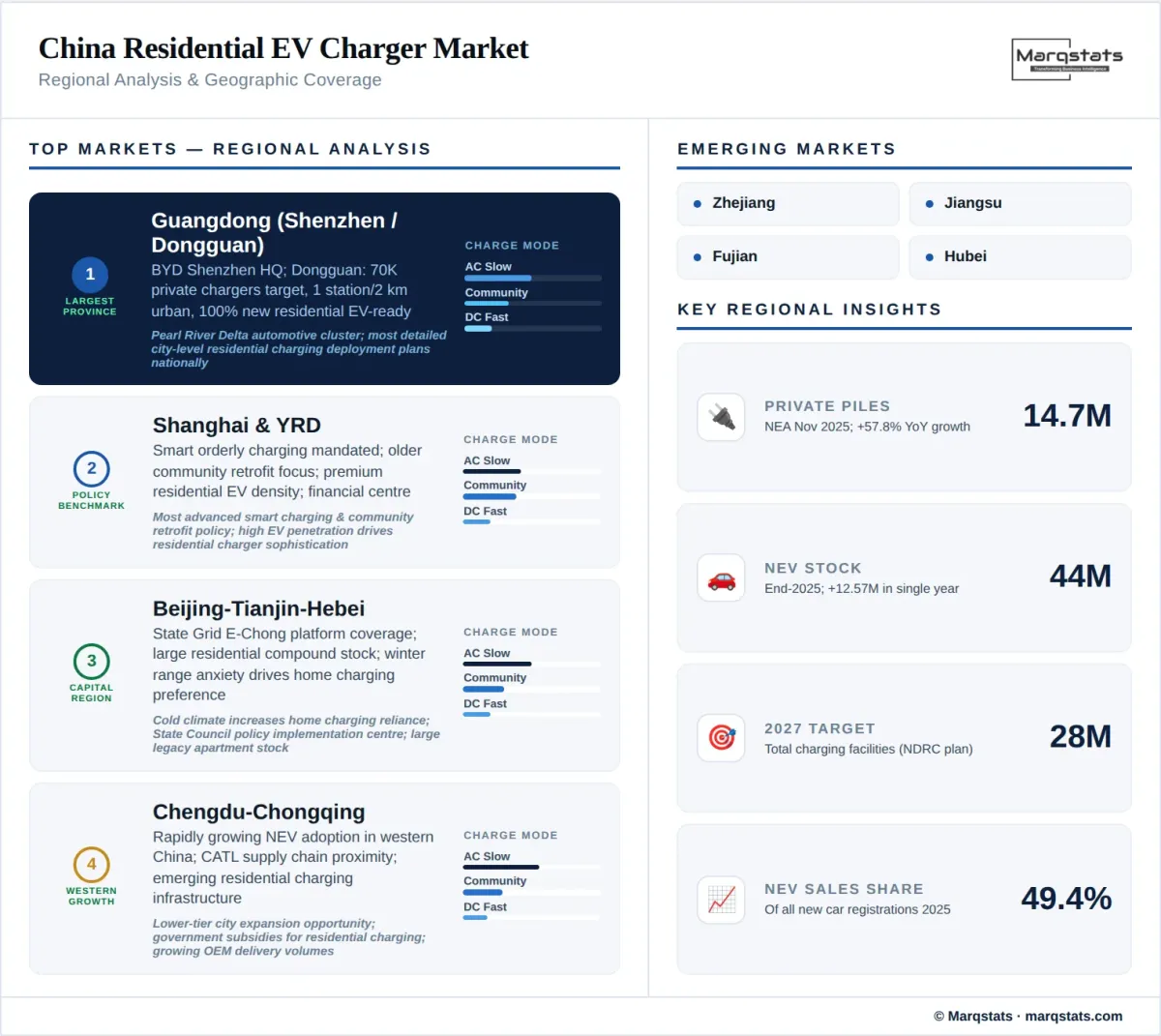
Guangdong Province (Including Dongguan, Shenzhen, Guangzhou)
Guangdong is China's largest provincial NEV market and home to its most concentrated EV manufacturing base, including BYD in Shenzhen and the broader Pearl River Delta automotive cluster. Dongguan's January 2023 three-year action plan — targeting 25,000 public chargers, 70,000 private chargers, and 3,000+ charging stations by end-2025, with one charging station every 2 km in urban areas and every 0.9 km in core urban areas — represents one of the most detailed and ambitious city-level residential charging deployment plans in China. The plan's requirement that 100% of new residential parking spots be equipped with EV charging or pre-installation conditions, and that 25% of existing parking lots be retrofitted with fast chargers, establishes Guangdong's cities as the implementation benchmarks for residential charging policy nationally.
Shanghai and Yangtze River Delta
Shanghai is China's most advanced city for residential EV charging policy sophistication, particularly in the smart orderly charging and older-community retrofit dimensions. Shanghai's 2024 implementation opinion explicitly mandates smart orderly charging for residential installations, calls for older residential communities to formulate retrofit action plans, and establishes shared charging spaces as a community resource. Shanghai's density of premium residential developments, its high EV penetration, and its role as China's primary financial and policy innovation centre make it the leading market for the smart-charging services and community-managed charging platform businesses that represent the residential market's next growth layer. The Yangtze River Delta region more broadly — including Jiangsu and Zhejiang — has the highest EV penetration and residential charging installation density of any Chinese economic region.
Beijing-Tianjin-Hebei and North China
Beijing and Tianjin combine high EV penetration with a large stock of older residential compounds — hutong-adjacent high-rises and 1980s-1990s-era apartment blocks — that represent the most challenging residential charging retrofit market in China. Beijing's grid infrastructure, property management complexity, and dense parking conditions have made community-level charging coordination more difficult than in newer-built southern cities, making it an important test market for the community charging management models and power-distribution upgrade frameworks that NEA policy is pushing nationally. Hebei and other northern provinces' rural areas represent the lower end of the geographic charging coverage spectrum, targeted by the NDRC's rural charging expansion directive.
Central and Western China — Emerging Markets
Central provinces (Hubei, Hunan, Henan) and western regions (Sichuan, Chongqing, Shaanxi) are emerging residential EV charger markets with rapidly growing NEV fleets driven by government green mobility programmes, local EV manufacturing (Chongqing's automotive industry, Zhengzhou's BYD plant), and expanding urban middle-class EV ownership. Meizhou in Guangdong's hinterland exemplifies the tier-3 and tier-4 city approach: its 2022 stability measures explicitly included optimising EV charger investment, construction, and operation modes and achieving full coverage of EV charging facilities across all residential communities and parking lots. This 'full coverage' aspiration, even at lower-tier city level, reflects the national policy ambition and creates a long-run residential charging growth opportunity across China's vast interior urban markets.
How Competition Is Evolving
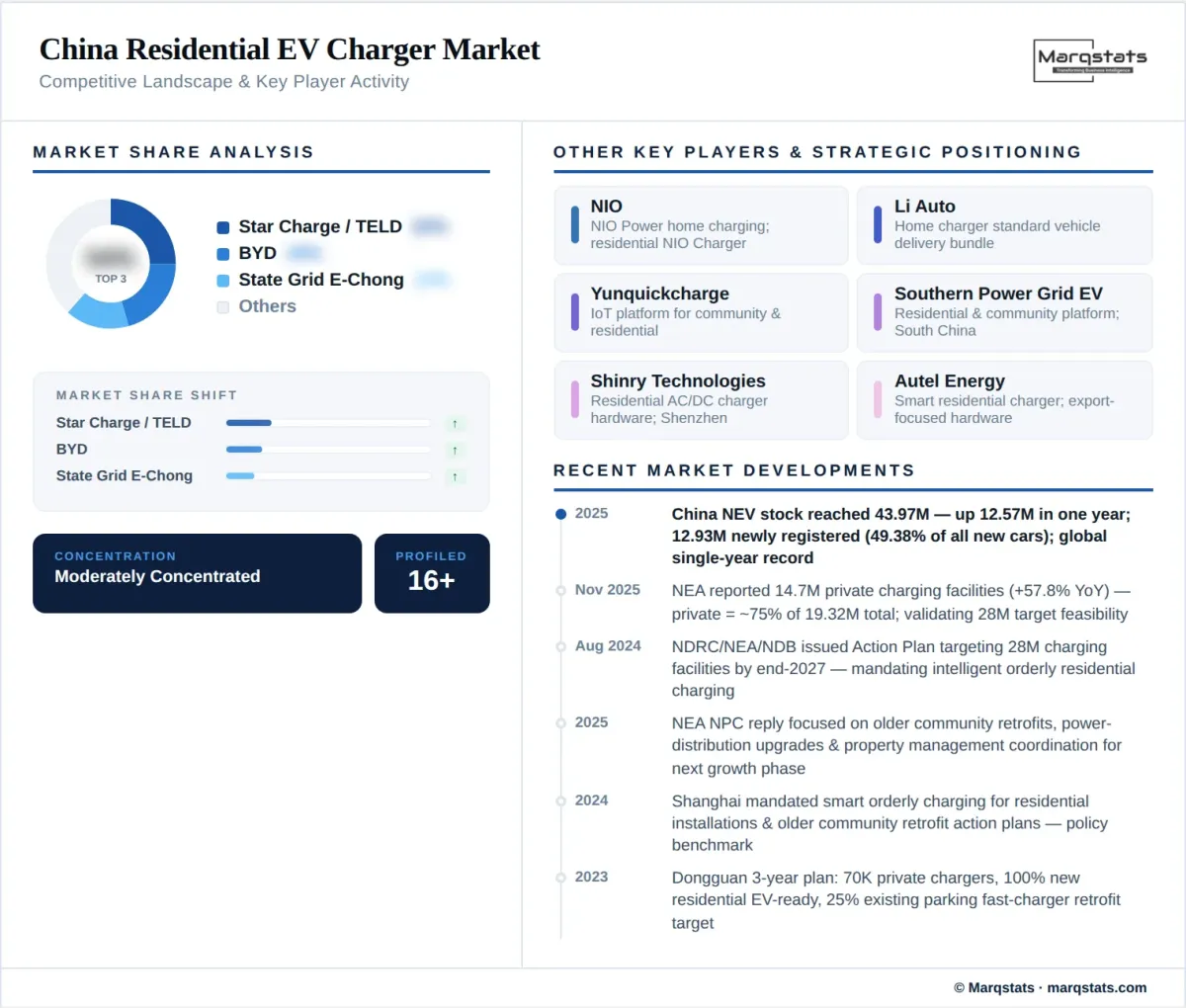
China's residential EV charger market is characterised by a highly domestic competitive ecosystem — with imported brands holding a negligible share — organised around three distinct competitive archetypes. Large charging infrastructure operators with national network scale — Star Charge (特来电), TELD (特锐德), Evcharger (云快充), and State Grid's e-Chong platform — compete for community charging deployment contracts and smart-platform services. OEM-affiliated charging brands — BYD's home charger programme, NIO Power's home-charging service, Li Auto's home charger delivery, and SAIC-affiliated charging operations — compete through vehicle-purchase bundling and OEM service-integration advantages. Domestic home-charging hardware manufacturers — including Shinry Technologies, Increase, CLOU Electronics, and a large number of smaller domestic manufacturers — compete primarily on hardware price, installation network coverage, and technical certification.
The competitive dynamics in China's residential market differ materially from Europe and the US because the OEM-bundling model is more dominant, the government-directed community deployment model is more prominent, and the hardware price competition is more intense due to China's manufacturing scale advantages. Star Charge's position as both China's largest independent public charging operator and a major residential charging supplier illustrates how the Chinese market's competitive leaders operate across the residential-commercial-public spectrum simultaneously rather than focusing on a single segment. The vehicle-grid interaction and smart orderly charging layer is the primary emerging competitive battleground, where grid operators (State Grid, Southern Power Grid), software platform companies, and hardware innovators are competing for the position-of-control that comes with owning the residential charging management interface.
Companies Covered
The report profiles 15+ companies with full strategy and financials analysis, including:
Recent Market Activity
Table of Contents
Coverage & Segmentation
This report provides a comprehensive analysis of China's residential EV charger market covering the 2021–2030 period, with 2025 as the base year. The study covers private pile hardware (AC 7 kW–22 kW slow chargers and DC 30 kW–120 kW fast chargers for fixed residential spaces), community-level shared charging infrastructure for residential compounds (新建小区 and 老旧小区), smart orderly charging controllers and grid-management platforms, vehicle-grid interaction (V2G) residential charger development, and the supporting power-distribution upgrade, property-management coordination, and TOU pricing integration services. Regulatory coverage spans the State Council 2023 guidance on residential EV charging, NDRC/NEA 2024–2027 Action Plan, municipal implementation frameworks in Shanghai, Dongguan, Fuzhou, and Yinchuan, and the NEA's monthly private charging facility statistics. Geographic coverage includes Guangdong (Pearl River Delta), Shanghai and Yangtze River Delta, Beijing-Tianjin-Hebei, and Central and Western China. The companion Marqstats global report (global-residential-ev-charger) and European and US market studies provide cross-market context.
Primary research included 40+ interviews with residential charging hardware manufacturers, community charging platform operators, property-management companies implementing residential EV charging programmes, grid operator smart-charging teams, OEM home-charger delivery service managers, and municipal development and reform bureau EV infrastructure programme officers. Secondary research drew from NEA monthly charging facility statistics, Ministry of Public Security NEV registration data, State Council 2023 residential EV guidance, NDRC/NEA 2024 action plan, Shanghai 2024 implementation opinion, Dongguan 2023 action plan, Fuzhou local implementation rules, Yinchuan parking plan, Fujian grid-managed charging case study, and IEA EV infrastructure data.