Statistics & Highlights

Market Snapshot

Market size in USD Billion
$3.80B
2025
Base year
$4.72B
2026
Estimated
  
$11.20B
2030
Forecast
Largest market
California (1.53M EVs, 31.97¢/kWh, Multifamily Grants, CTEP)
Fastest growing
Florida and Texas (334K and 295K EVs, MDU Battery-Buffered Charging)
Dominant segment
Smart Level 2 AC Home Chargers (7kW–19.2kW, NACS/J1772, TOU-Optimised)
Concentration
Moderately Fragmented (Tesla, ChargePoint, Leviton + Innovation Tier)
CAGR
24.13%
2026 – 2030
GROWTH
+$7.40B
Absolute
STUDY PARAMETERS
Base year2025
Historical period2021 – 2025
Forecast period2026 – 2030
Units consideredValue (USD BN), Volume (Units)
REPORT COVERAGE
Segments covered7 segments
Regions covered6 regions
Companies profiled16+
Report pages285+
DeliverablesPDF, Excel, PPT
Executive Summary

Key Takeaways

Market valued at USD 3.80 billion in 2025, projected to reach USD 11.20 billion by 2030 at 24.13% CAGR — DOE data showing 80% of US EV charging events at home and NREL's mid-case scenario of 26.8 million private-access Level 1 and Level 2 ports needed by 2030 establish the residential segment as the structural core of America's EV charging ecosystem, not a niche accessory market.
California is the nation's most important residential charger market with 1.53 million EVs, 31.97 cents/kWh average electricity price (EIA 2024), the strongest solar-plus-EV-charging economics in the country, multifamily EV charger grants, and a warehouse charger make-ready requirement — making it simultaneously the largest demand market and the most advanced policy environment for smart, solar-integrated, and multifamily residential charging.
The multifamily charging access deficit is the market's defining growth bottleneck — 44 million US households (31%) in multifamily housing contribute fewer than 5% of home charging events, representing the largest addressable whitespace in US residential EV charging; ADS-TEC's battery-buffered ChargeBox deployment at a 470-unit North Miami Beach multifamily complex (March 2024) demonstrates that grid-constraint-free MDU charging is technically viable without panel upgrades.
Bidirectional V2H and V2G charging is entering commercial scale in the US — GM Energy's 19.2 kW PowerShift bidirectional charger in PG&E's V2E pilot (March 2025, up to USD 4,500 incentives), Massachusetts' 100-charger V2X state programme deploying 1.5 MW of EV storage capacity (February 2025), and Wallbox's Quasar 2 V2H/V2G pre-order launch collectively signal that residential bidirectional charging has crossed from pilot to commercially available product in the US market.
NACS connector transition is reshaping the US residential charger product landscape — Tesla's opening of NACS to third parties and its adoption by Ford, GM, Rivian, Honda, and others has forced charger vendors into dual-connector product strategies; ChargePoint's Home Flex in both J1772 and NACS versions and Leviton's plug-in EV Series Smart Home expansion are direct market responses to the NACS transition's impact on the residential hardware replacement cycle.
IRS Alternative Fuel Vehicle Refueling Property Credit (30%, up to USD 1,000 per item, eligible census tracts) expires June 30, 2026 — the narrowing incentive window is creating a pull-forward installation incentive in 2025–2026, with subsequent market growth more dependent on natural EV-adoption-driven demand, utility-linked managed-charging programme growth, and multifamily make-ready mandates.
Market Insights

Market Overview & Analysis

Report Summary

The US residential EV charger market operates across two fundamentally different market structures that require distinct products, channels, and business models. The first is the single-family, driveway, and garage market — where EV-owning homeowners with dedicated parking install Level 1 or Level 2 chargers for overnight home charging, benefiting from straightforward panel connections, clear installation rights, and strong economic returns from time-of-use tariff scheduling. DOE data confirm that approximately 64% of all US EV charging through 2030 is projected to occur at single-family homes (NREL/DOE Fact of the Week 2024), reflecting the structural dominance of the 88.8 million single-unit detached and attached homes in the US housing stock (Census 2023). The second is the multifamily, renter, shared-parking, and non-garage market — where the legal complexity of installation rights, cost allocation between residents and building owners, shared-panel capacity constraints, and metering requirements create structural barriers that mean fewer than 5% of current home charging events occur in multifamily settings despite 31% of US households living there (Joint Office white paper).

Federal policy supports the residential market through the IRS Alternative Fuel Vehicle Refueling Property Credit: 30% of cost, up to USD 1,000 per charging port, for qualifying property placed in service from January 1, 2023 through June 30, 2026, with eligibility limited to qualifying low-income or non-urban census tracts. The temporal boundary of this incentive — expiring mid-2026 — is creating a pull-forward dynamic in 2025–2026 that will be followed by a period of more purely market-driven demand. State-level programmes vary significantly: California's multifamily EV charger grants and make-ready requirements, New York's building-code EV provisions, and Massachusetts' MassCEC-funded V2X programme represent the most advanced state-level residential charging policy architectures. The 2024 International Energy Conservation Code's EV infrastructure requirements for new dwellings are gradually embedding EV-readiness in new residential construction codes across adopting states.

The US residential charger market's evolution is strongly shaped by electricity-price geography. EIA's 2024 average US residential electricity price of 16.48 cents per kWh masks significant state-level variation: California at 31.97 cents/kWh has the strongest economic case for solar-plus-EV-charging integration and time-of-use tariff optimisation, while Texas at 14.94 cents/kWh, Florida at 14.14 cents/kWh, and Washington at 11.90 cents/kWh have less compelling smart-charging ROI but stronger simple overnight-rate economics. This electricity-price geography directly shapes which residential charger product tiers — basic Level 2, smart TOU-optimised, solar-integrated, or bidirectional — deliver the most compelling value proposition in each state market, and consequently which states are most attractive for premium-segment residential charger launches.

Market Dynamics

Key Drivers

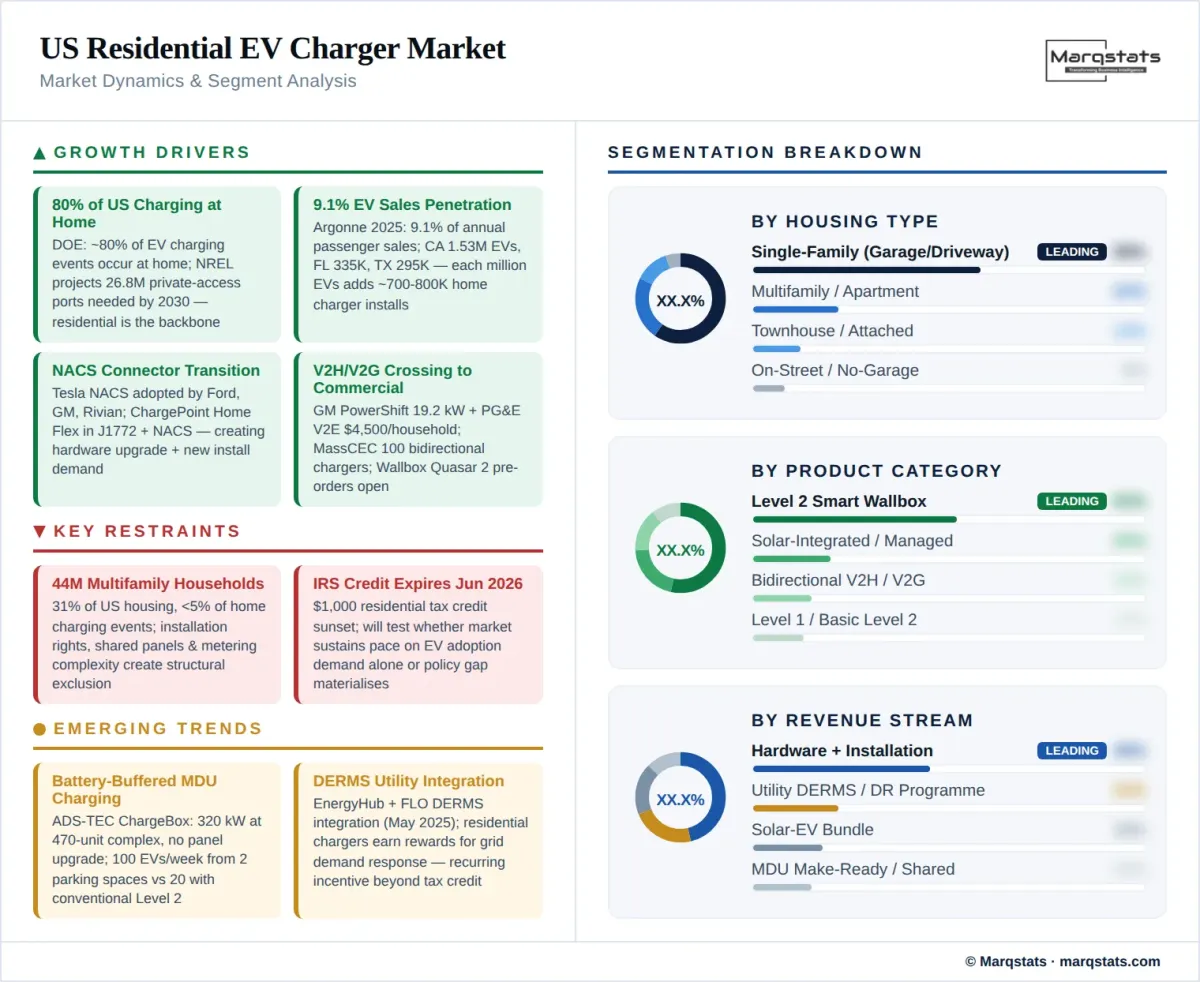
  • 80% of US EV charging at home creates a structurally captive residential demand base: DOE's figure that approximately 80% of US EV charging events occur at home reflects the economic logic of overnight Level 1 and Level 2 charging — cheaper per kWh than public DC fast charging in virtually all US markets, more convenient for predictable daily commuting, and compatible with the relatively low average US daily driving distance of 37 miles. NREL's 2030 scenario projects 26.8 million private-access ports needed across single-family homes, multifamily properties, and workplaces, confirming that the residential and private-access charging market is not a supplementary layer of the US charging system but its primary backbone.
  • US EV installed base at 9.1% of annual passenger vehicle sales (Argonne 2025) driving sequential residential charger demand growth: Argonne's tracking of plug-in vehicle penetration — 9.1% of annual sales in 2025 after 9.9% in 2024 — combined with DOE state registration data showing a nationally distributed and growing EV fleet anchored by California (1.53M), Florida (334.8K), Texas (294.7K), Washington (191.4K), and New York (168.1K + 111.4K PHEVs) creates a consistent sequential demand stream for residential Level 2 charger installations. Each additional 1 million EVs sold adds roughly 700,000–800,000 home charger installations based on DOE's 80% home-charging ratio and detached-home ownership rates.
  • IRS 30% tax credit and state incentive programmes maintaining positive economics through mid-2026: The IRS Alternative Fuel Vehicle Refueling Property Credit (30% of cost, up to USD 1,000 per item, through June 30, 2026 for individuals in eligible census tracts) provides a meaningful pull-forward incentive across markets where census tract eligibility overlaps with EV ownership. Combined with state-level rebates in California (SMUD, PG&E, SCE programmes), New York (NYSERDA), Colorado, and Massachusetts, the net out-of-pocket cost for a Level 2 home charger installation can be materially below retail price in the highest-incentive states through mid-2026.
  • EnergyHub-FLO DERMS integration and PG&E V2G pilot demonstrating utility-linked value proposition for smart and bidirectional chargers: The May 2025 EnergyHub-FLO collaboration — enabling residential FLO Home X3/X6/X8 charger owners to earn rewards for utility grid support through the first DERMS integration of FLO's next-generation charger platform — and GM's March 2025 PG&E V2E pilot offering up to USD 4,500 per household for bidirectional PowerShift charger adoption both demonstrate how utility programmes are creating tangible additional value streams that justify premium residential charger hardware investments beyond the basic overnight-charging economics. These programmes are accelerating smart and bidirectional charger adoption in utility service areas where grid flexibility is a commercial priority.
  • NACS transition creating a residential hardware replacement market alongside new EV installations: Tesla's opening of the North American Charging Standard to third parties and the subsequent OEM adoption by Ford, GM, Rivian, Honda, and others is driving a hardware-replacement demand cycle in which existing J1772-only residential charger owners must upgrade to NACS-compatible products as they acquire new NACS-equipped EVs. ChargePoint's Home Flex in dual J1772/NACS versions, Leviton's expanded EV Series Smart Home portfolio, and MSI's CES 2025 launch of solar-ready AC chargers with AI license-plate recognition all reflect vendor responses to the NACS transition's combined effect of new EV buyer demand plus existing-owner upgrade demand.

Key Restraints

  • Multifamily charging access deficit — 44 million households, fewer than 5% of home charging events: The Joint Office's data that 44 million US households (31%) in multifamily housing contribute fewer than 5% of home charging events defines a structural exclusion that single-family wallbox sales alone cannot address. Installation rights disputes between residents and building owners, shared-panel capacity limitations requiring expensive upgrades, individual metering complexity, and the economics of retrofitting older multifamily buildings with EV charging infrastructure create barriers that require purpose-built products (battery-buffered chargers, dynamic load management, sub-metering) and policy interventions (make-ready requirements, multifamily grants) rather than simply lower hardware prices.
  • Federal tax credit expiration June 30, 2026 creating an incentive cliff: The IRS Alternative Fuel Vehicle Refueling Property Credit expires on June 30, 2026 for residential applications. For the substantial portion of the US market where EV owners are in eligible census tracts, this represents a USD 1,000 reduction in installation economics. The expiration will test whether the US residential charger market can sustain its 2025–2026 installation pace on the basis of underlying EV adoption demand alone, or whether a policy gap materialises between the credit's expiration and any successor incentive programme.
  • Installation cost friction — permits, panel upgrades, and contractor availability: DOE's AFDC explicitly notes that home-charger installations must comply with local and state electrical codes, may require permits and electrical inspections, and may need panel capacity upgrades where existing household electrical service is at or near capacity. The total installed cost of a Level 2 home charger — including hardware, permitting, wiring, and panel upgrades where required — is typically USD 800 to USD 2,500 depending on installation complexity, compared with a Level 2 hardware retail price of USD 200 to USD 700. Electrical contractor availability and permit processing times vary significantly by state and municipality, creating geographic disparities in installation lead times that limit market accessibility.
  • US lacks an official national census of residential home charger installed base, creating market sizing uncertainty: NREL explicitly notes that single-family residential chargers are not tracked in the AFDC Station Locator, and AFDC's Q2 2024 infrastructure report of 188,096 public ports and 23,286 tracked private ports materially understates the true residential installed base. This data gap means that market sizing, competitive share estimation, and policy-programme impact assessment all rely on triangulated estimates from EV registration data, housing structure, and behavioural surveys rather than direct official counts — creating commercial and policy-planning uncertainty that does not exist in the same form in European markets with grant-programme tracking.

Key Trends

  • Bidirectional V2H and V2G residential charging crossing from pilot to commercial product: The Massachusetts MassCEC V2X programme (February 2025, 100 bidirectional chargers, 1.5 MW capacity, two-year demonstration across residential, school bus, municipal, and fleet participants), GM's PG&E V2E pilot (March 2025, 19.2 kW PowerShift, up to USD 4,500 per household, six eligible 2024 model-year EVs), and Wallbox Quasar 2's V2H/V2G pre-order launch collectively represent the US residential bidirectional charging market's transition from policy demonstration to commercially available product. The Mobility House's designation of these programmes as providing a scalable blueprint for V2X nationwide indicates that the next phase is moving from isolated utility pilots to replicable programme architecture.
  • Battery-buffered multifamily charging emerging as a grid-constraint-free MDU solution: ADS-TEC Energy's March 2024 deployment of its ChargeBox at a 470-unit multifamily residential complex in North Miami Beach demonstrated that battery-buffered ultra-fast charging (up to 320 kW per vehicle) in a multifamily setting requires no panel upgrades or high-powered electrical infrastructure changes — drawing from the existing grid, storing in built-in batteries, and discharging at high power on demand. The ChargeBox serving 100 EVs per week from two parking spaces versus 20 spaces for equivalent Level 2 chargers illustrates how battery-buffered solutions can resolve the space and electrical-capacity constraints that make conventional Level 2 retrofit uneconomical in dense multifamily buildings.
  • Manufacturer NEVI and Buy America programmes reshaping domestic US charger production: Star Charge's December 2023 announcement of a Columbus, Ohio manufacturing plant with initial capacity of 20,000 chargers annually — incorporating NEVI-ready DC fast chargers including the Titan 150 kW and Neptune split-system models — and Zerova Technologies' Phoenix, Arizona facility explicitly targeting NEVI programme and Build America/Buy America (BABA) requirements reflect how federal charging infrastructure investment policy is reshaping the domestic EV charger manufacturing base. While these announcements focus primarily on DC fast chargers, the domestic manufacturing infrastructure they create benefits residential-grade AC charger supply chains through shared component networks and installer relationships.
  • Solar-integrated and energy-managed home charging becoming the standard premium tier: MSI's CES 2025 launch of its EV Series and Eco Series solar-ready smart AC chargers with AI license-plate recognition, ChargePoint-LG Electronics partnership (June 2024) combining ChargePoint's charging management software with LG's EV charging hardware plus potential integration with LG's ThinQ smart home platform and energy storage systems, and Zerova's AW48 smart residential charger supporting Plug-and-Charge, Autocharge, and CTEP/NTEP standards all illustrate how the US premium residential charger tier is converging on solar readiness, home energy management integration, and ISO 15118-based smart-charging authentication as defining features.
US Residential EV Charger Market Dynamics Segment Analysis Infographic
Segment Analysis

Market Segmentation

Single-Family Detached and Attached Homes (Garage / Driveway)
Leading

Single-family homes with garages or dedicated driveways represent the largest and most commercially mature residential charger segment in the US, anchored by Census data showing 88.8 million single-unit detached and attached homes and a homeownership rate of 65.5% (Q4 2025 Census Housing Vacancy Survey). DOE's projection that 64% of US EV charging will occur at single-family homes through 2030 confirms this segment's structural dominance. This market is characterised by relatively straightforward Level 2 installation economics, strong IRS tax credit utilisation, and the clearest ROI from smart-charging and solar-integration features given the higher electricity prices in key markets. ChargePoint Home Flex, Tesla Wall Connector, Leviton EV Series Smart Home, Eaton home charging products, and Zerova AW48 all compete in this segment. The NACS connector transition is the primary near-term hardware dynamic, creating upgrade demand alongside new EV installation demand.

Multifamily, Apartments, and Renter Households

Multifamily and renter residential charging is the US market's defining structural gap and its highest-growth policy focus. The Joint Office's figures — 44 million multifamily households, 63% of rental households in multifamily buildings, fewer than 5% of home charging in multifamily settings — define the magnitude of the access deficit. ADS-TEC Energy's ChargeBox deployment at a 470-unit North Miami Beach multifamily complex (March 2024) — providing ultra-fast charging at up to 320 kW per vehicle without panel upgrades, serving 100 EVs per week from two parking spaces — is the clearest US commercial deployment of a battery-buffered MDU charging solution designed to overcome the electrical-infrastructure barrier. California's multifamily EV charger grants and New York's building code EV-ready requirements are the most advanced state-level policy responses to the MDU charging gap.

No-Garage Urban Households and On-Street Residential Charging

US households without garages or driveways — concentrated in dense urban areas of New York, Boston, Chicago, San Francisco, and Seattle — face the most severe home-charging access barriers, as they lack even Level 1 outlet access in a private space. Solutions for this segment include on-street residential EV charging (curbside chargers on residential streets), parking-structure charging, and managed Level 1 charging programmes. Toyota's May 2024 Empact vision programme installing 350 kW DC fast chargers in Baldwin Park and Sacramento, California — two communities with below-median income and EV penetration gaps — addresses the equity dimension of this access deficit, supplementing the residential charging ecosystem with community-access fast charging specifically targeting under-resourced residential neighbourhoods.

Level 1 EVSE (120V, Trickle Charging)
Leading

Level 1 EVSE — standard 120V outlet charging delivering approximately 1.2 kW or 4–5 miles of range per hour — remains a meaningful component of the US residential charging market, particularly for shorter-commute households, PHEVs, and first-time EV owners without immediate Level 2 installation capacity. DOE's AFDC explicitly notes that many EV drivers can meet daily needs with Level 1 if they have access to a nearby outlet, confirming that the Level 1 segment serves a real and non-trivial share of home-charging demand without requiring any infrastructure investment beyond an outlet availability check. MSI's EZgo Portable EV Charger, unveiled at CES 2025 with 11 kW maximum speed, plug-and-play functionality, and eight quick-connect adapter support, reflects the market's continued investment in portable and flexible Level 1-to-Level 2 crossover products.

Smart Level 2 AC Chargers (240V, 7 kW–19.2 kW)

Smart Level 2 AC chargers are the dominant US residential charger category by revenue, providing overnight home charging at 7 kW to 19.2 kW with app connectivity, scheduling, time-of-use tariff optimisation, and NACS/J1772 compatibility. Leviton's March 2024 launch of plug-in versions of its EV Series Smart Home stations — compatible with the My Leviton App and integrated with the Leviton Smart Load Center for real-time energy consumption visibility — and MSI's CES 2025 solar-ready EV Series with AI license-plate recognition illustrate the smart-charger tier's evolution beyond basic scheduling toward whole-home energy management integration. The ChargePoint-LG Electronics partnership (June 2024) pairing ChargePoint's charging management software with LG hardware, and potential integration with LG's ThinQ smart home platform and energy storage systems, represents a major OEM channel alliance combining platform and hardware scale.

Bidirectional V2H and V2G Chargers

Bidirectional residential chargers capable of vehicle-to-home (V2H) and vehicle-to-grid (V2G) energy export are the fastest-growing value segment, with the commercial product landscape maturing rapidly in 2024–2025. GM Energy's 19.2 kW PowerShift bidirectional charger — active in PG&E's V2E pilot with up to USD 4,500 per household in incentives for compatible 2024–2025 model-year Chevrolet, GMC, and Cadillac EVs — and the Massachusetts MassCEC V2X programme deploying 100 bidirectional chargers from Resource Innovations and The Mobility House for a two-year statewide demonstration are both commercially procured, utility-supported programmes. Star Charge's Columbus, Ohio plant producing bidirectional chargers from 7 kW to 480 kW confirms that bidirectional capability is moving from niche premium hardware to mainstream residential and commercial production.

Regional Analysis

By Geography

California

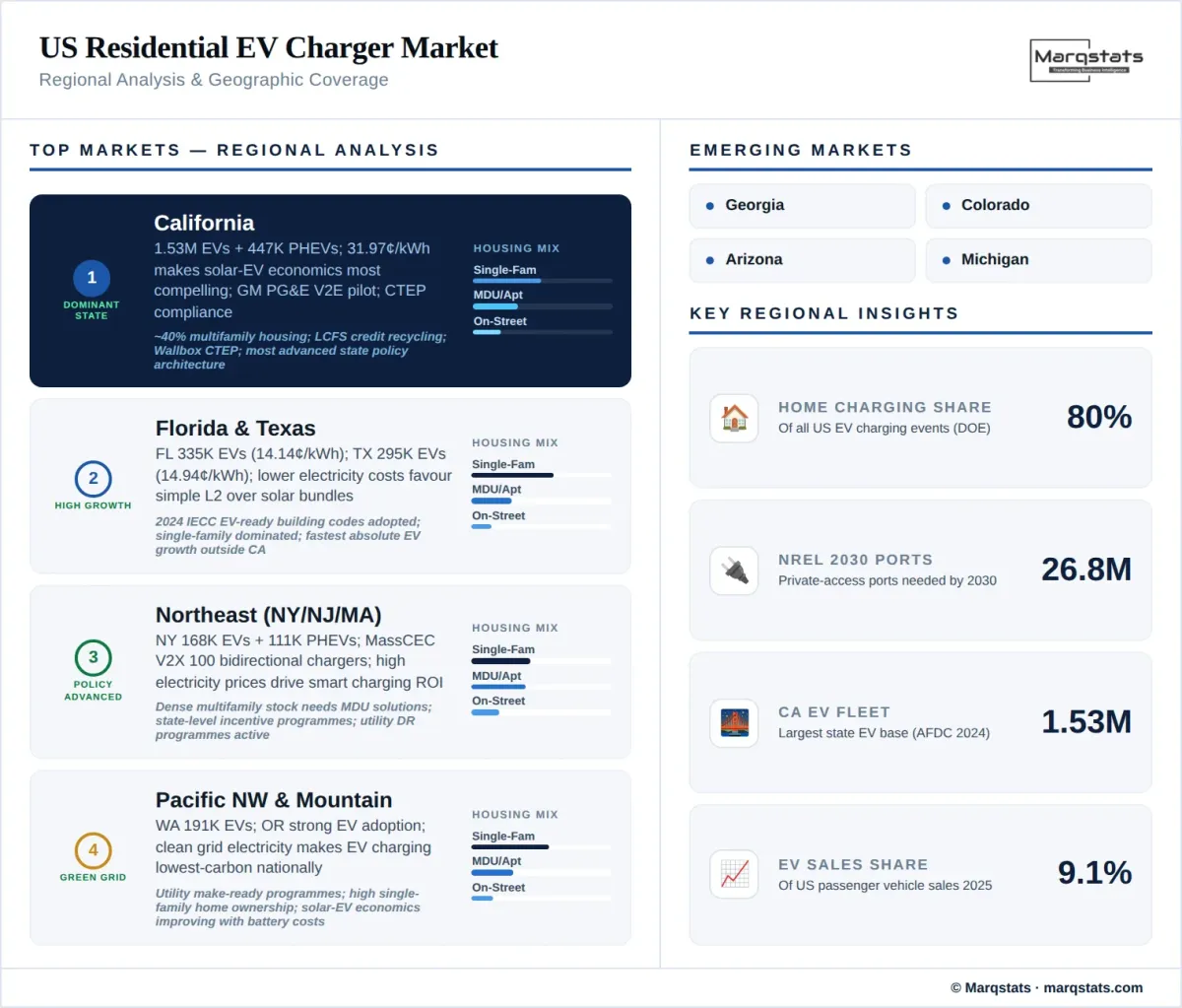
California is the US residential EV charger market's dominant state by every relevant metric: 1,533,900 EVs and 447,100 PHEVs (AFDC 2024 data); 64,160 public electric charging ports and 11,071 tracked private ports; the nation's highest average residential electricity price at 31.97 cents per kWh (EIA 2024) making solar-plus-EV-charging economics the most compelling in the country; and the most advanced state-level residential charging policy architecture including multifamily EV charger grants, warehouse charger make-ready requirements, Low Carbon Fuel Standard revenue recycling (Toyota's Clean Assist programme reinvesting LCFS credits into equitable community charging in Baldwin Park and Sacramento), and CTEP certification requirements that shape product compliance standards. GM's PG&E V2E pilot is California-specific at launch, and Wallbox's CTEP certification for the Supernova was a California-entry requirement. The state's 9.7 million housing units, approximately 40% of which are multifamily, and its high EV penetration combine to make California simultaneously the single-family smart-charger market and the multifamily-charging access problem in their most advanced domestic form.

Florida and Texas

Florida (334,800 EVs, 14.14 cents/kWh) and Texas (294,700 EVs, 14.94 cents/kWh) are the second and third largest US residential EV charger markets by EV installed base, with very different market profiles. Florida's large retiree population, high condominium ownership share, and flat suburban geography create a distinctive residential charging market where multifamily and condominium charging access is as significant as single-family driveway installation. ADS-TEC's March 2024 ChargeBox deployment at a 470-unit North Miami Beach multifamily complex was specifically chosen to demonstrate the battery-buffered MDU model in a Florida setting. Texas's rapid EV adoption growth, XCharge's plans for a 3 MWh battery storage EV charging superhub at the Watters Creek Village mixed-use development near Dallas, and Wallbox's ENSOL partnership deploying Supernova DC fast chargers across Texas urban centres and transit corridors (alongside Florida and Georgia) reflect the state's emergence as a major residential-adjacent and semi-commercial fast charging market.

New York and the Northeast

New York (168,100 EVs, 111,400 PHEVs) and the Northeast corridor — Massachusetts, Connecticut, New Jersey, and Maryland — represent the US market's most dense-urban residential charging challenge. New York City's apartment-dominant housing stock, active building-code EV provisions, and strong political commitment to vehicle electrification make multifamily make-ready and shared-building charging investment central to the state's residential EV charging strategy. Massachusetts is the most V2G-advanced state at the programme level: the February 2025 MassCEC-funded V2X demonstration programme, involving Resource Innovations and The Mobility House deploying 100 bidirectional chargers across residential, school bus, municipal, and commercial fleet participants for a two-year statewide demonstration, is one of the largest state-led V2X initiatives in the US. EnergyHub, headquartered in the New York area, and FLO's DERMS integration programme for North American residential charger owners further anchor the Northeast as the US market's most utility-programme-integrated residential charging region.

Pacific Northwest — Washington and Oregon

Washington State (191,400 EVs, 11.90 cents/kWh) and Oregon have the highest EV penetration rates outside California combined with the lowest residential electricity prices of major EV markets, creating a distinctive market profile where EV charging is extremely affordable but where the ROI for smart-charging, solar-integration, and time-of-use tariff optimisation features is lower than in California. The Pacific Northwest's high share of hydroelectric power means that EV charging at home is genuinely low-carbon without requiring solar integration — reducing the value proposition of premium solar-integrated chargers versus basic Level 2 smart chargers. Washington State's progressive EV policy, clean-vehicle incentives, and strong utility engagement with managed-charging programmes make it one of the most EV-ready regulatory environments for residential charger deployment, even if its low electricity prices temper premium-product economics.

Emerging State Markets — Southeast, Midwest, and Mountain West

Georgia, Arizona, Colorado, and Illinois represent the next tier of US residential EV charger markets, combining above-average EV adoption with a mix of housing types and electricity prices that support both single-family and increasingly multifamily residential charging investment. Wallbox's ENSOL partnership explicitly targets Georgia (alongside Texas and Florida) for Supernova DC fast charger deployment at urban centres and transit corridors. Zerova Technologies' Phoenix, Arizona NEVI-programme manufacturing facility and ACT Expo 2024 presentation of its full residential-to-commercial charger portfolio (AW48 smart residential to 480 kW commercial DZ) establish the Southwest as an important supply-side and emerging-demand market. Colorado's generous EV and charger incentive programmes and ski-resort-adjacent residential charging demand create a distinct premium residential charging market in the Mountain West.
US Residential EV Charger Market Regional Analysis Infographic
Competitive Landscape

How Competition Is Evolving

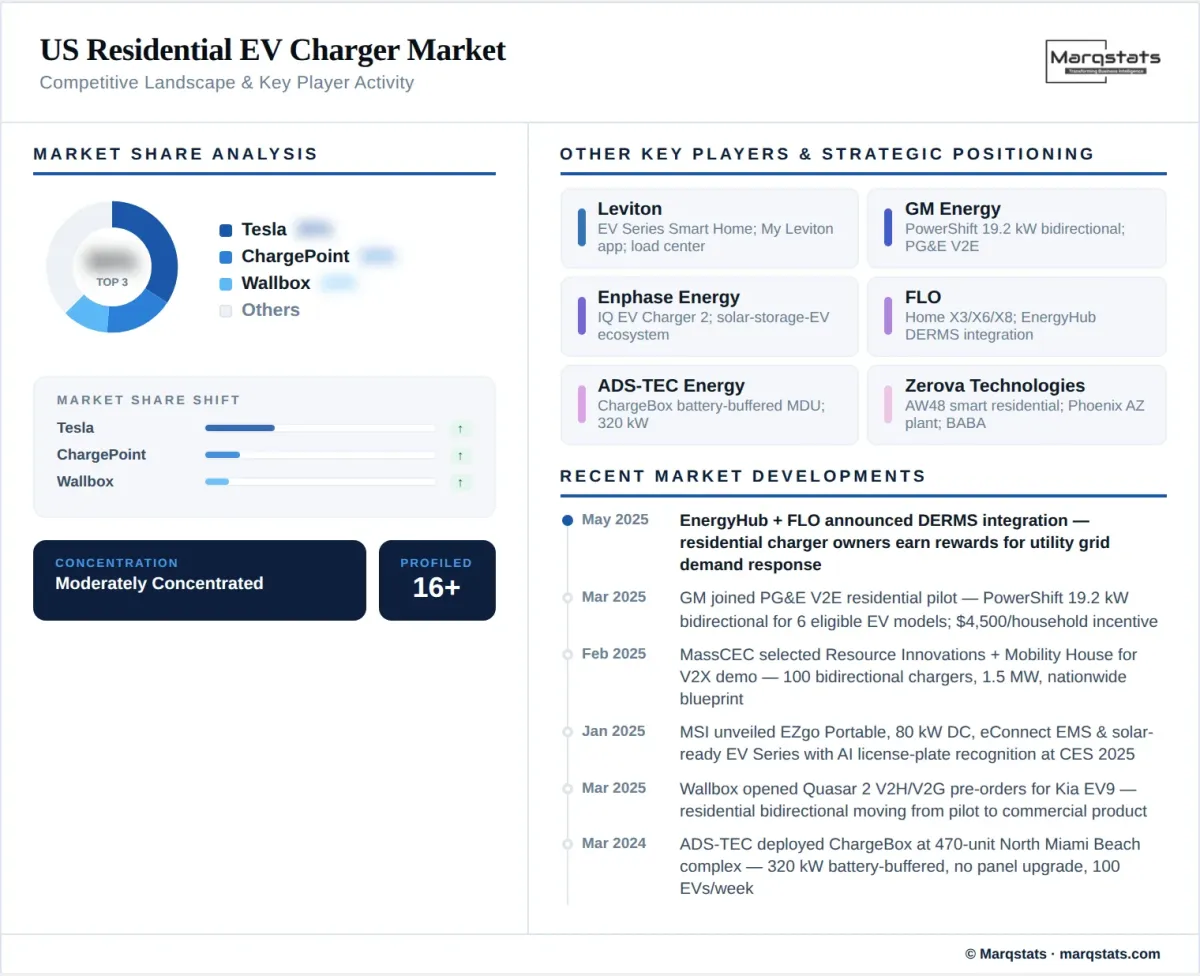
The US residential EV charger market is moderately fragmented, with three distinct competitive archetypes shaping the market. EV OEM-embedded charging ecosystems — Tesla (Wall Connector, Powerwall, Powershare), GM Energy (PowerShift bidirectional, V2H Bundle), Ford (Ford Charge Station Pro with Sunrun solar linkage) — compete on platform lock-in, vehicle-optimised integration, and bundled home-energy value propositions. Independent smart-charging platform providers — ChargePoint (Home Flex dual J1772/NACS), Leviton (EV Series Smart Home plug-in and hardwired), Wallbox (Pulsar Plus, Quasar 2, Supernova), Enphase (IQ EV Charger 2 solar ecosystem), Eaton — compete on cross-brand compatibility, installer channel access, smart-charging software, and bidirectional capability. Emerging hardware innovators — ADS-TEC Energy (ChargeBox battery-buffered MDU), Zerova (AW48 to DZ480 full-range CTEP/NEVI-ready), XCharge (battery storage EV charging superhubs), MSI (solar-ready AC with AI license-plate recognition) — compete on application-specific solutions for the market's most underserved installation contexts.

The ChargePoint-LG Electronics strategic partnership (June 2024), pairing ChargePoint's 306,000+ charging point network management software with LG's hardware manufacturing scale and potential ThinQ smart home and energy storage integration, represents the market's clearest hardware-software alliance combining the largest US charging network operator with a global consumer-electronics platform manufacturer. Microchip Technology's August 2024 introduction of flexible EV charger reference designs — including a single-phase AC residential design and commercial three-phase designs with OCPP and SoC options — signals the semiconductor layer's active investment in enabling a broader, faster, and more cost-competitive field of residential charger hardware manufacturers.
US Residential EV Charger Market Competitive Landscape Infographic
Major Players

Companies Covered

The report profiles 16+ companies with full strategy and financials analysis, including:

Tesla, Inc. (Wall Connector, Powershare Home Backup, Cybertruck V2H — Ecosystem and NACS Standard Setter)
ChargePoint Holdings, Inc. (Home Flex — J1772 and NACS; 306,000+ Network Points; LG Electronics Partnership)
Leviton Manufacturing Co., Inc. (EV Series Smart Home — Plug-In and Hardwired; My Leviton App; Smart Load Center Integration)
Wallbox Chargers S.L. (Quasar 2 V2H/V2G; Pulsar Plus; Supernova DC CTEP-Certified; ENSOL Solar Partnership)
General Motors — GM Energy (PowerShift 19.2 kW Bidirectional; PG&E V2E Pilot; USD 4,500 Incentives)
Enphase Energy, Inc. (IQ EV Charger 2 — Solar-Storage-EV Ecosystem)
Eaton Corporation plc (Home Charging, Load Management, Grid-Edge Energy)
FLO (Home X3/X6/X8 — EnergyHub DERMS Integration; North America Residential Network)
EnergyHub, Inc. (DERMS Grid-Edge Flexibility; Managed Residential Charging Demand Response)
ADS-TEC Energy plc (ChargeBox — Battery-Buffered Ultra-Fast MDU Charging, 320 kW, No Panel Upgrade)
Zerova Technologies (AW48 Smart Residential; DZ480 Commercial; Phoenix AZ Plant; NEVI and BABA Compliant)
MSI (EZgo Portable; EV Series Solar-Ready; 80 kW DC; eConnect EMS Energy Management — CES 2025)
Star Charge (Columbus OH Manufacturing Plant; Titan 150 kW NEVI; Bidirectional 7kW–480kW Range)
XCharge North America (Battery Storage EV Charging Superhub — Dallas TX; 3 MWh Storage, 200–400 kW)
Resource Innovations / The Mobility House (MassCEC V2X Programme — 100 Bidirectional Chargers, 1.5 MW)
Microchip Technology Inc. (EV Charger Reference Designs — Single-Phase Residential and Three-Phase Commercial)
Note: Full company profiles include revenue analysis, product portfolio, SWOT, and recent strategic developments.
Latest Developments

Recent Market Activity

May 2025
EnergyHub and FLO announce DERMS integration enabling residential FLO Home X3/X6/X8 charger owners to earn rewards for utility grid-demand response — the first integration of FLO's next-generation residential charger platform with a utility DERMS system, creating a recurring economic incentive for smart-charger adoption beyond the one-time IRS tax credit.
Mar 2025
GM joins PG&E's Vehicle-to-Everything residential pilot in California — GM Energy's 19.2 kW PowerShift bidirectional charger enables V2H and V2G for six eligible 2024 Chevrolet, GMC, and Cadillac EV models, with up to USD 4,500 per household in incentives, marking the first large-OEM bidirectional V2G programme in the US residential market.
Feb 2025
Massachusetts MassCEC selects Resource Innovations and The Mobility House for statewide V2X demonstration — 100 bidirectional chargers deployed across residential, school bus, municipal, and commercial fleet participants, totalling 1.5 MW of EV storage capacity, and designed as a scalable nationwide blueprint for V2X programme architecture.
Jan 2025
MSI unveils EZgo Portable EV Charger, 80 kW DC Fast Charger, eConnect EMS energy management system, and solar-ready EV Series/Eco Series AC chargers with AI license-plate recognition at CES 2025 — establishing MSI as a full-stack residential-through-commercial EV charging hardware and software vendor in the US market.
Jun 2024
ChargePoint and LG Electronics announce strategic partnership — LG AC and DC charging stations operating on ChargePoint's management software, with future integration of ChargePoint Home Flex with LG's ThinQ smart home platform and LG energy storage systems, combining the US's largest charging network with a global consumer-electronics platform.
Mar 2024
Wallbox achieves CTEP certification for Supernova DC fast charger in California — enabling deployment in commercial charging networks and expanding Wallbox's US market beyond residential into semi-commercial transit corridor deployments with ENSOL in Texas, Florida, and Georgia.
Mar 2024
ADS-TEC Energy deploys ChargeBox at a 470-unit multifamily residential complex in North Miami Beach — demonstrating battery-buffered ultra-fast charging (up to 320 kW per vehicle) in a multifamily setting without panel upgrades, serving 100 EVs per week from two parking spaces.
Aug 2024
Microchip Technology introduces flexible EV charger reference designs including single-phase AC residential and three-phase AC commercial designs with OCPP support, streamlining time-to-market for new US residential and commercial charger hardware manufacturers.
Report Structure

Table of Contents

1. Introduction
1.1 Study Objectives and Scope
1.2 Market Definition — US Residential EV Charger Stack: Level 1, Level 2, Smart, V2H/V2G, MDU
1.3 Key Assumptions and Study Period
1.4 Abbreviations — EVSE, V2H, V2G, V2X, DERMS, TOU, NACS, NEVI, BABA, CTEP, NTEP, MDU
1.5 Currency and Unit Conventions (USD, kW, kWh, cents/kWh)
2. Executive Summary
2.1 Market Snapshot 2025–2030
2.2 Policy Architecture — IRS Tax Credit, NEVI, 2024 IECC, State Programmes
2.3 Critical Findings by Housing Type, Product Tier, and State
3. Market Insights
3.1 Report Summary
3.2 Market Size and Historical Trend (2021–2025)
3.3 Market Forecast (2026–2030)
3.4 US EV Installed Base — The Residential Charging Demand Foundation
3.4.1 Argonne — 9.1% Plug-In Vehicle Share of US Passenger Sales 2025
3.4.2 DOE State Registration Data — California 1.53M, Florida 334K, Texas 295K
3.4.3 DOE — 80% of US EV Charging Occurs at Home
3.4.4 NREL — 28 Million Private-Access Ports Needed by 2030 (Mid-Case)
3.4.5 Census 2023 — 88.8M Single-Unit Homes; 65.5% Homeownership Q4 2025
3.4.6 Joint Office — 44M Multifamily Households; Under 5% of Home Charging in MDU
3.5 Market Dynamics
3.5.1 Key Drivers
3.5.1.1 80% Home Charging Rate — Structurally Captive Residential Demand
3.5.1.2 US EV Installed Base Expansion — 9.1% Annual Sales Share
3.5.1.3 IRS 30% Tax Credit and State Incentive Programmes
3.5.1.4 EnergyHub-FLO DERMS and PG&E V2G Pilot — Utility Value Streams
3.5.1.5 NACS Transition — Residential Hardware Replacement Cycle
3.5.2 Key Restraints
3.5.2.1 Multifamily Charging Access Deficit — 44M Households, Under 5% of Events
3.5.2.2 IRS Tax Credit Expiration June 30, 2026
3.5.2.3 Installation Cost Friction — Permits, Panel Upgrades, Contractor Access
3.5.2.4 No Official National Home Charger Installed Base Census
3.5.3 Key Trends
3.5.3.1 Bidirectional V2H and V2G — Pilot to Commercial Product
3.5.3.2 Battery-Buffered MDU Charging — ADS-TEC ChargeBox Model
3.5.3.3 NEVI and BABA Reshaping US Domestic Charger Manufacturing
3.5.3.4 Solar-Integrated Smart Charging as Standard Premium Tier
3.5.4 Key Opportunities
3.5.4.1 Multifamily Make-Ready and Battery-Buffered MDU Charging
3.5.4.2 Utility V2G Programme Expansion — PG&E, MassCEC, DERMS Integration
3.5.4.3 IRS Tax Credit Pull-Forward Installation in 2025–2026
3.5.4.4 NACS Transition Hardware Replacement Market
4. Regulatory and Policy Landscape
4.1 IRS Alternative Fuel Vehicle Refueling Property Credit
4.1.1 30% of Cost, Up to USD 1,000 Per Item — January 2023 to June 30, 2026
4.1.2 Eligible Census Tract Requirement — Low-Income and Non-Urban Zones
4.1.3 Qualifying Property — Hardware, Components, and Installation Labour
4.1.4 Post-June 2026 Incentive Landscape and Policy Risk
4.2 NEVI Programme and Domestic Manufacturing Requirements
4.2.1 National Electric Vehicle Infrastructure Formula Programme Structure
4.2.2 Build America / Buy America (BABA) Requirements for Federally Funded Chargers
4.2.3 Impact on US Residential Charger Supply Chain — Star Charge Ohio, Zerova Phoenix
4.3 2024 International Energy Conservation Code (IECC) EV Infrastructure Requirements
4.3.1 New Dwelling EV Infrastructure Provisions
4.3.2 State Adoption Status and Building-Code Implementation
4.4 California State Policy — Most Advanced Residential Charging Framework
4.4.1 California CTEP Certification Requirement for Commercial EV Chargers
4.4.2 Multifamily EV Charger Grants and Warehouse Make-Ready Requirements
4.4.3 LCFS Revenue Recycling — Toyota Clean Assist Equitable Community Charging
4.4.4 Utility Managed-Charging Programmes — PG&E, SCE, SDG&E, SMUD
4.5 New York State EV Policy — Building-Code EV Ready Provisions
4.6 Massachusetts — MassCEC V2X Programme and Clean Energy Center Funding
4.7 Colorado, Oregon, Washington — State EV Charger Incentive Structures
4.8 DOE AFDC Home Charging Compliance — Local Code, Permit, and Inspection Requirements
4.9 ISO 15118 Plug-and-Charge Standard — Smart Authentication for US Residential Chargers
4.10 NACS Connector Standard — Regulatory and Market Impact on Residential Hardware
5. Technology and Product Landscape
5.1 Level 1 EVSE — 120V Trickle Charging for Daily-Commute EVs and PHEVs
5.2 Smart Level 2 AC Chargers — 7kW to 19.2kW, TOU, Scheduling, App Control
5.2.1 OCPP and ISO 15118 Smart-Charging Authentication
5.2.2 NACS vs J1772 Connector Strategy in US Residential Market
5.3 Solar-Integrated and Energy-Managed Residential Chargers
5.3.1 Enphase IQ EV Charger 2 — Solar-Storage-EV Whole-Home Ecosystem
5.3.2 MSI EV Series Solar-Ready with AI License-Plate Recognition
5.3.3 MSI eConnect EMS — Dynamic Load Balancing and Energy Management
5.4 Bidirectional V2H and V2G Charger Technology
5.4.1 GM Energy PowerShift 19.2 kW — V2H and V2G for GM EV Fleet
5.4.2 Wallbox Quasar 2 — V2H/V2G Pre-Orders, Kia EV9 Compatibility
5.4.3 Vehicle Compatibility — Chevrolet Silverado/Equinox/Blazer EV, Cadillac Lyriq, GMC Sierra
5.4.4 Massachusetts MassCEC V2X Programme — The Mobility House Bidirectional Chargers
5.5 Battery-Buffered MDU Charging
5.5.1 ADS-TEC ChargeBox — 320 kW, No Panel Upgrade, 2 Spaces for 100 EVs/Week
5.5.2 XCharge Battery Storage EV Superhub — 3 MWh, 200–400 kW, Dallas TX
5.6 DERMS-Integrated Managed Residential Charging
5.6.1 EnergyHub-FLO Integration — First DERMS Platform with FLO Home X3/X6/X8
5.6.2 PG&E V2E Programme — V2G Data Collection and Grid-Resiliency Framework
5.7 Reference Design and Component Architecture
5.7.1 Microchip Technology EV Charger Reference Designs — Single-Phase Residential
5.7.2 OCPP SoC Integration and MPLAB X IDE Development Platform
6. Market Segmentation — By Housing Type
6.1 Housing-Type Segmentation Overview
6.2 Single-Family Detached and Attached Homes
6.2.1 Census 2023 — 88.8 Million Single-Unit Homes; 65.5% Homeownership Rate
6.2.2 NREL 64% of 2030 EV Charging at Single-Family Homes
6.2.3 Revenue Forecast (2026–2030)
6.3 Multifamily and Apartment Buildings
6.3.1 Joint Office — 44M MDU Households (31%); Under 5% of Home Charging
6.3.2 ADS-TEC ChargeBox MDU Solution — North Miami Beach 470-Unit Deployment
6.3.3 Make-Ready Policy — California Multifamily Grants and Warehouse Requirements
6.3.4 Revenue Forecast (2026–2030)
6.4 Renter Households Without Private Parking
6.4.1 Joint Office — 63% of Rental Households in Multifamily Buildings
6.4.2 Curbside and On-Street Residential Charging Solutions
6.5 No-Garage Urban Households
6.5.1 Toyota Empact — Community DC Fast Chargers in Baldwin Park and Sacramento
6.5.2 Equity-Focused Residential Charging Access Programmes
7. Market Segmentation — By Product Type
7.1 Product Segmentation Overview
7.2 Level 1 EVSE (120V Portable and Wall-Mounted)
7.2.1 MSI EZgo Portable — 11 kW Max, Eight Adapter Compatibility, CES 2025
7.3 Smart Level 2 AC Chargers (7kW–19.2kW)
7.3.1 ChargePoint Home Flex — J1772 and NACS, 306K+ Network
7.3.2 Leviton EV Series Smart Home — Plug-In and Hardwired, My Leviton App
7.3.3 Zerova AW48 — CTEP/NTEP, Plug-and-Charge, Autocharge Support
7.3.4 Revenue Forecast (2026–2030)
7.4 Solar-Integrated and Energy-Managed Chargers
7.4.1 Enphase IQ EV Charger 2
7.4.2 MSI EV Series Solar-Ready and eConnect EMS
7.4.3 Revenue Forecast (2026–2030)
7.5 Bidirectional V2H and V2G Chargers
7.5.1 GM Energy PowerShift 19.2 kW
7.5.2 Wallbox Quasar 2
7.5.3 Star Charge Bidirectional Range
7.5.4 Revenue Forecast (2026–2030)
7.6 Battery-Buffered MDU Chargers
7.6.1 ADS-TEC ChargeBox
7.6.2 XCharge Battery Storage Superhub
7.7 Product Revenue Forecast (2026–2030)
8. State and Regional Analysis
8.1 Regional Market Overview
8.2 California
8.2.1 EV Base — 1.53M EVs, 447K PHEVs (AFDC 2024)
8.2.2 Electricity — 31.97 cents/kWh (EIA 2024); Strongest Solar-EV ROI
8.2.3 CTEP Certification, Multifamily Grants, Warehouse Make-Ready
8.2.4 PG&E V2E Pilot — GM Energy V2G Programme
8.2.5 LCFS Revenue Recycling — Toyota Empact Equitable Charging
8.3 Florida
8.3.1 EV Base — 334,800 EVs; High Condominium and MDU Mix
8.3.2 ADS-TEC ChargeBox North Miami Beach MDU Deployment
8.3.3 Wallbox-ENSOL Supernova Solar-Integrated DC Deployment
8.4 Texas
8.4.1 EV Base — 294,700 EVs; Rapid Adoption Growth
8.4.2 XCharge Battery Storage Superhub — 3 MWh near Dallas
8.4.3 Wallbox-ENSOL Supernova Deployment — Urban and Transit Corridors
8.5 New York and Northeast
8.5.1 New York — 168,100 EVs, 111,400 PHEVs; Dense Urban MDU Market
8.5.2 Massachusetts — MassCEC V2X Programme, 100 Bidirectional Chargers, 1.5 MW
8.5.3 EnergyHub DERMS — Northeast Utility Grid-Flexibility Programmes
8.6 Pacific Northwest — Washington and Oregon
8.6.1 Washington — 191,400 EVs; Lowest Electricity Price (11.90¢/kWh)
8.6.2 Clean Energy Profile — Hydro-Dominant; Smart Charging Value Proposition
8.7 Emerging Markets — Georgia, Arizona, Colorado, Illinois
8.7.1 Georgia — Wallbox-ENSOL Target State; Southeast EV Growth
8.7.2 Arizona — Zerova Phoenix Plant; Southwest Manufacturing Hub
8.7.3 Colorado — Premium EV Incentive Stack; Mountain West Market
8.8 State Revenue Forecast (2026–2030)
9. Competitive Landscape
9.1 Market Concentration and Three-Archetype Competitive Structure
9.1.1 OEM Ecosystem Players — Tesla, GM Energy, Ford
9.1.2 Independent Smart-Charging Platforms — ChargePoint, Leviton, Wallbox, Enphase
9.1.3 Hardware Innovators — ADS-TEC, Zerova, XCharge, MSI, Star Charge
9.2 Market Share Analysis (2025)
9.3 ChargePoint — Platform Leader and LG Electronics Partnership
9.3.1 Home Flex J1772 and NACS Dual Connector
9.3.2 ChargePoint-LG Partnership — Hardware + Software + ThinQ + Storage
9.4 Tesla — Ecosystem Lock-In and NACS Standard Setting
9.5 Leviton — Smart Home Integration and Installer Channel
9.6 Wallbox — Bidirectional V2H/V2G and Solar-Integrated Leadership
9.6.1 Quasar 2 V2H/V2G Pre-Orders 2025
9.6.2 Supernova CTEP California and ENSOL Solar Deployment
9.7 GM Energy — OEM Bidirectional and V2G Market Leader
9.7.1 PowerShift 19.2 kW — PG&E V2E Pilot Architecture
9.8 Enphase Energy — Solar-Storage-EV Ecosystem
9.9 ADS-TEC Energy — Battery-Buffered MDU Innovation
9.10 Zerova Technologies — NEVI/BABA-Compliant Manufacturing
9.11 EnergyHub and FLO — DERMS-Integrated Managed Residential Charging
9.12 Key Competitive Strategies
9.12.1 Energy Management and Solar Integration as Value Differentiator
9.12.2 NACS Dual Connector as Hardware Transition Strategy
9.12.3 Battery Buffering to Solve MDU Grid-Constraint Problem
9.12.4 Utility Programme Partnership for V2G Revenue Stream
10. Company Profiles
10.1 Tesla, Inc.
10.1.1 Wall Connector, Powershare Home Backup, Cybertruck V2H
10.2 ChargePoint Holdings, Inc.
10.2.1 Home Flex — J1772 and NACS
10.2.2 LG Electronics Partnership — Hardware, Software, ThinQ, Storage
10.3 Leviton Manufacturing Co., Inc.
10.3.1 EV Series Smart Home — Plug-In Launch March 2024
10.3.2 My Leviton App and Smart Load Center Integration
10.4 Wallbox Chargers S.L.
10.4.1 Quasar 2 V2H/V2G Pre-Orders 2025
10.4.2 Supernova CTEP California March 2025
10.4.3 ENSOL Partnership — Texas, Florida, Georgia
10.5 General Motors — GM Energy
10.5.1 PowerShift 19.2 kW Bidirectional
10.5.2 PG&E V2E Pilot — USD 4,500 Incentives, Six GM EV Models
10.6 Enphase Energy, Inc.
10.7 Eaton Corporation plc
10.8 FLO
10.8.1 Home X3/X6/X8 — EnergyHub DERMS First Integration
10.9 EnergyHub, Inc.
10.10 ADS-TEC Energy plc
10.10.1 ChargeBox — North Miami Beach 470-Unit MDU Deployment
10.11 Zerova Technologies
10.11.1 AW48 Smart Residential; Phoenix AZ NEVI/BABA Plant
10.12 MSI
10.12.1 CES 2025 — EZgo, 80 kW DC, eConnect EMS, Solar-Ready AC
10.13 Star Charge
10.13.1 Columbus OH Plant — 20,000 Chargers/Year; Bidirectional Range
10.14 XCharge North America
10.14.1 Battery Storage Superhub — 3 MWh, Dallas TX
10.15 Resource Innovations / The Mobility House
10.15.1 MassCEC V2X Programme — 100 Bidirectional Chargers, 1.5 MW
10.16 Microchip Technology Inc.
10.16.1 EV Charger Reference Designs — Residential Single-Phase and Commercial
11. Value Chain and Ecosystem Analysis
11.1 Value Chain Overview — Semiconductor to Grid Services
11.2 Semiconductor and Power-Electronics Manufacturers
11.2.1 Microchip Technology EV Charger Reference Design Ecosystem
11.3 Charger Hardware OEMs — US Domestic vs Import Supply
11.4 Software and Platform Providers — OCPP, ISO 15118, DERMS APIs
11.5 Electrical Contractor and Installer Channel
11.6 Utilities and DERMS Aggregators
11.7 OEM Bundling — Tesla, GM Energy, Ford Charge Station Pro
11.8 Property Managers and Multifamily Building Owners
12. Investment and Programme Activity
12.1 IRS Tax Credit Pull-Forward — 2025–2026 Incentive Window
12.2 NEVI Domestic Manufacturing Investment — Star Charge, Zerova
12.3 Utility V2G Programme Investment — PG&E, MassCEC
12.4 State Grant Programmes — California Multifamily, NYSERDA, Massachusetts
12.5 Private Equity and Growth Capital in US EV Charging Infrastructure
13. Use Case Deep Dives
13.1 GM Energy-PG&E V2E California — Bidirectional Home Charging Business Model
13.2 MassCEC V2X — 100 Bidirectional Chargers as Scalable State Blueprint
13.3 ADS-TEC ChargeBox North Miami Beach — Battery-Buffered MDU Without Panel Upgrade
13.4 EnergyHub-FLO DERMS — Managed Residential Charging Grid Rewards Model
13.5 Wallbox-ENSOL Solar-Integrated DC — Texas, Florida, Georgia Deployment
13.6 ChargePoint-LG — Platform Plus Hardware Alliance for US Network Scale
14. Market Forecast and Scenario Analysis
14.1 Base Case Forecast 2026–2030
14.2 Bull Case — Tax Credit Extended, V2G Mandates, MDU Make-Ready Scaling
14.3 Bear Case — Tax Credit Expiry, Incentive Gap, Slower EV Adoption
14.4 Forecast by Housing Type
14.5 Forecast by Product Type
14.6 Forecast by State / Region
15. Strategic Recommendations
15.1 For Hardware OEMs — Dual NACS/J1772, Solar-Ready, MDU-Compatible as Standard
15.2 For CPOs and Infrastructure Funds — Battery-Buffered MDU as Investable Asset
15.3 For OEMs — V2G Utility Partnerships as Home-Energy Ecosystem Strategy
15.4 For Utilities — Managed Residential Charging as DER Grid Flexibility Asset
15.5 For Investors — IRS Credit Pull-Forward vs Post-2026 Natural Market Strategy
16. Study Scope and Methodology
16.1 Research Design and Approach
16.2 Primary Research — 40+ Interview Coverage
16.3 Secondary Research and Data Sources
16.4 Market Sizing Methodology — EV Registration, Housing Structure, Behavioural Data
16.5 Forecast Assumptions and Sensitivity
17. Appendix
17.1 US State EV Registration Data — Top 10 States (AFDC 2024)
17.2 State Average Residential Electricity Prices (EIA 2024)
17.3 NREL 2030 Private-Access Charging Port Scenarios
17.4 Vehicle-Charger V2H/V2G Compatibility Matrix — US Models
17.5 IRS Alternative Fuel Vehicle Refueling Property Credit Eligibility Summary
17.6 Abbreviations and Acronyms
17.7 List of Exhibits and Tables
17.8 Bibliography and References
17.9 About Marqstats Intelligence
Study Scope & Focus

Coverage & Segmentation

This report provides a comprehensive analysis of the United States residential EV charger market covering the 2021–2030 period, with 2025 as the base year. The study covers Level 1 EVSE, Level 2 AC smart home chargers (7 kW–19.2 kW), solar-integrated and energy-managed residential chargers, bidirectional V2H and V2G residential chargers, multifamily make-ready and battery-buffered MDU charging systems, on-street residential charging programmes, and supporting software platforms, installation services, and utility demand-response integration. Regulatory coverage spans the IRS Alternative Fuel Vehicle Refueling Property Credit (through June 30, 2026), 2024 IECC EV infrastructure requirements, NEVI programme domestic-manufacturing requirements (Buy America/Build America), California CTEP certification, state-level incentive programmes (California, New York, Massachusetts, Colorado, and others), and local building-code EV-ready parking provisions. State-level analysis covers California, Florida, Texas, New York and Northeast, Pacific Northwest (Washington, Oregon), and emerging markets in the Southeast, Midwest, and Mountain West. The companion Marqstats report on the Global Residential EV Charger Market (global-residential-ev-charger) provides the global market context.

Primary research included 40+ interviews with residential EV charger product leads, US electrical contractor and installer network managers, utility managed-charging programme managers, multifamily property developer EV infrastructure teams, state energy office EV programme administrators, and OEM home-energy integration product directors. Secondary research drew from Argonne National Laboratory monthly EV sales tracking, DOE AFDC state registration data and Q2 2024 infrastructure report, NREL national charging-needs study, Census Bureau 2023 housing-units data and Q4 2025 homeownership data, Census Housing Vacancy Survey, IRS tax credit guidance, Joint Office community-charging white paper, EIA 2024 state electricity price data, MassCEC V2X programme announcement, and company press releases and investor materials.
Frequently Asked Questions

FAQs About the US Residential EV Charger Market

The US residential EV charger market was valued at approximately USD 3.80 billion in 2025, covering Level 1 EVSE, smart Level 2 AC home chargers (7 kW–19.2 kW), solar-integrated and energy-managed chargers, bidirectional V2H/V2G residential chargers, multifamily battery-buffered MDU charging systems, and supporting software platforms and installation services. DOE data showing approximately 80% of US EV charging occurs at home makes the residential segment the structural backbone of the entire US EV energy management system.
The market is projected to expand at a CAGR of 24.13% during 2026–2030, reaching USD 11.20 billion by 2030. The growth trajectory is underpinned by Argonne's 9.1% plug-in vehicle annual sales share in 2025, NREL's mid-case projection of 28 million private-access charging ports needed by 2030 (including approximately 26.8 million residential and workplace Level 1 and Level 2 ports), and the transition from basic overnight Level 2 charging toward smart, solar-integrated, and bidirectional V2G residential charger products.
The Joint Office of Energy Efficiency and Renewable Energy estimates approximately 44 million US households (31% of all households) are in multifamily housing, and 63% of rental households are in multifamily buildings. Yet fewer than 5% of home charging events currently occur in multifamily settings. This structural gap — where the housing type representing nearly one-third of households contributes less than one-twentieth of home charging — is the primary policy and commercial challenge in the US residential charger market. Solutions include ADS-TEC Energy's ChargeBox battery-buffered ultra-fast charging (up to 320 kW per vehicle, no panel upgrade, deployed at a 470-unit North Miami Beach complex), California multifamily EV charger grants, and New York building-code EV-ready provisions.
The IRS Alternative Fuel Vehicle Refueling Property Credit provides 30% of installation cost, up to USD 1,000 per charging port, for qualifying property placed in service from January 1, 2023 through June 30, 2026 — for individuals located in eligible census tracts (low-income or non-urban areas). The credit covers hardware, essential components, and installation labour. The June 30, 2026 expiration date is creating a pull-forward installation dynamic in 2025–2026. Post-expiration, US residential charger market growth will depend more directly on underlying EV adoption demand, utility managed-charging programme economics, and state-level incentive programmes.
Tesla's opening of its North American Charging Standard to third-party manufacturers, and its adoption by Ford, GM, Rivian, Honda, and other OEMs, is forcing US residential charger vendors to address connector strategy. ChargePoint's Home Flex in both J1772 and NACS versions and Leviton's EV Series product expansion are direct market responses. The NACS transition creates two demand streams simultaneously: new EV buyers purchasing NACS-native vehicles that need NACS-compatible home chargers, and existing J1772 charger owners upgrading hardware as they switch to new NACS-equipped vehicles — adding an incremental replacement cycle on top of first-install demand.
GM Energy's 19.2 kW PowerShift bidirectional charger — active in PG&E's V2E pilot in California with up to USD 4,500 per household in incentives for six eligible 2024 Chevrolet, GMC, and Cadillac EV models — is the first large-OEM V2G programme in the US residential market. Wallbox's Quasar 2 V2H/V2G charger opened pre-orders in 2025. Massachusetts' MassCEC selected Resource Innovations and The Mobility House in February 2025 to deploy 100 bidirectional chargers as a statewide V2X demonstration totalling 1.5 MW, explicitly designed as a scalable national blueprint. Star Charge's Columbus, Ohio plant produces bidirectional chargers from 7 kW to 480 kW.
California leads by a wide margin with 1,533,900 EVs and 447,100 PHEVs (AFDC 2024 data), the nation's highest average electricity price at 31.97 cents/kWh (EIA 2024) creating the strongest solar-plus-EV-charging ROI, and the most advanced state-level residential charging policy including CTEP certification, multifamily grants, and V2G pilot programmes. Florida (334,800 EVs) and Texas (294,700 EVs) are the next largest markets. Washington State (191,400 EVs, 11.90 cents/kWh) and New York (168,100 EVs) have distinct profiles — Washington for clean low-cost charging, New York for dense urban multifamily charging access challenges.
NREL's national charging-needs study projects that in a mid-case scenario of 33 million plug-in vehicles by 2030, the US will need approximately 28 million charging ports in total — including approximately 1.2 million public ports and 26.8 million privately accessible Level 1 and Level 2 ports across single-family homes, multifamily properties, and workplaces. DOE separately projects that Level 1 and Level 2 charging will handle approximately 80% of all US EV charging by 2030, with 64% of charging occurring at single-family homes. These projections confirm that the private-access and residential charging market is approximately 20 times larger by port count than the public DC fast-charging network.
Yes. Marqstats offers custom editions tailored to specific states (California, Texas, Florida, New York, Massachusetts), housing-type segments (single-family vs multifamily vs MDU battery-buffered), product categories (smart Level 2, bidirectional V2H/V2G, solar-integrated), or OEM and CPO competitive intelligence. Contact sales@marqstats.com for customisation options.