Market Snapshot
Key Takeaways
Market Overview & Analysis
Report Summary
This analysis sizes the global automotive edge-AI infotainment market, encompassing multi-display digital cockpit domain controllers, consolidated vehicle compute platforms integrating infotainment with cabin monitoring, and unified cockpit-driving cross-domain controllers, valued on a Tier-1 ex-factory module wholesale basis in USD. Standalone telematics control units lacking graphics rendering, analog instrument clusters, aftermarket consumer electronics lacking vehicle bus integration, and pure autonomous driving computing platforms without cabin human-machine interface integration are explicitly excluded. The market is sized in USD across a 2021-2025 historical period and a 2026-2030 forecast period, with 2025 as the base year.
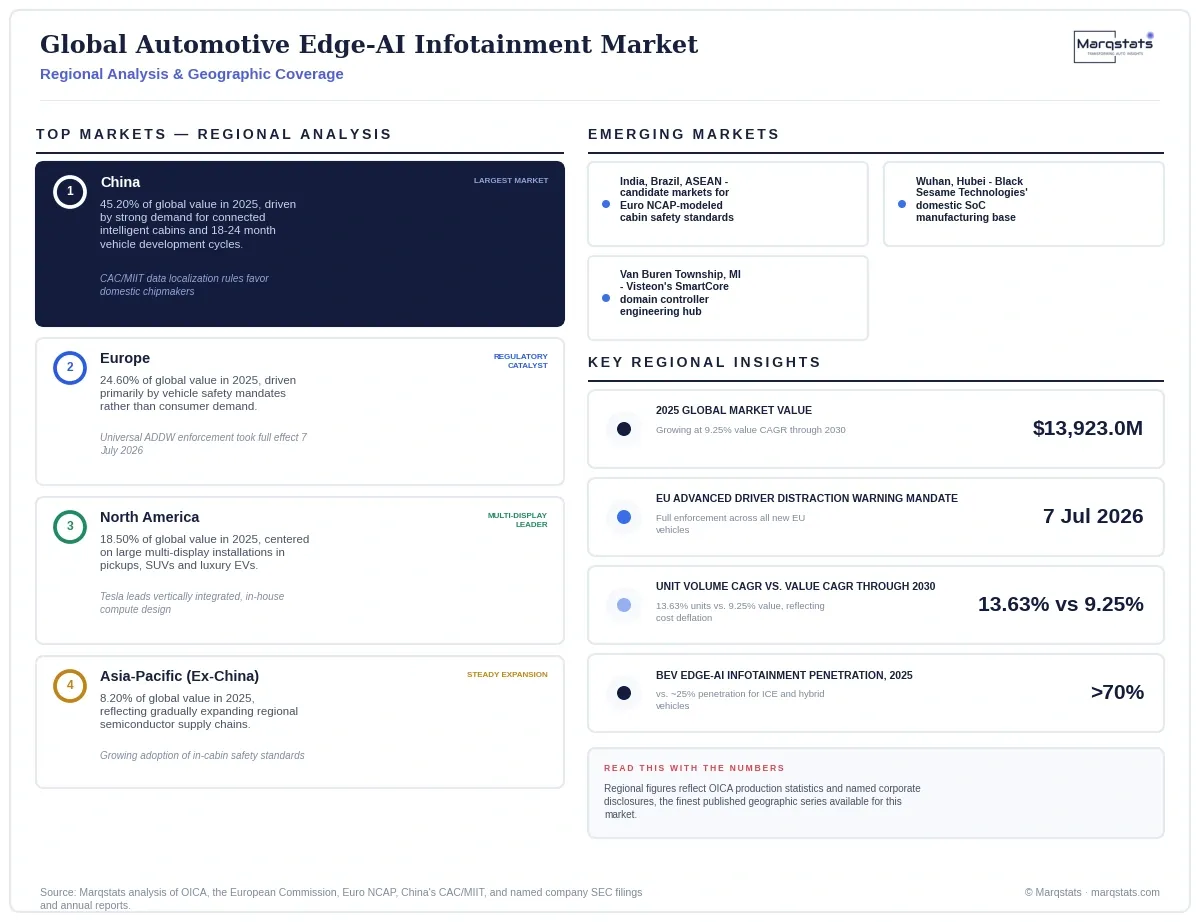
The global automotive edge-AI infotainment market grew from $2,352.2 million in 2021 to $13,923.0 million in 2025, a compound annual growth rate of 55.98% across the historical window, and is projected to reach $21,666.0 million by 2030, a 9.25% compound annual growth rate. This growth reflects the architectural transition from distributed, discrete electronic control units and projection-based smartphone mirroring toward centralized cockpit domain controllers with dedicated neural processing hardware, driven directly by statutory driver-monitoring mandates and the broader shift toward software-defined vehicle platforms.
The Base Case Scenario assumes timely statutory enforcement of Commission Delegated Regulation (EU) 2023/2590 on 7 July 2026 across all EU Member States, requiring all newly registered light vehicles to feature optical Advanced Driver Distraction Warning systems, alongside continued expansion of on-device generative AI voice assistance across mid-tier vehicles, yielding global installations of 62.80 million units (66.46% penetration) and a market value of $21,666.0 million at a system average selling price of $345. The Upside Case Scenario, reaching $25,450.0 million, is triggered by rapid consolidation toward single-box vehicle compute platforms and major developing automotive markets including India, Brazil and ASEAN member states adopting in-cabin safety standards modeled on Euro NCAP 2026 protocols, expanding the addressable base by 7.4 million units. The Downside Case Scenario, reaching only $18,150.0 million, is triggered by temporary 2026 phase-in waivers granted to OEMs for the universal ADDW mandate combined with persistent ASIL-B and ASIL-D mixed-criticality software integration delays.
Market Dynamics
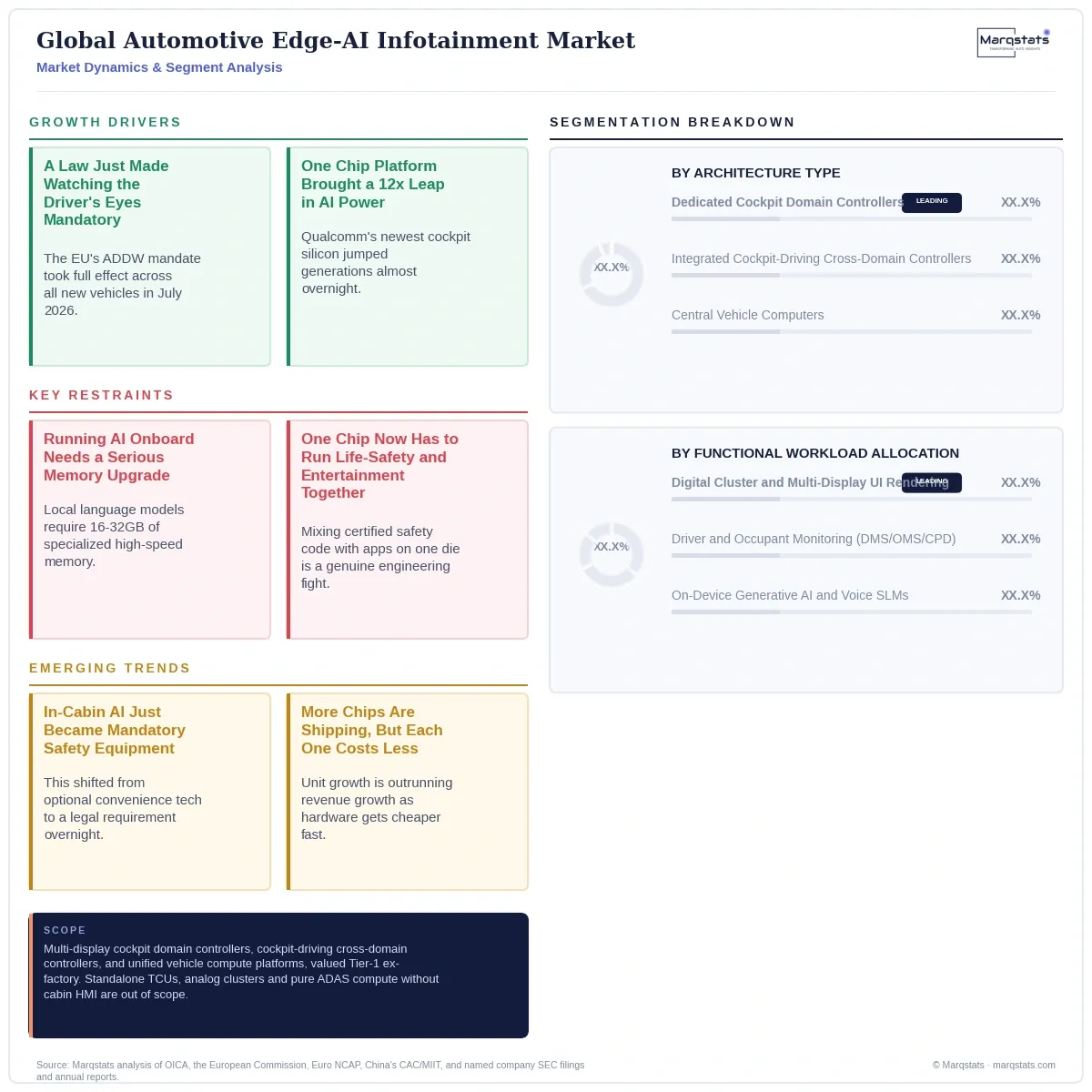
Key Drivers
- Statutory driver-monitoring mandates anchor baseline demand independent of consumer discretionary spending, exemplified by the European Union's General Safety Regulation II requiring Driver Drowsiness and Attention Warning systems for all newly registered vehicles since 7 July 2024 and expanding to universal Advanced Driver Distraction Warning enforcement on 7 July 2026, applying to passenger, commercial and light commercial vehicle segments across all 27 EU Member States.
- Merchant semiconductor providers are consolidating cockpit and driving-assistance workloads onto unified compute platforms, exemplified by Qualcomm Technologies, Inc.'s Snapdragon Cockpit Elite and Snapdragon Ride Elite platforms, unveiled in October 2024, delivering up to a 12-fold increase in neural processing capability to power digital cockpits, multi-modal generative AI and Level 2+ driver-assistance workloads within a single compute module.
- Domestic Chinese semiconductor providers are deploying comparable cross-domain architectures at lower cost points, exemplified by Black Sesame Technologies' Wudang C1200 and C1296 system-on-chip platforms and Horizon Robotics' Agentic CAR family, combining automated parking and highway assistance with digital cockpit displays on a single die, supporting China's 18-to-24-month vehicle development cadence.
- Consumer expectations for offline generative voice assistance are expanding compute allocation toward on-device language model processing, exemplified by Google LLC's integration of on-device generative AI capabilities directly into Android Automotive OS, enabling offline message summarization, navigation destination extraction and complex vehicle voice commands without persistent cloud connectivity.
- Cost-optimized silicon platforms are extending edge-AI infotainment penetration into the mass-market vehicle segment, exemplified by Qualcomm's Snapdragon 8155 and 8255 series and MediaTek's Dimensity Auto CV-1 and CM-1 chipsets, bringing domain controller bill-of-materials costs into reaching distance for vehicles priced below $25,000.
Key Restraints
- Executing localized language models alongside real-time graphics pipelines requires memory configurations of 16 to 32 gigabytes of unified LPDDR5X memory operating above 6,400 megatransfers per second, a substantial bill-of-materials cost addition that could otherwise offset the semiconductor cost deflation driving broader market penetration into mass-market vehicle segments.
- Mixed-criticality software integration presents genuine engineering complexity, since ASIL-B digital instrument clusters and, in cockpit-driving fusion architectures, ASIL-D automated driving functions must operate alongside uncertified Quality Management-grade infotainment applications on the same physical silicon die, requiring Type-1 automotive hypervisors capable of hardware-enforced isolation to prevent safety-critical threads from being disrupted by non-critical application failures.
- Cabin-facing sensors and interior microphones have prompted strict data privacy and localization mandates, exemplified by China's Cyberspace Administration and Ministry of Industry and Information Technology enforcing in-vehicle processing as the mandatory default for all cabin sensory data, prohibiting any off-board transfer of facial geometric vectors, voice patterns or passenger cabin recordings without statutory regulatory approval.
- Thermal constraints within passively cooled cockpit enclosures, typically limited to 15 to 35 watts, restrict how much neural processing performance can be packed into a single domain controller without active cooling, forcing Tier-1 systems integrators to manage genuine trade-offs between compute density, safety certification, and enclosure design within a fixed thermal budget.
Key Trends
- The European Union's phased General Safety Regulation II enforcement timeline, from Driver Drowsiness and Attention Warning in July 2024 to universal Advanced Driver Distraction Warning in July 2026, demonstrates that automotive safety regulation has become a genuine, structural demand anchor for edge-AI compute hardware, decoupling meaningful portions of market growth from discretionary consumer electronics spending cycles.
- The divergence between the market's 13.63% unit volume compound annual growth rate and its considerably lower 9.25% value compound annual growth rate through 2030 demonstrates that this market is experiencing genuine hardware commoditization even as physical adoption accelerates, meaning revenue-focused market participants face a structurally different growth trajectory than volume-focused participants.
- China's data localization enforcement under the Cyberspace Administration and Ministry of Industry and Information Technology, requiring in-vehicle processing as the mandatory default for cabin sensory data, indicates that Chinese domestic semiconductor and software providers hold a structural advantage over Western competitors specifically within China, since Chinese original equipment manufacturers cannot depend on externally hosted processing for cabin biometric and acoustic data under current regulatory constraints.
- The consistency between China's compressed 18-to-24-month vehicle development cadence and its position as the largest regional market at 45.20% of global value indicates that faster product iteration cycles, not merely regulatory pressure or consumer demand alone, are a genuine structural driver of regional edge-AI infotainment adoption rates.
- The requirement for hardware-enforced ISO 26262 ASIL-B safety partitioning within a single system-on-chip, separating safety-critical eye-tracking and instrument cluster functions from non-critical infotainment applications, demonstrates that automotive semiconductor competition in this category increasingly depends on functional safety software architecture as much as raw neural processing performance.
Strategic Implications
For a merchant silicon provider or AI startup entrant, supplying high-TOPS neural processing hardware alone is insufficient to secure automotive design wins; automakers and Tier-1 integrators require complete software enablement packages, including pre-certified ISO 26262 ASIL-B Type-1 hypervisors, standard board support packages optimized for Android Automotive OS, and turnkey vision models compliant with Commission Delegated Regulation (EU) 2023/2590, while hardware architectures must incorporate unified, high-bandwidth LPDDR5X memory subsystems with hardware-enforced memory virtualization to prevent language model processing from consuming bandwidth needed by real-time safety vision pipelines.
For an incumbent Tier-1 systems integrator, direct collaboration between silicon suppliers and automotive OEMs risks reducing traditional suppliers to low-margin contract manufacturers; to protect profitability, Tier-1 suppliers must position themselves as systems integration partners capable of managing tight thermal envelopes between 15 and 35 watts in passive fanless enclosures, integrating multi-panel curved optical displays, and delivering custom model-quantization toolchains that allow OEMs to compress and run proprietary neural networks efficiently on edge neural processing units.
For an automotive original equipment manufacturer, vehicle platform roadmaps must account for the structural shift toward local edge computing, since automakers relying entirely on cloud-tethered artificial intelligence risk regulatory non-compliance in markets with strict data localization laws such as China and face service disruptions in areas with limited cellular connectivity; sourcing strategies should prioritize scalable, pin-compatible system-on-chip families allowing the same base electrical architecture to serve both mass-market vehicles running mandatory safety models and premium trims offering advanced generative AI features, while coordinating digital cockpit development schedules with the July 2026 European enforcement date to maintain uninterrupted access to the EU single market.
Outlook
Base Case Scenario: $21,666.0 million by 2030 (9.25% five-year value CAGR), with global installations reaching 62.80 million units (66.46% penetration). This trajectory assumes timely statutory enforcement of Commission Delegated Regulation (EU) 2023/2590 across all EU Member States without derogation, steady 3.86% annual system average selling price deflation, and expanding on-device generative AI penetration across mid-tier vehicles, with cross-domain Cockpit-Driving controllers accounting for roughly 35% of total domain controller shipments by 2030.
Upside Case Scenario: $25,450.0 million by 2030, with installations reaching 70.20 million units (74.29% penetration). The specific trigger is rapid consolidation toward single-box vehicle compute platforms across both Asian and Western manufacturers, combined with consumer demand for multimodal, 7-billion-parameter on-device language models requiring baseline cockpit memory configurations to scale from 16 gigabytes to 32 or 64 gigabytes of unified LPDDR5X memory, mitigating system average selling price deflation, while major developing automotive markets including India, Brazil and ASEAN member states adopt in-cabin safety standards modeled on Euro NCAP 2026 protocols.
Downside Case Scenario: $18,150.0 million by 2030, with installations restricted to 51.50 million units (54.55% penetration). The specific trigger is regulatory authorities introducing temporary phase-in periods or exemptions for the July 2026 universal Advanced Driver Distraction Warning mandate under pressure from automotive trade associations regarding vehicle production costs, combined with persistent software engineering bottlenecks surrounding mixed-criticality isolation between ASIL-B digital clusters, ASIL-D automated driving functions and uncertified infotainment applications operating on the same single-die system-on-chip, causing OEMs to retain bifurcated, multi-box electronic control unit architectures.
Market Segmentation
Dedicated Cockpit Domain Controllers represent the majority of market value at $9,467.6 million (68.00% share) in 2025, projected to reach $11,916.3 million by 2030, since legacy automotive manufacturers often maintain separate engineering divisions for infotainment and chassis safety systems, sustaining demand for standalone cockpit-focused compute modules.
Integrated Cockpit-Driving Cross-Domain Controllers accounted for $3,619.9 million (26.00% share) in 2025, expanding rapidly to $7,583.1 million by 2030, particularly among Chinese New Energy Vehicle manufacturers aiming to lower bill-of-materials costs and eliminate secondary wiring harnesses by consolidating cockpit and driving-assistance functions onto a single compute module.
Central Vehicle Computers, consolidating infotainment, ADAS and body gateway functions into a centralized server paired with peripheral zonal controllers, represent the fastest-growing architectural segment at $835.5 million (6.00% share) in 2025, expanding to $2,166.6 million by 2030, though remaining concentrated in premium, software-defined vehicle programs.
Digital cluster and multi-display user interface rendering commands the largest workload share at $5,012.3 million (36.00% share) in 2025, reaching $6,066.5 million by 2030, reflecting the baseline compute demand of instrument cluster graphics and navigation displays that every edge-AI cockpit controller must support regardless of additional safety or voice functionality.
Driver and occupant monitoring workloads, spanning DMS, OMS and Child Presence Detection functions, accounted for $4,455.4 million (32.00% share) in 2025, expanding to $7,366.4 million by 2030, driven directly by European General Safety Regulation II mandates and Euro NCAP 2026 testing requirements that make optical driver-state monitoring a statutory compliance function.
On-device generative AI and voice small language models represent the fastest-growing workload category at $2,506.1 million (18.00% share) in 2025, expanding to $5,416.5 million by 2030, as automakers transition from basic keyword recognition systems toward responsive, offline conversational agents requiring substantially higher unified memory bandwidth.
Battery Electric Vehicles demonstrate the highest edge-AI infotainment penetration rate, exceeding 70% globally in 2025, since high-voltage battery systems easily accommodate the electrical and thermal profiles of multi-screen compute platforms, and consumer expectations within this segment favor advanced digital interfaces as a differentiating purchase factor.
Internal combustion engine and hybrid vehicles currently show a lower penetration rate of roughly 25%, but represent a large portion of absolute unit growth through 2030, since European General Safety Regulation II mandates require Advanced Driver Distraction Warning compliance across all passenger vehicle powertrains regardless of propulsion type.
By Geography
China
China is the largest regional market for edge-AI infotainment, accounting for $6,293.2 million (45.20% share) in 2025 and projected to reach $9,100.0 million by 2030, reflecting strong consumer demand for connected intelligent cabins and vehicle development cadences of 18 to 24 months, roughly half the historical duration common among Western legacy automakers, with the Cyberspace Administration and Ministry of Industry and Information Technology's in-vehicle processing mandate accelerating adoption of domestic semiconductor platforms.
Europe
Europe represents the second-largest market at $3,425.0 million (24.60% share) in 2025, projected to reach $5,850.0 million by 2030, with growth driven primarily by vehicle safety mandates rather than consumer electronics demand, as the universal Advanced Driver Distraction Warning registration deadline under Regulation (EU) 2019/2144 took effect 7 July 2026 across all 27 EU Member States.
North America
North America generated $2,575.8 million (18.50% share) in 2025, with adoption centered around large multi-display installations in full-size pickup trucks, large SUVs and luxury electric vehicles, and automakers including General Motors, Ford Motor Company and Stellantis N.V. utilizing centralized compute architectures to deploy software-defined vehicle features and generate software subscription revenue.
Asia-Pacific (Ex-China)
Asia-Pacific excluding China accounted for $1,141.7 million (8.20% share) in 2025, projected to reach $1,841.5 million by 2030, reflecting steadily expanding regional semiconductor supply chains and gradual adoption of in-cabin safety standards across Japan, South Korea and Southeast Asian automotive markets.
Rest of World
The Rest of World region accounted for $487.3 million (3.50% share) in 2025, projected to reach $758.0 million by 2030, maintaining a steady 3.50% share as vehicle connectivity infrastructure gradually modernizes across Latin America, the Middle East and other emerging automotive markets.
How Competition Is Evolving
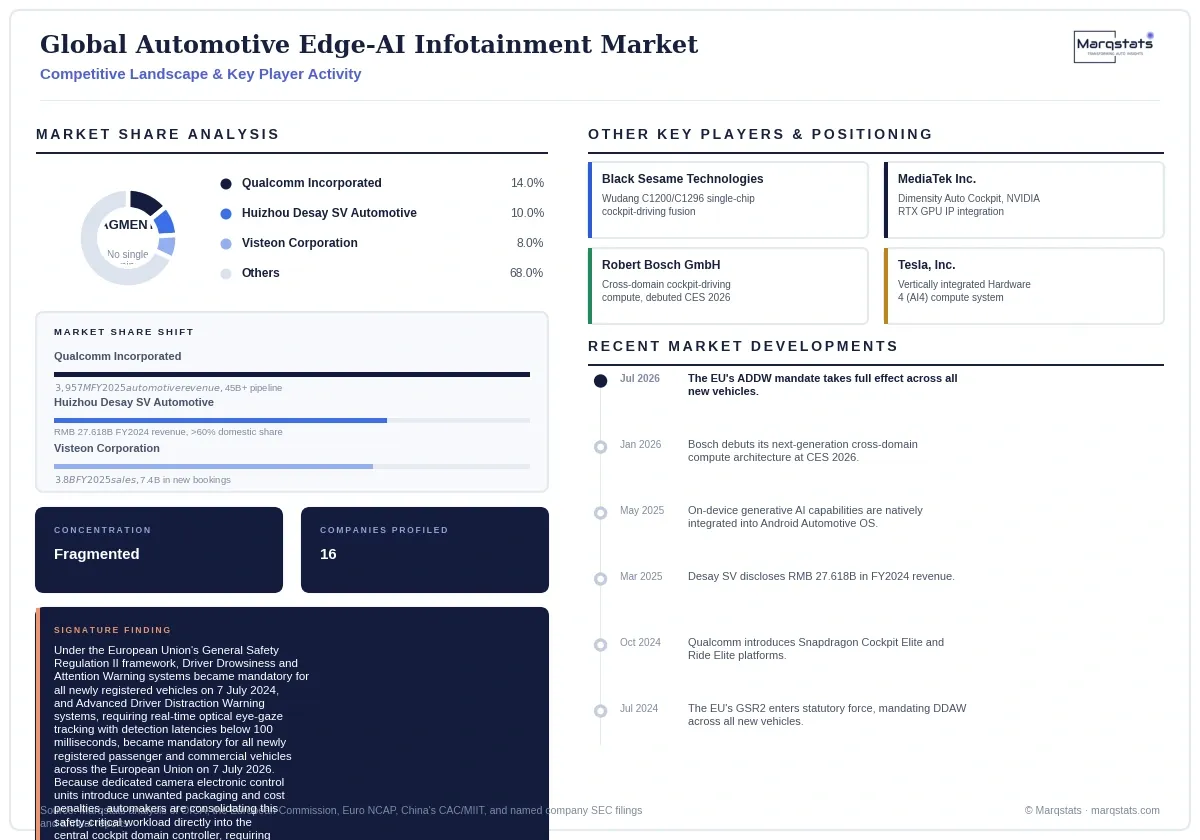
The global automotive edge-AI infotainment value chain is defined by interactions between merchant fabless semiconductor suppliers controlling chip design and neural acceleration intellectual property, and Tier-1 automotive systems integrators managing carrier board engineering, thermal packaging and functional safety certification; Qualcomm Incorporated maintains a leading position in digital cockpit platforms via its Snapdragon 8155 and 8295 systems-on-chip, supported by an automotive design-win pipeline exceeding $45 billion and fiscal year 2025 automotive segment revenue of $3,957 million.
Firms compete differently by tier: merchant silicon providers compete on power efficiency, neural processing performance per watt, and functional safety isolation capability, exemplified by Qualcomm's Snapdragon Cockpit Elite bringing custom Oryon CPU architectures into volume vehicle programs; Chinese fabless suppliers including Black Sesame Technologies and Horizon Robotics compete on cost-effective, single-chip Cockpit-Driving fusion solutions; and Tier-1 systems integrators including Huizhou Desay SV Automotive, Visteon Corporation and Robert Bosch GmbH compete on thermal packaging, functional safety hypervisor integration and vehicle homologation expertise.
The most significant recent competitive-landscape development is Robert Bosch GmbH debuting its next-generation cross-domain cockpit-driving central compute architecture at CES 2026 in Las Vegas in January 2026, demonstrating single-box consolidation of digital cockpit, interior vision and Level 2 automated parking functions, illustrating how established Tier-1 suppliers are directly responding to the industry-wide shift toward unified compute platforms.
Companies Covered
The report profiles 16+ companies with full strategy and financials analysis, including:
Recent Market Activity
Table of Contents
Coverage & Segmentation
Coverage spans the global automotive edge-AI infotainment market, encompassing multi-display digital cockpit domain controllers, consolidated vehicle compute platforms integrating infotainment with cabin monitoring, and unified cockpit-driving cross-domain controllers, valued on a Tier-1 ex-factory module wholesale basis. The market is sized in USD across a 2021-2025 historical period and a 2026-2030 forecast period, with 2025 as the base year. Three segmentation dimensions are quantified: architecture type, functional workload allocation, and vehicle propulsion type.
Excluded from scope: standalone telematics control units lacking graphics rendering engines, analog or segmented-LCD instrument clusters, mechanical center-console head units, aftermarket consumer electronics lacking vehicle bus integration, and pure autonomous driving computing platforms operating without cabin human-machine interface integration. A separate Marqstats study addresses the global connected car market on a comparable basis.