Market Snapshot
Key Takeaways
Market Overview & Analysis
Report Summary
This analysis sizes the European automotive telematics and connected data management market, encompassing OEM-fitted and aftermarket telematics hardware, cloud infrastructure, edge processing, applied analytics, and governance and security systems across passenger and commercial vehicles. The market is sized in USD across a 2025 base year and a 2026-2034 forecast period. Segmentation spans sales channel, end-user segment, service category, and technology layer, each independently quantified against the 2025 baseline.
The European automotive data management market reached USD 19.60 billion in 2025 and is projected to grow to USD 22.49 billion in 2026, reaching USD 67.47 billion by 2034, a 14.72% compound annual growth rate across the forecast period. This growth reflects the vehicular data lifecycle's evolution from an aftermarket telemetry niche into a central enterprise infrastructure layer, propelled by the transition toward software-defined vehicles, proliferating embedded telematics control units, and the EU Data Act's mandate for regulated third-party data access.
The base-case 2034 forecast of USD 67.47 billion assumes the managed application of Regulation (EU) 2023/2854 across member states without triggering systemic litigation, functional OEM cloud API gateways supplying telemetry to authorized third parties under FRAND cost-recovery models, and Cofinity-X's continued expansion across Tier 1 and Tier 2 supply networks satisfying battery passport compliance requirements. The binding upside condition, reflected in the market's own Accelerated Unbundling scenario reaching USD 78.50 billion, is whether the European Union enacts dedicated sector-specific legislation mandating standardized, low-latency on-board application interfaces by late 2026; the binding downside condition, reflected in a Defensive Encapsulation scenario reaching only USD 48.20 billion, is whether automakers successfully use UNECE R155 cybersecurity mandates to restrict third-party access, triggering FRAND pricing litigation in national courts that slows Data Act enforcement.
Market Dynamics
Key Drivers
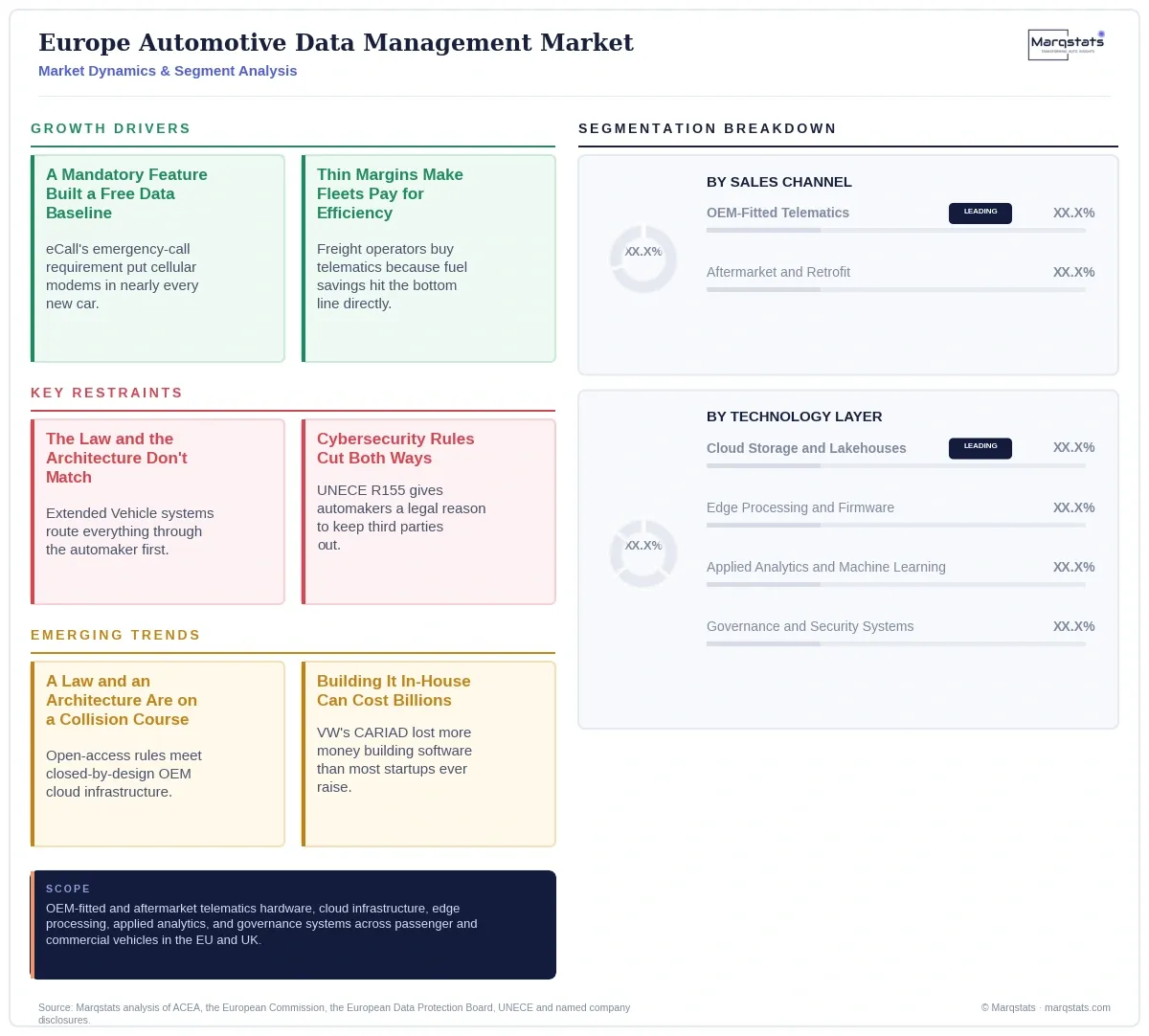
- Mandatory eCall connectivity under Regulation (EU) 2015/758 has driven embedded cellular modems across the overwhelming majority of new European passenger car sales, establishing a standardized telematics baseline that automakers and third-party service providers can build additional connected services on top of without separate hardware installation.
- Commercial fleet operators, accounting for 55.71% of 2025 market revenue, sustain premium telematics spending because narrow operating margins in road freight create direct financial incentives to reduce fuel consumption, monitor driver behavior, automate maintenance scheduling, and prevent unscheduled vehicle downtime across European road freight activity exceeding 1,867 billion tonne-kilometres annually.
- The EU Data Act's mandate for free, real-time, and FRAND-priced third-party access to vehicle telemetry, enforceable since 12 September 2025, is opening a genuinely new addressable market for independent repairers, replacement component manufacturers, and multi-brand fleet aggregators previously excluded from direct vehicle data access under proprietary OEM architectures.
- Sovereign industrial data spaces, exemplified by the Catena-X ecosystem operated by Cofinity-X GmbH since January 2023, are extending automotive data governance beyond vehicle telemetry into multi-tiered supply chains, driven by EU Battery Regulation digital passport requirements and Corporate Sustainability Due Diligence Directive component lifecycle tracking obligations.
- Edge computing architectures compressing raw sensor output by a factor exceeding 6,800 to 1, exemplified by BMW Group's Cloud Data Hub processing 110 terabytes of curated telemetry daily from 20 million vehicles, have made mass-market connected vehicle data pipelines commercially sustainable despite continuous raw generation of up to 25 gigabytes per operating hour per vehicle.
Key Restraints
- Automakers have built Extended Vehicle architectures that route all vehicle telemetry through proprietary OEM cloud servers before any third party can access it, a structural design choice industry coalitions AFCAR and CLEPA argue directly conflicts with the EU Data Act's mandate for real-time, non-discriminatory third-party access, since third-party operators must query the automaker's back-end server under manufacturer-controlled sampling frequencies and latency profiles.
- Automakers cite UNECE Regulations R155 and R156 cybersecurity type-approval obligations to justify restricting direct third-party access to internal vehicle CAN and Ethernet buses, creating a genuine and unresolved tension between the EU Data Act's open-access mandate and vehicle manufacturers' statutory cybersecurity responsibility to prevent unauthorized access to steering, braking and powertrain control systems.
- The average age of European Union passenger cars reached 12.7 years in 2024, with commercial heavy-duty trucks averaging 14.1 years and reaching 22.6 years in Greece, forcing automotive data platforms to support legacy OBD-II diagnostic protocols and retrofitted aftermarket hardware alongside modern cloud-native architectures across Southern, Central and Eastern Europe specifically.
- Neither vehicle manufacturers nor regulatory bodies publish standardized price schedules, per-API call fees, or volume discount rates for B2B vehicle data agreements, leaving the market definition of fair, reasonable and non-discriminatory commercial terms under the EU Data Act genuinely untested in public forums as of this analysis.
Key Trends
- The structural conflict between the EU Data Act's open-access mandate and automakers' Extended Vehicle architecture represents a genuine, unresolved regulatory and commercial dispute rather than a routine compliance transition, since the two frameworks impose fundamentally different technical requirements: one demands real-time, low-latency third-party access while the other channels all data through manufacturer-controlled infrastructure with manufacturer-set latency and sampling parameters.
- Volkswagen's CARIAD SE experience, recording a widening operating loss of negative 2,392 million euros in fiscal year 2023 against a parent group generating 22,600 million euros in consolidated operating profit, demonstrates that in-house proprietary software and data platform development carries substantial, sustained financial risk even for Europe's largest automakers, a pattern that has already prompted Volkswagen to pursue external software partnerships with Rivian Automotive and Mobileye.
- The market's own three-scenario framework discloses that European automotive data management's growth trajectory depends more heavily on which of three specific legal and technical architectures prevails, managed FRAND integration, accelerated regulatory unbundling, or defensive OEM encapsulation under cybersecurity justification, than on underlying vehicle sales volume or connectivity technology adoption curves alone.
- Sovereign industrial data spaces like Catena-X demonstrate that European automotive data governance is expanding beyond consumer vehicle telemetry into multi-tiered industrial supply chains, driven by genuinely distinct regulatory pressures, EU Battery Regulation digital passport requirements and Corporate Sustainability Due Diligence Directive component tracking, that operate independently of the consumer data access debate.
- The European Commission's publication of automotive-specific implementation guidance on 12 September 2025, clarifying which vehicle data categories must be shared under the Data Act, followed by a further design-obligation deadline of 12 September 2026 requiring new connected products to be built for direct third-party access, indicates that full practical enforcement of open vehicle data access is a multi-year phased process rather than a single enforcement date.
Strategic Implications
For an automotive OEM, continuing to invest primarily in proprietary, closed Extended Vehicle architectures carries genuine regulatory and litigation risk given the EU Data Act's FRAND access mandate; manufacturers should prioritize standardized, secure cloud API gateways that satisfy compliance requirements while directing remaining engineering resources toward differentiated proprietary services, such as certified battery health verification and brand-specific driver assistance, where system integration capability provides a durable competitive advantage independent of raw data access rights.
For a public cloud hyperscaler, opportunity lies in moving beyond generic compute and storage infrastructure toward domain-specific edge-to-cloud automotive solutions that solve the specific technical problem of compressing 15 to 25 gigabytes of hourly raw sensor data into commercially viable cellular transmission volumes; hyperscalers that replicate the BMW Cloud Data Hub or Continental CAEdge model of pre-integrated, compliance-ready platforms can secure long-term automotive enterprise contracts that generic infrastructure providers cannot.
For an independent aftermarket operator or fleet aggregator, the EU Data Act's enforcement creates a genuine, time-limited opportunity to operationalize statutory data access rights; rather than continuing to rely on physical OBD-II dongles and aftermarket hardware, independent service providers should form industry consortia, following the AFCAR and CLEPA model, to ingest and normalize standardized B2B telemetry feeds directly from OEM cloud platforms as design-obligation compliance takes effect through September 2026 and beyond.
Outlook
Base case (Managed FRAND Integration): USD 67.47 billion by 2034 (14.72% CAGR from the 2026 baseline of USD 22.49 billion). This trajectory assumes the European Union's Regulation (EU) 2023/2854 applies smoothly across member states without triggering systemic litigation, automakers establish functional cloud API gateways under reasonable FRAND cost-recovery terms, and Cofinity-X's Catena-X ecosystem continues expanding across Tier 1 and Tier 2 supply networks.
Upside case (Accelerated Unbundling): USD 78.50 billion by 2034 (16.94% CAGR from the 2026 baseline). The specific trigger is enactment of dedicated, sector-specific European Union legislation on in-vehicle data, functions and resources by late 2026, mandating standardized on-board application container runtimes and low-latency in-vehicle interfaces that allow authorized third-party software to execute within vehicle compute environments without routing through OEM cloud servers at all.
Downside case (Defensive Encapsulation): USD 48.20 billion by 2034 (9.99% CAGR from the 2026 baseline). The specific trigger is automakers successfully using UNECE R155 cybersecurity mandates and intellectual property law to classify vehicle telemetry as critical control data exempt from open API sharing, triggering FRAND pricing disputes and litigation in national courts that materially slows Data Act enforcement and keeps vehicle data locked within proprietary OEM ecosystems.
Market Segmentation
OEM-fitted telematics accounted for 70.41% of 2025 market value (USD 13.80 billion), as vehicle manufacturers integrated cellular connectivity directly into chassis electronic control units and central vehicle gateways under the mandatory eCall connectivity baseline, establishing direct, factory-level data generation across the overwhelming majority of new vehicle registrations.
Aftermarket and retrofit telematics held 29.59% of 2025 market value (USD 5.80 billion), sustaining stable revenue by providing external connectivity hardware and fleet software, including OBD-II dongles and modems, to older vehicle fleets concentrated across Southern, Central and Eastern Europe where average vehicle age exceeds 12 years.
Commercial fleet operators generated 55.71% of 2025 market revenue (USD 10.92 billion), the largest end-user segment, driven by narrow operating margins in road freight that create sustained demand for telematics applications reducing fuel consumption, monitoring driver behavior, and preventing unscheduled downtime across European freight activity exceeding 1,867 billion tonne-kilometres annually.
Consumer and private mobility generated 44.29% of 2025 market revenue (USD 8.68 billion), spanning in-cabin infotainment, connected navigation and usage-based insurance services, though vehicle manufacturers continue facing lower conversion rates for direct-to-consumer software subscriptions given constrained driver willingness to pay recurring fees.
Cloud storage and lakehouses captured 36.99% of 2025 market value (USD 7.25 billion), the largest technology layer, spanning scalable ingestion clusters, enterprise lakehouses and cold storage archives exemplified by BMW Group's 20-petabyte Cloud Data Hub governing 6,400 internal data assets on Amazon Web Services.
Edge processing and firmware held 28.01% of 2025 market value (USD 5.49 billion), covering in-vehicle high-performance compute, microcontrollers and parsing runtimes that execute the local filtering achieving a data compression ratio exceeding 6,800 to 1 before cellular transmission.
Applied analytics and machine learning held 21.02% of 2025 market value (USD 4.12 billion), covering ingested telemetry transformation, driver scoring and neural network training that powers predictive maintenance and fleet optimization applications across commercial and consumer segments.
Governance and security systems held 13.98% of 2025 market value (USD 2.74 billion), the smallest but fastest-growing compliance-driven layer, covering identity verification, cryptographic key storage and privacy pseudonymization required under GDPR and UNECE R155 cybersecurity type-approval obligations.
By Geography
Germany
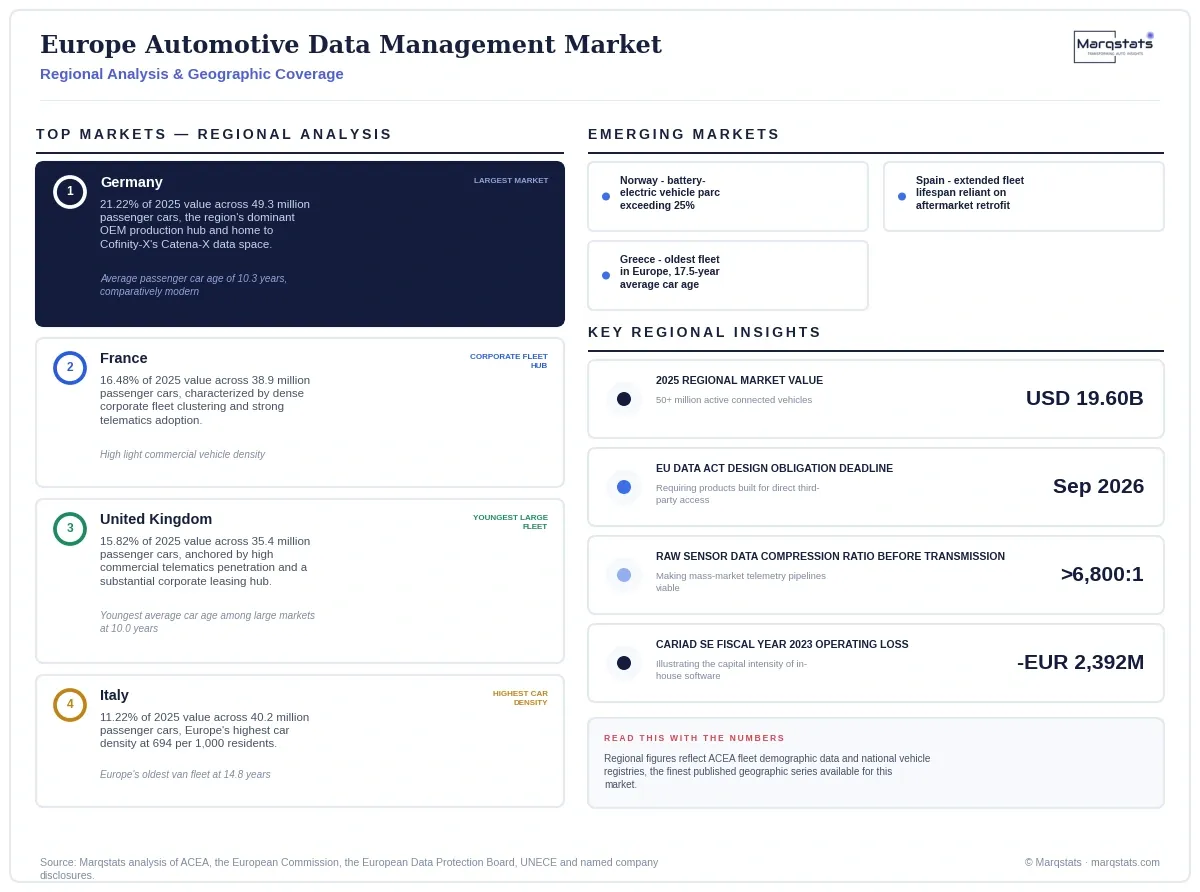
Germany leads the European market with 21.22% of 2025 value (USD 4.16 billion) across 49.3 million passenger cars, functioning as the region's dominant OEM production hub and the headquarters location for Cofinity-X's Catena-X data space, with an average passenger car age of 10.3 years reflecting a comparatively modern fleet.
France
France accounts for 16.48% of 2025 value (USD 3.23 billion) across 38.9 million passenger cars, characterized by dense corporate fleet clustering, high light commercial vehicle density, and strong telematics adoption supporting an average passenger car age of 10.8 years.
United Kingdom
The United Kingdom holds 15.82% of 2025 value (USD 3.10 billion) across 35.4 million passenger cars, anchored by high commercial telematics penetration, a substantial corporate leasing hub, and logistics optimization demand, with the region's youngest large-market average car age at 10.0 years.
Italy
Italy represents 11.22% of 2025 value (USD 2.20 billion) across 40.2 million passenger cars, the highest car density in Europe at 694 vehicles per 1,000 residents, though the fleet skews older, with an average passenger car age of 12.8 years and Europe's oldest van fleet at 14.8 years.
Spain, the Nordic Region and Rest of Europe
Spain holds 9.49% of 2025 value (USD 1.86 billion) across 25.6 million passenger cars with an extended fleet lifespan averaging 14.2 years, relying heavily on aftermarket retrofit hardware; the Nordic Region holds 8.52% (USD 1.67 billion), serving as Europe's electrification hub with Norway's battery-electric vehicle parc exceeding 25%; and the remaining Rest of Europe accounts for 17.24% (USD 3.38 billion), where fleet aging is most acute, with Greek passenger cars averaging 17.5 years and trucks averaging 22.6 years.
How Competition Is Evolving
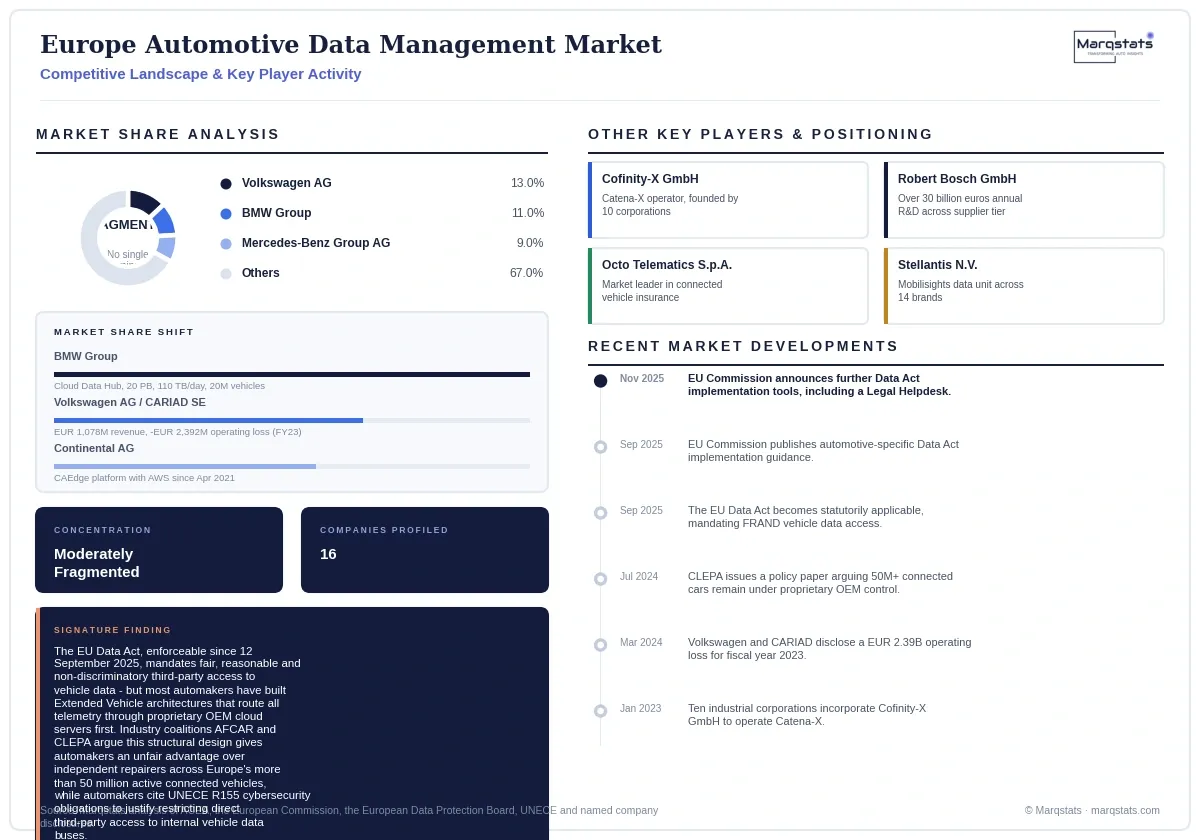
The European automotive data management market is moderately fragmented across automotive OEMs, Tier 1 suppliers, and cloud hyperscalers, with no single vendor commanding dominant share: automakers including Volkswagen AG, BMW Group, Mercedes-Benz Group AG and Stellantis N.V. each operate largely proprietary software and telematics units, while Amazon Web Services and Microsoft Azure supply cloud infrastructure across multiple competing OEM programs simultaneously.
Firms compete differently by tier: automakers compete on proprietary software architecture and first-party service bundling, exemplified by Mercedes-Benz Group's in-house MB.OS platform against Volkswagen's externally-partnered CARIAD SE approach, Tier 1 suppliers including Continental AG and Robert Bosch GmbH compete on edge-to-cloud platform integration such as the CAEdge development environment, and commercial telematics vendors including Geotab, Octo Telematics and Trimble compete on fleet-specific analytical depth rather than broad consumer connectivity.
The most significant recent competitive-landscape development is the consolidation of European industrial data governance around Cofinity-X GmbH, founded in January 2023 by ten automotive and industrial corporations including BMW Group, Mercedes-Benz Group, Volkswagen AG, BASF, Schaeffler, ZF Friedrichshafen, SAP, Siemens and T-Systems, establishing the commercial operating entity for the Catena-X sovereign data space now central to EU Battery Regulation and Corporate Sustainability Due Diligence Directive compliance.
Companies Covered
The report profiles 16+ companies with full strategy and financials analysis, including:
Recent Market Activity
Table of Contents
Coverage & Segmentation
Coverage spans the European automotive telematics and data management market, encompassing OEM-fitted and aftermarket telematics hardware, cloud infrastructure, edge processing, applied analytics, and governance and security systems across passenger and commercial vehicles in the European Union and the United Kingdom. The market is sized in USD across a 2025 base year and a 2026-2034 forecast period. Three segmentation dimensions are quantified: sales channel, end-user segment, and technology layer.
Excluded from scope: raw vehicle hardware manufacturing costs outside the telematics and data layer, cellular carrier connectivity transport fees billed directly by mobile network operators, and third-party insurance underwriting premiums beyond usage-based insurance telemetry services. Standalone connected-vehicle counts are calibrated against trade association models and hyperscaler client disclosures rather than statutory national registries, a disclosed data limitation this analysis addresses through triangulated sourcing. A separate Marqstats study addresses the United States automotive data management market on a comparable basis.