Market Snapshot
Key Takeaways
Market Overview & Analysis
Report Summary
This analysis sizes the United States automotive data management market as enterprise software platforms, cloud infrastructure services, edge computing middleware, and specialized telematics ingestion pipelines that ingest, normalize, store, govern, and analyze vehicle-generated datasets, covering recurring SaaS subscriptions, consumption-based PaaS cloud billing, and edge-to-cloud middleware licensing. The market is built from verified public software segment filings and official operational disclosures from primary enterprise participants, calibrated against Bureau of Transportation Statistics and Federal Highway Administration vehicle registration data. The market is sized in USD across a 2020-2024 historical period and a 2025-2029 forecast period, with 2024 as the base year.
The United States automotive data management market grew from USD 3,245.00 million in 2020 to USD 6,284.00 million in 2024, an 17.97% compound annual growth rate, and is projected to reach USD 14,412.00 million by 2029, an 18.06% compound annual growth rate. This growth occurred alongside, not despite, the near-total regulatory destruction of secondary data brokerage as a revenue stream: the Federal Trade Commission's consent order against General Motors and a record California settlement together consumed 63.75% of GM's cumulative broker proceeds, while the market's own analysis shows this enforcement redirected automotive data investment toward first-party fleet management SaaS, exemplified by Ford Pro's 650,000 commercial subscriptions monetized without comparable regulatory friction.
The base-case 2029 forecast of USD 14,412.00 million assumes continued expansion of commercial fleet telematics adoption, ongoing architectural transition from legacy distributed electronic control units toward centralized zonal domain compute controllers, and increasingly stringent federal incident reporting mandates under NHTSA Standing General Order 2021-01. The binding upside condition is whether Congress passes the federal SECURE Data Act introduced in April 2026, which would establish a uniform national privacy standard and data-broker registry potentially reducing the compliance fragmentation costs automakers currently face across more than twenty state privacy laws; the binding downside condition is whether continued state-level enforcement actions, following the Texas Attorney General's litigation against General Motors and the California Privacy Protection Agency's ongoing reviews, further chill enterprise willingness to expand connected vehicle data collection beyond core safety and commercial fleet compliance functions.
Market Dynamics
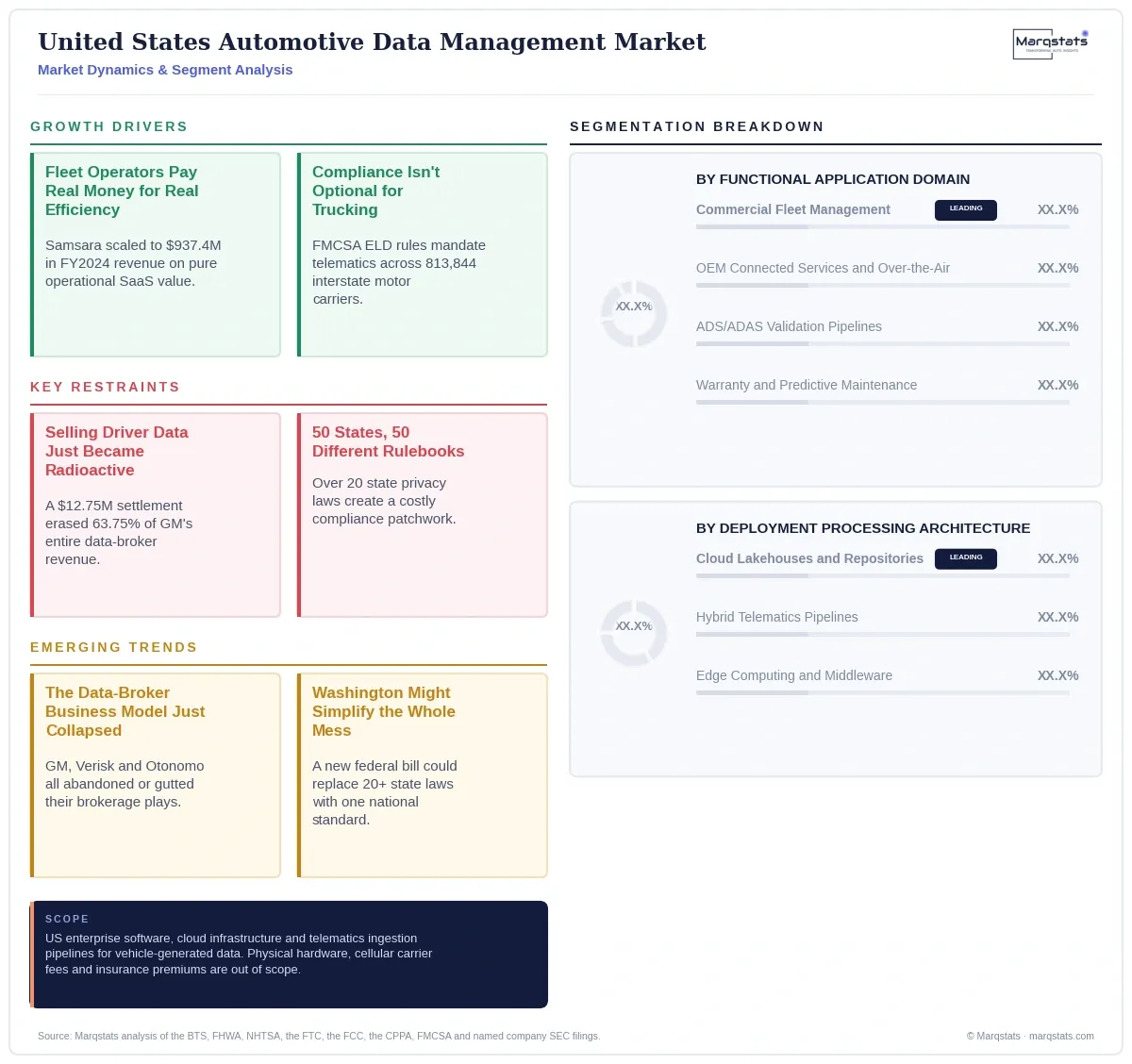
Key Drivers
- Commercial fleet operators sustain high SaaS premiums for telematics data when directly linked to operational efficiency and regulatory compliance: Samsara Inc. scaled to USD 937.40 million in fiscal year 2024 revenue with enterprise software subscriptions representing 98.00% of its overall revenue mix, and Geotab Inc. surpassed 4.00 million active connected vehicle subscriptions globally.
- Federal Motor Carrier Safety Administration Electronic Logging Device requirements create durable, compliance-mandated demand across 813,844 active interstate motor carriers, structurally distinguishing commercial telematics adoption from discretionary consumer connected-services spending that remains far more exposed to privacy-driven regulatory disruption.
- The architectural transition from legacy distributed electronic control units toward centralized zonal domain compute controllers is expanding both the volume and analytical sophistication of vehicle-generated data available for enterprise ingestion, sustaining demand for cloud lakehouse platforms including AWS IoT FleetWise, Snowflake Automotive Data Cloud, and Databricks-based telemetry architectures.
- NHTSA Standing General Order 2021-01 mandates automated capture and reporting of Level 2 ADAS crash incidents within one to five days of occurrence, creating a durable regulatory floor for real-time telemetry infrastructure investment among automakers pursuing advanced driver-assistance system deployment at scale.
- Edge computing middleware providers including BlackBerry QNX, Sonatus, and Sibros have established a commercially viable data attenuation architecture that reduces raw in-vehicle sensor generation of up to 10 terabytes annually per vehicle down to 10 to 50 megabytes of monthly cloud-ingested telemetry, making mass-market connected vehicle data pipelines economically sustainable at scale.
Key Restraints
- Regulatory enforcement has functionally destroyed secondary automotive data brokerage as a viable revenue stream: the Federal Trade Commission's 20-year consent order against General Motors and a record USD 12.75 million California settlement together consumed 63.75% of GM's entire USD 20.00 million cumulative broker revenue earned between 2020 and 2024, establishing a durable legal precedent that materially raises the compliance cost and litigation risk of any comparable data-monetization strategy.
- State-level privacy enforcement fragmentation, spanning more than twenty distinct state comprehensive privacy statutes led by the California Consumer Privacy Act and the Texas Data Privacy and Security Act, imposes substantial compliance overhead on automakers operating nationally, since consent mechanisms and data retention rules vary meaningfully across jurisdictions with no current uniform federal standard.
- Nearly 60% of the national vehicle fleet, 170.40 million of 284.60 million registered vehicles, remains completely unconnected to centralized cloud telematics pipelines, structurally limiting the addressable market for data management software regardless of continued growth within the connected segment.
- Cellular data backhaul fees ranging from USD 0.05 to USD 0.15 per gigabyte over commercial IoT roaming profiles make high-frequency raw CAN bus streaming commercially non-viable for volume passenger vehicle fleets, forcing software vendors to invest heavily in edge-based local feature extraction rather than simpler centralized cloud ingestion architectures.
Key Trends
- The collapse of secondary automotive data brokerage represents a genuine structural realignment of the entire market rather than an isolated General Motors compliance failure: Verisk Analytics' termination of its Driver Behavior scoring product after generating less than USD 1.00 million in annual revenue, and Otonomo's reverse merger with Urgent.ly at a steep valuation discount from its prior USD 1.40 billion capitalization, together demonstrate that data platforms lacking proprietary in-vehicle firmware control cannot sustain viable business models once regulatory scrutiny intensifies.
- Congress's introduction of the federal SECURE Data Act in April 2026 signals a potential inflection point toward regulatory consolidation: a uniform national data-broker registry and privacy standard could meaningfully reduce the multi-jurisdictional compliance burden automakers currently absorb, though the bill's ultimate passage and final provisions remain genuinely uncertain as of this analysis.
- Tesla's disproportionate 85.00% share of NHTSA-reported Level 2 ADAS crash incidents reflects a telemetry architecture advantage rather than an inferior safety record among legacy automakers, meaning federal safety data itself is currently a biased proxy for actual industry-wide ADAS performance until legacy manufacturers achieve comparable automated, continuous crash-reporting infrastructure.
- The 200,000-to-1 edge attenuation ratio between raw sensor generation and actual cloud-ingested telemetry demonstrates that automotive data management economics are fundamentally constrained by cellular and cloud storage costs rather than sensor or computational capability, meaning further market growth depends more on edge software sophistication than on raw data-generation capacity.
- Commercial fleet management's dominance at 49.33% of total market spend, anchored by regulatory-mandated Electronic Logging Device compliance across more than 800,000 interstate motor carriers, demonstrates that durable, compliance-driven enterprise demand has proven structurally more resilient to privacy-driven disruption than discretionary consumer-facing data monetization models.
Strategic Implications
For an enterprise software vendor entering the automotive telematics space, product positioning should emphasize first-party operational value, such as dispatch efficiency, driver safety scoring for internal fleet management, and predictive maintenance, rather than any secondary data-resale revenue stream, given the regulatory environment that has already dismantled comparable business models at General Motors and Verisk Analytics; vendors should also prioritize FMCSA Electronic Logging Device compliance capability to access the durable, compliance-mandated commercial fleet segment.
For an incumbent automotive manufacturer, immediate legal and product review of any existing data-sharing arrangements with consumer reporting agencies or data brokers is essential given the FTC's finalized 20-year consent order against General Motors and California's record USD 12.75 million settlement; manufacturers should invest in first-party connected-services monetization, following Ford Pro's model of nearly 650,000 paid commercial software subscriptions, while building automated, continuous telemetry infrastructure comparable to Tesla's to ensure accurate and timely regulatory safety reporting.
For an enterprise cloud vendor or financial investor, the collapse of independent data aggregators including Otonomo demonstrates that platforms lacking proprietary in-vehicle firmware control face structurally weak long-term viability; investment and partnership strategy should favor vertically integrated OEM programs and specialized commercial SaaS providers such as Samsara and Geotab over standalone secondary data-brokerage ventures, while monitoring the federal SECURE Data Act's legislative progress as a potential near-term catalyst for market consolidation.
Outlook
Base case: USD 14,412.00 million by 2029 (18.06% five-year value CAGR), serving 201.80 million connected vehicles. This trajectory assumes continued expansion of commercial fleet telematics adoption, the ongoing architectural transition toward centralized zonal domain compute controllers, and sustained NHTSA Standing General Order 2021-01 enforcement, without a fundamental change to the current state-by-state privacy enforcement landscape.
Upside case: an accelerated trajectory exceeding the base-case forecast, driven by passage of the federal SECURE Data Act introduced in April 2026. The specific trigger is congressional enactment of a uniform national privacy standard and Federal Trade Commission data-broker registry that reduces the current multi-jurisdictional compliance burden automakers face, potentially freeing enterprise resources currently allocated to state-by-state legal compliance toward expanded first-party connected-vehicle service development.
Downside case: a materially constrained trajectory reflecting continued or intensifying regulatory consent gridlock. The specific trigger is additional state attorneys general, following Texas's litigation against General Motors, pursuing comparable enforcement actions against other automakers, combined with continued telemetry ingestion pipeline failures similar to NHTSA's Audit Query AQ25002 into Tesla, further eroding automaker willingness to expand connected vehicle data collection beyond narrowly defined safety and commercial compliance functions.
Market Segmentation
Centralized cloud platforms captured 41.20% of 2024 market value (USD 2,589.00 million), anchored by hyperscalers including Amazon Web Services, Microsoft Azure and Snowflake, as automotive engineering teams increasingly migrate from proprietary time-series databases toward open table formats such as Apache Iceberg and Apache Parquet to execute distributed queries across petabyte-scale telemetry lakes.
Hybrid telematics pipelines held 34.30% of 2024 market value (USD 2,155.00 million), dominated by fleet software providers including Samsara Inc. and Geotab Inc., which combine on-device edge processing with centralized cloud analytics to balance real-time dispatch responsiveness against cellular backhaul and storage cost constraints.
Edge computing middleware accounted for 24.50% of 2024 market value (USD 1,540.00 million), supported by runtime providers including BlackBerry QNX, Sonatus and Sibros, which execute local feature extraction and data attenuation directly on vehicle hardware to reduce the volume of raw sensor data requiring cellular transmission.
Commercial fleet management represents the largest functional domain at 49.33% of 2024 spend (USD 3,100.00 million), driven by Federal Motor Carrier Safety Administration Electronic Logging Device compliance requirements across 813,844 active interstate motor carriers, real-time dispatch optimization, and predictive maintenance workflows anchored by Samsara Inc. and Trimble Inc.
OEM connected vehicle services accounted for 23.11% of 2024 spend (USD 1,452.00 million), driven by connected safety and firmware-over-the-air platforms including General Motors' OnStar, though this segment faces the most direct regulatory exposure following the Federal Trade Commission's consent order and California's record privacy settlement.
Autonomous driving system and advanced driver-assistance system validation pipelines held 19.92% of 2024 spend (USD 1,252.00 million), driven by perception model training data requirements at companies including Tesla, Inc. and Waymo LLC, and sustained by NHTSA Standing General Order 2021-01's mandatory crash-reporting infrastructure.
Warranty and predictive maintenance software held 7.64% of 2024 spend (USD 480.00 million), anchored by enterprise solutions including Ford Pro Intelligence, representing the smallest but most operationally durable functional domain given its direct linkage to measurable vehicle uptime and service-cost reduction.
Application SaaS dominates the component layer at 61.39% of 2024 spend (USD 3,858.00 million), as enterprise customers prioritize workflow automation and dispatch capabilities through platforms including Samsara Cloud and MyGeotab, reflecting buyer willingness to pay premium pricing for operational software rather than raw data infrastructure.
PaaS ingestion, normalization and time-series lakehouse infrastructure represented 38.61% of 2024 spend (USD 2,426.00 million), providing the foundational data pipelines that clean, decode and index incoming vehicle packets through platforms including AWS IoT FleetWise and Apache Kafka-based streaming architectures.
By Geography
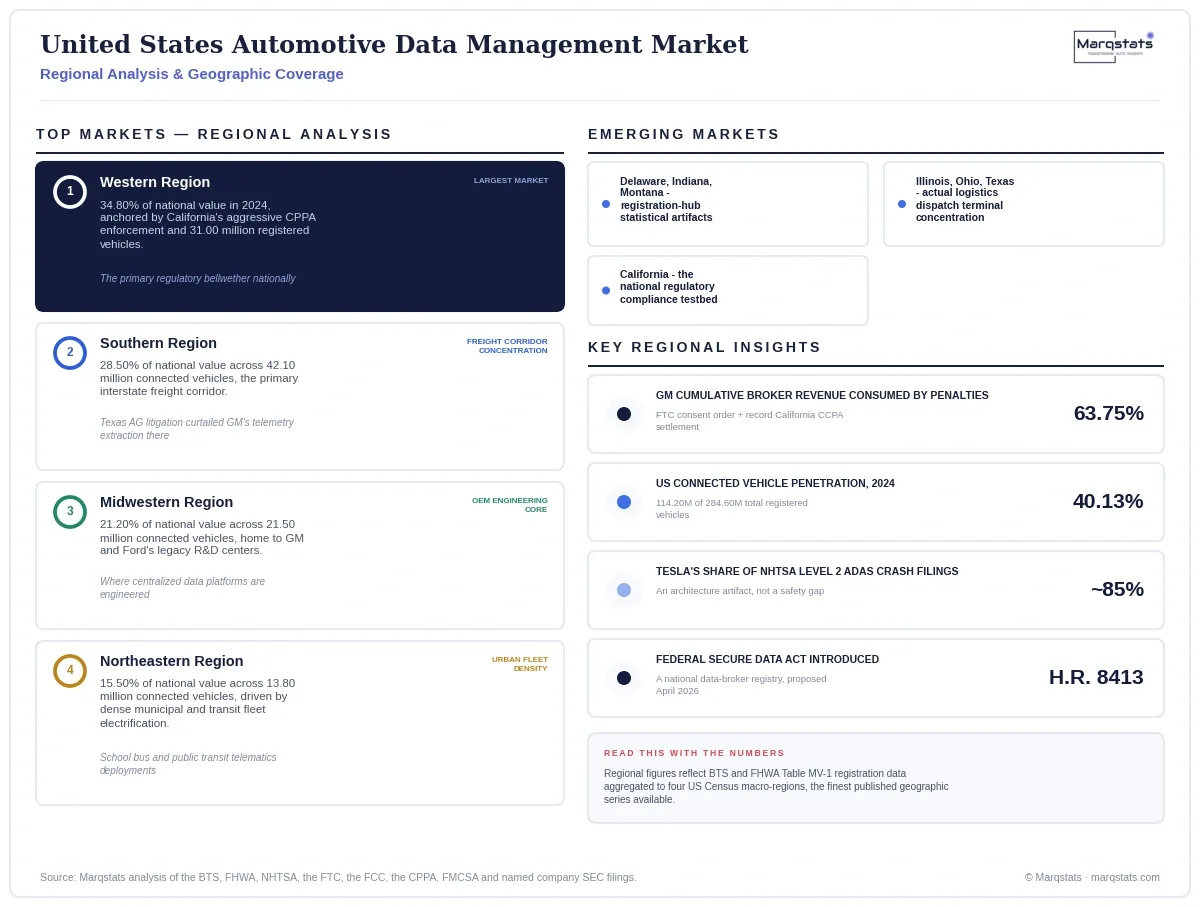
Western Region
The Western region leads the national market with USD 2,187.00 million in 2024 value, representing 34.80% of total spend and an active connected fleet of 36.80 million vehicles. California's fleet, exceeding 31.00 million registered motor vehicles, serves as the regulatory bellwether, since the California Privacy Protection Agency's aggressive enforcement of the California Consumer Privacy Act has forced automakers to reconstruct consumer consent mechanisms nationally, not just within the state.
Southern Region
The Southern region accounts for USD 1,791.00 million in 2024 value (28.50% of total spend) across 42.10 million connected vehicles, representing the primary transit corridor for United States interstate freight and concentrating high-density commercial telematics adoption along major freight arteries; Texas has emerged as an active enforcement jurisdiction, where the Attorney General's deceptive trade practices litigation against General Motors curtailed unconsented driver telemetry extraction across 1.80 million Texas residents.
Midwestern Region
The Midwestern region represents USD 1,332.00 million in 2024 value (21.20% of total spend) across 21.50 million connected vehicles, serving as the engineering core where legacy automakers including General Motors and Ford Motor Company develop centralized vehicle data platforms and conduct legacy telematics research and development.
Northeastern Region
The Northeastern region accounts for USD 974.00 million in 2024 value (15.50% of total spend) across 13.80 million connected vehicles, characterized by dense urban fleet management, municipal fleet electrification programs, and public transit telematics deployments across major metropolitan transit authorities.
How Competition Is Evolving
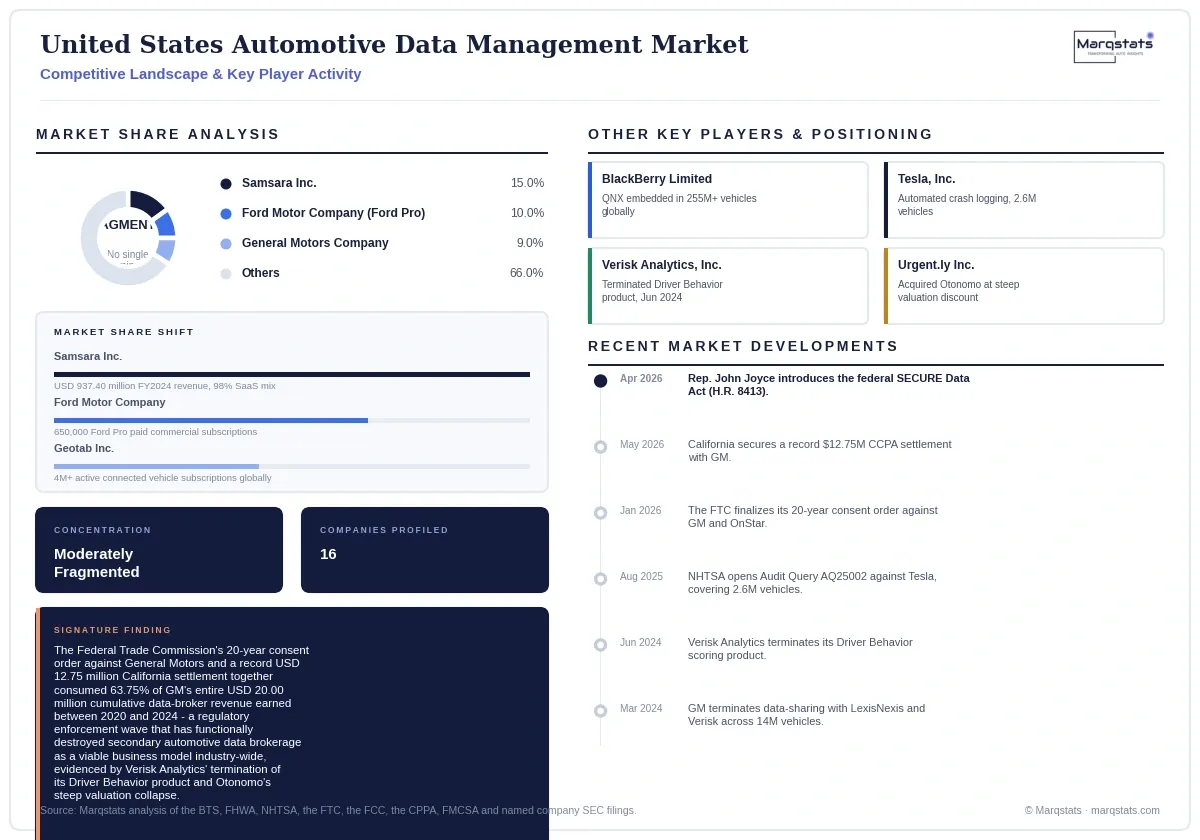
The United States automotive data management market is moderately fragmented across distinct competitive tiers: automotive OEMs including General Motors and Ford Motor Company build proprietary connected-vehicle platforms internally, pure-play commercial telematics vendors including Samsara Inc. and Geotab Inc. compete directly for enterprise fleet contracts, and hyperscale cloud providers including Amazon Web Services, Microsoft Azure and Snowflake supply the underlying infrastructure layer across nearly every market participant.
Firms compete differently by tier: commercial fleet vendors compete on net revenue retention and workflow automation depth, exemplified by Samsara's reported net retention rate exceeding 115%, OEMs compete on proprietary firmware control and first-party service bundling following Ford Pro's model of nearly 650,000 paid commercial subscriptions, and edge middleware providers including BlackBerry QNX compete on embedded deployment scale, with QNX software embedded across more than 255 million vehicles globally.
The most significant recent competitive-landscape development is the near-total collapse of the independent data-aggregator tier following intensified regulatory enforcement: Otonomo's reverse merger with Urgent.ly at a steep valuation discount from its prior USD 1.40 billion capitalization, combined with Verisk Analytics' termination of its Driver Behavior scoring product and General Motors' March 2024 termination of data-sharing agreements with LexisNexis Risk Solutions and Verisk, together demonstrate that standalone data-brokerage business models lacking proprietary in-vehicle firmware control cannot sustain commercial viability under current regulatory scrutiny.
Companies Covered
The report profiles 16+ companies with full strategy and financials analysis, including:
Recent Market Activity
Table of Contents
Coverage & Segmentation
Coverage spans the United States automotive data management market, encompassing enterprise software platforms, cloud infrastructure services, edge computing middleware, and specialized telematics ingestion pipelines that ingest, normalize, store, govern and analyze vehicle-generated data across passenger and commercial motor vehicles registered under Federal Highway Administration classifications. The market is sized in USD across a 2020-2024 historical period and a 2025-2029 forecast period, with 2024 as the base year. Three segmentation dimensions are quantified: deployment processing architecture, functional application domain, and software component layer.
Excluded from scope: physical in-vehicle electronic control units and telematics control units, primary sensor hardware, underlying cellular carrier connectivity transport fees, aftermarket consumer infotainment hardware, and third-party insurance underwriting premiums. Data in general circulation frequently conflates connected vehicle hardware shipments or usage-based insurance premiums with the underlying software layer; this analysis isolates the enterprise software, data pipeline and cloud ingestion layers specifically.