Market Snapshot
Middle bar: base-year value × (1 + CAGR), rounded to two decimals. This is a calculated illustration, not a separately researched annual estimate.
The ASEAN two-wheeler ABS and braking safety systems market was valued at approximately USD 175 million in 2025 and is projected to reach USD 440 million by 2030, expanding at a CAGR of 20.25% over 2026–2030. Growth is attributed to a regional regulatory wave: Malaysia mandated anti-lock braking systems on all new motorcycles of 150cc and above from January 2025, following a two-year study by the Malaysian Institute of Road Safety Research. The market spans OEM-fitted ABS and combined braking systems for two-wheelers across the ASEAN-6 of Indonesia, Vietnam, Thailand, the Philippines, Malaysia, and Singapore.
Southeast Asia is the world's densest two-wheeler region, with new sales above 15 million units in 2025 and registered fleets exceeding 200 million motorcycles. Demand is increasing owing to compliance-driven ABS fitment, rising premium-motorcycle penetration, and near-universal combined-braking-system adoption on commuter models. The forecast is policy-front-loaded, as regulatory triggers land across 2025 to 2027.
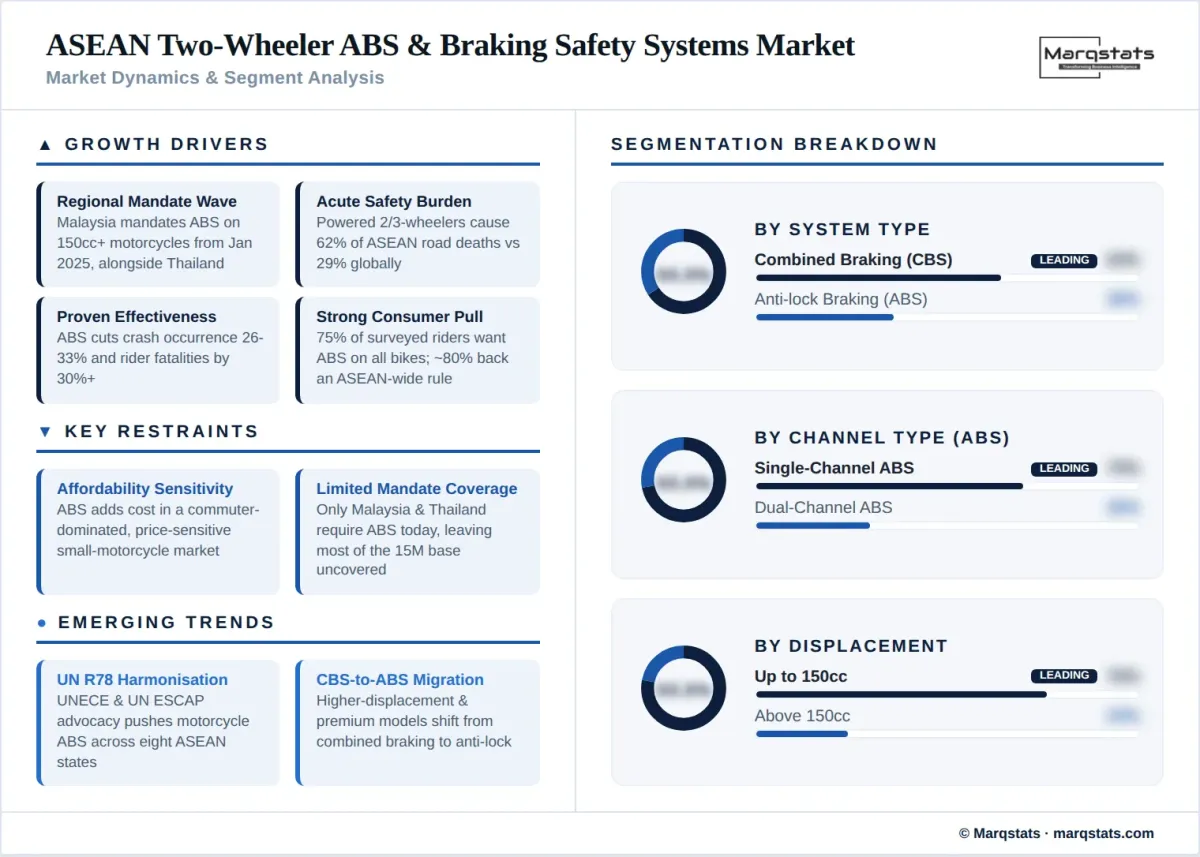
The market rests on an acute road-safety rationale. Powered two- and three-wheelers account for 62% of all ASEAN road deaths, against 29% globally, per UN Road Safety Fund data, and the region's fatality rate of 20.7 per 100,000 population is among the world's highest. Anti-lock braking reduces crash occurrence by 26–33% and rider fatalities by more than 30%.
The forecast is built on a three-scenario regulatory ladder. The status-quo scenario reflects the current Malaysia and Thailand mandates; a mid-case adds Vietnam, the region's swing market at about 3.4 million annual units; and full ASEAN-wide harmonisation under UN R78 addresses the entire 15-million-unit base, per UNECE advocacy. Content value is anchored at US$35–70 per single- or dual-channel system.
The base-year market reflects the current mandate footprint plus voluntary anti-lock fitment on premium motorcycles and near-universal combined-braking adoption on commuters. The forecast rises as Malaysia and Thailand reach full coverage, Vietnam moves toward adoption, and India’s all-two-wheeler rule reinforces regional supplier scale. Full ASEAN-wide harmonisation represents the upside case, under which anti-lock content alone is estimated to approach US$0.5–1.0 billion a year across the region’s 15-million-unit base.
Key Takeaways
Market Overview & Analysis
Report Summary
The ASEAN two-wheeler ABS and braking safety systems market covers OEM-fitted anti-lock braking systems, comprising the electronic control unit, hydraulic modulator, and wheel-speed sensors, together with combined braking systems, for L-category two-wheelers across Indonesia, Vietnam, Thailand, the Philippines, Malaysia, and Singapore. Aftermarket and retrofit fitment is excluded, as regulators advise against retrofitting older motorcycles. The market is the first regional assessment of two-wheeler braking safety systems, an adjacency to the Marqstats India two-wheeler ABS market report, with which it shares a Tier-1 supplier base.
The regulatory foundation is anchored on international standards. The reference regulation is UN R78, and a UN Road Safety Fund programme run with UNECE and UN ESCAP advocates motorcycle ABS across eight ASEAN states, with implementation activity in Malaysia and Vietnam, per UNECE coverage. Motorcycles feature in 65% of Vietnam's road crashes and more than 60% of road deaths in Malaysia, and rider fatalities reach as high as 74% in Thailand and Indonesia.
Southeast Asia's two-wheeler base is the largest worldwide. Indonesia sold 6.55 million units in 2025, Vietnam about 3.4 million, the Philippines 2.37 million, Thailand 1.73 million, and Malaysia 613,893, and the regional market returned above 15 million units, fully recovering to pre-pandemic levels. Growth is attributed to the regulatory wave and to premium-motorcycle penetration. Consumer support is strong, as 75% of surveyed riders favour ABS on all motorcycles and about 80% support an ASEAN-wide regulation.
Market structure follows the mandate footprint. Anti-lock braking is concentrated in Malaysia and Thailand and in premium models region-wide, while combined braking is near-universal on the commuter base that dominates ASEAN volume. Value shifts toward anti-lock braking over the forecast as mandates broaden and premium penetration rises, and the reconciled estimate advances from USD 175 million in 2025 toward USD 440 million by 2030. The pace is set by the sequence of national mandates rather than by underlying vehicle-volume growth, which is already near pre-pandemic peaks.
Market Dynamics
The ASEAN two-wheeler ABS and braking safety systems market is governed by regulation, safety policy, and regional supplier capacity. Mandates set a compliance floor, the road-safety burden anchors advocacy, and a shared Tier-1 supplier base with India improves availability. The dynamics below separate the regulatory and safety drivers from the affordability and coverage constraints that shape adoption.
Key Drivers
- Malaysia's ABS mandate for motorcycles of 150cc and above from January 2025, alongside Thailand's requirement, establishes compliance-driven demand across the region.
- Acute road-safety burden, as powered two- and three-wheelers account for 62% of ASEAN road deaths and the region's fatality rate is among the world's highest.
- Proven effectiveness, with anti-lock braking reducing crash occurrence by 26–33% and rider fatalities by more than 30%, cited by regulators and the WHO.
- Strong consumer pull, as 75% of surveyed ASEAN riders want ABS on all motorcycles and about 80% support an ASEAN-wide regulation.
- Regional supplier capacity, as India's ABS build-out serves the same Tier-1 ecosystem, improving availability and cost across ASEAN production.
Key Restraints
- Affordability sensitivity in a commuter-dominated market, where anti-lock braking adds cost to price-sensitive small motorcycles.
- Limited mandate coverage today, as only Malaysia and Thailand require motorcycle ABS, leaving most of the 15-million-unit base uncovered.
- Retrofit exclusion, as regulators advise against retrofitting older motorcycles, confining demand to new-vehicle fitment.
- Displacement thresholds, as Malaysia's 150cc-and-above rule covers only a minority of its small-displacement-heavy market.
Key Trends
- Regulatory-wave sequencing across the region, from Malaysia and Thailand toward Vietnam and, prospectively, Indonesia and the Philippines.
- Harmonisation toward UN R78 through UNECE and UN ESCAP advocacy across eight ASEAN states.
- Adoption of motorcycle safety-rating programmes, with Malaysia's MyMAP proposed for extension across ASEAN.
- Shift from combined braking systems toward anti-lock braking on higher-displacement and premium models.
Market Segmentation
System-type segmentation distinguishes anti-lock braking systems from combined braking systems. Combined braking is widely fitted on commuter models today, while anti-lock braking is the value and growth driver over the forecast.
Combined braking is treated within scope because it is the prevailing braking-safety system across ASEAN today and because the market transition is most clearly framed as a migration from combined braking toward anti-lock braking. Reporting both systems captures the full braking-safety content pool and avoids understating the installed base from which anti-lock penetration grows. It also allows the forecast to track the substitution of anti-lock for combined braking as the primary value-creating shift over the period.
Anti-lock braking prevents wheel lock during hard braking and is mandated in Malaysia and Thailand. It carries the highest content value per vehicle and is the fastest-growing system type. Adoption scales with mandates, premium-motorcycle penetration, and the regional regulatory wave.
Combined braking distributes braking force across both wheels and is widely fitted on small-displacement commuter motorcycles and scooters. It carries lower content value than anti-lock braking. The segment anchors baseline braking-safety volume across the region's high-volume commuter base. As anti-lock mandates broaden, combined braking is expected to retain the sub-threshold displacement bands where full anti-lock economics are not yet compelling.
Channel-type segmentation splits the anti-lock portion into single-channel and dual-channel systems. Single-channel systems address entry models, while dual-channel systems serve premium motorcycles.
Single-channel ABS acts on the front wheel and minimises cost for price-sensitive models. It is the volume configuration for entry and mid-displacement motorcycles brought into scope by mandates. The configuration captures most incremental anti-lock volume. As mandates extend into smaller displacement bands, single-channel fitment becomes the default anti-lock configuration for commuter motorcycles.
Dual-channel ABS regulates both wheels independently and is standard on premium and higher-displacement motorcycles. It carries higher content value per vehicle. The configuration anchors the value contribution of the anti-lock segment. Dual-channel penetration rises with premium-motorcycle demand and with any future extension of mandates into higher-performance categories.
Component segmentation isolates the electronic control unit, hydraulic modulator, and wheel-speed sensors that constitute an anti-lock system. The control unit and modulator carry most of the system value.
The electronic control unit governs modulation logic and is the highest-value electronic component. Its supply is concentrated among a small number of Tier-1 specialists. Localisation and regional sourcing influence the achievable cost point for entry models.
The hydraulic modulator executes brake-pressure pulsing and forms the mechanical core of the system. It is the most capacity-intensive component to manufacture. Modulator supply is a determinant of overall fitment capacity across the region.
Wheel-speed sensors detect impending lock and feed the control unit. Single-channel systems use one front sensor, while dual-channel systems use two, scaling sensor demand with the channel mix. Sensor volumes rise with anti-lock penetration. Sensor sourcing is less concentrated than modulator and control-unit supply, offering a broader regional supplier base for this element.
Displacement segmentation maps demand against the mandate thresholds. The up-to-150cc band dominates ASEAN volume, while the above-150cc band is where anti-lock mandates first apply.
The up-to-150cc band dominates ASEAN two-wheeler sales, reflecting the region's commuter and scooter base. Combined braking is the prevailing configuration in this band today. The band defines the largest volume opportunity as anti-lock mandates broaden. A shift of even a few percentage points of this band from combined to anti-lock braking materially changes regional content value, given the sheer unit scale.
The above-150cc band is where anti-lock braking is first mandated, notably under Malaysia's rule. It carries higher anti-lock and dual-channel penetration. The band contributes disproportionately to market value owing to richer content.
By Geography
Regional distribution reflects the scale of each ASEAN two-wheeler market, the status of anti-lock mandates, and the road-safety burden. Indonesia and Vietnam anchor volume, while Malaysia and Thailand anchor the regulatory frontier.
Indonesia
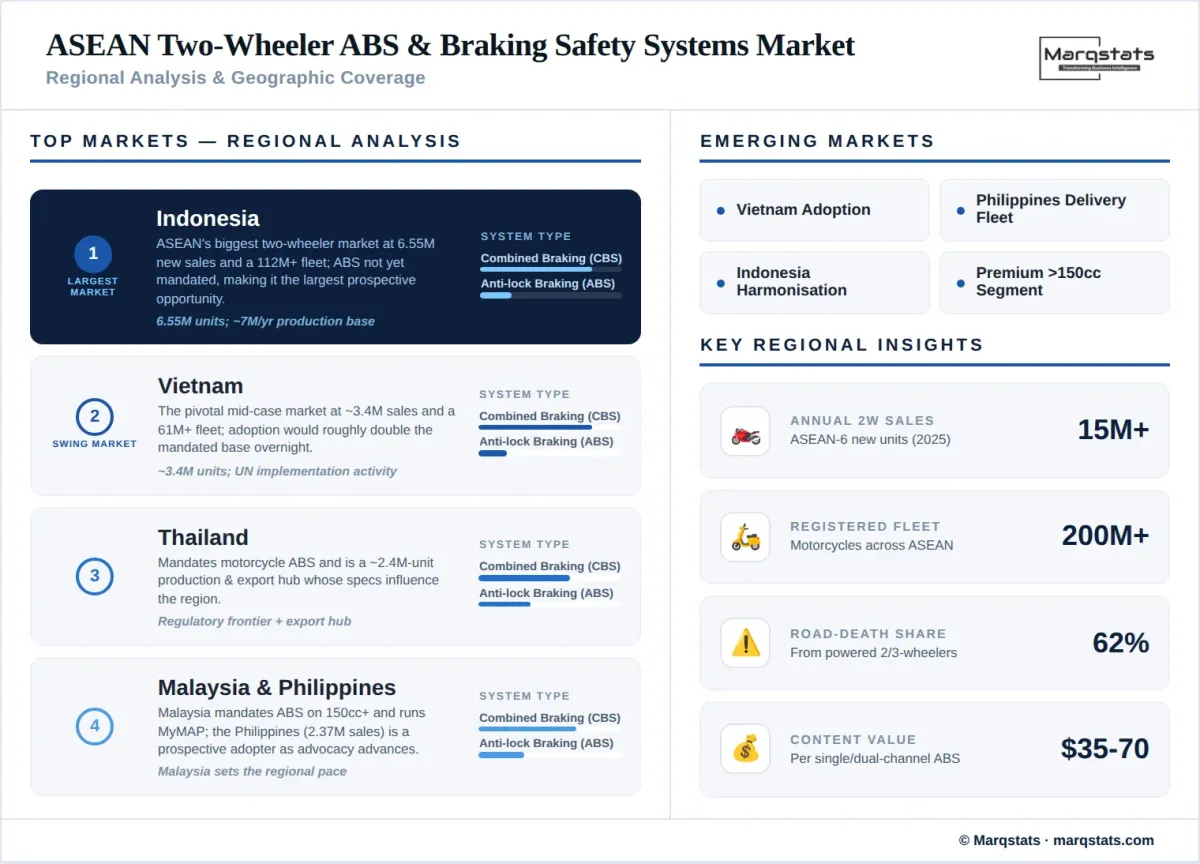
Indonesia is the largest two-wheeler market in ASEAN, with 6.55 million new sales in 2025 and a registered fleet exceeding 112 million motorcycles. Rider fatalities reach as high as 74% of road deaths. Anti-lock braking is not yet mandated, and combined braking prevails, making Indonesia the largest prospective opportunity under harmonisation. With production approaching seven million units a year, Indonesia is also a manufacturing base whose fitment decisions influence regional supply economics.
Vietnam
Vietnam is the region's swing market, with about 3.4 million new sales in 2025 and a fleet exceeding 61 million motorcycles. Motorcycles feature in 65% of the country's road crashes. Vietnam is considering anti-lock adoption and hosts UN Road Safety Fund implementation activity, making it the pivotal market for the mid-case scenario. Adoption in Vietnam would roughly double the mandated addressable base overnight, given the scale of its annual sales.
Thailand
Thailand mandates motorcycle anti-lock braking and is a major production hub, producing about 2.4 million units a year with substantial CKD exports. New sales reached 1.73 million in 2025, and motorcycles feature in 53–54% of road deaths. Thailand anchors the regulatory frontier alongside Malaysia. Its position as an ASEAN production and export hub means Thai fitment standards influence braking-system specifications for vehicles shipped across the region.
Philippines
The Philippines recorded 2.37 million new two-wheeler sales in 2025, with motorcycles involved in 31% of road deaths. Anti-lock braking is not yet mandated. The market is a prospective adopter as regional advocacy advances. High commuter volumes and a growing delivery-rider economy strengthen the safety case for future anti-lock adoption.
Malaysia
Malaysia mandates anti-lock braking on all new motorcycles of 150cc and above from January 2025, following a Ministry of Transport and MIROS study, and operates the MyMAP safety-rating programme. New sales reached 613,893 in 2025 against a fleet of about 14 million. Motorcycles feature in more than 60% of road deaths, and Malaysia sets the pace for regional regulation, with its deputy prime minister proposing that neighbouring states adopt similar measures.
Singapore
Singapore is a compact, high-standard market where motorcycles feature in 53–54% of road deaths. Vehicle-safety standards and enforcement are among the region's strongest. The market adopts anti-lock braking through premium models and prospective harmonisation, and it sets a benchmark for enforcement that regional advocacy references.
How Competition Is Evolving
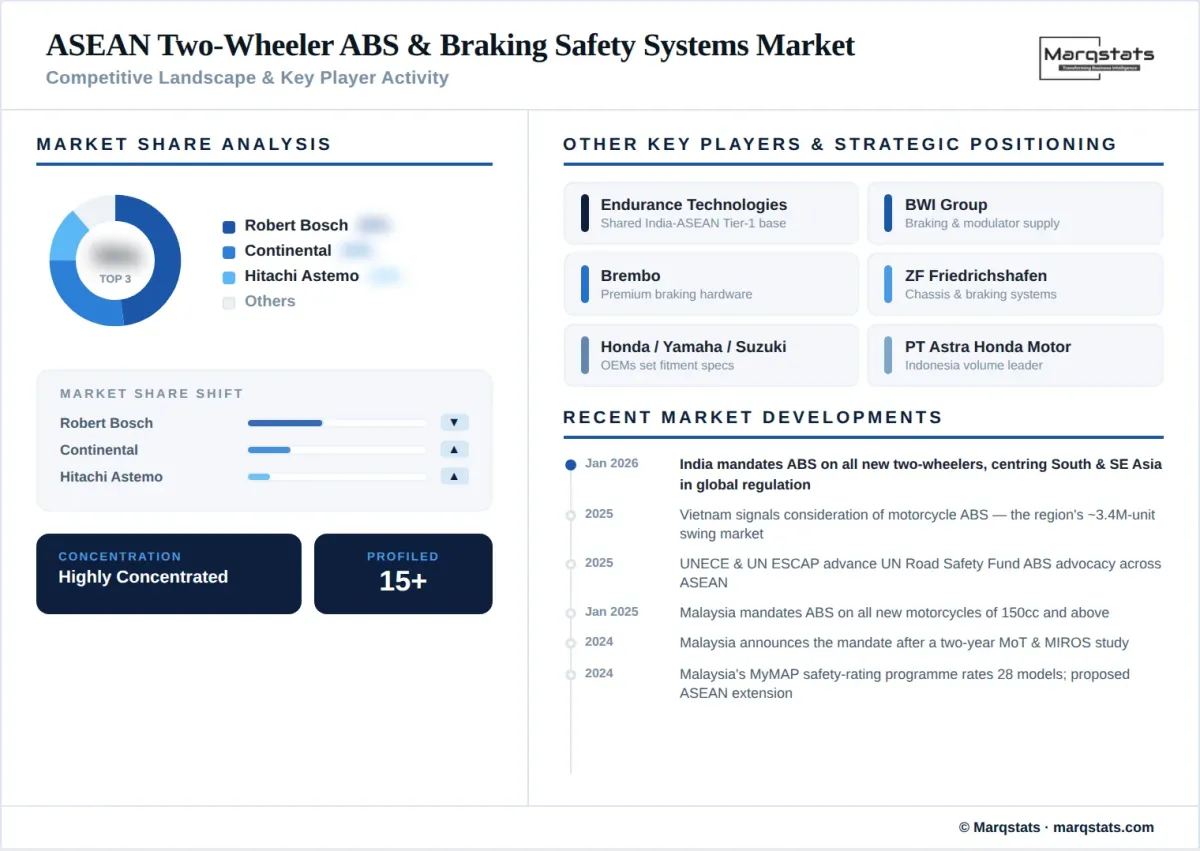
The ASEAN two-wheeler ABS and braking safety systems market is highly concentrated at the component-supply level. Robert Bosch and Continental anchor anti-lock braking supply across the region, supported by Hitachi Astemo, Endurance Technologies, and BWI. Concentration is attributable to the engineering and capital intensity of hydraulic-modulator and control-unit manufacturing, which raises barriers to entry.
Competition centres on OEM programme wins, regional capacity, and cost. The supplier ecosystem is shared with India, where a large anti-lock build-out serves the same Tier-1 base and improves availability across ASEAN production, an adjacency to the Marqstats Thailand electric vehicle market report. Growth is attributed to multi-year supply agreements tied to mandate compliance in Malaysia and Thailand.
Original-equipment manufacturers shape the structure, as Japanese makers dominate ASEAN two-wheeler production and set braking-system specifications. Honda, Yamaha, Suzuki, and Kawasaki, together with Indonesia's PT Astra Honda Motor, drive fitment decisions across the region. Growth is attributed to the alignment of OEM sourcing with the regulatory wave, and Indian makers extend the supplier and export base.
The competitive structure rewards suppliers able to serve both mandated and voluntary demand at commuter price points. The near-term determinant of position is the ability to scale single-channel systems for entry motorcycles as the regulatory wave broadens. Suppliers with regional capacity and OEM proximity are positioned to capture the incremental demand from Vietnam and prospective adopters. Vertical integration into disc-brake hardware and combined-braking content further differentiates suppliers able to offer bundled braking-safety systems to OEMs across the region.
Companies Covered
Companies covered in the report include:
Recent Market Activity
Table of Contents
Coverage & Segmentation
This report provides a comprehensive analysis of the ASEAN two-wheeler ABS and braking safety systems market for the historical period 2021–2025 and the forecast window 2026–2030, with 2025 as the base year. Coverage spans OEM-fitted anti-lock braking systems — electronic control unit, hydraulic modulator, and wheel-speed sensors — and combined braking systems, across the ASEAN-6 of Indonesia, Vietnam, Thailand, the Philippines, Malaysia, and Singapore, with reference to the broader ASEAN-10. The study examines market sizing by value, segment-level forecasts by system type, channel type, component, and displacement, country-level analysis, competitive positioning, and the regulatory framework.
The forecast is built on a three-scenario regulatory ladder: a status-quo scenario reflecting the Malaysia and Thailand mandates, a mid-case adding Vietnam, and full ASEAN-wide harmonisation under UN R78. Aftermarket and retrofit fitment is excluded. Deliverables include market sizing and forecasts, segment and country splits, company profiles, a regulatory and road-safety assessment, and scenario analysis. The report is intended for braking-system suppliers, two-wheeler OEMs, road-safety agencies, investors, and policy stakeholders.
The forecast provides annual estimates across the 2026–2030 window with sensitivity to three variables: the sequence and scope of national anti-lock mandates, the fitment split between anti-lock and combined braking, and per-system content value. The report frames the regional regulatory wave — Malaysia, Thailand, India, and prospectively Vietnam and Indonesia — as a single narrative, which distinguishes it from single-country assessments and supports investment decisions across the shared supplier base.