Market Snapshot
Middle bar: base-year value × (1 + CAGR), rounded to two decimals. This is a calculated illustration, not a separately researched annual estimate.
The electric vehicle testing, inspection, and certification (TIC) market is moving from a relatively narrow battery-safety testing business into a broader compliance, validation, and lifecycle-assurance market—driven by EV volumes that topped 17 million global sales in 2024, EV battery demand exceeding 950 GWh (up 25% YoY), and a regulatory environment that now demands not just safety validation but carbon-footprint verification, recycled-content compliance, battery-passport readiness, and second-life certification. Every battery programme needs validation at the cell, module, pack, transport, homologation, production, and increasingly end-of-life stage. The electric vehicle testing, inspection, and certification market size was valued at approximately USD 1.48 billion in 2025 and is projected to reach USD 4.87 billion by 2030, expanding at a CAGR of 26.92% during the forecast period (2026–2030).
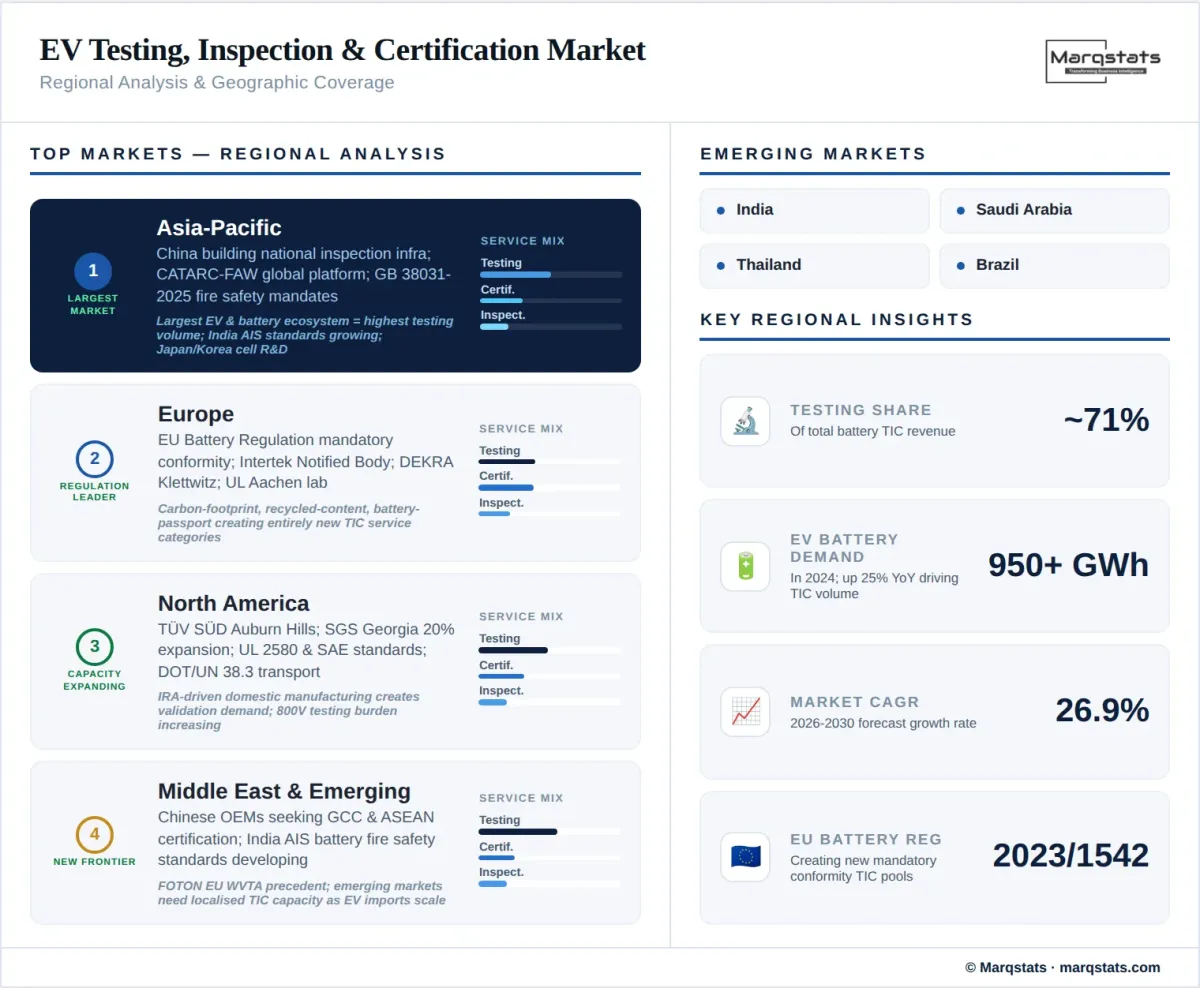
Testing still dominates the service mix at approximately 71% of broader battery TIC revenue, but the strategically most important growth area is certification and conformity assessment tied to the EU Battery Regulation (2023/1542) and battery-passport-style requirements. The EU Battery Regulation creates entirely new revenue pools for TIC firms in carbon-footprint assessment, life-cycle analysis, recycled-content verification, due-diligence readiness, digital battery-passport data management, and mandatory third-party CE conformity assessment. Intertek’s Swedish lab became one of the first accredited toward Notified Body status under the regulation in early 2026—a milestone that shows TIC providers are evolving from vendors of lab hours into gatekeepers for European market access. DEKRA’s Klettwitz Battery Test Center in Germany positions as an end-to-end facility covering development support, validation, certification testing, logistics, and recycling. Bureau Veritas markets carbon-footprint, life-cycle, and analytical testing specifically for EU Battery Regulation compliance.
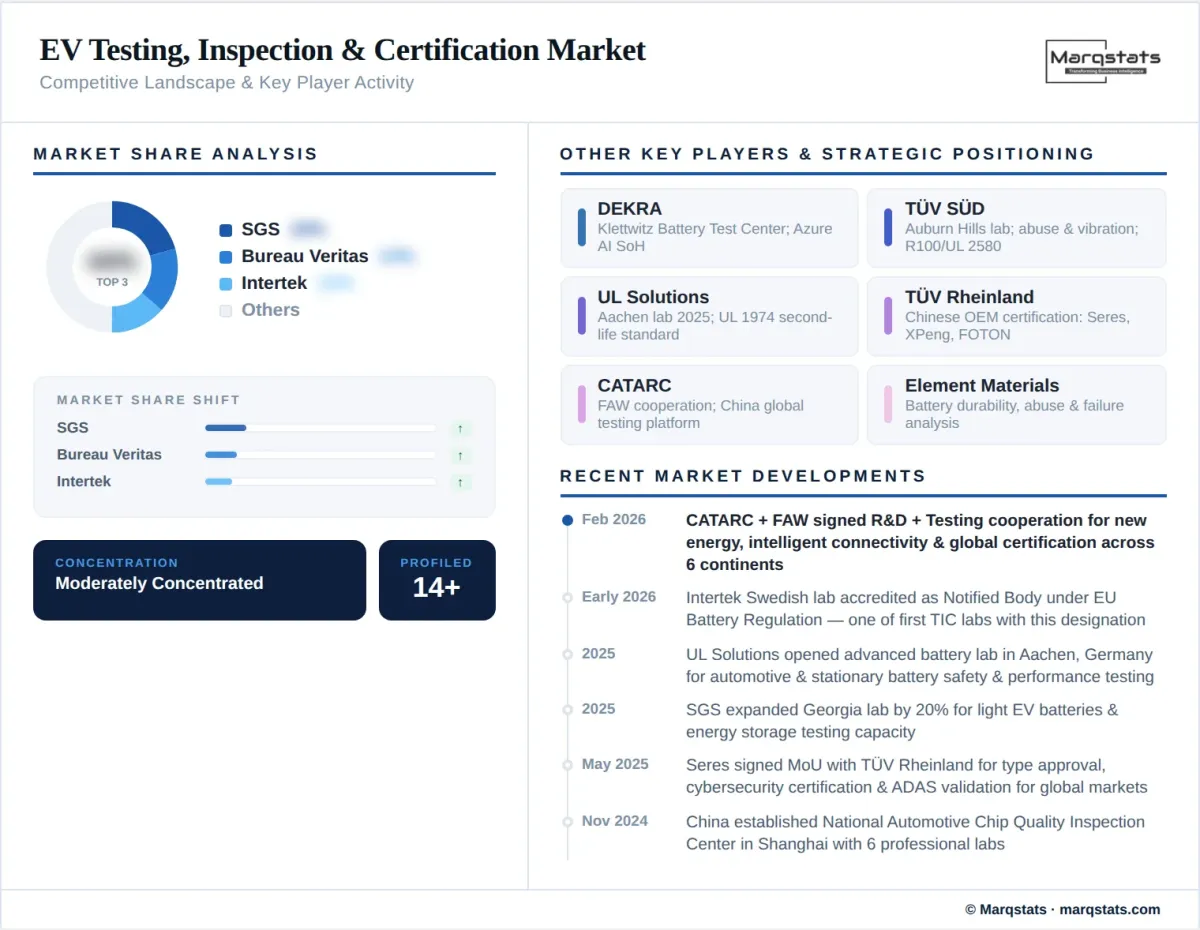
The top seven EV battery TIC companies—SGS, Bureau Veritas, Intertek, DEKRA, TÜV SÜD, UL Solutions, and Element Materials Technology—accounted for approximately 33.5% of the market in 2025, confirming a fragmented competitive landscape where no single player dominates globally across all services and geographies. Asia-Pacific leads by volume (testing demand centred in China, Japan, South Korea, and India), Europe is the most regulation-intensive market (EU Battery Regulation, UNECE R100, CE conformity), and North America is the fastest capacity-expansion market driven by gigafactory buildout. China is building dedicated national-level inspection centres, including the first National Automotive Chip Quality Inspection Center in Shanghai (November 2024). The Marqstats electric vehicle battery components market report and India EV battery recycling market report provide complementary coverage of the upstream materials and circular-economy layers driving TIC demand.
Key Takeaways
Market Overview & Analysis
Report Summary
The electric vehicle testing, inspection, and certification market covers all TIC services applied to EV batteries, EV powertrains, EV charging infrastructure, and associated systems across five service layers: (1) development and validation testing—performance, cycle life, durability, vibration, environmental testing, thermal runaway, and abuse testing at cell, module, and pack level; (2) homologation and regulatory approval—UNECE R100, UN 38.3, UL 2580, SAE J2929, India AIS standards, China GB 38031; (3) transport compliance—UN/DOT 38.3 T1–T8 test sequence for lithium battery shipment; (4) inspection, conformity assessment, and factory/process assurance—ISO/IEC 17025 lab competence, CE marking, IATF 16949 quality systems, and production-lot validation; and (5) lifecycle and circularity assurance—second-life battery certification (UL 1974), EU Battery Regulation carbon footprint, recycled-content verification, and battery-passport data management. EV charging infrastructure testing and certification (EVSE compliance, AC/DC charger safety) is included as an adjacent high-growth segment.
The market is being shaped by three forces simultaneously. First, simple scale: more EVs mean more battery programmes, more chemistry variants (LFP, NMC, NCA, solid-state), more platform derivatives, and more production-lot validation. Second, the shift toward higher-voltage (800V) and faster-charging architectures increases demand for validation of charging performance, thermal stability, and system integration—the testing burden gets heavier, not lighter, as batteries become more energy-dense. Third, the industrialisation of gigafactory-scale manufacturing means TIC is no longer only an R&D-lab business; it is a production-ramp business where scalable, automated testing systems for quality assurance and yield optimisation become commercial necessities.
Market Dynamics
Key Drivers
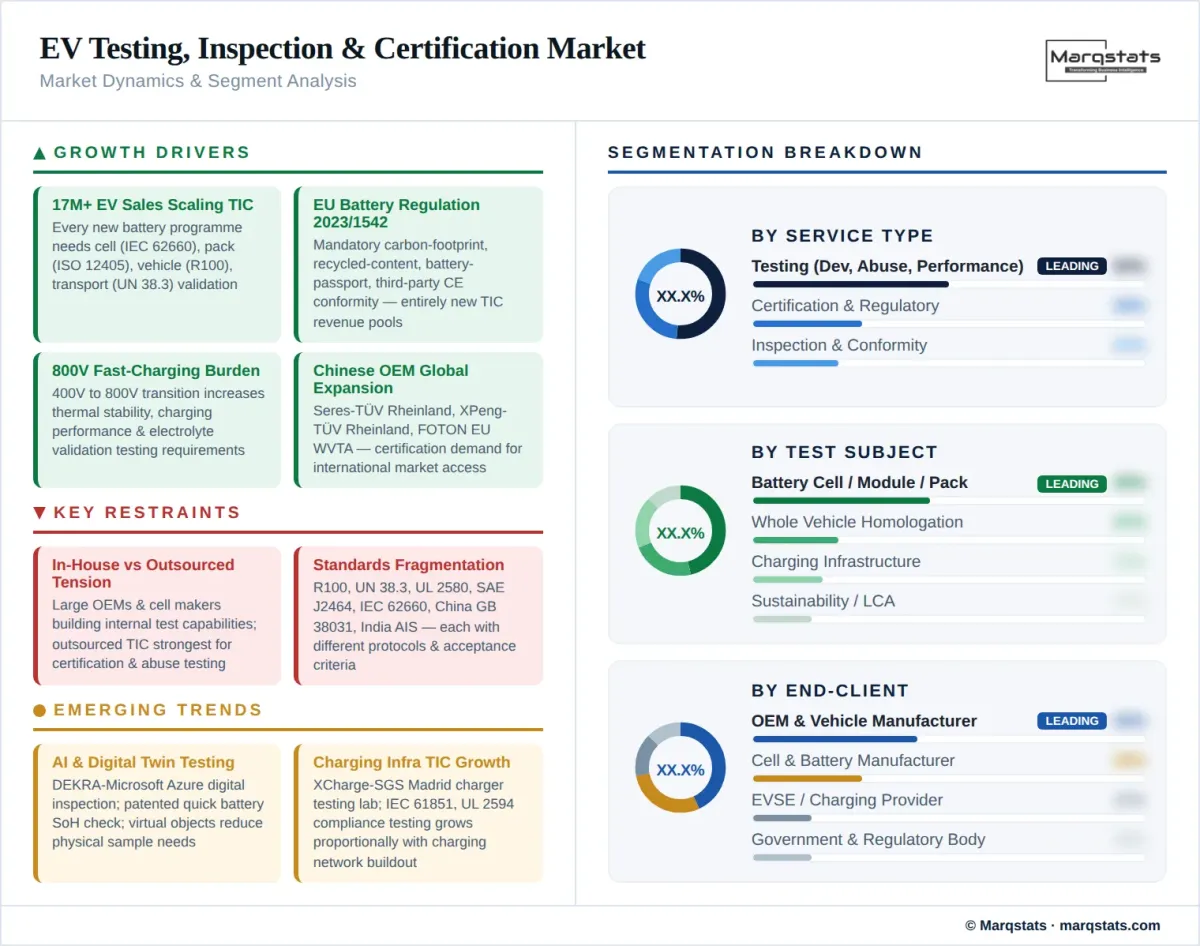
- EV volume scaling creating proportional TIC demand growth: Global electric car sales topped 17 million in 2024 (up 25%+ YoY). EV battery demand exceeded 950 GWh. Every new battery programme requires cell-level (IEC 62660), pack-level (ISO 12405), vehicle-approval (UNECE R100), transport (UN 38.3), and production validation testing. More OEM platforms, more chemistry variants, and more regional regulatory submissions multiply the testing workload per vehicle programme.
- EU Battery Regulation (2023/1542) creating entirely new TIC revenue pools: The regulation requires carbon-footprint declarations, social and environmental due-diligence for lithium, cobalt, nickel, and natural graphite, recycled-content minimums from 2031, QR-code battery-passport data, and mandatory third-party CE conformity assessment. This creates new demand for carbon-footprint verification, life-cycle analysis, recycled-content testing, supply-chain evidence assembly, and conformity assessment—services that did not exist in the pre-regulation TIC market. DEKRA describes the regulation as imposing rules around sustainability, carbon footprint, recycled content, safety and performance, conformity assessment, CE marking, and market surveillance.
- 800V and fast-charging architectures increasing the testing burden: The transition from 400V to 800V EV architectures increases demand for validation of charging performance at higher power levels, thermal stability under faster charge rates, electrolyte behaviour at higher voltages, and system integration testing. Solid-state battery testing requires entirely new protocols for ceramic/sulphide electrolyte behaviour, interface stability, and manufacturing defect detection. Hardware-in-the-loop (HIL) simulation for EV battery testing enables virtual validation of battery management systems before physical testing, reducing development cycles but adding HIL lab infrastructure demand.
- Gigafactory-scale production expanding TIC from R&D into manufacturing QA: North America’s expanding battery gigafactories increase demand for scalable, automated testing systems for quality assurance, yield optimisation, and regulatory compliance. TIC is no longer only about R&D lab validation; it now includes production-line quality gates, statistical process control validation, and lot-by-lot compliance verification. TÜV SÜD supported Italvolt’s planned gigafactory in Italy with design review, risk assessment, fire protection, battery testing, EMC, and IATF 16949 certification.
- China building dedicated national-level inspection infrastructure: China’s State Administration for Market Regulation established the first National Automotive Chip Quality Inspection Center in Shanghai (November 2024) with six professional labs for automotive chips. CATARC and FAW Group signed a cooperation agreement (February 2026) to co-develop a “R&D + Testing” closed-loop service covering new energy, intelligent connectivity, and certification operations globally. China’s GB 38031-2025 battery safety mandate tightens requirements for EV battery fire safety testing, creating compliance-driven TIC demand across all Chinese OEMs.
Key Restraints
- Outsourced vs in-house testing creating competitive tension: Large cell manufacturers and automotive OEMs increasingly build in-house testing capabilities for development and production validation, reducing the volume of outsourced TIC services for routine testing. Outsourced TIC remains strongest for regulatory certification (which requires independent third-party status), abuse/safety testing (which requires specialised facilities), and cross-market homologation (which requires multi-country accreditations). The market splits between high-value outsourced certification and commoditising outsourced routine testing.
- Long lead times for lab accreditation and Notified Body status: Achieving ISO/IEC 17025 accreditation, IATF 16949 certification, and EU Battery Regulation Notified Body designation requires 12–24 months of preparation and audit. Intertek’s early 2026 Notified Body accreditation timeline demonstrates the lead time. This creates barriers to entry for new TIC providers but also capacity constraints during rapid demand scaling.
- Standards fragmentation across regions increasing compliance complexity: EV batteries must simultaneously comply with UNECE R100 (Europe/UNECE), UN 38.3 (global transport), UL 2580 (North America), SAE J2464/J2929 (North America), IEC 62660 (international), China GB 38031, India AIS standards, and emerging EU Battery Regulation requirements. Each standard has different test protocols, sample requirements, and acceptance criteria. TIC providers serving global OEM customers must maintain accreditations across all these frameworks.
Key Trends
- AI-driven diagnostics and digital twin technology entering battery testing: DEKRA partnered with Microsoft to develop digital inspection solutions based on Azure cloud, including a patented quick battery State-of-Health check for electric cars validated by testing with vehicle manufacturers. Digital twins create virtual images of battery objects for inspection, enabling predictive testing and reduced physical sample requirements. AI-driven diagnostics are increasingly used for production-line defect detection, accelerated degradation modelling, and EV battery lifecycle health prediction.
- EV charging infrastructure testing and certification as adjacent growth segment: XCharge partnered with SGS to open a charging station testing facility in Madrid (September 2023), combining testing, charger management, and product delivery acceleration. As DC fast-charging networks scale globally, EVSE compliance testing (IEC 61851, UL 2594, UL 2202) creates a parallel TIC demand stream adjacent to battery testing. Charging infrastructure TIC grows proportionally with the charging network buildout.
- Chinese OEMs driving demand for international certification for global expansion: Seres Group signed an MoU with TÜV Rheinland (May 2025) for type approval, cybersecurity management certification, and ADAS validation to support global market access. XPeng signed a strategic cooperation agreement with TÜV Rheinland (January 2024) covering finished vehicles, systems, and components. FOTON obtained EU WVTA certification for its iBlue EV truck (August 2022). As Chinese EV brands expand globally, demand for Western TIC certification grows proportionally—particularly EU type approval, UNECE R100 compliance, and cybersecurity management system certification (UNECE R155/R156).
- Second-life battery certification creating post-vehicle TIC demand: UL Solutions’ UL 1974 covers auditing and certification of facilities that sort, grade, and repurpose used EV batteries. As the global EV parc grows past 50+ million vehicles, the volume of end-of-life batteries requiring TIC for second-life qualification, state-of-health verification, and safe redeployment creates an entirely new demand channel that extends TIC revenue beyond first-life vehicle launch.
Market Segmentation
The largest service segment at approximately 71% of battery TIC revenue. Covers cell-level performance and life testing (IEC 62660-1), cell safety and abuse testing (IEC 62660-3, thermal runaway, nail penetration, crush, overcharge), module and pack testing (ISO 12405), vibration and environmental testing, transport testing (UN 38.3 T1–T8), and production-line quality assurance. TÜV SÜD’s Auburn Hills lab specialises in mechanical abuse, vibration, and environmental testing of cells, modules, and packs. Intertek offers global EV/HEV/PHEV battery testing from cells to large packs.
Covers factory and process inspection, CE conformity assessment under EU Battery Regulation, production-lot verification, and quality-system auditing. ISO/IEC 17025 accreditation underpins laboratory competence and cross-border acceptance of test reports. This segment is growing fastest because the EU Battery Regulation makes third-party conformity assessment mandatory for batteries sold in Europe. Intertek’s Notified Body accreditation (early 2026) is the clearest signal of this segment’s strategic importance.
Covers homologation (UNECE R100, UL 2580), transport compliance (UN/DOT 38.3), safety certification, cybersecurity management system certification (UNECE R155/R156), and EU Battery Regulation sustainability certification. UL Solutions tests against UN/DOT 38.3, UNECE R100/R136, UL 2580, and SAE J2929. This segment captures the highest per-engagement value because certification is a regulatory gate—without it, products cannot access markets.
The newest and fastest-growing TIC layer. Covers carbon-footprint verification, recycled-content assessment, battery-passport data management, second-life certification (UL 1974), and end-of-life recycling compliance. Bureau Veritas markets carbon-footprint, life-cycle, and analytical testing for EU Battery Regulation compliance. CATL’s Yibin plant obtained PAS 2060 carbon neutrality certification from SGS—demonstrating that carbon verification is already being purchased at gigafactory scale.
Adjacent high-growth segment covering DC fast-charger safety testing (IEC 61851), AC charger compliance, EVSE interoperability testing, and charging station certification. XCharge and SGS opened a dedicated charging station testing facility in Madrid (September 2023). Charging infrastructure TIC grows in lockstep with the global charging network buildout.
IEC 62660 (Parts 1, 2, 3) for performance, reliability, abuse, and safety of lithium-ion cells. Cell-level thermal runaway testing under abuse conditions (nail penetration, crush, overcharge, short circuit) is the most safety-critical and highest-risk testing activity. Solid-state battery testing at cell level requires new protocols for ceramic/sulphide electrolyte interface behaviour.
ISO 12405 specifies test procedures for lithium-ion battery packs and systems in electrically propelled road vehicles. Pack-level testing includes vibration, shock, mechanical impact, immersion, fire exposure, and thermal management validation. HIL simulation increasingly supplements physical testing for BMS validation.
UNECE R100 for road-vehicle approval of batteries in categories M and N vehicles. Whole Vehicle Type Approval (WVTA) for European market access. FOTON’s iBlue EV truck obtained EU WVTA certification from TÜV Rheinland (August 2022). Vehicle-level testing integrates battery, powertrain, ADAS, and cybersecurity compliance into a single approval package.
By Geography
Asia-Pacific (China, Japan, South Korea, India)
The demand and manufacturing centre for EV battery TIC. China is building national-level inspection infrastructure: the National Automotive Chip Quality Inspection Center settled in Shanghai (November 2024), CATARC and FAW are co-developing a global testing and certification platform (February 2026), and China’s GB 38031-2025 tightens battery fire safety testing mandates. A joint China–Germany NEV test facility opened in Hefei (August 2021) to test high-voltage component safety and energy efficiency. India’s AIS standards for EV battery fire safety testing create growing TIC demand. Japan and South Korea host major cell manufacturers requiring extensive development and validation testing. China’s largest EV and battery ecosystem generates the highest testing volume globally.
Europe
The most regulation-intensive TIC market. The EU Battery Regulation (2023/1542) creates mandatory third-party conformity assessment, carbon-footprint declarations, recycled-content verification, and battery-passport requirements. UNECE R100 is the core road-vehicle battery approval framework. Intertek’s Swedish lab achieved Notified Body accreditation (early 2026). DEKRA’s Klettwitz Battery Test Center provides end-to-end lifecycle coverage. UL Solutions opened its Aachen advanced battery lab (2025). TÜV SÜD supported Italvolt’s planned Italian gigafactory. Chinese OEMs seeking European market access (Seres/TÜV Rheinland May 2025, XPeng/TÜV Rheinland January 2024, FOTON WVTA August 2022) generate significant cross-border certification demand.
North America
The fastest capacity-expansion market. SGS expanded its Suwanee, Georgia laboratory by 20% (2025) specifically for light EV and energy storage battery testing. North America’s gigafactory buildout creates demand for scalable production QA and yield optimisation testing. UL 2580 and SAE J2464/J2929 are the primary safety standards. TÜV SÜD’s Auburn Hills lab supports UNECE R100, UL 2580, and SAE J2464 compliance. XCharge/SGS opened a charging station testing facility in Madrid—a model that is being replicated in North American markets.
Rest of World
Emerging TIC demand in Southeast Asia, Middle East, Africa, and Latin America as EV assembly and battery production expand beyond the three core regions. India’s AIS battery safety standards and growing EV manufacturing create a fourth regional demand node. TÜV Rheinland’s Greater China operations provide a template for TIC expansion into emerging EV markets where local inspection infrastructure is still developing.
How Competition Is Evolving
The market is fragmented: the top seven players held approximately 33.5% combined share in 2025, meaning two-thirds of the market is served by smaller regional labs, OEM-affiliated testing centres, and specialist niche providers. SGS (Switzerland) is investing in North American battery test capacity close to US manufacturing hubs, with its Suwanee, Georgia lab expansion (20%, 2025) targeting light EV and energy storage. Bureau Veritas (France) is particularly well aligned to the EU Battery Regulation sustainability/compliance layer, offering carbon-footprint, life-cycle analysis, and analytical testing services.
Intertek (UK) is especially strong where battery testing meets regulatory process, and its early 2026 Notified Body accreditation under the EU Battery Regulation positions it as a European market-access gatekeeper. DEKRA (Germany) leans into full-service battery TIC with the Klettwitz Battery Test Center covering development, validation, certification, logistics, and recycling, plus its Microsoft Azure partnership for digital inspection solutions including a patented quick battery State-of-Health check. TÜV SÜD (Germany) is strong in abuse, vibration, environmental, and homologation testing, with its Auburn Hills lab supporting UNECE R100, UL 2580, SAE J2464, and ISO 12405 compliance.
UL Solutions (US) spans cross-regional compliance and lifecycle coverage, testing against UN/DOT 38.3, UNECE R100/R136, UL 2580, and SAE J2929, with its Aachen advanced battery lab (2025) and UL 1974 second-life certification expanding the lifecycle service envelope. Element Materials Technology (UK) is strong in automotive battery durability, performance, regulatory approval, and failure analysis. TÜV Rheinland (Germany) serves as a key international certification partner for Chinese OEMs expanding globally: Seres Group (May 2025), XPeng (January 2024), and FOTON (WVTA August 2022) all use TÜV Rheinland for European market access.
Companies Covered
Companies covered in the report include:
Recent Market Activity
Table of Contents
Coverage & Segmentation
This report provides a comprehensive analysis of the global electric vehicle testing, inspection, and certification market covering the historical period (2021–2025) and forecast period (2026–2030), with 2025 as the base year. The study examines market size in USD across service type (testing, inspection/conformity, certification, lifecycle/circularity, charging TIC), application level (cell, module, pack, vehicle, charging infrastructure), and geography covering 18 countries across Asia-Pacific, Europe, North America, and Rest of World. Company profiling covers 15+ TIC providers across global leaders, regional specialists, and OEM-affiliated testing operations. Standards analysis covers IEC 62660, ISO 12405, UNECE R100, UN 38.3, UL 2580, SAE J2464/J2929, EU Battery Regulation (2023/1542), China GB 38031-2025, India AIS standards, UNECE R155/R156 cybersecurity, and ISO/IEC 17025 lab competence.
Research methodology combines bottom-up modelling from EV production volumes, battery programme counts per OEM, testing hours per programme by standard, TIC provider lab capacity and revenue disclosures, and regulatory submission data. Primary research encompasses 40+ interactions with TIC laboratory directors, OEM homologation teams, cell manufacturer quality managers, EU Battery Regulation compliance specialists, and charging infrastructure certification bodies across China, Europe, and North America.