Market Snapshot
Middle bar: base-year value × (1 + CAGR), rounded to two decimals. This is a calculated illustration, not a separately researched annual estimate.
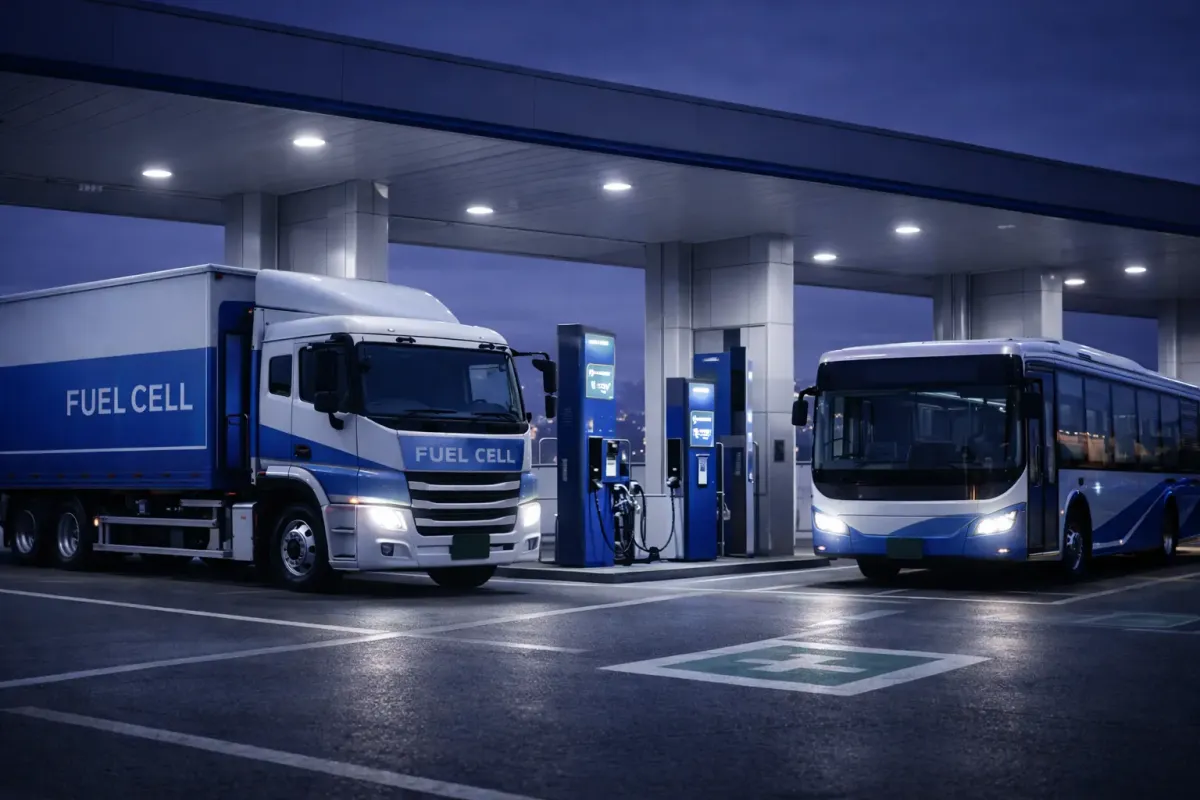
The China fuel cell commercial vehicle market was valued at USD 1.85 billion in 2025 and is projected to reach USD 8.40 billion by 2030, expanding at a CAGR of 35.28% during the forecast period 2026–2030. China has built the world’s largest real-world hydrogen fuel cell commercial vehicle ecosystem, with nearly 40,000 cumulative fuel cell vehicle sales by end-2025, 574 hydrogen refueling stations, and more than 360 tonnes per day of installed refueling capacity. The market is fundamentally a heavy-duty commercial logistics story: as of Q2 2025, China’s fuel cell truck fleet reached 22,000 units, accounting for 72% of the total fuel cell vehicle fleet, with buses at 25% and passenger cars at just 3%. Fuel cell trucks have commanded over 80% of new FCV sales since late 2023, establishing hydrogen as a targeted solution for trunk logistics, port operations, mining transport, steel and coking distribution, cold-chain freight, and intercity corridors.
China’s policy architecture has been deliberately designed to channel fuel cell vehicles into commercial applications. The 2020 shift from vehicle purchase subsidies to city-cluster demonstration programmes rewarded local ecosystems for actual commercialisation outcomes, explicitly prioritising medium- and heavy-duty commercial vehicles for medium- and long-distance transport. The five demonstration clusters—Beijing-Tianjin-Hebei, Shanghai, Guangdong, Zhengzhou, and Hebei—had promoted over 20,000 FCVs, built 200 stations, dispensed 40,000+ tonnes of hydrogen, and accumulated approximately 700 million km of pure-hydrogen operation by September 2025. The critical new development is the March 2026 national pilot framework issued by MIIT, which targets approximately 100,000 fuel cell vehicles by 2030 and average end-use hydrogen prices below RMB 25/kg, with some areas targeting RMB 15/kg.
The market is transitioning from demonstration scale toward selective commercialisation, but not yet toward broad national takeoff. The strongest deployments are clustered, corridor-based, and industrially linked: the 1,150 km Chongqing–Qinzhou hydrogen heavy-truck route launched in April 2025 logged nearly 7,000 trips by February 2026 and expanded cross-border freight toward Vietnam. Technology has improved substantially—a 300 kW fuel cell system now exceeds 25,000 hours of life and can cold-start at -40°C—but the harder challenge is ecosystem economics: hydrogen delivered cost, station utilisation, route density, and asset financing remain the critical bottlenecks. Meanwhile, battery-electric trucks are scaling rapidly in China, reaching approximately 25% of new truck sales in H1 2025 with 175% year-on-year growth, which narrows the economic window where hydrogen trucks are competitive to specific long-range, heavy-payload, high-utilisation corridors.
Key Takeaways
Market Overview & Analysis
Report Summary
The China fuel cell commercial vehicle market covers the production, sale, deployment, and operational infrastructure for hydrogen fuel cell electric trucks, buses, and specialty commercial vehicles operating in China’s domestic logistics, public transport, and industrial freight ecosystems. The market scope includes fuel cell heavy-duty tractors (49-ton class), medium-duty trucks, light commercial vehicles, city transit and intercity buses, sanitation vehicles, construction waste transporters, and cold-chain logistics vehicles. The hydrogen value chain—encompassing production (grey, blue, and green hydrogen), storage and transportation, refueling station infrastructure, and vehicle-side fuel cell systems—is integral to market dynamics.
China accounted for approximately 55.3% of total global fuel cell vehicle sales in H1 2025, making it the world’s largest FCV market ahead of South Korea (38,000 cumulative units globally) and the United States (19,000 units). The market structure is distinctive: unlike South Korea and the US where passenger FCEVs (Hyundai Nexo, Toyota Mirai) dominate, China’s market is overwhelmingly commercial. This reflects both policy design—the demonstration clusters explicitly targeted commercial applications—and the fundamental economics: fuel cell attributes (5–15 minute refueling, 600+ km range with 60–80 kg onboard hydrogen, stable output regardless of charge level, and payload preservation versus heavy battery packs) create the strongest value proposition in high-utilisation, heavy-duty, long-distance freight operations.
The industrial chain has matured significantly. More than 300 major parts companies in China now have domestic fuel cell component production capability. Core component localisation rates as of June 2025 exceed 90% for fuel cell stacks and air compressors, and exceed 80% for membrane electrodes, hydrogen gas circulation systems, and bipolar plates. However, critical upstream materials remain bottlenecks: domestic production rates for catalysts stand at only 19.5%, proton exchange membranes at 13.9%, and carbon paper at 5.1%. Fuel cell system costs have fallen to approximately RMB 1,000/kW in 2025 and are projected to reach RMB 570/kW within 3–5 years, with vehicle costs expected to fall below RMB 500,000.
Market Dynamics
Key Drivers
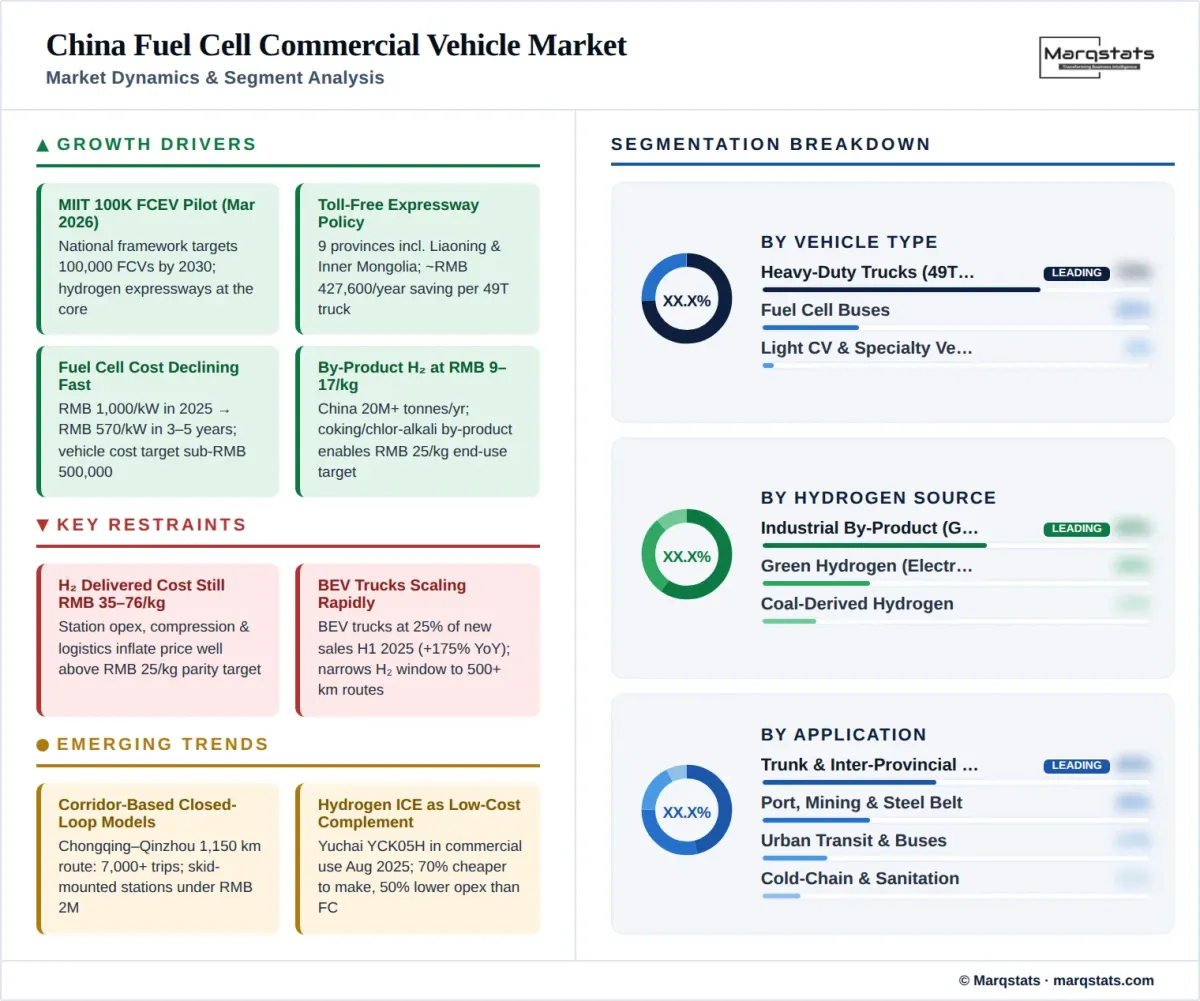
- National 100,000-vehicle pilot framework creating structured demand: MIIT’s March 2026 notification on comprehensive hydrogen energy application pilots sets a target of 100,000 FCEVs by 2030, with hydrogen expressways and corridors at the core. The pilot promotes large-scale FCEV application in medium-to-heavy-duty transport, medium-to-long-haul freight, and cold-chain logistics, while encouraging deployment in public transport, urban logistics, sanitation, and construction waste transport. This policy framework creates predictable demand for OEMs, system integrators, and infrastructure operators.
- Hydrogen expressway programme enabling corridor-based deployment: The December 2024 supplementary notice on fuel cell vehicle demonstration announced support for comprehensive hydrogen-powered highway demonstrations. The CASPRC’s ‘Hydrogen Vehicle Journey of Ten Thousand Miles’ project in April 2025 deployed over 200 fuel cells vehicles across 15 routes in five application scenarios, covering 1.62 million km and reducing 1,000 tonnes of CO2. The Chongqing–Qinzhou route (1,150 km) and free-expressway policies in nine provinces including Liaoning and Inner Mongolia demonstrate the corridor-based deployment model.
- Declining fuel cell system costs improving vehicle economics: Fuel cell system costs have fallen from approximately RMB 2,000+/kW in early demonstration phases to approximately RMB 1,000/kW in 2025. Fenergy projects further decline to RMB 570/kW within 3–5 years, with a 180 kW system falling to RMB 100,000 and complete vehicle costs falling below RMB 500,000. Stack costs for a 130 kW system are expected to decrease from RMB 150,000 to RMB 90,000 (approximately RMB 600/kW). This cost trajectory is critical for approaching commercial parity with diesel trucks priced at RMB 270,000–350,000.
- By-product hydrogen providing low-cost fuel supply: China is the world’s largest hydrogen producer at 20+ million tonnes annually. Industrial by-product hydrogen from coke-oven gas, chlor-alkali processes, and chemical fertiliser production offers the most realistic near-term commercialisation pathway, with production costs of RMB 9–17/kg. The 2026 pilot’s RMB 25/kg end-use price target and some areas targeting RMB 15/kg are achievable primarily through by-product hydrogen combined with local production-refueling integration in non-chemical industrial parks, a policy relaxation now available in 10 provinces including Shandong and Inner Mongolia.
- Toll exemptions and expressway subsidies reducing TCO directly: Nine provinces including Liaoning and regions in Inner Mongolia offer free expressway travel for hydrogen fuel cell vehicles. Using a 49-ton vehicle on Shandong Expressway as an example, at RMB 2.138/km over 200,000 km annually, the toll saving alone amounts to approximately RMB 427,600 per year. Combined with reasonably priced hydrogen, fuel cell heavy-duty trucks already demonstrate TCO advantage in specific corridor applications.
Key Restraints
- Hydrogen delivered cost remains above commercial parity in most regions: Despite falling production costs, end-use hydrogen prices in early 2026 ranged from RMB 35–76/kg across pilot cities, well above the RMB 25/kg threshold needed for broad commercial parity. The gap between production-side prices (below RMB 30/kg average in 2024) and dispensing prices reflects high storage, transportation, compression, and station operating costs. The mismatch between green hydrogen production capacity concentrated in northwest China and vehicle demand concentrated in coastal demonstration clusters further inflates logistics costs.
- Thin refueling station network limiting operational scalability: China’s 574 stations represent a significant installed base but can support only approximately 4,000–5,000 heavy trucks daily. Only about 30 hydrogen stations exist in or near highway service areas. Stations face constraints including a maximum of two refueling guns per facility, complex multi-departmental approval processes (land, fire, housing, emergency management), and limited land resources in urban areas. The 35 MPa stations account for over 90% of infrastructure, with 70 MPa and liquid hydrogen standards still undeveloped.
- Battery-electric trucks as an intensifying competitive threat: BEV trucks are scaling dramatically in China, reaching approximately 25% of new truck sales in H1 2025 with 175% year-on-year growth and over 76,100 units. Battery-electric heavy trucks achieved a 22% sales share in H1 2025. Expert opinion positions BEV trucks as advantaged within approximately 500 km range, which narrows hydrogen’s addressable market to routes exceeding 500–1,000 km where refueling time, range, and payload preservation matter more than energy cost.
- Financial fragility across the value chain: The hydrogen FCV industry remains in an early stage with strong policy and cash-flow dependence. Customers often settle payments only after deducting expected subsidies, and subsidy collection can take more than two years, creating extended receivable cycles. Due diligence for financing is hampered by lack of historical performance data, and financing rates have risen 20–30%. Companies in the midstream face declining profits, losses, personnel cuts, and difficulty raising capital.
Key Trends
- Shift from demonstration to selective corridor commercialisation: The market is moving beyond the five-cluster demonstration phase toward hydrogen expressway-linked deployment. The short-term vision (2025–2027) targets 40,000 vehicles and 600 stations with a vehicle-to-station ratio of 70:1. The medium-term (2028–2030) targets green hydrogen costs stabilised at RMB 20/kg, vehicle-to-station ratio of 50:1, and liquid hydrogen and hydrogen exchange station standards established. Long-term (2031+), hydrogen transport is expected to enter a zero-carbon fair pricing era with life-cycle costs matching diesel.
- Integrated vehicle-station-hydrogen closed-loop models: The most commercially viable deployments combine vehicle provision, hydrogen supply, and refueling infrastructure into closed-loop or semi-closed-loop ecosystems, particularly in ports, mining zones, steel belts, and coking operations. Skid-mounted hydrogen stations (investment under RMB 2 million, construction under two weeks) and manufacturing-and-supply-integrated stations using on-site green hydrogen (cost below RMB 20/kg) are enabling rapid, low-cost network expansion.
- Hydrogen combustion engines as an emerging complement to fuel cells: Yuchai Group’s YCK05H hydrogen internal combustion engine entered practical operation in August 2025 in a water sprinkler truck in Cangzhou, Hebei—China’s first hydrogen engine-powered finished vehicle in commercial use. Hydrogen combustion engines are 70% cheaper to manufacture, 50% lower in operating costs, and 400% longer in service life than fuel cells, making them an alternative for buses and specialty vehicles where fuel cell cost premiums are prohibitive.
- International partnerships deepening technology and market reach: Honda China and Dongfeng Motor Group launched a commercial HFCV demonstration in October 2025 on logistics routes in Wuhan, with expansion planned to Guangzhou and Shanghai. Sinotruk and Toyota Motor strengthened cooperation on hydrogen fuel cell tractors, with batch deliveries for market application. Wisdom Motors partnered with HY-X to bring Chinese fuel cell commercial vehicles to Germany. These partnerships validate China’s technology and open export channels.
Market Segmentation
Heavy-duty trucks (including 49-ton class tractors) are the dominant and fastest-growing segment, accounting for the majority of new fuel cell vehicle sales since late 2023. Trucks are the natural fit for hydrogen because they operate on predictable routes at high utilisation, where fast refueling (5–15 minutes versus hours for BEV), long range (600+ km), and payload preservation (fuel cell systems weigh approximately 120 kg versus 800+ kg for equivalent battery capacity) create decisive operational advantages. Dongfeng has sold more than 9,200 hydrogen vehicles cumulatively with over 30% market share across 40+ cities. Foton launched the Auman Starwing hydrogen heavy truck in January 2025. Great Wall’s FTXT with Yutong delivered hydrogen 49-ton tractors for coke transport in Anyang. Vehicle costs currently range from RMB 750,000–1,350,000 versus RMB 270,000–350,000 for diesel equivalents, but the gap is narrowing.
Buses represent approximately 25% of China’s cumulative fuel cell vehicle fleet (7,748 units as of Q2 2025) and were the initial anchor segment for fuel cell vehicle demonstrations. Hydrogen buses are deployed in urban transit, intercity routes, and airport shuttle services across the five demonstration clusters. However, growth momentum has shifted toward trucks as BEV buses have become highly cost-competitive for urban transit routes under 300 km daily range. Fuel cell buses retain advantages for intercity routes requiring 400+ km range and rapid turnaround, and in cold-climate regions where battery performance degrades.
Light commercial vehicles, sanitation trucks, construction waste transporters, cold-chain logistics vehicles, and urban delivery vans represent a growing but still small segment. The March 2026 MIIT pilot explicitly encourages FCEV application in city logistics, sanitation, and muck transport. Cold-chain logistics is a particularly promising application because hydrogen fuel cells provide both propulsion and auxiliary power for refrigeration without the battery drain that reduces BEV range. Yuchai Group’s hydrogen combustion engine deployment in sanitation vehicles signals that this segment may adopt both fuel cell and hydrogen ICE solutions.
Industrial by-product hydrogen from coke-oven gas, chlor-alkali, and chemical processes is the most commercially viable near-term fuel source, with production costs of RMB 9–17/kg. China’s established coal-chemical and steel industries generate substantial volumes of by-product hydrogen, particularly in provinces such as Hebei, Shandong, Shanxi, and Inner Mongolia where fuel cell truck deployments are concentrated. The proximity of by-product hydrogen supply to heavy-industry freight routes creates natural closed-loop ecosystems for fuel cell truck operations.
Green hydrogen from water electrolysis using renewable electricity is scaling rapidly in China, with production costs ranging from RMB 10–30/kg depending on electricity rates and utilisation. Total investment in hydrogen-related projects registered nationwide from January to July 2025 reached approximately RMB 119.9 billion, with hydrogen production capacity of 1.75 million Nm³/hour. The 2026 pilot targets green hydrogen exceeding 60% of total hydrogen supply in the long term, with the vehicle-to-station ratio maintained at 40:1.
Coal-derived hydrogen remains a significant source at RMB 9–15/kg production cost, but faces increasing carbon-price risk as China’s emissions trading system matures. The transition pathway envisions coal-derived hydrogen serving as a bridge fuel during the scale-up phase, progressively replaced by green hydrogen as electrolysis costs decline.
By Geography
North China (Beijing-Tianjin-Hebei, Inner Mongolia, Shanxi)
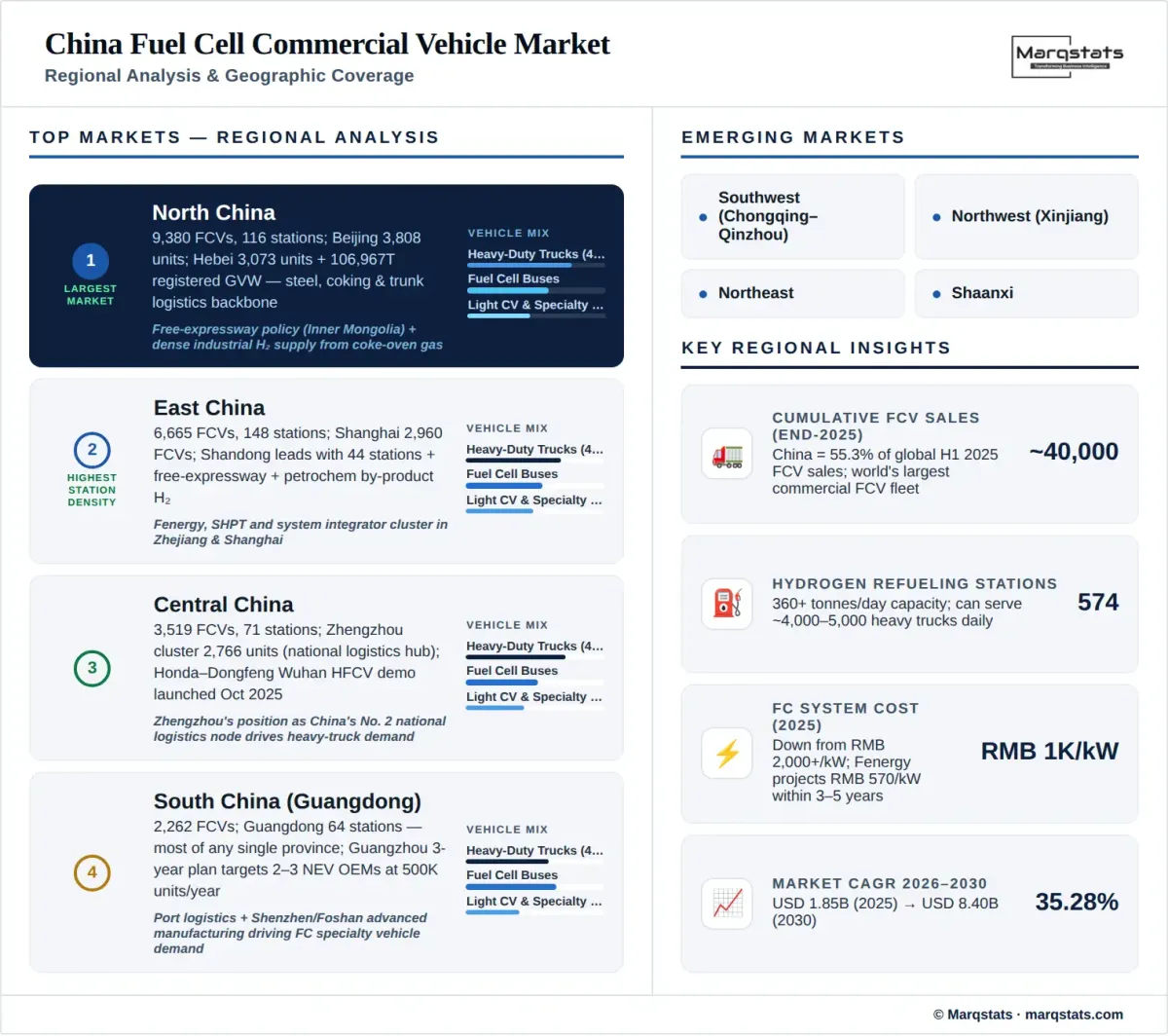
North China is the largest regional market with 9,380 fuel cell vehicles and 116 stations. Beijing leads with 3,808 registered FCVs, the highest vehicle-to-station ratio nationally at 238:1. Hebei ranks second with 3,073 vehicles and leads in registered gross vehicle weight (106,967 tons), reflecting the concentration of heavy-duty steel and coking logistics. Tianjin has the highest average vehicle weight nationally at 45.82 tons/unit, confirming trunk-line logistics dominance. Inner Mongolia benefits from free-expressway policies and abundant industrial hydrogen from coal-chemical operations.
East China (Shanghai, Shandong, Zhejiang, Jiangsu)
East China has 6,665 fuel cell vehicles and 148 stations, the highest station density among all regions. Shanghai is the technology and innovation hub with 2,960 registered vehicles and a vehicle-to-station ratio of 164:1. Shandong leads nationally in hydrogen station count at 44 locations and benefits from free-expressway policies and its large petrochemical industry providing by-product hydrogen. Zhejiang has 36 stations and is home to Fenergy and other fuel cell system manufacturers.
Central China (Henan, Hubei, Hunan)
Central China has 3,519 vehicles and 71 stations. Henan (Zhengzhou cluster) has 2,766 registered FCVs and ranks second in gross vehicle weight at 76,020 tons, reflecting the province’s position as a national logistics hub. Honda China and Dongfeng’s HFCV demonstration project launched in Wuhan highlights Hubei’s emergence as a fuel cell commercial vehicle testing ground.
South China (Guangdong)
South China has 2,262 vehicles and 80 stations, with Guangdong alone operating 64 hydrogen stations—the most of any single province. Guangdong (the Guangdong demonstration cluster including Shenzhen, Guangzhou, Foshan) has 2,164 registered FCVs. Guangzhou’s Three-Year Action Plan (2025–2027) targets preliminary commercial FCEV application and aims for 2–3 auto companies with annual NEV production exceeding 500,000 units.
Other Regions (Northeast, Southwest, Northwest)
The Northeast (405 vehicles, 16 stations), Southwest (1,357 vehicles, 40 stations), and Northwest (599 vehicles, 26 stations) represent frontier markets with significant development potential. The Northwest benefits from vast renewable energy resources for green hydrogen production, while the Southwest’s Chongqing–Qinzhou corridor demonstrates cross-regional freight capability. Shaanxi has the second-highest average vehicle weight at 43.76 tons/unit, reflecting mining and industrial logistics applications.
How Competition Is Evolving
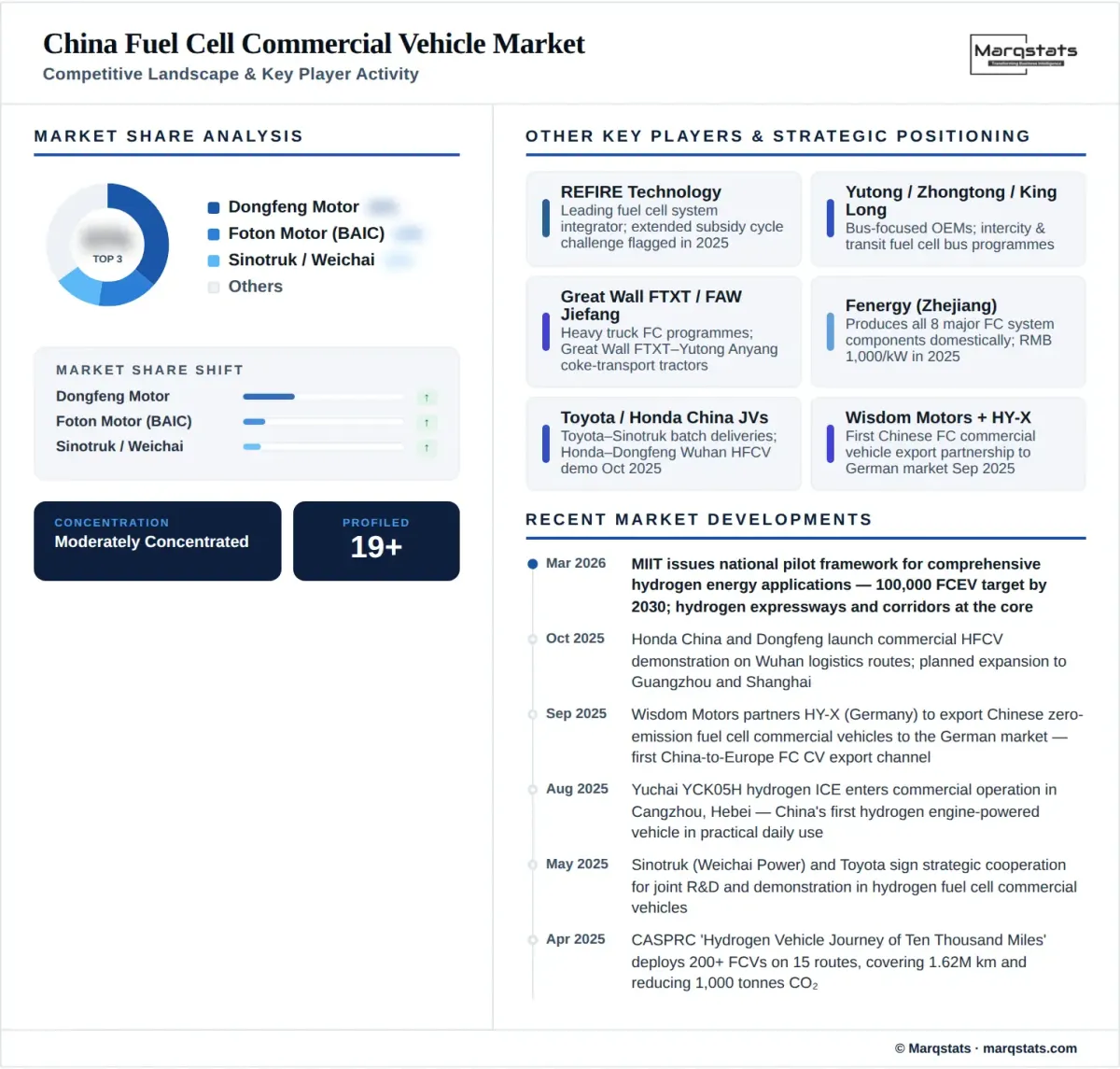
The China fuel cell commercial vehicle market features a layered competitive ecosystem spanning vehicle OEMs, fuel cell system integrators, and core component suppliers. Dongfeng Motor Corporation is the disclosed market leader with over 9,200 cumulative hydrogen vehicle sales and more than 30% share across 40+ cities. Foton Motor (BAIC Group) has expanded its FCEV portfolio with the Auman Starwing hydrogen heavy truck. Sinotruk (Weichai Power subsidiary) leverages its Toyota Motor partnership for hydrogen fuel cell tractors. FAW Jiefang, Yutong (buses), King Long (buses), Zhongtong (buses), and SAIC Motor are other significant vehicle manufacturers.
On the fuel cell system and component side, REFIRE Technology is one of China’s most visible system integrators, though its 2025 interim disclosure noted the industry’s continued early-stage financial dependency and extended subsidy collection cycles. Shanghai Hydrogen Propulsion Technology (SHPT) provides systems for multiple OEMs. Fenergy produces all eight major fuel cell system components domestically and achieved system costs of approximately RMB 1,000/kW in 2025. The competitive moat in this market increasingly belongs to players who control routes, fuel supply, and vehicle utilisation rather than those who only manufacture stacks or vehicles.
The BEV truck competitive threat is reshaping strategic positioning. With BEV trucks capturing approximately 25% of China’s new truck sales in H1 2025, fuel cell truck OEMs and system suppliers are concentrating on specific niches where hydrogen retains clear advantages: 49-ton class long-haul tractors, inter-provincial corridor freight, port and mining operations, and cold-chain logistics requiring 600+ km range and sub-15-minute refueling. The competitive winners will be those that build integrated vehicle-station-hydrogen ecosystems around these high-value corridors.
Companies Covered
Companies covered in the report include:
Recent Market Activity
Table of Contents
Coverage & Segmentation
This report provides a comprehensive analysis of the China fuel cell commercial vehicle market covering the historical period 2021–2025 and forecast period 2026–2030, with 2025 as the base year. The study examines market size in value (USD billion) and volume (units), segmented by vehicle type (heavy-duty trucks, medium-duty trucks, buses, light commercial and specialty vehicles), hydrogen source (industrial by-product, green electrolysis, coal-derived), fuel cell system power (sub-100 kW, 100–200 kW, 200+ kW), application (trunk logistics, port/mining, cold-chain, urban transit, sanitation), and geography (seven regional clusters). The competitive landscape profiles 19 leading vehicle OEMs, system integrators, and technology providers.
Primary research includes structured interviews with 40+ industry stakeholders spanning fuel cell vehicle OEMs, system integrators, hydrogen production and station operators, fleet logistics companies, government demonstration programme managers, and industry associations (CAAM, CATARC/CASPRC). Secondary research draws from MIIT policy notifications, CAAM production and sales statistics, CASPRC demonstration data, company disclosures and securities filings, and conference presentations including SNEC H2+ 2025. All market estimates represent Marqstats Intelligence proprietary calculations.