Market Snapshot
Key Takeaways
Market Overview & Analysis
Report Summary
The France used car market comprises all passenger-car ownership transfers recorded in metropolitan France and the overseas departments in a calendar year, sold through manufacturer-franchised networks, independent dealers and professional retailers, digital-first operators, and direct private-party channels. This study segments demand by vehicle type, propulsion type, seller type, sales channel, vehicle age, vehicle mileage, price band, certification status, vehicle positioning, and brand, with a 2025 base year, historical coverage from 2021 to 2025, and forecasts to 2030. Sizing is presented in unit-volume terms and complemented by value analysis in United States dollars.
Two published transaction series exist for the French market and they differ by roughly 40 thousand units. Registration-authority data places 2025 transactions at approximately 5.40 million, while a separate commercial series reports approximately 5.44 million. Marqstats sizes on the lower registration-derived figure for consistency with the historical series, and readers reconciling against the alternative source should expect a difference of under one percent, which does not affect any segment conclusion.
The defining structural feature is age. The secondary market has shifted decisively toward vehicles of ten to fifteen years old, and three forces drive it: corporate fleet renewal has slowed, the 2020 to 2023 disruption in new-car production removed a cohort that would now be reaching three to five years old, and prices for younger used vehicles have moved beyond the reach of many households. Transactions of vehicles under five years old fell about 8% through late 2025, and the shortfall is the single largest constraint on franchised dealer and certified programme supply.
Regulation has reshaped demand more directly in France than in neighbouring markets. Crit'Air 3 vehicles were barred from several low-emission zones from January 2025, with 25 zones active at the start of that year, and used listings for affected vehicles fell roughly 60% between the first quarter of 2023 and the first quarter of 2025. A simplification law adopted in April 2026 relaxed certain zone constraints and was subsequently challenged before the Constitutional Council, leaving the framework unsettled. Used electric prices have fallen in parallel as ex-leasing stock reaches the secondary market, which widens buyer access while compressing residual values for vehicles registered in earlier cohorts.
Market Dynamics
Key Drivers
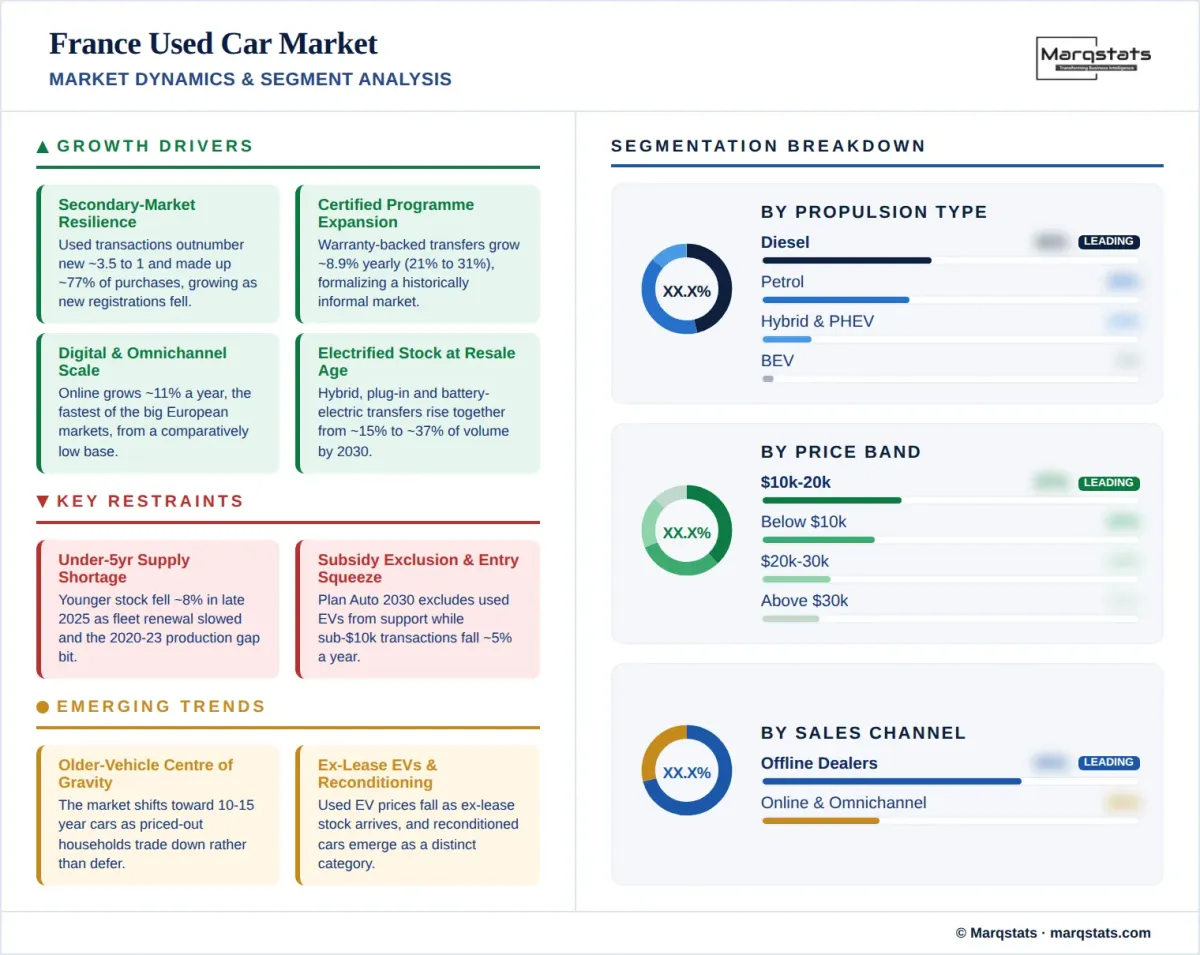
- The secondary market absorbs demand displaced from new cars, as used transactions outnumber new registrations by roughly three and a half to one and represent about 77% of all passenger-car purchases.
- Certified programme expansion lifts value per transaction, as warranty-backed transfers grow at an 8.93% CAGR and raise share from about 21% of volume to about 31% by 2030.
- Digital and omnichannel retail scales at an 11.08% CAGR, the fastest channel growth among the large European markets, from a comparatively low base.
- Electrified stock reaches resale age in volume, as hybrid, plug-in hybrid, and battery-electric transfers together rise from about 15% of volume to about 37% by 2030.
- Franchised networks grow fastest among seller types at a 4.21% CAGR, supported by manufacturer certified programmes that formalise a historically informal market.
Key Restraints
- Vehicles under five years old are in short supply, falling about 8% through late 2025 as fleet renewal slowed and the 2020 to 2023 production disruption removed a resale cohort.
- Diesel residual values are compressed by low-emission zone enforcement, as used listings for the affected Crit'Air 3 class fell roughly 60% between early 2023 and early 2025.
- Affordable inventory is contracting, as transactions below USD 10,000 decline at a negative 5.15% CAGR from about 30% of volume to about 22% by 2030.
- Low-emission zone rules suppress resale demand for older diesel stock, and the regulatory framework remains unsettled following the April 2026 simplification law and its constitutional challenge.
Key Trends
- The centre of gravity is shifting toward vehicles of ten to fifteen years old, as households priced out of younger stock trade down rather than defer purchase.
- Used electric prices are falling as ex-leasing volumes reach the secondary market, widening access while compressing residual values for earlier cohorts.
- Reconditioned vehicles are emerging as a distinct commercial category positioned between new and conventional used stock.
- Chinese marques remain marginal in resale at roughly 0.5% of transactions, lagging their new-registration share by a full ownership cycle.
Market Segmentation
Hatchbacks account for about 49% of 2025 volume, the highest concentration of any large European market, and hold broadly flat in unit terms while easing to about 46% by 2030. The weighting reflects the dominance of French superminis in the national parc, and the three most-traded used models in the country are all hatchbacks from domestic marques. Sedans account for about 12% of volume and contract at 2.18% annually to about 10% by 2030, the sharpest decline of any body style, as the format continues to lose relevance outside the premium segment.
SUV and crossover models hold about 23% of 2025 volume and grow at a 5.60% CAGR, reaching about 28% by 2030. Penetration remains below German and British levels because the French parc renewed later toward crossover formats. Pickup trucks are the fastest-growing body style at a 7.88% CAGR, though from a very small base of under 2% of volume. MPV and minivan models retain about 9% of transactions, a higher share than in neighbouring markets, reflecting the historic strength of French family formats.
Diesel remains the largest fuel type at about 45% of 2025 volume, a position France shares only with Spain, where the diesel share is higher still at about 49%. The segment nonetheless contracts fastest in the market at a negative 8.43% CAGR, falling to about 28% by 2030. The decline is driven by low-emission zone enforcement, which removed Crit'Air 3 and older diesel vehicles from urban demand, compounded by the collapse of diesel in new registrations from the late 2010s now working through the resale cycle. Gasoline holds about 39% of volume and declines far more gently at 1.67% annually, overtaking diesel as the largest fuel type during the forecast period.
Battery-electric transfers grow from roughly 162 thousand units in 2025 to roughly 680 thousand units by 2030, a 27.13% CAGR and the fastest of any propulsion segment, lifting share from about 3% to about 12%. Hybrids are already substantial at about 10% of 2025 volume, a higher base than in Germany or the United Kingdom, and grow at 14.87% annually to about 20% by 2030. Plug-in hybrids grow at 19.06% to about 5% of volume. Used electric prices have fallen as ex-leasing stock reaches the market, which widens buyer access while compressing residual values for vehicles registered in earlier cohorts.
Private sellers handle about 43% of 2025 transactions, the highest share of any large European market and well above the German and British equivalents. The concentration reflects a deep classifieds culture and a parc weighted toward older, lower-value vehicles that professional retailers decline to stock. The channel contracts at a negative 3.06% CAGR to about 35% by 2030 as instant-valuation and direct-purchase services convert private inventory into professional stock, however it remains the largest single seller type throughout the forecast period.
Independent dealers and professional retailers hold about 39% of 2025 volume and grow at a 3.54% CAGR to about 44% by 2030, overtaking private sellers as the largest channel during the forecast period. Franchised networks hold about 18% of volume, the lowest franchised share among the large European markets, and grow fastest among seller types at 4.21% annually to about 21% by 2030. Certified and warranty-backed transactions across both channels grow at 8.93% annually, rising from about 21% of the total market to about 31%.
Online and omnichannel transactions hold about 31% of 2025 volume and grow at an 11.08% CAGR, the fastest channel growth among the large European markets, reaching about 51% of transactions by 2030 and overtaking offline retail in the final forecast year. The base is comparatively low because the French market retained physical transaction habits longer than its neighbours, which leaves more room for conversion. Digital-first retailers combining reconditioning capacity with integrated financing have been the principal beneficiaries.
Offline transactions decline from about 69% of volume to about 49% by 2030 at a negative 5.80% CAGR. Physical sites retain particular relevance in France given the age profile of the parc, as older and lower-value vehicles are more often inspected before purchase and less often financed. The surviving network consolidates around larger regional groups, and independent operators without reconditioning capacity or a digital presence remain the most exposed.
Vehicles older than ten years account for about 49% of 2025 volume, the largest age cohort by a wide margin and the highest concentration in Western Europe. The cohort contracts at a negative 2.01% CAGR to about 42% by 2030, though it remains dominant throughout. Vehicles aged seven to ten years hold about 18% of volume and grow at 2.19% annually. Together these cohorts represent about two-thirds of all transactions, which is the structural reason average transaction price sits below German and British levels.
Vehicles up to three years old account for about 15% of 2025 volume and grow at a 4.78% CAGR to about 18% by 2030, while the four-to-six-year cohort holds about 18% and grows at 4.21% to about 21%. Both cohorts are constrained by the shortage of younger stock, as transactions of vehicles under five years old fell about 8% through late 2025. Recovery depends on corporate fleet renewal resuming and on the stronger 2023 to 2025 registration years reaching resale age from 2027.
Transactions below USD 10,000 account for about 30% of 2025 volume, the largest entry-tier share among the major European markets, and fall to about 22% by 2030 at a negative 5.15% CAGR. The USD 10,001 to USD 20,000 band is the volume core at about 37% of transactions and holds flat in unit terms while easing to about 35% of share. Together these bands represent about two-thirds of the market in 2025, and their combined share falls by ten percentage points across the forecast period.
The USD 20,001 to USD 30,000 band grows at 4.21% annually from about 18% of volume to about 21%. Transactions above USD 30,000 grow fastest at 8.80% annually, rising from about 15% of volume to about 22% and reaching USD 36.13 billion by 2030. Premium and luxury vehicles account for about 14% of transactions, the lowest premium share among the large European markets, reflecting a parc weighted toward domestic mass-market marques.
By Geography
Île-de-France
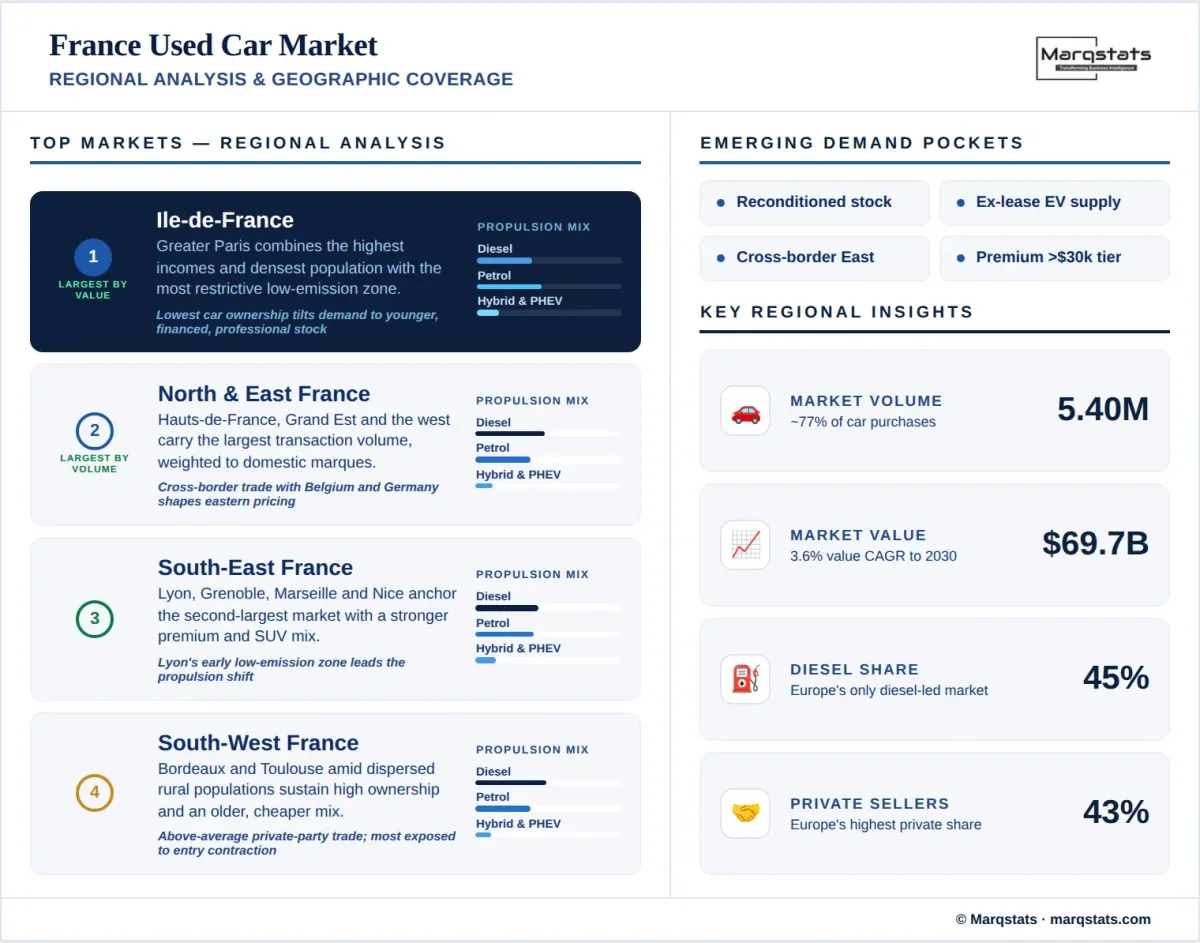
Île-de-France forms the largest regional market by transaction value, combining the highest household incomes in the country with the densest population. The Greater Paris low-emission zone is the most restrictive in France and has removed older diesel stock from local demand faster than anywhere else, pushing affected vehicles into resale channels in surrounding regions. Car ownership per household is the lowest in the country, which shifts a greater proportion of demand toward younger financed vehicles and toward professional rather than private channels.
Auvergne-Rhône-Alpes & Provence-Alpes-Côte d'Azur
The south-eastern regions form the second-largest market, anchored by the Lyon, Grenoble, Marseille, and Nice conurbations. Lyon operates one of the earliest and most developed low-emission zones in France, giving the region a propulsion mix shift ahead of the national average. Alpine and Mediterranean geography sustains above-average demand for SUV and crossover formats, and the region carries a stronger premium mix than the national picture, particularly along the Mediterranean coast.
Nouvelle-Aquitaine, Occitanie & the South West
The south-western regions combine dispersed rural populations with the Bordeaux and Toulouse metropolitan areas. Long travel distances and limited public transport sustain high vehicle ownership per household, and the regional mix skews toward older vehicles and toward the sub-USD 10,000 price band. Private-party transactions run above the national average, and the region is therefore among the most exposed to the contraction of affordable inventory across the forecast period.
Northern & Eastern France
The northern and eastern regions span Hauts-de-France, Grand Est, Normandy, Brittany, Pays de la Loire, Centre-Val de Loire, and Bourgogne-Franche-Comté, and together account for the largest share of national transaction volume. The mix is weighted decisively toward domestic mass-market marques and older vehicles, reflecting lower average household incomes outside the metropolitan centres. Proximity to Belgium, Luxembourg, and Germany supports cross-border trade in the eastern departments, where currency and registration considerations influence local pricing.
How Competition Is Evolving
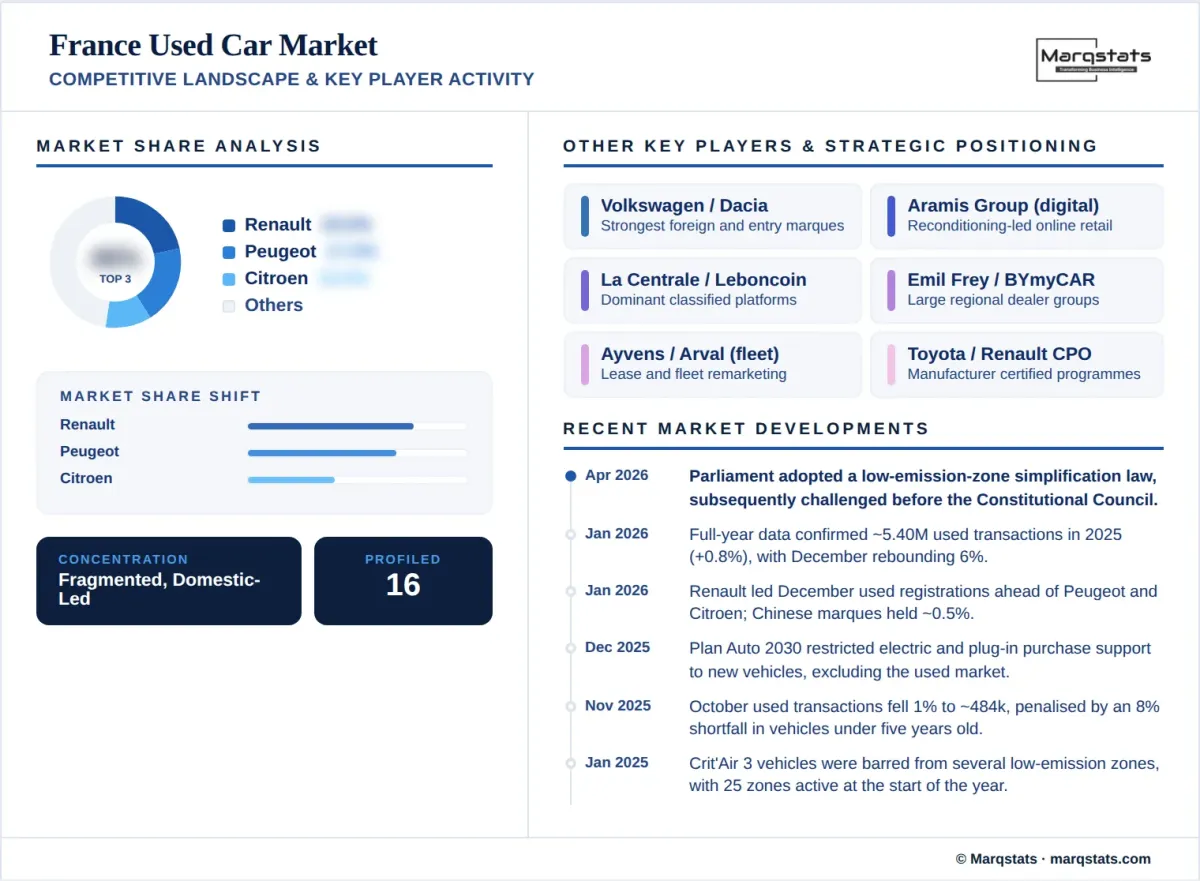
The France used car market is fragmented, and no operator controls more than a low single-digit share of annual transactions. About 43% of 2025 volume moved directly between private parties, the highest private share of any large European market, and the remaining professional volume is distributed across franchised networks, regional dealer groups, digital-first retailers, and several thousand independent traders. Concentration is increasing at the margin as certified programmes and digital operators absorb private supply, though France remains structurally more informal than Germany or the United Kingdom.
At brand level France is the most domestically concentrated market in Western Europe. Renault leads with roughly 19% of transactions, ahead of Peugeot at roughly 17% and Citroën at roughly 10%; the three marques together account for close to 47% of the market. Volkswagen is the strongest foreign brand at roughly 8%, followed by Dacia, whose position reflects a decade of strong entry-price registrations now reaching resale age. German premium marques and the Japanese and Korean brands occupy the tier below. Chinese marques remain marginal at roughly 0.5% of transactions, lagging their new-registration share by a full ownership cycle.
Brand concentration is reinforced at model level. The single most-traded used model accounts for more than twice the volume of the second, and the top three models are all superminis from domestic marques. The thirty most-traded models together represent under a fifth of the market, which confirms that concentration sits at brand and segment level rather than in individual nameplates, and that the long tail of the French parc remains extremely deep.
Competition centres on inventory acquisition and reconditioning capacity rather than on marketplace liquidity. The dominant classifieds platforms carry enormous private-listing volume, so professional retailers compete primarily on their ability to source, recondition, and warrant vehicles that private sellers cannot. Manufacturer-backed certified programmes provide the counterweight, growing at 8.93% annually and using warranty coverage and captive finance to formalise a market where informal transactions still dominate. Reconditioning throughput and financing attachment determine profit per unit far more than vehicle margin alone.
Companies Covered
The report profiles 16+ companies with full strategy and financials analysis, including:
Recent Market Activity
Table of Contents
Coverage & Segmentation
This report provides a comprehensive assessment of the France used car market across a 2025 base year, historical data from 2021 to 2025, and forecasts spanning 2026 to 2030. Market sizing is presented in unit-volume terms and complemented by value analysis in United States dollars, with segmentation by vehicle type, propulsion type, seller type, sales channel, vehicle age, vehicle mileage, price band, certification status, vehicle positioning, and brand. The transaction layer counted is the passenger-car ownership transfer as recorded by the national registration system, excluding commercial-vehicle and motorcycle transfers and excluding intra-company re-registrations.
The scope covers demand drivers, restraints, and structural trends, with particular focus on the persistence of diesel as the largest fuel type, the shift of the market toward vehicles of ten to fifteen years old, the shortage of stock under five years old, low-emission zone rules and the unsettled regulatory position following the April 2026 simplification law, the rising average age of vehicles changing hands, and the exceptional concentration of domestic marques. An extended forecast to 2035 is available under customization for subscribers requiring a longer planning horizon, alongside deeper cuts by region, brand, or channel on request.
Comparative benchmarking is drawn from adjacent Marqstats coverage, including the Germany used car market, which permits comparison of certified penetration, channel structure, and average transaction price against Europe's largest used-vehicle market by value.