Market Snapshot
Key Takeaways
Market Overview & Analysis
Report Summary
The Europe used car market comprises used passenger-car transactions recorded across the European region in a calendar year, transacted through manufacturer-franchised networks, independent dealers and professional retailers, digital platforms and auction services, and direct private-party channels. This study segments demand by vehicle type, propulsion type, seller type, sales channel, vehicle age, vehicle mileage, price band, certification status, vehicle positioning, and brand, with a 2025 base year, historical coverage from 2021 to 2025, and forecasts to 2030. Sizing is presented in unit-volume terms and complemented by value analysis in United States dollars.
Aggregation across Europe requires care, because national statistical authorities count different things. Some publish ownership transfers, some publish second-hand registrations, some publish keeper changes, and some publish nothing authoritative at all. Two markets carry particularly large definitional gaps: Italy, where gross series including dealer holding formalities can exceed the net figure by more than 70%, and Sweden, where circulating estimates differ by roughly a factor of two. This study normalises every market to a single transaction basis before aggregation, and the country reports disclose each national reconciliation in full.
Data confidence also varies materially by market. Germany, the United Kingdom, Italy, Spain, the Netherlands, Belgium and Türkiye are anchored to published national series and validate closely, in several cases to within a fraction of a percent. Poland's recent years are reconstructed from import inflows, while Sweden and Norway are research estimates built from parc and registration indicators because neither country publishes an authoritative annual transaction series. Regional totals are therefore more robust than any single weak component, though users should weight conclusions toward the well-anchored markets.
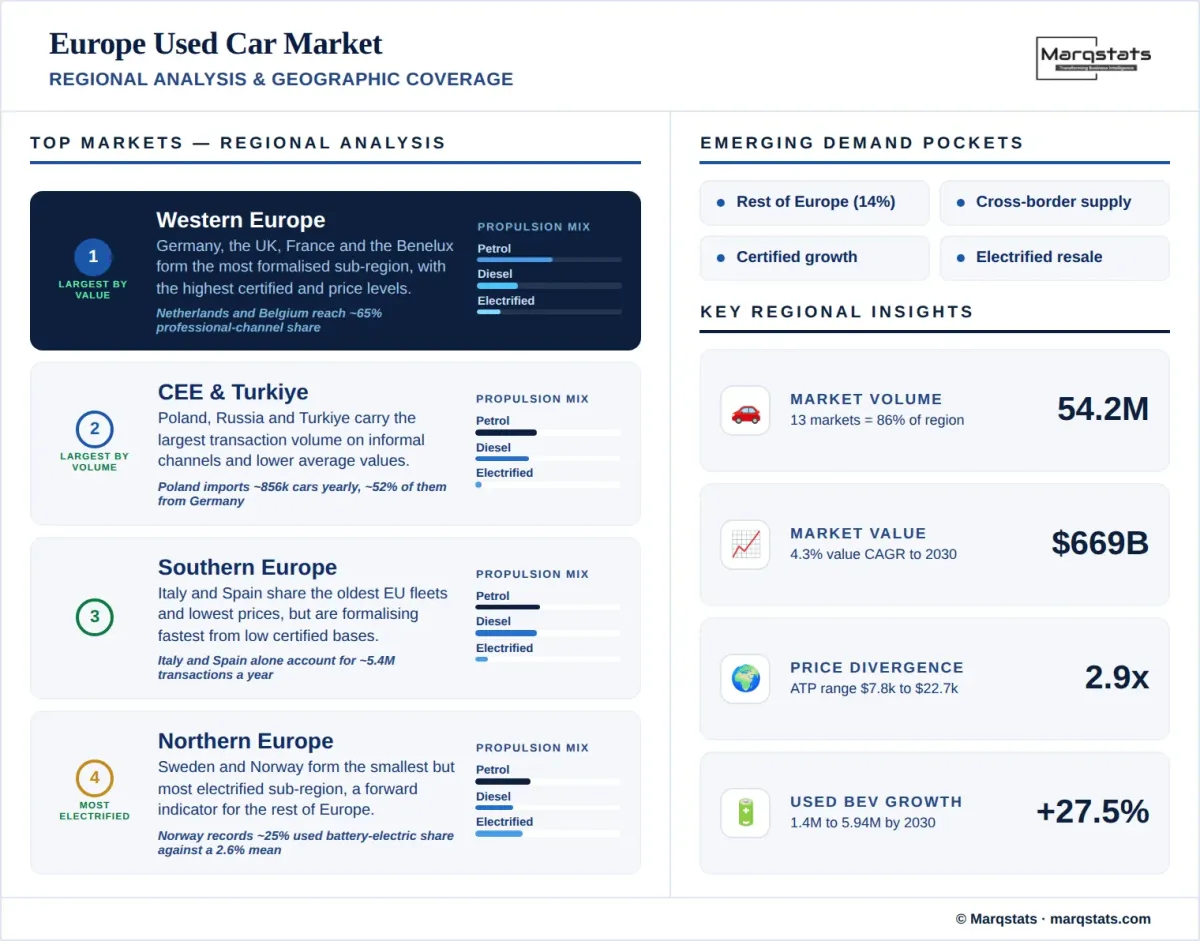
The structural picture is one of slow parc turnover meeting rapid channel change. Aggregate volume grows at only 1.64% because Europe's vehicle parc renews on a decade-plus cycle and new-car registrations across most of the region remain below pre-2020 levels. Within that flat envelope, value grows at 4.29%, certified transactions at 10.04%, online channels at 10.83%, and battery-electric transfers at 27.52%. The commercial opportunity in European used cars is therefore about capturing share and moving up the value chain, not about riding volume growth.
Market Dynamics
Key Drivers
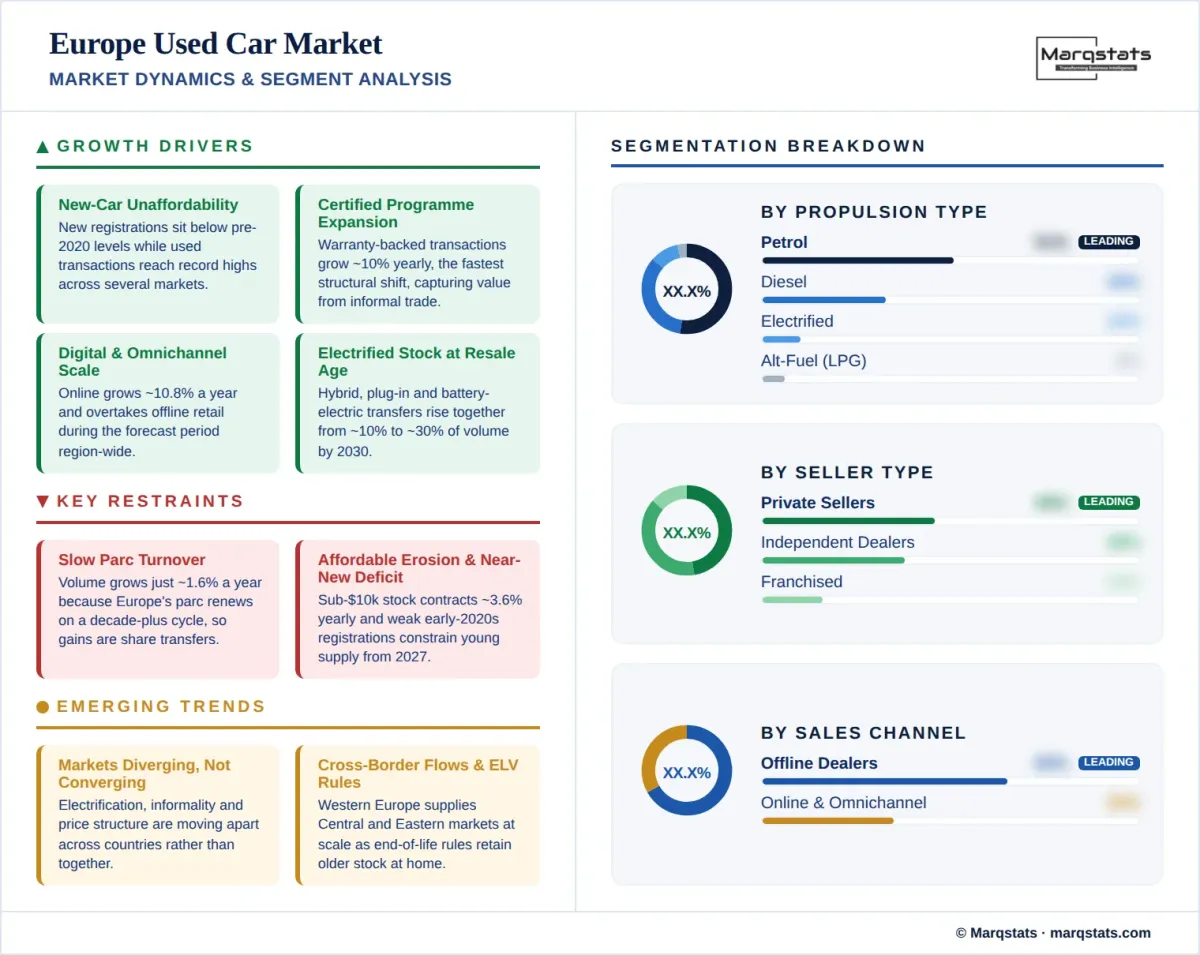
- New-car unaffordability redirects demand across the region, as registrations remain below pre-2020 levels while used transactions reach record highs in several markets.
- Certified programme expansion grows at a 10.04% CAGR, the fastest structural shift in the region, lifting warranty-backed share from about 20% to about 30% by 2030.
- Digital and omnichannel retail scales at a 10.83% CAGR and overtakes offline during the forecast period.
- Electrified stock reaches resale age in volume, as hybrid, plug-in hybrid and battery-electric transfers together rise from about 10% of volume to about 30% by 2030.
- Professional channels capture private-seller share, as franchised networks grow at 5.03% and independent retailers at 4.13% annually.
Key Restraints
- Aggregate volume growth is capped at a 1.64% CAGR because the European parc turns over on a decade-plus cycle.
- Affordable inventory is contracting at a negative 3.61% CAGR, reducing the supply of vehicles below USD 10,000 that carry a third of regional volume.
- Weak new-car registration years across the early 2020s will constrain near-new supply from around 2027 in most Western markets.
- Regulatory divergence raises the cost of pan-European operation, as low-emission zones, taxation and export rules differ by country and increasingly by city.
Key Trends
- National markets are diverging rather than converging, with electrification, informality and price structure moving apart rather than together.
- European end-of-life vehicle rules restricting export of non-roadworthy vehicles will retain older stock in domestic circulation.
- Battery state-of-health assessment is emerging as a competitive barrier in the most electrified markets.
- Cross-border flows are reshaping supply, with Western Europe supplying Central and Eastern markets at scale.
Market Segmentation
Hatchbacks account for about 36% of 2025 volume, the largest body type across the region, and contract marginally at 0.24% annually to about 33% by 2030. Concentration varies enormously by market, from about 49% in France to about 22% in Türkiye. Sedans hold about 23% of transactions and grow marginally at 0.33%, a share sustained almost entirely by Türkiye and Russia, where saloons dominate, against low-teens shares across most of Western Europe.
SUV and crossover models hold about 25% of 2025 volume and grow at a 5.81% CAGR, the strongest of any body style, reaching about 30% by 2030. Penetration ranges from about 48% in Norway to about 18% in Türkiye, tracking both the age of each national parc and the point at which crossovers came to dominate local new-car registrations. Pickup trucks hold about 3% of transactions and grow at 5.04% annually, concentrated in the Nordic markets.
Petrol accounts for about 51% of 2025 volume and declines at a 2.11% CAGR to about 42% by 2030. Diesel holds about 33% of transactions and contracts at a negative 5.99% CAGR to about 23%. The regional averages conceal a fourfold spread: diesel ranges from about 5.5% of transactions in the Netherlands to about 49% in Spain, with France at about 45% and Türkiye at about 32%. Alternative fuels hold about 6% of regional volume, almost entirely accounted for by liquefied petroleum gas in Türkiye and Italy.
Battery-electric transfers grow from 1.40 million units in 2025 to 5.94 million by 2030, a 27.52% CAGR lifting share from about 2.6% to about 10.2%. Hybrids grow at 19.28% annually to about 15% of volume and plug-in hybrids at 21.52% to about 5%. The spread across markets is the widest of any segment in this study, from about 25% battery-electric share in Norway to about 0.2% in Russia. Combined electrified share reaches about 30% of regional transactions by 2030, against about 72% in Norway and about 8% in Russia.
Private sellers handle about 46% of 2025 transactions across Europe, a share that surprises observers accustomed to Western European retail structures. The regional figure is pulled up by Russia at about 64%, Türkiye at about 55%, Poland at about 58% and Italy at about 50%, against about 32% in Norway and Switzerland and about 33% in the United Kingdom. The channel contracts at a negative 2.20% CAGR to about 38% by 2030, and the pace of that contraction is itself the clearest single indicator of market formalisation.
Independent dealers and professional retailers hold about 38% of 2025 volume and grow at a 4.13% CAGR to about 43% by 2030. Manufacturer-franchised networks hold about 16% and grow fastest among seller types at a 5.03% CAGR to about 19%. Certified and warranty-backed transactions grow at 10.04% annually from about 20% of the regional market to about 30%, the fastest structural shift measured in this study and the principal mechanism by which value is captured from the informal channel.
Online and omnichannel transactions hold about 35% of 2025 volume and grow at a 10.83% CAGR, overtaking offline retail during the forecast period and reaching about 55% of transactions by 2030. Penetration is already highest in Norway at about 48% and Sweden at about 43%, and lowest in Italy at about 24% and Spain at about 28%. The markets with the lowest current penetration record the fastest growth rates, which indicates convergence in channel behaviour even as other structural measures diverge.
Offline transactions hold about 65% of 2025 volume and decline at a negative 5.83% CAGR to about 45% by 2030. Physical sites retain their role in trade-in appraisal, inspection, warranty servicing and financing attachment, and they remain dominant in markets with older and lower-value stock where remote purchase is less practical. Consolidation is advancing across every major market, and operators combining physical footprint with reconditioning capacity and digital reach have gained ground consistently.
Vehicles older than ten years account for about 45% of 2025 transactions and contract at a negative 1.50% CAGR to about 39% by 2030. Vehicles aged seven to ten years hold about 23% and grow at 2.42% annually. Together these cohorts represent about 68% of regional volume, and their weighting varies from about 57% of transactions in Spain to about 29% in Belgium. European end-of-life vehicle rules restricting the export of non-roadworthy vehicles will slow the removal of the oldest cohort from domestic circulation.
Vehicles up to three years old account for about 14% of 2025 volume and grow at a 5.36% CAGR to about 17% by 2030, while the four-to-six-year cohort holds about 18% and grows at 4.50% to about 21%. Both cohorts depend on new-car registrations made three to six years earlier, and the weak registration years across the early 2020s create a supply constraint that surfaces from around 2027 in most Western markets. Corporate and leasing returns are the dominant source in Belgium, the Netherlands, Sweden and Switzerland.
Transactions below USD 10,000 account for about 34% of 2025 volume and fall to about 26% by 2030 at a negative 3.61% CAGR. The band ranges from about 58% of transactions in Poland and about 53% in Russia to about 12% in Switzerland and about 15% in Norway. The USD 10,001 to USD 20,000 band holds about 36% of regional transactions and remains broadly flat. Together these bands carry about 70% of European volume, which is the structural reason regional average transaction price sits near USD 12,348.
The USD 20,001 to USD 30,000 band grows at 4.94% annually from about 17% of volume to about 20%. Transactions above USD 30,000 grow at 9.99% annually, rising from about 13% of volume to about 20% and reaching USD 340.55 billion by 2030, roughly 42% of total regional value. Premium and luxury vehicles hold about 17% of transactions regionally, ranging from about 30% in Switzerland and 25% in Norway to about 12% in Türkiye and Russia.
By Geography
Western Europe
Germany, the United Kingdom, France, the Netherlands, Belgium, Switzerland, Austria and Ireland form the largest sub-region by value and the most formalised by channel. Certified penetration, franchised network coverage and average transaction price all run above the European average, and the Netherlands and Belgium record the highest professional channel shares in the study at about 65% each. The sub-region also faces the sharpest near-new supply constraint from 2027, since weak new-car registration years hit hardest where corporate leasing supplies most young stock.
Southern Europe
Italy, Spain, Portugal and Greece share the oldest traded fleets in Western Europe, the highest informal channel shares outside the east, and the lowest average transaction prices in the European Union. Italy and Spain alone account for about 5.4 million transactions, with about 50% and 57% respectively involving vehicles over ten years old. Both markets are formalising rapidly from low bases, with certified transactions growing at 11.19% in Italy and 10.87% in Spain, the fastest rates among the larger Western economies.
Northern Europe
Sweden, Norway, Denmark and Finland form the smallest sub-region by volume and the most electrified by a wide margin. Norway records about 25% battery-electric share of used transactions and Sweden about 10%, against a regional average of 2.6%. Average transaction prices and certification rates both run well above the European mean, and online channel penetration is the highest in the study. These markets function as a forward indicator for electrified resale dynamics that other European markets will encounter later in the decade.
Central & Eastern Europe and Türkiye
Poland, Russia, Türkiye and the wider Central and Eastern European markets account for the largest share of regional transaction volume while contributing proportionally less value. Informal channels dominate, with private sellers handling between about 55% and 64% of transactions in the largest markets, and franchised networks reaching only 8% to 10%. Poland functions as the region's principal import destination, taking roughly 856 thousand used passenger cars in 2025 with Germany supplying about 52%, which makes Western European disposal decisions a direct determinant of Central European supply.
How Competition Is Evolving
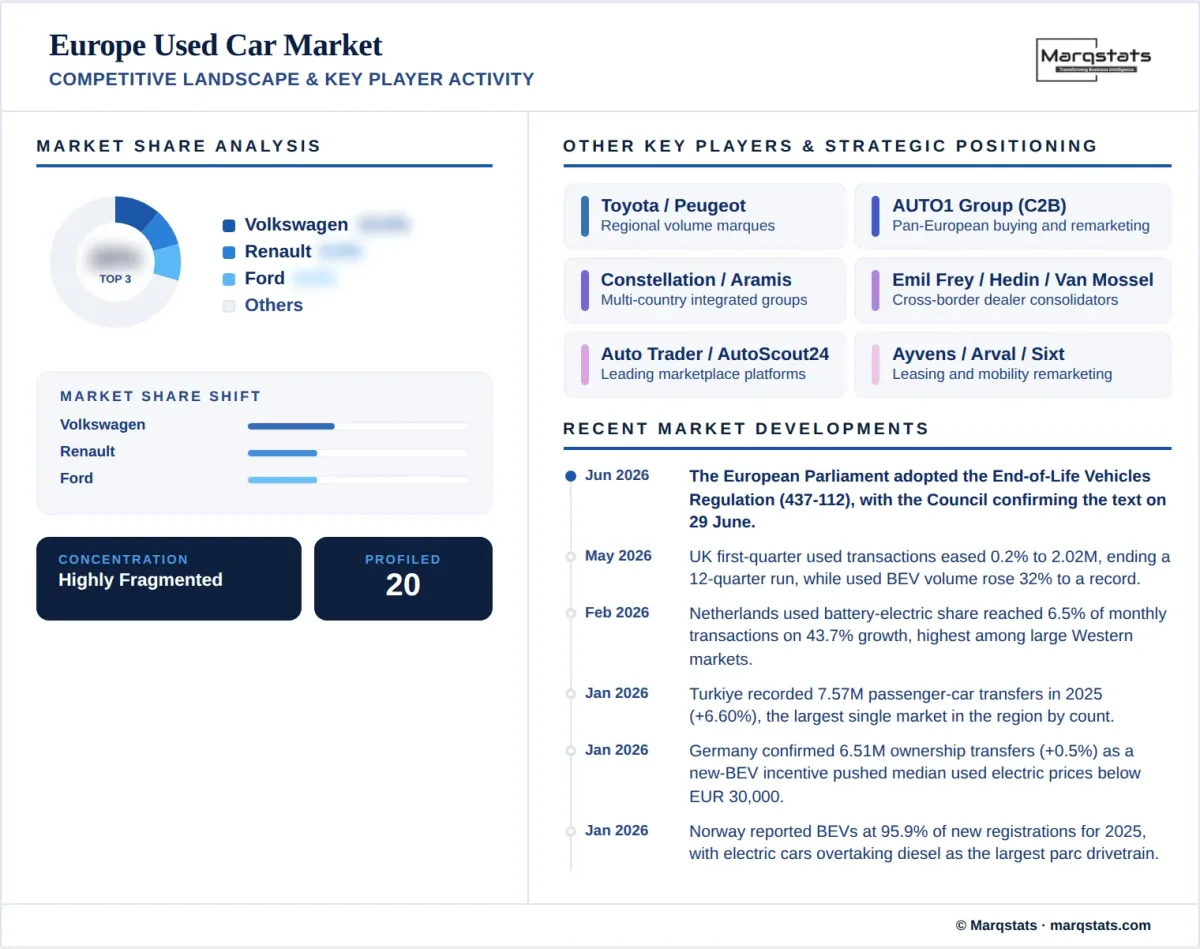
The Europe used car market is highly fragmented, and no operator holds more than a low single-digit share of regional transactions. About 46% of volume moves directly between private parties, and the remaining professional volume is distributed across manufacturer-franchised networks, pan-European dealer groups, national consolidators, digital-first retailers and many thousands of independent traders. Concentration is increasing at the margin as certified programmes grow at 10.04% annually and franchised networks at 5.03%, though from a base that leaves Europe substantially less consolidated than the North American market.
A small number of operators have achieved genuine multi-country scale. Vertically integrated groups combining consumer buying services, wholesale auction capacity and retail networks operate across several major markets, and pan-European dealer consolidators have assembled portfolios spanning Western and Northern Europe. Leasing and mobility operators form a parallel layer whose remarketing decisions determine the volume, timing and propulsion mix of near-new supply, and in the corporate-fleet markets of Belgium, the Netherlands and Sweden that influence exceeds that of any retailer.
Brand structure at regional level is dominated by volume marques accumulated over decades. Volkswagen leads with about 10% of transactions, followed by Renault and Ford at about 8% each and Toyota at about 6%. The regional aggregate nonetheless conceals substantial national variation: Renault leads in Türkiye and France, Ford in the United Kingdom, Fiat in Italy, Lada in Russia and Volvo in Sweden. Readers requiring brand-level precision should work from the individual country reports rather than the regional average.
Competitive differentiation is shifting from sourcing toward technical capability and capital cost. In the most electrified markets, battery state-of-health assessment and residual-risk management now determine which operators can profitably hold inventory, a materially higher barrier than conventional reconditioning. In the largest markets, financing attachment and access to securitised wholesale funding separate scaled operators from independents. Across both, vehicle history verification has become central wherever imported or cross-border stock forms a significant share of supply.
Companies Covered
The report profiles 16+ companies with full strategy and financials analysis, including:
Recent Market Activity
Table of Contents
Coverage & Segmentation
This report provides a comprehensive assessment of the Europe used car market across a 2025 base year, historical data from 2021 to 2025, and forecasts spanning 2026 to 2030. Thirteen national markets are modelled individually, namely Germany, the United Kingdom, France, Italy, Spain, Russia, the Netherlands, Sweden, Poland, Belgium, Norway, Switzerland and Türkiye, together accounting for about 86% of regional volume, with remaining markets aggregated into a Rest of Europe grouping. Market sizing is presented in unit-volume terms and complemented by value analysis in United States dollars, with segmentation across ten dimensions.
Every national market is normalised to a single transaction basis before aggregation, since national authorities publish ownership transfers, second-hand registrations or keeper changes depending on the country. Definitional reconciliations, data-confidence classifications and source-level caveats are disclosed in full within each country report. Users requiring country-level precision on price structure, channel mix, propulsion or brand should work from those reports rather than from regional averages, given the scale of divergence documented in this study.
The scope covers regional demand drivers, restraints and structural trends, with particular focus on the divergence between national markets, the pace of channel formalisation, electrified resale dynamics, cross-border supply flows and the regulatory framework following adoption of European end-of-life vehicle rules. Detailed treatment of the largest single market by transaction count is available in the Türkiye used car market report. An extended forecast to 2035 is available under customization, alongside deeper cuts by country, brand or channel on request.