Market Snapshot
Key Takeaways
Market Overview & Analysis
Report Summary
The Europe car wash equipment market comprises the manufacture and sale of vehicle-wash hardware and systems across three core wash formats — automatic in-bay gantry (rollover), tunnel/conveyor, and self-service high-pressure — together with attached subsystems and the recurring parts and consumables that support the installed base. The 2025 market of USD 1.46 billion sits against a European installed base of roughly 69,000 commercial wash sites, of which about 50,000 are in-bay gantry systems. The market is defined by equipment and system revenue, distinct from the wash-service revenue earned by operators.
Europe's defining feature is its in-bay gantry orientation. Roughly 50,000 of the region's 69,000 commercial sites are gantry systems, against about 8,000 conveyor/tunnel and 11,000 self-service sites. This contrasts with North America, where the United States alone operates about 17,500 conveyor sites. Europe's structure reflects fuel-retail forecourt integration and operator-chain economics that favour compact gantry machines over high-throughput tunnels, and it makes rollover equipment the region's largest and most defensible revenue base.
The market is served by a concentrated equipment tier atop a fragmented operator base. WashTec of Augsburg is the clearest documented leader, reporting more than 50,000 washes across 80-plus countries, over 600 in-house technicians, and the largest installed gantry base in Europe's core markets. Otto Christ, also of Germany, reports more than 20,000 systems installed worldwide across rollover, tunnel, self-service, payment, vacuum, and water-treatment lines. ISTOBAL of Spain, Kärcher, and Poland's BKF complete the front rank, above dozens of regional and local builders and distributors.
Regulation is reshaping equipment specifications rather than simply expanding core wash mechanics. EU ecodesign rules for electric motors and variable-speed drives push suppliers toward IE-class motors and more efficient pumps, blowers, and dryers. The new EU detergents and surfactants regulation, alongside REACH, tightens chemical formulation and demands precise dosing systems and documentation. Water-framework enforcement drives near-universal adoption of closed-loop reclamation and filtration. Self-service start, payment, and digital-control systems, including Kärcher's 2026 K!Control launch, add license-plate recognition, loyalty, and remote diagnostics.
The financial character of the market is increasingly recurring. Major suppliers report that service, spare parts, and consumables now approach half of revenue, insulating them from new-equipment volatility. WashTec closed 2025 with record group revenue of EUR 498.6 million and a 9.8% EBIT margin, with European business areas driving all growth, while ISTOBAL reached EUR 199 million on 23% equipment-sales growth. This recurring base, tied to the large installed gantry fleet, underpins a steadier equipment cycle than the wash-service market it supplies.
Market Dynamics
Key Drivers
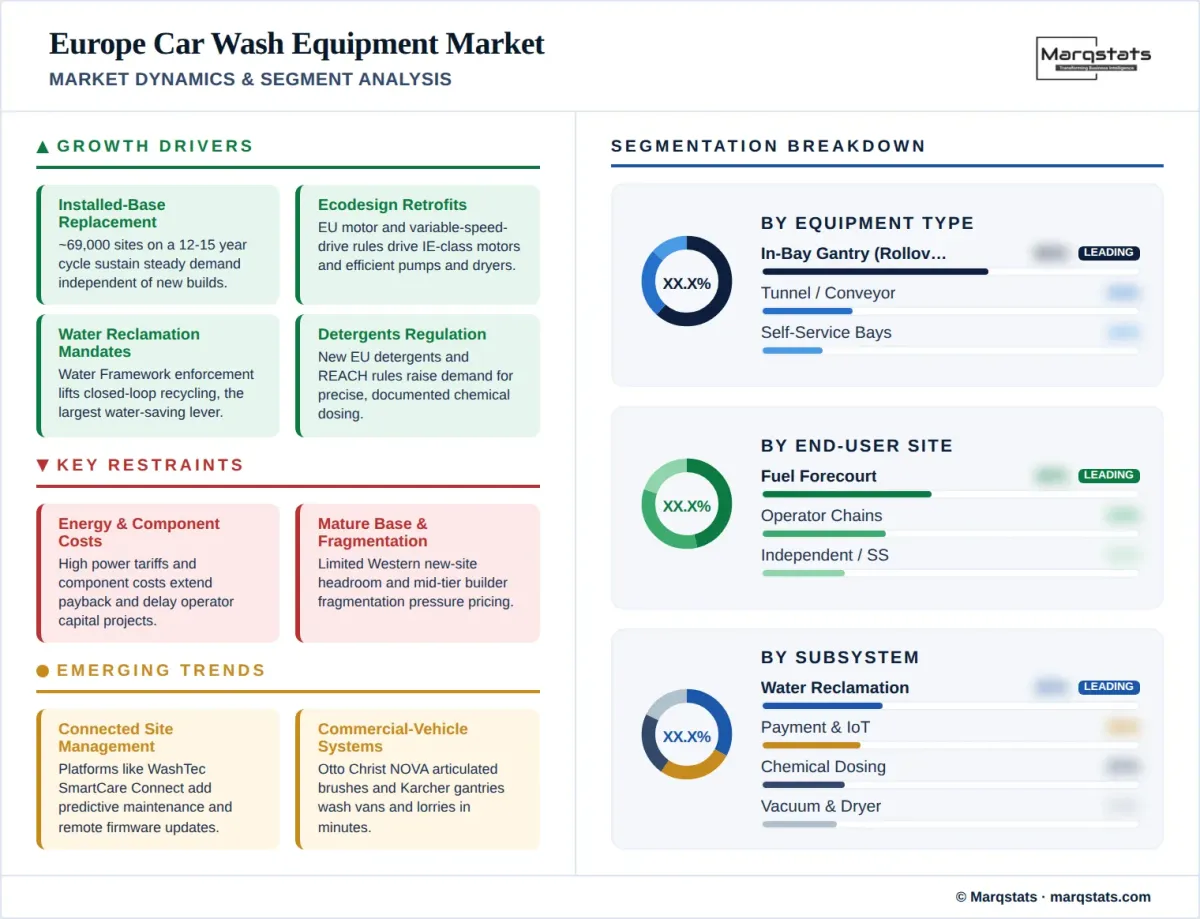
- Replacement of an ageing installed base of roughly 69,000 sites sustains steady equipment demand independent of new-site growth.
- EU ecodesign rules for motors and variable-speed drives drive retrofit demand for IE-class motors and efficient pumps, blowers, and dryers.
- Water-framework enforcement lifts adoption of closed-loop reclamation and filtration systems, the largest water-saving equipment lever.
- New EU detergents and surfactants regulation raises demand for precise chemical-dosing systems and reformulated, documented chemistry.
- Digital payment, license-plate recognition, and remote diagnostics expand as operators pursue unattended operation and subscription loyalty.
- Recurring service, parts, and consumables revenue anchors supplier turnover and funds continued equipment innovation.
Key Restraints
- High energy and component costs, alongside elevated power tariffs, extend equipment payback periods and delay operator capital projects.
- A mature installed base across Western Europe limits new-site headroom, concentrating demand in replacement and retrofit.
- Fragmentation among mid-tier and local builders pressures pricing and complicates standards across the region.
- Price competition from lower-cost entrants challenges commercial-grade gantry and tunnel suppliers on new installations.
Key Trends
- Water reclamation and filtration move toward near-universal specification on new installations under water-framework enforcement.
- Connected site management spreads through platforms such as WashTec's SmartCare Connect, adding predictive maintenance and remote firmware updates.
- Commercial-vehicle systems advance, led by Otto Christ's NOVA articulated brushes and Kärcher gantry lines for high-roof vans and lorries.
- Eco chemistry and biological detergents expand through supplier lines such as Otto Christ's ECO Line and ISTOBAL's ESENS chemical plant.
Market Segmentation
Automatic in-bay gantry systems form the largest equipment category in the Europe car wash equipment market, reflecting an installed base of roughly 50,000 units across the region's forecourts and operator chains. Gantry machines suit Europe's many mid-density sites where land and throughput do not justify a full tunnel, and modern systems add touch-free options, longer wash programs, and integrated water recycling. WashTec reports the largest installed gantry base in Europe's core markets, and the category anchors the region's replacement and retrofit demand throughout the forecast period. Average installed system prices in the tens of thousands of euros, combined with a twelve-to-fifteen-year replacement cycle across 50,000 units, generate a steady multi-thousand-unit annual base of gantry demand that is largely insulated from new-site swings.
Tunnel/conveyor systems are the fastest-growing equipment category, built on a smaller European base of about 8,000 sites against 17,500 in the United States alone. Higher-value than gantry machines, tunnels carry conveyor, high-throughput wash arches, drying, and increasingly subscription-oriented payment and site software. Franchise express-tunnel entry and premium operator development lift new-build demand, and the format captures the largest per-site equipment spend in the region. A single tunnel installation can carry equipment value several times that of a gantry machine, so even modest growth in European tunnel counts converts into outsized revenue, and the format pulls through the highest attachment of reclamation, drying, and digital subsystems.
Self-service high-pressure bays represent about 11,000 European sites and a durable equipment category, strongest in France, Spain, and Poland. Systems span high-pressure pumps, chemical arches, coin and cashless payment, and vacuum modules, with Poland's BKF and Spain's ISTOBAL prominent suppliers. The category adds digital start-and-pay systems, including Kärcher's 2026 K!Control launch, and remains resilient wherever attended washing is costly.
Water reclamation and filtration is the fastest-growing subsystem, driven by water-framework enforcement that makes closed-loop recycling near-standard on new European installations. Suppliers including Otto Christ and Kärcher market dedicated reclamation and water-treatment systems, cited as the largest water-saving lever for vehicle washing. Retrofit demand across the existing gantry base compounds new-install volumes throughout the forecast period. A traditional wash cycle consumes well over 100 litres of water, so reclamation that recovers the majority of that volume delivers both compliance and operating-cost savings, making it among the first subsystems specified on new sites and the most common retrofit on the installed base.
Chemical dosing systems gain from the new EU detergents and surfactants regulation and REACH, which demand precise, documented dosing and reformulated chemistry. Suppliers integrate dosing with branded chemical lines — Otto Christ's ECO Line and ISTOBAL's ESENS plant among them — tying recurring consumables revenue to installed equipment and raising the value of each wash system.
Payment, site-automation, and IoT systems are the highest-growth digital subsystem, spanning unattended start-and-pay, license-plate recognition, loyalty, and remote diagnostics. Kärcher's 2026 K!Control self-service system, WashTec's SmartCare Connect predictive-maintenance platform, and Otto Christ's operating terminals lead adoption, converting standalone machines into connected, subscription-capable sites.
Vacuum and dryer systems are standard modules bundled into forecourt, gantry, and tunnel packages across European suppliers. Dryers gain from EU ecodesign rules through higher-efficiency blowers and IE-class motors, while vacuum arrays expand at self-service and forecourt sites. Both categories tie to the recurring parts and consumables revenue that anchors supplier turnover.
Fuel-station forecourts are the largest equipment end-user in Europe, hosting extensive gantry networks operated by national fuel retailers. Forecourt integration favours compact rollover machines with reclamation and unattended payment, and retailer estate upgrades drive a substantial share of replacement demand. This channel anchors the region's in-bay gantry orientation.
Operator chains and dedicated wash sites are the fastest-growing end-user, investing in tunnels, premium gantries, and subscription-oriented site software. Chains such as Mr. Wash and IMO drive high-value tunnel and multi-bay equipment orders, and their premiumization supports the strongest per-site equipment spend and digital-subsystem attachment.
Independent and self-service operators form a large, fragmented end-user base, purchasing gantry, self-service, and jet-wash equipment through distributors. Concentrated in Southern and Central Europe, this channel sustains steady mid-value demand and is a primary adopter of cashless start-and-pay and compact reclamation systems.
Passenger-car wash systems account for the large majority of European equipment revenue, spanning gantry, tunnel, and self-service formats. Rising paint-protection-film and premium ownership shifts demand toward gentler touch-free processes, while an ageing mass-market fleet sustains high-frequency gantry use.
Commercial-vehicle wash systems are the fastest-growing application, driven by logistics, bus, and truck fleets and by mobility-as-a-service operators. Dedicated systems such as Otto Christ's NOVA articulated-brush units and Kärcher's high-roof gantry lines wash vans and lorries in under five minutes, and Euro 7 and ESG pressures steer fleets toward professional, water-managed washing.
By Geography
Germany
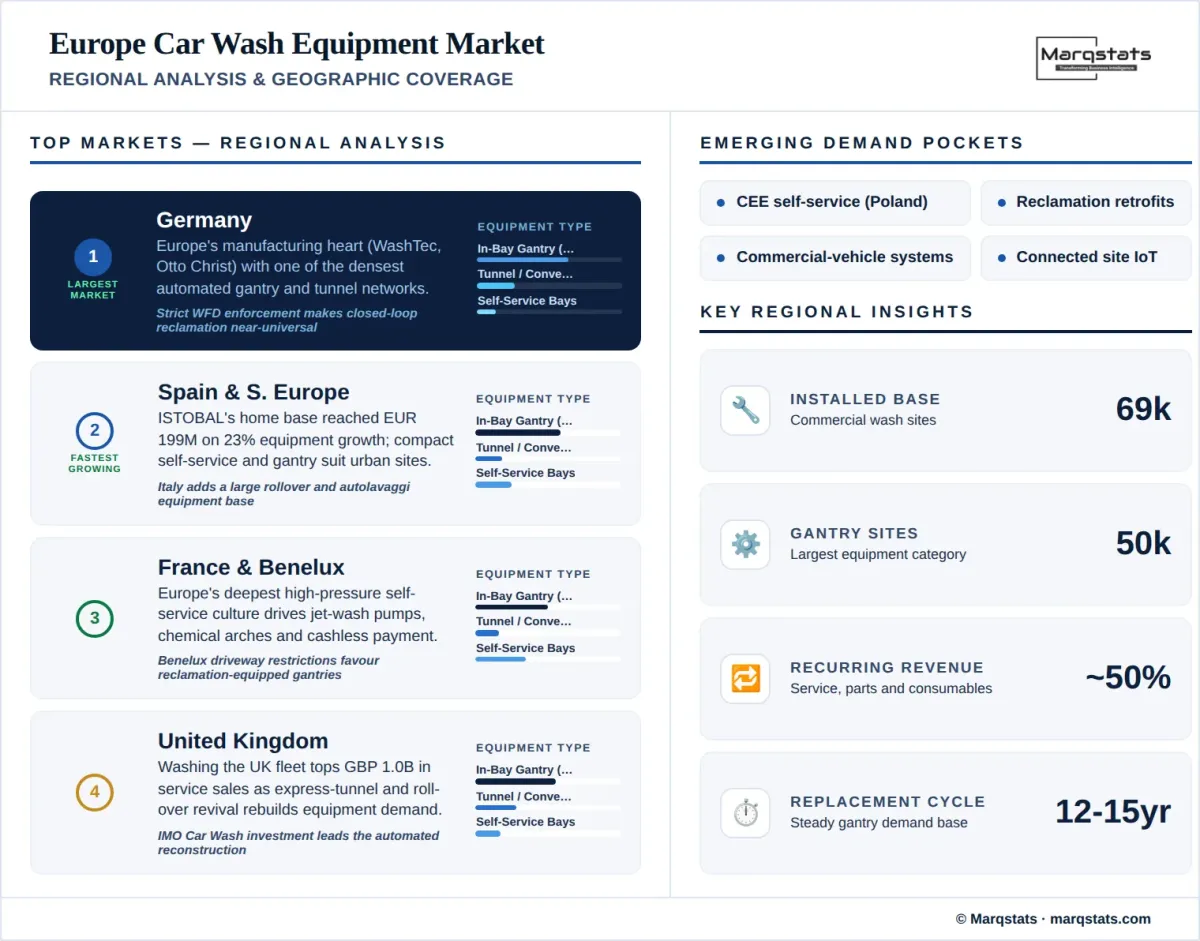
Germany is Europe's largest car wash equipment market and its manufacturing heart, home to WashTec of Augsburg and Otto Christ. The country combines one of the world's densest networks of automated gantry and tunnel systems with strict Water Framework Directive enforcement, producing near-universal adoption of closed-loop reclamation and high-efficiency filtration. WashTec's SmartCare Connect predictive-maintenance platform is piloted domestically before wider European rollout, reinforcing Germany's technology leadership. As the base of the region's two largest gantry manufacturers, Germany also functions as the export hub for European wash equipment, shipping systems across the region's core markets and beyond, and its dense fuel-retail forecourt estate sustains one of the largest replacement-equipment pipelines in Europe.
Spain & Southern Europe
Spain anchors Southern Europe and hosts ISTOBAL, which reached EUR 199 million in 2025 on 23% equipment-sales growth, a new Massanassa plant doubling chemical output, and expansion across 17 subsidiaries. Spain and Portugal favour compact self-service and gantry systems for constrained urban sites, and Italy adds a large rollover and autolavaggi equipment base served by suppliers including Autoequip. Southern Europe records the region's fastest equipment growth.
France & Benelux
France is a major equipment market shaped by Europe's deepest high-pressure self-service culture, driving strong demand for jet-wash pumps, chemical arches, and cashless payment systems. ISTOBAL cites strong French performance and a new Norway subsidiary extending Nordic reach. Benelux markets combine high wash intensity with driveway-wash restrictions, supporting reclamation-equipped gantry and forecourt systems.
United Kingdom
The United Kingdom is a substantial equipment market where the Car Wash Association's membership spans rollover, conveyor, self-service jet-wash operators, and equipment manufacturers and distributors. Washing the UK passenger-car fleet generates more than GBP 1.0 billion in annual service sales, and a revival of automated express tunnels and roll-over investment by operators such as IMO Car Wash rebuilds equipment demand after years of hand-wash displacement.
Central & Eastern Europe
Central and Eastern Europe is the fastest-growing regional cluster, led by Poland's dense self-service sector and its roughly 40 domestic equipment producers, headed by BKF. The region combines rising vehicle ownership, new organized capacity, and export-oriented equipment manufacturing, narrowing the automation gap with Western Europe and drawing gantry, tunnel, and self-service investment from a lower base.
How Competition Is Evolving
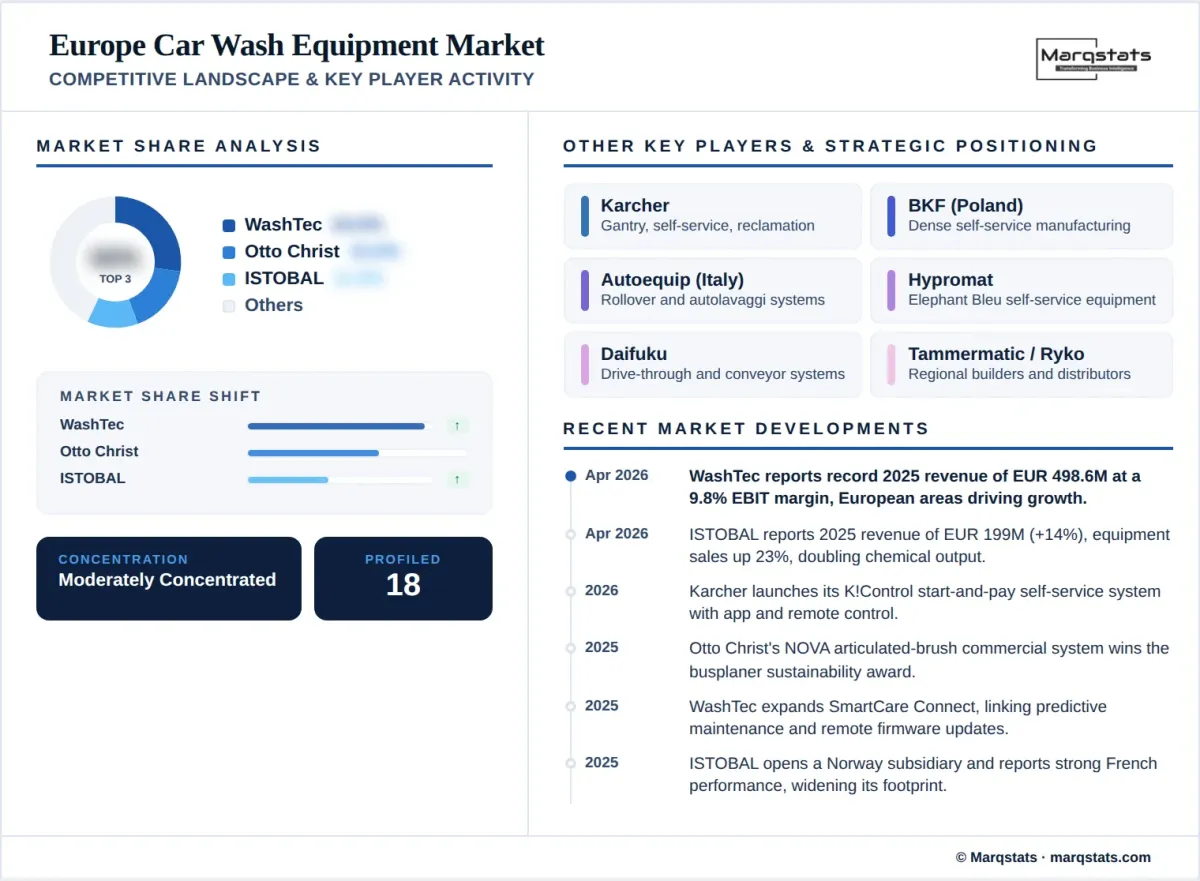
The Europe car wash equipment market is moderately concentrated at the supplier tier atop a fragmented operator base. WashTec of Augsburg is the clearest documented leader, reporting the largest installed gantry base in Europe's core markets, more than 50,000 washes across 80-plus countries, over 600 in-house technicians, and record 2025 group revenue of EUR 498.6 million at a 9.8% EBIT margin, with European business areas driving all growth. Otto Christ, also German, reports more than 20,000 installed systems across a full portfolio spanning rollover, tunnel, self-service, payment, vacuum, and water treatment.
ISTOBAL of Spain, Kärcher, and Poland's BKF complete the front rank. ISTOBAL reached EUR 199 million in 2025, up 14%, with equipment sales rising 23%, a doubled chemical plant, and a network of 17 subsidiaries across more than 80 countries. Kärcher supplies gantry, self-service, vacuum, and water-reclamation systems from a EUR 3.48 billion group and launches its K!Control self-service start-and-pay system in 2026. BKF leads a dense Polish self-service manufacturing cluster, while Daifuku, Autoequip, and numerous regional builders and distributors fill out the long tail.
Competition increasingly turns on recurring service and digital differentiation rather than core wash mechanics alone. Suppliers report service, parts, and consumables approaching half of revenue, and connectivity has become a key differentiator through platforms such as WashTec's SmartCare Connect, which links predictive maintenance and remote firmware updates to reduce downtime and subscription churn. Water reclamation, precise chemical dosing, efficient motors, and license-plate-recognition payment define the next equipment cycle, with consolidation advancing gradually as leaders extend service networks and chemical integration across the region.
Companies Covered
The report profiles 18++ companies with full strategy and financials analysis, including:
Recent Market Activity
Table of Contents
Coverage & Segmentation
This report provides a comprehensive analysis of the Europe car wash equipment market covering the historical period 2021 to 2025 and the forecast period 2026 to 2030, with 2025 as the base year. The study defines the market as annual revenue from the manufacture and sale of vehicle-wash equipment and systems — automatic in-bay gantry, tunnel/conveyor, and self-service formats — together with attached subsystems (water reclamation, chemical dosing, payment and automation, vacuum, and dryers) and the recurring parts and consumables that support the installed base; wash-service revenue earned by operators is excluded and covered in a separate study. Market size is presented in value terms (USD), with historical figures reflecting euro and sterling exchange effects and forecasts assuming constant exchange rates.
The study segments the market by equipment type, subsystem, end-user/site, and vehicle application, and examines country demand across Germany, Spain and Southern Europe, France and Benelux, the United Kingdom, and Central and Eastern Europe, alongside supplier concentration, regulation, and technology. Market sizing triangulates a bottom-up installed-base model — roughly 69,000 European commercial wash sites across gantry, self-service, and conveyor formats, with replacement cycles, new installs, subsystem attachment, and aftermarket parts — against a top-down reconciliation of supplier revenues, and cross-checks against public installed-base ratios. The competitive section profiles 18 equipment suppliers and systems providers.