Market Snapshot
Middle bar: base-year value × (1 + CAGR), rounded to two decimals. This is a calculated illustration, not a separately researched annual estimate.
The global fleet tire monitoring system market is valued at USD 1,519.99 million in 2025 and is projected to reach USD 2,647.25 million by 2030, registering a CAGR of 11.74% over 2026–2030. The market covers tire pressure and temperature sensors, receivers and gateways, and the cloud monitoring and predictive maintenance subscriptions that commercial fleets buy for trucks above 3.5 tonnes, trailers, and buses and coaches. Marqstats estimates 8.51 million monitored commercial assets worldwide in 2025, carrying about 66.83 million monitored tire positions, rising to 17.66 million assets by 2030.
Market size and forecast figures are generated using Marqstats' proprietary estimation framework, updated as of October 2026.
Coverage spans two offerings, three vehicle types, two fitment routes and five regions: North America, Europe, Asia-Pacific, Latin America, and the Middle East and Africa. The analysis benchmarks 16 tire makers, sensor and braking suppliers, inflation system makers and telematics platforms, including Compagnie Générale des Établissements Michelin SCA, Continental AG, The Goodyear Tire & Rubber Company, Bridgestone Corporation and Sensata Technologies Holding plc. Passenger car TPMS, light vans under 3.5 tonnes, automatic tire inflation hardware sold without monitoring, and general fleet telematics without an active tire module sit outside the market.
Key Takeaways
Market Overview & Analysis
Report Summary
The global fleet tire monitoring system market comprises the hardware and software that commercial fleets use to track tire pressure, temperature and condition on heavy vehicles, valued at USD 1,519.99 million in 2025. Hardware covers valve-mounted, rim-mounted and in-tire sensors, the receivers, repeaters and gateways that collect their signals, and installation. Software covers paid monitoring, alerting and predictive maintenance subscriptions delivered through a tire maker's platform, a telematics provider or a fleet's own back office.
The unit hierarchy runs from fleet customer to vehicle or asset, monitored tire position, physical sensor and active subscription, and each level answers a different question. A tractor and a trailer are separate assets, a vehicle may have sensors on only some axles, and sensors are often reused when a tire is replaced or retreaded. Marqstats counts installed assets, tire positions, annual sensor shipments and paid subscription years separately, and does not treat broad telematics registrations as tire monitoring.
Fitment routes differ by region. The EU requires TPMS on all new M2, M3, N2, N3, O3 and O4 vehicles, so every new European truck, bus and trailer carries a system, though many only warn the driver on the dashboard. In North America, Asia-Pacific and the rest of the world, fitment is optional, and most monitored assets are retrofits sold by tire dealers, telematics providers and tire makers. OE fitment and retrofits each added close to 1 million assets worldwide in 2025.
Platform scale is not the same as tire monitoring adoption. Michelin Connected Fleet reported 660,000 connected vehicles across 70,000 customers in 48 countries in June 2026, or about 9.43 vehicles per customer, and its platform processes about 300 million journeys a year. These figures describe the wider connected fleet business, and Michelin does not disclose how many of these vehicles run an active tire module.
Hardware prices anchor the value build. Fleet TPMS sensors sell for about USD 25 to USD 50 each and gateways for USD 100 to USD 300 per vehicle, and a fully installed tractor-trailer system with 18 sensors costs about USD 650 to USD 1,500. On that basis Marqstats uses an installed cost of USD 48.61 per tire position plus a USD 200 gateway, or about USD 588.89 for an eight-position truck or trailer and USD 491.67 for a six-position bus, with OE supply priced 20% lower.
History shows fast growth from a small base. Marqstats estimates that monitored assets rose from 3.36 million in 2021 to 8.51 million in 2025 as the EU mandate took effect and North American fleets retrofitted trailers, and market value rose from USD 769.44 million to USD 1,519.99 million. No source publishes a global count of active tire-monitored vehicles, and the installed base is a Marqstats construction from vehicle flows and fitment rates.
Penetration varies widely by region. Marqstats estimates monitored assets at 26.49% of Europe's eligible trucks, trailers and buses in 2025, against 10.46% in North America, 6.96% in Asia-Pacific and about 3.3% in Latin America and the Middle East and Africa. By 2030 Europe reaches 53.96% and North America 19.25%, while hardware's share of value falls from 80.99% to 67.99% as software grows.
Fleet economics explain the buying decision. A fleet of 100 tractors and 100 trailers on a five-axle configuration has 1,800 tire positions, 10 per tractor and 8 per trailer, and at about USD 48.61 per position plus a USD 200 gateway per asset it costs about USD 127,500 to equip fully. At a 20% adoption rate the same fleet monitors 360 positions, and at 50% it monitors 900, so the adoption level, rather than the number of fleets, drives sensor demand. Against a road call cost of USD 600 to USD 1,200, a fleet that avoids one tire breakdown per asset each year recovers most of its hardware cost within the first year.
Annual sensor demand has three parts. First-fit sensors go on new trucks, trailers and buses at the factory, retrofit sensors go on existing assets, and replacement sensors cover batteries that run down and sensors lost or damaged at tire changes. Marqstats applies a seven-year sensor life to the installed base, and replacement sensors make up a growing share of hardware value as the monitored fleet ages. Tire changes do not automatically create new sensor demand, because shops often move a working sensor to the new tire or to a retreaded casing.
Software adds a recurring layer. Telematics providers price tire monitoring as an add-on module at about GBP 5 to GBP 10 per vehicle per month, and Marqstats applies about USD 114.30 per subscribed asset per year in 2025. Software and subscriptions account for USD 288.96 million, or 19.01% of 2025 value, and the market reaches an estimated USD 1,730.04 million in 2026. Broader tire management platforms, including digital inspection and tire cost analysis, are covered in the Marqstats Fleet Tire Management Software Market report.
Market Dynamics
Key Drivers
Five factors support fleet tire monitoring demand worldwide.
- EU fitment mandate for heavy vehicles. The EU General Safety Regulation required TPMS on new types of trucks, buses and trailers from July 2022 and on all new registrations from July 2024. The EU registered 307,460 new trucks and 38,238 new buses in 2025, and every one now leaves the factory with tire pressure monitoring. The rule does not require retrofits on vehicles registered before July 2024, so penetration rises as fleets renew. Marqstats estimates Europe added about 1.59 million OE-fitted trucks, buses and trailers over 2022–2025 as the rule phased in.
- Roadside breakdown and downtime costs. A single tire road call costs about USD 600 to USD 1,200, and an out-of-service shutdown costs at least USD 760 a day. Michelin reported up to 80% fewer emergency roadside tire events in early European pilots of its Smart Predictive Tire trailer solution, which gives fleets a clear payback case. Fleets that track roadside events per million miles see the saving directly. Insurers and shippers also ask fleets for evidence of tire safety programs.
- Fuel and tire life savings. Under-inflation raises rolling resistance and wears tires faster, and Michelin's trailer pilots showed up to 4% lower fuel use and up to 9% longer tire life where chronic under-inflation was corrected. For a truck running 120,000 miles a year, fuel savings alone run to about USD 700 a year. Under-inflation by 8 to 12 psi is typical on steer tires, according to Aperia's fleet data. Correct inflation also reduces irregular wear, which raises casing quality for retreading.
- Sensor-ready tires. Continental launched Sensor Ready commercial tires in June 2026 with a sensor pocket built into the tire during curing, starting with the Conti Coach HA3, so fleets can add a sensor without tools or adhesives. The pocket stays in the casing through retreading, which lowers the cost of keeping a sensor in service. Fleets can also buy Sensor Ready tires now and fit sensors later as budgets allow. Sensor-ready casings also lower the labor cost of each retrofit.
- Telematics marketplaces and integration. Michelin Connected Fleet and Platform Science agreed in July 2026 to offer Michelin Smart Predictive Tire through Platform Science's Virtual Vehicle marketplace, and Aperia added API links to ELD and back-office systems in March 2026. Easier access through existing telematics lifts software and subscriptions to a 24.01% CAGR. Marketplace access also lets small fleets switch on tire monitoring without new hardware contracts. Open APIs also let fleets feed tire alerts into existing maintenance software.
Key Restraints
Four constraints hold back fleet tire monitoring growth.
- Upfront hardware cost for small fleets. A fully equipped tractor-trailer costs about USD 650 to USD 1,500 to fit, and small carriers with thin margins delay spending even when the payback is short. Outside Europe, fitment on new trucks remains optional, and Marqstats estimates OE fitment at about 15% of new North American trucks in 2025. Lease and rental fleets also hesitate to fit hardware to assets they do not keep. Payback depends on fleets acting on alerts, which needs trained maintenance staff.
- Weak heavy truck demand in key markets. EU truck registrations fell 6.2% in 2025 and US Class 8 retail sales ran 13.6% below 2024 through November 2025. Fewer new trucks mean fewer OE fitments, and fleets that defer truck purchases also defer retrofit spending. ACT Research expected about 229,000 US Class 8 sales in 2026, a modest recovery. Trailer builds hit their lowest monthly level since 2010 in December 2025, at 11,801 units.
- Alert fatigue and data overload. Basic TPMS systems send frequent low-pressure alerts that change with ambient temperature, and fleets stop acting on them. Aperia claims its Halo platform sends two to three times fewer alerts than traditional TPMS, which shows how much noise standard systems create. Drivers who receive too many false alerts disable displays or ignore warnings. Vendors answer with temperature-compensated thresholds and prioritized action lists.
- Interoperability and sensor reuse. Sensors, gateways and platforms from different suppliers often do not work together, and a trailer that moves between carriers may carry sensors the hauling fleet cannot read. Sensor batteries last several years, and sensors removed at tire changes are not always reinstalled, which reduces active coverage. Open data standards for tire sensors remain limited across suppliers. Sensor theft and damage during tire service also reduce active coverage.
Key Trends
Four shifts are changing how fleets buy and use tire monitoring.
- Predictive analytics over threshold alerts. Michelin's Smart Leak algorithm flags early signs of tire degradation from pressure and temperature patterns, and Michelin's Optimized Tire Performance service predicts maintenance needs up to two months ahead. Fleets now pay for predicted events rather than for raw pressure readings. Predictions tie tire data to maintenance workflows, which makes software stickier. Michelin's service launched in Spain in October 2020 and now runs across Europe and North America.
- Tires-as-a-service bundles. Goodyear's Tires-as-a-Service offering bundles tires, monitoring, predictive insights and service into one subscription in North America and Europe, with Aperia's Halo Connect i3 supplying automatic inflation and pressure sensing under a March 2025 agreement. Bundles shift spending from one-off hardware to recurring fees. Aperia reports that 95% of tires stayed properly inflated for several Goodyear long-haul customers. Fleets on these bundles pay per mile or per vehicle rather than per tire.
- Trailer monitoring as a separate product. Michelin Connected Fleet launched Smart Predictive Tire for Class 7 and 8 trailers in March 2026, and trailers account for 31.50% of 2025 market value. Trailers often sit unpowered and move between tractors, so gateways with their own power and cellular links become standard. Trailer pools that cross fleets favor platform-neutral monitoring. Trailer monitoring also links with cargo and door sensors on the same gateway.
- Sensors built into the tire. Continental's Sensor Ready tires and in-tire sensors from other tire makers move the sensor from the valve to the tire inner liner, which allows tread depth and load estimates in addition to pressure and temperature. In-tire sensors also stay with the tire through retreading and track the casing over its life. In-tire sensors also record tire identity, which helps retreaders and fleets track casings. The sensor pocket design also cuts installation time at tire shops.
Market Segmentation
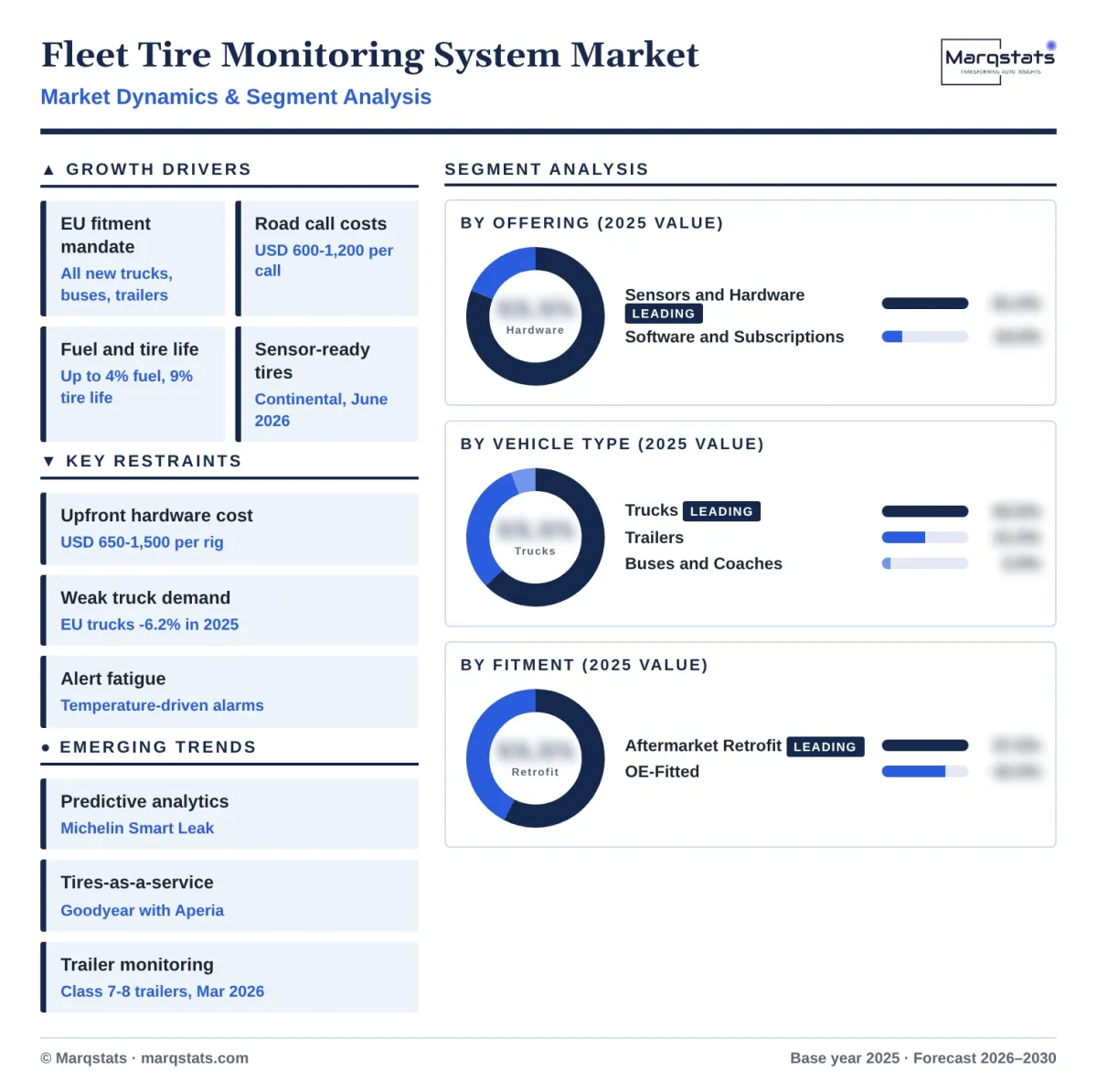
Sensors and hardware account for an estimated USD 1,231.03 million, or 80.99% of 2025 value, the larger offering, and are projected to reach USD 1,799.88 million by 2030 at a 7.89% CAGR. The segment covers OE and retrofit sensor kits, gateways, displays, installation and replacement sensors, which Marqstats bases on a seven-year sensor life. Hardware prices decline about 2% a year as sensor costs fall. Its share of value falls from 80.99% in 2025 to 67.99% by 2030. Gateways and repeaters make up a larger share of trailer kits, since each trailer needs its own powered link.
Software and subscriptions account for an estimated USD 288.96 million, or 19.01% of 2025 value, and are projected to reach USD 847.37 million by 2030 at a 24.01% CAGR, the faster offering. Paid monitoring covers about 45% of equipped assets in North America and 25% in Europe in 2025, where many OE systems only warn the driver on the dashboard. Annual fees rise about 2% a year as predictive features are added. Its share of value rises from 19.01% in 2025 to 32.01% by 2030. Predictive leak detection and maintenance scheduling carry higher fees than basic pressure alerts.
Trucks above 3.5 tonnes account for an estimated USD 951.43 million, or 62.60% of 2025 value, the largest vehicle type, and are projected to reach USD 1,678.12 million by 2030 at a 12.02% CAGR. Tractors carry 10 tire positions and medium trucks six, and Marqstats uses an average of eight positions per truck. Tractors in long-haul service carry the highest tire costs per asset. Its share of value holds near 63% through 2030.
Trailers account for an estimated USD 478.82 million, or 31.50% of 2025 value, and are projected to reach USD 799.80 million by 2030 at a 10.81% CAGR. Europe's semi-trailer fleet numbered about 3.1 million units in 2024, and US trailer net orders reached 173,144 units in 2025. Trailer tires are often the least inspected tires on a combination vehicle. Its share of value eases from 31.50% in 2025 to 30.21% by 2030.
Buses and coaches account for an estimated USD 89.74 million, or 5.90% of 2025 value, and are projected to reach USD 169.33 million by 2030 at a 13.54% CAGR, the fastest vehicle type. The EU had 699,238 buses in operation in 2024, and transit operators fit monitoring to protect passengers and schedules. Coaches running long intercity routes gain most from temperature alerts. Its share of value rises from 5.90% in 2025 to 6.40% by 2030.
OE-fitted systems account for an estimated USD 646.62 million, or 42.54% of 2025 value, and are projected to reach USD 1,243.39 million by 2030 at a 13.97% CAGR, the faster route. Truck, bus and trailer makers fit TPMS at the factory, required in the EU and optional elsewhere, and Marqstats estimates 962,319 OE-fitted assets worldwide in 2025. OE fitment spreads beyond Europe as truck makers offer TPMS as standard on premium models. Its share of value rises from 42.54% in 2025 to 46.97% by 2030. OE systems in Europe often feed the dashboard only until a fleet activates a cloud service.
Aftermarket retrofits account for an estimated USD 873.37 million, or 57.46% of 2025 value, the larger route, and are projected to reach USD 1,403.86 million by 2030 at a 9.96% CAGR. Fleets, tire dealers and telematics providers fitted an estimated 969,420 existing assets in 2025, mainly in North America, where most of the truck fleet predates any fitment. Tire dealers bundle retrofits with service contracts and roadside programs. Its share of value eases from 57.46% in 2025 to 53.03% by 2030. Retrofit kits also suit mixed fleets that run trucks and trailers from several makers.
By Geography
North America
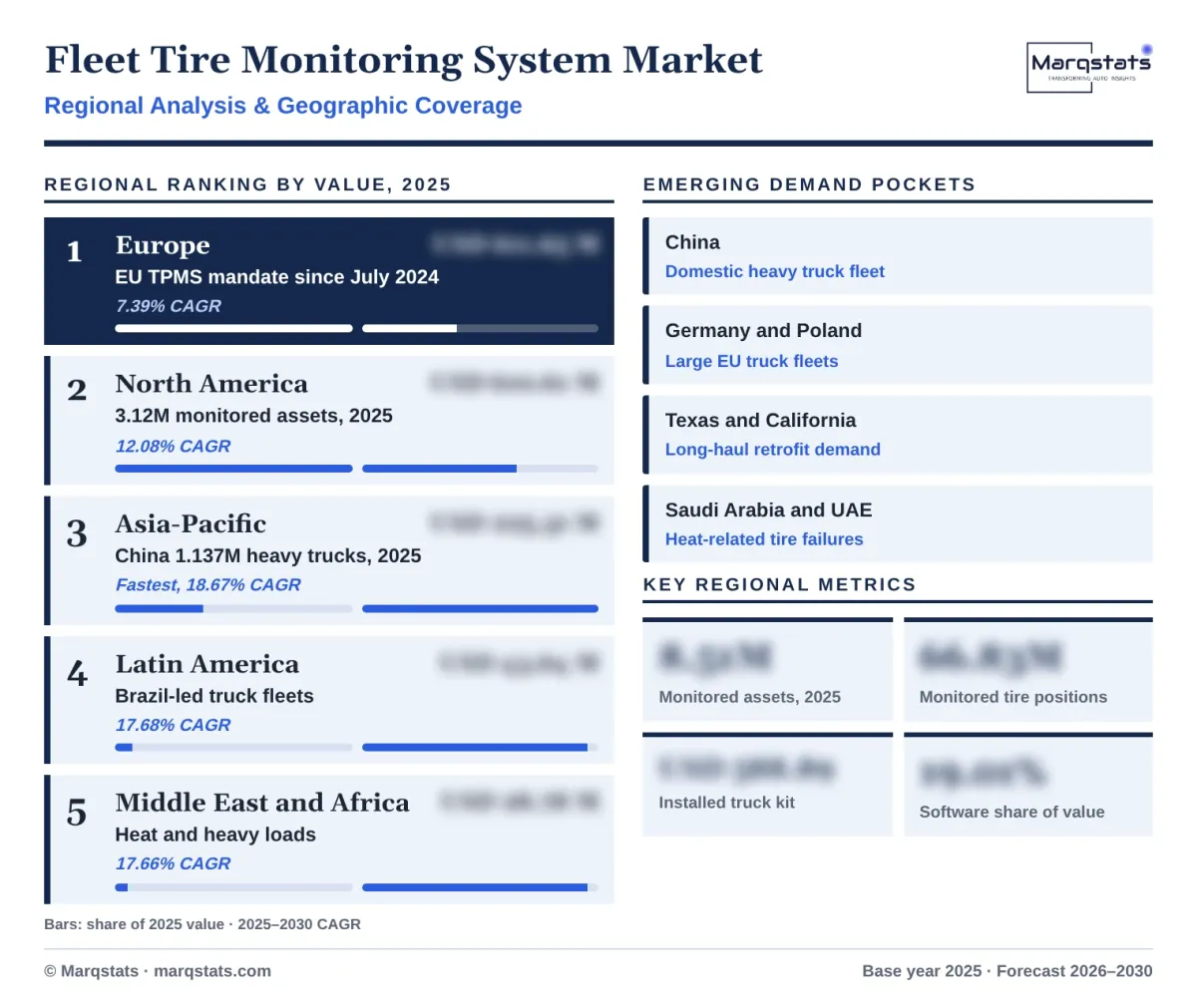
North America accounts for 40.17% of 2025 value, or USD 610.61 million, and is projected to reach USD 1,079.88 million by 2030 at a 12.08% CAGR, becoming the largest region. The United States registered 12,599,614 single-unit trucks and 3,482,896 combination trucks in 2024, and Marqstats estimates 3.12 million monitored assets in 2025, about 10.46% of the region's eligible fleet. Dedicated and long-haul carriers in Texas, California and the Midwest lead retrofit demand. Monitored assets rise from 3.12 million in 2025 to 5.74 million by 2030. Canada and Mexico add cross-border long-haul fleets that run the same monitoring platforms.
Europe
Europe is the largest regional market at 40.25% of 2025 value, or USD 611.65 million, and is projected to reach USD 873.81 million by 2030 at a 7.39% CAGR. The EU had 6,162,673 trucks above 3.5 tonnes in 2024 with an average age of 14 years, and the July 2024 mandate lifts monitored assets from 26.49% of the eligible fleet in 2025 to 53.96% by 2030 as older trucks retire. Germany, France, Poland, Italy and Spain hold the largest truck fleets in the region. Monitored assets rise from 2.91 million in 2025 to 5.93 million by 2030.
Asia-Pacific
Asia-Pacific accounts for 14.82% of 2025 value, or USD 225.31 million, and grows fastest at an 18.67% CAGR to USD 530.17 million by 2030. China sold about 1.137 million heavy trucks in 2025, including about 330,000 exports, and India, Japan, South Korea and Australia add large truck and bus fleets with low current penetration of about 6.96%. Rising truck exports from China also carry monitoring hardware into other regions. Monitored assets rise from 2.02 million in 2025 to 4.89 million by 2030. Domestic Chinese sensor makers supply low-cost kits, which lowers the average price per position in the region.
Latin America
Latin America accounts for 2.87% of 2025 value, or USD 43.64 million, and is projected to reach USD 98.48 million by 2030 at a 17.68% CAGR. Brazil, Argentina, Chile and Colombia run long-haul truck and bus fleets on rough roads, and cargo theft and tire damage make telematics bundles attractive. Brazil holds the largest truck and bus fleet in the region. Penetration rises from 3.31% of eligible assets in 2025 to 7.84% by 2030.
Middle East and Africa
The Middle East and Africa account for 1.89% of 2025 value, or USD 28.78 million, and are projected to reach USD 64.91 million by 2030 at a 17.66% CAGR. High ambient temperatures in Saudi Arabia and the United Arab Emirates raise tire failure risk, and mining and logistics fleets in South Africa adopt monitoring for heavy loads. Long desert routes and heavy loads make heat-related tire failures common. Penetration rises from 3.27% of eligible assets in 2025 to 7.75% by 2030.
How Competition Is Evolving
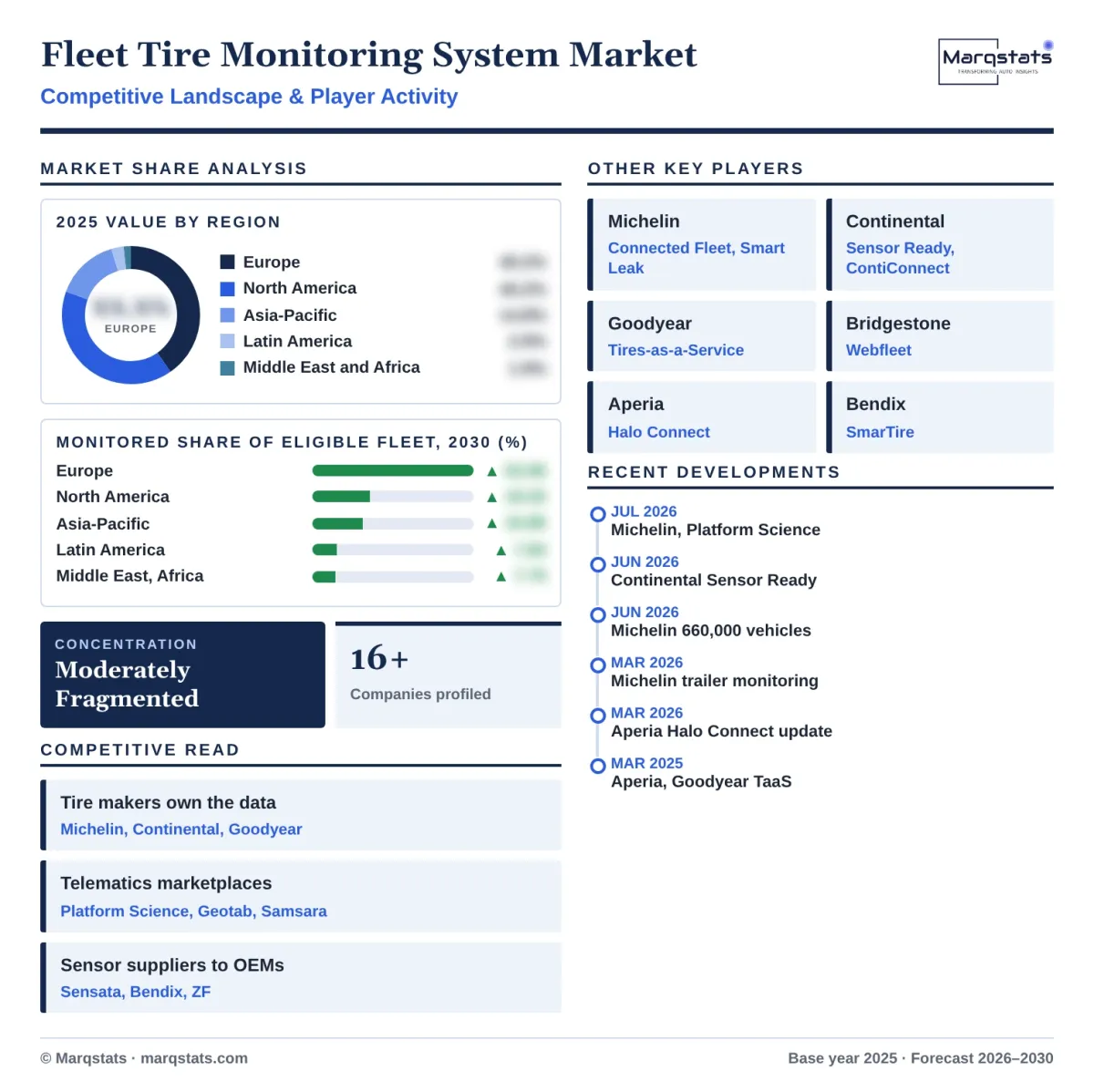
The global fleet tire monitoring system market is moderately fragmented, with tire makers, sensor suppliers, braking system makers and telematics platforms competing for the same fleets. Compagnie Générale des Établissements Michelin SCA, Continental AG, The Goodyear Tire & Rubber Company, Bridgestone Corporation, Pirelli & C. S.p.A. and The Yokohama Rubber Co., Ltd. sell monitoring with their tires and service networks, while Sensata Technologies Holding plc, Bendix Commercial Vehicle Systems LLC and ZF Friedrichshafen AG supply sensors and systems to vehicle makers and fleets. Vendor shares of active monitored assets are not disclosed, and no company reports its tire module base separately from wider telematics, so Marqstats does not rank vendors by share.
Specialists and platforms fill the gaps. Aperia Technologies, Inc., Pressure Systems International, LLC, Doran Manufacturing, LLC and Advantage PressurePro, LLC sell inflation and monitoring systems for trucks and trailers, and Platform Science, Inc., Geotab Inc. and Samsara Inc. carry tire data through their telematics marketplaces. Fleets increasingly buy tire monitoring as one module inside a telematics contract rather than as a stand-alone system. Bridgestone's Webfleet and Michelin's Connected Fleet show how tire makers bought telematics businesses to own the fleet data relationship.
Competition centers on data quality, alert accuracy and integration. Tire makers argue that their knowledge of casings and wear gives better predictions, as with Michelin's Smart Leak algorithm, while telematics providers argue that fleets want one platform for all vehicle data. Partnerships such as Michelin Connected Fleet with Platform Science in July 2026, and Aperia with Goodyear for Tires-as-a-Service, combine both strengths. Vehicle makers also shape the market, since a TPMS supplier chosen for factory fitment on a truck or trailer platform keeps that position for the life of the model.
Product moves reshape the field. Continental's Sensor Ready tires bring the sensor into the tire, Aperia added leak detection and API integration to Halo Connect in March 2026, and Michelin split trailer monitoring into its own product the same month. US truck tire demand, which sets the size of the North American retrofit pool, is covered in the Marqstats US Commercial Truck Tire Market report.
Companies Covered
Companies covered in the report include:
Recent Market Activity
Table of Contents
Coverage & Segmentation
The global fleet tire monitoring system market comprises tire pressure and temperature sensors, gateways, installation and paid monitoring subscriptions for trucks above 3.5 tonnes, trailers, and buses and coaches, valued in US dollars at fleet purchase prices for retrofits and supply prices for OE fitment. The market excludes passenger cars, light vans, inflation hardware without monitoring and telematics without an active tire module. Coverage uses a 2025 base year, a 2021–2025 historical period and a 2026–2030 forecast period, with 2026 as the estimated year. Truck tire volumes and retread practice draw on the Marqstats US Commercial Truck Tire Market report.
Segmentation covers two offerings, three vehicle types, two fitment routes and five regions, with 16 companies profiled. Installed assets equal prior assets less retirements plus OE fitments on new vehicles and retrofits on the existing fleet; hardware value applies installed costs per position and gateway; and software applies a subscribed share and annual fee to installed assets. New vehicle volumes come from EU, US and China registration and sales data. Retreading, which moves sensors between casings, is covered in the Marqstats US Truck Tire Retreading Market report.