Market Snapshot
Middle bar: base-year value × (1 + CAGR), rounded to two decimals. This is a calculated illustration, not a separately researched annual estimate.
The India electric two-wheeler fleet market — covering vehicles accessed through fleet-as-a-service rental, battery-swap shared mobility, and platform-integrated FaaS models rather than outright individual ownership — was valued at USD 0.32 billion in 2025 and is projected to reach USD 1.75 billion by 2030, expanding at a CAGR of 40.39% during the 2026–2030 forecast period. This market is structurally distinct from both the broader electric two-wheeler market (which measures consumer and commercial vehicle sales) and the commercial EV delivery market (which measures fleet procurement by end use). The fleet market specifically covers the vehicle access intermediary layer: companies that procure EVs, manage fleets, and provide vehicles to delivery workers on rental or subscription terms, including battery-swap networks that provide EVs and energy-as-a-service simultaneously.
The India electric two-wheeler fleet market exists because of a fundamental structural mismatch in India's delivery economy: the workers who need EVs most — delivery gig workers riding 80–120 km/day at INR 1.53/km versus INR 3.44/km for ICE — are also the workers least able to afford them. An EV at INR 90,000–1,30,000 requires a down payment and EMI commitment that most gig workers without formal credit histories cannot access. The fleet market solves this by interposing a capital layer between vehicle manufacturers and riders: fleet operators (Zypp Electric, Yulu, Chartered Bikes) buy or lease EVs at volume, and rent them to riders at daily or monthly rates (INR 200–600/day typical) that fit within gig earning cycles. Industry analyses identify this Electric Two-Wheeler Mobility-as-a-Service (E2W-MaaS) model as a structurally critical enabler of India's hyperlocal delivery economy — distinct from China's e-2W fleet model, which focuses on commuting, in that India's model is delivery-first and hyperlocal-demand-driven.
Two sub-segments define this market. The first is the high-speed registered EV FaaS segment — fleet operators deploying registered high-speed EVs (TVS iQube, Ola S1X, Ather 450, Bajaj Chetak) to delivery workers via daily or monthly rental plans, with fleet operators managing charging, maintenance, and vehicle lifecycle. The second is the low-speed unregistered E2W segment — vehicles with motors capped at 250W and speeds at 25 km/h, exempt from registration, insurance, and licence requirements — growing at approximately 21% CAGR with an estimated 1.6 lakh units in active commercial fleet use. The low-speed segment is disproportionately important for quick commerce (Yulu-Zepto, 20,000 shared DeX EVs) and hyperlocal errand delivery where short routes, low payloads, and operational simplicity make low-speed vehicles economically optimal. Battery-swap networks — operationally eliminating 3–5 hour charging downtime by providing sub-2-minute battery exchanges at swap stations — are the highest-value infrastructure in this market, directly determining whether fleet operators can achieve the 3–5 trips per hour per vehicle that makes their unit economics work at scale.
Key Takeaways
Market Overview & Analysis
Report Summary
The India electric two-wheeler fleet market covers the ecosystem of companies and business models that provide electric two-wheelers to gig delivery workers through access models other than outright purchase. This includes: (i) formal FaaS operators (Zypp Electric, Chartered Bikes, e-Sprinto) that rent registered high-speed EVs to delivery workers; (ii) shared EV platforms (Yulu, Indofast Energy) operating battery-swap networks for both high-speed and low-speed EVs; (iii) informal neighbourhood fleet holders who rent EVs daily or weekly; and (iv) platform-integrated rental programmes where delivery apps (Zomato, Swiggy) facilitate rider access to FaaS operators directly within the rider application. The study period is 2021–2030, with 2025 as base year.
The report is anchored in an E2W-MaaS analytical framework for India. Industry analyses identify two primary fleet operating models: the Direct Rental Model, where players rent bikes to gig workers who then choose their own platforms and working hours; and the Platform Partnership Model, where players partner with platforms or logistics companies to provide both bikes and riders as required, with platforms paying a per-order or rental fee to the fleet operator. Alongside these organised models, a significant informal sector of neighbourhood-based fleet holders operates at the city-level scale, providing daily or weekly rentals without the operational infrastructure of formal FaaS operators.
The India E2W fleet market is currently at a nascent but high-momentum stage. Penetration remains limited — the 1.6 lakh low-speed units and the formal FaaS high-speed fleet together represent a small fraction of India's 1.2 million active delivery riders. But the growth rate, the capital flowing into the sector (Zypp Electric, Yulu, and e-Sprinto have all received external funding), and the platform commitments that make the FaaS model commercially viable (platforms paying per-order fees that guarantee fleet operator revenue) are together creating the conditions for rapid scale. Industry analyses project this market to achieve strong revenue growth and EBITDA-positive trajectories for leading operators as vehicle counts and per-vehicle utilisation increase, making it one of the more investable verticals within India's broader gig economy infrastructure.
Market Dynamics
Key Drivers
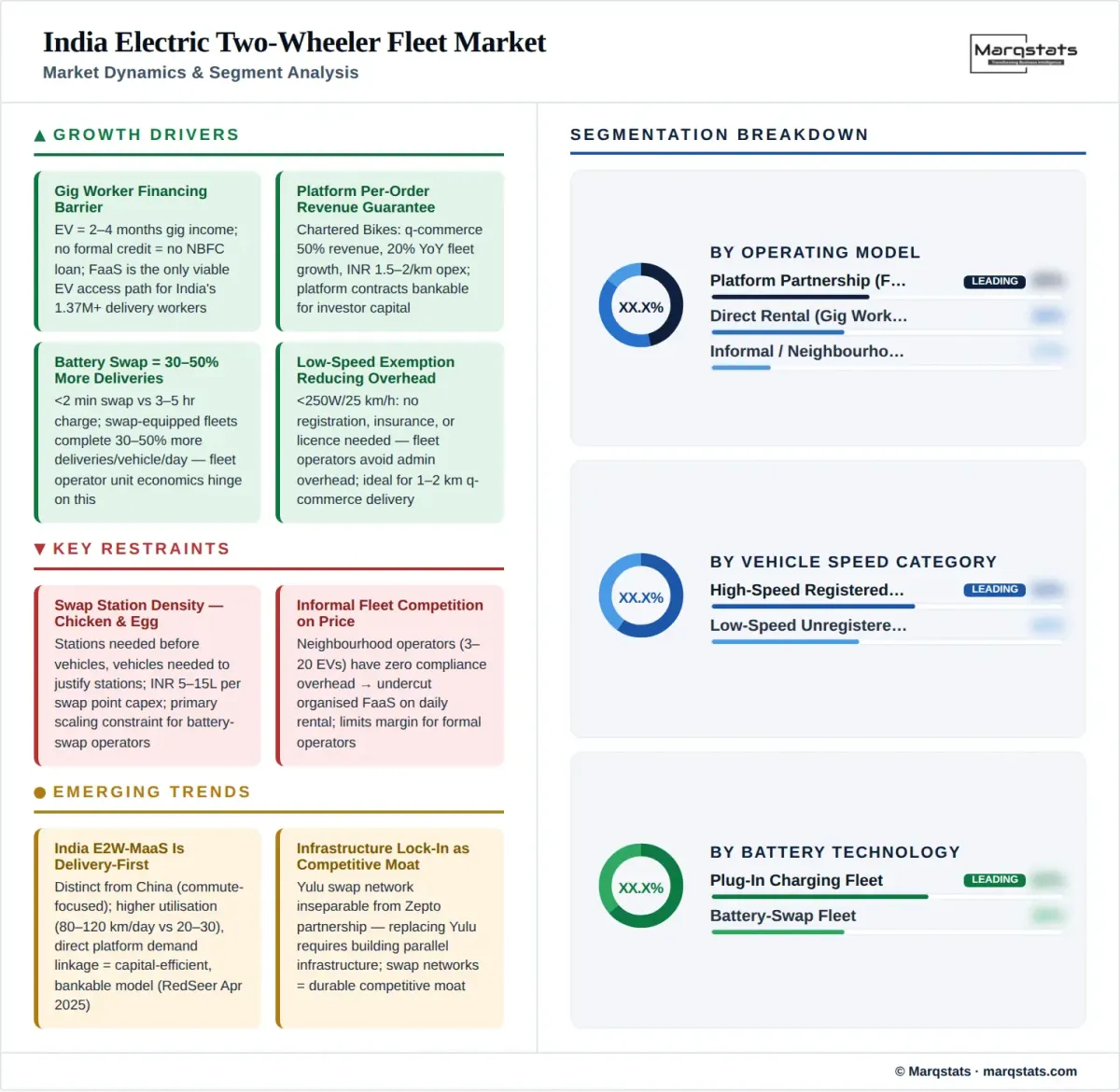
- Gig worker financing barrier creating structural demand for FaaS: India's delivery gig workforce — estimated at 1.37 million workers in food delivery alone, growing at 18–23% CAGR — predominantly lacks the formal credit history, collateral, and stable income documentation required for conventional NBFC vehicle loans. An EV at INR 90,000–1,30,000 represents 2–4 months of total gig income for a typical delivery worker. Without the FaaS layer, EV adoption by this workforce is constrained to the small fraction with credit access — meaning platform commitments to 100% EV fleets by 2030 are structurally dependent on FaaS operators scaling their vehicle pools faster than the financing market matures.
- Platform per-order and rental fee models creating guaranteed fleet operator revenue: The platform partnership model — where platforms pay fleet operators a per-order fee or monthly rental per vehicle deployed — creates a revenue guarantee that makes FaaS unit economics bankable. Chartered Bikes reports quick commerce as 50% of its revenue with 20% fleet growth year-on-year, operating costs of INR 1.5–2/km versus INR 4/km for petrol, and growing vehicle counts driven by platform demand pull. This model is structurally different from consumer EV rental (where utilisation is variable) because delivery platform demand is predictable at a city-dark-store level.
- Battery swap infrastructure reducing fleet operator downtime cost: A fleet operator's unit economics are fundamentally driven by vehicle utilisation — the fraction of operating hours that each vehicle is on the road generating revenue versus charging. At 3–5 hours charging downtime per charge cycle versus under 2 minutes for battery swap, a single swap-equipped EV can complete 30–50% more deliveries per day than a plug-in equivalent under identical operating conditions. For fleet operators running 100+ vehicles across a city's dark-store network, the cumulative difference is material — swap-equipped fleets achieve higher revenue per vehicle, lower idle fleet counts, and faster payback on vehicle investment.
- Low-speed E2W exemptions lowering fleet operator capital and operational requirements: The government's exemption of vehicles with motors below 250W and speeds below 25 km/h from registration, insurance, and licence requirements dramatically reduces fleet operator regulatory overhead in the low-speed segment. Operators do not need to track registration renewals, manage insurance claims, or verify driver licence status for low-speed fleet vehicles. This reduces operating cost and administrative burden, making the low-speed segment particularly attractive for fleet operators targeting the quick commerce intra-zone delivery use case where short routes (1–2 km) make 25 km/h entirely adequate.
- In-app platform integration giving FaaS operators direct rider acquisition channels: Zomato's in-app 'Rent an EV' feature, Swiggy's in-app financing and EV rental partner discovery, and similar integrations in other platform apps give FaaS operators a direct, zero-acquisition-cost channel to reach delivery riders at the moment they are onboarding to the platform. This integration removes the marketing spend that would otherwise be required for rider acquisition, directly improving FaaS operator unit economics and accelerating fleet utilisation ramp-up.
Key Restraints
- Swap station density remains the binding infrastructure constraint: Battery-swap fleet models deliver their full unit-economic advantage only when swap stations are dense enough that no vehicle travels more than 2–3 km to reach a swap point — comparable to the delivery radius itself. At anything less than this density, riders experience meaningful dead-time travelling to swap stations, eroding the utilisation advantage. Building this density requires capital investment per station (estimated at INR 5–15 lakh per swap point depending on battery format) and a critical mass of vehicles in the catchment area to justify the investment. The chicken-and-egg problem — you need stations before deploying vehicles, but you need vehicles to justify stations — is the primary scaling constraint for battery-swap fleet operators.
- Low-speed E2W quality and safety concerns from unregulated imports: As low-speed vehicles proliferate in commercial use, concerns about product quality have grown. Industry reporting notes an influx of unregistered low-speed Chinese EV imports sold with lead-acid batteries (rather than lithium) at very low prices, bypassing RTO regulations and creating safety risks. These vehicles — often assembled in India using imported knockdown kits — undercut legitimate FaaS operators and platform-qualified fleet vehicles on price while creating higher maintenance, battery failure, and rider safety risks. For fleet operators, managing a mixed fleet with variable quality low-speed vehicles creates disproportionate servicing overhead.
- Informal fleet holder competition suppressing organised FaaS pricing power: The informal neighbourhood fleet holder segment — individuals owning 3–20 EVs rented daily to local gig workers — competes directly with organised FaaS operators on price and convenience. Because informal operators have zero compliance overhead (no formal registration, no insurance tracking, no fleet management software), they can undercut organised FaaS on daily rental rates. This creates pricing pressure that limits the margin organised operators can generate per vehicle, complicating the unit economics case for the formal fleet market and slowing the investor capital deployment needed to scale swap infrastructure.
- Platform fee compression reducing per-vehicle revenue for fleet operators: As platforms mature and delivery unit economics come under investor scrutiny, pressure on per-delivery payout rates creates downstream pressure on what platforms pay fleet operators per order or per vehicle day. Fleet operators in the platform partnership model are exposed to this pass-through: if a platform reduces per-delivery earnings to gig workers, it typically also renegotiates fleet operator per-vehicle fees. This revenue compression risk is most acute for fleet operators with concentrated platform relationships and limited diversification across multiple platform clients.
Key Trends
- India E2W-MaaS model is structurally distinct from China and global peers: Industry analyses indicate that while China's E2W fleet market focuses on daily commuting use cases, India's model is fundamentally delivery-first. This distinction matters: India's gig worker economics create higher EV adoption urgency (fuel savings are a personal income gain, not just a sustainability choice), higher vehicle utilisation (80–120 km/day for delivery workers versus 20–30 km/day for commuters), and a direct platform-demand linkage that creates bankable revenue visibility for fleet operators. The India E2W-MaaS model is therefore more capital-efficient per vehicle deployed — higher utilisation means faster payback — but also more concentrated in its demand dependence on platform delivery growth.
- EBITDA-positive fleet operators demonstrating commercial viability: Industry analyses note that several businesses in India's E2W-MaaS segment are already achieving strong revenue growth and EBITDA-positive status without placing the operational burden on gig workers. This commercial viability — demonstrated by Chartered Bikes (20% fleet growth, Q-commerce at 50% of revenue) and the fleet economics implied by Zypp Electric's scale target — provides the proof-of-concept that is attracting institutional capital to the segment and validating the sector's investment case beyond platform-funded pilot programmes.
- Ride-hailing, e-commerce, and urban mobility creating additional E2W-MaaS growth vectors: Industry analyses indicate that beyond delivery, ride-hailing (Rapido, Ola Bike for EV bike-taxi as policies evolve), e-commerce logistics (Amazon, Flipkart institutional fleet procurement via FaaS operators), and other short-distance urban mobility applications provide additional growth vectors for E2W-MaaS operators beyond their initial quick commerce and food delivery anchors. Fleet operators that establish multi-application capability — serving quick commerce, food delivery, and parcel logistics from the same vehicle pool — achieve higher utilisation and lower per-vehicle idle cost than single-application specialists.
- Formalisation and compliance investment differentiating scale operators from informal fleet holders: As the E2W-MaaS market matures, the distinction between formal FaaS operators (with AIS-156 compliant vehicles, registered fleet management, battery tracking, and insurance) and informal neighbourhood fleet holders will widen. Platforms are increasingly requiring fleet partners to meet minimum compliance standards — AIS-156 battery certification, GPS tracking, insurance coverage — as part of their EV partner programme eligibility. This compliance requirement creates a natural filter that advantages formal FaaS operators in platform partnership channels, even if informal operators retain price advantage in the direct-to-rider market.
Market Segmentation
High-speed registered EV FaaS — fleet operators deploying registered, insured, high-speed electric scooters to delivery workers via formal rental contracts — is the larger segment by fleet value and the primary focus of formal FaaS operators. Vehicle models deployed in this segment include the TVS iQube, Bajaj Chetak, Ola S1X Gen3, Ather 450, and Hero Electric NYX HX. Fleet operators in this segment bear the full regulatory burden (VAHAN registration, insurance, periodic compliance) but benefit from higher daily rental pricing (INR 300–600/day versus INR 150–250/day for low-speed), ability to serve longer delivery routes (food delivery, parcel), and platform partnership eligibility requirements that demand registered, compliant vehicles. Zypp Electric's 1 lakh (100,000) e-scooter target with Zomato and Chartered Bikes' quick commerce fleet (50% of revenue) are the primary scale examples in this segment.
Low-speed unregistered EVs are a distinct and disproportionately important segment for the E2W-MaaS market, particularly for quick commerce and hyperlocal delivery. Industry analyses indicate approximately 1.6 lakh (160,000) units currently in active commercial fleet use, growing at approximately 21% CAGR. The regulatory exemption from registration, insurance, and driving licence makes these vehicles operationally simpler for both fleet operators and riders — fleet operators avoid the administrative overhead of maintaining registered fleets, and riders can begin working without possessing a valid driving licence. The Yulu-Zepto deployment of 20,000 shared DeX EVs is the most commercially prominent example, with Yulu's purpose-built DeX model (60 km range, 10 kg payload, battery-swap) specifically engineered for quick commerce use cases. The low-speed segment is most competitive in dense urban environments with short delivery radii (1–2 km), where the 25 km/h speed cap does not materially impair delivery performance relative to congested urban traffic conditions.
In the direct rental model, fleet operators rent electric two-wheelers to gig workers independently — workers choose which platforms to work for and what hours to work, with the vehicle available to them on daily, weekly, or monthly terms. This model offers gig workers maximum flexibility (multi-apping across Zomato, Swiggy, Blinkit simultaneously is possible) and gives fleet operators platform-agnostic revenue streams not dependent on any single platform's per-delivery rates. Rental rates in this model typically range from INR 200–400/day for low-speed EVs to INR 350–600/day for high-speed EVs, with some operators offering monthly packages (INR 4,000–8,000/month) for riders who prefer predictable costs. The direct rental model also serves gig workers who have recently joined a platform and are in a 'trial period' before committing to vehicle purchase.
In the platform partnership model, fleet operators enter formal commercial agreements with delivery platforms (Zomato, Swiggy, Blinkit, Zepto, Amazon) to supply a defined fleet of vehicles — and in some cases riders as well — to support platform delivery operations. The platform pays the fleet operator either a per-order fee (based on deliveries completed by the operator's vehicles) or a per-vehicle daily rental fee. This model provides fleet operators with predictable, volume-guaranteed revenue and direct integration into platform dispatch systems. The Zypp-Zomato partnership (targeting 1 lakh e-scooters) and Yulu-Zepto deployment (20,000 shared DeX EVs) are the two most publicly documented examples. Platform partnership model operators typically achieve higher vehicle utilisation than direct rental operators because platform dispatch optimisation concentrates orders into the fleet operator's vehicle pool during peak hours, reducing idle time.
A substantial portion of India's E2W-MaaS market operates informally — individuals or small operators owning 3–20 EVs rented to neighbourhood delivery workers on daily or weekly terms. This segment is essentially invisible to formal market statistics but is operationally significant in dense urban delivery markets. Independent assessments acknowledge this informal layer as part of the E2W-MaaS ecosystem. Informal fleet holders offer lower rental rates than formal operators (lower compliance overhead, no fleet management software, minimal insurance) and have strong hyperlocal customer relationships with regular riders. The informal segment's existence complicates organised FaaS pricing and market penetration, particularly in Tier-2 cities where formal operator infrastructure is limited but informal vehicle availability is growing as second-hand EV availability increases.
Plug-in EV fleet models — where vehicles are charged at fixed charging points at hubs, dark stores, or rider residences — represent the majority of current high-speed FaaS deployments. Fleet operators typically establish dedicated charging infrastructure at their hub locations (INR 50,000–1,50,000 per charging station depending on power level) and schedule vehicle charging during off-peak hours. BigBasket's deployment of 4,000+ Kazam charging points at 773 locations provides a model for platform-supported hub-charging infrastructure that fleet operators can leverage. The constraint of plug-in models is per-vehicle downtime of 3–5 hours per charge cycle — manageable for food delivery (one charge per shift) but suboptimal for quick commerce (multiple charge cycles required per shift at high daily distances).
Battery-swap fleet models — where depleted batteries are exchanged for charged batteries at swap stations in under 2 minutes — are the operationally superior model for high-utilisation quick commerce applications. Yulu's swap network for DeX vehicles and Indofast Energy's swap station deployment (2,750 stations targeting 10,000 swap points across 40+ cities) are the primary infrastructure examples. For fleet operators, swap-equipped fleets generate materially higher revenue per vehicle per day because downtime is eliminated — a swap-equipped fleet can complete 30–50% more deliveries per vehicle per day than an equivalent plug-in fleet in the same operating environment. The swap model's scalability is dependent on battery standardisation (different OEMs use incompatible battery formats, creating fragmentation risk) and swap station capex recovery (which requires minimum vehicle density to achieve utilisation-based payback).
By Geography
Tier-1 Metro Cities — Primary Market
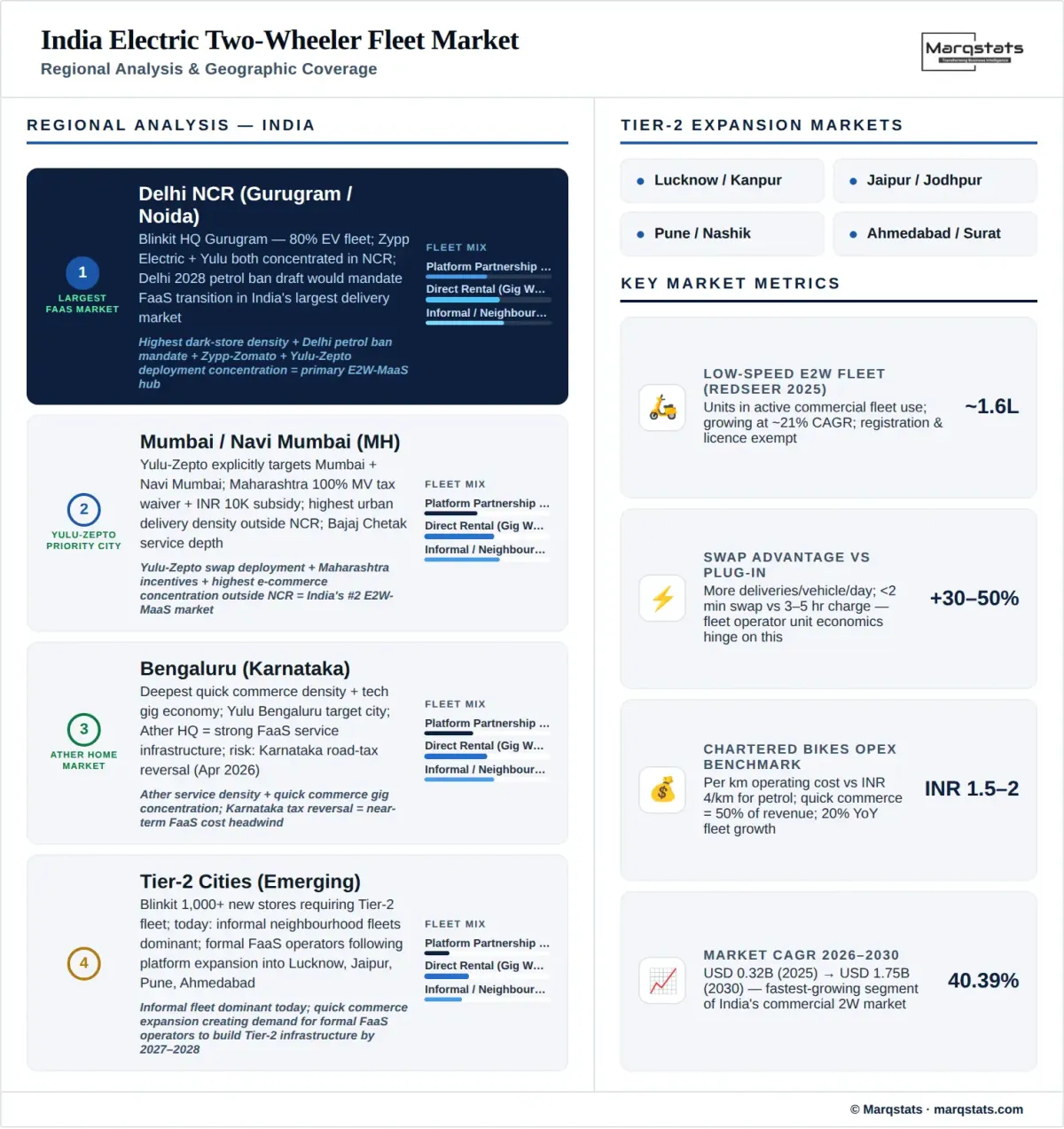
Tier-1 metro cities — Delhi NCR, Mumbai, Bengaluru, Chennai, Hyderabad, and Kolkata — are the primary market for India's E2W-MaaS segment, accounting for the vast majority of current organised FaaS deployments. These cities combine the highest gig worker density, the highest dark-store concentration per square km, the deepest quick commerce penetration, and the most developed EV charging and swap infrastructure. Yulu's 5-city deployment focus (Bengaluru, Mumbai, Navi Mumbai, Delhi, Gurugram) explicitly targets the highest-density delivery corridors in India's top metros. Zypp Electric's Zomato partnership similarly concentrates initial deployment in metro markets where platform delivery density justifies fleet operator investment. Delhi NCR's proposed petrol 2W registration ban from 2028 would, if enacted, structurally mandate the FaaS market transition from optional to operational requirement in India's largest city.
Tier-2 Cities — Emerging Market
Tier-2 cities — Lucknow, Jaipur, Pune, Ahmedabad, Coimbatore, Surat, Indore, Patna — are an emerging E2W-MaaS market driven by quick commerce dark-store expansion and e-commerce platform delivery network growth. Blinkit's 2,000+ store target requires 700–1,000 new dark stores in Tier-2 cities, each requiring a delivery fleet. However, Tier-2 E2W-MaaS deployment today is dominated by the informal neighbourhood fleet holder model rather than organised FaaS operators — formal operators have not yet built the hub infrastructure, swap station networks, or rider acquisition channels needed to operate profitably in smaller cities. As quick commerce platforms commit capital to Tier-2 expansion and as formal FaaS operators follow their platform clients into new cities, Tier-2 represents the primary 2026–2030 growth market for this segment.
How Competition Is Evolving
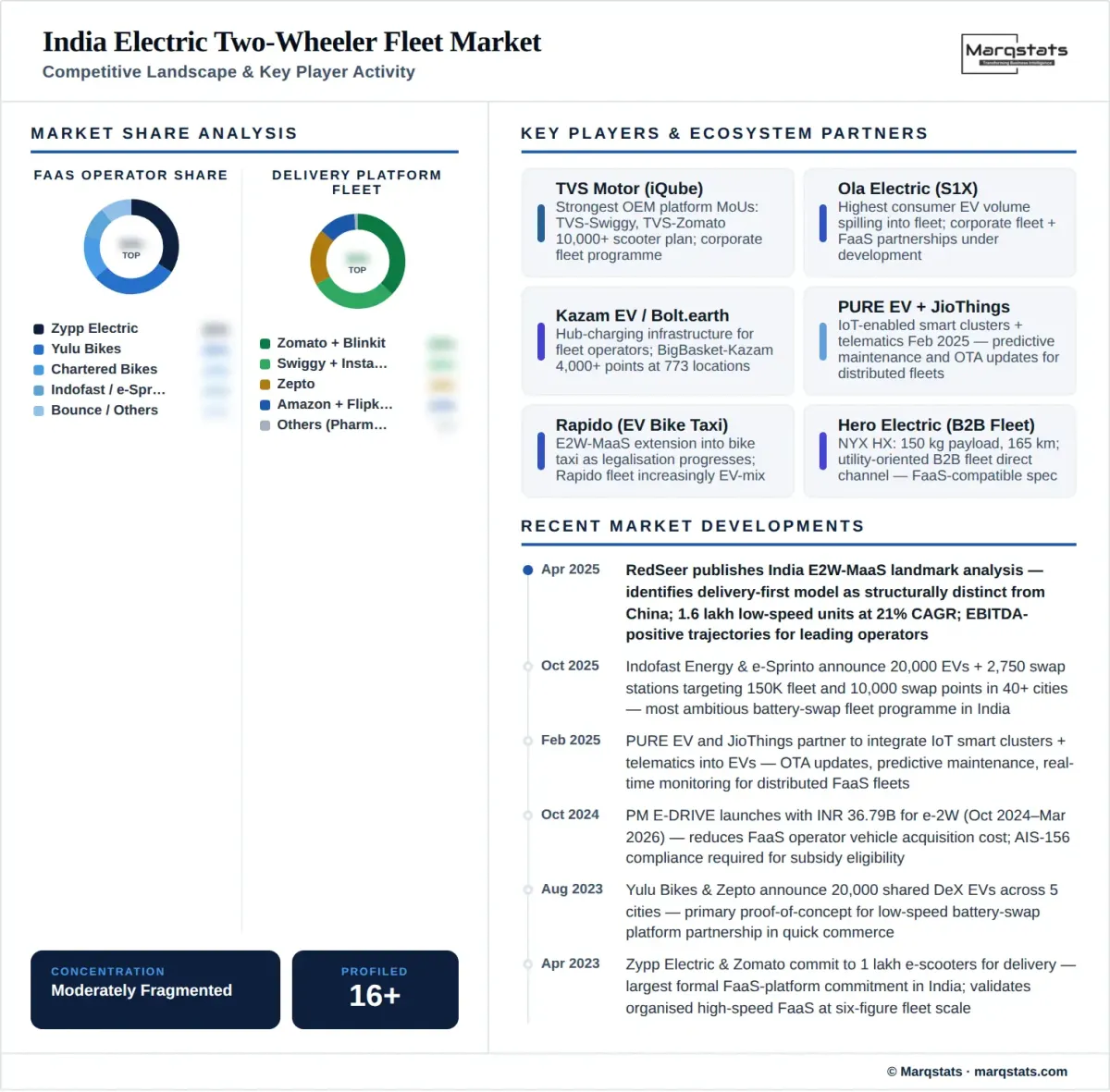
The India electric two-wheeler fleet market is characterised by a small number of formal scale operators, a larger number of city-specific niche players, and a vast informal layer of neighbourhood fleet holders. At the formal scale layer, Zypp Electric (Zomato partnership, 1 lakh e-scooter target) and Yulu Bikes (Zepto partnership, 20,000 shared DeX EVs, battery-swap infrastructure) are the two most publicly scaled operators. Chartered Bikes is the strongest unit-economics case study — quick commerce at 50% of revenue, 20% fleet growth, INR 1.5–2/km operating cost. Indofast Energy-e-Sprinto is the most ambitious swap infrastructure programme (20,000 EVs, 2,750 stations). The formal competitive landscape is still nascent enough that competitive dynamics are driven more by platform partnership allocation (who gets the Zomato, Zepto, or Swiggy partnership) than by direct head-to-head pricing competition between FaaS operators.
The competitive moat in this market is being built primarily at the infrastructure layer — battery-swap station networks, hub-charging facilities, and fleet management software create switching costs that make fleet operators sticky once they have established a city-level operational presence. Yulu's swap network, for example, is operationally inseparable from its Zepto partnership — replacing Yulu as Zepto's fleet partner would require building a parallel swap infrastructure, not just switching vehicle suppliers. This infrastructure lock-in is the primary basis for competitive differentiation and the reason why the companies that build swap networks fastest and widest will likely capture disproportionate market share as the E2W-MaaS market scales. OEM involvement in this market is evolving from vehicle supply to potential co-investment in swap infrastructure — TVS Motor's delivery programme investments and Ola Electric's corporate fleet programme both point toward OEM-FaaS partnerships that could reshape the competitive dynamic as the market matures.
Companies Covered
Companies covered in the report include:
Recent Market Activity
Table of Contents
Coverage & Segmentation
This report covers India's electric two-wheeler fleet market — the ecosystem of companies providing EV access to delivery workers through FaaS rental, battery-swap shared mobility, and platform-integrated fleet programmes rather than outright ownership. The study period is 2021–2030, with 2025 as base year. Both high-speed registered EVs (above 250W, VAHAN registration required) and low-speed unregistered EVs (up to 250W/25 km/h, registration exempt) are included as distinct sub-segments. Operating model coverage includes formal FaaS operators (Zypp, Yulu, Chartered Bikes), battery-swap network operators (Indofast Energy, Yulu), informal neighbourhood fleet holders, and platform-integrated rental programmes. Geographic coverage spans Tier-1 metros (Delhi NCR, Mumbai, Bengaluru, Chennai, Hyderabad) as the primary market and Tier-2 cities as the emerging growth market. Policy analysis focuses on PM E-DRIVE, low-speed EV exemptions, AIS-156 battery standards, battery-as-a-service policy enablement, and NITI Aayog battery swapping policy direction. Primary research includes 40+ interviews with FaaS operators, platform fleet programme managers, swap station operators, OEM corporate sales teams, and gig workers across India's major delivery markets.