Market Snapshot
Key Takeaways
Market Overview & Analysis
Report Summary
The Asia-Pacific automotive tire pressure monitoring system market comprises direct, wheel-mounted pressure sensors and indirect, wheel-speed-based systems that alert drivers to under-inflated tires, sold as original equipment and through aftermarket replacement channels across passenger cars, light commercial vehicles, and heavy trucks, buses, and trailers. This study segments the market by system type, vehicle category, and sales channel, with a 2025 base year, historical coverage from 2021 to 2025, and forecasts to 2030. Market size is stated as sensor and system revenue in United States dollars.
Regulatory fragmentation across the region's major markets has historically complicated supplier product strategy, since China, Japan, India, and South Korea have each pursued fitment mandates on differing timelines and, until recently, differing radio-frequency specifications. Japan's 2025 alignment to the 433 MHz band that already dominates China and much of the rest of the region materially simplifies this environment, allowing suppliers to standardise sensor hardware across a larger share of regional demand rather than maintaining market-specific product variants. This standardisation reduces the inventory and engineering overhead international suppliers previously carried to serve Japan as a distinct product variant, freeing resources that suppliers are increasingly redirecting toward heavy-vehicle and connected-sensor product development instead.
Heavy commercial vehicle fitment represents the market's most significant structural expansion in progress: TPMS has historically been concentrated in passenger vehicles, yet UNECE Regulation 141 is extending mandatory fitment to trucks, buses, and trailers across markets that reference international vehicle safety frameworks, often implemented through central tire inflation system equivalents rather than passenger-vehicle-style individual wheel sensors. This expansion is adding a distinct vehicle-category growth vector on top of the passenger-vehicle demand base that has driven the market to date. Electric vehicle production growth is a further distinct driver worth tracking separately, since EV manufacturers increasingly specify TPMS explicitly as a range-optimisation tool rather than a safety feature alone, given the direct relationship between correct tire inflation and rolling resistance, and therefore energy consumption per kilometre. This EV-specific framing has, in several cases, led manufacturers to specify higher-accuracy direct TPMS configurations than regulatory minimums alone would require, treating tire-pressure accuracy as a competitive range-disclosure consideration rather than a compliance checkbox.
Market Dynamics
Key Drivers
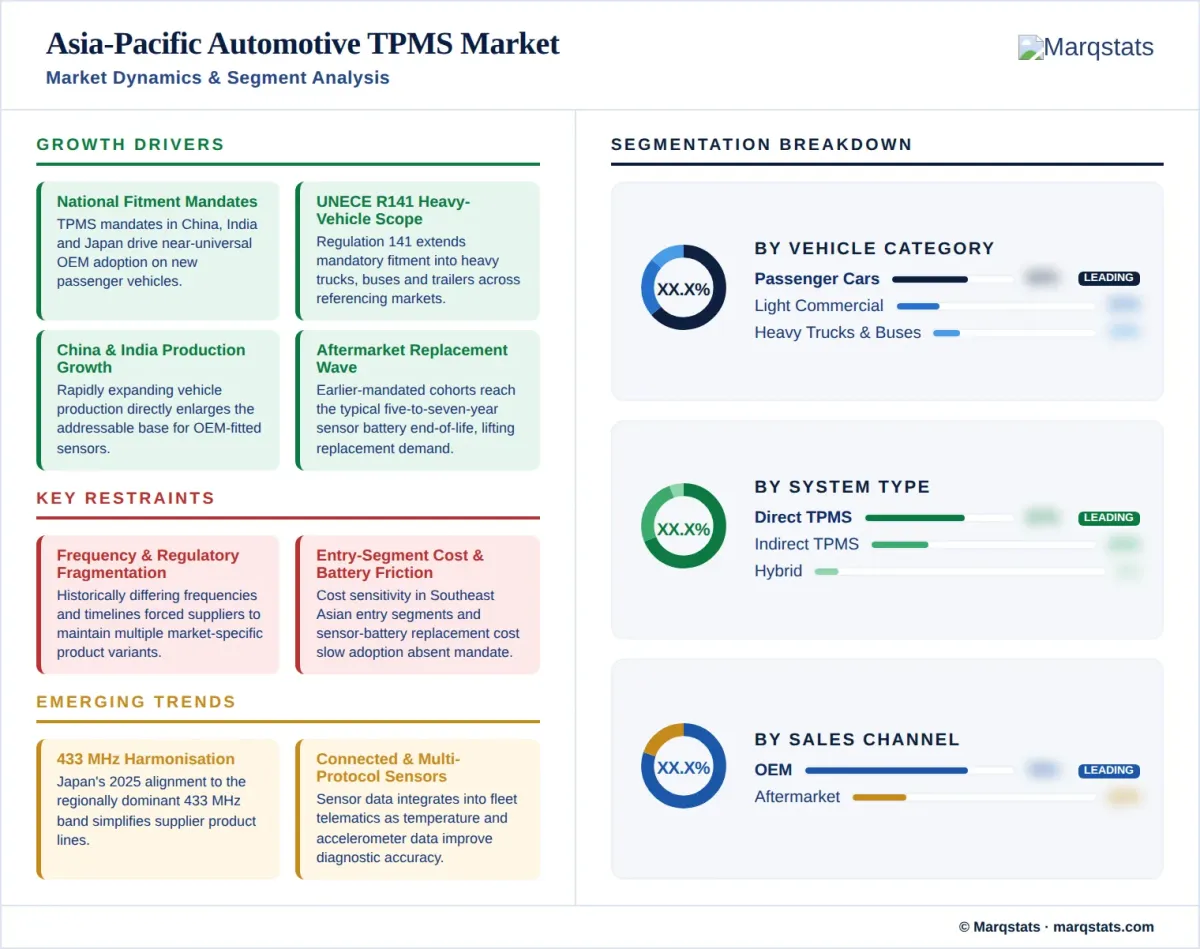
- National TPMS fitment mandates in China, India, and Japan are driving near-universal OEM adoption on new passenger vehicles.
- UNECE Regulation 141 is extending mandatory TPMS fitment into heavy trucks, buses, and trailers across referencing markets.
- Rapidly expanding vehicle production in China and India directly expands the addressable base for OEM-fitted sensors.
- Rising aftermarket replacement demand is emerging as earlier-mandated vehicle cohorts reach typical sensor battery end-of-life.
- Electric vehicle OEMs are specifying TPMS as a direct lever for range optimisation, since correctly inflated tires reduce rolling resistance.
Key Restraints
- Historical frequency and regulatory fragmentation across regional markets has required suppliers to maintain multiple product variants.
- Cost sensitivity in entry-level vehicle segments across emerging Southeast Asian markets slows adoption absent regulatory mandate.
- Sensor battery life and replacement cost remain a persistent consumer friction point in aftermarket replacement decisions.
Key Trends
- Frequency harmonization around the 433 MHz band is simplifying regional sensor product lines following Japan's 2025 alignment.
- Connected TPMS, integrating sensor data into telematics and fleet management platforms, is expanding beyond simple driver alerts.
- Multi-protocol sensors incorporating temperature and accelerometer data alongside pressure are improving diagnostic accuracy.
- Universal-fit aftermarket sensor kits are gaining share among independent service providers seeking simplified inventory management.
- Heavy vehicle fitment is increasingly implemented through central tire inflation system equivalents rather than individual wheel sensors.
Market Segmentation
Direct TPMS, using pressure sensors mounted inside each wheel to communicate wirelessly with a central control unit, holds roughly two-thirds of regional revenue, reflecting regulatory preference for its immediate, per-wheel pressure accuracy over indirect alternatives. Valve-stem and band-mounted sensor designs both remain in commercial use, with valve-stem designs holding the larger installed base across the region. MEMS-capacitive pressure sensing technology dominates within direct TPMS specifically, valued for its accuracy and manufacturing cost profile relative to alternative sensing approaches, and continues to gain share as automotive-grade MEMS production scales further across regional semiconductor supply chains.
Indirect TPMS, which infers pressure loss from wheel-speed signal differences via the vehicle's existing anti-lock braking sensors, represents a smaller, persistent share of the market, valued for its lower incremental hardware cost since it requires no dedicated pressure sensors. Hybrid configurations combining both approaches are the fastest-growing system-type sub-category, as manufacturers seek to capture indirect TPMS's cost advantage alongside direct TPMS's accuracy in specific applications. Indirect systems remain most common in cost-sensitive entry-level vehicle segments and in markets where regulatory requirements specify pressure-loss detection without mandating the individual-wheel accuracy direct systems provide.
Passenger cars represent the largest vehicle-category segment by revenue, reflecting both the scale of regional passenger vehicle production and the maturity of passenger-vehicle TPMS mandates relative to commercial vehicle regulation, which has developed on a more recent timeline. Within this category, sensor count per vehicle is a straightforward four-wheel specification in the substantial majority of cases, giving passenger-car revenue a close and predictable relationship to vehicle production volume that other categories do not share to the same degree.
Light commercial vehicles are following passenger cars in fitment pattern, with regulatory scope in most major markets extending to this category on a similar or only slightly delayed timeline relative to passenger cars. Fleet operators in this category increasingly value TPMS beyond regulatory compliance alone, citing fuel-efficiency and tyre-life benefits that directly affect total cost of ownership for vehicles in continuous commercial service.
Heavy trucks, buses, and trailers represent the fastest-growing vehicle-category segment, driven by UNECE Regulation 141 implementation across referencing markets, though fitment in this category more commonly takes the form of central tire inflation system equivalents rather than the individual wheel sensors standard in passenger vehicles. Multi-axle trailers present a particular fitment complexity, since sensor count scales directly with axle and wheel count, giving this vehicle sub-category a materially higher per-unit sensor content than a standard passenger car despite lower overall unit production volumes.
Original equipment fitment accounts for the large majority of market revenue, directly reflecting the regulatory mandates that have driven this market's growth, with automakers integrating TPMS as a standard rather than optional specification across most new vehicle production in mandate-covered markets. Supplier qualification for OEM programmes typically spans a multi-year vehicle development cycle, giving incumbent suppliers on a given vehicle platform a durable position that new entrants find difficult to displace mid-cycle.
Aftermarket replacement demand is a growing channel as the region's earliest-mandated vehicle cohorts, concentrated in markets that implemented fitment requirements earliest, reach the five-to-seven-year battery life typical of direct TPMS sensors, creating a replacement cycle that is only beginning to reach scale across much of the region. Universal-fit aftermarket sensor kits, designed to serve multiple vehicle makes and models from a single stock-keeping unit, are gaining share in this channel as independent service shops seek to simplify inventory relative to OEM-specific replacement parts.
By Geography
China
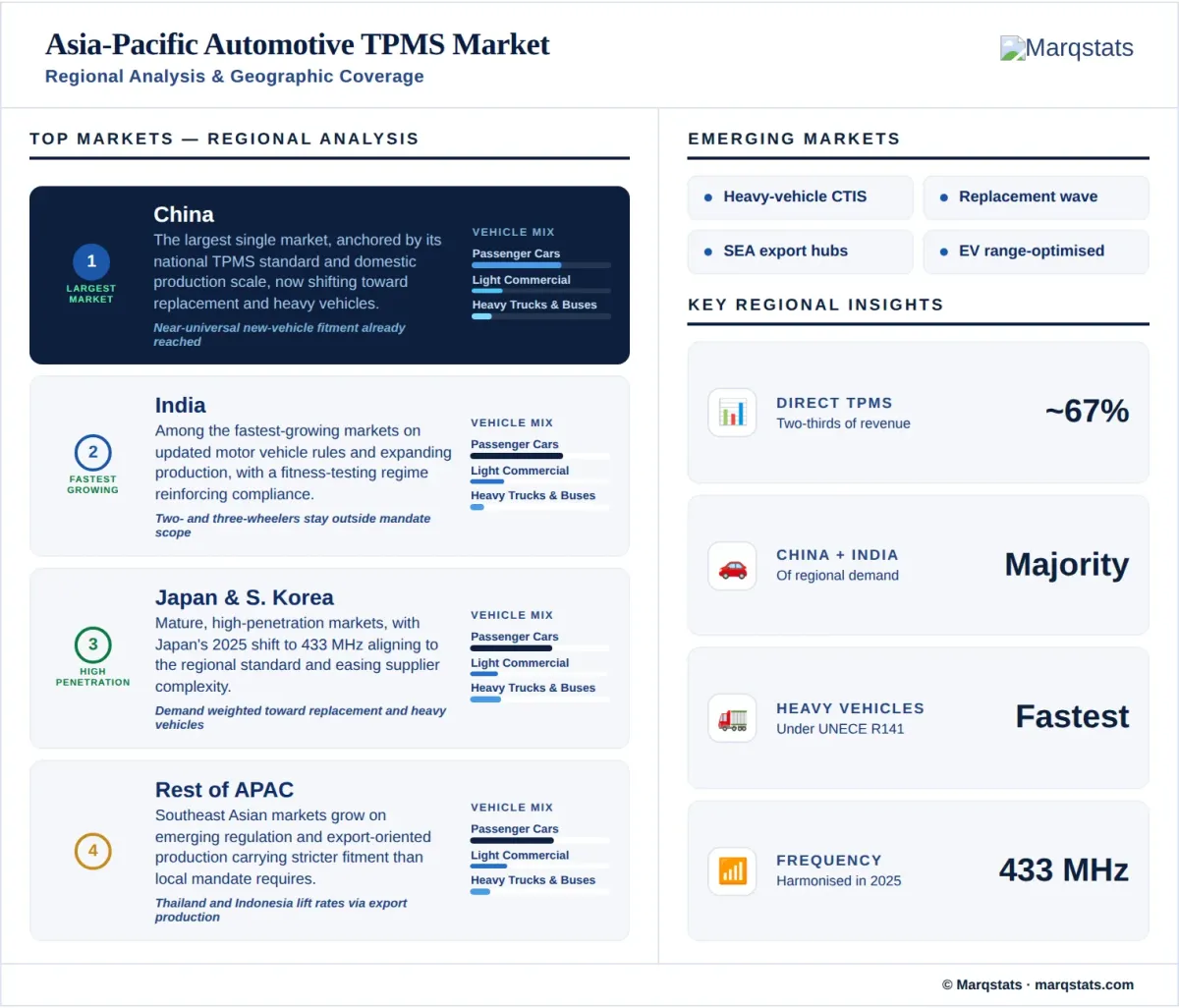
China represents the largest single market within the region, anchored by its national TPMS standard and the scale of domestic vehicle production. Domestic Chinese sensor manufacturers have scaled into significant regional and increasingly global suppliers, competing on cost alongside established international Tier-1 suppliers. China's domestic new-vehicle market has already reached near-universal TPMS fitment on new production, shifting the market's growth driver within the country increasingly toward replacement demand and heavy-vehicle fitment expansion rather than new passenger-vehicle penetration alone. China's vehicle export growth is a further factor supporting domestic sensor manufacturer scale, since vehicles built for export to markets with their own TPMS mandates add incremental demand beyond what domestic registration figures alone would capture.
India
India is among the fastest-growing markets in the region, driven by updated central motor vehicle rules extending TPMS requirements and rapidly expanding domestic vehicle production, with the country's upcoming vehicle fitness testing regime expected to further reinforce compliance across the existing vehicle parc over time. Domestic and international automakers operating in India have both accelerated TPMS specification ahead of full regulatory mandate in several vehicle segments, reflecting rising consumer safety awareness alongside the anticipated regulatory timeline. India's two-wheeler and three-wheeler segments, which dominate the country's overall vehicle parc by unit count, remain largely outside current TPMS mandate scope, meaning the addressable market tracks the smaller four-wheeler passenger and commercial vehicle segment specifically rather than total vehicle production.
Japan and South Korea
Japan and South Korea represent mature, high-penetration markets, with Japan's 2025 shift to the 433 MHz frequency band aligning the market with the regional standard already dominant in China and reducing the product-variant complexity international suppliers previously had to manage to serve the market. Both markets show a demand profile increasingly weighted toward replacement and heavy-vehicle fitment rather than new passenger-vehicle penetration, reflecting their already-mature TPMS adoption base relative to faster-growing emerging markets elsewhere in the region. South Korea's strong domestic automotive supplier base, anchored by Hyundai Mobis, gives the country an influence on regional TPMS technology standards disproportionate to its vehicle production volume alone.
Rest of Asia-Pacific
Southeast Asian markets, including Indonesia, Thailand, and Vietnam, represent a smaller, growing market, with adoption shaped by a mix of emerging domestic regulation and the gradual extension of regional and international automaker safety specifications into vehicles produced or sold in these markets. Thailand and Indonesia's roles as regional vehicle export manufacturing hubs mean a meaningful share of TPMS-equipped production in these countries is destined for markets with stricter fitment requirements than domestic regulation alone would require, lifting effective fitment rates above what local mandate status would otherwise suggest. Vietnam's rapidly growing domestic vehicle market represents the region's newest meaningful growth pocket, though from a smaller current base than its larger Southeast Asian neighbours.
How Competition Is Evolving
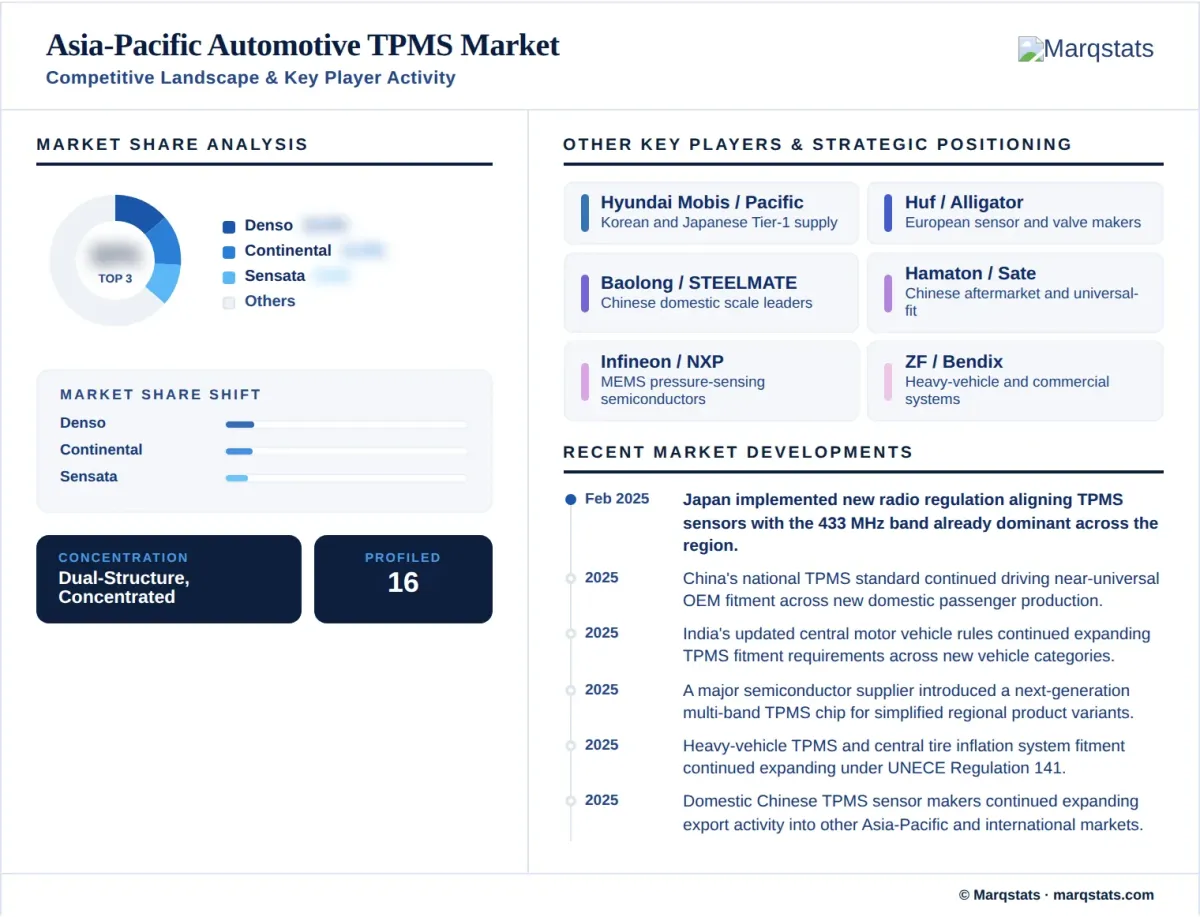
The market is moderately concentrated, with established international Tier-1 automotive suppliers and semiconductor companies competing alongside a significant group of domestic Chinese TPMS sensor manufacturers who have scaled rapidly on the strength of China's large domestic mandate-driven market. This dual structure, international suppliers with global platform relationships and domestic Chinese suppliers with strong local cost and relationship advantages, defines competitive dynamics across most of the region. International suppliers retain the stronger position in original equipment programmes for global and premium automotive brands, while domestic Chinese suppliers hold a particularly strong position in the aftermarket and in OEM programmes for domestic Chinese automotive brands specifically. Consolidation activity has been more visible among domestic Chinese suppliers seeking export scale than among established international players, whose competitive position is already anchored in long-standing global platform relationships that acquisition activity would not meaningfully strengthen.
Competitive strategy centers on frequency-band standardisation capability following Japan's 2025 alignment, sensor accuracy and battery life, and the ability to serve both direct passenger-vehicle sensor programmes and the emerging heavy-vehicle central tire inflation system opportunity. Domestic Chinese suppliers, including Shanghai Baolong Automotive and STEELMATE, have increasingly pursued export opportunities into other regional and global markets, extending the domestic cost and scale advantage that built their position in China's mandate-driven home market. Semiconductor suppliers compete on sensor chip integration and multi-band radio support specifically, since the underlying MEMS pressure-sensing silicon increasingly represents a larger share of total sensor value than the mechanical housing and battery components that once dominated sensor bill-of-materials cost, a shift that favours suppliers with strong semiconductor design capability over those competing on mechanical assembly alone.
Companies Covered
The report profiles 16+ companies with full strategy and financials analysis, including:
Recent Market Activity
Table of Contents
Coverage & Segmentation
This report provides a comprehensive assessment of the Asia-Pacific automotive tire pressure monitoring system market across a 2025 base year, historical data from 2021 to 2025, and forecasts spanning 2026 to 2030. Market size is stated as sensor and system revenue in United States dollars. Segmentation covers three dimensions: system type, vehicle category, and sales channel, alongside country-level analysis spanning China, India, Japan and South Korea, and the rest of Asia-Pacific.
The scope covers direct and indirect TPMS systems, including sensor hardware and associated control units, sold as original equipment and through aftermarket replacement channels for passenger cars, light commercial vehicles, heavy trucks, buses, and trailers. The study excludes manual tire pressure gauges, telemetry systems without pressure sensing, and prototype or racing-only TPMS solutions. This report is scoped to Asia-Pacific specifically, covering China, India, Japan, South Korea, and the wider Southeast Asian region; readers requiring North American or European TPMS coverage should refer to Marqstats' separate regional and global automotive sensor reports. Country-level detail beyond the split covered here is available under customization, alongside deeper cuts by system type, vehicle category, or radio frequency band.