Market Snapshot
Key Takeaways
Market Overview & Analysis
Report Summary
Aquavoltaics represents the convergence of two resource pressures that are intensifying simultaneously: the need for large-scale renewable energy deployment in land-constrained coastal and delta regions, and the need to protect productive aquaculture land from displacement by utility-scale solar farms. The technical premise is straightforward — solar PV panels are mounted on piles or floating structures above active fish ponds, covering typically 30–60% of the water surface to balance irradiance reduction against power generation — but the commercial and regulatory architecture required to make the model bankable is more complex, involving aquaculture management agreements, fishery-yield monitoring protocols, grid connection rights, and in many jurisdictions environmental impact assessment (EIA) processes distinct from conventional solar permitting.
The market traces its modern commercial lineage to two parallel developments: China's early-mover pile-mounted fishery solar projects in the Yangtze Delta (including the Cixi installations and subsequent Anhui, Jiangsu, and Shandong projects) which demonstrated that solar panels deliberately spaced to allow sunlight penetration are compatible with continued fish farming; and Taiwan's government-led aquavoltaic programme, which from 2017 onwards formalised a permitting framework allowing solar installations on licensed aquaculture ponds subject to fishery yield maintenance conditions. Taiwan's framework has attracted the widest range of project developers of any national market, including domestic operators such as HD Renewable Energy and J&V Energy, and international entrants including Lightsource bp and Aquila Clean Energy APAC.
The technology ecosystem has two layers. The project development layer includes IPPs, utilities, and specialised aquavoltaic operators who assemble permits, finance, engineering, and fishery management into bankable assets. The enabling technology layer includes floating PV structure manufacturers (led by Ciel & Terre's Hydrelio platform and its newer Fusio and WattRack products launched in October and December 2025 respectively), EPC contractors, aquaculture management specialists, and — for the offshore lane — integrated marine systems providers such as AKVA group, Alotta Energy, and Fjord Maritime. The Taixi project in Taiwan, developed by Laketricity using Ciel & Terre's Hydrelio aiR floating solution, is cited as one of the first large-scale floating PV installations on a commercial fish farm and serves as a key proof-of-concept for the global industry.
Market Dynamics
Key Drivers
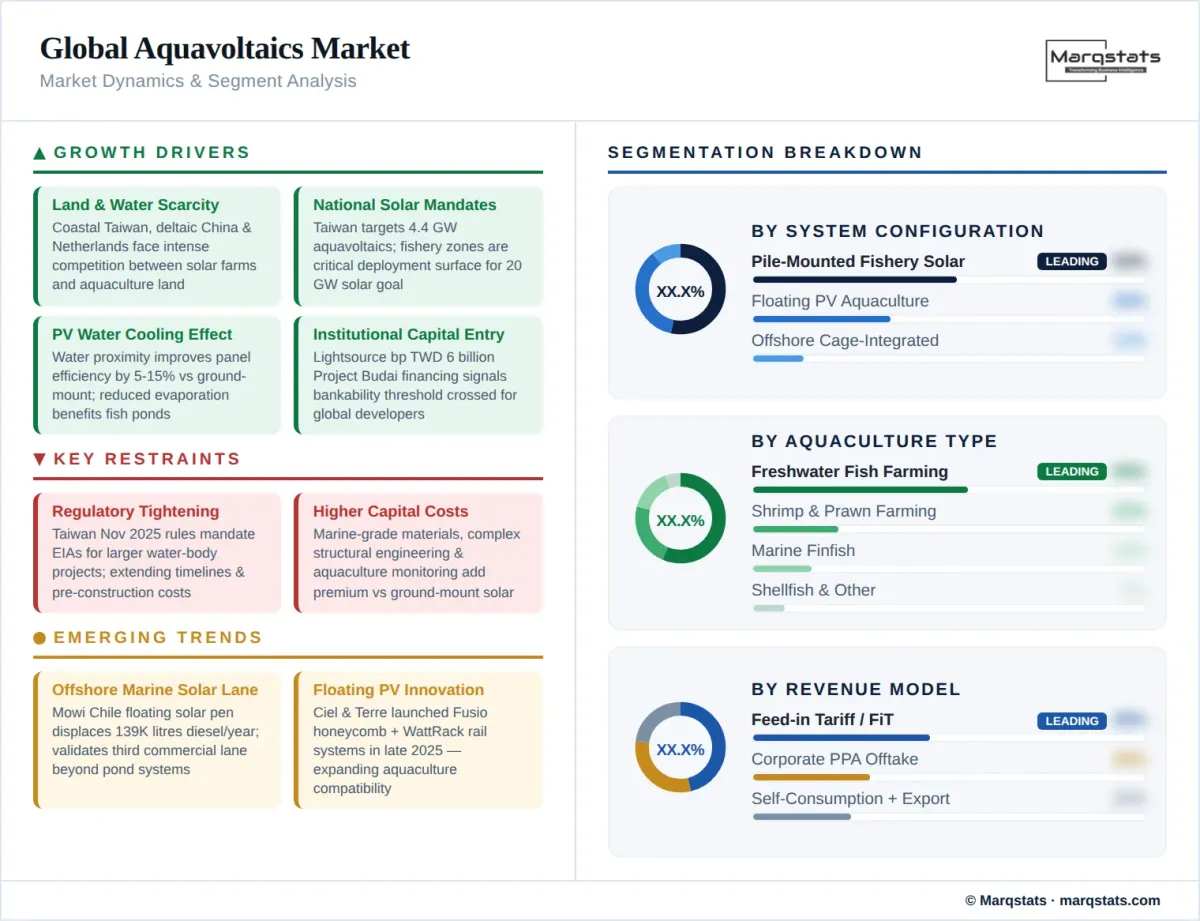
- Dual-use land and water scarcity forcing co-location models: In coastal Taiwan, deltaic China, the Netherlands, Vietnam, and Bangladesh, competition for productive fishpond land from urban development and utility-scale solar has created a political and economic imperative for co-location. Governments in these markets have crafted fishery-solar frameworks that permit solar deployment on licensed aquaculture land only if farming activity is maintained — converting what was previously a conflict into a policy-backed synergy. The same land-scarcity logic is beginning to apply in the Netherlands, South Korea, and parts of Southeast Asia.
- National renewable energy targets requiring non-agricultural solar deployment options: Taiwan's 20 GW solar target by 2025 — which has faced significant challenges from agricultural and ecological land-use restrictions — positioned fishery solar as a critical unlocking mechanism. The government's explicit 4.4 GW aquavoltaic ambition reflects the calculation that fishery zones are among the few large-scale solar deployment surfaces that can absorb significant capacity without triggering land-use objections, provided aquaculture activity is genuinely maintained.
- Solar panel water cooling improving PV efficiency by 5–15%: Water proximity moderates panel operating temperatures, with studies reporting solar efficiency improvements of 5–15% compared to ground-mounted systems in equivalent irradiance conditions. Reduced thermal degradation also extends panel service life, improving project-level IRR. The water body additionally benefits from partial shading — reducing evaporation, suppressing algal bloom growth, and in some species improving feed conversion ratios under more stable temperature regimes.
- Growing corporate PPA demand from aquaculture and food companies: Aquila Clean Energy APAC's January 2026 financial close on a 26.3 MW Taiwan fishery-solar project was structured to sell power via corporate PPAs — reflecting a shift from government feed-in tariffs toward direct corporate offtake. As food and aquaculture companies face Scope 2 and Scope 3 decarbonisation obligations, co-located fishery solar offers a direct supply-chain clean-energy solution.
- International project finance capital entering the category: Lightsource bp's TWD 6 billion project financing for Project Budai — its first fishery-solar venture globally — signals that the category has crossed a bankability threshold where major international project developers and their financial partners are willing to underwrite aquavoltaic assets. This institutional credibility attracts further capital and de-risks the asset class for second-mover developers.
Key Restraints
- Regulatory tightening and EIA requirements lengthening project timelines: Taiwan's November 2025 solar rules — banning certain ground-mounted and floating solar in protected areas and mandating EIAs for larger water-body projects — are extending project development timelines and increasing pre-construction costs. Eco-Business reported in February 2026 that Taiwan's already-delayed renewables target has slipped further as tighter solar rules slow rollout. Projects that cannot demonstrate genuine aquaculture integration face increasing risk of permit denial.
- Social licence risk from non-compliant fishery-solar operators: IEEE Spectrum documented criticisms of early Taiwan aquavoltaic projects for overbuilding or failing to maintain promised farming activity. This reputational damage has triggered broader regulatory scrutiny and community resistance in some areas, raising due-diligence and compliance costs for all market participants. Operators that cannot evidence continued aquaculture yields through traceability and monitoring systems face growing social and commercial risk.
- Technical uncertainty in aquaculture compatibility across species and systems: The 2025 global aquavoltaics review highlighted unresolved questions around ecological impacts, layout optimisation (panel coverage ratios, row spacing, orientation), effects on phytoplankton and dissolved oxygen, and aquaculture efficiency across different species and production systems. These uncertainties increase technology and operating risk for developers entering new geographies or farming systems without prior deployment data.
- Higher capital costs compared to conventional utility-scale solar: Pile-mounted or floating PV structures designed for active aquaculture ponds cost more per MWp than equivalent ground-mounted systems, due to marine-grade materials requirements, more complex structural engineering, aquaculture monitoring systems, and EPC execution in working fish farm environments. This capital cost premium must be justified by the combination of solar revenue, aquaculture income, and any policy incentives.
Key Trends
- Aquaculture integration quality becoming the primary competitive differentiator: Leading operators are no longer selling 'solar over ponds' as a land-use arbitrage; they are selling operating models that preserve yields, support species selection, enable traceability, and satisfy environmental management requirements. HD Renewable Energy's Star Aquaculture site in Tainan combines outdoor mullet culture, reservoir ponds, and indoor white-shrimp facilities under the solar canopy — demonstrating that vertically integrated aquaculture-solar operations can command premium valuations and regulatory favour.
- Three-lane market architecture emerging: The aquavoltaics market is structurally differentiating into three competitive lanes: (1) Taiwan and China pond-based fishery solar farms at utility scale; (2) floating PV systems on aquaculture reservoirs and managed water bodies globally; and (3) offshore and cage-integrated marine aquaculture energy systems. Mowi's collaboration with AKVA group, Alotta Energy, and Fjord Maritime to deploy a floating solar-powered fish pen in Chile — covering approximately 57% of site energy needs and eliminating 350 tonnes of CO₂ annually — illustrates that the third lane is achieving commercial deployment.
- Floating solar technology innovation accelerating aquaculture compatibility: Ciel & Terre's 2025 product launches — the Fusio honeycomb racking (October 2025) and WattRack rail-based structure (December 2025) — expand the range of floating configurations available for aquaculture ponds with varying wave exposure, water-level variation, and panel density requirements. The Hydrelio aiR Optim and the new products together provide a more complete toolbox for aquavoltaic system designers, reducing bespoke engineering requirements.
- Coastal offshore solar expanding the addressable resource base: A 2026 commentary in The Innovation Energy highlighted the solar PV potential in global coastal aquaculture zones, while CHN Energy's 1 GW HG14 floating PV project off the coast of Dongying (China, now in commercial operation) signals that offshore floating solar is scaling rapidly and will create further adjacencies with marine aquaculture.
Market Segmentation
Pile-mounted fishery solar — where PV panels are elevated on fixed piles driven into the pond bed, leaving the water surface largely unobstructed below — is the dominant system type in China and the original commercial configuration for large-scale aquavoltaics. The Cixi Hangzhou Fengling project (320 MW total, Phases 1 and 2 completed 2017 and 2020) exemplifies this architecture: panels are deliberately spaced to allow sufficient sunlight penetration for fish growth, with the installation generating approximately 352 GWh annually across 299.5 hectares. This configuration is best suited to shallow, large-surface freshwater ponds and is less adaptable to water level variation than floating systems. It accounts for an estimated 50–55% of installed capacity globally as of 2025.
Floating PV aquaculture systems use buoyant structures — such as Ciel & Terre's Hydrelio platform (1.4 GW installed across 340+ projects globally) — to mount panels directly on the water surface of fish or shrimp ponds. This configuration adapts to water level variations and is more suited to the operational realities of managed fishery ponds in Taiwan and Europe, where pond draining, aeration, and harvest cycles require flexible surface access. The Taixi aquavoltaic project in Taiwan, developed by Laketricity using Ciel & Terre's Hydrelio aiR technology, operates with a 40% pond coverage limit designed to balance power generation with fishery compatibility. Floating PV aquaculture is the fastest-growing sub-segment, driven by expanding deployment in Taiwan, Europe, and Southeast Asia.
Offshore and cage-integrated solar is an emerging third configuration, where solar panels are mounted on or adjacent to marine aquaculture structures — open-water fish pens, longlines, or offshore cage systems — to power on-site energy loads such as aeration, monitoring, feeding systems, and wellboat operations. The Mowi installation in Chile — developed with AKVA group, Alotta Energy, and Fjord Maritime — is among the first commercial deployments of this configuration, expected to displace 139,200 litres of diesel annually and reduce CO₂ emissions by approximately 350 tonnes per year. While currently a small share of market revenue, this lane addresses the significant diesel dependency of marine aquaculture operations globally and is attracting growing interest in Norway, Scotland, and Chile.
Freshwater fish farming — including carp, tilapia, catfish, and mullet species dominant in China, Taiwan, Vietnam, Bangladesh, and India — represents the largest aquaculture type by installed aquavoltaic capacity, owing to the extensive shallow-pond infrastructure in these geographies that is amenable to both pile-mounted and floating PV configurations. China's multi-gigawatt fishery solar pipeline is predominantly freshwater-focused. Taiwan's HD Renewable Energy Star Aquaculture site harvested mullet in 2024 under its solar canopy in Tainan's Qigu district, demonstrating freshwater-species compatibility at commercial scale.
Shrimp and prawn aquavoltaics is a growing sub-segment, with HD Renewable Energy's Star Aquaculture site adding an indoor white-shrimp facility stocked in 2025 under the solar sheltered environment — representing one of the clearest commercial examples of solar-enhanced production conditions for high-value crustaceans. Bangladesh's solar-powered aeration and water circulation systems in semi-intensive shrimp farming, while not full aquavoltaic configurations, demonstrate the species' compatibility with solar integration.
Marine finfish aquavoltaics is anchored by the offshore cage-integrated solar opportunity, where salmon farming in Norway and Chile — dominated by companies including Mowi — and sea bass and sea bream production in Mediterranean Europe represent the most commercially advanced demand. Mowi's Chile floating solar pen deployment signals that the world's largest Atlantic salmon producer views solar integration as a viable diesel-displacement and emissions-reduction tool. The addressable energy market in global marine finfish farming is large given the sector's significant diesel consumption in remote offshore and coastal sites.
By Geography
Asia-Pacific
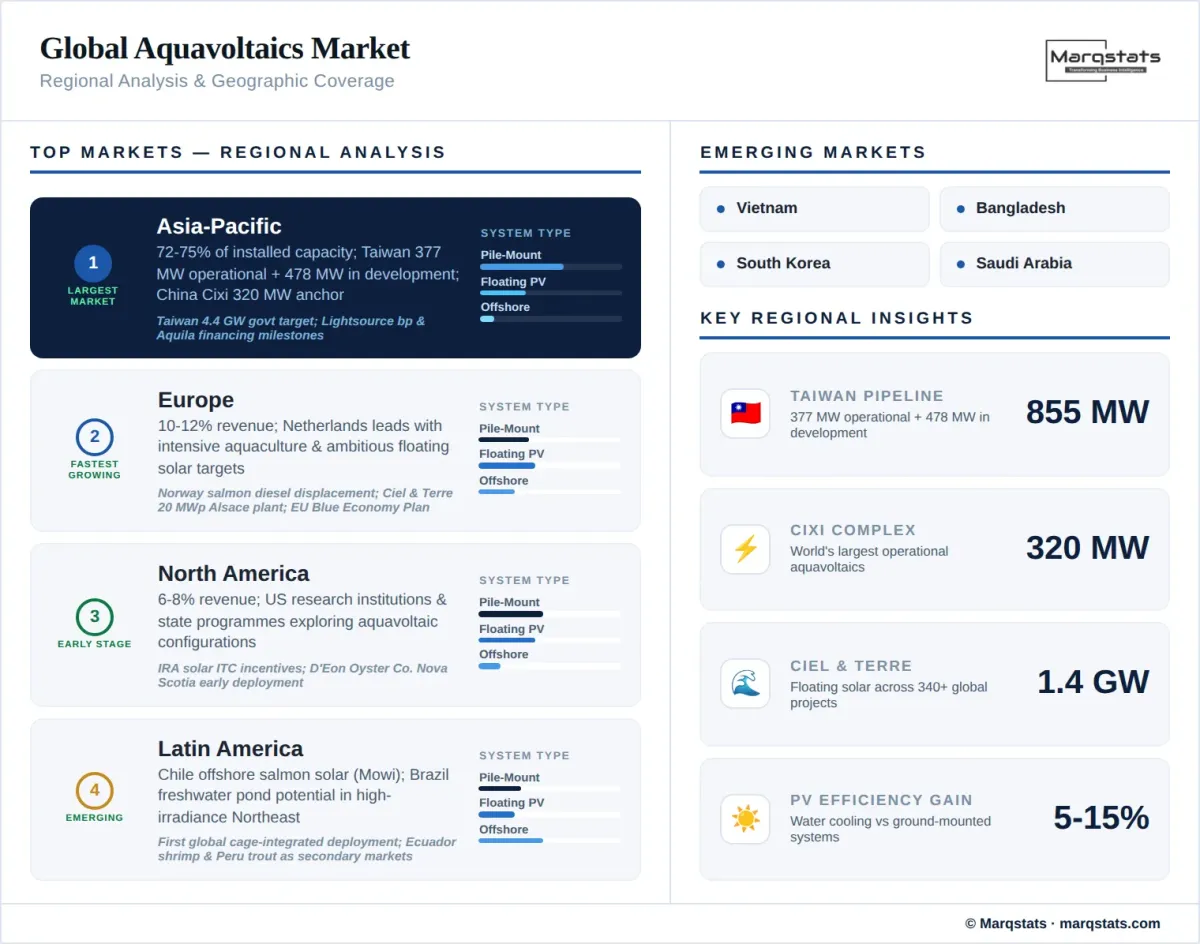
Asia-Pacific dominates the global aquavoltaics market, accounting for an estimated 72–75% of 2025 installed capacity and market revenue. Taiwan is the most commercially sophisticated national market: Global Energy Monitor tracked 377 MW of operational fishery-solar farms and 478.4 MW in active development as of October 2025, with Lightsource bp's 115 MWp Project Budai and Aquila Clean Energy APAC's 26.3 MW portfolio entry both reaching financing milestones in 2025–2026. China represents the largest installed base by capacity, anchored by the Cixi (320 MW, Hangzhou Fengling), Anhui (CGN, 260 MW unsubsidised), and numerous other fishery-solar installations across Zhejiang, Jiangsu, Shandong, and Guangdong provinces. Japan, South Korea, Vietnam, and Bangladesh are secondary markets at earlier adoption stages. A 2026 commentary in The Innovation Energy highlighted the solar PV potential in global coastal aquaculture zones, reinforcing APAC's structural primacy in the market.
Europe
Europe accounts for approximately 10–12% of 2025 market revenue and is the fastest-growing regional market outside Asia-Pacific. The Netherlands, with its extensive intensive aquaculture infrastructure and ambitious offshore wind and solar targets, is the leading European market. Norway is an emerging market driven by salmon farming diesel displacement — the Mowi-AKVA group-Alotta Energy-Fjord Maritime Chile deployment is likely a precursor to similar Norwegian deployments. France, Germany, and the United Kingdom are developing floating solar at scale (Ciel & Terre completed a 20 MWp floating plant in Alsace in January 2025) but pure aquavoltaic deployments remain at pilot and early commercial stage. EU renewable energy policy, the Farm to Fork Strategy's aquaculture sustainability provisions, and the EU's Blue Economy Action Plan collectively provide supportive regulatory tailwinds.
North America
North America represents approximately 6–8% of 2025 market revenue, primarily anchored by the United States where research institutions, state clean-energy programmes, and aquaculture operators in California, Hawaii, the Gulf Coast, and the Pacific Northwest are exploring aquavoltaic configurations. Canada's D'Eon Oyster Co. solar-powered aquaculture system in Nova Scotia represents one of the earliest documented North American deployments. The Inflation Reduction Act's investment tax credit for solar and the USDA's rural energy programme provide meaningful economic incentives for aquaculture-solar co-location. Scale deployments comparable to Taiwan and China have not yet materialised in North America, but the underlying resource base — extensive freshwater pond aquaculture in the Southeast, coastal shellfish operations, and salmon RAS facilities — is substantial.
Latin America
Latin America is emerging as a meaningful market driven by two distinct segments: offshore salmon farming solar integration in Chile, and freshwater pond aquaculture solar in Brazil. Mowi's floating solar-powered fish pen deployment in Chile — the first of its type globally for cage aquaculture — positions Chile as the lead market for offshore marine aquaculture solar in the region. Brazil's shrimp, tilapia, and catfish aquaculture sectors represent a large addressable market for pond-based aquavoltaics, particularly in the Northeast where solar irradiance is among the highest in the world. Ecuador's shrimp industry and Peru's trout and salmon sector are additional emerging markets.
Middle East and Africa
The Middle East and Africa represent nascent but high-potential markets, estimated at 2–3% of 2025 revenue. The GCC countries' aggressive renewable energy targets and growing interest in food security through aquaculture — particularly land-based RAS and coastal marine aquaculture in Saudi Arabia and UAE — create a structural opening for aquavoltaic systems. Bangladesh and India (via coastal brackishwater shrimp and freshwater pond aquaculture) are the primary South Asian markets, with Bangladesh already deploying solar-powered aeration in shrimp farms as a precursor to fuller aquavoltaic integration.
How Competition Is Evolving
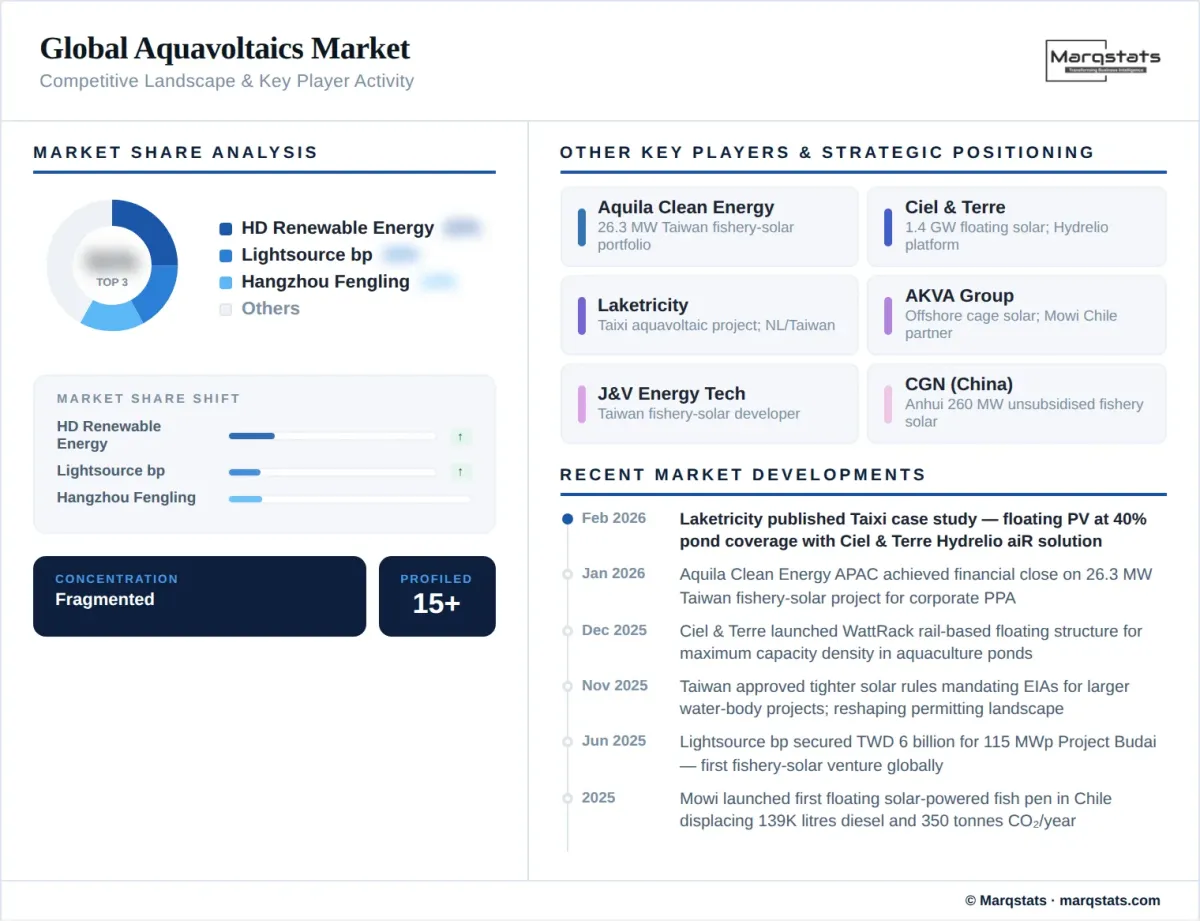
The global aquavoltaics market is a project-developer-led, fragmented market where competitive advantage is determined by permitting capability, fishery management credibility, project finance access, and technology integration — rather than proprietary technology ownership. No single player has achieved global market dominance; instead, there are clear national market leaders in Taiwan and China, emerging international entrants backed by project finance, and a distinct ecosystem of floating PV technology providers and aquaculture integration specialists.
In Taiwan — the deepest commercial market — HD Renewable Energy (HDRE) is the most vertically integrated operator, combining solar project development through its core IPP business with aquaculture operations through its Star Aquaculture arm. The Qigu, Tainan site demonstrates the integration depth that regulators now require: outdoor mullet culture in reservoir ponds, and an indoor white-shrimp facility stocked in 2025 under the solar-sheltered environment, with a stated commitment to traceability and ecological management. Lightsource bp's entry via Project Budai — a 115 MWp plant in Chiayi County financed at TWD 6 billion in June 2025, developed with GreenRock Energy for fishery management and Shihlin Electric as EPC, targeting completion in 2026 — represents the largest single international entrant by deal scale. Aquila Clean Energy APAC, which reached financial close on a 26.3 MW fishery-solar project in January 2026, is building a broader Taiwan solar-fishery portfolio through community partnerships including the Nan Ying Aquaculture Association.
In floating PV technology — which underpins most aquavoltaic pond systems globally — Ciel & Terre (France) is the market's closest equivalent to a global platform leader. Its Hydrelio platform has been installed in 1.4 GW of floating solar projects across 340+ global deployments, and the company launched three new products in the second half of 2025: the Fusio honeycomb racking (October 2025) for robustness and scalability, and the WattRack rail-based structure (December 2025) for maximum capacity density — expanding its coverage of aquavoltaic pond configurations. The Taixi aquavoltaic project in Taiwan, developed by Laketricity using Ciel & Terre's Hydrelio aiR solution, is cited as a reference deployment for floating solar-fishery compatibility. In the offshore cage lane, AKVA group, Alotta Energy, and Fjord Maritime function as a consortium enabling the Mowi Chile deployment — demonstrating early-mover positioning in what may become the most commercially distinctive aquavoltaic sub-segment.
Companies Covered
The report profiles 15+ companies with full strategy and financials analysis, including:
Recent Market Activity
Table of Contents
Coverage & Segmentation
This report provides a comprehensive analysis of the global aquavoltaics market covering the historical period 2021–2025 and the forecast period 2026–2030, with 2025 as the base year. The study examines market size and revenue forecasts in USD billion, segmented by system configuration (pile-mounted fishery solar, floating PV aquaculture systems, offshore and marine cage-integrated solar), aquaculture type (freshwater finfish, shrimp and prawn, marine finfish, shellfish and other), and geography (Asia-Pacific, Europe, North America, Latin America, Middle East and Africa). Scope covers project development and EPC services, floating structure and mounting systems, aquaculture management integration, and O&M services deployed in aquavoltaic configurations. Conventional floating solar on non-aquaculture water bodies (reservoirs, irrigation ponds, waste-water treatment) is excluded from scope unless explicitly deployed in a co-location model with active aquaculture.
Research drew from peer-reviewed aquavoltaics literature including the 2025 global aquavoltaics review published in academic journals covering installed capacity and geographic distribution, technical commentary in The Innovation Energy (2026), Global Energy Monitor's Taiwan fishery solar tracker (October 2025), company press releases and project finance announcements, IEEE Spectrum reporting on Taiwan's aquavoltaic programme, Eco-Business reporting on Taiwan regulatory developments, and vendor product documentation from Ciel & Terre, AKVA group, and Laketricity. The competitive assessment is grounded in verified project milestones, financing events, and publicly disclosed operating data.