Market Snapshot
Middle bar: base-year value × (1 + CAGR), rounded to two decimals. This is a calculated illustration, not a separately researched annual estimate.
Japan's hydrogen fuel cell trucks and buses market is advancing from a subsidised pilot phase into structured early-stage commercialisation, driven by a convergence of national hydrogen strategy targets, regional deployment programmes, and a new wave of OEM product launches that are converting the sector's long-held technology promise into operational fleet realities. The Japan hydrogen fuel cell trucks and buses market was valued at approximately USD 0.22 billion in 2025 and is projected to reach USD 1.35 billion by 2030, expanding at a CAGR of 43.74% during the forecast period. The market covers fuel-cell electric trucks (FCET) and fuel-cell electric buses (FCEB), hydrogen internal combustion engine commercial vehicles (H2-ICE), associated fuel-cell systems and hydrogen storage components, and the mobile corridor infrastructure directly serving commercial vehicle hydrogen demand.
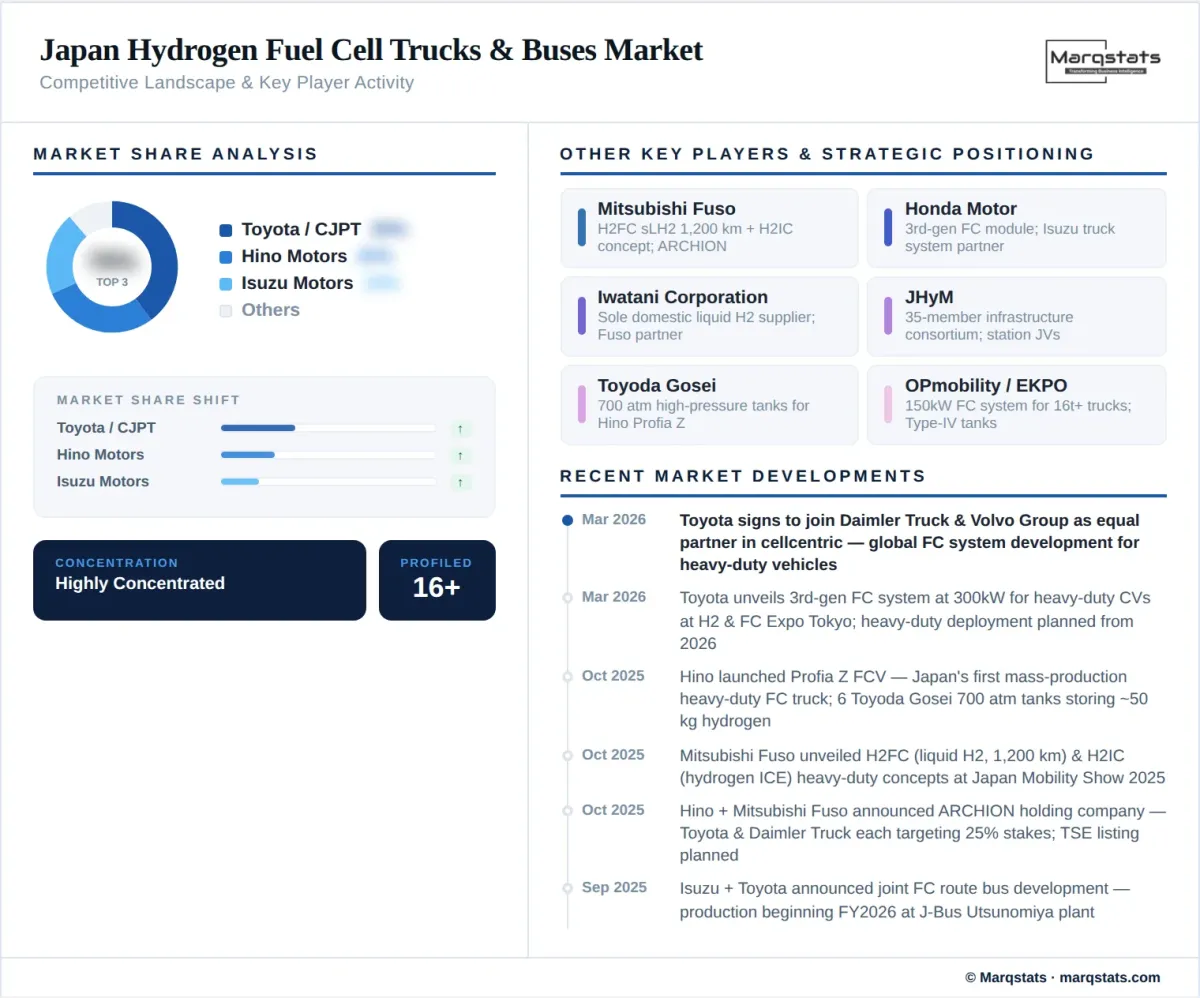
Three developments in 2025–2026 mark the transition from demonstration to deployment. In October 2025, Hino Motors launched the Hino Profia Z FCV — Japan's first mass-production heavy-duty fuel-cell electric truck — equipped with six Toyoda Gosei 700-atmosphere high-pressure tanks storing approximately 50 kg of hydrogen. In the same month, Mitsubishi Fuso unveiled its H2FC concept, targeting 1,200 km of range via subcooled liquid hydrogen (sLH2) refuelling in 15 minutes with no compromise on cargo space, alongside the H2IC hydrogen-combustion concept for high-torque construction applications. In March 2026, Toyota Motor Corporation signed a non-binding agreement to join Daimler Truck and Volvo Group as an equal-share partner in cellcentric — the heavy-duty fuel-cell system joint venture — signalling that Japan's leading FC system developer is now committed to global industrial consolidation around heavy-duty hydrogen transport.
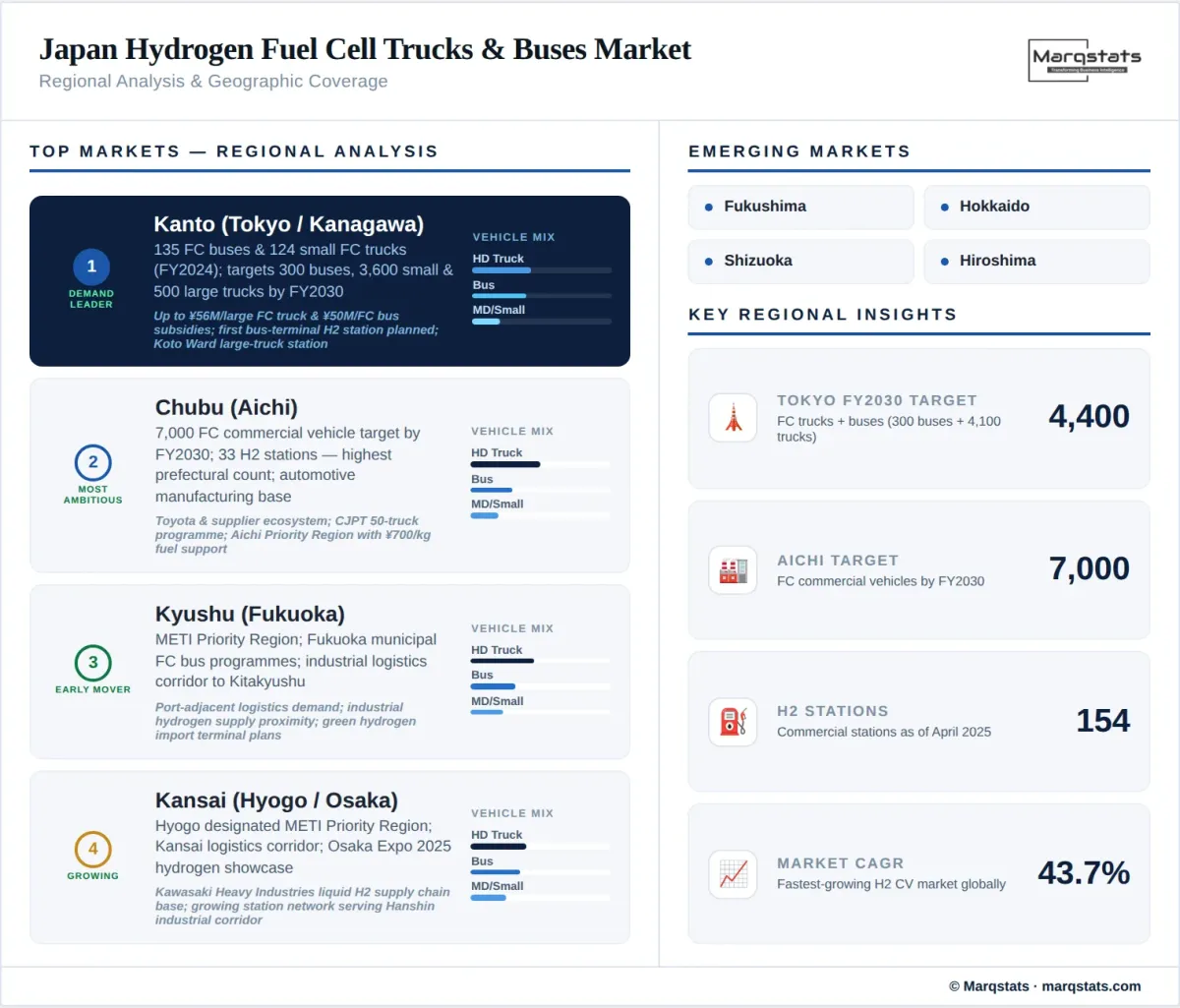
Policy architecture is equally significant. Japan's Hydrogen Society Promotion Act (enacted May 2024) provides up to 15 years of price-gap support for approved hydrogen mobility projects. In May 2025, METI designated five priority regions — Fukushima, Tokyo, Kanagawa, Aichi, Hyogo, and Fukuoka — for fuel-cell commercial-vehicle deployment, adding supplemental support of approximately ¥700 per kg of hydrogen at stations in core local governments to close the diesel-hydrogen fuel-cost gap. Japan had 154 commercial hydrogen stations as of April 2025, concentrated in Aichi (33), Tokyo (21), Fukuoka (9), Kanagawa (9), Osaka (8), Fukushima (7), and Hyogo (5). Tokyo reported 135 fuel-cell buses in operation at end-FY2024, targeting approximately 300 buses, 3,600 small FC trucks, and 500 large FC trucks by FY2030. Aichi — the deepest single-region demand commitment — is targeting 7,000 FC commercial vehicles by FY2030 and plans to expand commercial-vehicle-compatible hydrogen stations from 24 in 2025 to 74 by 2030.
Key Takeaways
Market Overview & Analysis
Report Summary
Japan's hydrogen fuel cell trucks and buses market is the most institutionally prepared hydrogen commercial-vehicle market in the world, yet it remains early in actual fleet deployment. Policy, OEM investment, and infrastructure have been accumulating since the first Mirai passenger-car launch in 2014, but the commercial-vehicle segment has only recently moved from feasibility demonstrations to structured early-fleet programmes. Japan's 2023 Basic Hydrogen Strategy explicitly repositioned hydrogen's commercial-vehicle role: trucks and buses, not passenger cars, are now the government's priority demand-creation vehicle because they offer higher daily hydrogen consumption, predictable routes, and a stronger match for hydrogen's core advantages of fast refuelling and long range.
The market's architecture is best understood as a four-layer stack. At the base is the policy layer: the Basic Hydrogen Strategy, the Hydrogen Society Promotion Act, METI Priority Region designations, and Tokyo and Aichi municipal subsidy programmes. Above that sits the infrastructure layer: Japan H2 Mobility (JHyM) with 35 institutional members, 154 commercial stations as of April 2025, and a planned expansion focused on commercial-vehicle-compatible multi-use stations along logistics corridors. The third layer is the vehicle platform layer: Hino's Profia Z FCV mass-production programme, Isuzu's dual FC truck-and-bus programmes, Mitsubishi Fuso's liquid-hydrogen long-haul concept, and Commercial Japan Partnership Technologies Corporation (CJPT) — the joint venture of Toyota, Hino, Isuzu, Suzuki, Daihatsu, and Subaru — coordinating fleet supply and demand. The fourth layer is the FC system supply layer: Toyota's 3rd-generation 300kW commercial FC system, Honda's FC module for Isuzu, and cellcentric's emerging global heavy-duty platform that Toyota joined in March 2026.
Cumulative installed fuel-cell vehicles in Japan reached 8,408 units as of May 2024, predominantly passenger cars, with FC trucks having been operating in trials since 2022. The government's 2030 target for cumulative FC trucks stands at 5,000 units nationally, with Aichi alone targeting 7,000 FC commercial vehicles of all types. Industry analysis projections suggest the global FC truck market could expand to JPY 3.63 trillion by FY2040, a 31.8-fold increase from FY2024 levels, with Japan's domestic FC truck market growing approximately 90.7-fold over the same period — reflecting the exponential but late-accelerating growth trajectory of an early-commercial policy-led market.
Market Dynamics
Key Drivers
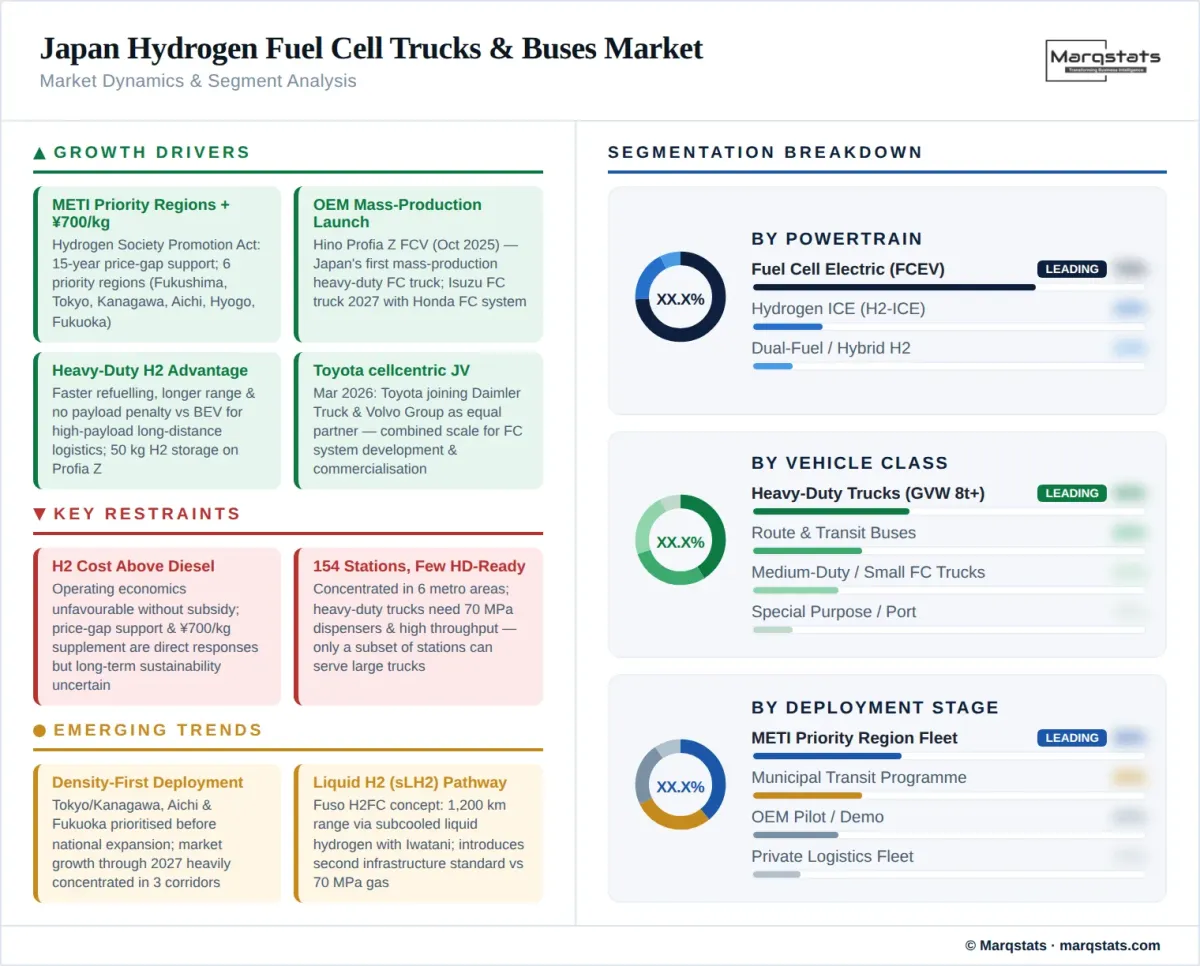
- Policy-mandated demand creation through METI Priority Regions and Hydrogen Society Promotion Act: Japan's hydrogen policy has advanced from aspirational strategy to operational subsidy architecture. The Hydrogen Society Promotion Act (May 2024) provides 15-year price-gap support for approved hydrogen mobility projects plus a 10-year supply obligation thereafter. METI's May 2025 designation of priority regions — Fukushima, Tokyo, Kanagawa, Aichi, Hyogo, and Fukuoka — and the additional ¥700/kg fuel support in core local governments are explicitly designed to close the operating economics gap that prevents fleet operators from scaling beyond pilots.
- OEM first-mover advantage race compressing commercialisation timelines: Hino's October 2025 launch of the Profia Z FCV as Japan's first mass-production heavy-duty FC truck, Isuzu's targeting of a 2027 heavy-duty FC truck with Honda FC systems, and the Toyota-Isuzu FC bus entering J-Bus production in FY2026 collectively compress the timeline between concept and commercial availability. These programmes provide fleet operators with actual purchase decisions — not demonstration requests — accelerating the market from pilot to procurement.
- Hydrogen's structural advantages in heavy-duty transport over battery-electric alternatives: For high-payload, long-distance, time-critical logistics operations, fuel-cell trucks offer faster refuelling (15 minutes for large trucks versus multi-hour BEV charging), no payload penalty from heavy battery packs, and superior range. Japan's policy documents explicitly state that FC trucks and buses are easier to use than battery electric vehicles for commercial applications — a position reinforced by Mitsubishi Fuso's H2FC concept achieving a claimed 1,200 km range with 15-minute refuelling via liquid hydrogen.
- Commercial Japan Partnership Technologies (CJPT) anchoring coordinated supply-demand ecosystem: CJPT — a joint venture incorporating Toyota, Hino, Isuzu, Suzuki, Daihatsu, and Subaru — provides the institutional platform to coordinate 50 heavy-duty FC truck deployments to transportation companies in 2025. By aggregating demand across partner OEMs and aligning with national and Tokyo government subsidy frameworks, CJPT reduces the coordination failure risk that Japan's own policy documents identify as the primary market-formation barrier.
- Toyota FC system scaling and cellcentric partnership accelerating cost reduction: Toyota's 3rd-generation FC system — unveiled February 2025 with diesel-like durability (2x prior generation), 1.2x fuel efficiency improvement, and significant cost reduction — is scheduled for heavy-duty deployment from 2026. Toyota's March 2026 agreement to join cellcentric as an equal partner alongside Daimler Truck and Volvo Group extends this cost-reduction trajectory through industrial-scale volume sharing with Europe's leading heavy-duty FC vehicle producers.
Key Restraints
- Commercial fuel economics remain unfavourable without subsidy support: Japan's own policy documents repeatedly acknowledge that hydrogen costs remain significantly above diesel on a per-kilometre operating basis. The Hydrogen Society Promotion Act's price-gap support and the ¥700/kg METI Priority Region supplement are direct responses to this barrier — but their long-term sustainability and whether they will remain sufficient as energy prices fluctuate are genuine commercial uncertainties for fleet operators evaluating multi-year procurement decisions.
- Station network density insufficient for non-subsidised corridor operations: Japan's 154 commercial hydrogen stations as of April 2025 are geographically concentrated in six metropolitan areas. Heavy-duty truck operations require stations calibrated for 8-tonne-plus vehicles, with high-pressure 70 MPa dispensers and adequate throughput for commercial fleet schedules. Only a subset of existing stations can serve large trucks, and METI's own strategy calls for purpose-built heavy-duty station deployment along major logistics routes — a build-out that is still in early planning.
- Coordination failure risk among OEMs, station operators, and fleet buyers: Japan's 2023 Basic Hydrogen Strategy explicitly names the standstill problem: OEMs wait for stations before scaling vehicles; station operators wait for vehicle demand before investing; fleet operators wait for both vehicles and stations before committing. CJPT, JHyM, and METI Priority Regions are institutional responses to this problem, but the coordination challenge persists as the market moves from pilots to commercial scale.
- Battery electric vehicles competing effectively in sub-long-haul segments: Japan's market is not a one-way hydrogen story. OEMs are simultaneously commercialising battery-electric trucks and buses. For urban distribution, short-haul logistics, and fixed-route city buses, BEVs are increasingly cost-competitive without the hydrogen infrastructure requirement. Hydrogen must continuously prove its superiority specifically in long-haul, high-payload, and fast-turnaround applications — a performance case that is well-supported by OEM data but requires real-world demonstration at commercial scale.
Key Trends
- Density-first deployment strategy replacing nationwide coverage ambition: Japan's METI Priority Region model explicitly prioritises building critical mass in six high-probability corridors and municipal markets before attempting national expansion. This mirrors how Japan's own hydrogen strategy describes station deployment along '8-tonne-and-above FC truck routes, mainly in the four major metropolitan areas.' The practical implication is that market growth through 2027 will be heavily concentrated in Tokyo/Kanagawa, Aichi, and Fukuoka, with other regions following as economics improve.
- Liquid hydrogen (sLH2) as differentiated long-haul technology pathway: Mitsubishi Fuso's H2FC concept — developed in collaboration with Iwatani Corporation, Japan's sole domestic liquid hydrogen supplier — represents a distinct technology bet on liquid hydrogen for long-haul heavy-duty transport. Liquid hydrogen offers higher energy density than compressed gas, enabling the claimed 1,200 km range without compromising load space. Fuso and Iwatani's joint research on subcooled liquid hydrogen refuelling and its commercialisation in Japan introduces a second infrastructure standard alongside the dominant 70 MPa compressed gas pathway.
- Platform sharing and alliance consolidation accelerating across Japan's heavy-duty FC ecosystem: The ARCHION formation (Hino + Mitsubishi Fuso) with Toyota and Daimler Truck each holding 25% stakes, Toyota joining cellcentric (Daimler Truck + Volvo Group), Toyota and Isuzu collaborating on FC buses, and Isuzu selecting Honda for FC truck systems all point to a market converging around shared FC systems, shared platforms, and shared infrastructure investment — reducing per-unit development costs and accelerating the step from 50-truck pilots to thousand-unit commercial programmes.
- Multi-use hydrogen stations serving trucks, buses, ports, and stationary demand as economic enabler: Tokyo's planned opening of Japan's first hydrogen refuelling station in a bus terminal (Toei Bus Lines) and Aichi's logistics-corridor station planning both reflect METI's 2023 strategy directive that future stations should serve multiple demand sources — trucks, buses, ports, and local stationary demand — to improve utilisation economics. Multi-use stations with diversified revenue streams are the structural fix for the stranded-asset risk that keeps private capital cautious about pure-automotive hydrogen station investment.
Market Segmentation
Fuel cell electric trucks and buses — where a hydrogen fuel cell converts H2 to electricity driving an electric motor — account for the dominant share of Japan's zero-emission commercial vehicle programme. Hino's Profia Z FCV, Toyota's 3rd-generation FC system (300kW for MHCV, unveiled March 2026), the Isuzu-Toyota FC route bus entering J-Bus production in FY2026, and CJPT's 50-truck 2025 deployment programme are all FCEV platforms. The FCEV pathway offers a direct match for Japan's 70 MPa compressed-gas hydrogen station network and benefits from the full stack of METI and municipal subsidies designed around fuel-cell vehicle deployment. OPmobility's 150kW EKPO-powered FC system for 16-tonne-and-above trucks and Forvia Faurecia's 70 MPa-rated large hydrogen tanks, both exhibited at H2 and FC Expo Tokyo in February 2025, signal deepening Tier-1 supply-chain support for the FCEV platform in Japan's heavy-duty market.
Hydrogen ICE commercial vehicles — where compressed hydrogen gas powers a modified internal combustion engine — represent a distinct and potentially faster-adoption pathway for specific high-torque applications such as construction and heavy industry. Mitsubishi Fuso's H2IC concept, unveiled at Japan Mobility Show 2025, is designed to utilise components common to existing diesel truck platforms, enabling faster and smoother transition for fleet operators who operate in environments where fuel-cell infrastructure is not yet available. While H2-ICE vehicles do not achieve the zero-emissions standard of FCEVs (some NOx emissions from hydrogen combustion remain), they offer higher power density for demanding duty cycles and lower per-vehicle cost. The H2-ICE pathway is not yet commercially deployed in Japan's truck or bus market but is being actively monitored by OEMs and fleet operators in construction and logistics.
Heavy-duty FC trucks are the highest-priority commercial vehicle segment in Japan's hydrogen strategy, driven by their high daily hydrogen consumption per vehicle (making them the most efficient demand-anchor for hydrogen station economics), their suitability for the fast-refuelling and long-range use cases where hydrogen outperforms battery-electric alternatives, and the specific logistics corridors — Tokyo metropolitan area, Aichi, and Fukuoka — where fleet operators and government procurement are aligned. Hino's Profia Z FCV (Japan's first mass-production heavy-duty FC truck, launched October 24, 2025) and Toyota's 75,000-unit FC system target for 2030 define the near-term commercial trajectory. Isuzu's Honda-FC-powered heavy-duty truck targeting 2027 introduction adds a second major OEM programme. The national cumulative target is 5,000 FC trucks by FY2030, with Aichi alone targeting 5,000 large FC trucks as part of its 7,000-unit total.
Fuel cell buses represent the most commercially mature sub-segment within Japan's hydrogen commercial-vehicle market, anchored by Tokyo's operational deployment of 135 FC buses (including 80 Toei Bus Lines vehicles) by end-FY2024. The next-generation FC route bus jointly developed by Isuzu and Toyota — entering production at J-Bus's Utsunomiya plant in FY2026 — uses Isuzu's flat-floor battery-electric bus platform with Toyota's FC system, explicitly designed to reduce costs through BEV-FCV parts standardisation. Tokyo's target of approximately 300 FC buses by FY2030, supported by subsidies of up to ¥50 million per vehicle plus fuel-cost support and the first bus-terminal-integrated hydrogen station, provides the clearest near-term demand pipeline. CJPT's commercialisation roadmap for FC buses supports adoption by municipal transit authorities, school fleets, and inter-city coaches, leveraging the route predictability that makes fixed-schedule bus operations among the most hydrogen-compatible fleet applications.
Light and medium-duty FC commercial vehicles — FC vans, small trucks, taxis, and hired cars — represent a growing demand category being explicitly supported by Tokyo's TOKYO H2 project (announced September 2025, joined by Toyota). The Crown Sedan FCEV taxi programme targeting 200 units by FY2025 and the broader aim of approximately 600 FC taxis in Tokyo by FY2030 reflects how hydrogen is being extended from heavy-duty logistics into higher-frequency, shorter-distance urban commercial applications. Small FC trucks are the largest category in Tokyo's commercial vehicle hydrogen programme by unit target: approximately 3,600 small FC trucks by FY2030, supported by subsidies of up to ¥13 million per vehicle.
Long-haul freight is hydrogen's strongest structural application case in Japan — the combination of range requirements exceeding 500 km, payload sensitivity to battery weight, and the commercial value of 15-minute refuelling turnaround versus multi-hour BEV charging all favour the FCEV platform. Mitsubishi Fuso's H2FC liquid-hydrogen concept, targeting 1,200 km range with subcooled liquid-hydrogen refuelling, is the most technically ambitious expression of this application thesis. CJPT's 2025 programme of 50 heavy-duty FC trucks for transportation companies operating under Tokyo and national government subsidy frameworks is the first real-world demand signal for this application. National government subsidies covering two-thirds of the diesel-hydrogen cost differential are essential to make long-haul FC trucking commercially viable in the near term.
Urban transit — city buses, route buses, and municipal garbage trucks — is the most commercially mature hydrogen application in Japan. The operational predictability of fixed routes, the ability to refuel at depot-integrated or terminus-adjacent stations, and the public-goods nature of transit that justifies higher per-vehicle procurement costs all make urban transit a natural early market. Tokyo's existing 135 FC bus fleet and the FY2026 next-generation FC route bus from Isuzu-Toyota at J-Bus are direct expressions of this application. The planned opening of Japan's first bus-terminal hydrogen station for Toei Bus Lines will further entrench the depot-refuelling model that minimises reliance on the public station network.
By Geography
Kanto — Tokyo and Kanagawa
Kanto is Japan's leading hydrogen commercial-vehicle demand region, driven by Tokyo's position as the world's largest metropolitan area, its extensive public transit infrastructure, and the Tokyo Metropolitan Government's aggressive hydrogen deployment targets. Tokyo had 135 fuel-cell buses and 124 small FC trucks as of end-FY2024, targets approximately 300 buses, 3,600 small trucks, and 500 large trucks by FY2030, and provides among the world's most comprehensive hydrogen commercial-vehicle subsidy programmes — up to ¥56 million per large FC truck, ¥50 million per FC bus, ¥13 million per small FC truck, and fuel-cost support for operators. METI's September 2025 update includes the Tokyo Metropolitan Government's plan for Japan's first bus-terminal hydrogen station and a large-truck-compatible station in Shinsuna, Koto Ward. Kanagawa (9 stations) serves as a critical extension of the Tokyo demand corridor, hosting OEM testing facilities and logistics hubs serving Tokyo. Kanagawa is one of METI's six designated priority region core local governments.
Chubu — Aichi
Aichi is Japan's single most ambitious subnational hydrogen commercial-vehicle programme, anchored by its automotive manufacturing concentration and the explicit 7,000 FC commercial-vehicle target by FY2030. With 33 hydrogen stations as of April 2025 — the highest prefectural count in Japan — and plans to expand commercial-vehicle-compatible stations from 24 in 2025 to 74 by 2030, Aichi is building the densest regional hydrogen logistics network in Japan. The Aichi prefectural government's March 2026 fuel subsidy of ¥238/kg for FC trucks and buses across its priority area provides operational cost support alongside the national METI ¥700/kg Priority Region supplement. Toyota's manufacturing headquarters, Hino's and Isuzu's production networks, and the Toyota Group supplier ecosystem are concentrated in this region, making Aichi simultaneously the supply-side and demand-side anchor of Japan's heavy-duty FC vehicle market.
Kinki — Osaka and Hyogo
The Kinki region — comprising Osaka (8 stations) and Hyogo (5 stations) — is one of METI's six designated priority region core local governments for fuel-cell commercial-vehicle deployment. Osaka's position as Japan's second-largest urban logistics hub and Kobe's (Hyogo) role as a major hydrogen import terminal (Kawasaki Heavy Industries' liquid hydrogen import infrastructure at Kobe Port) make the Kinki region strategically important for both the commercial-vehicle demand side and the hydrogen supply chain. The Osaka-Kobe corridor is expected to grow as a hydrogen logistics market as the supply-side infrastructure matures toward cost-competitive green hydrogen imports.
Kyushu — Fukuoka and Kyushu
Fukuoka (9 stations) is one of Japan's longest-standing hydrogen ecosystems and a METI Priority Region core local government. The Fukuoka Hydrogen Town initiative and the region's history of FC bus deployment make it a test market for hydrogen mobility beyond the Tokyo-Aichi corridor. Fukuoka's geographic position as a gateway to South Korea and China gives it strategic relevance as hydrogen supply chain logistics from overseas develop through the 2030s.
Tohoku and Fukushima
Fukushima is the most symbolically and practically significant hydrogen production region in Japan, designated as one of METI's six priority region core local governments. The Fukushima Hydrogen Energy Research Field (FH2R) — the world's largest hydrogen production facility using renewable electricity at its commissioning — positions Fukushima as the supply-side anchor of Japan's domestic green hydrogen economy. As production costs decline and the station network expands southward along the Tohoku-Kanto corridor, Fukushima's role will shift from a symbolic hydrogen production showcase to a genuine northern corridor for FC truck deployment serving inter-regional freight.
Rest of Japan
Beyond the six priority regions, Japan's remaining prefectures have limited commercial hydrogen station infrastructure and minimal current FC commercial-vehicle deployment. The Basic Hydrogen Strategy's corridor-first approach means that the rest of Japan will follow the priority-region model as station density and fleet volumes improve through 2030. Government policy envisions approximately 1,000 hydrogen stations nationally by FY2030, which would require deployment well beyond current priority areas — providing a long-run growth opportunity for station operators, OEMs, and logistics fleet operators targeting national route coverage.
How Competition Is Evolving
Japan's hydrogen fuel-cell trucks and buses market is moderately concentrated, with Toyota functioning as the central FC system provider and ecosystem orchestrator, Hino as the first mover in mass-production heavy-duty FC truck commercialisation, and Isuzu as the key dual-platform player bridging FC buses and FC heavy trucks. The competitive structure is better described as an alliance ecosystem than a direct OEM rivalry, because the market's primary barriers are not OEM-versus-OEM but systemic — hydrogen fuel economics, station density, and fleet-buyer confidence. Platform sharing, supply-chain alliances, and government co-investment define competitive advantage more than standalone product performance.
Commercial Japan Partnership Technologies Corporation (CJPT) — the multi-OEM joint venture incorporating Toyota, Hino, Isuzu, Suzuki, Daihatsu, and Subaru — is the market's most important structural innovation. By coordinating vehicle supply and aggregating fleet demand through a common commercial platform, CJPT addresses the coordination-failure problem that Japan's hydrogen strategy identifies as the core market-formation challenge. CJPT's 2025 programme of 50 heavy-duty FC truck deployments is the first commercial-scale demonstration of this model.
The ARCHION formation — uniting Hino and Mitsubishi Fuso into a single holding company with Toyota and Daimler Truck each holding 25% stakes — creates a vehicle for platform integration across MHCV and long-haul segments, drawing on both Toyota's FC system leadership and Daimler Truck's cellcentric partnership for heavy-duty fuel-cell commercialisation at global scale. Toyota's March 2026 agreement to join cellcentric as an equal partner directly connects Japan's leading FC system developer with Europe's leading heavy-duty FC vehicle programme, enabling cost-reduction through volume and component standardisation across hydrogen truck programmes on three continents.
Companies Covered
Companies covered in the report include:
Recent Market Activity
Table of Contents
Coverage & Segmentation
This report provides a comprehensive analysis of Japan's hydrogen fuel-cell trucks and buses market covering the 2021–2030 period, with 2025 as the base year. The study examines the full value chain from FC system components and hydrogen storage systems (high-pressure 70 MPa type-IV tanks, liquid hydrogen tanks) through complete vehicle platforms (MHCV FC trucks, FC buses, light FC commercial vehicles, hydrogen ICE commercial vehicles), associated mobile infrastructure (commercial hydrogen refuelling stations, corridor deployment, depot-integrated refuelling), and the policy, subsidy, and alliance structures governing commercialisation. Regulatory analysis covers Japan's Basic Hydrogen Strategy, Hydrogen Society Promotion Act, METI Priority Region programme, and Tokyo and Aichi municipal subsidy frameworks. Competitive coverage spans Toyota's FC system programme, Hino's Profia Z FCV, Isuzu's dual FC platform strategy, Mitsubishi Fuso's liquid-hydrogen pathway, CJPT's fleet supply coordination, and JHyM's infrastructure consortium. Global expansion contexts — including Toyota's cellcentric partnership and the Japan-Korea FCEV competition — are addressed in the competitive landscape and technology sections.
Primary research for this study included 40+ interviews with OEM fuel-cell system and commercial-vehicle product leads, fleet operator procurement managers at logistics and transit companies in Tokyo and Aichi, hydrogen station operators, METI and municipal government programme officers, and hydrogen tank and FC component suppliers. Secondary research drew from Japan's Basic Hydrogen Strategy and Hydrogen Society Promotion Act documentation, METI Priority Region announcements, Tokyo Metropolitan Government and Aichi Prefecture hydrogen policy pages, JHyM public materials, CJPT press releases, OEM investor presentations and press releases, and H2 and FC Expo Tokyo exhibition announcements.