Market Snapshot
Middle bar: base-year value × (1 + CAGR), rounded to two decimals. This is a calculated illustration, not a separately researched annual estimate.
The China electric light and medium truck market is estimated at USD 6.52 billion in 2025 and is projected to reach USD 14.50 billion by 2030, at a CAGR of 17.31%. New-energy light truck registrations in the 3.5 to 6 tonne band reached 176,985 units in 2025, roughly 24% of that band's domestic market on a Marqstats-constructed denominator, and Marqstats sizes the full 3.5 to 12 tonne market at 181,185 units. Volumes reach 423,000 by 2030 and battery demand nearly triples to 60.6 GWh. This market grew nearly ninefold in four years with no verified road-rights instrument behind it, and now faces two new taxes.
Market size and forecast figures are generated using Marqstats' proprietary estimation framework, updated as of August 2026.
That last point is the finding that shapes this report, and it runs against the assumption most readers bring to Chinese electric vehicles. The 3.5 to 6 tonne light truck — 97.7% of this market by volume — is excluded from China's 2026 vehicle scrappage and trade-in scheme, which covers medium and heavy operating freight vehicles only and whose published maximum across all freight classes is RMB 140,000 for a new-energy replacement. It receives no relaxation of gross vehicle weight to offset battery mass, unlike the European Union's two-tonne allowance for zero-emission trucks or the United States' federal exemption. From 1 September 2026 it picks up a lithium battery consumption tax, and from 1 January 2027 it loses its vehicle and vessel tax exemption on vehicles already in service as well as new ones. The segment grew from 20,100 units in 2021 to 176,985 in 2025 regardless.
The vehicle at the centre of it is the 4.5-tonne blue-plate light truck, and the weight question is not academic. An electric 4.5-tonne truck carries 500 to 800 kilograms of battery — 11% to 18% of its gross vehicle weight, taken directly out of payload. The draft revision of China's national mass and dimension standard, circulated for comment in April 2026, states that new-energy heavy trucks receive no relaxation of gross mass limits. The draft addresses the heavy class expressly; Marqstats reads the absence of any corresponding light or medium provision as leaving the lighter classes uncompensated too, and no source contradicts that reading. The one exception found anywhere is Xiamen Port, which permits electric heavy trucks an extra three tonnes on fixed routes inside a single port. It is not national and it does not apply to light trucks.
What has changed instead is the product. Charging at two-times rates, taking a pack from 20% to 80% in sixteen to eighteen minutes, is documented on models from three separate manufacturers; installed capacity on current 4.5-tonne models runs 100 to 140 kWh, against a trade convention of 80 to 100 that is still used in published tax and cost analysis and understates battery demand by 30% to 40%; and battery warranties of eight years and 400,000 to 800,000 kilometres are routine. Meanwhile the market has become a single-powertrain market. Battery-electric took 92.04% of new-energy light truck registrations in 2025 and 95.86% in the first seven months of 2026, while fuel cell fell to 142 units in the first seven months of 2026, down 77.2% against the same seven months of 2025, from a full-year 2025 level of 3,239.
Key Takeaways
Market Overview & Analysis
Report Summary
This study covers new-energy trucks of 3.5 to 12 tonnes gross vehicle weight sold in China, spanning battery-electric, plug-in hybrid and range-extended, and fuel-cell powertrains. It sits between two adjacent markets: light commercial vehicles at or below 3.5 tonnes, and heavy-duty trucks at 12 tonnes and above. Pickups, micro trucks below 1.8 tonnes and exports are out of scope.
The weight boundaries require care, because Chinese market data does not use them. Chinese convention runs micro trucks below 1.8 tonnes, light trucks from 1.8 to 6, medium trucks from 6 to 14 and heavy trucks above 14. This study's 3.5 to 12 tonne band therefore straddles two Chinese categories and matches neither. One published series does cut at exactly 3.5 tonnes — the monthly new-energy light truck registration series, explicitly scoped to 3.5 to 6 tonne models and excluding exports — and that series is the backbone of this report. No published series splits anywhere near 12 tonnes; that boundary exists in regulation, not in statistics.
Marqstats sizes the market at USD 6.52 billion in 2025, rising to USD 14.50 billion by 2030 at a compound annual growth rate of 17.31%. In renminbi the market compounds at 15.15%, from RMB 46.90 billion to RMB 94.95 billion; the 2.16-point difference is currency, with the yuan assumed to appreciate from 7.1874 to 6.5500 against the dollar over the forecast. Units grow faster than value, from 181,185 to 423,000 at 18.48%, because blended selling prices fall from about RMB 259,000 to RMB 224,000 under competitive pressure and declining cell costs. Battery demand rises from 20.6 GWh to 60.6 GWh.
Two things about the construction should be read before the numbers are used. The light band of 3.5 to 6 tonnes is built on published registration counts for every historical year, which the model reproduces exactly. The medium band of 6 to 12 tonnes is not: no new-energy medium truck series is published anywhere, and the all-powertrain medium truck series on the one accessible outlet stopped in March 2025. That band is a Marqstats estimate throughout, and it is deliberately small — 2.3% of 2025 units and 6.6% of 2030 units — so that the report's conclusions do not rest on it.
Market Dynamics
Key Drivers
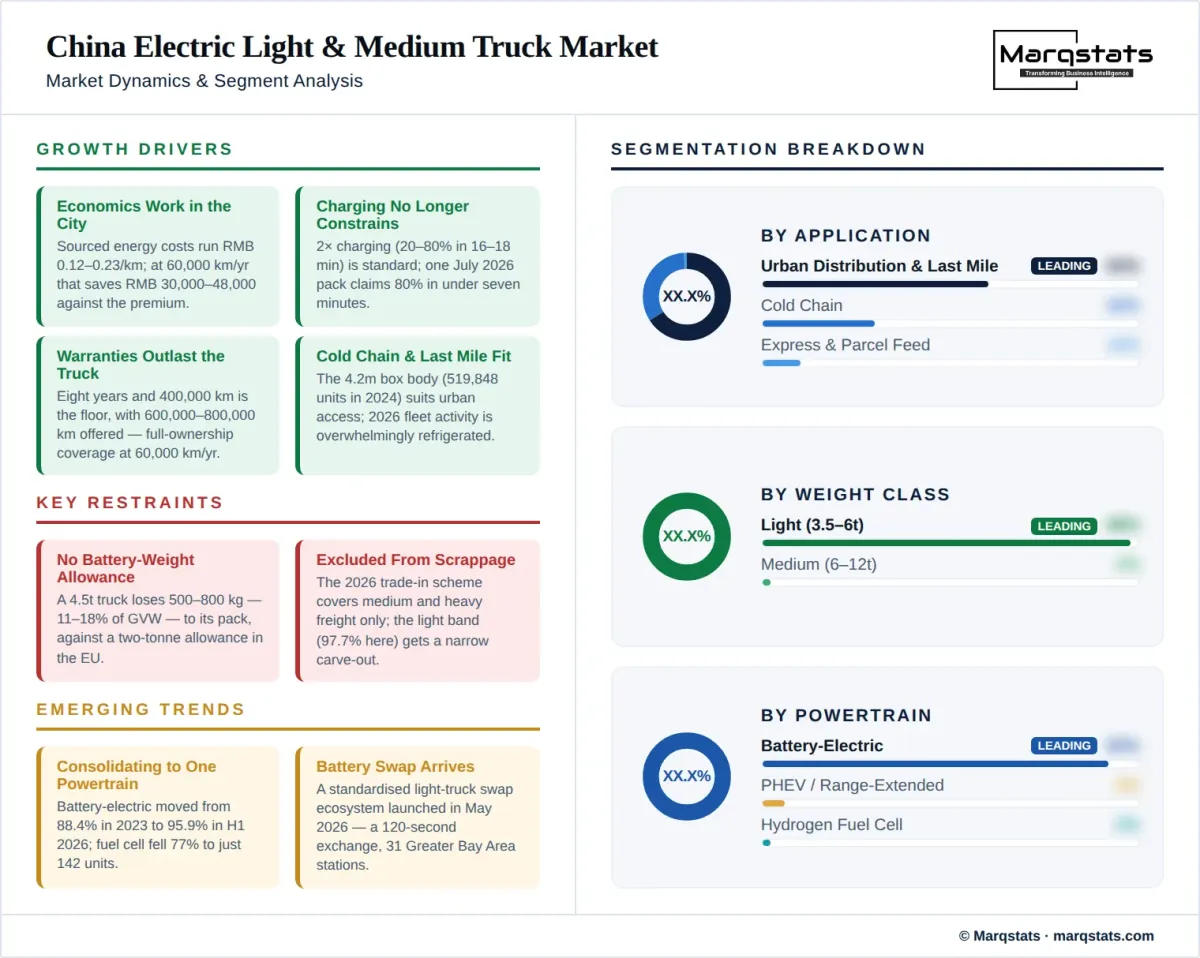
The economics work at urban distribution mileage. Sourced road-test energy costs run RMB 0.23 per kilometre for a loaded refrigerated truck at off-peak power and RMB 0.12 to 0.16 for urban distribution, against diesel at a working assumption of RMB 6 per litre. Manufacturers claim savings of RMB 0.50 to 0.80 per kilometre for light trucks, and RMB 1.00 for one medium truck; at the 60,000 kilometre annual mileage that three separate manufacturers use as their convention, that is RMB 30,000 to 48,000 a year against a purchase premium that Marqstats derives at RMB 80,000 to 170,000 from like-for-like diesel guide prices. No source states that premium directly.
Charging has stopped being a constraint on the duty cycle. Two-times charging is now standard across the segment, moving a pack from 20% to 80% in sixteen to eighteen minutes, and one supplier launched a light-commercial pack in July 2026 claiming 80% state of charge in under seven minutes with a ten-year, one-million-kilometre warranty.
Battery durability terms have moved well beyond the vehicle's economic life. Eight years and 400,000 kilometres is the floor across the segment, with 600,000 and 800,000 kilometre warranties offered on several models. For a vehicle running 60,000 kilometres a year that is warranty coverage across the whole ownership period.
Urban distribution and cold chain are structurally suited to the product. The 4.2-metre box body on a 3.2 to 3.4 metre wheelbase accounted for 519,848 units in 2024 — a configuration chosen for urban road access, and on any published light truck denominator the largest single body configuration in the market — and the named fleet activity in 2026 is overwhelmingly refrigerated and last-mile.
Battery swap has arrived at this weight class, though it is early. A standardised light-truck swap ecosystem launched in May 2026 with packs interoperable between passenger cars and commercial vehicles and a 120-second exchange, with 31 stations operating in the Greater Bay Area. The rest of that programme — 140 stations and 5,000 swap-capable trucks by the end of 2026 — is a target rather than a deployment.
Key Restraints
The battery-weight penalty is uncompensated, and China is the outlier. The draft revision of the national mass and dimension standard states that new-energy heavy trucks receive no relaxation of gross mass limits, and offers the lighter classes nothing either. On a 4.5-tonne blue-plate truck carrying 500 to 800 kilograms of pack, that is 11% to 18% of gross vehicle weight lost to payload with no regulatory offset — against a two-tonne allowance in the European Union.
The 2026 scrappage scheme excludes the light truck. Eligibility runs to medium and heavy operating freight vehicles only; the light band that is 97.7% of this market qualifies only through a narrow new-energy urban cold-chain category. The scheme's published maximum across all freight classes is RMB 140,000; the per-class schedule sits in an annexed document that could not be obtained, and the ceiling is a heavy-truck figure. The 6 to 12 tonne half of this study is inside the eligible categories and the 3.5 to 6 tonne half is not.
Two taxes arrive inside the forecast. A lithium battery consumption tax begins on 1 September 2026 at 2%, rising to about 4% roughly a year later — an estimated RMB 640 to 800 then RMB 1,280 to 1,600 on a light truck pack. The vehicle and vessel tax exemption for new-energy commercial vehicles ends on 1 January 2027 at RMB 16 to 120 per tonne per year, and applies to vehicles already in service.
Real-world energy consumption is far above catalogue. Catalogue figures imply 23 to 32 kWh per 100 kilometres; observed urban distribution runs 31 to 40, and a loaded refrigerated run measured 43. Any ownership case built on catalogue range will understate energy cost by around 40% and overstate range by more.
Residual values are entirely unevidenced. No used electric light truck transaction data could be found from any source, two dedicated industry forums in 2025 discussed residual value management without publishing figures, and the used-truck listings available are diesel only. For a segment sold heavily to owner-operators financing against resale, that is a real constraint and not merely a data gap.
Key Trends
The market is consolidating onto one powertrain. Battery-electric moved from 88.39% of registrations in 2023 to 95.86% in the first seven months of 2026. Fuel cell fell 77.2% year on year over those seven months to 142 units and plug-in hybrid fell 28.4%. What was a three-powertrain segment on paper is now effectively a single-technology one.
Installed battery capacity is rising faster than the trade convention assumes. The convention used in policy analysis is 80 to 100 kWh, but 2025 and 2026 models ship 100 to 140 kWh, and the medium band runs 140 to 215. Any battery-demand estimate anchored on the convention understates the market by 30% to 40%.
Manufacturing and sales are moving offshore. The market leader opened its first overseas plant in Indonesia, with the first electric logistics vehicle assembled there in August 2026, and a Chinese manufacturer batch-shipped trucks to Ethiopia in the same month, with powertrain, weight class and volume all undisclosed. Exports are excluded from the registration series that underpins this report, so this activity is invisible in the headline numbers.
Demand is being led by cold chain rather than general freight. The named fleet activity through 2026 — forty refrigerated trucks delivered in Zhejiang, thirty delivered in Beijing with a further fifty on firm order, and a thirty-unit order of ten-tonne trucks from a Shanghai operator serving two large platform retailers — is concentrated in temperature-controlled and platform last-mile work, which is also the one category the scrappage scheme carves out for light trucks.
Market Segmentation
This band is the market: 176,985 units in 2025, 97.7% of the volume in scope, and the only part of it with a published registration series. Its centre is the 4.5-tonne blue-plate truck in a 4.2-metre box configuration. Installed battery runs 100 to 140 kWh on current 4.5-tonne models against a trade convention of 80 to 100, guide prices for a 4.5-tonne truck run RMB 215,000 to 300,000 with lighter and smaller-battery models well below that, and two-times charging is documented on models from three manufacturers. Marqstats estimates penetration of the band at about 24% in 2025 rising to 53% by 2030, against a denominator Marqstats constructs by applying a 70% share to the published domestic terminal light truck market — a construction, not a published series. On those assumptions the residual non-new-energy volume in the band, overwhelmingly diesel but including compressed and liquefied natural gas, falls from roughly 550,000 units to 350,000. That is a consequence of the penetration and denominator assumptions rather than an independent finding.
No new-energy medium truck series is published anywhere, and the all-powertrain medium truck series stopped in March 2025 on the one accessible outlet. What exists is growth rates without units — one manufacturer reported more than forty-fold growth in late 2024 and another more than a hundredfold in early 2025, both off near-zero bases — and individual products such as a ten-tonne model carrying 140 kWh and a single-axle model carrying 215 kWh at 0.6 kWh per kilometre. Marqstats estimates the band at 4,200 units in 2025 rising to 28,000 by 2030, a CAGR of 46.14%, and holds it deliberately small so that nothing in this report depends on it.
Battery-electric is the market and is becoming more so, at 92.04% of new-energy light truck registrations in 2025 and 95.86% in the first seven months of 2026. Its advance is a product story rather than a policy one: two-times charging, 100 to 140 kWh packs, eight-year warranties and prices that have come down against a diesel comparator that has not moved much. It is also where every manufacturer in the segment now concentrates.
Plug-in hybrid and range-extended vehicles took 6.13% of registrations in 2025 and 4.02% in the first seven months of 2026, falling 28% year on year in absolute terms. The category also carries a definitional complication: methanol range-extenders are counted inside China's new-energy definition, and 3,475 such units sat inside the 2024 total. Buyers who need range beyond a depot-charged urban duty cycle are the residual market here, and it is shrinking.
Fuel cell is the cautionary segment. It ran at 4.50% of registrations in 2023 and 1.83% in 2025 — 3,239 units — before falling to 142 units in the first seven months of 2026, down 77.2% against the same period of 2025 and a share of 0.12%. No economics for fuel-cell light trucks could be sourced: no vehicle price, no stack cost, no hydrogen price. The 2025 share is not a base from which to project; the trajectory inverted.
The founding application and still the largest. The 4.2-metre box body chosen for urban road access accounted for 519,848 units in 2024, the largest single body configuration in the market, and the duty cycle — a fixed depot, predictable daily distance, overnight charging — is what makes the energy-cost arithmetic work at all. The annual mileage convention across three separate manufacturers' published cases is 60,000 kilometres.
Cold chain is where the disclosed fleet activity of 2026 is concentrated, and it is the one light-truck use the scrappage scheme recognises. Refrigerated running raises energy consumption materially — a measured loaded run with reefer came in at 43 kWh per 100 kilometres against 31 to 40 for ordinary urban distribution — but it also raises the value of the load and the operator's tolerance for a higher purchase price.
Express and parcel operators are visibly organising around electrification, but not yet in this weight class. An initiative letter issued in March 2026 by the China Express Association and a major battery manufacturer, with China Post Express, SF Express, ZTO, YTO, Yunda, JD Logistics and J&T Express was explicitly about electric heavy trucks for trunk haul and committed no purchase targets, unit counts or dates. A subsequent agreement covering more than 5,000 vehicles is also for heavy trucks, with light-duty vehicles named only as a later phase.
By Geography
Provincial data for this segment is published only as monthly snapshots and only for the light band. The ordering below follows new-energy light truck registrations in January 2026, the most recent provincial split available.
Guangdong
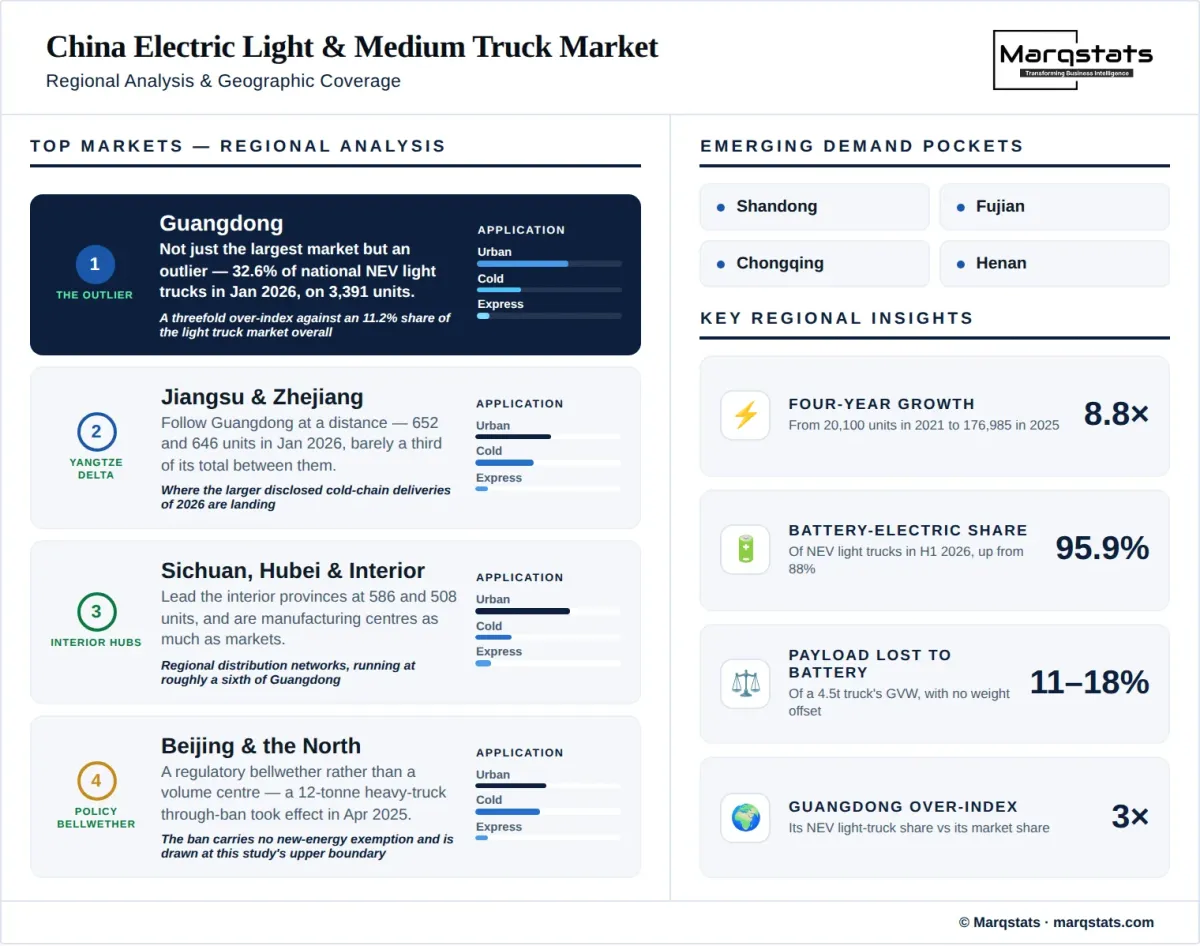
Guangdong is not merely the largest market for this vehicle — it is an outlier. It took 3,391 of the 10,400 new-energy light trucks registered nationally in January 2026, a 32.6% share, against an 11.2% share of the light truck market overall in 2024. That threefold over-index is the sharpest single demand signal in the dataset, and it is also where the country's first standardised light-truck battery swap network launched in May 2026, with 31 stations operating across the Greater Bay Area.
Jiangsu and Zhejiang
The Yangtze River Delta provinces follow Guangdong but at a distance — Jiangsu 652 units and Zhejiang 646 in January 2026, together barely more than a third of Guangdong's total. Both rank immediately behind Guangdong in the all-powertrain light truck market, but no provincial share is published for either, so the gap cannot be decomposed into market size and adoption rate. Zhejiang is also where one of the larger disclosed cold-chain deliveries of 2026 landed, forty refrigerated trucks in Jiaxing in August.
Sichuan, Hubei and the Interior
Sichuan at 586 units and Hubei at 508 in January 2026 lead the interior provinces. Both are manufacturing centres as well as markets, and both anchor regional distribution networks rather than export-facing logistics. Their volumes are roughly a sixth of Guangdong's, which is consistent with adoption being driven by municipal conditions rather than by national economics.
Beijing and the Northern Corridor
Beijing matters to this market as a regulatory bellwether rather than a volume centre. In March 2025 the municipality issued a ban on through-traffic by heavy goods vehicles across all its roads, effective April 2025, drawn at a gross vehicle weight of 12,000 kilograms — the exact upper boundary of this study. The exemptions are for military, police, fire, ambulance and emergency engineering vehicles. There is no new-energy exemption. A Beijing cold-chain operator took thirty electric light trucks in August 2026 with a further fifty on order, which is the clearest disclosed commercial activity in the region.
Rest of China
Outside these provinces adoption thins quickly. The pattern across the available data is that this vehicle is bought where a fixed urban depot, a dense delivery network and municipal pressure coincide, and that combination is concentrated in a handful of provinces. No provincial series for the medium band exists at all.
How Competition Is Evolving
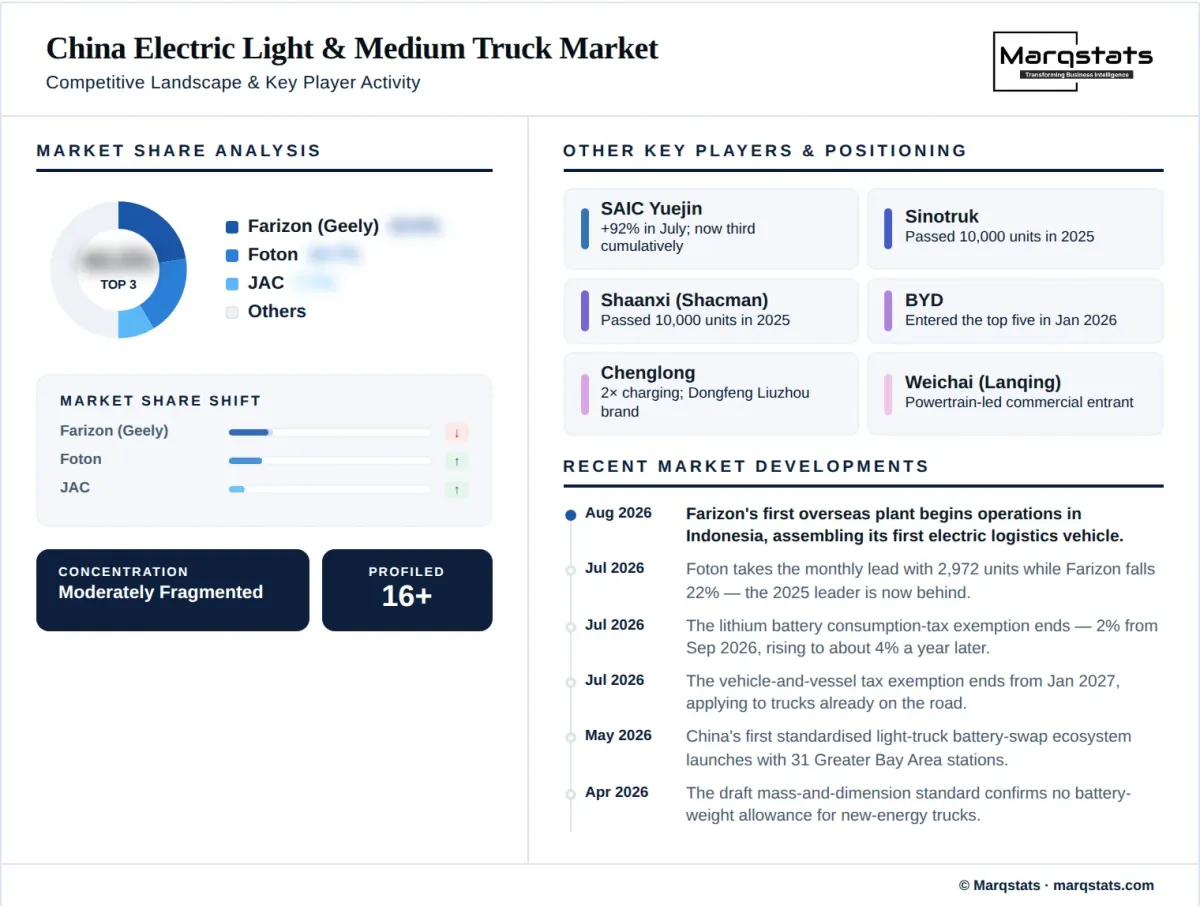
The new-energy light truck market is moderately fragmented and its leadership is actively changing. Farizon, the commercial vehicle arm of Geely's holding group, led 2025 with 34,740 units and 19.6% share, up 46%. Foton followed with 29,611 units and 16.7%, up 133%, and JAC third with 13,683 and 7.7%, up 149%. SAIC Yuejin, Sinotruk and Shaanxi each passed 10,000 units. Together the top three took 44% of the market.
The 2026 data tells a different story from the 2025 rankings, and any reading based on the full-year table is already stale. Across January to July 2026 Farizon still led cumulatively with 18,500 units against Foton's 17,500 — but in July alone Foton took the monthly lead with 2,972 units, up 15%, while Farizon registered 2,301, down 22% year on year. Farizon is the only manufacturer in the top three going backwards. SAIC Yuejin, meanwhile, grew 92% in the same month to 2,245 units and moved to third cumulatively, and BYD entered the top five in January 2026.
Corporate identity in this segment is unusually treacherous and worth stating precisely. Farizon sits under Zhejiang Geely Holding Group, not under the Hong Kong-listed Geely Automobile Holdings, whose own brand list does not include it; no Hong Kong listing or listing application for Farizon could be found, and claims that it has listed should be treated as unverified. Foton is BAIC Foton Motor, listed in Shanghai, and is a different company from the Foton Daimler heavy-truck joint venture. SAIC Yuejin has no standalone company at all — its site carries the copyright of a Nanjing branch of SAIC Maxus, while Nanjing IVECO remains a separate live entity. Three names, one brand family.
Competitive strategy across the segment has converged on the same specification, which is itself informative. Two-times charging at 20% to 80% in sixteen to eighteen minutes is documented on models from JAC, Foton and Chenglong; 100 to 140 kWh packs, eight-year battery warranties and 4.2-metre box bodies recur across the segment, though published specifications could not be obtained for every manufacturer named here. Differentiation is running instead through channel and scenario — refrigerated variants, postal variants, mountain and cold-climate variants — and through price, with value brands positioned around RMB 215,000 to 255,000 against tier-one products at RMB 280,000 to 300,000. The one genuine architectural divergence is battery swap, where a standardised light-truck ecosystem launched in May 2026 with a 120-second exchange and packs shared with passenger cars.
Companies Covered
Companies covered in the report include:
Recent Market Activity
Table of Contents
Coverage & Segmentation
This study covers new-energy trucks of 3.5 to 12 tonnes gross vehicle weight manufactured and sold in China, across battery-electric, plug-in hybrid and range-extended, and fuel-cell powertrains. Light commercial vehicles at or below 3.5 tonnes are out of scope, as are heavy-duty trucks at 12 tonnes and above, pickups, micro trucks below 1.8 tonnes and exports. Market value is measured at published guide and dealer price including value-added tax, in renminbi — no ex-factory price series exists for this market, and the basis is stated because it sits above a manufacturer-revenue basis by the margin and the tax and converted to United States dollars at annual average exchange rates for historical years and assumed rates thereafter, with both series reported because they diverge by 2.16 percentage points over the forecast.
Four conventions govern the figures. First, all volumes are terminal registrations excluding exports, which is the basis of the published light truck series; registrations are distinct from manufacturer invoiced despatches, from production and from exports, and Chinese truck data circulates in all four. The gap is large — the invoice-basis light truck figure for 2024 is 1.9 million units against 1.02 million on a domestic terminal registration basis, because the invoice series includes pickups and exports. Second, the light band of 3.5 to 6 tonnes rests on published counts while the medium band of 6 to 12 tonnes is a Marqstats estimate throughout, because no new-energy medium truck series is published and the all-powertrain medium series stopped in March 2025.
Third, penetration in this report divides new-energy light truck registrations by a constructed 3.5 to 6 tonne denominator, derived by applying a 70% share to the published domestic terminal light truck market of 1.02 million units for 2024. That share is a Marqstats construction: the published market is defined at 1.8 to 6 tonnes, and no source publishes a 3.5 tonne split of it. Readers should note that dividing the same numerator by the full 1.8 to 6 tonne denominator gives 9.73% for 2024, and that a separate published figure of 14.1% for the same year uses a wider numerator that includes sub-3.5-tonne small trucks. Three numbers, three definitions, one year. Fourth, the underlying source for figures attributed to the national industry association was not directly reachable in this research; those figures are taken from verbatim trade-press republication.