Statistics & Highlights

Market Snapshot

Market size in USD Billion
$2.15B
2025
Base year
$2.67B
2026
Estimated
  
$6.35B
2030
Forecast
Largest market
Europe — France (Only Market with Legal Framework + Direct Subsidy)
Fastest growing
India (ARAI AIS-123, Urban Air Quality Policy, Large LCV Installed Base)
Dominant segment
Full BEV Retrofit (ICE-to-BEV, ~70–75% Revenue Share)
Concentration
Fragmented — Pre-Competitive; No Dominant Global Player
CAGR
24.18%
2026 – 2030
GROWTH
+$4.20B
Absolute
STUDY PARAMETERS
Base year2025
Historical period2021 – 2025
Forecast period2026 – 2030
Units consideredValue (USD BN)
REPORT COVERAGE
Segments covered6 segments
Regions covered7 regions
Companies profiled13+
Report pages270+
DeliverablesPDF, Excel, PPT
Executive Summary

Key Takeaways

Market valued at USD 2.15 billion in 2025, projected to reach USD 6.35 billion by 2030 at 24.18% CAGR — the electric LCV retrofit market is growing against a global LCV installed base of approximately 250–300 million combustion vans and light trucks, with retrofit economics strongest where specialist bodies, refrigeration units, or vocational fit-outs make full vehicle replacement financially irrational and low-emission zone compliance deadlines create unavoidable operational pressure.
Stellantis Pro One + Qinomic OEM-backed retrofit programme (April 2025) is the market's most important industrialisation signal — sourcing 200+ electric components directly from Stellantis's supply chain and recovering combustion parts into the SUSTAINera circular-economy system, the programme elevates electric LCV retrofit from bespoke engineering into an OEM-quality, warranty-compliant, multi-model conversion offering for mid-size Stellantis vans in France, establishing the commercial template for OEM-partnered retrofit at scale.
France leads the global van EV retrofit market as the only jurisdiction with both a broad legal framework (since 4 April 2020) and direct financial subsidies — company retrofit support of 40% up to €4,000–€8,000 per vehicle depending on class, combined with low-emission zone (ZFE) compliance pressure in Paris, Lyon, and other major cities, makes France the world's most commercially mature electric van retrofit market and the primary reference market for regulatory frameworks developing in the UK, India, and North America.
Low-emission zone and ULEZ compliance is the most powerful near-term demand catalyst for the zero emission van conversion market in the UK and Europe — London's Ultra Low Emission Zone, Paris's Zone à Faibles Émissions, and 30+ European city LEZs create operating access restrictions that force fleet operators to electrify or replace diesel vans, with retrofit offering a faster and lower-capital path to compliance than full fleet replacement when vans already carry expensive bodies or operate on urban distribution cycles well within retrofit battery range.
India is the electric LCV retrofit market's fastest-growing country — ARAI's AIS-123 type-approval framework for electric vehicle retrofit, the Delhi government's fleet electrification policies, and a large installed base of CNG and diesel three-wheeler and LCV cargo fleets are driving rapid growth in the Indian electric vehicle retrofit market, with domestic startups including Sirius Cleantech, Exponent Energy, and others building retrofit kit manufacturing and certified installation networks.
The automotive EV retrofit powertrain market is valued at USD 4.62 billion globally in 2024 at a 13.4% CAGR (all vehicle classes) — with the electric van conversion kit market specifically at USD 860 million in 2024 at an 8.9% CAGR through 2034 — indicating that while retrofit is growing across all vehicle types, the LCV segment's growth rate is substantially above the broader automotive retrofit average due to fleet-specific commercial economics, LEZ pressure, and OEM programme launches.
Market Insights

Market Overview & Analysis

Report Summary

The global electric LCV retrofit & conversion market is best understood as a homologation and systems-integration industry rather than a simple aftermarket kit market. This distinction is commercially critical: a van retrofit involves removing the combustion engine, fuel system, exhaust, and associated thermal management from a registered, in-service vehicle and replacing them with a battery pack, electric motor, inverter, battery management system, and charging system — while preserving the vehicle's original body approval, maintaining GVWR within legal limits, and obtaining a revised type approval or national certification that allows the retrofitted vehicle to operate legally on public roads. This certification requirement — under France's homologation framework, the UK's Zemo CVRAS scheme, India's ARAI AIS-123 standard, California's CARB Category X process, or the emerging EU harmonisation framework — is both the primary technical barrier to entry for kit manufacturers and the primary source of competitive moat for certified conversion companies with established homologation relationships.

The market operates through three commercial models. The OEM-partnered retrofit model — typified by Stellantis Pro One/Qinomic and Renault/Phoenix Mobility — involves the original vehicle manufacturer providing original electric components and homologation support, with a specialist conversion partner handling installation and certification. This model delivers the highest conversion quality, best warranty coverage, and strongest fleet-operator confidence, but is currently limited to specific vehicle-brand and model combinations. The independent retrofit specialist model — typified by BEDEO (UK/France) and Dangel (France) — operates across multiple base-vehicle platforms using third-party powertrain kits, building proprietary vehicle-specific conversion interfaces and homologation dossiers for each model they support. This model offers broader platform coverage but requires sustained investment in vehicle-specific engineering and certification. The kit manufacturer distribution model — where companies like EV West (US), E-Trofit, and component kit suppliers sell conversion hardware directly to certified workshops — distributes installation across accredited installer networks, scaling market access without requiring vertical integration into installation operations.

The electric van conversion kit market is the most commercially transparent sub-segment, valued at USD 860 million in 2024 at an 8.9% CAGR through 2034. The 100 kW power class accounts for approximately 48% of kit market revenue, reflecting the dominance of mid-size delivery and service van platforms (Renault Master, Fiat Ducato, Mercedes Sprinter equivalent classes) where 100 kW motors provide adequate urban and peri-urban driving performance within acceptable weight and packaging constraints. The LCV-specific retrofit market sits within the broader automotive EV retrofit powertrain market, which independent assessments value at approximately USD 4.62 billion in 2024 at a 13.4% CAGR, confirming that LCV retrofit — while growing faster in proportional terms — is currently a smaller absolute market than passenger-car retrofit in weight-adjusted value terms.

Market Dynamics

Key Drivers

  • Low-emission zone and urban access restrictions creating non-negotiable fleet electrification pressure: London's Ultra Low Emission Zone, Paris's Zone à Faibles Émissions Mobilité (ZFE-m), and 30+ European city LEZs create hard legal deadlines for diesel fleet electrification that cannot be resolved through voluntary green procurement — they are operating-access restrictions. For fleet operators whose diesel vans are approaching ULEZ or ZFE non-compliance thresholds but already carry expensive refrigeration, shelving, or specialist bodies, retrofit electrification is the lowest-total-cost path to compliance. The low-emission zone van retrofit market UK is directly catalysed by London ULEZ's expansion in August 2023 to cover all 33 London boroughs, and the ZEV mandate's requirement for 22% of van manufacturers' sales to be zero-emission in 2024, creating a multi-layer compliance incentive structure that makes ICE-to-EV van conversion commercially compelling for urban delivery and service fleets.
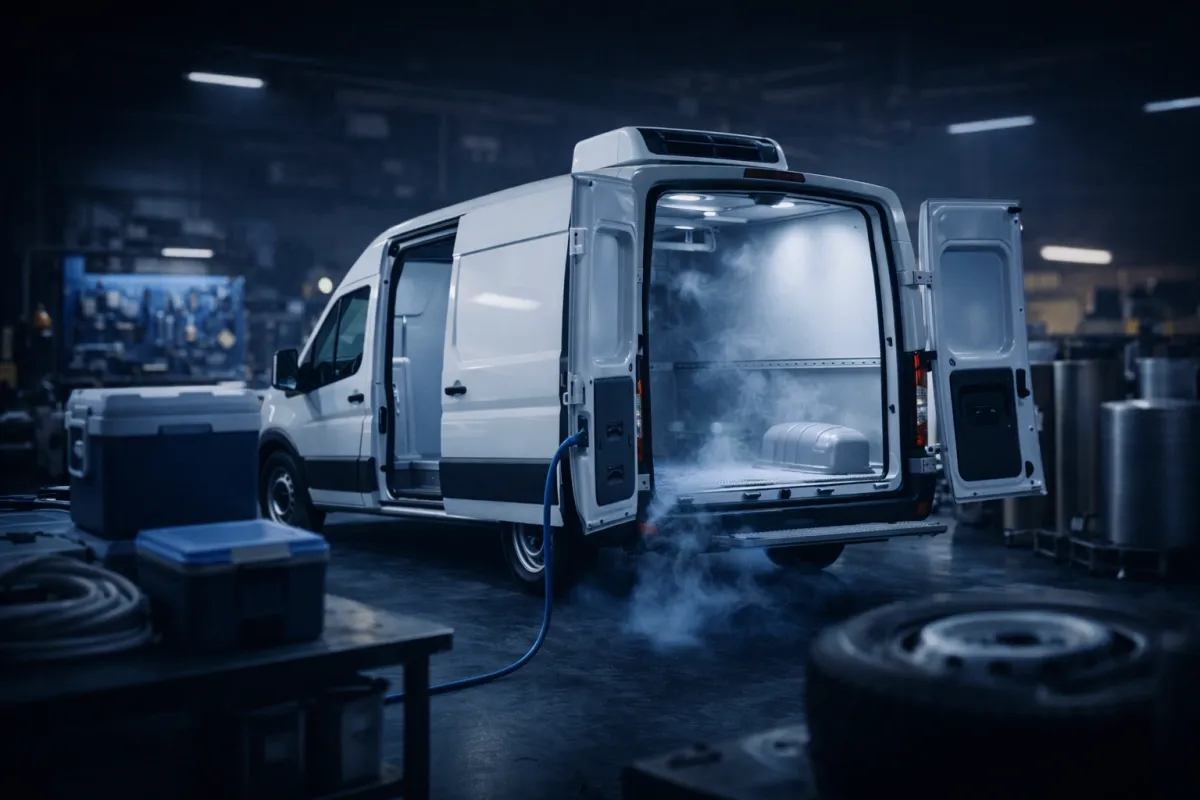
  • Sunk fit-out investment making full-vehicle replacement economically irrational for specialist vocational fleets: The electric LCV retrofit market's strongest commercial driver is the economics of specialist bodies and vocational equipment. A refrigerated delivery van fleet with €15,000–25,000 of insulation, refrigeration compressor, and cold-chain equipment per vehicle cannot justify scrapping the van solely to acquire an electric base vehicle, when a €30,000 retrofit can convert the existing vehicle to electric while preserving the body investment intact. BEDEO's strategic positioning — explicitly targeting fleets with costly add-ons such as refrigerated units that make full replacement economically unattractive — defines the economic logic that applies equally to shelving-van fleets, tipper operators, and specialist service-body operators across Europe and India.
  • France's legal framework and direct financial subsidies creating the world's first mass-market van retrofit ecosystem: France's legal authorisation of electric retrofit since 4 April 2020, combined with company retrofit subsidies of 40% of acquisition cost up to €8,000 for eligible vans, has created the conditions for the van EV retrofit market Europe's most commercially advanced national ecosystem. Stellantis's April 2025 launch of Qinomic retrofit for Fiat Scudo/Opel Vivaro/Peugeot Expert/Citroën Jumpy in France first — and Renault/Phoenix Mobility's Renault Master retrofit programme at the Flins circular-economy plant — both reflect that France is the only European market currently offering the policy certainty that justifies industrial-scale retrofit programme investment.
  • India's ARAI AIS-123 framework and fleet electrification policy creating fast-growth retrofit demand: India's Automotive Research Association of India (ARAI) has established AIS-123 as the technical standard governing electric vehicle retrofit, providing a type-approval pathway for conversion systems. Delhi's fleet electrification policies, the National Electric Mobility Mission Plan's commercial vehicle targets, and the large installed base of CNG and diesel three-wheel and light commercial cargo vehicles collectively create a structurally large addressable market for the electric vehicle retrofit market India. Independent assessments suggest India could represent the largest addressable market for LCV retrofit globally by installed base in the medium term, and domestic startups including Sirius Cleantech and Exponent Energy are building the certified workshop networks and vehicle-specific kit homologation that the Indian electric LCV retrofit market requires.
  • OEM circular-economy and decarbonisation commitments accelerating industrialisation of retrofit programmes: Stellantis's involvement in electric LCV retrofit through its Qinomic partnership is directly driven by its Dare Forward 2030 decarbonisation strategy and circular-economy commitments through SUSTAINera. The Stellantis-Qinomic model — sourcing electric components from Stellantis's supply chain, recovering combustion parts for remanufacturing, and delivering OEM-backed warranty and quality standards — creates a virtuous OEM incentive where retrofit simultaneously extends vehicle asset life, provides component demand for Stellantis's EV supply chain, and reduces scope-3 fleet emissions without requiring the fleet operator to purchase a new vehicle. Renault's parallel partnership with Phoenix Mobility for Renault Master retrofit at the Flins Re-Factory reinforces the pattern of OEM circular-economy strategy as a structural demand driver for fleet electrification retrofit solutions.

Key Restraints

  • Complex, fragmented national homologation and type-approval frameworks creating regulatory friction: The electric LCV retrofit market's most significant structural barrier is the absence of a unified international homologation framework. France's system requires UTAC certification. The UK Zemo CVRAS scheme covers vans but a dedicated zero-emission retrofit accreditation framework is still under study. India's AIS-123 requires ARAI type approval for each conversion system. California's CARB requires either an EPA certificate or CARB Category X EV conversion approval. This national-level fragmentation means that a conversion kit validated for one market cannot be commercially sold in another without separate certification investment — multiplying costs for kit manufacturers and restricting the addressable market of each certified product to the specific jurisdiction where its homologation was obtained.
  • Retrofit economics constrained by kit cost, conversion labour, and range-payload trade-offs: BEDEO's entry-level kit for large vans at approximately €30,000, combined with installation labour, homologation fees, and downtime costs, results in total retrofit costs often in the range of €35,000–€50,000 per vehicle. This compares with the purchase price of factory-new electric vans from Renault, Stellantis, Ford, and others that — with government purchase subsidies — can often be acquired for similar or lower total cost of ownership when fleet financing and residual values are considered. The ICE to EV van conversion cost market is therefore acutely sensitive to the pricing of new electric vans: every improvement in e-LCV supply, competitive pricing, and purchase incentive reduces the retrofit addressable market for standard-spec vehicles and concentrates retrofit demand among the specialist-body and high-fit-out segments where new-build logic does not apply.
  • Purpose-built new electric vans improving rapidly, compressing the retrofit addressable market for standard use cases: Renault's Flexis joint venture received letters of intent for 15,000 new electric vans from 10 European transport and distribution companies in January 2025. Stellantis's factory Cargo Box BEV with 18.3 m³ and 110 kWh battery entered production at Atessa. Ford E-Transit, Mercedes eSprinter, and VW e-Crafter are all commercially available. The van electrification market is therefore bifurcating: retrofit is gaining the specialist-body, sunk-investment cases, while factory new-build EV wins the standard-spec fleet-renewal cases. This structural competition from improving new-build supply is the primary long-run constraint on the retrofit market's growth ceiling.

Key Trends

  • Modular platform-agnostic retrofit powertrain kits emerging as the market's primary scalability architecture: Early electric LCV retrofit was vehicle-specific engineering — each conversion was tailored to a single van model's specific floor plan, subframe, battery enclosure location, and electrical architecture. The market's 2025 direction is toward modular retrofit EV powertrain platforms designed to be adapted across multiple base-vehicle models with model-specific interface brackets and software calibration rather than full re-engineering. This approach — which BEDEO's Reborn Electric range and Qinomic's modular kit architecture both reflect — dramatically reduces the per-vehicle engineering cost and time-to-market for new model coverage, enabling retrofit kit manufacturers to expand platform compatibility faster and at lower unit cost.
  • Certified workshop networks becoming the critical distribution and installation infrastructure: The electric van retrofit certified workshop market in Europe is emerging as the market's primary commercial infrastructure challenge and investment opportunity. Unlike commercial van shelving upfit, which can be performed by any mechanical workshop, EV retrofit requires high-voltage safety training, homologation-compliant installation procedures, and manufacturer-certified technician accreditation — creating a structured certified installer channel that kit manufacturers and OEM programme operators must build and maintain. Stellantis's Qinomic programme is building its certified partner network alongside its French market launch, and Zemo's CVRAS accreditation scheme in the UK provides the framework for a certified LCV retrofit workshop network to develop alongside ZEV mandate compliance demand.
  • Second life commercial van electrification converging with circular-economy supply-chain strategy: Stellantis's explicit framing of electric retrofit as circular economy — recovering combustion engines, fuel systems, and exhaust components for remanufacturing through SUSTAINera while installing Stellantis-sourced EV components — introduces a second-life commercial van electrification narrative that extends beyond regulatory compliance toward corporate sustainability. This circular-economy positioning is increasingly aligned with corporate ESG commitments from fleet operators who use fleet carbon footprint reduction as both a regulatory compliance tool and a supply-chain sustainability credential with major retail and logistics clients. The second-life commercial van electrification segment is therefore gaining traction within corporate fleet decarbonisation programmes that previously prioritised new-vehicle EV procurement.
  • India and emerging-market retrofit growing faster than Europe on volume, driven by three-wheeler and small LCV base: While Europe currently leads in commercial-value terms, India's sheer volume of CNG and diesel three-wheelers and small light commercial vehicles — combined with urban air quality mandates, the AIS-123 regulatory framework, and a growing domestic EV retrofit startup ecosystem — positions India for the fastest growth rate in the global electric vehicle retrofit market India through 2030. India EV retrofit commercial vehicle policy, driven by MoRTH guidelines and the FAME programme's focus on commercial vehicle electrification, is accelerating certified workshop deployment in Tier-1 and Tier-2 Indian cities.
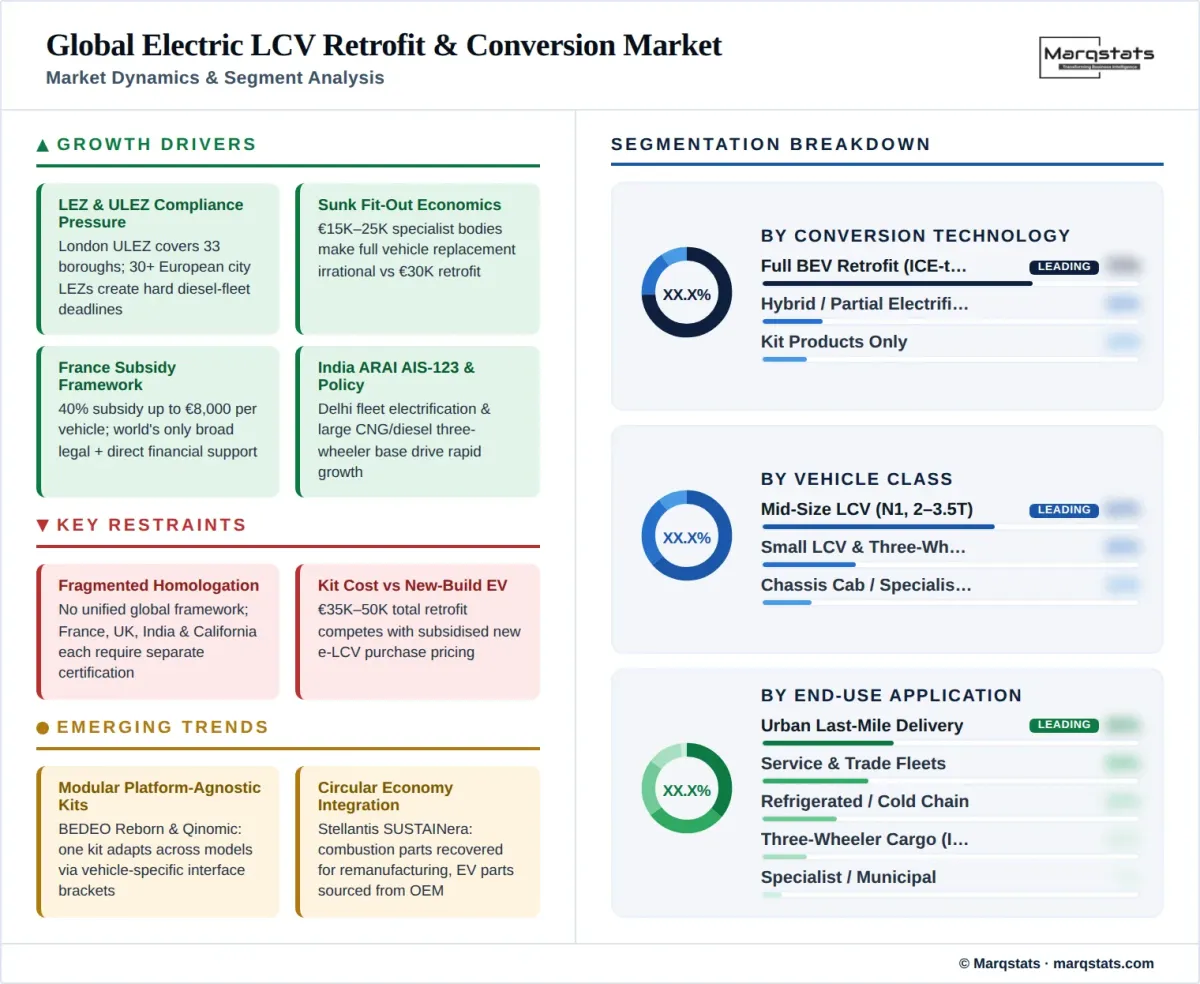
Global Electric LCV Retrofit Conversion Market Dynamics Segment Analysis Infographic
Segment Analysis

Market Segmentation

Full Battery-Electric Retrofit (ICE-to-BEV)
Leading

Full battery-electric retrofit — complete removal of the combustion engine and drivetrain, replacement with a battery pack, electric motor, inverter, battery management system (BMS), and AC charging system — is the dominant segment of the global electric LCV retrofit market by revenue, representing approximately 70–75% of total conversion value. This is the technology deployed by Stellantis/Qinomic (Fiat Scudo, Opel Vivaro, Peugeot Expert, Citroën Jumpy in France), BEDEO (large van conversions for urban delivery), and the Renault/Phoenix Mobility Master retrofit programme. Full BEV retrofit delivers zero tailpipe emissions at the point of use, satisfying LEZ and ULEZ compliance requirements, ZEV mandate obligations, and urban logistics decarbonisation commitments. Battery range for commercially available ICE-to-BEV van retrofits currently ranges from approximately 100 km to 200 km depending on battery capacity and vehicle weight, which is adequate for the urban distribution, city last-mile delivery, and intra-urban service cycles that represent the primary retrofit addressable fleet segments.

Hybrid and Partial-Electrification Retrofit

The hybrid van conversion market — adding an electric motor, battery, and regenerative braking system to an existing combustion van without full drivetrain replacement — serves fleets that require longer range than current BEV retrofit batteries provide, operate in areas without depot-charging infrastructure, or have vocational power requirements (hydraulic systems, refrigeration) that benefit from combined combustion-plus-electric auxiliary power. Dangel's Reborn Electric range under the DANGEL, powered by BEDEO brand explicitly includes hybrid-electric options for large diesel vans where full BEV conversion would impose unacceptable range or payload constraints. The hybrid retrofit segment is growing more slowly than full BEV retrofit but serves an important transitional fleet segment where operational requirements prevent immediate full electrification.

Electric Van Conversion Kit Products (Component Level)

The electric van conversion kit market — covering the sale of packaged conversion hardware (motor, inverter, battery modules, BMS, charging connector, and vehicle-specific interface brackets) to certified conversion workshops, fleet maintenance facilities, or direct fleet operators — is the most commoditised and price-competitive segment of the electric LCV retrofit value chain. The 100 kW power class accounts for approximately 48% of kit revenue, serving mid-size LCV conversion requirements for Renault Master, Fiat Ducato, and Mercedes Sprinter-class vehicles. Kit suppliers include both specialist EV conversion companies and emerging domestic manufacturers in India who are building kit manufacturing capability aligned with ARAI AIS-123 homologation requirements. The EV conversion kit market is growing at approximately 8.9% CAGR through 2034, reflecting its more commoditised competitive structure versus the higher-margin certified-conversion programme businesses.

Mid-Size LCV (N1, 2.0–3.5 Tonnes)
Leading

Mid-size light commercial vehicles — the Renault Master, Fiat Ducato, Citroën Relay, Peugeot Boxer, Mercedes Sprinter, and equivalent Class L platforms in India — are the electric LCV retrofit market's primary volume and value segment. This class offers the best balance between battery packaging feasibility (the floor and underbody space available after body mounting allows meaningful battery capacity without excessive payload penalty), commercial deployment scale (they are the most common fleet delivery and service vehicles in Europe and India), and existing fit-out investment justification. Stellantis's Qinomic programme focuses on mid-size vans. Renault's Phoenix Mobility partnership centres on the Master. BEDEO's commercial programmes target large vans in this class. India's AIS-123 framework is also most commercially active in this vehicle weight range.

Small LCV and Three-Wheelers (India-Specific Growth Segment)

In India, the electric vehicle retrofit market India is disproportionately concentrated in small LCVs (under 2.0 tonnes GVW) and three-wheel commercial vehicles — the segment where domestic EV retrofit startups are most active and where the combination of low existing vehicle values (reducing the cost justification barrier), urban delivery use cases (range-adequate for available battery sizes), and acute air quality pressure in major Indian cities creates the most compelling retrofit market. Delhi's three-wheeler fleet electrification policy and urban cargo vehicle clean-air programmes in Mumbai, Bangalore, and Pune are the primary policy demand drivers for this sub-segment.

Regional Analysis

By Geography

France — Global Market Leader

France is the global electric LCV retrofit market's most commercially advanced national market, driven by the combination of legal framework clarity (since April 2020), direct financial subsidies (up to €8,000 per vehicle for company retrofits), low-emission zone compliance pressure (Paris, Lyon, Grenoble, Toulouse ZFEs), and the presence of both OEM-partnered programmes (Stellantis/Qinomic, Renault/Phoenix Mobility) and specialist independent retrofit operators (BEDEO, Dangel). The Stellantis/Qinomic April 2025 France-first launch, with over 200 Stellantis-sourced electric components and SUSTAINera combustion parts recovery, makes France the single most important commercial validation market for the electric LCV retrofit industry globally. Reuters initially reported BEDEO targeting 20,000 van conversions per year — an aspiration that, if partially achieved, would make France's retrofit volume alone significant relative to total European new e-LCV registrations. Renault and Phoenix Mobility's Renault Master retrofit programme at the Flins Re-Factory brings the circular-economy manufacturing lens to the retrofit value chain, assembling conversion kits at a factory site dedicated to vehicle second-life operations.

United Kingdom

The UK van EV retrofit market is the second most commercially structured national market, with Zemo Partnership's CVRAS (Clean Vehicle Retrofit Accreditation Scheme) providing a credible accreditation framework for retrofit technology providers covering vans. The UK's ULEZ expansion to all 33 London boroughs in August 2023, the ZEV mandate's van electrification targets, and a large urban delivery fleet create strong structural demand for ULEZ-compliant van conversion market solutions. Zemo's ongoing study of a dedicated zero-emission retrofit accreditation scheme signals the UK's commitment to creating a structured retrofit market, though the absence of the direct financial subsidies France offers means UK retrofit demand is more compliance-driven than incentive-driven. The EV retrofit van UK market 2025 is characterised by strong interest from last-mile delivery and urban service fleet operators managing diesel vans approaching ULEZ non-compliance at earlier-than-expected refresh cycles.

Rest of Europe

Beyond France and the UK, the zero emission van conversion Europe market is developing in Germany, Netherlands, Spain, and Italy as LEZ frameworks tighten and fleet operators begin planning electrification roadmaps that cannot wait for full replacement cycles. The EU has not yet established a harmonised van retrofit regulatory framework equivalent to France's national scheme, meaning each member state must develop its own type-approval and subsidy architecture. The commercial van EV retrofit subsidy Europe landscape outside France remains fragmented, with most states relying on general clean-vehicle fund mechanisms rather than dedicated retrofit support. GGGI's policy guidance for governments developing retrofit frameworks explicitly notes that countries need EV-conversion-specific technical legislation addressing weight, balance, braking, suspension, and power-system changes — providing a template for EU member state framework development.

India

India represents the electric vehicle retrofit market India's fastest national growth trajectory, anchored by ARAI's AIS-123 standard, MoRTH retrofit authorisation guidelines, and the structural economics of a large installed base of ageing CNG and diesel three-wheelers and small LCVs whose replacement cost is high relative to retrofit economics. India's van electrification retrofit market India 2025 is concentrated in urban delivery, last-mile logistics, and commercial passenger transport segments where EV conversion startup companies including Sirius Cleantech and others are actively building AIS-123-homologated conversion kits and certified workshop networks. Stellantis's electric powertrain retrofit project with SENAI in Brazil — converting Fiat Fiorino and Peugeot Partner Rapid models — provides a methodological template for emerging-market retrofit programme development that India's fleet electrification retrofit solutions ecosystem is following.

North America

North America's electric LCV retrofit market is technically permissible but more certification-heavy and subsidy-sparse than Europe. The US Environmental Protection Agency's conversion manufacturer compliance requirements and California CARB's Category X Electric Vehicle Conversion process (established in 2023) provide the regulatory pathways for EV conversion kit market US participation, but the absence of direct federal subsidy for van retrofit — unlike France's company support scheme — means demand is primarily compliance-led (California fleet operators approaching clean fleet mandates) rather than incentive-driven. The commercial electric delivery van conversion segment in the US is most active among fleet operators managing diesel vans in California's high-compliance-intensity regulatory environment.
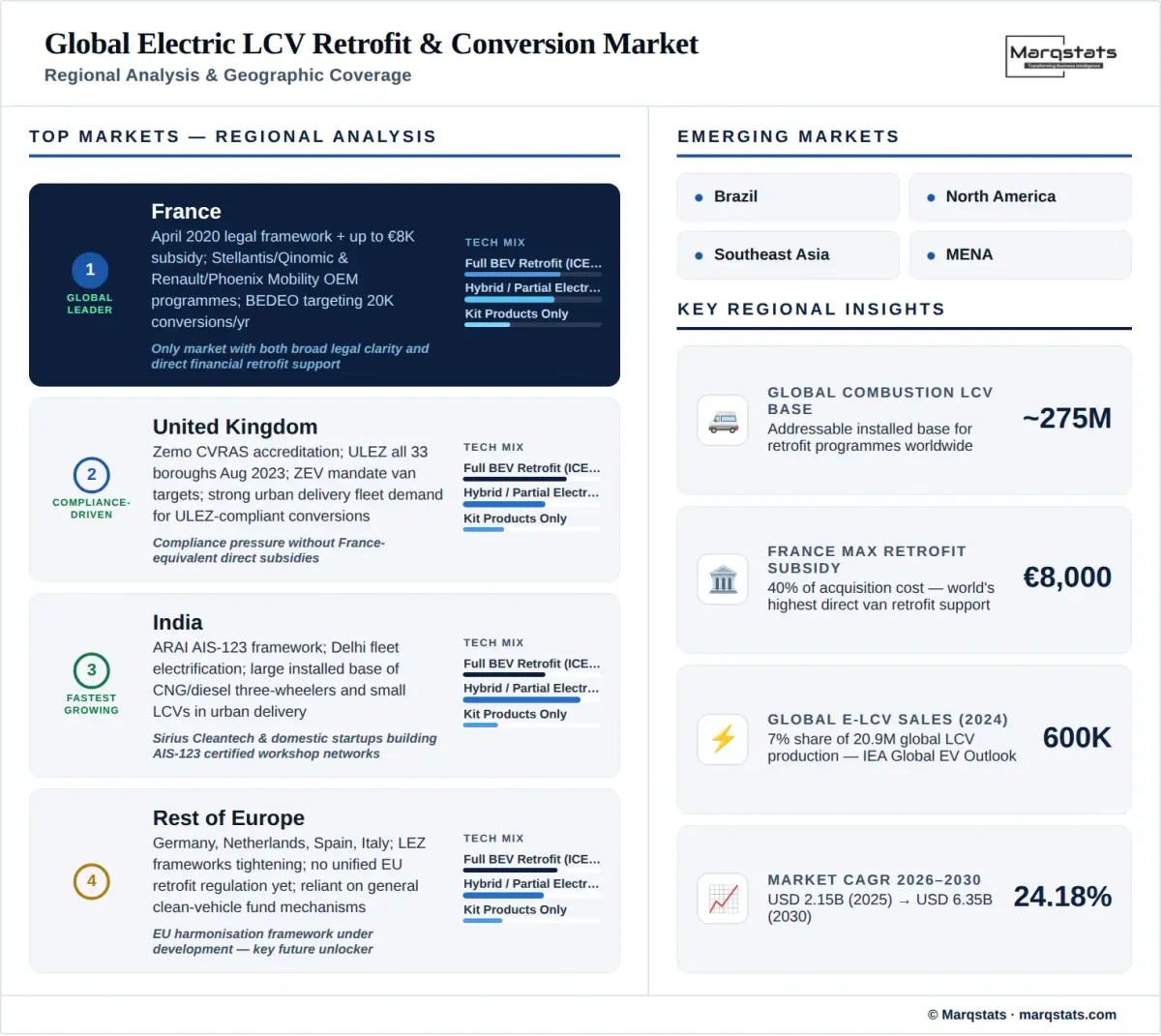
Global Electric LCV Retrofit Conversion Market Regional Analysis Infographic
Competitive Landscape

How Competition Is Evolving

The global electric van conversion companies Europe and global competitive landscape is characterised by a small number of specialist operators with vehicle-specific homologation depth, OEM-partnered programme operators with supply-chain integration advantages, and emerging component kit manufacturers serving certified workshop networks. The market is pre-competitive in the sense that there is no single dominant global player across all geographies and all vehicle classes — the homologation complexity and vehicle-specificity of retrofit programmes means that competitive advantage is concentrated in specific national regulatory expertise and specific vehicle-model conversion depth rather than in global scale economies.

BEDEO (UK, operating in France as DANGEL powered by BEDEO) is the most visible independent specialist, having targeted 20,000 conversions per year and developed the commercial relationship with Dangel for large-van hybrid and electric conversions. BEDEO's basic kit for large vans at approximately €30,000 targets fleets with expensive existing bodies — refrigeration, specialist equipment — that make new-vehicle replacement less attractive than retrofit. Stellantis/Qinomic represents the most commercially significant OEM-partnered programme, with Stellantis sourcing electric components and Qinomic developing the conversion system over two and a half years with the SUSTAINera circular-economy unit — a model that delivers OEM-level quality and compliance certification but is currently limited to mid-size Stellantis van models in France. Renault/Phoenix Mobility's partnership for Renault Master retrofit at Flins brings a different OEM logic: leveraging the circular-economy manufacturing infrastructure of the Re-Factory to assemble conversion kits industrially rather than in distributed workshop settings.
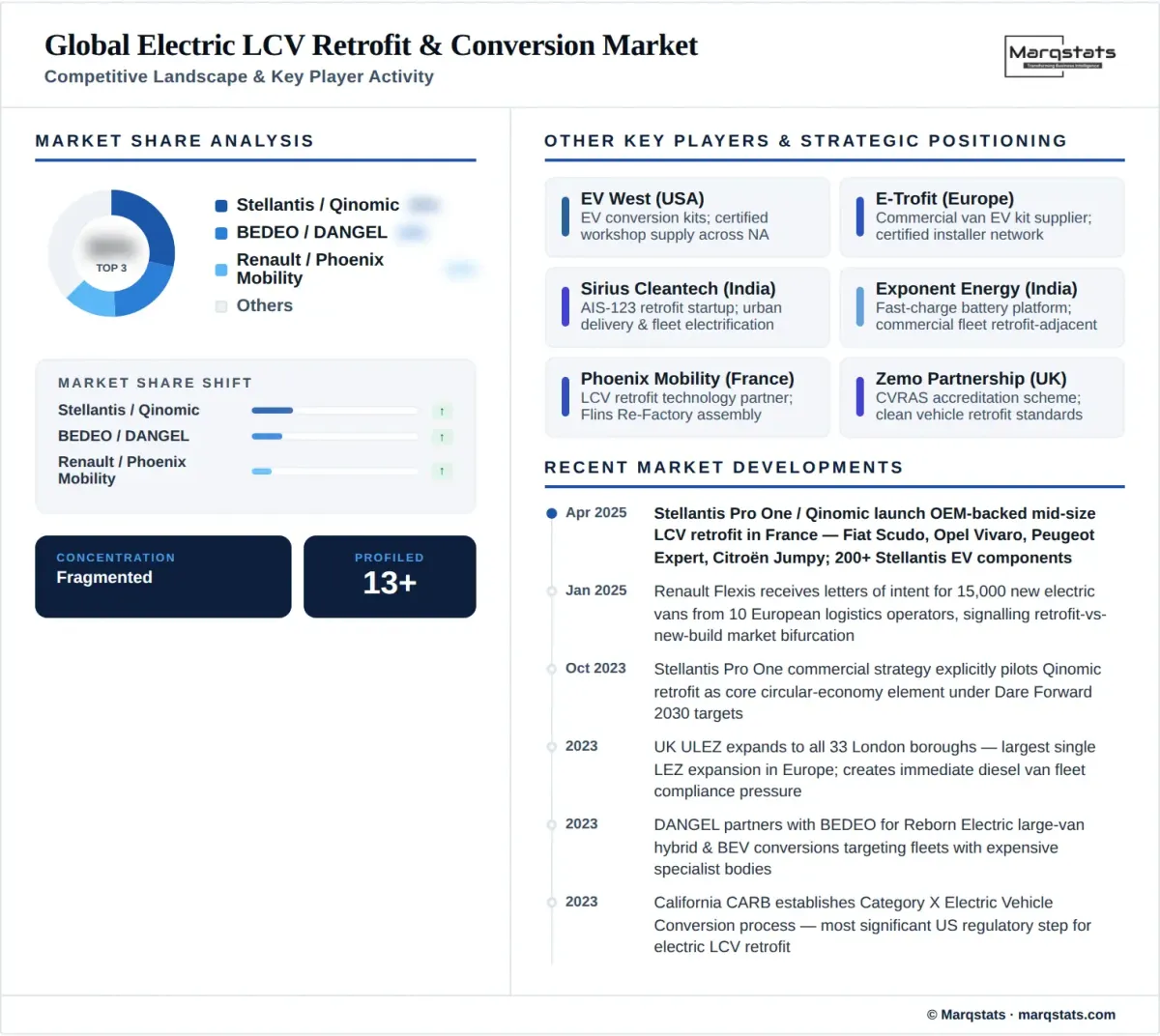
Global Electric LCV Retrofit Conversion Market Competitive Landscape Infographic
Major Players

Companies Covered

The report profiles 13+ companies with full strategy and financials analysis, including:

Stellantis Pro One / Qinomic (France — OEM-Backed Retrofit; Fiat Scudo, Opel Vivaro, Peugeot Expert, Citroën Jumpy; 200+ Stellantis Components; SUSTAINera Circular Economy)
BEDEO (UK/France — Large Van Electric and Hybrid Retrofit; €30,000 Base Kit; 37 kWh / 120 km Range; Independent Multi-Model Specialist)
DANGEL powered by BEDEO (France — Reborn Electric Range; Large Diesel Van Hybrid-Electric and BEV Conversion under Dangel Brand)
Renault Group / Phoenix Mobility (France — Renault Master BEV Retrofit; Flins Re-Factory Assembly; Strategic Partnership Signed July 2022)
Qinomic (Stellantis Partner — Electric Retrofit Powertrain System; OEM Component Sourcing; Modular Multi-Model Kit Architecture)
EV West (USA — EV Conversion Kits; Certified Workshop Supply; Passenger and Commercial Vehicle Retrofit Components)
E-Trofit (Europe — Commercial Van EV Conversion Kit Supplier; Certified Installer Network Distribution)
Sirius Cleantech (India — Commercial EV Retrofit Startup; AIS-123 Framework; Urban Delivery and Fleet Electrification)
Exponent Energy (India — Fast-Charge EV Technology; Commercial Fleet Electrification; Retrofit-Adjacent Battery Platform)
Stellantis / SENAI Brazil (Brazil — Fiat Fiorino and Peugeot Partner Rapid Retrofit; Circular Economy Research Programme)
Phoenix Mobility (France — LCV Retrofit Technology Partner for Renault; Grenoble-Based Conversion Specialist)
EDF Energy / Zemo Partnership (UK — CVRAS Accreditation Scheme; Clean Vehicle Retrofit Standards)
GGGI (Global — Electric Retrofit Policy Framework Development; Emerging Market Government Advisory)
Note: Full company profiles include revenue analysis, product portfolio, SWOT, and recent strategic developments.
Latest Developments

Recent Market Activity

Apr 2025
Stellantis Pro One launches electric retrofit solution for LCVs in partnership with Qinomic in France — the first application covers mid-size Stellantis vans including the Fiat Scudo, Opel Vivaro, Peugeot Expert, and Citroën Jumpy, with Qinomic purchasing 200+ electric components (batteries, motors) directly from Stellantis while combustion parts are recovered into the SUSTAINera circular-economy remanufacturing system. Developed over two and a half years with Stellantis's Circular Economy Business Unit, the programme delivers OEM-level quality, safety, and durability compliance.
Jul 2022
Renault Group and Phoenix Mobility sign strategic partnership for Renault Master electric LCV retrofit at the Flins Re-Factory — targeting 1,000 retrofit kits in the first stage of a commercial operation at Renault's dedicated circular-economy manufacturing site, with the Master retrofit kit extending the programme to other Renault models over time.
Jan 2023
Stellantis and SENAI launch electric powertrain retrofit project in Brazil — converting Fiat Fiorino and Peugeot Partner Rapid models as part of the Rota 2030 programme, making converted vehicles available to B2B customers from April 2023 to collect usage data — an early proof-of-concept for OEM-led retrofit in South America.
Oct 2023
Stellantis introduces Pro One commercial vehicle strategy — explicitly piloting a retrofit programme with Qinomic as part of the Dare Forward 2030 targets, framing retrofit as a core element of its circular economy approach alongside electrified propulsion, connected vehicles, and service revenue goals.
2023
France DANGEL partners with BEDEO for Reborn Electric large-van retrofit range — marketing hybrid-electric and fully electric conversions for large diesel vans under the DANGEL, powered by BEDEO brand, targeting urban delivery fleets with expensive existing specialist bodies.
2023
UK ULEZ expands to all 33 London boroughs — the largest single expansion of Ultra Low Emission Zone coverage in any European city, creating immediate operational pressure on pre-Euro 6 diesel van fleets and making ULEZ-compliant van conversion market UK the market's most urgent near-term compliance demand segment.
2023
California CARB establishes Category X Electric Vehicle Conversion process — providing a dedicated regulatory pathway for zero-emission vehicle conversions with no combustion source, the most significant US regulatory development for electric LCV retrofit since EPA's conversion manufacturer guidelines.
Report Structure

Table of Contents

1. Introduction
1.1 Market Definition — Electric LCV Retrofit vs Factory New-Build EV Van
1.2 Study Objectives and Scope
1.3 Three Commercial Models — OEM-Partnered, Independent Specialist, Kit Distribution
1.4 Key Assumptions and Study Period
1.5 Abbreviations — BEV, ICE, BMS, CVRAS, AIS-123, ZFE, ULEZ, ZEV, CARB, UTAC
1.6 Currency Conventions (USD/EUR/INR) and Vehicle Class Definitions
2. Executive Summary
2.1 Market Snapshot 2025–2030
2.2 Regulatory Architecture — France, UK CVRAS, India AIS-123, CARB Category X, EPA
2.3 Critical Findings by Technology, Region, and OEM Programme
3. Market Insights
3.1 Report Summary — Homologation and Systems-Integration Industry
3.2 Market Size and Historical Trend (2021–2025)
3.3 Market Forecast (2026–2030)
3.4 Global LCV Market Context — The Addressable Retrofit Base
3.4.1 IEA — Electric LCV Sales 600,000 in 2024, 7% Global Share
3.4.2 OICA — Global LCV Production 20.9M in 2024; Combustion Installed Base
3.4.3 ACEA EU Van Registrations — 1,447,273 in 2025; 80.7% Still Diesel
3.4.4 SMMT UK LCV Market — 315,422 in 2025; 9.5% BEV Share
3.5 Electric Van Conversion Kit Market Context
3.5.1 Kit Market USD 860M in 2024; 8.9% CAGR to 2034
3.5.2 100 kW Power Class — 48% Revenue Share
3.5.3 Automotive EV Retrofit Powertrain Market USD 4.62B in 2024; 13.4% CAGR
3.6 Market Dynamics
3.6.1 Key Drivers
3.6.1.1 LEZ / ULEZ / ZFE Compliance Pressure — Non-Negotiable Urban Access Deadline
3.6.1.2 Sunk Fit-Out Investment — Refrigerated, Shelving, Specialist-Body Economics
3.6.1.3 France Legal Framework and Direct Subsidy — World's Only Mass-Market Van Retrofit
3.6.1.4 India ARAI AIS-123 and Fleet Electrification Policy
3.6.1.5 OEM Circular-Economy Commitments — Stellantis SUSTAINera, Renault Re-Factory
3.6.2 Key Restraints
3.6.2.1 Fragmented National Homologation Frameworks — No Unified EU Standard
3.6.2.2 Retrofit Economics vs New-Build e-LCV Pricing
3.6.2.3 Improving Factory EV Van Supply Compressing Standard-Spec Retrofit Market
3.6.3 Key Trends
3.6.3.1 Modular Platform-Agnostic Retrofit Powertrain Kits — Scalability Architecture
3.6.3.2 Certified Workshop Networks — Critical Distribution and Installation Infrastructure
3.6.3.3 Second Life Commercial Van Electrification — Circular Economy Narrative
3.6.3.4 India and Emerging Markets — Volume Growth Faster Than Europe
3.6.4 Key Opportunities
3.6.4.1 Refrigerated and Specialist-Body Van Fleet Retrofit — Highest ROI Segment
3.6.4.2 Certified Workshop Network Accreditation — UK, France, India
3.6.4.3 OEM-Partnered Retrofit Programme Expansion Beyond France
3.6.4.4 North America CARB Category X — California Fleet Compliance Market
4. Regulatory and Policy Framework
4.1 France — World's Most Advanced National Van Retrofit Market
4.1.1 Legal Authorisation Since 4 April 2020
4.1.2 Company Retrofit Subsidy — 40% Up to €4,000 / €6,000 / €8,000 by Vehicle Class
4.1.3 ZFE-m Low-Emission Zones — Paris, Lyon, Grenoble, Toulouse Compliance Deadlines
4.1.4 UTAC Homologation Requirements for Retrofit Kits
4.2 United Kingdom — CVRAS and ZEV Mandate
4.2.1 Zemo Partnership CVRAS — Clean Vehicle Retrofit Accreditation Scheme
4.2.2 ULEZ All-London Expansion August 2023 — Compliance Demand Catalyst
4.2.3 ZEV Mandate — 22% Van ZEV Target 2024; Trajectory to 2035
4.2.4 Dedicated Zero-Emission Retrofit Accreditation Study — Zemo 2025
4.3 European Union — Fragmented Member State Framework
4.3.1 Absence of Unified EU Type-Approval Standard for EV Van Retrofit
4.3.2 Commercial van EV retrofit subsidy Europe — Country-by-Country Status
4.3.3 GGGI Policy Framework for EU Member State Retrofit Legislation
4.4 India — ARAI AIS-123 Framework
4.4.1 AIS-123 Technical Standard for EV Retrofit Type Approval
4.4.2 MoRTH India EV Retrofit Commercial Vehicle Policy
4.4.3 Delhi Three-Wheeler Fleet Electrification Policy
4.4.4 FAME Commercial Vehicle Programme — Retrofit Alignment
4.5 United States and Canada
4.5.1 EPA Conversion Manufacturer Compliance Requirements
4.5.2 California CARB Category X EV Conversion Process (2023)
4.5.3 Canada Transport Canada Retrofit Framework
4.6 Brazil and Latin America
4.6.1 Stellantis SENAI Rota 2030 Retrofit Programme
4.6.2 Brazil Regulatory Framework for Retrofit Electrification
4.7 Clean Commercial Vehicle Retrofit Policy — Global Benchmarking
5. Technology and Product Landscape
5.1 Full Battery-Electric (ICE-to-BEV) Retrofit Architecture
5.1.1 Core Components — Motor, Inverter, Battery Pack, BMS, Charger
5.1.2 Battery Sizing and Range: 100–200 km for Urban LCV Use Cases
5.1.3 Vehicle-Specific Interface Engineering — Floor, Subframe, Electrical
5.2 Hybrid and Partial-Electrification Retrofit
5.2.1 Hybrid Van Conversion Market — DANGEL/BEDEO Reborn Electric
5.2.2 Applications — Long-Range Mixed-Duty and Refrigeration Aux Power
5.3 Electric Van Conversion Kit Products
5.3.1 Kit Market Structure — 100 kW Class Dominant (48% Revenue)
5.3.2 Key Kit Suppliers — EV West, E-Trofit, Qinomic Component Platform
5.3.3 EV Conversion Kit LCV — From 30kW Entry to 150kW Premium Class
5.4 Modular Platform-Agnostic Retrofit Powertrain Systems
5.4.1 Model-Specific Interface Brackets + Universal Powertrain Core
5.4.2 Retrofit EV Powertrain Modular Platform LCV — 2025 Design Direction
5.5 Battery Electric Van Retrofit Supply Chain
5.5.1 Battery Modules — Stellantis Direct Sourcing via Qinomic
5.5.2 Motor and Inverter Supply — Domestic vs Imported Components
5.5.3 Battery Electric Van Retrofit Supply Chain India vs Europe
5.6 Circular Economy and Component Recovery Architecture
5.6.1 Stellantis SUSTAINera — Combustion Part Recovery and Remanufacturing
5.6.2 Renault Re-Factory Flins — Industrial Kit Assembly for Second-Life Vans
6. Market Segmentation — By Conversion Technology
6.1 Technology Segmentation Overview
6.2 Full Battery-Electric Retrofit (ICE-to-BEV)
6.2.1 Market Share — ~70–75% of Total Retrofit Revenue
6.2.2 Stellantis/Qinomic, BEDEO, Renault/Phoenix Mobility — Programme Scale
6.2.3 Revenue Forecast (2026–2030)
6.3 Hybrid and Partial-Electrification Retrofit
6.3.1 DANGEL Reborn Electric — Large Van Hybrid Conversion
6.3.2 Use Cases — Long Range, Refrigeration Aux Power
6.3.3 Revenue Forecast (2026–2030)
6.4 Electric Van Conversion Kit Products (Component Level)
6.4.1 Kit Market — USD 860M 2024; 8.9% CAGR
6.4.2 EV Kit Manufacturer Market Share — Fragmented
6.4.3 Revenue Forecast (2026–2030)
6.5 Certified Installation and Homologation Services
6.6 Technology Revenue Forecast (2026–2030)
7. Market Segmentation — By Vehicle Class
7.1 Vehicle Class Segmentation Overview
7.2 Mid-Size LCV (N1, 2.0–3.5 Tonnes)
7.2.1 Dominant Segment — Stellantis/Qinomic, Renault Master, Sprinter Class
7.2.2 Revenue Forecast (2026–2030)
7.3 Small LCV and Three-Wheelers (India-Dominant)
7.3.1 India Electric Vehicle Retrofit Market India — Delhi, Mumbai, Bangalore
7.3.2 India AIS-123 Certified Conversion Volume
7.3.3 Revenue Forecast (2026–2030)
7.4 Specialist Body Conversions — Refrigerated, Service, Tipper
7.4.1 Electric Tipper Van Conversion UK Europe — Growing Intersection
7.4.2 Refrigerated Last-Mile EV Retrofit — Highest Per-Vehicle Value Segment
7.5 Vehicle Class Revenue Forecast (2026–2030)
8. Regional Analysis
8.1 Regional Market Overview
8.2 France — Global Market Leader
8.2.1 Legal Framework (2020), Subsidy (40%/€8K), ZFE — Full Policy Stack
8.2.2 Stellantis Pro One / Qinomic — April 2025 Launch
8.2.3 Renault / Phoenix Mobility — Master Retrofit at Flins Re-Factory
8.2.4 BEDEO and DANGEL — Independent Specialist Ecosystem
8.3 United Kingdom
8.3.1 CVRAS Accreditation Framework — Zemo Partnership
8.3.2 ULEZ All-London August 2023 — Compliance Demand Catalyst
8.3.3 ZEV Mandate Fleet Electrification — Van Retrofit Pathway
8.3.4 EV Retrofit Van UK Market 2025 — Last-Mile and Urban Service Fleet
8.4 Rest of Europe
8.4.1 Germany, Netherlands, Spain, Italy — ZFE and LEZ Development
8.4.2 Fragmented Subsidy Architecture — No France-Equivalent in Other EU States
8.4.3 Zero Emission Van Conversion Europe — Pan-EU Demand Drivers
8.5 India
8.5.1 ARAI AIS-123 — India EV Retrofit Commercial Vehicle Policy
8.5.2 Delhi Three-Wheeler and LCV Fleet Electrification Policy
8.5.3 Van Electrification Retrofit Market India 2025 — Startup Ecosystem
8.5.4 EV Commercial Van Conversion India Startups — Sirius, Exponent
8.6 North America
8.6.1 California CARB Category X — Most Active US Retrofit Pathway
8.6.2 EPA Conversion Manufacturer Rules — Compliance-Led Not Incentive-Led
8.6.3 Electric Delivery Van Conversion US — Fleet Compliance Market
8.7 Rest of World — Brazil, Southeast Asia
8.7.1 Stellantis SENAI Brazil — Fiat Fiorino and Peugeot Partner Rapid Retrofit
8.7.2 Southeast Asia LCV Retrofit Emerging Markets
8.8 Regional Revenue Forecast (2026–2030)
9. Competitive Landscape
9.1 Market Concentration — Pre-Competitive Fragmented Structure
9.2 OEM-Partnered Programme Tier
9.2.1 Stellantis Pro One / Qinomic — OEM Component Sourcing + Circular Economy
9.2.2 Renault Group / Phoenix Mobility — Master Retrofit at Flins Re-Factory
9.3 Independent Specialist Tier
9.3.1 BEDEO — UK/France; Large Van Specialist; €30K Base Kit
9.3.2 DANGEL powered by BEDEO — Reborn Electric Large Van Range (France)
9.4 Kit Manufacturer Distribution Tier
9.4.1 EV West, E-Trofit, and Kit Supply Chain Players
9.4.2 India AIS-123-Certified Kit Manufacturers — Sirius Cleantech
9.5 Key Competitive Strategies
9.5.1 Vehicle-Model Homologation Depth as Competitive Moat
9.5.2 Certified Workshop Network as Scalable Distribution Channel
9.5.3 OEM Component Sourcing for Quality and Warranty Differentiation
9.5.4 Circular-Economy Narrative for ESG-Driven Fleet Procurement
9.6 New-Build E-LCV Supply as the Primary Competitive Threat to Retrofit
10. Company Profiles
10.1 Stellantis Pro One / Qinomic
10.1.1 France Launch April 2025 — Fiat Scudo, Opel Vivaro, Peugeot Expert, Citroën Jumpy
10.1.2 200+ Stellantis Components; SUSTAINera Circular-Economy Recovery
10.2 BEDEO
10.2.1 Large Van Electric and Hybrid Retrofit — €30,000 Base Kit
10.2.2 Target: 20,000 Conversions Per Year
10.3 DANGEL powered by BEDEO
10.3.1 Reborn Electric Range — Large Diesel Van Hybrid/BEV in France
10.4 Renault Group / Phoenix Mobility
10.4.1 Renault Master BEV Retrofit — Flins Re-Factory Assembly
10.4.2 Letter of Intent July 2022; 1,000 Kits Target Stage 1
10.5 Qinomic (Stellantis Partner)
10.6 EV West
10.7 E-Trofit
10.8 Sirius Cleantech
10.8.1 India AIS-123 EV Retrofit — Urban Commercial Fleet
10.9 Exponent Energy
10.10 Stellantis / SENAI Brazil
10.10.1 Fiat Fiorino and Peugeot Partner Rapid B2B Retrofit (2023)
10.11 Phoenix Mobility
10.12 EDF Energy / Zemo Partnership
10.13 GGGI
11. Value Chain and Ecosystem Analysis
11.1 Value Chain Overview — Component Supply to Fleet Delivery
11.2 EV Powertrain Component Suppliers — Batteries, Motors, Inverters, BMS
11.3 Retrofit Kit Manufacturers and System Integrators
11.4 Certified Workshop Installation Network
11.5 OEM Homologation and Type-Approval Partners
11.6 Fleet Operators and Fleet Management Companies
11.7 Circular-Economy Component Recovery — Combustion Part Remanufacturing
12. Investment and Programme Activity
12.1 Stellantis Qinomic Partnership Investment — Two-and-a-Half Years Development
12.2 Renault Re-Factory Flins — Circular Economy Infrastructure Capital
12.3 France Government Retrofit Subsidy Programme — Fleet Support Budget
12.4 India FAME Commercial Vehicle Programme — Retrofit Financing
12.5 UK CVRAS Scheme Development and Certification Infrastructure
12.6 India EV Retrofit Startup Funding — Sirius Cleantech, Exponent Energy
13. Use Case Deep Dives
13.1 Stellantis/Qinomic France — OEM-Backed Retrofit Industrialisation Model
13.2 BEDEO/DANGEL — Refrigerated and Specialist-Body Van Fleet Retrofit Economics
13.3 Renault/Phoenix Mobility — Re-Factory Circular-Economy Kit Assembly
13.4 India Three-Wheeler AIS-123 Retrofit — Delhi Urban Fleet Electrification
13.5 California CARB Category X — Clean Fleet Mandate Retrofit Pathway
13.6 UK ULEZ Compliance — Retrofit vs Replace Economics for London Fleet Operators
14. Market Forecast and Scenario Analysis
14.1 Base Case Forecast 2026–2030
14.2 Bull Case — France Subsidy Extended, EU Harmonised Framework Adopted
14.3 Bear Case — New-Build e-LCV Price Parity Compresses Retrofit Addressable Market
14.4 Forecast by Conversion Technology
14.5 Forecast by Vehicle Class
14.6 Forecast by Region
14.7 Electric LCV Retrofit Market CAGR Forecast vs New-Build EV Van Market
15. Strategic Recommendations
15.1 For Retrofit Kit Manufacturers — Modular Platform Architecture and Homologation Investment
15.2 For OEMs — Circular-Economy Retrofit as Component Revenue and ESG Credential
15.3 For Fleet Operators — Retrofit vs Replace Decision Framework for Specialist-Body Vans
15.4 For Policy Makers — France Model as Blueprint for EU Member State Subsidy Design
15.5 For Investors — Certified Workshop Network as Market-Access Infrastructure Asset
16. Study Scope and Methodology
16.1 Research Design and Approach
16.2 Primary Research — 40+ Interview Coverage
16.3 Secondary Research and Data Sources
16.4 Market Sizing Methodology — National Programme Volume × Revenue Per Conversion
16.5 Forecast Assumptions — Policy, Technology, and New-Build Competition Scenarios
17. Appendix
17.1 Global Electric LCV Sales and Installed Base Data — IEA 2024
17.2 France Electric Van Retrofit Subsidy Eligibility and Amount Table
17.3 Country-by-Country Retrofit Regulatory Status Summary
17.4 Electric Van Conversion Kit Market — 100kW Class Revenue Detail
17.5 Vehicle-by-Vehicle Retrofit Programme Availability — France, UK, India
17.6 Stellantis SUSTAINera Circular Economy Programme Overview
17.7 Abbreviations and Acronyms
17.8 List of Exhibits and Tables
17.9 Bibliography and References
17.10 About Marqstats Intelligence
3.6.4.4 Clean Commercial Vehicle Retrofit Policy — GGGI Global Framework
5.5.4 Van Conversion Kit Motor Battery Market — Component-Level Analysis
6.3.4 Hybrid Van Conversion Market Global — Revenue Forecast
12.7 Brazil and Latin America Government Retrofit Programme Funding
13.7 Stellantis SENAI Brazil — Emerging Market Retrofit Blueprint
Study Scope & Focus

Coverage & Segmentation

This report provides a comprehensive analysis of the global electric LCV retrofit & conversion market covering the 2021–2030 period, with 2025 as the base year. The study covers full battery-electric (ICE-to-BEV) LCV retrofit, hybrid and partial-electrification van conversion, electric van conversion kit products (component market), and the associated certified workshop installation services, homologation and type-approval services, and fleet electrification retrofit programme management. Vehicle coverage spans N1 mid-size LCVs (2.0–3.5 tonnes), small LCVs and three-wheelers (primarily India), and chassis-cab-based conversions where specialist bodies are preserved. Regulatory coverage includes France's legal framework (April 2020), UK Zemo CVRAS scheme, India ARAI AIS-123, US EPA conversion manufacturer rules, California CARB Category X, and emerging EU harmonisation frameworks. Geographic coverage spans France, United Kingdom, Germany, Netherlands, Rest of Europe, India, North America (USA and Canada), and Rest of World. Related market context is provided for the global electric van conversion kit market (USD 860M in 2024) and the broader automotive EV retrofit powertrain market (USD 4.62B in 2024).

Primary research included 40+ interviews with electric LCV retrofit kit manufacturers, OEM circular-economy programme managers, certified conversion workshop operators, fleet electrification managers at European and Indian logistics and utility companies, urban clean-air policy officers, and type-approval homologation consultants. Secondary research drew from IEA Global EV Outlook 2024–2025 (electric LCV sales data), ACEA EU van registration statistics 2025, SMMT UK LCV data 2025, France official retrofit subsidy portal, Zemo CVRAS scheme documentation, India ARAI AIS-123 standard, California CARB Category X documentation, EPA conversion manufacturer compliance guidance, Stellantis press releases (April 2025, October 2023, January 2023), Renault/Phoenix Mobility press release (July 2022), Reuters reporting on BEDEO and Flexis e-van demand, and GGGI electric retrofit policy framework publications.
Frequently Asked Questions

FAQs About the Global Electric LCV Retrofit & Conversion Market

The global electric LCV retrofit market covers the conversion of in-service internal-combustion light commercial vehicles into battery-electric or hybrid-electric powertrains, preserving the vehicle body and vocational fit-out while replacing the combustion drivetrain with modular electric powertrain kits. This is a homologation and systems-integration industry — not a simple aftermarket kit market — because each converted vehicle requires revised type approval under national frameworks including France's UTAC certification, UK Zemo CVRAS, India's ARAI AIS-123, or California's CARB Category X process.
The market is projected to grow at a CAGR of 24.18% from 2026 to 2030, reaching USD 6.35 billion by 2030. This high growth rate reflects the market's current early-stage scale (USD 2.15 billion in 2025), the rapid commercialisation triggered by Stellantis Pro One/Qinomic's April 2025 France launch, accelerating LEZ and ULEZ compliance pressure across European cities, India's AIS-123-led retrofit ecosystem growth, and the inherent limitations of full fleet replacement cycles that make retrofit the only practical short-term electrification path for urban delivery and service fleets with expensive specialist bodies.
France is the world's only national market offering both a comprehensive legal framework for electric van retrofit (legalised since 4 April 2020) and direct government financial subsidies — covering 40% of acquisition cost up to €4,000, €6,000, or €8,000 per vehicle depending on class for company fleet operators. This combination of regulatory clarity and financial support has attracted OEM-partnered programmes (Stellantis/Qinomic, Renault/Phoenix Mobility), specialist retrofit operators (BEDEO, DANGEL), and certified workshop network development that no other country has yet replicated. France's Zone à Faibles Émissions Mobilité policy in Paris, Lyon, and other major cities adds non-negotiable compliance pressure that makes retrofit economically compelling for urban diesel van fleets.
The Stellantis Pro One / Qinomic electric retrofit solution, launched in April 2025 in France, is the most commercially significant OEM-backed LCV retrofit programme in the world. Developed over two and a half years with Stellantis's Circular Economy Business Unit (SUSTAINera), the programme allows owners of mid-size Stellantis vans — Fiat Scudo, Opel Vivaro, Peugeot Expert, and Citroën Jumpy — to convert their combustion vehicles to electric. Qinomic sources over 200 electric components (batteries, motors) directly from Stellantis's supply chain, while removed combustion parts (engines, fuel systems) are recovered into SUSTAINera's remanufacturing system. The programme delivers OEM-level quality, safety, and durability compliance.
India's Automotive Research Association of India (ARAI) has established AIS-123 as the technical standard governing electric vehicle retrofit in India, providing the type-approval pathway that conversion kit manufacturers must obtain to sell legally compliant retrofit systems. The Ministry of Road Transport and Highways (MoRTH) provides overarching policy authorisation for electric vehicle conversion. Delhi's fleet electrification policies, urban air quality mandates in Mumbai, Bangalore, and Pune, and the FAME programme's commercial vehicle electrification targets collectively drive demand for AIS-123-certified electric LCV retrofit solutions. Indian startups including Sirius Cleantech are building AIS-123-homologated conversion kits and certified installation networks.
London's Ultra Low Emission Zone (ULEZ), expanded to all 33 London boroughs in August 2023, Paris's Zone à Faibles Émissions Mobilité (ZFE-m), and 30+ European city LEZs create hard legal operating-access restrictions for non-compliant diesel vans that cannot be resolved through voluntary green procurement. For fleet operators whose diesel vans are approaching ULEZ or ZFE non-compliance thresholds but already carry expensive refrigeration, specialist shelving, or custom bodywork, retrofit electrification is frequently the lowest total-cost compliance path. The ULEZ compliant van conversion market UK and zero emission van conversion Europe market are both directly catalysed by these urban access deadline pressures.
The electric van conversion kit market — covering packaged hardware kits (motor, inverter, battery modules, BMS, charger, and vehicle-specific interface brackets) sold to certified conversion workshops or direct fleet operators — was valued at approximately USD 860 million in 2024, growing at an 8.9% CAGR through 2034. The 100 kW power class accounts for approximately 48% of kit revenue, reflecting the dominance of mid-size LCV conversion requirements. This is the most commoditised and price-competitive segment of the broader electric LCV retrofit value chain, contrasted with the higher-margin OEM-partnered programme and certified-conversion business models.
Refrigerated delivery van fleets typically carry €15,000–25,000 of insulation, refrigeration compressor, and cold-chain equipment per vehicle. Scrapping the entire van to acquire an electric base vehicle means losing this fit-out investment entirely. A €30,000–40,000 retrofit converts the existing vehicle to electric while preserving the body investment intact. The same economics apply to service vans with heavy shelving investment, hydraulic tipper operators, and specialist vocational configurations. BEDEO explicitly targets fleets with costly add-ons that make full replacement uneconomical — and this 'sunk fit-out' logic is the electric LCV retrofit market's most durable commercial demand driver, immune to the pricing competition from new-build factory EVs.
Yes. Marqstats offers custom editions tailored to specific country markets (France van retrofit ecosystem, UK ULEZ compliance retrofit, India AIS-123 startup market), vehicle types (refrigerated van retrofit, small LCV India, specialist body conversions), conversion technology (full BEV vs hybrid), or OEM/company competitive intelligence. Contact sales@marqstats.com for customisation options.