Market Snapshot
Key Takeaways
Market Overview & Analysis
Report Summary
The Uganda two-wheeler market comprises motorcycles, scooters and mopeds used for personal transport, commercial motorcycle-taxi services and delivery across internal combustion and electric propulsion. Uganda is an East African nation of about 48 million people, and its two-wheeler demand is inseparable from the boda-boda sector — motorcycle taxis that provide affordable mobility and income for a very large number of riders. The motorcycle industry is among Uganda's largest sources of employment, and demand concentrates in Kampala and other urban centres while extending deep into rural areas.
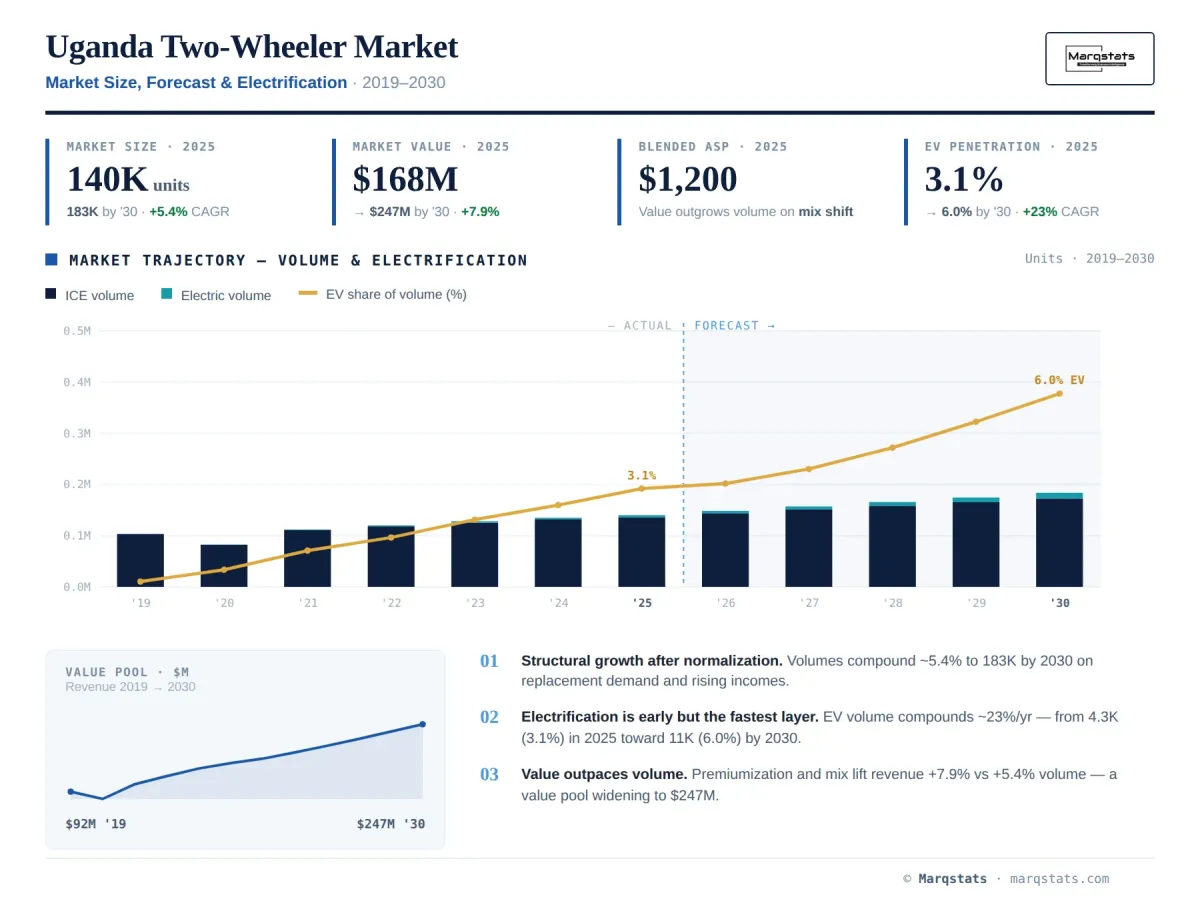
Between 2019 and 2025 the market grew from about 103,000 units to about 140,000 units, supported by an established asset-financing ecosystem in which riders purchase machines on daily, weekly or monthly instalments and replace them every few years. This financing loop, alongside new-entrant demand, sustains a steady flow of new-bike sales. Growth over the forecast period combines steady unit expansion with two structural shifts: the maturation of the motorcycle-taxi fleet alongside rising private ownership, and the rapid electrification of the fleet from a small yet fast-growing base.
Uganda sits at the centre of the Africa two-wheeler market, where motorcycle taxis anchor mobility and Indian and Chinese OEMs supply the bulk of volume. Electrification is advancing faster in Uganda than anywhere else on the continent, driven by local electric-motorcycle assemblers, battery-swap networks priced for daily rider economics, and a national policy framework that exempts local electric-vehicle assembly from duties and taxes, and is moderated by charging-infrastructure gaps outside major corridors and the eventual phase-out of fiscal incentives.
Two features define Uganda's market. First, it is overwhelmingly a motorcycle-taxi market: the boda-boda sector shapes demand, financing and brand preference, favouring durable, affordable commuter motorcycles from Indian brands. Second, it is electrifying faster than any other market on the continent: purpose-built electric machines paired with battery-swapping and rider financing deliver compelling savings for high-mileage taxi riders, which has made Uganda the largest electric two-wheeler market in Africa despite modest incomes.
Asset financing is the mechanism that ties these features together. Most riders cannot pay cash for a motorcycle, so a dense ecosystem of financiers offers machines on small down-payments followed by daily, weekly or monthly instalments, typically over a two-year term, often bundled with GPS tracking and insurance. After repayment, riders usually run the bike for a further period before reselling it and financing a newer one, a cycle that renews demand roughly every four years and steadily feeds new-bike sales. This same infrastructure is now being extended to electric machines and battery-swap subscriptions, where lower running costs improve rider affordability and repayment capacity, which is a central reason electric adoption has scaled quickly among commercial riders ahead of private buyers.
Market Dynamics
Key Drivers
- Market is driven by the boda-boda economy, in which motorcycle taxis provide affordable mobility and income for a very large number of riders.
- An established asset-financing ecosystem lets riders buy machines on instalments and replace them every few years, sustaining new-bike demand.
- Rising private ownership is expanding fast at a 20.10% CAGR as households acquire motorcycles for personal transport beyond taxi use.
- Electrification is accelerating owing to local assembly, battery-swap networks and compelling running-cost savings for high-mileage riders.
- A national electric-mobility strategy, with duty and tax exemptions for local assembly, is stimulating investment and domestic production.
Key Restraints
- Charging and battery-swap infrastructure remains concentrated on major corridors, limiting electric adoption in rural areas.
- New registration and digital number-plate costs raised bike prices in 2025, temporarily slowing new sales.
- Demand is sensitive to low incomes, financing terms and interest costs in a credit-driven market.
- Electric momentum depends partly on fiscal incentives that the government cannot sustain indefinitely.
Key Trends
- The motorcycle-taxi fleet is maturing at a 5.20% negative CAGR while private ownership rises, shifting the demand mix.
- Electric boda-bodas are scaling owing to battery-swap models that deliver up to 85 kilometres per swap and cut operating costs.
- Local assembly is expanding, moreover creating jobs and reducing reliance on imported internal combustion machines.
- Online sales are rising fastest at a 38.00% CAGR from a small base as digital financing and sales platforms spread.
Market Segmentation
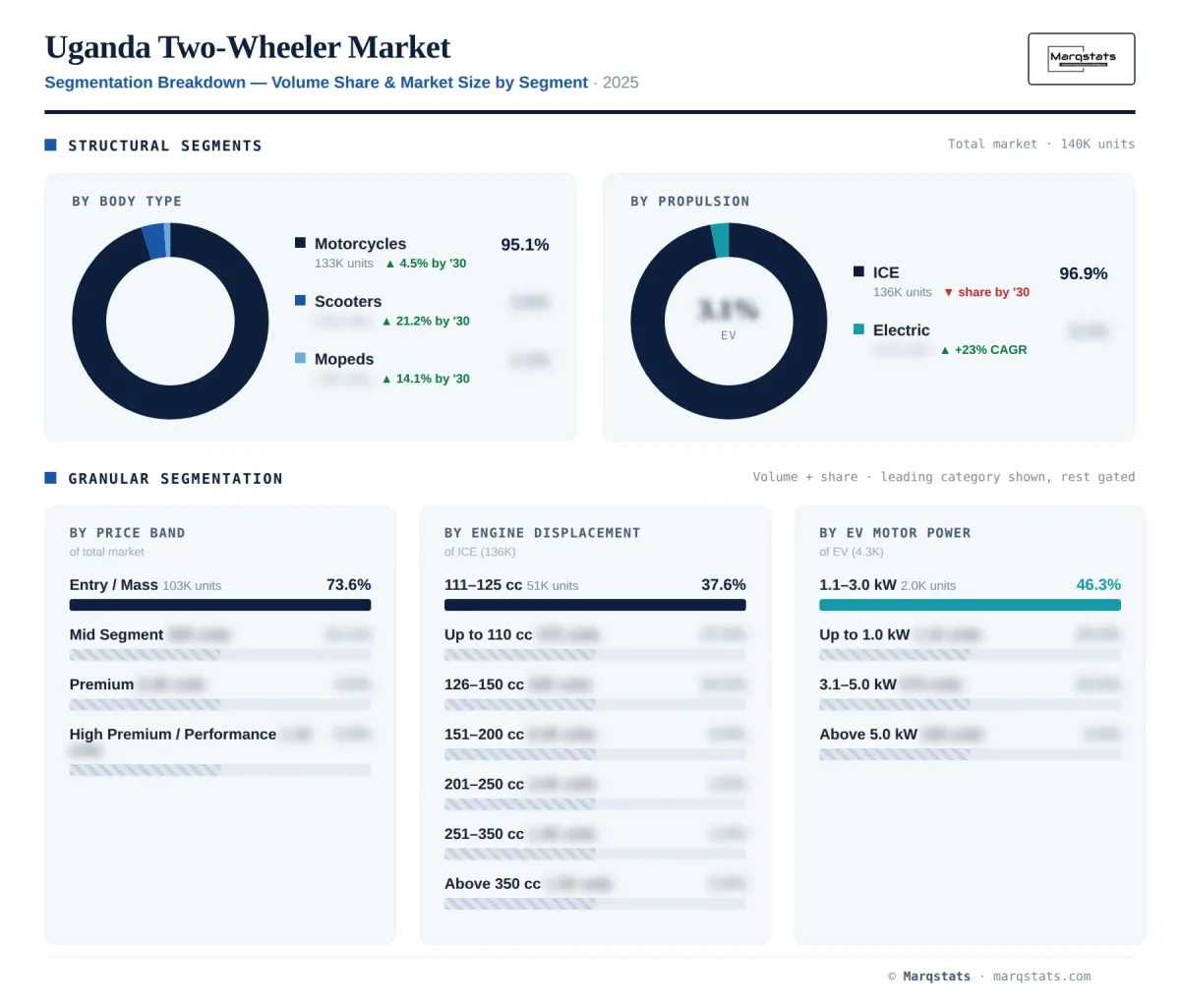
Motorcycles accounted for about 95% of 2025 volume, at roughly 133.19 thousand units, and are forecast to reach about 168.01 thousand units by 2030 at a 4.50% CAGR. They are the foundation of Ugandan mobility, used overwhelmingly for boda-boda taxi services, personal transport and delivery, and demand concentrates in affordable, durable commuter classes suited to mixed road conditions. Motorcycles drive nearly all of the market's absolute growth.
Scooters accounted for about 3.8% of 2025 volume, at roughly 5.26 thousand units, growing fastest to about 12.62 thousand units by 2030 at a 21.20% CAGR. Uptake is increasing owing to urban commuting in Kampala and the arrival of electric scooter models, and the segment is a focal point for early electric adoption despite its small base.
Mopeds accounted for about 1.1% of 2025 volume, at roughly 1.55 thousand units, growing to about 2.85 thousand units by 2030 at a 14.10% CAGR. The segment remains small, serving low-cost short-trip mobility, and overlaps increasingly with entry-level electric models in urban use.
ICE two-wheelers supplied about 97% of 2025 volume, at roughly 135.7 thousand units, and grow to about 172.42 thousand units by 2030 at a 4.60% CAGR. Petrol motorcycles remain the default owing to affordability, established fuelling and servicing networks, and rider familiarity, however their share erodes as electric substitution accelerates and as policy favours local electric assembly over internal combustion imports.
Electric two-wheelers accounted for about 3% of 2025 volume, at roughly 4.3 thousand units, expanding to about 11.08 thousand units by 2030 at a 23.30% CAGR — the fastest-growing propulsion class. Uganda became Africa's largest electric two-wheeler market in 2025, driven by local assemblers, battery-swap networks and compelling running-cost savings for high-mileage taxi riders, and adoption is moderated by charging gaps outside major corridors and reliance on fiscal incentives.
Within ICE machines, the 111–125cc class was the largest displacement band in 2025 at about 50.97 thousand units — the boda-boda commuter core — followed by the up-to-110cc class at about 36.64 thousand units and the 126–150cc class at about 32.79 thousand units. The 251–350cc band grows fastest at a 14.50% CAGR from a small base, while the 201–250cc and 151–200cc classes also grow strongly. Across electric motor-power bands, the 1.1–3.0 kW class leads volume and the up-to-1.0 kW category grows fastest at a 31.40% CAGR, reflecting entry-level electric taxi and commuter demand.
The displacement mix reflects the market's boda-boda core. Sub-150cc machines dominate because they balance purchase price, fuel economy and durability for daily taxi and commuting use, and they anchor the entry and mass price band. Larger classes remain small, serving utility and niche leisure roles, however their faster growth and higher prices lift the blended average value, which is why revenue grows at a 7.90% CAGR against a 5.40% volume CAGR. On the electric side, mid-power models suited to taxi duty cycles lead adoption, with battery-swap economics central to rider uptake.
The entry and mass band dominated 2025 volume at about 102.98 thousand units, or roughly 74% of the market, and grows at a 4.10% CAGR. The mid segment followed at about 29.54 thousand units and grows faster at 8.20%, while the premium and high-premium/performance bands, at about 6.33 thousand and 1.14 thousand units, grow at 11.60% and 8.20% CAGRs. This structure confirms an affordability-led, finance-driven market, however the faster growth of higher bands, alongside higher-priced electric machines, drives the gap between value and volume growth.
The motorcycle-taxi segment — ride-hail, rental and tourism use — was the largest end use in 2025 at about 75.38 thousand units, or roughly 54% of volume, however it eases at a 5.20% negative CAGR as the boda-boda fleet matures. Private B2C ownership, at about 32.4 thousand units, grows fastest at a 20.10% CAGR as households acquire motorcycles for personal transport, while delivery and logistics use, at about 19 thousand units, grows at 3.90%. B2B and fleet demand grows at 11.60%, and government and institutional use expands quickly from a low base.
This end-user pattern captures a market in transition. For years the boda-boda taxi trade defined demand, yet its share is now easing as the fleet matures and as riders and households increasingly buy motorcycles for private use, a shift reflected in the fast growth of the B2C segment. Delivery and logistics remain a meaningful and steady use case, reinforced by electric fleets serving last-mile platforms, while fleet and institutional demand broadens the commercial base. The net effect is a gradual rebalancing from taxi-led to more diversified ownership.
Offline dealerships retained about 97% of 2025 volume, at roughly 135.53 thousand units, and grow at a 3.50% CAGR, reflecting the central role of physical dealers, financiers and service networks in a credit-driven market. Online channels, though only about 3% of volume at roughly 4.47 thousand units, grow fastest at a 38.00% CAGR as digital sales and financing platforms, including rider-focused mobile apps, expand access.
The channel structure reflects how motorcycles are financed in Uganda. Because most purchases are made through asset-financing programmes with instalment repayment, physical dealers and finance partners remain central to the transaction, particularly for first-time and taxi riders. Digital platforms are growing quickly by streamlining loan applications, credit scoring and fleet management, and electric operators in particular use app-based financing and battery-swap accounts. Over the forecast period, online tools are expected to complement rather than replace the dealer-and-financier model that underpins the market.
By Geography
Two-wheeler demand in Uganda concentrates in and around Kampala and the Central region, which hold the largest share of population, commerce and boda-boda activity, and extends across regional towns and rural districts. Regional differences are shaped by urbanisation, road conditions and charging access, and these factors determine where electric models and commercial fleets are most prevalent. Domestic electric operators and battery-swap networks are most developed in the capital and along major corridors.
Kampala & Central Region
Kampala and the surrounding Central region form the dominant demand centre, concentrating boda-boda activity, commerce, delivery and the densest dealer, financing and battery-swap networks. The capital anchors both taxi and private demand and leads electric adoption, hosting the assembly plants and swap stations of local electric operators. It is also the focal point for online sales and digital financing.
Regional Towns & Corridors
Towns such as Jinja, Mbarara and Masaka, and the corridors linking them to Kampala, form a strong secondary base of commuter and commercial demand. Solar-powered charging and swap stations along major routes are extending electric feasibility beyond the capital, and these corridors are early testbeds for inter-urban electric boda-boda operations.
Rural Districts
Rural districts rely heavily on motorcycles for transport across long distances and mixed road conditions, with demand skewed toward the most affordable, durable commuter classes. Electrification lags here owing to sparser charging access, and growth is attributed to rising incomes, financing reach and gradual infrastructure improvement.
How Competition Is Evolving
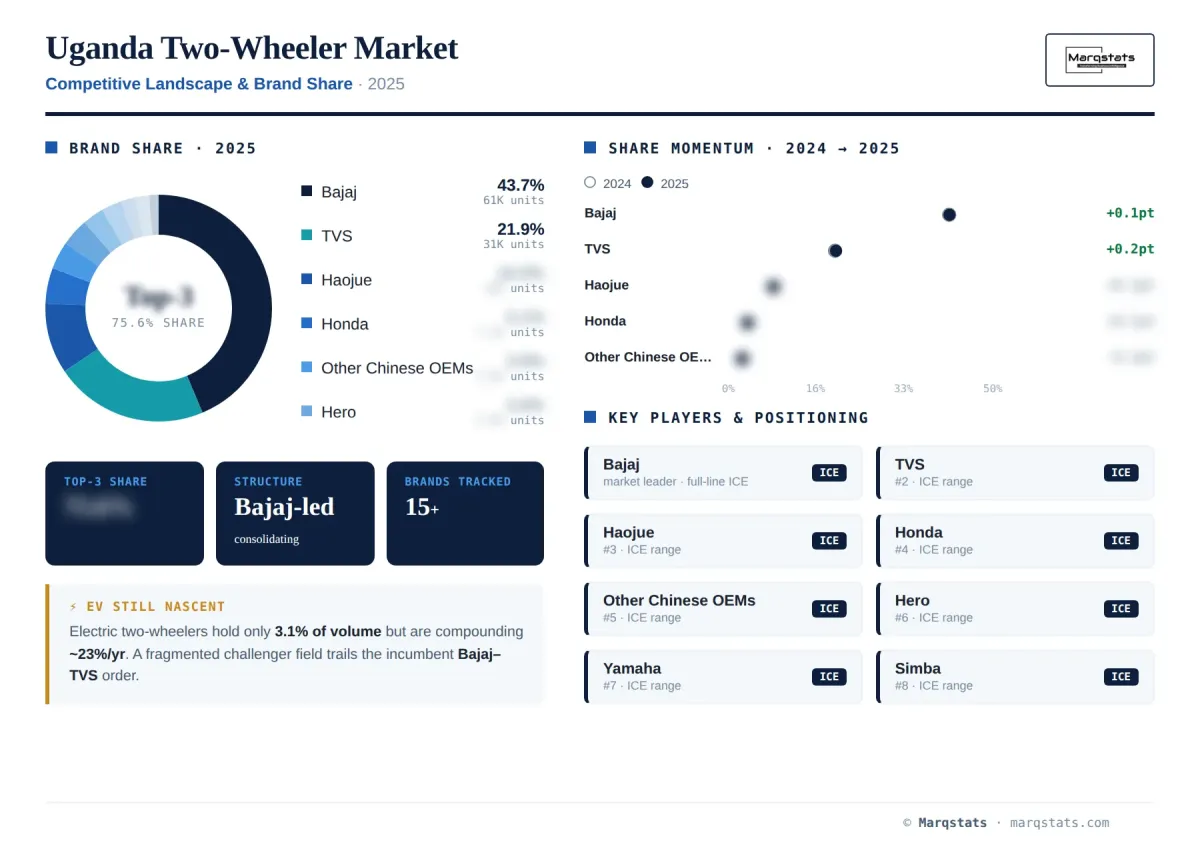
The Uganda two-wheeler market is moderately concentrated and dominated by Indian brands, an unusual structure in which Bajaj holds about 44% of volume and TVS about 22%, together accounting for roughly two-thirds of the market. Chinese brand Haojue, Japanese brands Honda, Yamaha and Suzuki, Indian brand Hero and domestic name Simba fill out the internal combustion field, while local electric assemblers contest the fast-growing electric segment. Competition centres on price, durability, financing availability and after-sales support.
Bajaj's dominance rests on the durability and low running costs of its commuter models, which suit boda-boda economics, backed by wide dealer, spare-parts and financing coverage, with TVS a strong second on a similar proposition. Japanese brands compete on reputation and resale value in the mid and upper tiers, and Chinese brands add value options. The electric segment is contested by purpose-built local operators — including battery-swap pioneers and local assemblers — that pair African-designed machines with financing and swap networks, and by global electric brands entering the market.
At the brand level, the Indian incumbents compete primarily on affordability, coverage and financing, which sustain their dominance in a price-sensitive, credit-driven market. Electric operators differentiate through battery-swap economics, rider financing and local assembly, and their compelling running-cost savings are winning taxi riders despite higher upfront prices. Over the forecast period the internal combustion leaders are expected to retain the bulk of volume, however local electric players are positioned to capture a rising share of new sales as swap networks and financing scale.
Companies Covered
The report profiles 16+ companies with full strategy and financials analysis, including:
Recent Market Activity
Table of Contents
Coverage & Segmentation
This report provides a comprehensive analysis of the Uganda two-wheeler market across a 2025 base year, historical data from 2021 to 2025, and forecasts spanning 2026 to 2030. The study sizes the market in both volume (thousand units) and value (USD million) and segments it by vehicle type (motorcycles, scooters and mopeds), propulsion type (internal combustion engine, electric), engine displacement and motor power, price band, end user, and sales channel. Brand-level analysis covers the Indian leaders, Chinese and Japanese OEMs, and the local electric assemblers that shape Ugandan supply.
The study examines market drivers, restraints and trends, segment-level growth, regional demand across Kampala and the wider country, competitive structure, and forward catalysts including the boda-boda economy, electrification, asset financing and national electric-mobility policy. All market estimates represent Marqstats-reconciled figures derived from a bottom-up methodology validated against top-down benchmarks, using national statistics, trade indicators and registration data rather than any single external source.
The report is designed for two-wheeler manufacturers, importers, assemblers and distributors, electric-mobility operators, fleet and delivery platforms, financiers, battery and component suppliers, and policymakers assessing Uganda's mobility and electrification path. It supports market sizing, brand and channel benchmarking, and scenario planning around electrification, financing and policy. Volume and value forecasts are provided at segment level for the 2026–2030 window, with 2021–2025 historical context, enabling comparison against neighbouring East African markets.