Market Snapshot
Key Takeaways
Market Overview & Analysis
Report Summary
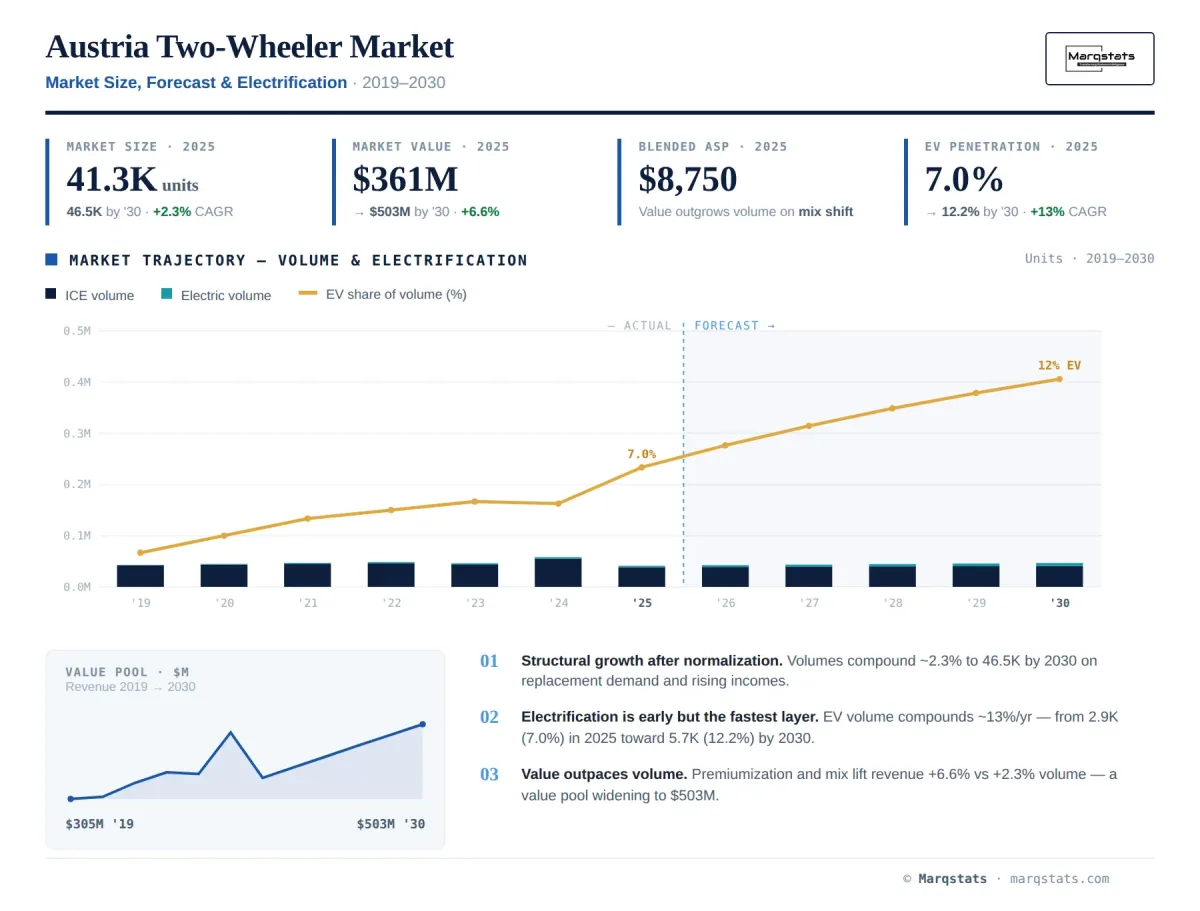
The Austria two-wheeler market is a premium, motorcycle-led European market anchored by domestic manufacturing and strong leisure demand. Two-wheelers in Austria serve touring, sport, and off-road riding across Alpine terrain, alongside urban commuting in Vienna and other cities. The market generated USD 361.1 million in revenue in 2025 on roughly 41,270 units, an average value density consistent with high incomes and a product mix weighted toward larger, higher-priced motorcycles rather than entry mopeds.
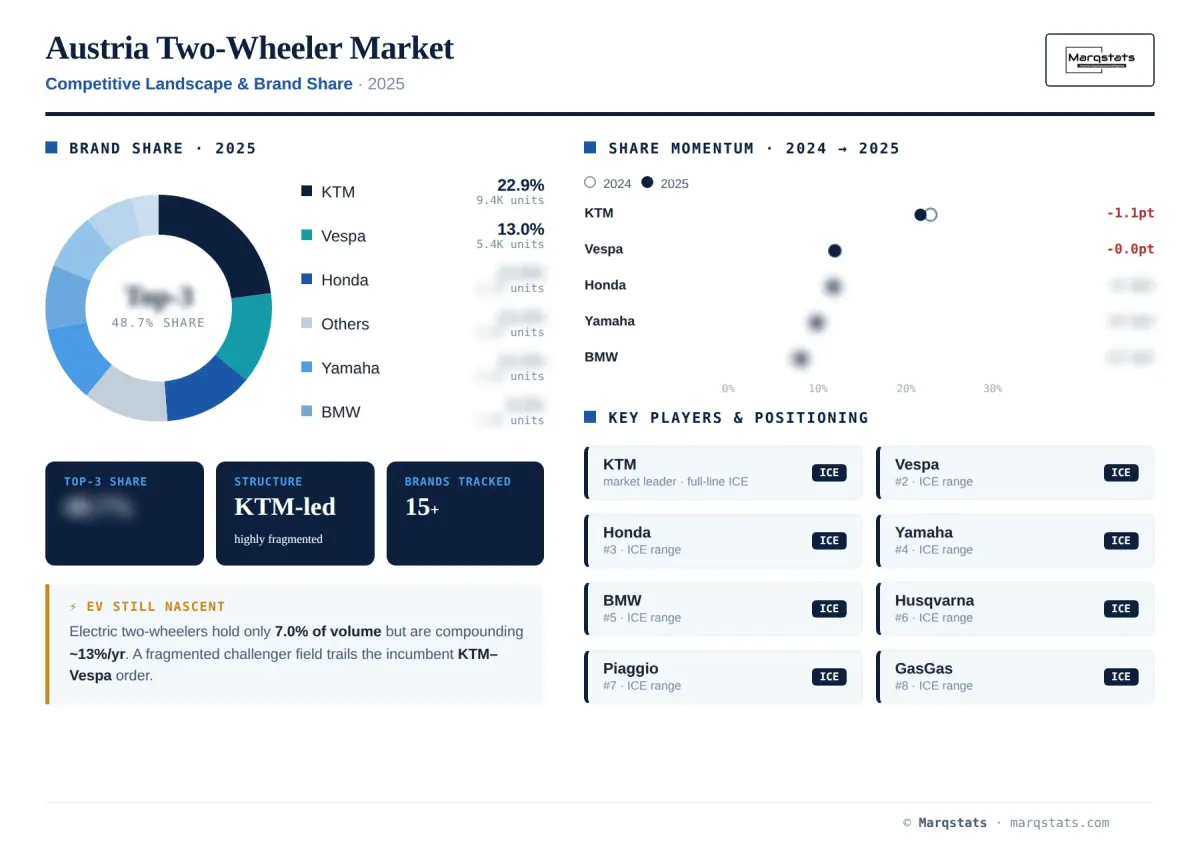
Austria market structure is shaped by its role as a production base. Pierer Mobility, the parent of KTM, Husqvarna, and GASGAS, manufactures at Mattighofen and Munderfing in Upper Austria, and these domestic brands command the foremost position in the national market. KTM alone holds about 22.9% of revenue, and the three Austrian-owned brands together approach 35%, a concentration of home-market share that anchors dealer networks, servicing, and rider communities across the country.
Regulation and corporate events framed the recent path. The full introduction of the Euro 5+ emissions standard on 1 January 2025 pulled combustion demand into 2024, when two-wheeler registrations reached about 58,000 units, before a correction through 2025 recorded by national registration data from Statistics Austria. In parallel, KTM AG entered court-supervised restructuring in late 2024 and halted production, a disruption that reshaped supply through the first half of 2025 before full manufacturing resumed.
Premiumisation is the central value theme. Average selling prices rise across the forecast period as buyers favour larger-displacement machines, premium marques, and higher-specification electric models. The premium and high-performance price bands expand faster than entry tiers, and revenue compounds at 6.60% even as unit demand grows more slowly at 2.31%. This gap between value and volume growth defines the Austrian market and reflects a rider base oriented toward enthusiast and touring machines rather than low-cost commuting mopeds.
The domestic production base gives Austria a competitive character distinct from import-only markets. Because KTM, Husqvarna, and GASGAS are engineered and assembled within the country, the health of the KTM group directly shapes model availability, dealer support, and rider communities in the home market. The 2024 to 2025 restructuring therefore had a domestic dimension beyond its financial scope, temporarily constraining supply of the market single largest brand before full production resumed and ownership stabilised under a global partner.
Market Dynamics
Key Drivers
- Domestic manufacturing anchors demand, with KTM, Husqvarna, and GASGAS supplying close to 35% of national revenue and sustaining dense dealer and service networks across Austria.
- Premiumisation lifts average selling prices, so revenue grows almost three times faster than units; the premium and high-performance bands expand fastest among all price tiers.
- Alpine leisure and touring demand supports the large above-350 cc segment, the single largest displacement band, which underpins the high value density of the market.
- Electrification accelerates from a small base, with electric two-wheeler revenue expanding at a 17.30% CAGR as electric mopeds and light electric motorcycles enter the range.
- Growth in urban delivery raises fleet demand, and the delivery and logistics end-user segment expands at an 8.72% CAGR to serve courier and food-delivery operators.
Key Restraints
- A short Alpine riding season and cold winters concentrate demand in warmer months, constraining year-round two-wheeler usage and dampening volume growth.
- The 2024 to 2025 restructuring of KTM AG and the associated production halt disrupted domestic supply and dealer inventories through the first half of 2025.
- Pull-forward of combustion demand ahead of the Euro 5+ standard inflated 2024 registrations and produced a market correction in 2025, distorting near-term growth comparisons.
- High vehicle taxation and elevated purchase prices moderate entry-level volume growth and skew demand toward committed enthusiasts and higher-value machines.
Key Trends
- Electric two-wheeler revenue grows fastest at 17.30% CAGR, rising from about 7% of the market in 2025 toward 12% by 2030 as electric ranges broaden.
- Online retail expands fastest among channels at a 12.33% CAGR, though physical dealers still handle the large majority of value.
- Premiumisation continues as the high-premium and performance band grows at an 8.04% CAGR, faster than entry and mid segments, lifting the market average price.
- Ownership of the domestic KTM group shifted to Bajaj Auto through 2025, aligning Austrian production with a global partner and reshaping the competitive structure.
Market Segmentation
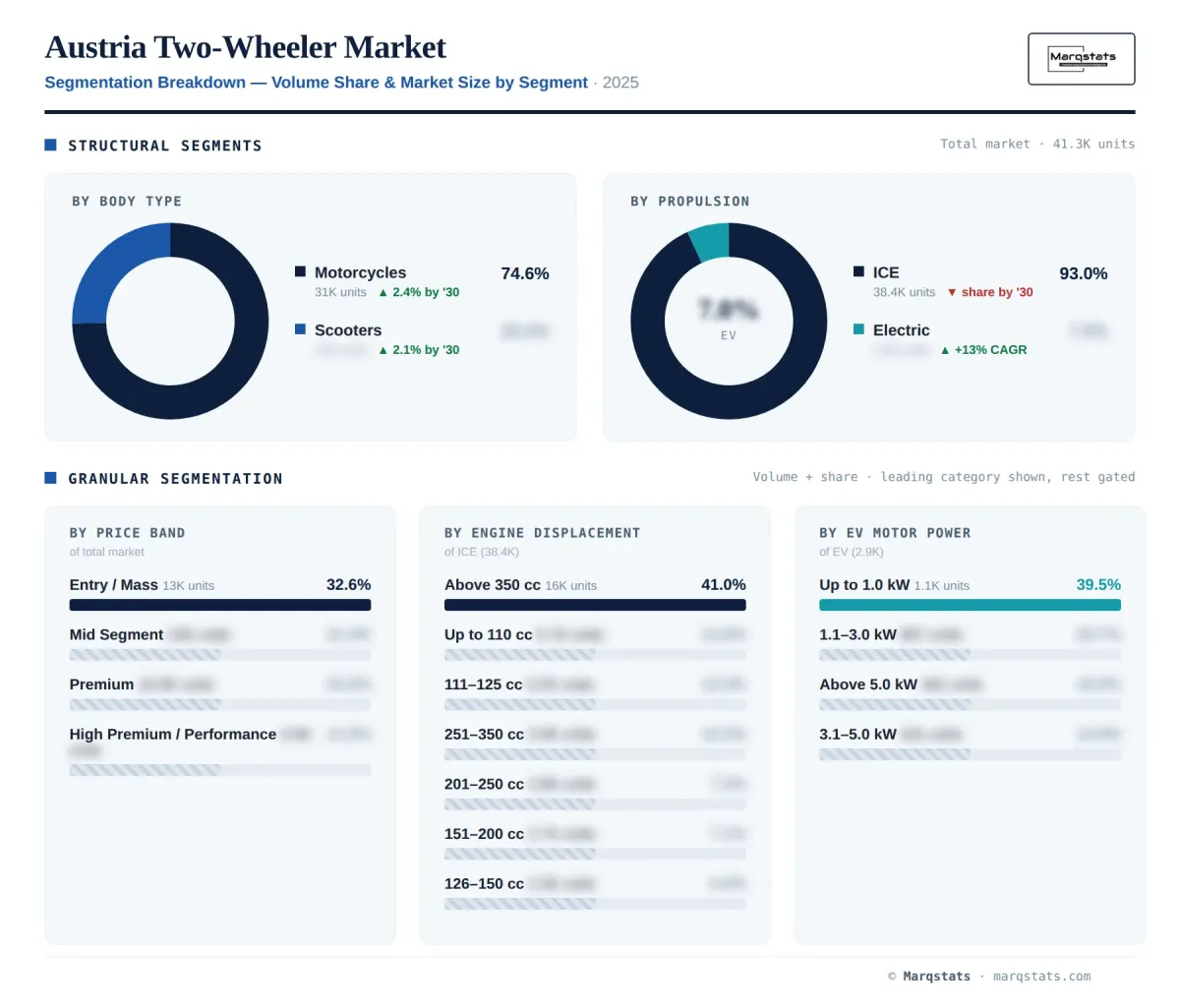
Motorcycles form the dominant vehicle-type segment, generating USD 269.3 million in 2025, roughly three-quarters of market revenue, and rising to USD 376.7 million by 2030 at a 6.67% CAGR. The segment reflects Austria orientation toward touring, sport, and off-road riding, and it carries the higher average price that lifts the market value density. Domestic brands KTM, Husqvarna, and GASGAS, together with premium marques such as BMW, anchor the motorcycle segment.
Scooters and mopeds generated USD 91.8 million in 2025 and grow to USD 126.7 million by 2030 at a 6.39% CAGR. The segment serves urban commuting in Vienna and other cities, where light two-wheelers handle short trips. Electric mopeds are the primary growth engine within this segment as buyers respond to expanding electric ranges and urban-mobility demand, even though the segment remains smaller than motorcycles by both value and volume.
The contrast between the two vehicle types defines the Austrian market. Where many European markets lean toward scooters and mopeds for cost-efficient urban mobility, Austria is weighted toward motorcycles, which command both the larger revenue share and the higher average price. This orientation reflects the strength of the domestic sport and off-road brands, the Alpine touring culture, and a rider base willing to invest in higher-value machines, and it shapes the market response to premiumisation and electrification alike.
Internal combustion engine models dominate the Austria two-wheeler market, generating USD 335.8 million in 2025, about 93% of revenue, and growing to USD 442.2 million by 2030 at a 5.46% CAGR. Combustion demand is anchored in the larger-displacement touring and sport segments where electric alternatives remain limited. The combustion share declines gradually over the forecast period as electric models capture the commuting and light-vehicle tiers.
Electric is the fastest-growing propulsion category, expanding from USD 25.3 million in 2025 to USD 61.2 million by 2030 at a 17.30% CAGR. Electric revenue rises from roughly 7% of the market toward 12% by 2030, mirroring electric two-wheeler momentum visible in other electric two-wheeler markets tracked by Marqstats. Growth concentrates in electric mopeds and light electric motorcycles, with the above-5.0 kW power band expanding fastest at 19.56% as higher-performance electric machines enter the range.
Within combustion models, the above-350 cc band is the single largest tier by revenue at USD 137.7 million in 2025, reflecting demand for touring, sport, and off-road motorcycles across Alpine terrain. The up-to-110 cc and 111 to 125 cc bands follow at USD 50.0 million and USD 45.2 million, capturing entry mopeds and licence-tier commuters, while the 251 to 350 cc band adds USD 34.4 million from mid-capacity machines. The mix skews toward larger displacements more than in most European markets, consistent with Austria enthusiast and touring demand.
Within electric models, the up-to-1.0 kW band leads at USD 10.0 million in 2025, consistent with electric mopeds, followed by the 1.1 to 3.0 kW band at USD 7.5 million. The higher-power bands are smaller yet expand fastest: the above-5.0 kW band grows at a 19.56% CAGR as full electric motorcycles gain acceptance. The electric motor-power mix therefore shifts gradually toward higher-power tiers over the forecast period as the range of electric machines widens.
The entry and mid price bands together account for the largest share of revenue, at USD 117.7 million and USD 113.2 million in 2025, serving mainstream commuting and mid-capacity demand. The premium and high-premium bands, however, grow faster, at 7.09% and 8.04% CAGR respectively, reflecting the premiumisation that carries the Austrian market. The high-premium and performance band, at USD 42.9 million in 2025, is the fastest-expanding price tier and lifts the market average selling price over the forecast period. The premium band, at USD 87.4 million in 2025, adds further weight to the upper half of the market, so the two higher tiers together approach USD 130 million and gain share as buyers trade up toward touring, sport, and higher-specification electric machines.
The B2C segment dominates the Austria two-wheeler market, generating USD 337.4 million in 2025, roughly 93% of revenue, and growing at a 6.47% CAGR. Private ownership reflects the country strong leisure and enthusiast base. Fleet and commercial demand is smaller yet faster-growing: the delivery and logistics segment expands at an 8.72% CAGR to serve urban courier and food-delivery operators, while the B2B and fleet segment grows at 8.32%. Ride-hail, rental, and tourism demand is minor at USD 0.6 million, and government and institutional demand adds a further USD 6.2 million in 2025.
Offline dealers remain the dominant channel, handling USD 321.3 million of revenue in 2025 and growing at a 5.50% CAGR, owing to the service, financing, and registration support that motorcycle purchases require. Online sales, however, expand fastest at a 12.33% CAGR, rising from USD 39.8 million as direct-to-consumer models and digital configurators gain share. The channel shift is gradual, and physical dealers retain the large majority of value through the forecast period, supported by the dense domestic dealer network. Financing, servicing, and registration support keep buyers anchored to physical outlets, and dealers increasingly pair in-store sales with digital configuration and reservation tools to capture the growing share of online-originated demand.
By Geography
Vienna and Eastern Austria
Vienna, together with Lower Austria and Burgenland, forms the largest demand centre for two-wheelers in Austria. The capital concentrates urban commuting demand, where scooters, mopeds, and electric two-wheelers handle short trips, alongside a base of premium motorcycle owners. Eastern Austria also hosts the densest dealer and service presence, and it leads adoption of electric mopeds within the national market.
Upper Austria and the Production Heartland
Upper Austria is the manufacturing heart of the national market. KTM, Husqvarna, and GASGAS are built at Mattighofen and Munderfing, and the province anchors the domestic supply chain, dealer relationships, and rider communities tied to these brands. The 2024 to 2025 production halt and subsequent restart at these plants directly shaped domestic supply, and the province remains central to the competitive structure of the Austrian two-wheeler market.
Alpine and Southern Austria
Tyrol, Salzburg, Styria, and Carinthia form the Alpine and southern demand cluster, oriented toward touring, sport, and off-road motorcycling. Demand here concentrates in the larger-displacement segments, supporting the above-350 cc band that leads the national displacement mix. Scenic road networks and a strong leisure-riding culture sustain enthusiast demand across these provinces.
Across all provinces, national registrations followed the European pattern of a 2024 pull-forward and a 2025 correction under the Euro 5+ transition, a trend documented in registration releases from the European motorcycle industry association, while value growth is carried by premiumisation and the early electrification of the light-vehicle segment.
How Competition Is Evolving
The Austria two-wheeler market is moderately fragmented, shaped by the strength of domestic brands and a broad field of premium importers. KTM holds the foremost position at about 22.9% of revenue in 2025, and the three Austrian-owned brands, KTM, Husqvarna, and GASGAS, together approach 35% of the market. Vespa and Honda follow at roughly 13.0% and 12.8%, with Yamaha, BMW, Piaggio, and others completing the field. Competition centres on premium positioning, model breadth, and the depth of domestic dealer and service networks.
The dominant competitive event of the period was the restructuring of KTM AG. The company entered court-supervised restructuring in late 2024, halted production, and secured creditor approval of a restructuring plan in early 2025 before completing the proceedings in mid-2025 with a substantial restructuring gain and restored positive equity. Full production resumed at the Austrian plants by mid-2025, and ownership of the group passed to strategic partner Bajaj Auto through 2025. These events reshaped the competitive structure while preserving KTM position as the domestic market leader.
Because the market is premium and motorcycle-led, brand strategy in Austria prioritises product breadth, racing heritage, and dealer relationships over entry-level volume. Domestic brands compete on sport and off-road strength, while premium importers such as BMW and Ducati compete in touring and performance segments. Electric specialists and scooter houses address the commuting tier, and the pace of each participant electric roadmap is emerging as a growing determinant of future share as electrification accelerates from its small base.
The Bajaj Auto alliance adds a further dimension to the competitive structure. As a global partner with scale in India and access to cost-efficient manufacturing and mid-capacity platforms, Bajaj strengthens the KTM group ability to broaden its range and stabilise supply. Scooter and moped houses including Piaggio and KYMCO contest the urban commuting segment, while electric specialists such as Zero Motorcycles, Niu Technologies, and Vmoto target the emerging electric tiers. The combined presence of domestic sport brands, premium European marques, mainstream Japanese manufacturers, and electric challengers gives Austria a diverse supplier base whose future balance depends on the pace of electrification and the reinvigoration of the domestic KTM group.
Companies Covered
The report profiles 16+ companies with full strategy and financials analysis, including:
Recent Market Activity
Table of Contents
Coverage & Segmentation
This report provides a comprehensive analysis of the Austria two-wheeler market for the 2021 to 2025 historical period and the 2026 to 2030 forecast period, with 2025 as the base year. The study quantifies market size in revenue terms, in USD, and in unit volume, and segments the market by vehicle type, propulsion type, engine displacement and motor power, price band, end user, sales channel, and brand. It examines the drivers, restraints, and trends shaping demand, and profiles the competitive structure of the market.
The study focuses on registered two-wheelers, spanning motorcycles, scooters, mopeds, and electric light vehicles. Coverage addresses the motorcycle-led character of the Austrian market, the role of domestic manufacturing by the KTM group, the restructuring that reshaped supply through 2025, and the early electrification of the light-vehicle segment. Values are reported in USD MN throughout, consistent with a market below USD 1 billion in size, and regional demand is examined across Vienna and Eastern Austria, Upper Austria, and the Alpine provinces.