Market Snapshot
Middle bar: base-year value × (1 + CAGR), rounded to two decimals. This is a calculated illustration, not a separately researched annual estimate.
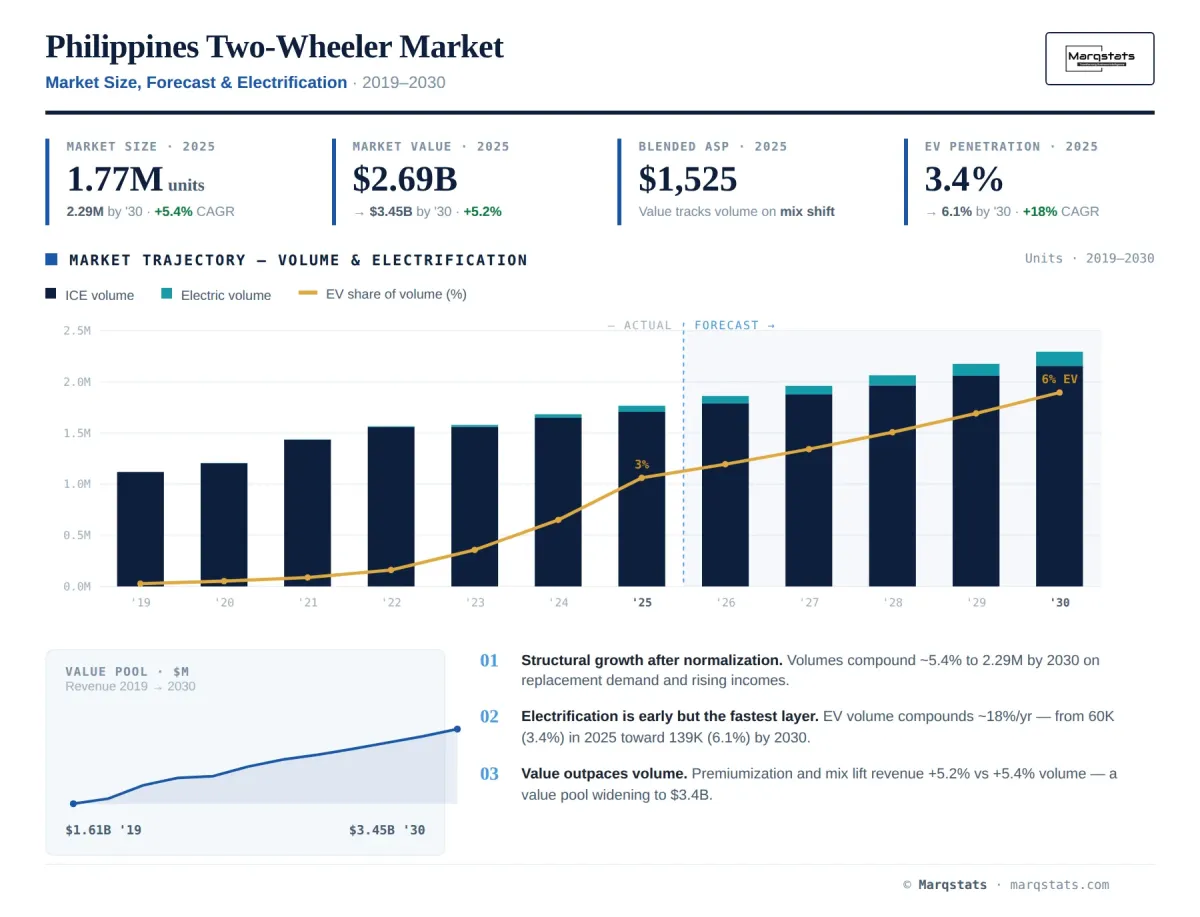
The Philippines two-wheeler market reached 1.77 million units in 2025 and is projected to reach 2.29 million units by 2030, expanding at a 5.37% CAGR across the 2026–2030 forecast period; in value terms the market rises from USD 2.69 billion to USD 3.45 billion. The Philippines is Southeast Asia's third-largest two-wheeler market, behind Indonesia and Vietnam, and one of its fastest-growing, sustained by an insufficient mass-transit system, worsening congestion, and the central role of motorcycles in commuting, small business, and a booming delivery economy.
Demand is affordability-led and financing-driven, concentrated in entry and mass commuter models, while automatic scooters increasingly dominate new sales. Honda leads the market by a wide margin, having surged in 2025, ahead of Yamaha and a long tail of budget and Chinese brands. The two-wheeler also underpins livelihoods, powering app-based delivery and a large yet still-informal motorcycle-taxi sector served by platforms such as Angkas, Move It, and JoyRide.
Electrification remains early, with electric models under 4% of volume, framed by the Electric Vehicle Industry Development Act and its CREVI roadmap, though purchase incentives stay limited and value-for-money remains the primary buying criterion. Growth is driven by rising mobility needs and the delivery economy, tempered by economic uncertainty and thin electric-vehicle support, producing a large, resilient, combustion-led market with a fast-rising premium and electric fringe.
Key Takeaways
Market Overview & Analysis
Report Summary
The Philippines two-wheeler market comprises motorcycles, scooters, and mopeds sold for personal and commercial use across internal combustion and electric propulsion. This study segments demand by vehicle type, propulsion type, engine displacement and motor power, price band, end user, sales channel, and brand, with a 2025 base year, historical coverage from 2021 to 2025, and forecasts to 2030. Motorcycles are woven into daily Filipino life, serving as affordable personal transport, small-business tools, and income sources for delivery and ride-hail riders across a congested, archipelagic country.
Demand is strong and record-setting. The Motorcycle Development Program Participants Association reported nine-month 2025 sales of about 1.40 million units, up 12.8%, and targeted a record of roughly 1.79 million for the full year, with automatic scooters at around 65% of member sales. Motorcycles remain a practical answer to an insufficient mass-transit system, and demand is reinforced by fuel efficiency, low running costs, and easier financing access.
Supply is led by Japanese incumbents and a broad field of budget brands. Honda dominates and has widened its lead, followed by Yamaha, with Suzuki, Kawasaki, and India's TVS in supporting positions, and local and Chinese brands such as Rusi, Euromotor, Skygo, and MotorStar serving the value tier. Electric two-wheelers remain a small share, contested by Chinese entrants and light-electric brands, and constrained by price and limited incentives despite an enabling policy framework.
The market's character is shaped by the country's geography and demographics. A young, fast-urbanising population of more than 115 million, spread across thousands of islands with limited rail and bus capacity, makes the motorcycle the default mode of private and commercial transport. This structural dependence, combined with the rise of app-based delivery and moto-taxi platforms, has turned the two-wheeler into both a household necessity and an income-generating tool, underpinning demand that has proved resilient through economic cycles and setting record sales in 2025.
Market Dynamics
Key Drivers
- Growth is driven by an insufficient mass-transit system and worsening congestion, which make two-wheelers the most practical mobility option across cities and provinces, where riders can weave through traffic that immobilises larger vehicles.
- The delivery and gig economy expands demand, as courier platforms and app-based moto-taxis such as Angkas, Move It, and JoyRide turn motorcycles into income-generating assets.
- Affordability and financing sustain volume, with motorcycles serving as a low-cost alternative to cars amid tight household budgets and expanding consumer credit, and low down-payment installment plans widening access for first-time buyers across income levels.
- Rising incomes and premiumisation lift value, as premium and big-bike segments grow at above-25% rates from a small base alongside the mass commuter core, broadening the market beyond pure utility demand.
Key Restraints
- Economic uncertainty constrains spending, with slower 2025 growth and cautious household budgets weighing on discretionary purchases in the entry tier.
- Electric adoption is limited by price and thin support, as electric models remain costlier than combustion equivalents and government incentives under the EVIDA framework stay modest.
- Regulatory uncertainty persists, as motorcycle taxis still lack a permanent legal framework and light-electric vehicles face inconsistent enforcement across jurisdictions.
Key Trends
- Scooterization accelerates, as automatic scooters capture the majority of new sales and grow far faster than conventional underbone motorcycles.
- Electrification advances slowly from a small base, guided by the CREVI roadmap; the Thailand electric two-wheeler market offers a regional benchmark for the transition.
- Chinese and value brands expand, widening consumer choice at the entry level and pressuring pricing across commuter segments.
- Digital retail grows rapidly, with the online channel expanding at a 16.43% CAGR alongside dense physical dealer networks nationwide.
Market Segmentation
Under this study's classification, motorcycles, chiefly underbone commuters plus street and sport models, account for 52.6% of 2025 volume at about 929,000 units, growing at a 2.56% CAGR. Industry reporting that groups automatic step-throughs as scooters places automatics near 65% of new sales, so the practical centre of demand is shifting decisively toward automatic models even where underbones are counted as motorcycles. Traditional underbones retain a loyal following in rural and provincial markets for their durability, load capacity, and low cost, yet their share of new sales is steadily eroding as urban buyers migrate to automatics.
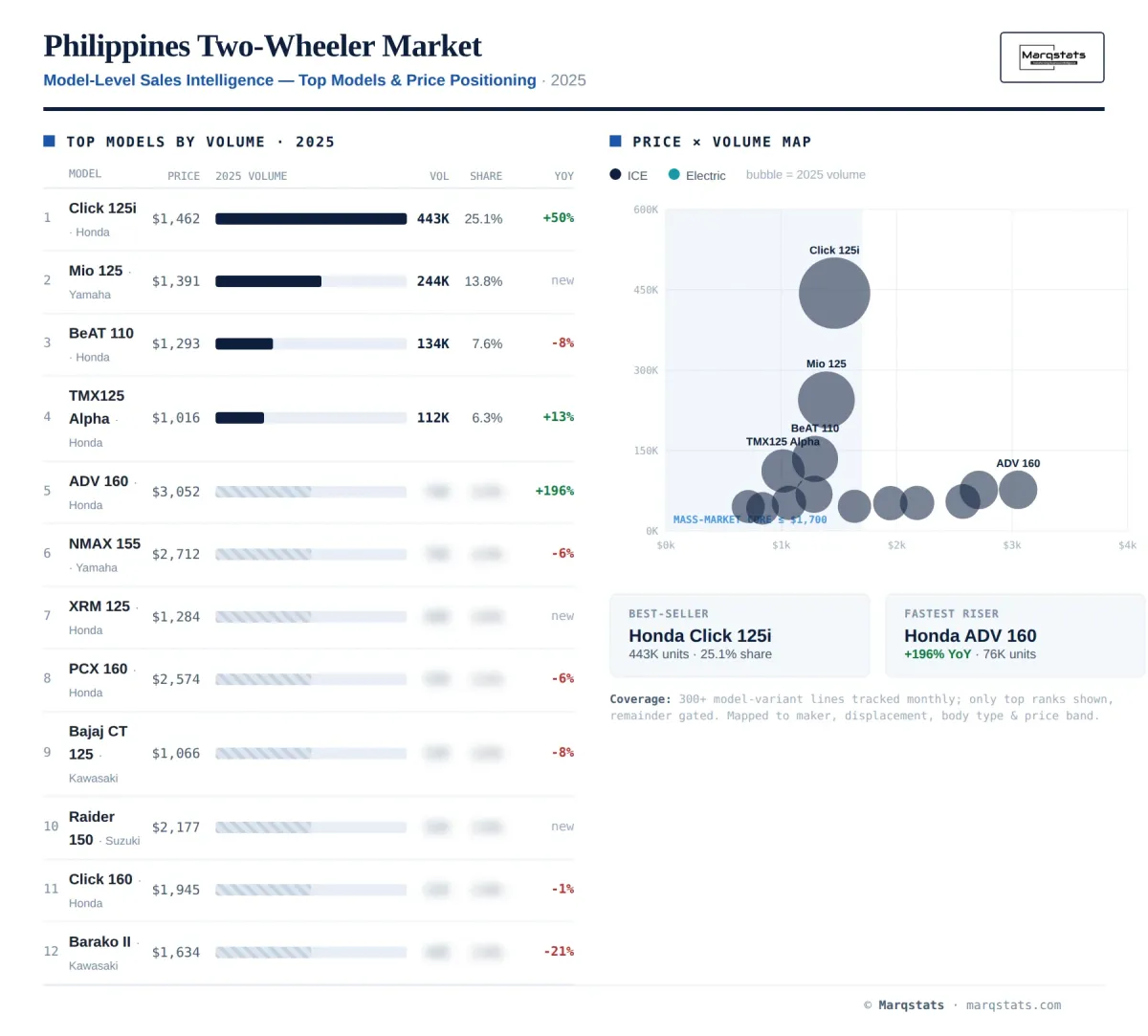
Scooters account for about 837,000 units in 2025, roughly 47% of volume, and grow far faster at an 8.09% CAGR. Automatic transmission, convenience, and urban practicality drive rapid share gains, and scooters host almost all electric two-wheeler models, positioning the category to overtake conventional motorcycles within the forecast period. Popular automatic models from Honda and Yamaha lead this shift, appealing to younger, urban, and gig-employed riders who prioritise ease of use and low running costs over the utility of traditional underbones.
Mopeds register negligible sales across the study period and do not form a material commercial segment in the Philippines, where underbones and automatic scooters fill the affordable-commuter role that mopeds occupy in some other markets, leaving the market structured around motorcycles, scooters, and a small yet expanding premium fringe.
Combustion models hold about 96.6% of 2025 volume, roughly 1.71 million units, growing at close to a 5% CAGR. Affordability, dense service networks, fuel efficiency, and strong resale value keep combustion firmly dominant across commuter and premium classes, with imports from Chinese and other brands supplementing local assembly. For the price-sensitive majority, the low purchase and running costs of small-displacement petrol machines, together with familiar servicing and abundant spare parts, make combustion the default choice well beyond the forecast period, even as electric options slowly appear.
Electric two-wheelers hold about 3.4% of 2025 volume, roughly 60,000 units including light-electric models, growing at an 18.25% volume CAGR to reach about 139,000 units by 2030. Adoption is early and price-constrained, led by Chinese entrants and light-electric brands, and shaped by the enabling yet incentive-light EVIDA framework rather than direct purchase subsidies. The Comprehensive Roadmap for the Electric Vehicle Industry targets a large multi-segment EV fleet and tens of thousands of charging points by 2028, and offers benefits such as a discount on the motor-vehicle user's charge and import-duty relief, yet uptake remains modest against value-for-money buying behaviour.
Regulatory friction adds complexity at the light end of the market. Enforcement action against e-bikes and e-trikes on major roads, set against local-government powers to license light electric vehicles, has created uncertainty for the informal electric segment that dominates early adoption. The forecast assumes gradual growth as Chinese models proliferate, prices fall, and charging and financing options mature, rather than a subsidy-driven acceleration.
The entry and mass band is the volume core at about 1.31 million units in 2025, roughly 74% of the market, growing at a 3.67% CAGR, while the mid segment adds about 378,000 units. Together these bands frame an affordability-led market where financing terms and fuel economy are decisive purchase factors for the commuter majority. Installment financing and low down-payments are central to demand at these tiers, and the 111–125cc displacement class alone accounts for roughly half of all volume, defining the mainstream commuter machine around which the market is built.
Premium and high-premium performance bands are small in units yet the fastest-growing, expanding at roughly 25% volume CAGRs as rising incomes and enthusiast demand lift big-bike, sport, and touring sales. Marques such as Kawasaki, Royal Enfield, and imported premium brands anchor this rapidly expanding upmarket tier. Although these bands remain a small share of volume, they contribute a disproportionate share of value, and their double-digit growth reflects an emerging enthusiast and leisure-riding culture alongside the dominant commuter market, giving manufacturers a higher-margin avenue for expansion.
Private consumers account for about 83% of 2025 volume, sustaining the commuter, scooter, and premium segments in line with incomes, financing access, and mobility needs across urban and rural areas. Household demand is anchored by the motorcycle's role as a primary vehicle for families and workers, and its low cost relative to a car keeps it the default first vehicle for millions of aspiring owners as incomes rise.
Commercial demand grows faster than private use. Delivery and logistics expands at a 9.83% CAGR as courier platforms scale, while ride-hail and moto-taxi services add distinctive Philippine demand, turning riders into micro-entrepreneurs dependent on two-wheelers for daily income. Motorcycle-taxi platforms such as Angkas, Move It, and JoyRide operate a large service still governed by a pilot rather than a permanent law, and a bill to institutionalise motorcycles-for-hire was refiled in Congress in 2025, a step that would formalise demand from a sector already central to urban mobility and rider livelihoods.
Physical dealerships dominate, handling the large majority of sales and providing financing, registration, and after-sales service. Dense dealer coverage and installment financing are central to the reach of Honda, Yamaha, and the budget brands across the archipelago.
The online channel is the fastest-growing route to market at a 16.43% CAGR, as marketplaces and manufacturer platforms support research, comparison, and booking. Digital retail complements the dealer network, especially among younger urban buyers and for accessory and financing discovery, and social-media-driven discovery increasingly shapes model shortlists before buyers complete purchases at physical dealerships.
By Geography
National Capital Region & Luzon
Metro Manila and the wider Luzon region concentrate the largest share of demand and nearly all premium and electric activity. Severe congestion, a large delivery and moto-taxi workforce, and higher incomes drive scooter, premium, and early electric adoption, while Central Luzon and Calabarzon add substantial commuter and commercial volume. The capital region also hosts most of the country's charging infrastructure and the densest platform-based delivery networks, making it the primary testing ground for electric two-wheelers and for the regulation of motorcycles-for-hire and light electric vehicles.
Visayas
The Visayas, centred on Cebu and Iloilo, sustain strong commuter and small-business demand across island provinces where motorcycles are essential to mobility. Affordable underbone and automatic scooters dominate, with tourism and logistics supporting incremental fleet demand. Inter-island geography and limited public transport make the two-wheeler indispensable for daily movement, and Cebu's growing urban and business-process-outsourcing economy is lifting demand for scooters and mid-tier models across the central islands.
Mindanao
Mindanao, led by Davao and Cagayan de Oro, relies heavily on two-wheelers across largely rural and agricultural areas. Entry-tier combustion models dominate, and demand is closely tied to agricultural incomes, trade, and the practical need for transport in areas underserved by public transit. Motorcycles also serve as informal passenger and cargo carriers in many communities, reinforcing baseline demand for affordable, durable machines that can handle mixed road conditions. Budget and Chinese brands find particularly strong acceptance here, where purchase price and running cost outweigh brand prestige for most buyers.
Philippines within ASEAN
The Philippines is Southeast Asia's third-largest two-wheeler market after Indonesia and Vietnam, and among the fastest-growing. Its youthful population, rising urbanisation, and delivery-driven demand position it for sustained expansion, though electrification trails regional leaders owing to limited incentives. Where markets such as Vietnam and Taiwan have moved further on electric adoption, the Philippines remains combustion-led, making it one of the region's larger untapped opportunities for electric two-wheelers should policy support and affordable models converge over the forecast period.
How Competition Is Evolving
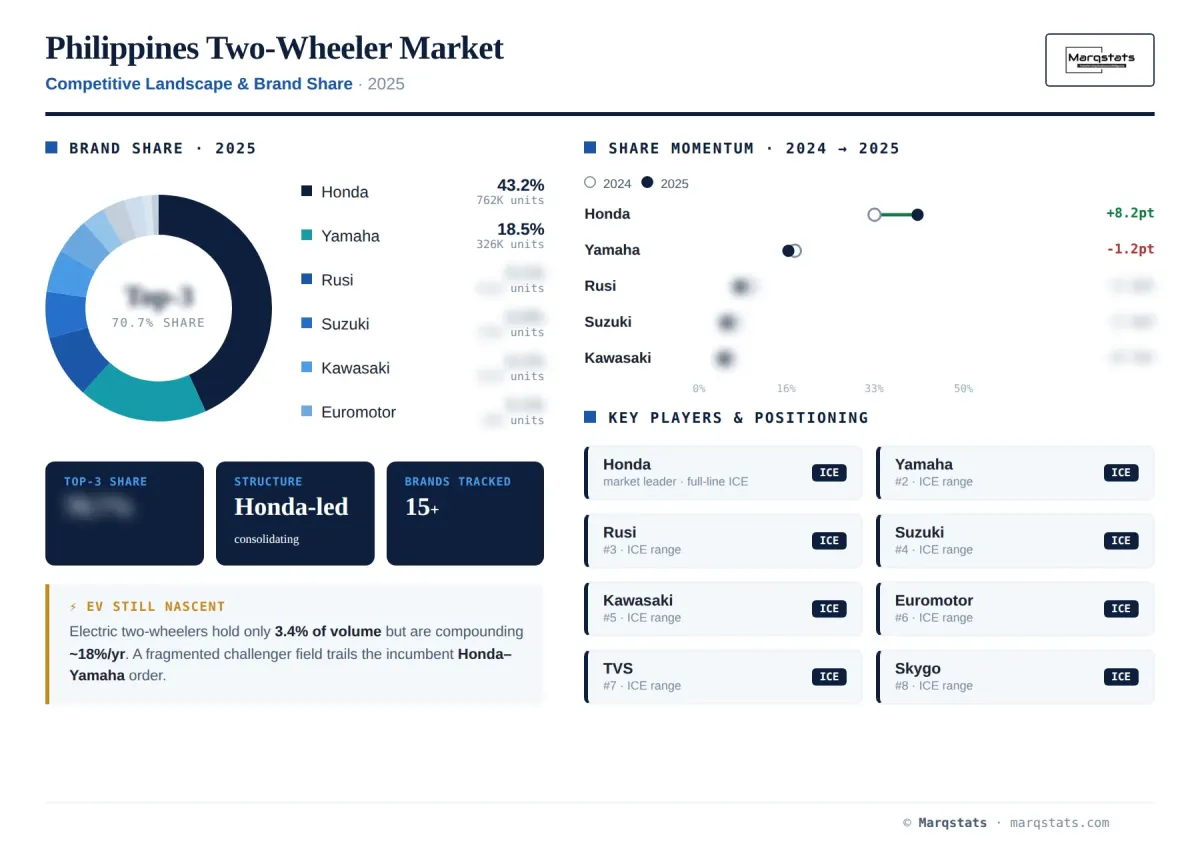
The Philippines two-wheeler market is moderately concentrated around Honda, which leads by a wide margin and widened its advantage in 2025, supported by unmatched dealer reach, financing, product breadth, and resale value. On the industry association's member basis Honda holds roughly 55% of sales and is approaching one million annual units, while across the full market, including local and Chinese budget brands, its share is lower yet still commanding. Honda's advance in 2025 reflected strong scooter demand, an expanded model range, and the durability and fuel economy for which its engines are known, qualities that carry particular weight among first-time and income-dependent buyers.
Yamaha holds a clear second position, strong in scooters and sport models, followed by Suzuki, Kawasaki, and India's TVS. A broad field of value brands, including Rusi, Euromotor, Skygo, MotorStar, and Motoposh, competes on price at the entry level, while premium marques such as Royal Enfield and Kawasaki anchor the fast-growing big-bike tier. Electric competition is nascent, contested by light-electric and Chinese brands. The persistence of a large budget tier alongside dominant Japanese incumbents reflects a market segmented sharply by price, in which brand trust, resale value, and financing availability determine outcomes as much as product specification.
Competition centres on price, financing, dealer and service reach, and fuel economy in the commuter tiers, and on brand and performance at the premium end. Growth is attributed to brands that combine affordability with dense distribution, moreover rewarding those expanding scooter and premium line-ups. The market's fragmented value tier and Honda's dominance coexist, so scale, financing partnerships, and after-sales networks remain the decisive competitive levers.
Companies Covered
Companies covered in the report include:
Recent Market Activity
Table of Contents
Coverage & Segmentation
This report provides a comprehensive assessment of the Philippines two-wheeler market across a 2025 base year, historical data from 2021 to 2025, and forecasts spanning 2026 to 2030. Market sizing is presented in unit-volume terms and complemented by value analysis in United States dollars, with segmentation by vehicle type, propulsion type, engine displacement and motor power, price band, end user, sales channel, and brand. Brand-level shares, segment growth rates, and competitive positioning are quantified to support commercial and investment decisions.
The scope covers demand drivers, restraints, and structural trends, with particular focus on scooterization, the delivery and moto-taxi economy, the affordability-led competitive structure, and the early electrification transition and its policy dependencies. Competitive analysis quantifies brand shares and profiles combustion and electric producers, while segment forecasts identify where volume and value growth concentrate through 2030. Particular attention is paid to the regulatory path of motorcycles-for-hire and light electric vehicles, given their influence on commercial demand. An extended forecast to 2035 is available under customization for subscribers requiring a longer planning horizon, alongside deeper cuts by region, brand, or channel on request.